anaheim-gazette 1912-03-14
Scanned page
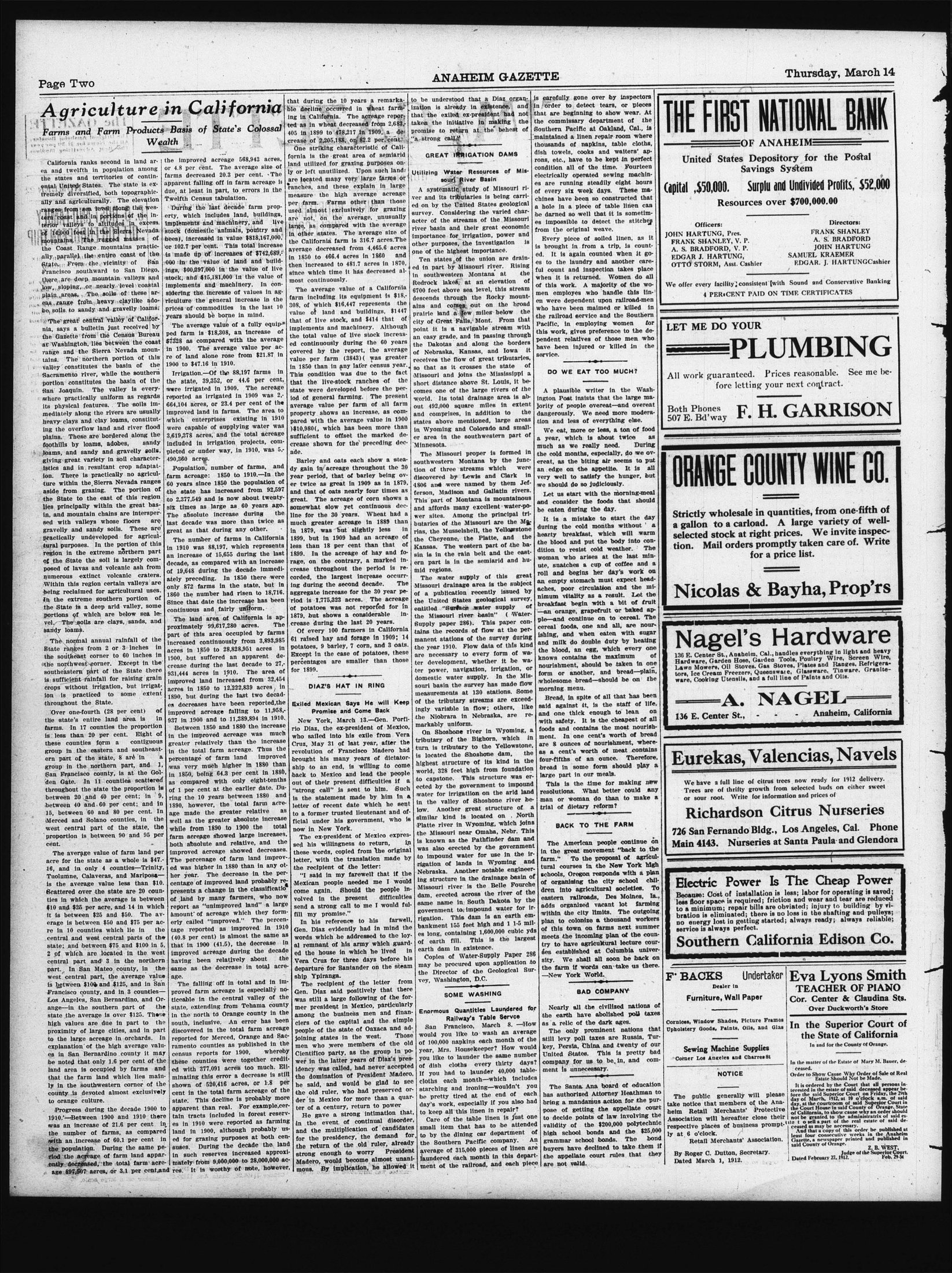
Searchable text
Agriculture in California
Farms and Farm Products Basis of State's Colossal Wealth
California ranks second in land area and twelfth in population among the states and territories of continental United States. The state is extremely diversified, both topographically and agriculturally. The elevation ranges from sea level along the western coast and in portions of the interior valleys to altitudes in excess of 14,000 feet in the Sierra Nevada mountains. The rugged masses of the Coast Range mountains practically parallel the entire coast of the State. From the vicinity of San Francisco southward to San Diego, there are deep mountain valleys and low, sloping, or nearly level coastal plain areas. The soils of these areas range from heavy claylike adobe soils to sandy and gravelly loams.
The great central valley of California, says a bulletin just received by the Gazette from the Census Bureau at Washington, lies between the coast range and the Sierra Nevada mountains. The northern portion of this valley constitutes the basin of the Sacramento river, while the southern portion constitutes the basin of the San Joaquin. The valley is everywhere practically uniform as regards its physical features. The soils immediately along the rivers are usually heavy clays and clay loams, constituting the overflow land and river flood plains. These are bordered along the foothills by loams, adobes, sandy loams, and sandy and gravelly soils, giving great variety in soil characteristics and in resultant crop adaptation.
the improved acreage 568,943 acres,
or 4.8 per cent. The average size of farms decreased 20.3 per cent. The apparent falling off in farm acreage is due, at least in part, to errors in the Twelfth Census tabulation.
During the last decade farm property, which includes land, buildings, implements and machinery, and live stock (domestic animals, poultry and bees), increased in value $818,167,000,
or 102.7 per cent. This total increase is made up of increases of $742,689,000 in the value of land and buildings, $60,297,000 in the value of live stock, and $15,181,000 in the value of implements and machinery. In considering the increase of values in agriculture the general increase in the prices of commodities in the last 10 years should be borne in mind.
The average value of a fully equipped farm is $18,308, an increase of $7328 as compared with the average in 1900. The average value per acre of land alone rose from $21.87 in 1900 to $47.16 in 1910.
Irrigation.—Of the 88,197 farms in the state, 39,352, or 44.6 per cent, were irrigated in 1909. The acreage reported as irrigated in 1909 was 2,664,104 acres, or 23.4 per cent of the improved land in farms. The area to which enterprises existing in 1910 were capable of supplying water was 3,619,378 acres, and the total acreage included in irrigation projects, completed or under way, in 1910, was 5,490,360 acres.
Population, number of farms, and farm age: 1850 to 1910—In that during the 10 year decline occurred farming in California. The ted as in wheat decrease 405 in 1899 to 478,217 decrease of 2,205,188, or one striking character fornia is the great acre land utilized for grazing or left unutilized. Are located many very ranches, and these e measure the high a per farm. Farms o used almost exclusively are not on the ave large, as compared w in other states. The California farm is average decreased fro in 1850 to 466.4 acres then increased to 481 since which time it h most continuously.
The average value of farm including its equiv 308, of which $16,447 value of land and that of live stock, an implements and machi the total value of liv ed continuously during covered by the repo value per farm (384 in 1850 than in any L This condition was that the live-stock state were developed lod of general farming average value per f property shows an i paired with the avera) $10,980(which has sufficient to offset crease shown for th ade.
Barley and oats easy gain in acreage th
Sacramento river, while the southern portion constitutes the basin of the San Joaquin. The valley is everywhere practically uniform as regards its physical features. The soils immediately along the rivers are usually heavy clays and clay loams, constituting the overflow land and river flood plains. These are bordered along the foothills by loams, adobes, sandy loams, and sandy and gravelly soils, giving great variety in soil characteristics and in resultant crop adaptation. There is practically no agriculture within the Sierra Nevada ranges aside from grazing. The portion of the State to the east of this region lies principally within the great basin, and mountain chains are interspersed with valleys whose floors are gravelly and sandy soils. These are practically undeveloped for agricultural purposes. In the portion of this region in the extreme northern part of the State the soil is largely composed of lavas and volcanic ash from numerous extinct volcanic craters. Within this region certain valleys are being reclaimed for agricultural uses. In the extreme southern portion of the State is a deep arid valley, some portions of which are below sea level. The soils are clays, sands, and sandy loams.
The normal annual rainfall of the State ranges from 2 or 3 inches in the southeast corner to 60 inches in the northwest corner. Except in the southeastern part of the State there is sufficient rainfall for raising grain crops without irrigation, but irrigation is practiced to some extent throughout the State.
Over one-fourth (28 per cent) of the state's entire land area is in farms. In 17 counties the proportion is less than 20 per cent. Eight of these counties form a contiguous group in the eastern and southeastern part of the state, 8 are in a group in the northern part, and 1, San Francisco county, is at the Golden Gate. In 11 counties scattered throughout the state the proportion is between 20 and 40 per cent; in 9, between 40 and 60 per cent; and in 15, between 60 and 80 per cent. In Merced and Solano counties, in the west central part of the state, the proportion is between 90 and 95 per cent.
The average value of farm land per acre for the state as a whole is $47.16, and in only 4 counties—Trinity, Tuolumne, Calaveras, and Mariposa—is the average value less than $10. Scattered over the state are 20 counties in which the average is between
Irrigation. Of the 85,147 farms in the state, 39,352, or 44.6 per cent, were irrigated in 1909. The acreage reported as irrigated in 1909 was 2,-664,104 acres, or 23.4 per cent of the improved land in farms. The area to which enterprises existing in 1910 were capable of supplying water was 3,619,378 acres, and the total acreage included in irrigation projects, completed or under way, in 1910, was 5,-490,360 acres.
Population, number of farms, and farm acreage: 1850 to 1910.—In the 60 years since 1850 the population of the state has increased from 92,597 to 2,377,549 and is now about twenty-six times as large as 60 years ago. The absolute increase during the last decade was more than twice as great as that during any other.
The number of farms in California in 1910 was 88,197, which represents an increase of 15,655 during the last decade, as compared with an increase of 19,648 during the decade immediately preceding. In 1850 there were only 872 farms in the state, but in 1860 the number had risen to 18,716. Since that date the increase has been continuous and fairly uniform.
The land area of California is approximately 99,617,280 acres. The part of this area occupied by farms increased continuously from 3,893,985 acres in 1850 to 28,828,951 acres in 1900, but suffered an apparent decrease during the last decade to 27,-931,444 acres in 1910. The area of improved land increased from 32,454 acres in 1850 to 12,222,839 acres in 1890, but during the last two decades decreases have been reported,the improved acreage falling to 11,958,-937 in 1900 and to 11,389,894 in 1910.
Between 1850 and 1880 the increase in the improved acreage was much greater relatively than the increase in the total farm acreage. Thus the percentage of farm land improved was very much higher in 1880 than in 1850, being 64.3 per cent in 1880, as compared with only eight-tenths of 1 per cent at the earlier date. During the 10 years between 1880 and 1890, however, the total farm acreage made the greater relative as well as the greater absolute increase while from 1890 to 1900 the total farm acreage showed large increases both absolute and relative, and the improved acreage showed decreases. The percentage of farm land improved was higher in 1880 than in any other year. The decrease in the percentage of improved land probably represents a change in the classification of land by many farmers, who now
This condition was that the live-stock state were developed lod of general farming average value per farm property shows an impaired with the average $10,980(), which has sufficient to offset an increase shown for thisade.
Barley and oats easily gain in acreage this year period, that of er twice as great in and that of oats nearly great. The acreage is somewhat slow yet line for the 30 years much greater acreage in 1879, was but slightly 1899, but in 1909 had less than 18 per cent. In the acreage rage on the contrary crease throughout thercorded, the largest being during the second aggregate increase for riod is 1,775,323 acres of potatoes was not. But shows a decrease during the last.
Of every 100 farms 61 raised hay and for potatoes, 9 barley, 7 except in the case of percentages are small for 1899.
DIAZ'S HAT
Exiled Mexican Sayl Promise and C
New York, Marchio Diaz, the ex-president who sailed into his Cruz, May 31 of last revolution of France brought his many ships to an end, is back to Mexico and out of their present "strong call" is sent is the statement made letter of recent date to a former trusted official under his gov't now in New York.
The ex-president used his willingness these words,copied letter withthe trainthe recipientofthe "I said in my fam Mexican people need come again.Shouldvolvedinthepre
The average value of farm land per acre for the state as a whole is $47.16, and in only 4 counties—Trinity, Tuolumne, Calaveras, and Mariposa—is the average value less than $10. Scattered over the state are 20 counties in which the average is between $10 and $25 per acre, and 14 in which it is between $25 and $50. The average is between $50 and $75 per acre in 10 counties which lie in the central and west central parts of the state; and between $75 and $100 in 5, 2 of which are located in the west central part and 3 in the northern part. In San Mateo county, in the west central part, the average value is between $100 and $125, and in San Francisco county, and in 3 counties—Los Angeles, San Bernardino, and Orange—in the southern part of the state the average is over $125. These high values are due in part to the proximity of large cities, and in part to the large acreage in orchards. In explanation of the high average values in San Bernardino county it may be noted that only 1.6 per cent of the land area is occupied by farms and that the farm land which lies mainly in the southwestern corner of the county is devoted almost exclusively to orange culture.
Progress during the decade 1900 to 1910.'—Between 1900 and 1910 there was an increase of 21.6 per cent in the number of farms, as compared with an increase of 60.1 per cent in the population. During the same period the acreage of farm land apparently decreased, the total farm acreage 897,507 acres, or 3.1 per cent, and ring the 10 years between 1890, however, the total farm acreage made the greater relative as well as the greater absolute increase while from 1890 to 1900 the total farm acreage showed large increases, both absolute and relative, and the improved acreage showed decreases. The percentage of farm land improved was higher in 1880 than in any other year. The decrease in the percentage of improved land probably represents a change in the classification of land by many farmers, who now report as "unimproved land" a large amount of acreage which they formerly called "improved." The percentage reported as improved in 1910 (40.8 per cent) is almost the same as that in 1900 (41.5), the decrease in improved acreage during the decade having been relatively about the same as the decrease in total acreage.
The falling off in total and in improved farm acreage is especially noticeable in the central valley of the state, extending from Tehama county in the north to Orange county in the south, inclusive. An error has been discovered in the total farm acreage reported for Merced, Orange and Sacramento counties as published in the census reports for 1900, whereby these counties were together credited with 377,091 acres too much. Eliminating this error a decrease is still shown of 520,416 acres, or 1.8 per cent in the total farm acreage of the state. This decline is probably more apparent than real. For example, certain tracts included in forest reserves in 1910 were reported as farming land in 1900, although probably used for grazing purposes at both censuses. During the decade the land in such reserves increased approximately from 9,000,000 to 28,000,000 acres. It is worthy of note, however,
The ex-president used his willingness these words, copied letter, with the tracing recipient of them.
"I said in my farm Mexican people need come again. Should involved in the present send a strong call to fill my promise."
In his reference Gen. Diaz evidently words which he added remnant of his sided the house in which Vera Cruz for three departure for Santa ship Ypiranga.
The recipient of Gen. Diaz said pos was still a large former president in Mexico among the business ciers of the capital people of the state joining states in men who were me Cientifico party, as wer in the latter yidency was called, he domination of he said, and would the old ruler, who der in Mexico for ter of a century, re
He gave a strong in the event of c and the multiplication for the presidency the return of the strong enough to Madero, would become mous. By implicat
that during the 10 years a remarkable decline occurred in wheat farming in California. The acreage reported as in wheat decreased from 2,683,405 in 1899 to 478,217 in 1909, a decrease of 2,205,188, or 82.2 per cent.
One striking characteristic of California is the great area of semiarid land utilized for grazing purposes only or left unutilized. Upon such lands are located many very large farms or ranches, and these explain in large measure the high average acreage per farm. Farms other than those used almost exclusively for grazing are not, on the average, unusually large, as compared with the average in other states. The average size of the California farm is 316.7 acres. The average decreased from 4,465.6 acres in 1850 to 466.4 acres in 1860 and then increased to 481.7 acres in 1870, since which time it has decreased almost continuously.
The average value of a California farm including its equipment is $18,-308, of which $16,447 represents the value of land and buildings, $1447 that of live stock, and $414 that of implements and machinery. Although the total value of live stock increased continuously during the 60 years covered by the report, the average value per farm (3843) was greater in 1850 than in any later census year. This condition was due to the fact that the live-stock ranches of the state were developed before the period of general farming. The present average value per farm of all farm property shows an increase, as compared with the average value in 1900 ($10,980), which has been more than sufficient to offset the marked decrease shown for the preceding decade.
Barley and oats each show a steady gain in acreage throughout the 30 year period that of barley being overstored to be understood that a Diaz organization is already in existence, and that the exiled ex-president had not taken the initiative in making the promise to return at the behest of "a strong call."
GREAT Irrigation DamS
Utilizing Water Resources of Missouri River Basin
A systematic study of Missouri river and its tributaries is being carried on by the United States geological survey. Considering the varied character of the streams of the Missouri river basin and their great economic importance for irrigation, power and other purposes, the investigation is one of the highest importance.
Ten states of the union are drained in part by Missouri river. Rising in southwestern Montana at the Redrock lakes, at an elevation of 6700 feet above sea level, this stream descends through the Rocky mountains and comes out on the broad prairie land a few miles below the city of Great Falls, Mont. From that point it is a navigable stream with an easy grade, and in passing through the Dakotas and along the borders of Nebraska, Kansas, and Iowa it receives the flow of great tributaries, so that as it crosses the state of Missouri and joins the Mississippi a short distance above St. Louis, it becomes one of the large rivers of the world. Its total drainage area is about 492,000 square miles in extent and comprises, in addition to the states above mentioned, large areas in Wyoming and Colorado and smaller areas in the southwestern part of Minnesota.
The Missouri proper is formed in southwestern Montana by the junction of three streams which were carefully gone over by inspectors in order to detect tears, or pieces that are beginning to show wear. At the commissary department of the Southern Pacific at Oakland, Cal., is maintained a linen repair room where thousands of napkins, table cloths, dish towels, cooks and waiters' aprons, etc., have to be kept in perfect condition all of the time. Fourteen electrically operated sewing machines are running steadily eight hours of every six week days. These machines have been so constructed that a hole in a piece of table linen can be darned so well that it is sometimes impossible to detect the stitches from the original weave.
Every piece of soiled linen, as it is brought in from a trip, is counted. It is again counted when it goes to the laundry and another careful count and inspection takes place when it is returned. Women do all of this work. A majority of the women employes who handle this linen were dependent upon railroad-men who have been maimed or killed in the railroad service and the Southern Pacific, in employing women for this work, gives preference to the dependent relatives of those men who have been injured or killed in the service.
DO WE EAT TOO MUCH?
A plausible writer in the Washington Post insists that the large majority of people overeat—and overeat dangerously. We need more moderation and less of everything else.
We eat, more or less, a ton of food a year, which is about twice as much as we really need. During the cold months, especially, do we overeat, as the biting air seems to put an edge on the appetite. It is all
This condition was due to the fact that the live-stock ranches of the state were developed before the period of general farming. The present average value per farm of all farm property shows an increase, as compared with the average value in 1900 ($10,980), which has been more than sufficient to offset the marked decrease shown for the preceding decade.
Barley and oats each show a steady gain in acreage throughout the 30 year period, that of barley being over twice as great in 1909 as in 1879, and that of oats nearly four times as great. The acreage of corn shows somewhat slow yet continuous decline for the 30 years. Wheat had a much greater acreage in 1889 than in 1879, was but slightly less in 1899, but in 1909 had an acreage of less than 18 per cent than that of 1899. In the acreage of hay and forage, on the contrary, a marked increase throughout the period is recorded, the largest increase occurring during the second decade. The aggregate increase for the 30 year period is 1,775,323 acres. The acreage of potatoes was not reported for in 1879, but shows a considerable increase during the last 20 years.
Of every 100 farmers in California 61 raised hay and forage in 1909; 14 potatoes, 9 barley, 7 corn, and 3 oats. Except in the case of potatoes, these percentages are smaller than those for 1899.
DIAZ'S HAT IN RING
Exiled Mexican Says He will Keep Promise and Come Back
New York, March 13.—Gen. Porfirio Diaz, the ex-president of Mexico, who sailed into his exile from Vera Cruz, May 31 of last year, after the revolution of Francisco Madero had brought his many years of dictatorship to an end, is willing to come back to Mexico and lead the people out of their present difficulties if a "strong call" is sent to him. Such is the statement made by him in a letter of recent date which he sent to a former trusted lieutenant and official under his government, who is now in New York.
The ex-president of Mexico expressed his willingness to return, in these words, copied from the original letter, with the translation made by the recipient of the letter:
"I said in my farewell that if the Mexican people needed me I would come again. Should the people involved in the present difficulties
Missouri and joins the Mississippi a short distance above St. Louis, it becomes one of the large rivers of the world. Its total drainage area is about 492,000 square miles in extent and comprises, in addition to the states above mentioned, large areas in Wyoming and Colorado and smaller area in the southwestern part of Minnesota.
The Missouri proper is formed in southwestern Montana by the junction of three streams which were discovered by Lewis and Clark in 1806 and were named by them Jefferson, Madison and Gallatin rivers. This part of Montana is mountainous and affords many excellent water-power sites. Among the principal tributaries of the Missouri are the Marias, the Musselshell, the Yellowstone Cheyenne, the Platte, and the Kansas. The western part of the basin is in the rain belt and the eastern part is in the semiarid and humid regions.
The water supply of this great Missouri drainage area is the subject of a publication recently issued by the United States geological survey, entitled "Surface water supply of the Missouri river basin" (Water Supply paper 286). This paper contains the records of flow at the permanent stations of the survey during the year 1910. Flow data of this kind are necessary to every form of water development, whether it be water power, navigation, irrigation, or domestic water supply. In the Missouri basin the survey has made flow measurements at 130 stations. Some of the tributary streams are exceedingly variable in flow; others, like the Niobrara in Nebraska, are remarkably uniform.
On Shoshone river in Wyoming, a tributary of the Bighorn, which in turn is tributary to the Yellowstone, is located the Shoshone dam, the highest structure of its kind in the world, 328 feet high from foundation to capstone. This structure was erected by the government to impound water for irrigation on the arid land in the valley of Shoshone river below. Another great structure of a similar kind is located on North Plathe river in Wyoming, which joins the Missouri near Omaha, Nebrra. This is known as the Pathfinder dam and was also erected by the government to impound water for use in the irrigation of lands in Wyoming and Nebraska. Another notable engineering structure in the drainage basin of Missouri river is the Belle Fourche dam, erected across the river of the Missouri and joins the Mississippi a short distance above St. Louis, it becomes one of the large rivers of the world. Its total drainage area is about 492,000 square miles in extent and comprises, in addition to the states above mentioned, large areas in Wyoming and Colorado and smaller area in the southwestern part of Minnesota.
The Missouri proper is formed in southwestern Montana by the junction of three streams which were discovered by Lewis and Clark in 1806 and were named by them Jefferson, Madison and Gallatin rivers. This part of Montana is mountainous and affords many excellent water-power sites. Among the principal tributaries of the Missouri are the Marias, the Musselshell, the Yellowstone Cheyenne, the Platte, and the Kansas. The western part of the basin is in the rain belt and the eastern part is in the semiarid and humid regions.
The water supply of this great Missouri drainage area is the subject of a publication recently issued by the United States geological survey, entitled "Surface water supply of the Missouri river basin" (Water Supply paper 286). This paper contains the records of flow at the permanent stations of the survey during the year 1910. Flow data of this kind are necessary to every form of water development, whether it be water power, navigation, irrigation, or domestic water supply. In the Missouri basin the survey has made flow measurements at 130 stations. Some of the tributary streams are exceedingly variable in flow; others, like the Niobrara in Nebraska, are remarkably uniform.
On Shoshone river in Wyoming, a tributary of the Bighorn, which in turn is tributary to the Yellowstone, is located the Shoshone dam, the highest structure of its kind in the world, 328 feet high from foundation to capstone. This structure was erected by the government to impound water for irrigation on the arid land in the valley of Shoshone river below. Another great structure of a similar kind is located on North Plathe river in Wyoming, which joins the Missouri near Omaha, Nebrra. This is known as the Pathfinder dam and was also erected by the government to impound water for use in the irrigation of lands in Wyoming and Nebraska. Another notable engineering structure in the drainage basin of Missouri river is the Belle Fourche dam, erected across the river ofthe Missouri and joins the Mississippi a short distance above St. Louis, it becomes one of the large rivers ofthe world. Its total drainage area is about 492,000 square miles in extent and comprises, in addition to the states above mentioned, large areas in Wyoming and Colorado and smaller area in the southwestern part of Minnesota.
The Missouri proper is formed in southwestern Montana by the junction of three streams which were discovered by Lewis and Clark in 1806 and were named by them Jefferson, Madison and Gallatin rivers. This part of Montana is mountainous and affords many excellent water-power sites. Among the principal tributaries ofthe Missouri are the Marias, the Musselshell, the Yellowstone Cheyenne, the Platte, and the Kansas. The western part ofthe basin is in the rain belt and the eastern part is inthe semiarid and humid regions.
The water supply of this great Missouri drainage area is the subject of a publication recently issued by the United States geological survey, entitled "Surface water supply ofthe Missouri river basin" (Water Supply paper 286). This paper contains the records of flow atthe permanent stations ofthe survey duringthe year 1910. Flow data of this kind are necessary to every form of water development, whether it be water power, navigation, irrigation, or domestic water supply. Inthe Missouri basinthe survey has made flow measurements at 130 stations. Someofthe tributary streams are exceedingly variable in flow; others, likethe Niobrara in Nebraska, are remarkably uniform.
On Shoshone river in Wyoming,a tributary ofthe Bighornwhichin turnis tributarytotheYellowstoneislocatedtheShoshonedam,thehigheststructureofitskindintheworld,328feethighfromfoundationtocapstone.Thestructurewaserectedbythegovernmenttoimpoundwaterforirrigiationontheridlandinther ValleyofShoshoneriverbelow.AnothergreatstructureofasimilarkindislocatedonNorthPlatheriverinWyomingwhichjoinstheMissourinearOmaha,NebrraThisisknownasthePathfinderdamandwasalsoerectedbythegovernmenttoimpoundwaterforuseintherirrigationoflandsinWyomingandNebraska.AnothernotableengineeringstructureinthenydrainagebasinofMissouririveristheBelleFourchedam,erectedacrosstheriveroftheMissouriandjoinstheMissouriashortdistanceaboveSt.Louis.itbecomesoneofthelargestrivalsoftheMissouriashortdistanceaboveSt.Louis.itbecomesoneofthelargestrivalsoftheMissouriashortdistanceaboveSt.Louis.itbecomesoneofthelargestrivalsoftheMissouriashortdistanceaboveSt.Louis.itbecomesoneofthelargestrivalsoftheMissouriashortdistanceaboveSt.Louis.itbecomesoneofthelargestrivalsoftheMissouriashortdistanceaboveSt.Louis.itbecomesoneofthelargestrivalsoftheMissouriashortdistanceaboveSt.Louis.itbecomesoneofthelargestrivalsoftheMissouriashortdistanceaboveSt.Louis.itbecomesoneofthelargestrivalsoftheMissouriashortdistanceaboveSt.Louis.itbecomesoneofthelargestrivalsoftheMissouriashortdistanceaboveSt.Louis.itbecomesoneofthelargestrivalsoftheMissouriashortdistanceaboveSt.Louis.itbecomesoneofthelargestrivalsoftheMissouriashortdistanceaboveSt.Louis.itbecomesoneofthelargestrivalsoftheMissouriashortdistanceaboveSt.Louis.itbecomesoneofthelargestrivalsoftheMissouriashortdistanceaboveSt.Louis.itbecomesoneofthelargestrivalsoftheMissouriashortdistanceaboveSt.Louis.itbecomesoneofthelargestrivalsoftheMissouriashortdistanceaboveSt.Louis.itbecomesoneofthelargestrivalsoftheMissouriashortdistanceaboveSt.Louis.itbecomesoneofthelargestrivalsoftheMissouriashortdistanceaboveSt.Louis.itbecomesoneofthelargestrivalsoftheMissouriashortdistanceaboveSt.Louis.itbecomesoneofthelargestrivalsoftheMissouriashortdistanceaboveSt.Louis.itbecomesoneofthelargestrivalsoftheMissouriashortdistanceaboveSt.Louis.itbecomesoneofthelargestrivalsoftheMissouriashortdistanceaboveSt.Louis.itbecomesoneofthelargestrivalsoftheMissouriashortdistanceaboveSt.Louis.itbecomesoneofthelargestrivalsoftheMissouriashortdistanceaboveSt.Louis.itbecomesoneofthelargestrivalsoftheMissouriashortdistanceaboveSt.Louis.itbecomesoneofthelargestrivals oftheMissouriashortdistanceaboveSt.Louis.itbecomesoneofthelargestrivals oftheMissouriashortdistanceaboveSt.Louis.itbecomesoneofthelialfoodasawearthfastbreakfastwhichwillwarmthebloodandputbodyintoconditiontostrictcoldweather.Thewomanwhoarisesatlastminute,snatchesacupofcoffeeandarelollandbegainsherday'sworkonanemptystomachmustexpectheadaches,poorcirculationandtheminimumvitalityasresult.Letthebreakfastbeginwithabitoffruit-anorange,grapefruitorbakedapple—andcontinueontocereal.Thecerealfoods,一andall,arenourishing,andwheneatenwithsugarandmilkdodoubledutyby heatingtheblood,an蛋,whicheveryonecontainsthemaximumofnourishmentshouldbakeninoneformoranother,andbread—plainwholesomebread—shouldbeonthemorningmenu.Bread,inspiteofallthathas beensaidagainstit,它是staffoflife,andone thick enoughtoleanonwithsafety。它是cheapestofallfoodsandcontainsthemostnourishment.Inonecent'sworthofbreadare8ouncesofnourishmentwhereasacent'sworthofmeatcontainsfour-fifthsforsofanounceTherefore,breadinsomeformshouldplayalargepartinourmeals。这是timeformakingnewresolutions。Whatbettercouldanymanorwomando thantomakeatrivalof dietaryreform?
BACK TO THE FARM
The American people continue oninthegreatmovement"backtothefarm."TootheproposalofagriculturalcoursesintheNewYorkhighschools.Oregonrespondswithanplanoforganizingthecityschoolchildrenintoagriculturalsocieties.Toeasternrailroads.DesMoines.Ia.,
is the statement made by him in a letter of recent date which he sent to a former trusted lieutenant and official under his government, who is now in New York.
The ex-president of Mexico expressed his willingness to return, in these words, copied from the original letter, with the translation made by the recipient of the letter:
"I said in my farewell that if the Mexican people needed me I would come again. Should the people involved in the present difficulties send a strong call to me I would fulfill my promise."
In his reference to his farwell, Gen. Diaz evidently had in mind the words which he addressed to the loyal remnant of his army which guarded the house in which he lived in Vera Cruz for three days before his departure for Santander on the steam ship Ypiranga.
The recipient of the letter from Gen. Diaz said positively that there was still a large following of the former president in Mexico, particularly among the business men and financiers of the capital and the simple people of the state of Oaxaca and adjoining states in the west. Those men who were members of the old Clientifico party, as the group in power in the latter years of Diaz's presidency was called, had never accepted the domination of President Madero, he said, and would be glad to see the old ruler, who had preserved order in Mexico for more than a quarter of a century, return to power.
He gave a strong intimation that, in the event of continual disorder, and the multiplication of candidates for the presidency, the demand for the return of the old ruler, already strong enough to worry President Madero, would become almost unanimous. By implication, he allowed it
in the valley of Shoshone river below. Another great structure of a similar kind is located on North Platte river in Wyoming, which joins the Missouri near Omaha, Nebraska. This is known as the Pathfinder dam and was also erected by the government to impound water for use in the irrigation of lands in Wyoming and Nebraska. Another notable engineering structure in the drainage basin of Missouri river is the Belle Fourche dam, erected across the river of the same name in South Dakota by the government to impound water for irrigation. This dam is an earth embankment 155 feet high and 1 1-5 miles long, containing 1,600,000 cubic yds of earth fill. This is the largest earth dam in existence.
Copies of Water-Supply Paper 286 may be procured upon application to the Director of the Geological Survey, Washington, D.C.
SOME WASHING
Enormous Quantities Laundered for Railway's Table Service
San Francisco, March 8. —How would you like to wash an average of 100,000 napkins each month of the year, Mrs. Housekeeper? How would you like to launder the same number of dish cloths every thirty days?
If you had to launder 40,000 tablecloths each month—which includes starching and ironing—wouldn't you be pretty tired at the end of each day's work, especially if you also had to keep all this linen in repair?
Care of the table linen is just one small item that has to be attended to by the dining car department of the Southern Pacific company. An average of 315,000 pieces of linen are laundered each month in this department of the railroad, and each piece
BACK TO THE FARM
The American people continue on in the great movement "back to the farm." To the proposal of agricultural courses in the New York high schools, Oregon responds with a plan of organizing the city school children into agricultural societies. To eastern railroads, Des Moines, Ia., adds organized vacant lot farming within the city limits. The outgoing plan to colonize a thousand workers of this town on farms next summer meets the incoming plan of the country to have agricultural lecture courses established at Columbia university. We shall all soon be back on the farm if words can take us there.
—New York World.
BAD COMPANY
Nearly all the civilized nations of the earth have abolished poll taxes as a relic of the dark ages.
The only prominent nations that still levy poll taxes are Russia, Turkey, Persia, China and twenty of our United States. This is pretty bad company for us to be in, and comment is unnecessary.
The Santa Ana board of education has authorized Attorney Heathman to bring a mandamus action for the purpose of getting the appellate court to decide points of law involving the validity of the $200,000 polytechnic high school bonds and the $25,000 grammar school bonds. The bond buyers have declined to take them if the appellate court rules that they are not valid.
THE FIRST NATIONAL BANK
OF ANAHEIM
United States Depository for the Postal Savings System
Capital ,$50,000. Surplu and Undivided Profits, $52,000
Resources over $700,000.00
Officers:
JOHN HARTUNG, Pres.
FRANK SHANLEY
FRANK SHANLEY, V. P.
A. S. BRADFORD
A. S. BRADFORD, V. P.
JOHN HARTUNG
EDGAR J. HARTUNG,
SAMUEL KRAEMER
OTTO STORM, Asst. Cashier
EDGAR. J. HARTUNGCashier
We offer every facility consistent with Sound and Conservative Banking
4 PERCENT PAID ON TIME CERTIFICATES
LET ME DO YOUR
PLUMBING
All work guaranteed. Prices reasonable. See me before letting your next contract.
Both Phones
507 E. Bd'way
F. H. GARRISON
Both Phones
507 E. Bd'way F. H. GARRISON
ORANGE COUNTY WINE CO.
Strictly wholesale in quantities, from one-fifth of a gallon to a carload. A large variety of well-selected stock at right prices. We invite inspection. Mail orders promptly taken care of. Write for a price list.
Nicolas & Bayha, Prop's
Nagel's Hardware
136 E. Center St., Anaheim, Cal., handles everything in light and heavy Hardware, Garden Hose, Garden Tools, Poultry Wire, Screen Wire, Lawn Mowers, Oil Stoves, Gas Stoves, Plates and Ranges, Refrigerators, Ice Cream Freezers, Queensware, Glaseware, Tinware. Granite-ware, Cooking Utensils, and a full line of Paints and Oils.
A. NAGEL
136 E. Center St., Anaheim, California
Eurekas, Valencias, Navels
We have a full line of citrus trees now ready for 1912 delivery. Trees are of thrifty growth from selected buds on either sweet or sour root. Write for information and prices of
Richardson Citrus Nurseries
726 San Fernando Bldg., Los Angeles, Cal. Phone Main 4143. Nurseries at Santa Paula and Glendora
Electric Power Is The Cheap Power
Because: Cost of installation is less; labor for operating is saved;
Richardson Citrus Nurseries
726 San Fernando Bldg., Los Angeles, Cal. Phone Main 4143. Nurseries at Santa Paula and Glendora
Electric Power Is The Cheap Power
Because: Cost of installation is less; labor for operating is saved; less floor space is required; friction and wear and tear are reduced to a minimum; repair bills are obviated; injury to building by vibration is eliminated; there is no loss in the shafting and pulleys; no energy lost in getting started; always ready; always reliable; service is always perfect.
Southern California Edison Co.
F' BACKS Undertaker
Dealer in
Furniture, Wall Paper
Cornices, Window Shades, Picture Frames
Upholstery Goods, Paints, Oils, and Glas
Sewing Machine Supplies
Corner Los Angeles and Charles St
NOTICE
The public generally will please take notice that members of the Anaheim Retail Merchants' Protective Association will hereafter close their respective places of business promptly at 6 o'clock.
Retail Merchants' Association.
By Roger C. Dutton, Secretary.
Dated March 1, 1912.
Eva Lyons Smith
TEACHER OF PIANO
Cor. Center & Claudina Sts.
Over Duckworth's Store
In the Superior Court of the State of California
In and for the County of Orange.
In the matter of the Estate of Mary M. Bauer, deceased.
Order to Show Cause Why Order of Sale of Real Estate Should Not be Made.
It is ordered by the Court that all persons interested in the estate of said deceased appear before the said Superior Court on Friday, the 29th day of March, 1912, at 10 o'clock a.m. of said day, at the courtroom of said Superior Court in the Court House in said County of Orange, State of California, to show cause why an order should not be granted to the administratrix of said estate to sell a part of the real estate of said deceased as may be necessary.
And that a copy of this order be published at least four consecutive weeks in the Anaheim Gazette, a newspaper printed and published in said County of Orange.
Z. B. WEST,
Judge of the Superior Court.
Dated February 27, 1912.
Feb. 29-5t