anaheim-gazette 1912-02-22
Scanned page
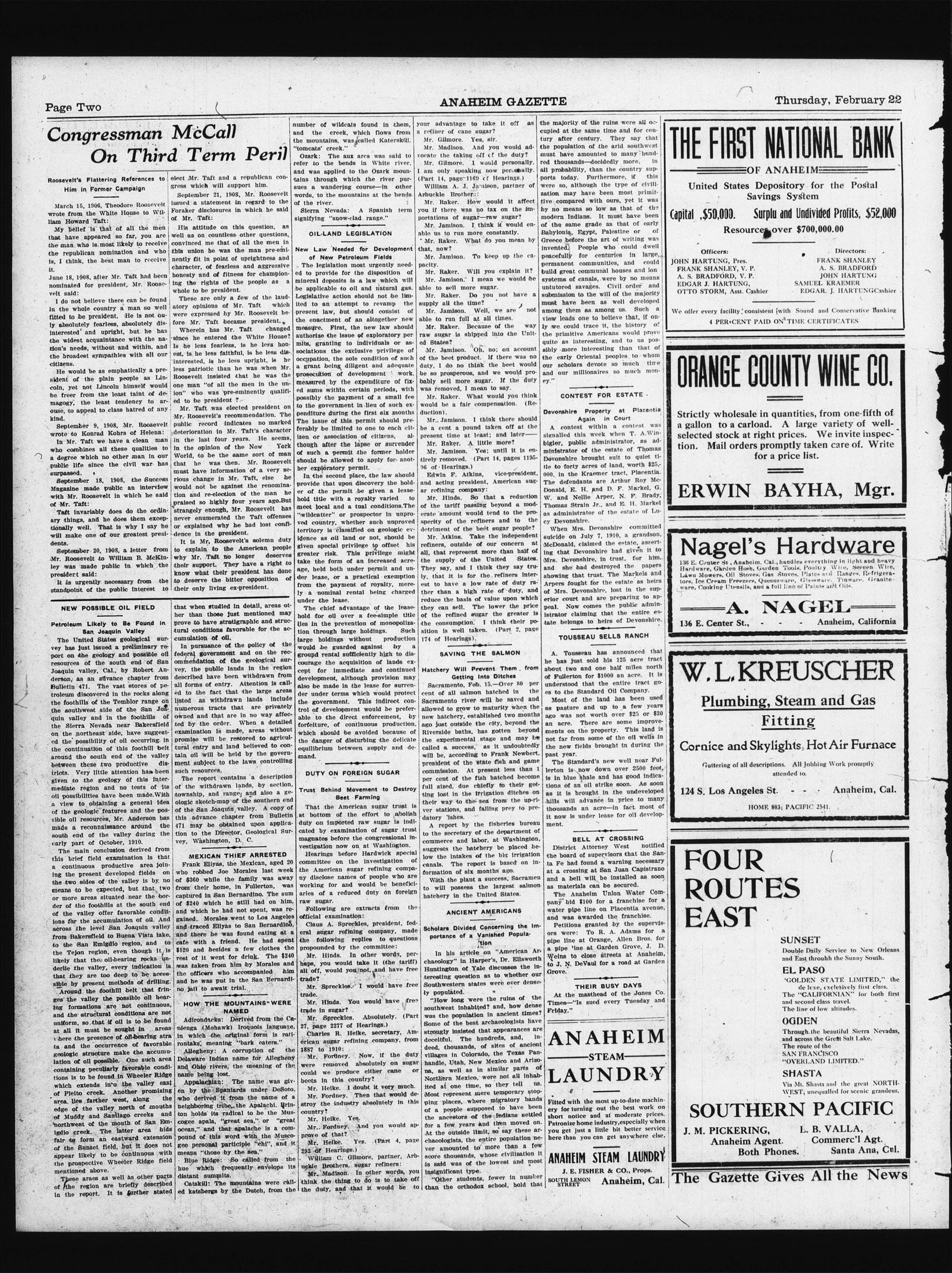
Searchable text
Congressman McCall
On Third Term Peril
Roosevelt's Flattering References to Him in Former Campaign
March 15, 1906, Theodore Roosevelt wrote from the White House to William Howard Taft:
My belief is that of all the men that have appeared so far, you are the man who is most likely to receive the republican nomination and who is, I think, the best man to receive it.
June 18, 1908, after Mr. Taft had been nominated for president, Mr. Roosevelt said:
I do not believe there can be found in the whole country a man so well fitted to be president. He is not only absolutely fearless, absolutely disinterested and upright, but he has the widest acquaintance with the nation's needs, without and within, and the broadest sympathies with all our citizens.
He would be as emphatically a president of the plain people as Lincoln, yet not Lincoln himself would be freer from the least taint of demagogy, the least tendency to arouse, to appeal to class hatred of any kind.
September 9, 1908, Mr. Roosevelt wrote to Konrad Kohrs of Helena:
In Mr. Taft we have a clean man who combines all these qualities to a degree which no other man in our public life since the civil war has surpassed.
elect Mr. Taft and a republican congress which will support him.
September 21, 1908, Mr. Roosevelt issued a statement in regard to the Foraker disclosures in which he said of Mr. Taft:
His attitude on this question, as well as on countless other questions, convinced me that of all the men in this union he was the man pre-eminently fit in point of uprightness and character, of fearless and aggressive honesty and of fitness for championing the rights of the people as a whole to be president.
These are only a few of the laudatory opinions of Mr. Taft which were expressed by Mr. Roosevelt before Mr. Taft became president.
Wherein has Mr. Taft changed since he entered the White House? Is he less fearless, is he less honest, is he less faithful, is he less disinterested, is he less upright, is he less patriotic than he was when Mr. Roosevelt insisted that he was the one man "of all the men in the union" who was pre-eminently qualified to be president?
Mr. Taft was elected president on Mr. Roosevelt's recommendation. The public record indicates no marked deterioration in Mr. Taft's character in the last four years. He seems, in the opinion of the New York World, to be the same sort of man that he was then. Mr. Roosevelt must have information of a very se-
number of wildcats and the creek, where the mountains, was "tomcats' creek."
Ozark: The auxiliary refer to the bends and was applied to contains through which sues a wandering words, to the mountain of the river.
Sierra Nevada: signifying "snow-clay."
NEW POSSIBLE OIL FIELD
Petroleum Likely to Be Found in San Joaquin Valley
The United States geological survey has just issued a preliminary report on the geology and possible oil resources of the south end of San Joaquin valley, Cal., by Robert Anderson, as an advance chapter from Bulletin 471. The vast stores of petroleum discovered in the rocks along the foothills of the Temblor range on the southwest side of the San Joaquin valley and in the foothills of the Sierra Nevada near Bakersfield on the northeast side, have suggested the possibility of oil occurring in the continuation of this foothill belt around the south end of the valley between these two productive districts. Very little attention has been given to the geology of this intermediate region and no tests of its oil possibilities have been made. With a view to obtaining a general idea of the geologic features and the possible oil resources, Mr. Anderson has made a reconnaissance around the south end of the valley during the early part of October, 1910.
The main conclusion derived from this brief field examination is that a continuous productive area joining the present developed fields on the two sides of the valley is by no means to be expected, but that two or more areas situated near the border of the plain people as Lincoln, yet not Lincoln himself would be freer from the least taint of demagogy, the least tendency to arouse, to appeal to class hatred of any kind.
September 9, 1908, Mr. Roosevelt wrote to Konrad Kohrs of Helena:
In Mr. Taft we have a clean man who combines all these qualities to a degree which no other man in our public life since the civil war has surpassed.
September 18, 1908, the Success Magazine made public an interview with Mr. Roosevelt in which he said of Mr. Taft:
Taft invariably does do the ordinary things, and he does them exceptionally well. That is why I say he will make one of our greatest presidents.
September 20, 1908, a letter from Mr. Roosevelt to William B. McKinley was made public in which the president said:
It is urgently necessary from the standpoint of the public interest to
Roosevelt insisted that he was the one man "of all the men in the union" who was pre-eminently qualified to be president?
Mr. Taft was elected president on Mr. Roosevelt's recommendation. The public record indicates no marked deterioration in Mr. Taft's character in the last four years. He seems, in the opinion of the New York World, to be the same sort of man that he was then. Mr. Roosevelt must have information of a very serious change in Mr. Taft, else he would not be against the renomination and re-election of the man he praised so highly four years ago. But strangely enough, Mr. Roosevelt has never enumerated the Taft offenses or explained why he had lost confidence in the president.
It is Mr. Roosevelt's solemn duty to explain to the American people why Mr. Taft no longer deserves their support. They have a right to know what their president has done to deserve the bitter opposition of their only living ex-president.
In the second place provide that upon hold title with a meet local and a "wildcatter" or proved country, where territory is classified as oil land given special private greater risk. This take the form of age, held both under lease, or a pledge from the payment by a nominal remand under the lease.
The chief advantage hold for oil over lies in the prevention through large holdings which would be guarded group rental sufficiency the acquaintance for immediate development, although also be made in the der under terms with the government.
Trol of development able to the direct forfeiture, of con-which should be at the danger of disquilibrium between mand.
MEXICAN THIEF ARRESTED
Frank Eliyas, the Mexican, aged 20 who robbed Joe Morales last week of $360 while the family was away from their home, in Fullerton, was captured in San Bernardino. The sum that when studied in detail, areas other than those just mentioned may prove to have stratigraphic and structural conditions favorable for the accumulation of oil.
In pursuance of the policy of the federal government and on the recommendation of the geological survey, the public lands in the region described have been withdrawn from all forms of entry. Attention is called to the fact that the large areas listed as withdrawn lands include numerous tracts that are privately owned and that are in no way affected by the order. When a detailed examination is made, areas without promise will be restored to agricultural entry and land believed to contain oil will be held by the government subject to the laws controlling such resources.
The report contains a description of the withdrawn lands, by section, township, and range; and also a geologic sketch-map of the southern end of the San Joaquin valley. A copy of this advance chapter from Bulletin 471 may be obtained upon application to the Director, Geological Survey, Washington, D.C.
MEXICAN THIEF ARRESTED
Frank Eliyas, the Mexican, aged 20 who robbed Joe Morales last week of $360 while the family was away from their home, in Fullerton, was captured in San Bernardino. The sum that when studied in detail, areas other than those just mentioned may prove to have stratigraphic and structural conditions favorable for the accumulation of oil.
In pursuance of the policy of the federal government and on the recommendation of the geological survey, the public lands in the region described have been withdrawn from all forms of entry. Attention is called to the fact that the large areas listed as withdrawn lands include numerous tracts that are privately owned and that are in no way affected by the order. When a detailed examination is made, areas without promise will be restored to agricultural entry and land believed to contain oil will be held by the government subject to the laws controlling such resources.
The report contains a description of the withdrawn lands, by section, township, and range; and also a geologic sketch-map of the southern end of the San Joaquin valley. A copy of this advance chapter from Bulletin 471 may be obtained upon application to the Director, Geological Survey, Washington, D.C.
DUTY ON FORCE
Trust Behind Mo-Beet
That the American at bottom of the duty on imported dicated by examina magnates before thievigation now o-
Hearings before committee on thie American suy disclose names working for andaries of a reduc-
a view to obtaining a general idea of the geologic features and the possible oil resources, Mr. Anderson has made a reconnaissance around the south end of the valley during the early part of October, 1910.
The main conclusion derived from this brief field examination is that a continuous productive area joining the present developed fields on the two sides of the valley is by no means to be expected, but that two or more areas situated near the border of the foothills at the south end of the valley offer favorable conditions for the accumulation of oil. And across the level San Joaquin valley from Bakersfield to Buena Vista lake, to the San Emigdio region, and to the Tejon region, even though it is likely that the oil-bearing rocks underlie the valley, every indication is that they are too deep to be accessible by present methods of drilling.
Around the foothill belt that fringes the valley the possible oil bearing formations are not continuous, and the structural conditions are not uniform, so that if oil is to be found at all it must be sought in areas where the presence of oil-bearing strata and the occurrence of favorable geologic structure make the accumulation of oil possible. One such area containing peculiarly favorable conditions is to be found in Wheeler Ridge which extends into the valley east of Pleito creek. Another promising area lies farther west, along the edge of the valley north of mouths of Muddy and Santiago creeks and northwest of the mouth of San Emigdio creek. The latter area bids fair to form an eastward extension of the Sunset field, but it does not appear likely to be continuous with the prospective Wheeler Ridge field mentioned above.
These araces as well as other parts of the region are briefly described in the report. It is further stated
MEXICAN THIEF ARRESTED
Frank Eliyas, the Mexican, aged 20 who robbed Joe Morales last week of $360 while the family was away from their home, in Fullerton, was captured in San Bernardino. The sum of $240 which he still had on him, and which he had not spent, was regained. Morales went to Los Angeles and traced Eliyas to San Bernardino, and there he was found eating at a cafe with a friend. He had spent $120 and besides a few clothes the rest of it went for drink. The $240 was taken from him by Morales and the officers who accompanied him and he was put in the San Bernardino jail to await trial.
HOW THE MOUNTAINS WERE NAMED
Adirondacks: Derived from the Canlenga (Mohawk) Iroquois language, in which the original form is ratirontaks, meaning "bark eaters."
Allegheny: A corruption of the Delaware Indian name for Allegheny and Ohio rivers, the meaning of the name being lost.
Appalachian: The name was given by the Spaniards under DeSoto, who derived it from the name of a neighboring tribe, the Apalachi. Brinton holds its radical to be the Muscogee apala, "great sea," or "great ocean," and that apalache is a compound of this word with the Muscogee personal participle "chi", and it means "those by the sea."
Blue Ridge: So called from the hue which frequently envelops its distant summits.
Catskill: The mountains were called katsbergs by the Dutch, from the
number of wildcats found in them,
and the creek, which flows from the mountains, was called Katerskill,
"tomcats' creek."
Ozark: The aux arcs was said to refer to the bends in White river,
and was applied to the Ozark mountains through which the river pursues a wandering course—in other words, to the mountains at the bends of the river.
Sierra Nevada: A Spanish term signifying "snow-clad range."
OIL-LAND LEGISLATION
New Law Needed for Development of New Petroleum Fields
The legislation most urgently needed to provide for the disposition of mineral deposits is a law which will be applicable to oil and natural gas. Legislative action should not be limited to an attempt to revamp the present law, but should consist of the enactment of an altogether new measure. First, the new law should authorize the issue of exploratory permits, granting to individuals or associations the exclusive privilege of occupation, the sole condition of such a grant being diligent and adequate prosecution of development work, measured by the expenditure of fixed sums within certain periods, with possibly the payment of a small fee to the government in lieu of such expenditure during the first six months. The issue of this permit should preferably be limited to one to each citizen or association of citizens, although after the lapse or surrender of such a permit the former holder should be allowed to apply for another exploratory permit.
your advantage to take it off as a refiner of cane sugar?
Mr. Gilmore. Yes, sir.
Mr. Madison. And you would advocate the taking off of the duty?
Mr. Gilmore. I would personally. I am only speaking now personally. (Part 14, page 1169 of Hearings.)
William A. J. Jamison, partner of Arbuckle Brothers:
Mr. Raker. How would it affect you if there was no tax on the importations of sugar—raw sugar?
Mr. Jamison. I think it would enable us to run more constantly.
Mr. Raker. What do you mean by that, now?
Mr. Jamison. To keep up the capacity.
Mr. Raker. Will you explain it?
Mr. Jamison. I mean we would be able to sell more sugar.
Mr. Raker. Do you not have a supply all the time?
Mr. Jamison. Well, we are not able to run full at all times.
Mr. Raker. Because of the way raw sugar is shipped into the United States?
Mr. Jamison. Oh, no; on account of the beet product. If there was no duty, I do no think the beet would be so prosperous, and we would probably sell more sugar. If the duty was removed, I mean to say.
Mr. Raker. What would you think would be a fair compensation. (Reduction).
Mr., Jamison. I think there should be a cent a pound taken off at the present time at least; and later——
Mr. Raker. A little more?
Mr. Jamison. Yes; until it is entirely removed. (Part 14, pages 1195-96 of Hearings.)
Edwin E. Atkins, vice-president,
the majority of the ruins were all occupied at the same time and for century after century. They say that the population of the arid southwest must have amounted to many hundred thousands—decidedly more, in all probability, than the country supports today. Furthermore, if this were so, although the type of civilization may have been most primitive compared with ours, yet it was by no means so low as that of the modern Indians. It must have been of the same grade as that of early Babylonia, Egypt, Palestine or of Greece before the art of writing was invented. People who could dwell peacefully for centuries in large permanent communities, and could build great communal houses and lonely systems of canals, were by no means untutored savages. Civil order and submission to the will of the majority must have been as well developed among them as among us. Such a view leads one to believe that, if only we could trace it, the history of the primitive Americans would prove quite as interesting, and to us possibly more interesting than that of the early Oriental peoples to whom our scholars devote so much time and our millionaires so much money."
CONTEST FOR ESTATE
Devonshire Property at Placentia Again in Court
A contest within a contest was signalled this week when T. A.Winbigler, public administrator, as administrator of the estate of Thomas Devonshire brought suit to quiet title to forty acres of land, worth $25,000 in the Kraemer tract, Placentia.
prosecution or development work, measured by the expenditure of fixed sums within certain periods, with possibly the payment of a small fee to the government in lieu of such expenditure during the first six months. The issue of this permit should preferably be limited to one to each citizen or association of citizens, although after the lapse or surrender of such a permit the former holder should be allowed to apply for another exploratory permit.
In the second place, the law should provide that upon discovery the holder of the permit be given a leasehold title with a royalty varied to meet local and a tual conditions. The "wildcatter" or prospector in unproved country, whether such unproved territory is classified on geologic evidence as oil land or not, should be given special privilege to offset his greater risk. This privilege might take the form of an increased acreage, held both under permit and under lease, or a practical exemption from the payment of royalty, merely a nominal rental being charged under the lease.
The chief advantage of the leasehold for oil over a fee-simple title lies in the prevention of monopolization through large holdings. Such large holdings without production would be guarded against by a group rental sufficiently high to discourage the acquisition of lands except for immediate and continued development, although provision may also be made in the lease for surrender under terms which would protect the government. This indirect control of development would be preferable to the direct enforcement, by forfeiture, of continuous production, which should be avoided because of the danger of disturbing the delicate equilibrium between supply and demand.
DUTY ON FOREIGN SUGAR
Trust Behind Movement to Destroy Beet Farming
That the American sugar trust is at bottom of the effort to abolish duty on imported raw sugar is indicated by examination of sugar trust magnates before the congressional investigation now on at Washington.
Hearings before Hardwick special committee on the investigation of the American sugar refining company disclose names of people who are working for and would be beneficiaries of a reduced duty on foreign prosecution or development work, measured by the expenditure of fixed sums within certain periods, with possibly the payment of a small fee to the government in lieu of such expenditure during the first six months. The issue of this permit should preferably be limited to one to each citizen or association of citizens, although after the lapse or surrender of such a permit the former holder should be allowed to apply for another exploratory permit.
In the second place, the law should provide that upon discovery the holder of the permit be given a leasehold title with a royalty varied to meet local and a tual conditions. The "wildcatter" or prospector in unproved country, whether such unproved territory is classified on geologic evidence as oil land or not, should be given special privilege to offset his greater risk. This privilege might take the form of an increased acreage, held both under permit and under lease, or a practical exemption from the payment of royalty, merely a nominal rental being charged under the lease.
The chief advantage of the leasehold for oil over a fee-simple title lies in the prevention of monopolization through large holdings. Such large holdings without production would be guarded against by a group rental sufficiently high to discourage the acquisition of lands except for immediate and continued development, although provision may also be made in the lease for surrender under terms which would protect the government. This indirect control of development would be preferable to the direct enforcement, by forfeiture, of continuous production, which should be avoided because of the danger of disturbing the delicate equilibrium between supply and demand.
SAVING THE SALMON
Hatchery Will Prevent Them from Getting Into Ditches
Sacramento, Feb. 15.—Over 80 percent of all salmon hatched in the Sacramento river will be saved and allowed to grow to maturity when the new hatchery, established two months ago just outside the city, beyond the Riverside baths, has gotten beyond the experimental stage and may be called a success, as it undoubtedly will be, according to Frank Newbert, president of the state fish and game commission. At present less than 1 per cent of the fish hatched become full sized, due chiefly to their getting lost in the irrigation ditches on their way to the sea from the up-river stations, and falling prey to predatory fishes.
A report by the fisheries bureau to the secretary of the department of commerce and labor, at Washington, suggests the hatchery be placed below the intakes of the big irrigation canals. The report is based on information of six months ago.
With the plant a success, Sacramen to will possess the largest salmon hatchery in the United States.
CONTEST FOR ESTATE
Devonshire Property at Placentia Again in Court
A contest within a contest was signalled this week when T. A.Winbigler, public administrator, as administrator of the estate of Thomas Devonshire brought suit to quiet title to forty acres of land, worth $25,-000, in the Kraemer tract, Placentia. The defendants are Arthur Roy McDonald, E. H. and D. F. Markel, G. W. and Nellie Arper, N. F. Brady, Thomas Strain Jr., and E. H. Markel as administrator of the estate of Lucy Devonshire.
When Mrs. Devonshire committed suicide on July 7, 1910, a grandson, McDonald, claimed the estate, asserting that Devonshire had given it to Mrs. Devonshire, in trust, for him, and she had destroyed the papers showing that trust. The Markels and Arpers fought for the estate as heirs of Mrs. Devonshire, lost in the superior court and are preparing to appeal. Now comes the public administrator claiming that the entire estate belongs to heirs of Devonshire.
TOUSSEAU SELLS RANCH
A. Tousseau has announced that he has just sold his 125 acre tract about two and one half miles north of Fullerton for $1000 an acre. It is understood that the entire tract goes to the Standard Oil Company.
Most of the land has been used as pasture and up to a few years ago was not worth over $25 or $30 an acre. There are some improvements on the property. This land is not far from some of the oil wells in the new fields brought in during the past year.
The Standard's new well near Fullerton is now down over 2500 feet, is in blue shale and has good indications of an oil strike soon. As soon as it is brought in the undeveloped hills will advance in price to many thousands an acre—in fact most of it now is under lease for oil development.
BELL AT CROSSING
District Attorney West notified the board of supervisors that the Santa Fe had found a warning necessary at a crossing at San Juan Capistrano and a bell will be installed as soon as materials can be secured.
The Anaheim Union Water Com-
That the American sugar trust is at bottom of the effort to abolish duty on imported raw sugar is indicated by examination of sugar trust magnates before the congressional investigation now on at Washington.
Hearings before Hardwick special committee on the investigation of the American sugar refining company disclose names of people who are working for and would be beneficiaries of a reduced duty on foreign raw sugar.
Following are extracts from the official examination:
Claus A. Spreckles, president, federal sugar refining company, made the following replies to questions propounded by the committee:
Mr. Hinds. In other words, perhaps you would take it (the tariff) all off, would you not, and have free trade?
Mr. Spreckles. I would have free trade.
Mr. Hinds. You would have free trade in sugar?
Mr. Spreckles. Absolutely. (Part 27, page 2277 of Hearings.)
Charles R. Helke, secretary, American sugar refining company, from 1887 to 1910:
Mr. Fordney. Now, if the duty were removed absolutely on sugar could we produce either cane or beets in this country?
Mr. Heike. I doubt it very much.
Mr. Fordney. Then that would destroy the industry absolutely in this country?
Mr. Heike. Yes.
Mr. Fordney. And you would approve of that?
Mr. Heike. Yes. (Part 4, page 292 of Hearings.)
William C. Gilmore, partner, Arbuckle Brothers, sugar refiners:
Mr. Madison. In other words, you think the thing to do is to take off the duty, and that it would be to their way to the sea from the upriver stations, and falling prey to predatory fishes.
A report by the fisheries bureau to the secretary of the department of commerce and labor, at Washington, suggests the hatchery be placed below the intakes of the big irrigation canals. The report is based on information of six months ago.
With the plant a success, Sacramen to will possess the largest salmon hatchery in the United States.
ANCIENT AMERICANS
Scholars Divided Concerning the Importance of a Vanished Population
In his article on "American Archaeology" in Harper's, Dr. Ellsworth Huntington of Yale discusses the interesting question as to whether our Southwestern states were ever densely populated.
"How long were the ruins of the southwest inhabited? and, how dense was the population in ancient times? Some of the best archaeologists have strongly insisted that appearances are deceitful. The hundreds, and, indeed, thousands, of sites of ancient villages in Colorado, the Texas Panhandle, Utah, New Mexico and Arizona, as well as in similar parts of Northern Mexico, were not all inhabited at one time, so they tell us. Most represent mere temporary stopping places, where migratory bands of a people supposed to have been the ancestors of the Indians settled for a few years and then moved on. At the outside limit, so say these archaeologists, the entire population never amounted to more than a few score thousands, whose civilization it is said was of the lowest and most insignificant type.
"Other students, fewer in number than the orthodox school, hold that..."
BELL AT CROSSING
District Attorney West notified the board of supervisors that the Santa Fe had found a warning necessary at a crossing at San Juan Capistrano and a bell will be installed as soon as materials can be secured.
The Anaheim Union Water Company bid $100 for a franchise for a water pipe line on Placentia avenue, and was awarded the franchise.
Petitions granted by the supervisors were: To R. A. Adams for a pipe line at Orange, Allen Bros. for a pipe line at Garden Grove, J. D. Weins to close streets at Anaheim, to J. N. DeVaul for a road at Garden Grove.
THEIR BUSY DAYS
At the masthead of the Jones Co. Times—"Is sued every Tuesday and Friday."
ANAHEIM STEAM LAUNDRY
Fitted with the most up-to-date machinery for turning out the best work on short notice and at moderate prices. Patronize home industry, especially when you get just a little bit better service here than you can get anywhere else.
ANAHEIM STEAM LAUNDRY
J. E. FISHER & CO., Props.
SOUTH LEMON STREET
Anaheim, Cal.
THE FIRST NATIONAL BANK
OF ANAHEIM
United States Depository for the Postal Savings System
Capital, $50,000. Surplus and Undivided Profits, $52,000
Resources over $700,000.00
Officers:
JOHN HARTUNG, Pres.
FRANK SHANLEY
FRANK SHANLEY, V. P.
A. S. BRADFORD
A. S. BRADFORD, V. P.
EDGAR J. HARTUNG,
SAMUEL KRAEMER
OTTO STORM, Asst. Cashier
EDGAR. J. HARTUNGCashier
We offer every facility consistent with Sound and Conservative Banking
4 PERCENT PAID ON TIME CERTIFICATES
ORANGE COUNTY WINE CO.
Strictly wholesale in quantities, from one-fifth of a gallon to a carload. A large variety of well-selected stock at right prices. We invite inspection. Mail orders promptly taken care of. Write for a price list.
FOR ESTATE
Property at Placentia in Court
Within a contest was seek when T. A.WinAdministrator, as adeate estate of Thomas
right suit to quiet title of land, worth $25,
mer tract, Placentia.
Sare Arthur Roy Mcand D. F. Markel, G.
Arper, N. F. Brady,
r., and E. H. Markel
of the estate of Ludvonshire committed
17, 1910, a grandson,
ad the estate, assertshire had given it to
in trust, for him.
Destroyed the papers
st. The Markels and
for the estate as heirs
ire, lost in the supware preparing to apcess the public adminthat the entire esheirs of Devonshire.
SELLS RANCH
has announced that
his 125 acre tract
one half miles north
$1000 an acre. It is
the entire tract gord Oil Company.
Land has been used
up to a few years
worth over $25 or $30
are some improveproperty. This land is
one of the oil wells in
brought in during the
is new well near Fuldown over 2500 feet,
and has good indicastrike soon. As soon
it in the undeveloped
price in price to many
cre—in fact most of
lease for oil develop-
AT CROSSING
Money West notified
servisors that the Sana warning necessary
San Juan Capistrano
be installed as soon
be secured.
Union Water Com-
UNANOL COUNTY WINE CO.
Strictly wholesale in quantities, from one-fifth of a gallon to a carload. A large variety of well-selected stock at right prices. We invite inspection. Mail orders promptly taken care of. Write for a price list.
ERWIN BAYHA, Mgr.
Nagel's Hardware
136 E. Center St., Anaheim, Cal., handles everything in light and heavy
Hardware, Garden Hose, Garden Tools, Poultry Wire, Screens Wire,
Lawn Mowers, Oil Stoves, Gas Stoves, Plates and Ranges. Refrigerators,
Ice Cream Freezers, Queensware, Glassware. Tinware. Graniteware, Cooking Utensils, and a full line of Paints and Oils.
A. NAGEL
136 E. Center St., - - - Anaheim, California
W.L.KREUSCHER
Plumbing, Steam and Gas
Fitting
Cornice and Skylights, Hot Air Furnace
Guttering of all descriptions. All Jobbing Work promptly attended to.
124 S. Los Angeles St. - - - Anaheim, Cal.
HOME 803; PACIFIC 2541.
FOUR ROUTES
FOUR ROUTES EAST
SUNSET
Double Daily Service to New Orleans and East through the Sunny South.
EL PASO
'GOLDEN STATE LIMITED,' the de luxe, exclusively first class.
The "CALIFORNIAN" for both first and second class travel.
The line of low altitudes.
OGDEN
Through the beautiful Sierra Nevadas, and across the Great Salt Lake.
The route of the SAN FRANCISCO "OVERLAND LIMITED."
SHASTA
Via Mt. Shasta and the great NORTH-WEST, unequalled for scenic grandeur.
SOUTHERN PACIFIC
J. M. PICKERING,
Anaheim Agent.
Both Phones.
L. B. VALLA,
Commerc'l Agt.
Santa Ana, Cal.
The Gazette Gives All the News