anaheim-gazette 1912-02-08
Scanned page
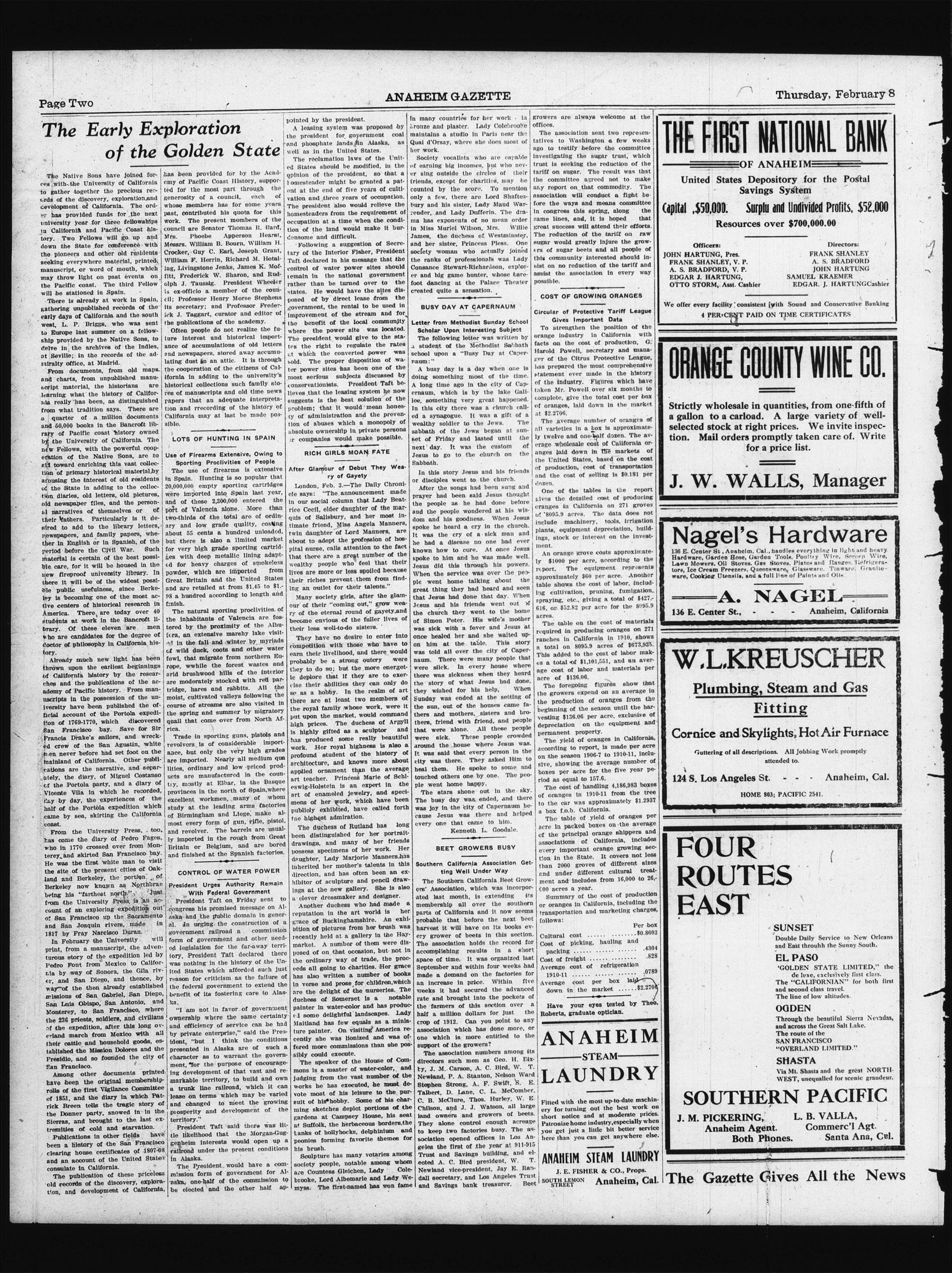
Searchable text
The Early Exploration of the Golden State
The Native Sons have joined forces with the University of California to gather together the precious records of the discovery, exploration, and development of California. The order has provided funds for the next university year for three fellowships in California and Pacific Coast history. Two Fellows will go up and down the State for conference with the pioneers and other old residents seeking everywhere material, printed manuscript, or word of mouth, which may throw light on past events on the Pacific coast. The third Fellow will be stationed in Spain.
There is already at work in Spain, gathering unpublished records of the early days of California and the south west, L. P. Briggs, who was sent to Europe last summer on a fellowship provided by the Native Sons, to delve in the archives of the Indies, at Seville; in the records of the admirability office, at Madrid.
From documents, from old maps and charts, from unpublished manuscript material, the historians are learning what the history of California really has been, as distinguished from what tradition says. There are a quarter of a million documents and 50,000 books in the Bancroft library of Pacific coast history owned by the University of California. The new Fellows, with the powerful cooperation of the Native Sons, are to aid toward enriching this vast collection of primary historical material by has been provided for by the Academy of Pacific Coast History, supported for the most part through the generosity of a council, each of whose members has for some years past, contributed his quota for this work. The present members of the council are Senator Thomas R. Bard, Mrs. Phoebe Apperson Hearst, Messrs. William B. Bourn, William H. Crocker, Guy C. Earl, Joseph Grant, William F. Herrin, Richard M. Hotaling, Livingstone Jenks, James K. Moffitt, Frederick W. Sharon, and Rudolph J. Taussig. President Wheeler is ex-officio a member of the council; Professor Henry Morse Stephens its secretary; and Professor Frederick J. Taggart, curator and editor of the publications of the academy.
Often people do not realize the future interest and historical importance of accumulations of old letters and newspapers, stored away accumulating dust in an attic. It is through the cooperation of the citizens of California in adding to the university's historical collections such family stores of manuscripts and old time news papers that an adequate interpretation and recording of the history of California may at last be made possible.
LOTS OF HUNTING IN SPAIN
Use of Firearms Extensive, Owing to Sporting Proclivities of People
The use of firearms is extensive pointed by the president.
A leasing system would be no opinion of the president homesteader might be at the end of five vacation and three years.
The president also would homesteaders from the occupation at a time tion of the land would densome and difficult.
Following a suggestion of the Interior Fatt declared in his control of water power remain in the nation rather than be turned states. He would have posed of by direct government, the rental improvement of the benefit of the land where the power site The president would rates the right to regain which the convert sold. The proper dister power sites has most serious subject conservationists. Principles that the leasing suggests is the best problem; that it would city of administration tion of abuses which absolute ownership in or companies would
and charts, from unpublished manuscript material, the historians are learning what the history of California really has been, as distinguished from what tradition says. There are a quarter of a million documents and 50,000 books in the Bancroft library of Pacific coast history owned by the University of California. The new Fellows, with the powerful cooperation of the Native Sons, are to aid toward enriching this vast collection of primary historical material by arousing the interest of old residents of the State in adding to the collection diaries, old letters, old pictures, old newspaper files, and the personal narratives of themselves or of their fathers. Particularly is it desired to add to the library letters, newspapers, and family papers, whether in English or in Spanish, of the period before the Civil War. Such material is certain of the best possible care, for it will be housed in the new fireproof university library. In there it will be of the widest possible public usefulness, since Berkeley is becoming one of the most active centers of historical research in America. There are today over 40 students at work in the Bancroft library. Of these eleven are men who are candidates for the degree of Doctor of philosophy in California history.
Already much new light has been thrown upon the earliest beginnings of California history by the researches and the publications of the academy of Pacific history. From manuscripts in the possession of the university have been published the official account of the Portola expedition of 1769-1770, which discovered San Francisco bay. Save for Sir Francis Drake's sailors, and wrecked crew of the San Agustin, white men never before had set foot on the mainland of California. Other publications are the narrative, and separately, the diary, of Miguel Costanzo of the Portola party, and a diary of Vicente Vila in which he recorded Day by day, the experiences of the half of the Portola expedition which came by sea, skirting the California coast.
From the University Press, too, has come the diary of Pedro Fages, who in 1770 crossed over from Monterey and skirted San Francisco bay. He was the first white man to visit the site of the present cities of Oakland and Berkeley, the portion of Berkeley now known as Northbrae being his "farthest north."
LOTS OF HUNTING IN SPAIN
Use of Firearms Extensive, Owing to Sporting Proclivities of People
The use of firearms is extensive in Spain. Hunting is so popular that 20,000,000 empty sporting cartridges were imported into Spain last year, and of these 2,300,000 entered the port of Valencia alone. More than two-thirds of the total are of ordinary and low grade quality, costing about 55 cents a hundred unloaded, but there is also a limited market for very high grade sporting cartridges with deep metallic lining adapted for heavy charges of smokeless powder, which are imported from Great Britain and the United States and are retailed at from $1.45 to $1.98 a hundred according to length and finish.
The natural sporting proclivities of the inhabitants of Valencia are fostered by the proximity of the Albuera, an extensive marshy lake visited in the fall and winter by myriads of wild duck, coots and other water fowl, that migrate from northern Europe, wwhile the forest wastes and arid brushwood hills of the interior are moderately stocked with red partridge, hares and rabbits. All the moist, cultivated valleys following the course of streams are also visited in the spring and summer by migratory quail that come over from North Africa.
Trade in sporting guns, pistols and revolvers is of considerable importance, but only the very high grades are imported. Nearly all medium qualities, ordinary and low priced products are manufactured in the country, mostly at Elbar, in the Basque provinces in the north of Spain, where excellent workmen, many of whom study at the leading arms factories of Birmingham and Liege, make almost every form of gun, rifle, pistol, and revolver. The barrels are usually imported in the rough from Great Britain or Belgium, and are bored and finished at the Spanish factories.
CONTROL OF WATER POWER
President Urges Authority Remain With Federal Government
Most serious subject conservationists. Principles that the leasing suggests is the best problem; that it would try administration of abuses which absolute ownership insurer companies would...
CONTROL OF WATER POWER
President Urges Authority Remain With Federal Government
President Taft on Friday sent to congress his promised message on Alaska and the public domain in general. In urging the construction of a government railroad a commission form of government and other needed legislation for the far-away territory, President Taft declared there was nothing in the history of the United States which afforded such just reason for criticism as the failure of the federal government to extend the benefit of its fostering care to Alaska.
"I am not in favor of government ownership where the same certainty and efficiency of service can be had by private enterprise," said the President, "but I think the conditions presented in Alaska are of such a character as to warrant the government, for the purpose of encouraging development of that vast and remarkable territory, to build and own a trunk line railroad, which it can lease on terms which may be varied and changed to meet the growing prosperity and development of the territory."
President Taft said there was little likelihood that the Morgan-Guggenheim interests would open up a railroad under the present conditions in Alaska.
The President would have a commission form of government for Alaska, one-half of the commission to be elected and the other half ap-
The duchess of Rutland been distinguished with drawings, and many possess specimens of daughter, Lady Mary inherited her mother's direction, and has exhibited sculpture works at the new galleries a clever dressmaker.
Another duchess with reputation in the arts grace of Buckinghamshire bition of pictures recently held at a good market. A number of poses of on that occasion the ordinary way of feeds all going to chick has also written a verse and prose are the delight of the duchess of Somerset painter in water-colored some delightful Maitland has few picture painter. On viscibly she was lion-fered more commissions sibly could execute.
The speaker of the mons is a master of judging from the various works he has executed vote most of his lot suit of his hobby. Mining sketches depict gardens at Campeset at Suffolk, the herb banks of hollyhocks peonies forming fae his brush.
Sculpture has made society people, notably are Countess Gleichbrooke, Lord Albemarle myss. The first-nam
pointed by the president.
A leasing system was proposed by the president for government coal and phosphate lands in Alaska, as well as in the United States.
The reclamation laws of the United States should be modified, in the opinion of the president, so that a homesteader might be granted a patent at the end of five years of cultivation and three years of occupation. The president also would relieve the homesteaders from the requirement of occupation at a time when the condition of the land would make it burdensome and difficult.
Following a suggestion of Secretary of the Interior Fisher, President Taft declared in his message that the control of water power sites should remain in the national government rather than be turned over to the states. He would have the sites disposed of by direct lease from the government, the rental to be used in improvement of the stream and for the benefit of the local community where the power site was located. The president would give to the states the right to regulate the rates at which the converted power was sold. The proper disposition of water power sites has been one of the most serious subjects discussed by conservationists. President Taft believes that the leasing system he now suggests is the best solution of the problem; that it would mean honesty of administration and the prevention of abuses which a monopoly of absolute ownership in private persons or companies would make possible.
RICH GIRLS MOAN FATE
After Glamour of Debut They Wea-
In many countries for her work in bronze and plaster. Lady Colebrooke maintains a studio in Paris near the Quai d'Orsay, where she does most of her work.
Society vocalists who are capable of earning big incomes, but who never sing outside the circles of their friends, except for charities, may be counted by the score. To mention only a few, there are Lord Shaftesbury and his sister, Lady Maud Warrender, and Lady Dufferin. The drama has exponents of no mean order in Miss Muriel Wilson, Mrs. Willie James, the duchess of Westminster, and her sister, Princess Pless. One society woman who actually joined the ranks of professionals was Lady Consance Stewart-Richardson, explorer and big game hunter, whose barefoot dancing at the Palace Theater created quite a sensation.
BUSY DAY AT CAPERNAUM
Letter from Methodist Sunday School Scholar Upon Interesting Subject
The following letter was written by a student of the Methodist Sabbath school upon a "Busy Day at Capernaum:"
A busy day is a day when one is doing something most of the time. A long time ago in the city of Capernaum, which is by the lake Galilee, something very great happened. In this city there was a church called a synagogue. It was a gift of a wealthy soldier to the Jews. The sabbath of the Jews began at sunset of Friday and lasted until the next day. It was the custom of Jesus to go to the church on the Sabbath.
In this story Jesus and his friends growers are always welcome at the offices.
The association sent two representatives to Washington a few weeks ago to testify before the committee investigating the sugar trust, which trust is seeking the reduction of the tariff on sugar. The result was that the committee agreed not to make any report on that commodity. The association will conduct a fight before the ways and means committee in congress this spring, along the same lines, and, it is hoped that great success will attend their efforts. The reduction of the tariff on raw sugar would greatly injure the growers of sugar beets and all people of this community interested should insist on no reduction of the tariff and assist the association in every way possible.
COST OF GROWING ORANGES
Circular of Protective Tariff League Gives Important Data
To strengthen the position of the orange industry in California with facts on the cost of production, G. Harold Powell, secretary and manager of the Citrus Protective League, has prepared the most comprehensive statement ever made in the history of the industry. Figures which have taken Mr. Powell over six months to complete, give the total cost per box of oranges, laid down in the market at $2.2706.
The average number of oranges of all varieties in a box is approximately twelve and one-half dozen. The average wholesale cost of California oranges laid down in the markets of the United States, based on the cost of production, cost of transportation and the cost of selling is $0.181 per
RICH GIRLS MOAN FATE
After Glamour of Debut They Weary of Gayety
London, Feb. 3.—The Daily Chronicle says: "The announcement made in our social column that Lady Beatrice Cecil, elder daughter of the marquis of Salisbury, and her most intimate friend, Miss Angela Manners, twin daughter of Lord Manners, are about to adopt the profession of hospital nurse, calls attention to the fact that there are a great number of the wealthy people who feel that their lives are more or less spoiled because their riches prevent them from finding an outlet for their talents."
Many society girls, after the glamour of their "coming out," grow weary of the eternal round of gayety,and become envious of the fuller lives of their less well-to-do sisters.
They have no desire to enter into competition with those who have to earn their livelihood, and there would probably be a strong outcry were they to do so; but the more energetic deplore that if they are to exercise their abilities they can only do so as a hobby. In the realm of art there are at least two members of the royal family whose work, were it put upon the market, would command high prices. The duchess of Argyll is highly gifted as a sculptor and has produced some really beautiful work. Her royal highness is also a profound student of the history of architecture, and knows more about applied ornament than the average art teacher. Princess Marie of Schleswig-Holstein is an expert in the art of enameled jewelry, and specimens of her work, which have been publicly exhibited, have called forth the highest admiration.
The duchess of Rutland has long been distinguished for her portrait drawings, and many of her friends possess specimens of her work. Her daughter, Lady Marjorie Manners,has inherited her mother's talents in this direction, and has often been an exhibitor of sculpture and pencil drawings at the new gallery. She is also a clever dressmaker and designer.
A long time ago in the city of Capernaum, which is by the lake Galilee, something very great happened. In this city there was a church called a synagogue. It was a gift of a wealthy soldier to the Jews. The sabbath of the Jews began at sunset of Friday and lasted until the next day. It was the custom of Jesus to go to the church on the Sabbath.
In this story Jesus and his friends or disciples went to the church.
After the songs had been sung and prayer had been said Jesus thought the people as he had done before and the people wondered at his wisdom and his goodness. When Jesus spoke he heard a cry in the church. It was the cry of a sick man and he had a disease no one had ever known how to cure. At once Jesus spoke to him and he was made well. Jesus did this through his powers. When the service was over the people went home talking about the great thing they had heard and seen that Jesus had done that day. When Jesus and his friends went out of the church they went to the home of Simon Peter. His wife's mother was sick with a fever and Jesus at once healed her and she waited upon him at the table. This story was told all over the city of Capernaum. There were many people that were slick. In every house where there was sickness when they heard the story of what Jesus had done, they wished for his help. When Sunday was ended at the setting of the sun, out of the houses came fathers and mothers, sisters and brothers, friend with friend, and people that were alone. All these people were sick. These people crowded around the house where Jesus was. It was said that every person in the city was there. They asked Him to heal them. He spoke to some and touched others one by one. The people went home happy.
The stars shone out in the sky. The busy day was ended, and there was joy in the city of Capernaum because Jesus was there and helped every one that came to him.
Kenneth L. Goodale.
BEET GROWERS BUSY
Southern California Association Getting Well Under Way
The Southern California Beet Growers' Association, which was incorporated last month, is extending its doing something most of the time.
A long time ago in the city of Capernaum, which is by the lake Galilee, something very great happened. In this city there was a church called a synagogue. It was a gift of a wealthy soldier to the Jews. The sabbath of the Jews began at sunset of Friday and lasted until the next day. It was the custom of Jesus to go to the church on the Sabbath.
In this story Jesus and his friends or disciples went to the church.
After the songs had been sung and prayer had been said Jesus thought the people as he had done before and the people wondered at his wisdom and his goodness. When Jesus spoke he heard a cry in the church. It was the cry of a sick man and he had a disease no one had ever known how to cure. At once Jesus spoke to him and he was made well. Jesus did this through his powers. When the service was over the people went home talking about the great thing they had heard and seen that Jesus had done that day. When Jesus and his friends went out of the church they went to the home of Simon Peter. His wife's mother was sick with a fever and Jesus at once healed her and she waited upon him at the table. This story was told all over the city of Capernaum. There were many people that were slick. In every house where there was sickness when they heard the story of what Jesus had done, they wished for his help. When Sunday was ended at the setting of the sun, out of the houses came fathers and mothers, sisters and brothers, friend with friend, and people that were alone. All these people were sick. These people crowded around the house where Jesus was. It was said that every person in the city was there. They asked Him to heal them. He spoke to some and touched others one by one. The people went home happy.
The stars shone out in the sky. The busy day was ended, and there was joy in the city of Capernaum because Jesus was there and helped every one that came to him.
Kenneth L. Goodale.
BEET GROWERS BUSY
Southern California Association Getting Well Under Way
The Southern California Beet Growers' Association, which was incorporated last month, is extending its doing something most of the time.
A long time ago in the city of Capernaum, which is by the lake Galilee, something very great happened. In this city there was a church called a synagogue. It was a gift of a wealthy soldier to the Jews. The sabbath of the Jews began at sunset of Friday and lasted until the next day. It was the custom of Jesus to go to the church on the Sabbath.
In this story Jesus and his friends or disciples went to the church.
After the songs had been sung and prayer had been said Jesus thought the people as he had done before and the people wondered at his wisdom and his goodness. When Jesus spoke he heard a cry in the church. It was the cry of a sick man and he had a disease no one had ever known how to cure. At once Jesus spoke to him and he was made well. Jesus did this through his powers. When the service was over the people went home talking about the great thing they had heard and seen that Jesus had done that day. When Jesus and his friends went out of the church they went to the home of Simon Peter. His wife's mother was sick with a fever and Jesus at once healed her and she waited upon him at the table. This story was told all over the city of Capernaum. There were many people that were slick. In every house where there was sickness when they heard the story of what Jesus had done, they wished for his help. When Sunday was ended at the setting of the sun, out of the houses came fathers and mothers, sisters and brothers, friend with friend, and people that were alone. All these people were sick. These people crowded around the house where Jesus was. It was said that every person in the city was there. They asked Him to heal them. He spoke to some and touched others one by one. The people went home happy.
The stars shone out in the sky. The busy day was ended, and there was joy in the city of Capernaum because Jesus was there and helped every one that came to him.
Kenneth L. Goodale.
BEET GROWERS BUSY
Southern California Association Getting Well Under Way
The Southern California Beet Growers' Association, which was incorporated last month, is extending its doing something most of the time.
A long time ago in the city of Capernaum, which is by the lake Galilee, something very great happened. In this city there was a church called a synagogue. It was a gift of a wealthy soldier to the Jews. The sabbath of the Jews began at sunset of Friday and lasted until the next day. It was the custom of Jesus to go to the church on the Sabbath.
In this story Jesus and his friends or disciples went to the church.
After the songs had been sung and prayer had been said Jesus thought the people as he had done before and the people wondered at his wisdom and his goodness. When Jesus spoke he heard a cry in the church. It was the哭of a sick man and he had a disease no one had ever known how to cure. At once Jesus spoke to him and he was made well. Jesus did this through his powers. When the service was over the people went home talking about the great thing they had heard and seen that Jesus had done that day. When Jesus and his friends went out of the church they went to the home of Simon Peter. His wife's mother was sick with a fever and Jesus at once healed her and she waited upon him at the table. This story was told all over the city of Capernaum. There were many people that were slick. In every house where there was sickness when they heard the story of what Jesus had done, they wished for his help. When Sunday was ended at the setting of the sun, out ofthe houses came fathers and mothers,sisters and brothers,friend with friend,and people that were alone.All these people were sick.These people crowded aroundthe housewhereJesuswas.Iwassaidthateverypersoninthercitywasthere.Theysaidthateverypersoninthercitywasthere.Theysaidthateverypersoninthercitywasthere.Theysaidthateverypersoninthercitywasthere.Theysaidthateverypersoninthercitywasthere.Theysaidthateverypersoninthercitywasthere.Theysaidthateverypersoninthercitywasthere.Theysaidthateverypersoninthercitywasthere.Theysaidthateverypersoninthercitywasthere.Theysaidthateverypersoninthercitywasthere.Theysaidthateverypersoninthercitywasthere.Theysaidthateverypersoninthercitywasthere.Theysaidthateverypersoninthercitywasthere.Theysaidthateverypersoninthercitywasthere.Theysaidthateverypersoninthercitywasthere.Theysaidthateverypersoninthercitywasthere.Theysaidthateverypersoninthercitywasthere.Theysaidthateverypersoninthercitywasthere.Theysaidthateverypersoninthercitywasthere.Theysaidthateverypersoninthercitywasthere.Theysaidthateverypersoninthercitywasthere.Theysaidthateverypersoninthercitywasthere.Theysaidthateverypersoninthercitywasthere.Theysaidthateverypersoninthercitywasthere.Theysaidthateverypersoninthercitywasthere.Theysaidthateverypersoninthercitywasthere.Theysaidthateverypersoninthercitywasthere.Theysaidthateverypersoninthercitywasthere.Theysaidthateverypersoninhercitywasthere.Theysaidthateverypersoninhercitywasthere.Theysaidthateverypersoninhercitywasthere.Theysaidthateverypersoninhercitywasthere.Theysaidthatverypersoninhercitywasthere.Theysaidthatvery personinhercitywasthere.Theysaidthatvery personinhercitywasthere.Theysaidthatvery personinhercitywasthere.Theysaidthatvery personinhercitywasthere.Theysaidthatvery personinhercitywasthere.Theysaidthatvery personinhercitywasthere.Theysaidthatvery personinhercitywasthere.Theysaidthatvery personinhercitywasthere.Theysaidthatvery personinhercitywasthere.Theysaidthatvery personinhercitywasthere.Theysaidthatvery personinhercitywasshere.Theysaidthatvery personinhercitywasshere.Theysaidthatvery personinhercitywasshere.Theysaidthatvery personinhercitywasshere.Theysaidthatvery personinhercitywasshere.Theysaidthatvery personinhercitywasshere.Theysaidthatvery personinhercitywasshere.Theysaidthatvery personinhercitywasshere.Theysaidthatvery personinhercitywasshere.Theysaidthatvery personinhercitywasshere.Theysaidthatvery personinhercitywasshere.Theys aid thatvery person inhercity wass here .They aid thatvery person inhercity wass here .They aid thatvery person inhercity wass here .They aid thatvery person inhercity wass here .They aid thatvery person inhercity wass here .They aid thatvery person inhercity wass here .They aid thatvery person inhercity wass here .They aid thatvery person inhercity wass here .They aid thatvery person inhercity wass here .They aid thatvery person inherCity wass here .They aid thatvery person inherCity wass here .They aid thatvery person inherCity wass here .They aid thatvery person inherCity wass here .They aid thatvery person inherCity wass here .They aid thatvery person inherCity wass here .They aid thatvery person inherCity wass here .They aid thatvery person inherCity wass here .They aid thatvery person inherrCity wass here .They aid thatvery person inherrCity wass here .They aid thatvery person inherrCity wass here .They aid thatvery person inherrCity wass here .They aid thatvery person inherrCity wass here .They aid thatvery person inherrCity wass here .They aid thatvery person inherrCity wass here .They aid thatvery person inherrCity wass here .They aid thatvery personinherrCity wass here .They aid thatvery personinherrCity wass here .They aid thatvery personinherrCity wass here .They aid thatvery personinherrCity wass here .They aid thatvery personinherrCity wass here .They aid thatvery personinherrCity wass here .They aid thatvery personinherrCity wass here .They aid thatvery personinherrCity wass here .They aid theriyersonherrCity wass here .They aid theriyersonherrCity wass here .They aid theriyersonherrCity wass here .They aid theriyersonherrCity wass here .They aid theriyersonherrCity wass here .They aid theriyersonherrCity wass here .They aid theriyersonherrCity wass here .They aid theriyersonherrCity wass here .
Summary of the cost of production
The duchess of Rutland has long been distinguished for her portrait drawings, and many of her friends possess specimens of her work. Her daughter, Lady Marjorie Manners, has inherited her mother's talents in this direction, and has often been an exhibitor of sculpture and pencil drawings at the new gallery. She is also a clever dressmaker and designer.
Another duchess who had made a reputation in the art world is her grace of Buckinghamshire. An exhibition of pictures from her brush was recently held at a gallery in the Haymarket. A number of them were disposed of on that occasion, but not in the ordinary way of trade, the proceeds all going to charities. Her grace has also written a number of books in verse and prose for children, which are the delight of the nurseries. The duchess of Somerset is a notable painter in water-color and has produced some delightful landscapes. Lady Maitland has few equals as a miniature painter. On visiting America recently she was lionized and was offered more commissions than she possibly could execute.
The speaker of the House of Commons is a master of water-color, and judging from the vast number of the works he has executed, he must devote most of his leisure to the pursuit of his hobby. Some of his charming sketches depict portions of the gardens at Campsey House, his seat at Suffolk, the herbaceous borders, the banks of hollyhocks, delphinium and peonies forming favorite themes for his brush.
Sculpture has many votaries among society people, notable among whom are Countess Gleichen, Lady Colebrooke, Lord Albemarle and Lady Wemyss. The first-named has won fame
BEET GROWERS BUSY
Southern California Association Getting Well Under Way
The Southern California Beet Growers' Association, which was incorporated last month, is extending its membership all over the southern parts of California and it now seems probable that before the next beet harvest it will have on its books every grower of beets in this section.
The association holds the record for accomplishing results in a short space of time. It was organized last September and within four weeks had made a demand on the factories for an increase in price. Within five weeks it had secured the advanced rate and brought into the pockets of the farmers of this section over a half a million dollars for just the crop of 1912. Can you point to any association which has done more, or one which is more entitled to the support of the growers?
The association numbers among its directors such men as Geo. H. Eixy, J. M. Carson, A. C. Bird, W. T. Newland, P. A. Stanton, Nelson Ward Stephen Strong, A. F. Swift, S. E. Talbert, D. Lane, C. L. McComber, C. B. McClure, Thos. Hurley, W. E. Chilson, and J. J. Watson, all large land owners and growers of beets. They alone control enough acreage to keep two factories busy. The association opened offices in Los Angeles the first of the year at 911-915 Trust and Savings building, and elected A. C. Bird president, W. T. Newland vice-president, Jay E. Randall secretary, and Los Angeles Trust and Savings bank treasurer.
Beet
The table of yield of oranges per acre in packed boxes on the average of the principal orange shippers and associations of California, includes every important orange growing section in the State. It covers not less than 2000 groves of different sizes and under different cultural treatment and includes from 16,000 to 26,000 acres a year.
Summary of the cost of production or oranges in California, including the transportation and marketing charges, follows:
Per box
Cultural cost $0.8603
Cost of picking, hauling and packing .4304
Cost of freight .828
Average cost of refrigeration 1910-11 .0789
Average cost per box laid down in the market $2.2706
Have your eyes tested by Theo Roberts, graduate optician.
ANAHEIM STEAM LAUNDRY
Fitted with the most up-to-date machinery for turning out the best work on short notice and at moderate prices. Patronize home industry, especially when you get just a little bit better service here than you can get anywhere else.
ANAHEIM STEAM LAUNDRY
J. E. FISHER & CO., Props.
SOUTH LEMON STREET Anaheim, Cal.
THE FIRST NATIONAL BANK
OF ANAHEIM
United States Depository for the Postal Savings System
Capital ,$50,000. Surplu and Undivided Profits, $52,000
Resources over $700,000.00
Officers:
JOHN HARTUNG, Pres.
FRANK SHANLEY
FRANK SHANLEY, V. P.
A. S. BRADFORD
A. S. BRADFORD, V. P.
JOHN HARTUNG
EDGAR J. HARTUNG,
SAMUEL KRAEMER
OTTO STORM, Asst. Cashier
EDGAR. J. HARTUNGCashier
We offer every facility consistent with Sound and Conservative Banking
4 PERCENT PAID ON TIME CERTIFICATES
ORANGE COUNTY WINE CO.
Strictly wholesale in quantities, from one-fifth of a gallon to a carload. A large variety of well-selected stock at right prices. We invite inspection. Mail orders promptly taken care of. Write for a price list.
Strictly wholesale in quantities, from one-fifth of a gallon to a carload. A large variety of well-selected stock at right prices. We invite inspection. Mail orders promptly taken care of. Write for a price list.
J. W. WALLS, Manager
Nagel's Hardware
136 E. Center St., Anaheim, Cal., handles everything in light and heavy Hardware, Garden Hose, Garden Tools, Poultry Wire, Screen Wire, Lawn Mowers, Oil Stoves, Gas Stoves, Plates and Ranges, Refrigerators, Ice Cream Freezers, Queensware, Glassware, Tinware, Granite ware, Cooking Utensils, and a full line of Paints and Oils.
A. NAGEL
136 E. Center St., - - - Anaheim, California
W.L.KREUSCHER
Plumbing, Steam and Gas Fitting
Cornice and Skylights, Hot Air Furnace
Guttering of all descriptions. All Jobbing Work promptly attended to.
124 S. Los Angeles St. - - - Anaheim, Cal.
HOME 803; PACIFIC 2541.
FOUR ROUTES
FOUR ROUTES EAST
SUNSET
Double Daily Service to New Orleans and East through the Sunny South.
EL PASO
‘GOLDEN STATE LIMITED,’ the de luxe, exclusively first class.
The “CALIFORNIAN” for both first and second class travel.
The line of low altitudes.
OGDEN
Through the beautiful Sierra Nevadas, and across the Great Salt Lake.
The route of the SAN FRANCISCO “OVERLAND LIMITED.”
SHASTA
Via Mt. Shasta and the great NORTH-WEST, unequalled for scenic grandeur.
SOUTHERN PACIFIC
J. M. PICKERING,
Anaheim Agent.
Both Phones.
L. B. VALLA,
Commerc’l Agt.
Santa Ana, Cal.
The Gazette Gives All the News