anaheim-gazette 1910-12-08
Scanned page
Searchable text
PROBLEMS OF IRRIGATION
Use of Concrete Structures for Distributing Water
While concrete and masonry have been the standard materials for irrigation structures in the older irrigated regions of foreign countries, the use of concrete on the irrigation systems of the United States was practically unknown until a few years ago, with the exception of Southern California, where concrete has been used during the last twenty years or more for lining canals, for cement pipes, for concrete distributing flumes, and for measuring boxes and other smaller structures. During the last few years and especially since the beginning of the work of the U.S. Reclamation Service in 1902, concrete structures are widely used, not only on the 25 government projects located in 15 states and territories, but on many of the new private projects. On some of the older systems wooden structures which have decayed are often replaced by permanent concrete structures. For instance, the Modesto and Turlock irrigation systems in California are replacing many of the wooden structures with concrete as fast as they need renewal. This is also true of the Arkansas valley sugar beet and irrigated land company of Colorado, which has done some very interesting reinforced-concrete work, and of many other projects in the other states.
The obstacles which have in the past prevented the more rapid extension of cement, writes Prof. Etcheverry, of the University of California, have been its cost and the difficulties of handling it, as compared with the lower first cost of wooden structures, which are easily erected by common laborers. The difficulties in the manipulation of cement with considerable repairs afterwards, averaging not less than 8 per cent yearly for the entire life. The cost of renewal distributed over the sixteen years amounts to 6 per cent a year. If we assume the interest on the capital invested to be 6 per cent then the total annual cost for support it during some skilled labor, the cost of concrete as great as three wooden flume, in den flume or a steel more economical,
Colorado, which has done some very interesting reinforced-concrete work, and of many other projects in the other states.
The obstacles which have in the past prevented the more rapid extension of cement, writes Prof. Etcheverry, of the University of California, have been its cost and the difficulties of handling it, as compared with the lower first cost of wooden structures, which are easily erected by common laborers. The difficulties in the manipulation of cement are not serious. Now that concrete is so widely used in cities and on the farms, any observant, careful person can, with a little reading and some practice, learn how to construct the simple structures. As regards its cost in comparison with lumber, the cost of cement has very materially decreased, and it can be purchased for from $2.50 to $3 in most regions, while the price of lumber has advanced. Another reason for the increasing use of concrete for irrigation work is the rapid development and improvements in reinforced-concrete construction, which is well adapted for irrigation structures.
The one gerat advantage of concrete over lumber is its great durability. It is true that, as a rule, the first cost of concrete structures is more than that of wooden ones, but almost invariably concrete is more economical. The difference in first cost is not as great as is usually supposed. A few general comparative figures, based on facts collected from different projects, will help convince those who are still strong advocates of wooden structures.
Omitting the parts of irrigation systems already discussed, the structures most frequently used are gates or turnouts, or division boxes placed at the heads of ditches; measuring boxes, drops or falls used where the slope of the ground is steeper than the grade that can be given to the canal; pipe syphons and flumes to cross depressions and for side hill work; bridges and culverts.
As regards durability, the wooden structures can be classified into two groups. In the first group are those structures which are partly in the ground, which include gates at the head of ditches, division and measuring boxes, drops, culverts, etc., and in the second group are those which are all above ground, such as flumes and wooden stave pipes when supported above ground or buried underground. The life of wooden structures depends on the quality of lumber used, on the strength of the structure, and the workmanship. For in-
with considerable repairs afterwards, averaging not less than 8 per cent yearly for the entire life. The cost of renewal distributed over the sixteen years amounts to 6 per cent a year. If we assume the interest on the capital invested to be 6 per cent then the total annual cost for the structures of the first group is not less than 26 per cent of the first cost, and for the second group 20 per cent.
Concrete structures, if properly constructed, will last forever; but assuming depreciation and repairs at 2 per cent, gives a total annual cost of 8 per cent as compared with 26 per cent for wooden structures of the first group. Based on these figures concrete structures are more economical if their first cost is less than 3 1/4 times the cost of wooden structures of the first group, and 2 1/2 times the cost of wooden structures of the second group. However, the actual cost of many concrete structures is much less than would be given by such ratios, and is often only a little higher than wooden structures. This is especially true of concrete structures built partly in the ground, for they require only simple forms, and when these forms can be used over many times, as where several structures of the same size are required, the cost is greatly reduced. For illustration, on the Orland project, in California, the average cost of several small drops was $32.82; the estimated cost of a wooden structure of the same size is $29.74, or 15 per cent less. The average cost of 60 concrete turn-outs was $25.50, as compared with $19.80, the estimated cost of wooden turn-outs, which was 20 per cent less. On the University Farm at Davis, California, a concrete checkgate cost about 50 per cent more than wooden ones. The Arkansas valley sugar beet and irrigated land company of Colorado has during the last few years constructed some very interesting reinforced concrete structures. The cost of two large reinforced concrete drops was $131 per foot of fall, and the corresponding cost of a series of substantial wooden drops was $120 per foot of fall. The wooden structures were built in 1899, but in 1904 were in such poor condition that the operation of the canal at full supply caused some uneasiness for fear of breaks support it during our some skilled labor.
the cost of concrete as great as three wooden flume, in den flume or a steel more economical, a price of lumber includes conditions which use of concrete—for Modesto and Turloo California have replaced bench flumes, which al miles, running by concrete channel means of a wall on a slope lining on this concrete floor in
A. L. Whitaker, day by burro team do for Imperial valle police on Thursday's clock to tell them containing $70 and been stolen from his Whitaker with his by arrived here yesed beneath a peep Fifth street. Whitaker awakened by hearing commotion. He readers to make an in found nothing but he had placed both file. When her cravent he saw two men He did not follow thieved another pair his baggage. By that es were far away. now he has no money seeking friends among Day Adventists, his He clerked, he said at San Fernando.
Newport drainage gun suit in the superjudgment declaring $15,000 bonds valid interested in the district are named as deficient trict is formed to o at Old Newport.
A. S. Bradford, for grand jury, and H. tary, have given notice that complaints may fore the grand jury December 5, or 10 or 12th.
structures can be classified into two groups. In the first group are those structures which are partly in the ground, which include gates at the head of ditches, division and measuring boxes, drops, culverts, etc., and in the second group are those which are all above ground, such as flumes and wooden stave pipes when supported above ground or buried underground. The life of wooden structures depends on the quality of lumber used, on the strength of the structure, and the workmanship. For instance, a flume well built and with sufficient strength to prevent springing and settling, so that there will be minimum leakage, will last much longer than a weaker flume.
The short life of wooden irrigation structures is greatly due to the lumber being alternately dry and wet. The life of the structures of the first group is in addition shortened by the wood being partly in contact with moist earth.
The cost of repairs of these structures after they have been constructed three or four years becomes quite an item, and at the end of six to eight years for pine, and eight to ten years for redwood, complete replacing is necessary. The annual cost of repairs and maintenance averages usually about 5 per cent for the first three years and 15 per cent for the next four or five years, averaging about 10 to 12 per cent for the entire life of not over 10 years. In addition to this should be added the cost of renewal, which if distributed over 10 years will amount to 10 per cent per year. The life of well constructed redwood flumes and of wooden-stave pipe is greater, and may be as long as 20 years, but is usually 12 to 16 years, with practically no repairs the first five to eight years, but land company of Colorado has during the last few years constructed some very interesting reinforced concrete structures. The cost of two large reinforced concrete drops was $131 per foot of fall, and the corresponding cost of a series of substantial wooden drops was $120 per foot of fall. The wooden structures were built in 1899, but in 1904 were in such poor condition that the operation of the canal at full supply caused some uneasiness for fear of breaks and they required complete renewal two years afterwards, making their life about seven years.
In a general way it can be stated that, as a rough approximation, wooden structures built in contact with the ground, such as gates, drops, etc. will cost in place, including excavation and back-filling, from $40 to $50 a thousand. Small reinforced concrete structures of the simplest type will cost $10 to $12 a cubic yard, ordinary reinforced-concrete structures at $12 to $16, and elaborate structures with thin reinforced walls $15 to $20. Usually a structure requiring 1000 ft of lumber can be built with about 4 to 5 cubic yards of concrete, and the concrete structure will cost from 25 to 50 per cent more.
With the structures of the second group, that is, wooden flumes and wooden-stave pipes, the comparison is not quite so favorable to concrete as with the other structures. This is because of their longer life as compared with the wooden structures in contact with earth, and to the greater difficulty in constructing them of concrete. The cost per cubic yard of concrete is considerably greater, especially for flumes crossing canyons and deep depressions, because this requires expensive forms to
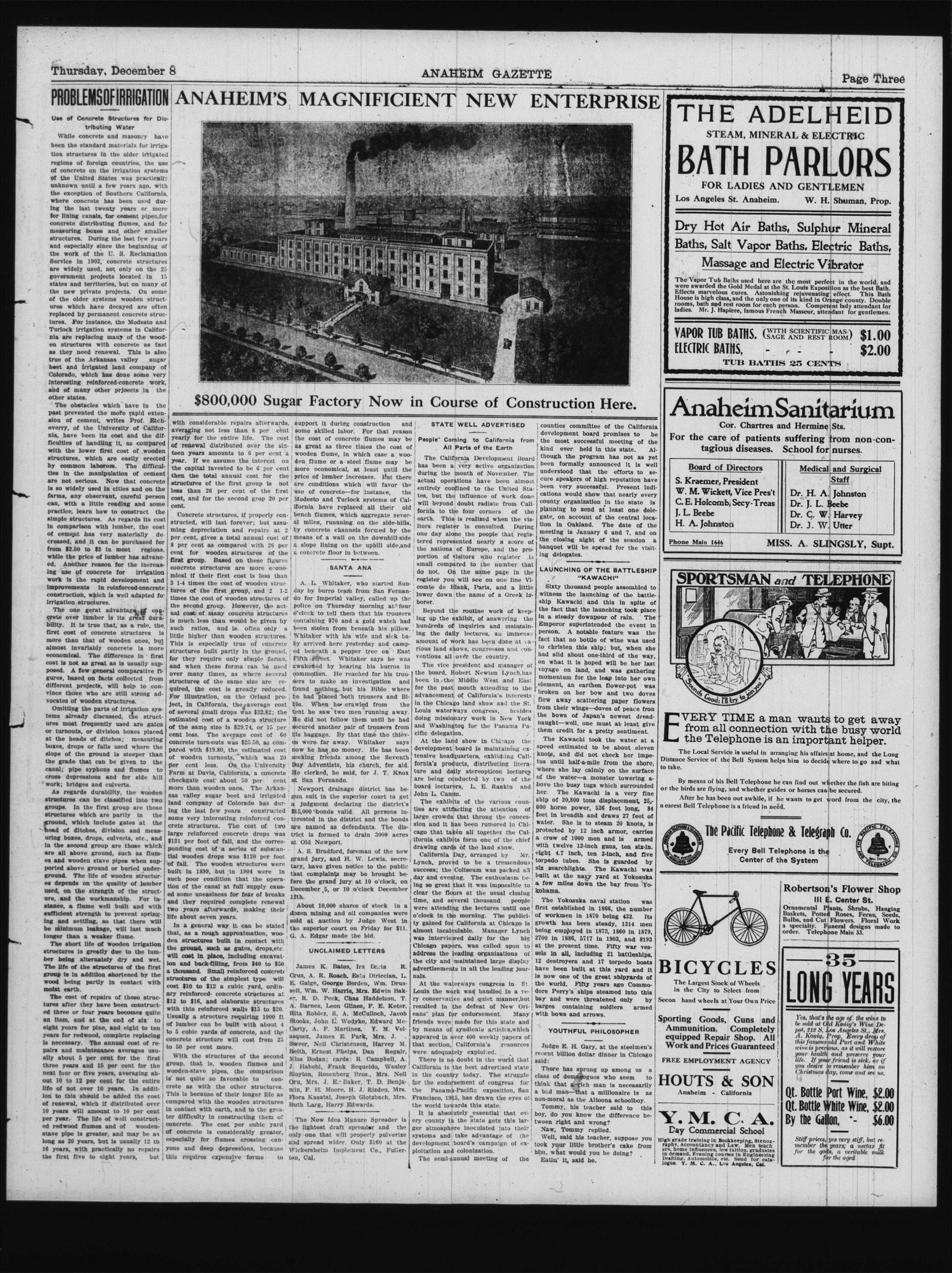
ANAHEIM GAZETTE
S MAGNIFICENT NEW ENTERPRISE
Sugar Factory Now in Course of Construction Here.
STATE WELL ADVERTISED
People Coming to California from All Parts of the Earth
The California Development Board has been a very active organization during the month of November. The counties committee of the California development board promises to be the most successful meeting of the kind ever held in this state. Although the program has not as yet been formally announced it is well understood that the efforts to se-
SUGAR Factory Now in Course of Construction Here.
STATE WELL ADVERTISED
People Coming to California from All Parts of the Earth
The California Development Board has been a very active organization during the month of November. The actual operations have been almost entirely confined to the United States, but the influence of work done will beyond doubt radiate from California to the four corners of the earth. This is realized when the visitors register is consulted. During one day alone the people that registered represented nearly a score of the nations of Europe, and the proportion of visitors who register is small compared to the number that do not. On the same page in the register you will see on one line Vicomte de Blank, Paris, and a little lower down the name of a Greek laborer.
Beyond the routine work of keeping up the exhibit, of answering the hundreds of inquiries and maintaining the daily lectures, an immense amount of work has been done at various land shows, congresses and conventions all over the country.
The vice president and manager of the board, Robert Newton Lynch, has been in the Middle West and East for the past month attending to the advancement of California's interests in the Chicago land show and the St. Louis waterways congress, besides doing missionary work in New York and Washington for the Panama Pacific delegation.
At the land show in Chicago the development board is maintaining extensive headquarters, exhibiting California's products, distributing literature and daily stereopticon lectures are being conducted by two of the board lecturers, L. E. Rankin and John L. Camm.
The exhibits of the various counties are attracting the attention of large crowds that throng the concession and it has been rumored in Chicago that taken all together the California exhibits form one of the chief drawing cards of the land show.
California Day, arranged by Mr. Lynch, proved to be a tremendous success; the Coliseum was packed all day and evening. The enthusiasm being so great that it was impossible to clear the floors at the usual closing time and several thousand people committee of the California development board promises to be the most successful meeting of the kind ever held in this state. Although the program has not as yet been formally announced it is well understood that the efforts to secure speakers of high reputation have been very successful. Present indications would show that nearly every county organization in the state is planning to send at least one delegate, on account of the central location in Oakland. The date of the meeting is January 6 and 7, and on the closing night of the session a banquet will be spread for the visiting delegates.
LAUNCHING OF THE BATTLESHIP "KAWACHI"
Sixty thousand people assembled to witness the launching of the battleship Kawachi and this in spite of the fact that the launching took place in a steady downpour of rain. The Emperor superintended the event in person. A notable feature was the fact that no bottle of wine was used to christen this ship; but, when she had slid about one-third of the way, on what it is hoped will be her last voyage on land, and was gathering momentum for the leap into her own element, an earthen flower-pot was broken on her bow and two doves flew away scattering paper flowers from their wings—doves of peace from the bows of Japan's newest dreadnaught—well, one must at least give them credit for a pretty sentiment.
The Kawachi took the water at a speed estimated to be about eleven knots, and did not check her impetus until half-a-mile from the shore, where she lay calmly on the surface of the water—a monster towering above the busy tugs which surrounded her. The Kawachi is a very fine ship of 20,800 tons displacement, 25,000 horse power, 526 feet long, 84 feet in breadth and draws 27 feet of water. She is to steam 20 knots, is protected by 12 inch armor, carries a crew of 1000 men and is armed with twelve 12-inch guns, ten six-in.eight 4.7 inch, ten 3-inch, and five torpedo tubes. She is guarded by six searchlights. The Kawachi was built at the navy yard at Yokosuka a few miles down the bay from Yokohama.
A. S. Bradford, foreman of the new grand jury, and H. W. Lewis, secretary, have given notice to the public that complaints may be brought before the grand jury at 10 o'clock on December 5, or 10 o'clock December 12th.
About 10,000 shares of stock in a dozen mining and oil companies were sold at auction by Judge West in the superior court on Friday for $11. G. A. Edgar made the bid.
UNCLAIMED LETTERS
James K. Bates, Ira Daria R. Cruz, A. R. Roach, Esta Diriccian, L. E. Galge, George Berden, Wm. Drussell, Wm. W. Harris, Mrs. Edwin Baker, R. D. Peck, Chas Haddelson, T. A. Barnes, Leon Glines, F. E. Keter, Rita Roblez, S. A. McCulloch, Jacob Stooks, John L. Wodyke, Edward McCarty, A. F. Martinez, Y. M. Velasquez, James E. Park, Mrs. J. Sweer, Neil Christensen, Harvey M. Reith, Ernest Phelps, Dan Regair, Miss Bodan; cards: R. Campbell, A. J. Habebi, Frank Sequeido, Wesley Sloyton, Rosenberg Bros., Mrs. Nell Oru, Mrs. J. E. Baker, T. D. Benjamin, F. H. Moore, H. J. Rizden, Mrs. Flora Kasatal, Joseph Glotzbach, Mrs. Ruth Larg, Harry Edwards.
The New Idea Manure Spreader is the lightest draft spreader and the only one that will properly pulverize and spread wider. Only $160 at the Wickersheim Implement Co., Fullerton, Cal.
The exhibits of the various counties are attracting the attention of large crowds that throng the concession and it has been rumored in Chicago that taken all together the California exhibits form one of the chief drawing cards of the land show.
California Day, arranged by Mr. Lynch, proved to be a tremendous success; the Coliseum was packed all day and evening. The enthusiasm being so great that it was impossible to clear the floors at the usual closing time, and several thousand people were attending the lectures until one o'clock in the morning. The publicity gained for California at Chicago is almost incalculable. Manager Lynch was interviewed daily for the big Chicago papers, was called upon to address the leading organizations of the city and maintained large display advertisements in all the leading journals.
At the waterways congress in St. Louis the work was handled in a very conservative and quiet manner, but resulted in the defeat of New Orleans' plan for endorsement. Many friends were made for this state and by means of syndicate articles which appeared in over 400 weekly papers of that section, California's resources were adequately exploited.
There is no doubt in the world that California is the best advertised state in the country today. The struggle for the endorsement of congress for the Panama-Pacific exposition, San Francisco, 1915, has drawn the eyes of the world towards this state.
It is absolutely essential that every county in the state gets this larger atmosphere inoculated into their systems and take advantage of the development board's campaign of exploitation and colonization.
The semi-annual meeting of the ship of 20,800 tons displacement, 25,-000 horse power, 526 feet long, 84 feet in breadth and draws 27 feet of water. She is to steam 20 knots, is protected by 12 inch armor, carries a crew of 1000 men and is armed with twelve 12-inch guns, ten six-in.eight 4.7 inch, ten 3-inch, and five torpedo tubes. She is guarded by six searchlights. The Kawachi was built at the navy yard at Yokosuka a few miles down the bay from Yokohama.
The Yokosuka naval station was first established in 1866, the number of workmen in 1870 being 432. Its growth has been steady, 1314 men being employed in 1873, 1860 in 1879, 2700 in 1886, 5717 in 1903, and 8193 at the present time. Fifty war vessels in all, including 21 battleships, 12 destroyers and 17 torpedo boats have been built at this yard and it is now one of the great shipyards of the world. Fifty years ago Commodore Perry's ships steamed into this bay and were threatened only by barges containing soldiers armed with bows and arrows.
YOUTHFUL PHILOSOPHER
Judge E. H. Gary, at the steelmen's recent billion dollar dinner in Chicago said:
There has sprung up among us a class of demagogues who seem to think that a rich man is necessarily a bad man—that a millionaire is as non-moral as the Altoona schoolboy.
Tommy, his teacher said to this boy, do you know the difference between right and wrong?
Naw, Tommy replied.
Well, said his teacher, suppose you took your little brother's cake from him what would you be doing?
Eatin' it, said he.
THE ADELHEID
STEAM, MINERAL & ELECTRIC
BATH PARLORS
FOR LADIES AND GENTLEMEN
Los Angeles St. Anaheim. W. H. Shuman, Prop.
Dry Hot Air Baths, Sulphur Mineral
Baths, Salt Vapor Baths, Electric Baths,
Massage and Electric Vibrator
The Vapor Tub Baths used here are the most perfect in the world, and were awarded the Gold Medal at the St. Louis Exposition as the best Bath. Effects marvelous cures. Astonishing rejuvenating effect. This Bath House is high class, and the only one of its kind in Orange county. Double rooms, bath and rest room for each person. Competent lady attendant for ladies. Mr. J. Hapiere, famous French Masseur, attendant for gentlemen.
VAPOR TUB BATHS. (WITH SCIENTIFIC MASSEUR AND REST ROOM) $1.00
ELECTRIC BATHS, - - - $2.00
TUB BATHS 25 CENTS
AnaheimSanitarium
Cor. Chartres and Hermine Sts.
For the care of patients suffering from non-contagious diseases. School for nurses.
Board of Directors
Medical and Surgical
Anaheim Sanitarium
Cor. Chartres and Hermine Sts.
For the care of patients suffering from non-contagious diseases. School for nurses.
Board of Directors
S. Kraemer, President
W. M. Wickett, Vice Pres't
C. E. Holcomb, Secy-Treas
J. L. Beebe
H. A. Johnston
Medical and Surgical Staff
Dr. H. A. Johnston
Dr. J. L. Beebe
Dr. C. W. Harvey
Dr. J. W. Utter
Phone Main 1646
MISS. A. SLINGSLY, Supt.
SPORTSMAN and TELEPHONE
EVERY TIME a man wants to get away from all connection with the busy world the Telephone is an important helper.
The Local Service is useful in arranging his affairs at home, and the Long Distance Service of the Bell System helps him to decide where to go and what to take.
By means of bis Bell Telephone he can find out whether the fish are biting or the birds are flying, and whether guides or horses can be secured.
After he has been out awhile, if he wants to get word from the city, the nearest Bell Telephone is a friend in need.
The Pacific Telephone & Telegraph Co.
Every Bell Telephone is the Center of the System
Robertson's Flower Shop
The Pacific Telephone & Telegraph Co.
Every Bell Telephone is the Center of the System
BICYCLES
The Largest Stock of Wheels in the City to Select from
Secon hand wheels at Your Own Price
Sporting Goods, Guns and Ammunition. Completely equipped Repair Shop. All Work and Prices Guaranteed
FREE EMPLOYMENT AGENCY
HOUTS & SON
Anaheim - California
Y. M. C. A.
Day Commercial School
High grade training in Bookkeeping, Stenography, Accountancy and Law. Men teachers, home influences, low tuition, graduates in demand. Evening courses in Engineering Drafting, Automobile, etc. Send for catalogue.
Robertson's Flower Shop
III E. Center St.
Ornamental Plants, Shrubs, Hanging Baskets, Potted Roses, Ferns, Seeds, Bulbs, and Cut Flowers. Floral Work a specialty. Funeral designs made to order. Telephone Main 33.
35 LONG YEARS
Yes, that's the age of the wine to be sold at Old Konig's Wine Depot, 212 S. Los Angeles St., Mrs. A. Konig, Prop. Every drop of this famous old Port and White wine is precious, as it will restore your health and preserve your life. If your friend is sick, or if you desire to remember him on Christmas day, come and see us.
Qt. Bottle Port Wine, $2.00
Qt. Bottle White Wine, $2.00
By the Gallon, *-$6.00
Stiff prices, yes very stiff, but remember the years; a nectar fit for the gods, a veritable milk for the aged