anaheim-gazette 1910-11-03
Scanned page
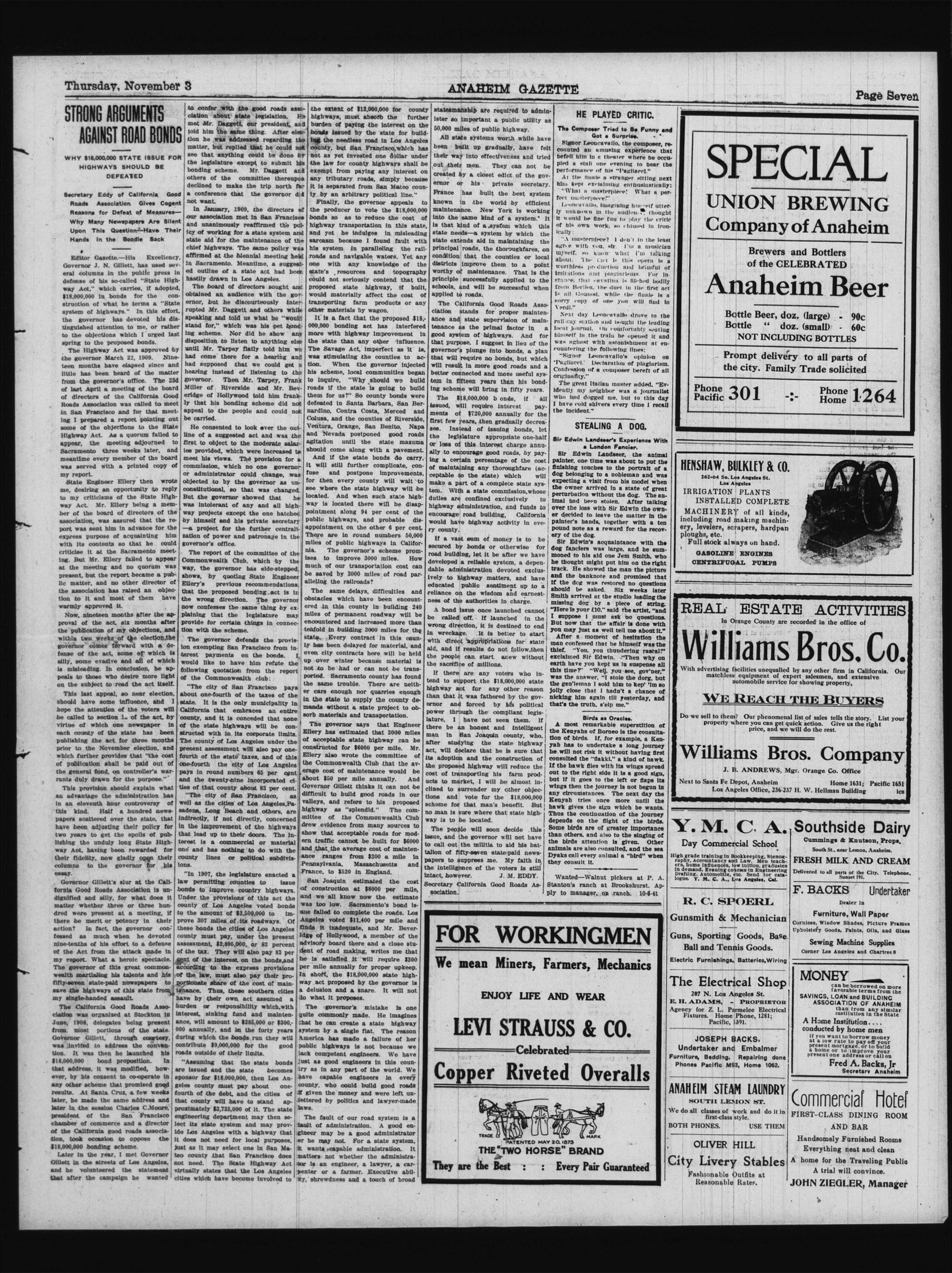
Searchable text
STRONG ARGUMENTS AGAINST ROAD BONDS
WHY $18,000,000 STATE ISSUE FOR HIGHWAYS SHOULD BE DEFEATED
Secretary Eddy of California Good Roads Association Gives Cogent Reasons for Defeat of Measures—Why Many Newspapers Are Silent Upon This Question—Have Their Hands in the Boodle Sack
Editor Gazette.—His Excellency, Governor J. N. Gillett, has used several columns in the public press in defense of his so-called "State Highway Act," which carries, if adopted, $18,000,000 in bonds for the construction of what he terms a "State system of highways." In this effort, the governor has devoted his distinguished attention to me, or rather to the objections which I urged last spring to the proposed bonds.
The Highway Act was approved by the governor March 22, 1909. Nineteen months have elapsed since and little has been heard of the matter from the governor's office. The 23d of last April a meeting of the board of directors of the California Good Roads Association was called to meet in San Francisco and for that meeting I prepared a report pointing out some of the objections to the State Highway Act. As a quorum failed to appear, the meeting adjourned to Sacramento three weeks later, and meantime every member of the board was served with a printed copy of my report.
to confer with the good roads association about state legislation. He met Mr. Daggett, our president, and told him the same thing. After election he was addressed regarding the matter, but replied that he could not see that anything could be done by the legislature except to submit his bonding scheme. Mr. Daggett and others of the committee thereupon declined to make the trip north for a conference that the governor did not want.
In January, 1909, the directors of our association met in San Francisco and unanimously reaffirmed the policy of working for a state system and state aid for the maintenance of the chief highways. The same policy was affirmed at the biennial meeting held in Sacramento. Meantime, a suggested outline of a state act had been hastily drawn in Los Angeles.
The board of directors sought and obtained an audience with the governor, but he discourteously interrupted Mr. Daggett and others while speaking and told us what he "would stand for," which was his pet bonding scheme. Nor did he show any disposition to listen to anything else until Mr. Tarpey flatly told him we had come there for a hearing and had supposed that we could get a hearing instead of listening to the governor. Then Mr. Tarpey, Frank Miller of Riverside and Mr. Beveridge of Hollywood told him frankly that his bonding scheme did not appeal to the people and could not be carried.
He consented to look over the outline of a suggested act and was the first to object to the moderate salaries provided, which were increased to meet his views. The provision for a commission, which no one governor or administrator could change was the extent of the highways, must burden of payment bonds issued by the needle county, but not as yet invoked by law for coexempt from any tributary it is separated by an arbitration by an arbitrator.
Finally, the producer took bonds so as to highway transport and yet he in sarcasm because his system in roads and naval one with an state's resource could not seriose proposed state would materially transporting for other materials.
It is a fact that 000,000 bonding more with higher than The Savage Act was stimulating tion. When his scheme, looked to inquire, "Wroads if the strom them for us?" defeated in San Bernardino, Contra Colusa, and the Ventura, Orange and Nevada post agitation until should come aloud.
And if the state will still furnish fuse and pos
State Engineer Ellery then wrote me, desiring an opportunity to reply to my criticisms of the State Highway Act. Mr. Ellery being a member of the board of directors of the association, was assured that the report was sent him in advance for the express purpose of acquainting him with its contents so that he could criticise it at the Sacramento meeting. But Mr. Ellery failed to appear at the meeting and no quorum was present, but the report became a public matter, and no other director of the association has raised an objection to it and most of them have warmly approved it.
Now, nineteen months after the approval of the act, six months after the publication of my objections, and within two weeks of the election, the governor comes forward with a defense of the act, some of which is silly, some evasive and all of which is misleading. In conclusion, he appeals to those who desire more light on the subject to read the act itself.
This last appeal, so near election, should have some influence, and I hope the attention of the voters will be called to section 1.0 of the act, by virtue of which one newspaper in each county of the state has been publishing the act for three months prior to the November election, and which further provides that "the cost of publication shall be paid out of the general fund, on controller's warrants duly drawn for the purpose."
This provision should explain what an advantage the administration has in an eleventh hour controversy of this kind. Half a hundred newspapers scattered over the state, that have been adjusting their policy for two years to get the spoils of publishing the unduly long State Highway Act, having been rewarded for their fidelity, now gladly open their columns to the governor for his essay.
Governor Gillett's slur at the California Good Roads Association is undignified and silly, for what does it
Then Mr. Tarpey, Frank Miller of Riverside and Mr. Beveridge of Hollywood told him frankly that his bonding scheme did not appeal to the people and could not be carried.
He consented to look over the outline of a suggested act and was the first to object to the moderate salaries provided, which were increased to meet his views. The provision for a commission, which no one governor or administrator could change, was objected to by the governor as unconstitutional, so that was changed. But the governor showed that he was intolerant of any and all highway projects except the one hatched by himself and his private secretary—a project for the further centralization of power and patronage in the governor's office.
The report of the committee of the Commonwealth Club, which by way, the governor has side-stepped, shows, by quoting State Engineer Ellery's previous recommendations, that the proposed bonding act is in the wrong direction. The governor now confesses the same thing by explaining that the legislature may provide for certain things in connection with the scheme.
The governor defends the provision exempting San Francisco from interest payments on the bonds. I would like to have him refute the following quotation from the report of the Commonwealth club:
"The city of San Francisco pays about one-fourth of the taxes of the state. It is the only municipality in California that embraces an entire county, and it is conceded that none of the state highways will be constructed with its corporate limits. The county of Los Angeles under the present assessment will also pay one-fourth of the state taxes, and of this one-fourth the city of Los Angeles pays in round numbers 65 per cent and the twenty-nine incorporated cities of that county about 83 per cent.
"The city of San Francisco, as well as the cities of Los Angeles, Pasadena, Long Beach and others, are indirectly, if not directly, concerned in the improvement of the highways that lead up to their doors. The interest is a commercial or material one and has nothing to do with the county lines or political subdivisions.
"In 1907, the legislature enacted a law permitting counties to issue bonds to improve country highways. Under the provisions of this act the governor will not allow such bonds to be issued."
And if she still fails to fuse and pose for them every day see where she located. And way is located on pointment along public highways appointment on there are in many miles of public ncia. The governises to improvem much of our trafic be saved by 300 alleling the railroad.
The same obstacles which erased in this county encountered and tenfold in building state. Every county has been delayed even city contract not to be had or ported. Sacramento the same trouble cars enough in the state to s mands without any sorb materials are.
The governor Ellery has estimated acceptable states constructed for Ellery also wrote the Commonwealth age cost of ma about $50 per m Governor Gillett difficult to build valleys, and refer highway as "spirituate" committee of the drew evidence from show that acceptern traffic cannot and that the average ranges from Pennsylvania, M France, to $520 San Joaquin eof construction and we all know
in an eleventh hour controversy of this kind. Half a hundred newspapers scattered over the state, that have been adjusting their policy for two years to get the spoils of publishing the unduly long State Highway Act, having been rewarded for their fidelity, now gladly open their columns to the governor for his essay.
Governor Gillett's slur at the California Good Roads Association is undignified and silly, for what does it matter whether three or three hundred were present at a meeting, if there be merit or potency in their action? In fact, the governor confessed as much when he devoted nine-tenths of his effort to a defense of the Act from the attack made in my report. What a heroic spectacle. The governor of this great commonwealth martialing his talents and his fifty-seven state-paid newspapers to save the highways of this state from my single-handed assault.
The California Good Roads Association was organized at Stockton in June, 1908, delegates being present from most portions of the state. Governor Gillett, through courtesy, was invited to address the convention. It was then he launched his $18,000,000 bond proposition. In that address, it was modified, however, by his consent to co-operate in any other scheme that promised good results. At Santa Cruz, a few weeks later, he made the same address and later in the session Charles C.Moore, president of the San Francisco chamber of commerce and a director of the California good roads association, took occasion to oppose the $18,000,000 bonding scheme.
Later in the year, I met Governor Gillett in the streets of Los Angeles, and he volunteered the statement that after the campaign he wanted well as the cities of Los Angeles, Pasadena, Long Beach and others, are indirectly, if not directly, concerned in the improvement of the highways that lead up to their doors. The interest is a commercial or material one and has nothing to do with the county lines or political subdivisions.
"In 1907, the legislature enacted a law permitting counties to issue bonds to improve country highways. Under the provisions of this act the county of Los Angeles voted bonds to the amount of $3,500,000 to improve 307 miles of its roadways. Of these bonds the cities of Los Angeles county must pay, under the present assessment, $2,895,000, or 83 percent of the tax. They will also pay 83 per cent of the interest on the bonds,and according to the express provisions of the law, must also pay their proportionate share of the cost of maintenance. Thus, these southern cities have by their own act assumed a burden or responsibility which,with interest, sinking fund and maintenance, will amount to $285,000 or $300,000 annually,and in the forty years during which the bonds run they will contribute $9,000,000 for the good roads outside of their limits.
"Assuming that the state bonds are issued and the state becomes sponsor for $18,000,000,then Los Angeles county must pay about one-fourth of the debt,and the cities of that county will have to stand approximately $3,735,000 of it.The state engineering department may then select its state system and may provide Los Angeles with a highway that it does not need for local purposes, just as it may select one in San Mateo county that San Francisco does not need. The State Highway Act virtually states that the Los Angeles cities which have become involved to
ANAHEIM GAZETTE
the extent of $12,000,000 for county highways, must absorb the further burden of paying the interest on the bonds issued by the state for building the needless road in Los Angeles county, but San Francisco, which has not as yet invested one dollar under the law for county highways shall be exempt from paying any interest on any tributary roads, simply because it is separated from San Mateo county by an arbitrary political line."
Finally, the governor appeals to the producer to vote the $18,000,000 bonds so as to reduce the cost of highway transportation in this state, and yet he indulges in misleading sarcasm because I found fault with his system in paralleling the railroads and navigable waters. Yet any one with any knowledge of the state's resources and topography could not seriously contend that the proposed state highway, if built, would materially affect the cost of transporting farm products or any other materials by wagon.
It is a fact that the proposed $18,000,000 bonding act has interfered more with highway improvement in the state than any other influence. The Savage Act, imperfect as it is, was stimulating the counties to action. When the governor injected his scheme, local communities began to inquire, "Why should we build roads if the state is going to build them for us?" So county bonds were defeated in Santa Barbara, San Bernardino, Contra Costa, Merced and Colusa, and the counties of Riverside, Ventura, Orange, San Benito, Napa and Nevada postponed good roads agitation until the state mazuma should come along with a pavement.
And if the state bonds do carry, it will still further complicate confuse and postpone improvements.
statesmanship are required to administer so important a public utility as 50,000 miles of public highway.
All state systems worth while have been built up gradually, have felt their way into effectiveness and tried out their men. They can not be created by a closet edict of the governor or his private secretary. France has built the best system known in the world by efficient maintenance. New York is working into the same kind of a system." It is that kind of a system which this state needs—a system by which the state extends aid in maintaining the principal roads, the thoroughfares, on condition that the counties or local districts improve them to a point worthy of maintenance. That is the principle successfully applied to the schools, and will be successful when applied to roads.
The California Good Roads Association stands for proper maintenance and state supervision of maintenance as the primal factor in a good system of highways. And for that purpose, I suggest in lieu of the governor's plunge into bonds, a plan that will require no bonds, but which will result in more good roads and a better connected and more useful system in fifteen years than his bonding scheme will bring in fifty years.
The $18,000,000 bonds, if all issued, will require interest payments of $720,000 annually for the first few years, then gradually decreases. Instead of issuing bonds, let the legislature appropriate one-half or less of this interest charge annually to encourage good roads, by paying a certain percentage of the cost of maintaining any thoroughfare (acceptable to the state) which will
HE PLAYED CRITIC.
The Composer Tried to Be Funny and Got a Surprise.
Signor Leoncavallo, the composer, recounted an amusing experience that befell him in a theater where he occupied a stall one evening to hear the performance of his "Lagliaccel."
At the house a stranger sitting next him kept exclaiming enthusiastically:
"What a masterpiece! What a perfect masterpiece!"
Leoncavallo imagining himself utterly unknown in the audience thought it would be fine fun to play the critic of his own work, so chilled in ironically:
"A masterpiece? I don't in the least agree with you, sir. I'm a musician myself, so know what I'm talking about. The fact is this opera is a worthless production and brimful of limitations and plagiarisms. For instance, that cavatina is filched bodily from Berlioz; the duet in the first act is all Guarnod; while the finale is a sorry copy of one you will find in Verdi."
Next day Leoncavallo drove to the railway station and bought the leading local journal. On comfortably seating himself in the train he opened it and was against with astonishment at encountering the following lines:
"Signor Leoncavallo's opinion on 'Lagliaccel: Declaration of plagiarism. Confession of a composer bereft of all originality."
The great Italian master added, "Evidently my neighbor was a journalist who had dogged me, but to this day I have cold shivers every time I recall the incident."
STEALING A DOG.
Sir Edwin Landseer's Experience With a London Fancier.
Sir Edwin Landseer, the animal painter, one time was about to put the finishing touches to the portrait of a dog belonging to a nobleman and was
The governor says that Engineer Ellery has estimated that 3000 miles of acceptable state highway can be constructed for $6000 per mile. Mr. Ellery also wrote the committee of the Commonwealth Club that the average cost of maintenance would be about $50 per mile annually. And Governor Gillett thinks it can not be difficult to build good roads in our valleys, and refers to his proposed highway as "splendid." The committee of the Commonwealth Club drew evidence from many sources to show that acceptable roads for modern traffic cannot be built for $6000 and that the average cost of maintenance ranges from $300 a mile in Pennsylvania, Massachusetts and France, to $520 in England.
San Joaquin estimated the cost of construction at $8000 per mile, and we all know now the estimate better connected and more useful system in fifteen years than his bonding scheme will bring in fifty years.
The $18,000,000 bonds, if issued, will require interest payments of $720,000 annually for the first few years, then gradually decreases. Instead of issuing bonds, let the legislature appropriate one-half or less of this interest charge annually to encourage good roads, by paying a certain percentage of the cost of maintaining any thoroughfare (acceptable to the state) which will make a part of a complete state system. With a state commission, whose duties are confined exclusively to highway administration, and funds to encourage road building, California would have highway activity in every county.
If a vast sum of money is to be secured by bonds or otherwise for road building, let it be after we have developed a reliable system, a dependable administration devoted exclusively to highway matters, and have educated public sentiment up to a reliance on the wisdom and earnestness of the authorities in charge.
A bond issue once launched cannot be called off. If launched in the wrong direction, it is destined to end in wreckage. It is better to start with direct appropriations for state aid, and if results do not follow, then the people can start anew without the sacrifice of millions.
If there are any voters who intend to support the $18,000,000 state highway act for any other reason than that it was fathered by the governor and forced by his political power through the compliant legislature, I have not seen them. If there be an honest and intelligent man in San Joaquin county, who after studying the state highway act, will declare that he is sure that its adoption and the construction of the proposed highway will reduce the cost of transporting his farm products to market. I will be almost inclined to surrender my other objections and vote for the $18,000,000 scheme for that man's benefit. But no man is sure where that state highway is to be located.
The people will soon decide this issue, and the governor will not have to call out the militia to aid his battalion of fifty-seven state-paid newspapers to suppress me. My faith in the intelligence of the voters is still intact, however.
J. M. EDDY.
Secretary California Good Roads Association.
STEALING A DOG.
Sir Edwin Landseer's Experience With a London Fancier.
Sir Edwin Landseer, the animal painter, one time was about to put the finishing touches to the portrait of a dog belonging to a nobleman and was expecting a visit from his model when the owner arrived in a state of great perturbation without the dog. The animal had been stolen. After talking over the loss with Sir Edwin the owner decided to leave the matter in the painter's hands, together with a ten pound note as a reward for the recovery of the dog.
Sir Edwin's acquaintance with the dog fanciers was large, and he summoned to his aid one Jem Smith, who he thought might put him on the right track. He showed the man the picture and the banknote and promised that if the dog was restored no questions should be asked. Six weeks later Smith arrived at the studio leading the missing dog by a piece of string. "Here is your £10," said the artist, "and I suppose I must ask no questions. But now that the affair is done with you may just as well tell me about it."
After a moment of hesitation the man confessed that he himself was the thief. "You, you thundering rascall!" exclaimed Sir Edwin. "Then why on earth have you kept us in suspense all this time?" "Well, you see, gov'ner," was the answer. "I stole the dorg, but the gen'leman I sold him to kep 'im so jolly close that I hadn't a chance of nicking him again till yesterday, and that's the truth, s'elp me."
Birds as Oricles.
A most remarkable superstition of the Kenyabs of Borneo is the consultation of birds. If, for example, a Kenyah has to undertake a long journey he will not risk it without having first consulted the "fakki," a kind of hawk. If the hawk files with its wings spread out to the right side it is a good sign, but if it goes to the left or flaps its wings then the journey is not begun in any circumstances. The next day the Kenyah tries once more until the hawk gives the sign which be wants. Thus the continuation of the journey depends on the flight of the birds. Some birds are of greater importance than others, and also to the singing of the birds attention is given. Other animals are also consulted, and the sea Dyaks call every animal a "bird" when they consult it.
Wanted—Walnut pickers at P. A. Stanton's ranch at Brookshurst. Apply to manager, on ranch. 10-6-4t
FOR WORKINGMEN
We mean Miners, Farmers, Mechanics
ENJOY LIFE AND WEAR
LEVI STRAUSS & CO.
Celebrated
Copper Riveted Overalls
THE "TWO HORSE" BRAND
They are the Best : Every Pair Guaranteed
SPECIAL
UNION BREWING
Company of Anaheim
Brewers and Bottlers
of the CELEBRATED
Anaheim Beer
Bottle Beer, doz. (large) - 90c
Bottle “doz. (small) - 60c
NOT INCLUDING BOTTLES
Prompt delivery to all parts of
the city. Family Trade solicited
Phone Pacific 301 - Phone Home 1264
HENSHAW, BULKLEY & CO.
Phone 301 - Phone 1264
Pacific
HENSHAW, BULKLEY & CO.
262-64 So. Los Angeles St.
Los Angeles
IRRIGATION PLANTS
INSTALLED COMPLETE
MACHINERY of all kinds,
including road making machinery,
levelers, scrapers, hardpan ploughs, etc.
Full stock always on hand.
GASOLINE ENGINES
CENTRIFUGAL PUMPS
REAL ESTATE ACTIVITIES
In Orange County are recorded in the office of
Williams Bros. Co.
With advertising facilities unequalled by any other firm in California. Our matchless equipment of expert salesmen, and extensive automobile service for showing property,
WE REACH THE BUYERS
Do we sell to them? Our phenomenal list of sales tells the story. List your property where you can get quick action. Give us the right price, and we will do the rest.
Williams Bros. Company
J. B. ANDREWS, Mgr. Orange Co. Office
Next to Santa Fe Depot, Anaheim Home 1631; Pacific 1651
Los Angeles Office, 236-237 H. W. Hellman Building icz
Y. M. C. A. Southside Dairy
Day Commercial School
High grade training in Bookkeeping, Stenography, Accountancy and Law. Men teachers, home influences, low tuition, graduates in demand. Evening courses in Engineering Drafting, Automobile, etc. Send for catalogue. Y. M. C. A., Los Angeles, Cal.
Cummings & Knutson, Props.
South St., near Lemon, Anaheim.
FRESH MILK AND CREAM
Delivered to all parts of the City. Telephone, Sunset 191.
F. BACKS Undertaker
Y.M.C.A. Day Commercial School
High grade training in Bookkeeping, Stenography, Accountancy and Law. Men teachers, home influences, low tuition, graduates in demand. Evening courses in Engineering Drafting, Automobile, etc. Send for catalogue. Y.M.C.A., Los Angeles, Cal.
R. C. SPOERL
Gunsmith & Mechanician
Guns, Sporting Goods, Base Ball and Tennis Goods.
Electric Furnishings, Batteries, Wiring
The Electrical Shop
207 N. Los Angeles St.
E. H. ADAMS, - PROPRIETOR
Agency for Z. L. Parmelee Electrical Fixtures. Home Phone, 1281; Pacific, 1391.
JOSEPH BACKS,
Undertaker and Embalmer
Furniture, Bedding. Repairing done
Phones Pacific M93, Home 1062.
ANAHEIM STEAM LAUNDRY
SOUTH LEMON ST.
We do all classes of work and do it in first-class style.
BOTH PHONES. USE THEM
OLIVER HILL
City Livery Stables
Fashionable Outfits at Reasonable Rates.
Southside Dairy
Cummings & Knutson, Props.
South St., near Lemon, Anaheim.
FRESH MILK AND CREAM
Delivered to all parts of the City. Telephone, Sunset 191.
F. BACKS Undertaker
Dealer in
Furniture, Wall Paper
Cornices, Window Shades, Picture Frames
Upholstery Goods, Palms, Oils, and Glass
Sewing Machine Supplies
Corner Los Angeles and Chartres 8
MONEY
can be borrowed on more favorable terms from the SAVINGS, LOAN and BUILDING ASSOCIATION OF ANAHEIM than from any similar institution in the State
A Home Institution... conducted by home men
If you want to borrow money at a low rate to pay off your present mortgage, or to build a home or to improve your present one address or call on Fred A. Backs, Jr.
Secretary Anaheim
Commercial Hotel
FIRST-CLASS DINING ROOM AND BAR
Handsomely Furnished Rooms Everything neat and clean
A home for the Traveling Public
A trial will convince.
JOHN ZIEGLER, Manager