anaheim-gazette 1910-11-03
Scanned page
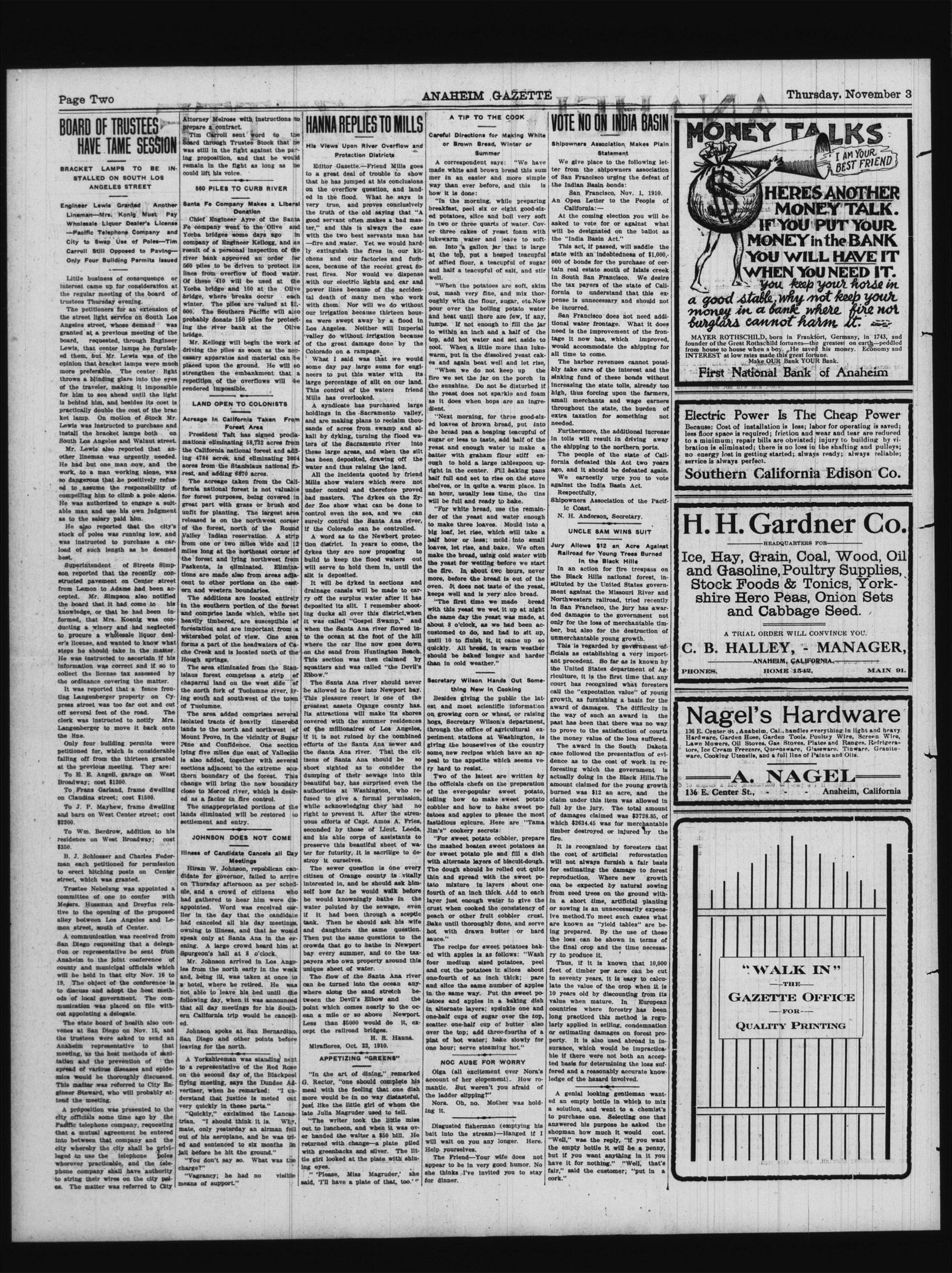
Searchable text
BOARD OF TRUSTEES HAVE TAME SESSION
BRACKET LAMPS TO BE INSTALLED ON SOUTH LOS ANGELES STREET
Engineer Lewis Granted Another Lineman—Mrs. Konig Must Pay Wholesale Liquor Dealer's License—Pacific Telephone Company and City to Swap Use of Poles—Tim Carroll Still Opposed to Paving—Only Four Building Permits Issued
Little business of consequence or interest came up for consideration at the regular meeting of the board of trustees Thursday evening.
The petitioners for an extension of the street light service on South Los Angeles street, whose demand was granted at a previous meeting of the board, requested, through Engineer Lewis, that center lamps be furnished them, but Mr. Lewis was of the opinion that bracket lamps were much more preferable. The center light throws a blinding glare into the eyes of the traveler, making it impossible for him to see ahead until the light is behind him, and besides its cost is practically double the cost of the bracket lamp. On motion of Stock Mr. Lewis was instructed to purchase and install the bracket lamps both on South Los Angeles and Walnut street.
Mr. Lewis also reported that another lineman was urgently needed. He had but one man now, and the work, to a man working alone, was Attorney Melrose with instructions to prepare a contract.
Tim Carroll sent word to the board through Trustee Stock that he was still in the fight against the parking proposition, and that he would remain in the fight as long as he could lift his voice.
560 PILES TO CURB RIVER
Santa Fe Company Makes a Liberal Donation
Chief Engineer Ayre of the Santa Fe company went to the Olive and Yorba bridges some days ago in company of Engineer Kellogg, and as result of a personal inspection of the river bank approved an order for 560 piles to be driven to protect its lines from overflow of flood water. Of these 410 will be used at the Yorba bridge and 150 at the Olive bridge, where breaks occur each winter. The piles are valued at $2,000. The Southern Pacific will also probably donate 150 piles for protecting the river bank at the Olive bridge.
Mr. Kellogg will begin the work of driving the piles as soon as the necessary apparatus and material can be placed upon the ground. He will so strengthen the embankment that a repetition of the overflows will be rendered impossible.
LAND OPEN TO COLONISTS
Acreage In California Taken From Forest Area
President Taft has signed proclamations eliminating 58,732 acres from the California national forest and adding 4784 acres, and eliminating 3084 acres from the Stanislaus national forest and adding 6870 acres.
HANNA REPEAT
His Views Upon Protection
Editor Gazette to a great deal that he has jumped on the overflow in the flood very true, and the truth of the good servant officer," and this with the two boats—fire and waterly extinguish the chens and our aces, because of rest fires. Nor with our electric power lines because total death of men with them. Now our irrigation beds were swept by Los Angeles. Valley do without of the great d Colorado on a m What I said some day pay me neers to put the large percentage This control of Mills has overlaid A syndicate holdings in the and are making sands of acres kall by dyking, ters of the Sac these large areas has been deposi water and thus All the incide
throws a blinding glare into the eyes of the traveler, making it impossible for him to see ahead until the light is behind him, and besides its cost is practically double the cost of the bracet lamp. On motion of Stock Mr. Lewis was instructed to purchase and install the bracket lamps both on South Los Angeles and Walnut street.
Mr. Lewis also reported that another lineman was urgently needed. He had but one man now, and the work, to a man working alone, was so dangerous that he positively refused to assume the responsibility of compelling him to climb a pole alone. He was authorized to engage a suitable man and use his own judgment as to the salary paid him.
He also reported that the city's stock of poles was running low, and was instructed to purchase a carload of such length as he deemed best.
Superintendent of Streets Simpson reported that the recently constructed pavement on Center street from Lemon to Adams had been accepted. Mr. Simpson also notified the board that it had come to his knowledge, or that he had been informed, that Mrs. Koenig was conducting a winery and had neglected to procure a wholesale liquor dealer’s license, and wanted to know what steps he should take in the matter. He was instructed to ascertain if his information was correct and if so to collect the license tax assessed by the ordinance covering the matter.
It was reported that a fence fronting Langenberger property on Cypress street was too far out and cut off several feet of the road. The clerk was instructed to notify Mrs. Langenberger to move it back onto the line.
Only four building permits were petitioned for, which is considerable falling off from the thirteen granted at the previous meeting. They are:
To E. E. Angell, garage on West Broadway; cost $1200.
To Franz Garland, frame dwelling on Claudina street; cost $1500.
To J. P. Mayhew, frame dwelling and barn on West Center street; cost $2200.
To Wm. Berdrow, addition to his residence on West Broadway; cost $350.
B. J. Schlosser and Charles Federman each petitioned for permission to erect hitching posts on Center street, which was granted.
Trustee Nebelung was appointed a committee of one to confer with strengthen the embankment that a repetition of the overflows will be rendered impossible.
LAND OPEN TO COLONISTS
Acreage In California Taken From Forest Area
President Taft has signed proclamations eliminating 58,732 acres from the California national forest and adding 4784 acres, and eliminating 3094 acres from the Stanislaus national forest, and adding 6870 acres.
The acreage taken from the California national forest is not valuable for forest purposes, being covered in great part with grass or brush and unfit for planting. The largest area released is on the northwest corner of the forest, north of the Round Valley Indian reservation. A strip from one or two miles wide and 12 miles long at the northeast corner of the forest and lying northwest from Paskenta, is eliminated. Eliminations are made also from areas adjacent to other portions on the eastern and western boundaries.
The additions are located entirely in the southern portion of the forest and comprise lands which, while not heavily timbered, are susceptible of forestation and are important from a watershed point of view. One area forms a part of the headwaters of Cache Creek and is located north of the Hough springs.
The area eliminated from the Stanislaus forest comprises a strip of chaparral land on the west side of the north fork of Tuolumne river, lying south and southwest of the town of Tuolumne.
The area added comprises several isolated tracts of heavily timbered lands to the north and northwest of Mount Provo, in the vicinity of Sugar Pine and Confidence. One section lying five miles due east of Vallecchio is also added, together with several sections adjacent to the extreme southern boundary of the forest. This change will bring the new boundary close to Merced river, which is desired as a factor in fire control.
The unappropriated portions of the lands eliminated will be restored to settlement and entry.
JOHNSON DOES NOT COME
Illness of Candidate Cancels all Day Meetings
Hiram W. Johnson, republican candidate for governor, failed to arrive on Thursday afternoon as per schedule, and a crowd of citizens who had gathered to hear him were disarmed.
A syndicate holdsings in the city and are making sands of acres kall by dyking, waters of the Sacramento large areas have been deposited water and thus All the incipient Mills show water under control and bad masters. The der Zee show water control even surely control it if the Colorado A word as to station district. In dykes they are build to keep this will serve to hold silt is deposited It will be dyml drainage canals ry off the surplus deposited its slit ing ducks all over it was called "O when the Santa Ana citizens of Santa Barbara short sighted dumping of these beautiful bay, ha authorities at fused to give while acknowledged right to preventuous efforts of seconded by those and his able co preserve this be ter for futurity, stroy it ourselves The sewer quic citizen of Orange interested in, and self how far he would know
To J. P. Mayhew, frame dwelling and barn on West Center street; cost $2200.
To Wm. Berdrow, addition to his residence on West Broadway; cost $350.
B. J. Schlosser and Charles Federman each petitioned for permission to erect hitching posts on Center street, which was granted.
Trustee Nebelung was appointed a committee of one to confer with Meters. Hussman and Dreyfus relative to the opening of the proposed alley between Los Angeles and Lemon street, south of Center.
A communication was received from San Diego requesting that a delegation or representative be sent from Anaheim to the joint conference of county and municipal officials which will be held in that city Nov. 16 to 19. The object of the conference is to discuss and adopt the best methods of local government. The communication was placed on file without appointing a delegate.
The state board of health also convenes at San Diego on Nov. 15, and the trustees were asked to send an Anaheim representative to that meeting, as the best methods of sanitation and the prevention of the spread of various diseases and epidemics would be thoroughly discussed. This matter was referred to City Engineer Steward, who will probably attend the meeting.
A proposition was presented to the city officials some time ago by the Pacific telephone company, requesting that a mutual agreement be entered into between that company and the city whereby the city shall be privileged to use the telephone poles wherever practicable, and the telephone company shall have authority to string their wires on the city poles. The matter was referred to City
JOHNSON DOES NOT COME
Illness of Candidate Cancels all Day Meetings
Hiram W. Johnson, republican candidate for governor, failed to arrive on Thursday afternoon as per schedule, and a crowd of citizens who had gathered to hear him were disappointed. Word was received earlier in the day that the candidate had canceled all his day meetings, owning to illness, and that he would speak only at Santa Ana in the evening. A large crowd heard him at Spurgeon's hall at 8 o'clock.
Mr. Johnson arrived in Los Angeles from the north early in the week and, being ill, was taken at once to a hotel, where he retired. He was not able to leave his bed until the following day, when it was announced that all day meetings for his Southern California trip would be cancelled.
Johnson spoke at San Bernardino, San Diego and other points before leaving for the north.
A Yorkshireman was standing next to a representative of the Red Rose on the second day of the Blackpool flying meeting, says the Dundee Advertiser, when he remarked: "I understand that justice is meted out very quickly in these parts."
"Quickly," exclaimed the Lancastrian. "I should think it is. Why mate, only yesterday an airman fell out of his aeroplane, and he was tried and sentenced to six months in jail before he hit the ground."
"You don't say so. What was the charge?"
"Vagrancy; he had no visible means of support."
ANAHEIM GAZETTE
HANNA REPLIES TO MILLS
His Views Upon River Overflow and Protection Districts
Editor Gazette.—Friend Mills goes to a great deal of trouble to show that he has jumped at his conclusions on the overflow question, and landed in the flood. What he says is very true, and proves conclusively the truth of the old saying that "A good servant often makes a bad master," and this is always the case with the two best servants man has—fire and water. Yet we would hardly extinguish the fires in our kitchens and our factories and furnaces, because of the recent great forest fires. Nor would we dispense with our electric lights and car and power lines because of the accidental death of many men who work with them. Nor will we do without our irrigation because thirteen houses were swept away by a flood in Los Angeles. Neither will Imperial valley do without irrigation because of the great damage done by the Colorado on a rampage.
What I said was that we would some day pay large sums for engineers to put this water with its large percentage of silt on our land. This control of the waters friend Mills has overlooked.
A syndicate has purchased large holdings in the Sacramento valley, and are making plans to reclaim thousands of acres from swamp and alkali by dyking, turning the flood waters of the Sacramento river into these large areas, and when the silt has been deposited, drawing off the water and thus raising the land.
All the incidents quoted by friend
A TIP TO THE COOK
Careful Directions for Making White or Brown Bread, Winter or Summer
A correspondent says: "We have made white and brown bread this summer in an easier and more simple way than ever before, and this is how it is done:
"In the morning, while preparing breakfast, peel six or eight good-sized potatoes, slice and boll very soft in two or three quarts of water. Cover three cakes of yeast foam with lukewarm water and leave to soften. Into a gallon jar that is large at the top, put a heaped teacupful of sifted flour, a teacupful of sugar and half a teacupful of salt, and stir well.
"When the potatoes are soft, skim out, mash very fine, and mix thoroughly with the flour, sugar, etc. Now pour over the boiling potato water and heat until there are few, if any, lumps. If not enough to fill the jar to within an inch and a half of the top, add hot water and set aside to cool. When a little more than lukewarm, put in the dissolved yeast cakes and again beat well and let rise,
"When we do not keep up the fire we set the jar on the porch in the sunshine. Do not be disturbed if the yeast does not sparkle and foam as it does when hops are an ingredient."
"Next morning, for three good-sized loaves of brown bread, put into the bread pan a heaping teacupful of sugar or less to taste, add half of the yeast and enough water to make a batter with graham flour stiff enough to hold a large tablespoon upright in the center. Fill baking pans"
VOTE NO ON INDIA BASIN
Shipowners Association Makes Plain Statement
We give place to the following letter from the shipowners association of San Francisco urging the defeat of the Indian Basin bonds:
San Francisco, Nov. 1, 1910.
An Open Letter to the People of California:
At the coming election you will be asked to vote for or against what will be designated on the ballot as the "India Basin Act."
This act, if passed, will saddle the state with an indebtedness of $1,000,000 of bonds for the purchase of certain real estate south of Islais creek in South San Francisco. We desire the tax payers of the state of California to understand that this expense is unnecessary and should not be incurred.
San Francisco does not need additional water frontage. What it does need is the improvement of the frontage it now has, which improved, would accommodate the shipping for all time to come.
The harbor revenues cannot possibly take care of the interest and the slinking fund of these bonds without increasing the state tolls, already too high, thus forcing upon the farmers, small merchants and wage earners throughout the state, the burden of extra taxation for something not needed.
Furthermore, the additional increase in tolls will result in driving away the shipping to the northern ports.
The people of the state of California defeated this Act two years ago, and it should be defeated again.
A syndicate has purchased large holdings in the Sacramento valley, and are making plans to reclaim thousands of acres from swamp and alkali by dyking, turning the flood waters of the Sacramento river into these large areas, and when the silt has been deposited, drawing off the water and thus raising the land.
All the incidents quoted by friend Mills show waters which were not under control and therefore proved bad masters. The dykes on the Zyder Zee show what can be done to control even the sea, and we can surely control the Santa Ana river, if the Colorado can be controlled.
A word as to the Newbert protection district. In years to come, the dykes they are now proposing to build to keep the flood waters out will serve to hold them in, until the silt is deposited.
It will be dyked in sections and drainage canals will be made to carry off the surplus water after it has deposited its silt. I remember shooting ducks all over this district, when it was called "Gospel Swamp," and when the Santa Ana river flowed into the ocean at the foot of the hill where the car line now goes down on the sand from Huntington Beach. This section was then claimed by squatters and was called "the Devil's Elbow."
The Santa Ana river should never be allowed to flow into Newport bay. This pleasure resort is one of the greatest assets Orange county has. Its attractions will make its shores covered with the summer residences of the millionaires of Los Angeles, if it is not ruined by the combined efforts of the Santa Ana sewer and the Santa Ana river. That the citizens of Santa Ana should be so short sighted as to consider the dumping of their sewage into this beautiful bay, has surprised even the authorities at Washington, who refused to give a formal permission, while acknowledging they had no right to prevent it. After the strenuous efforts of Capt. Amos A. Fries, seconded by those of Lleut Leeds, and his able corps of assistants to preserve this beautiful sheet of water for futurity, it is sacrilege to destroy it ourselves.
The sewer question is one every citizen of Orange county is vitally interested in, and he should ask himself how far he would walk before he would knowingly bathe in the fire we set the jar on the porch in the sunshine. Do not be disturbed if the yeast does not sparkle and foam as it does when hops are an ingredient.
"Next morning, for three good-sized loaves of brown bread, put into the bread pan a heaping teacupful of sugar or less to taste, add half of the yeast and enough water to make a batter with graham flour stiff enough to hold a large tablespoon upright in the center. Fill baking pans half full and set to rise on the stove shelves, or in quite a warm place. In an hour, usually less time, the tins will be full and ready to bake.
"For white bread, use the remainder of the yeast and water enough to make three loaves. Mould into a big loaf, let rise, which will take a half hour or less; mold into small loaves, let rise, and bake. We often make the bread, using cold water with the yeast for wetting before we start the fire. In about two hours, never more, before the bread is out of the oven. It does not taste of the yeast, keeps well and is very nice bread.
"The first time we made bread with this yeast we wet it up at night the same day the yeast was made, at about 8 o'clock, as we had been accustomed to do, and had to sit up, until 10 to finish it, it came up so quickly. All bread, in warm weather should be baked longer and harder than in cold weather."
Secretary Wilson Hands Out Something New in Cooking
Besides giving the public the latest and most scientific information on growing corn or wheat, or raising hogs, Secretary Wilson's department, through the office of agricultural experiment stations at Washington, is giving the housewives of the country some new recipes which have an appeal to the appetite which seems very hard to resist.
Two of the latest are written by the officials chefs on the preparation of the ever-popular sweet potato, telling how to make sweet potato cobbler and how to bake sweet potatoes and apples to please the most fastidious epicure. Here are "Tama Jim's" cookery secrets:
"For sweet potato cobbler, prepare the mashed beaten sweet potatoes as for sweet potato pie and fill a dish with alternate layers of biscuit-dough. The dough should be rolled out quite thin and spread with the sweet potato mixture in layers about one-fourth of an inch thick. Add to each layer just enough water to give the sinking fund of these bonds without increasing the state tolls, already too high, thus forcing upon the farmers, small merchants and wage earners throughout the state, the burden of extra taxation for something not needed.
Furthermore, the additional increase in tolls will result in driving away the shipping to the northern ports.
The people of the state of California defeated this Act two years ago, and it should be defeated again.
We earnestly urge you to vote against the India Basin Act.
Respectfully,
Shipowners Association of the Pacific Coast.
N. H. Anderson, Secretary.
UNCLE SAM WINS SUIT
Jury Allows $12 an Acre Against Railroad for Young Trees Burned In the Black Hills
In an action for fire trespass on the Black Hills national forest, instituted by the United States government against the Missouri River and Northwestern railroad, tried recently in San Francisco, the jury has awarded damages to the government not only for the loss of merchantable timber, but also for the destruction of unmerchantable young growth.
This is regarded by government officials as establishing a very important precedent. So far as is known by the United States department of Agriculture, it is the first time that any court has recognized what foresters call the "expectation value" of young growth, as furnishing a basis for the award of damages. The difficulty in the way of such an award in the past has been that there was no way to prove to the satisfaction of courts the money value of the loss suffered.
The award in the South Dakota case followed the presentation of evidence as to the cost of work in reforestation which the government is actually doing in the Black Hills. The amount claimed for the young growth burned was $12 an acre, and the claim under this item was allowed in full by the jury. The total amount of damages claimed was $3728.85, of which $2634.45 was for merchantable timber destroyed or injured by the fire.
It is recognized by foresters that the cost of artificial reforestation will not always furnish a fair basis for estimating the damage to forest reproduction. Where new growth can be expected by natural sowing from seed trees on the ground with
APPETIZING "GREENS"
"In the art of dining," remarked G. Rector, "one should complete his meal with the feeling that one dish more would be in no way distasteful, just like the little girl of whom the late Julia Magruder used to tell.
"The writer took the little miss out to luncheon, and when it was over handed the waiter a $50 bill. He returned with change—a plate piled with greenbacks and silver. The little girl looked at the plate with shining eyes.
'Please, Miss Magruder,' she said, 'I'll have a plate of that, too.'"
NOC AUSE FOR WORRY
Olga (all excitement over Nora's account of her elopement). How romantic. But weren't you afraid of the ladder slipping?"
Nora. Oh, no. Mother was holding it.
Disgusted fisherman (emptying his bait into the stream)—Hanged if I will wait on you any longer. Here. Help yourselves.
The Friend—Your wife does not appear to be in very good humor. No she thinks I've invited you to stay for dinner.
A genial looking gentleman wanted an empty bottle in which to mix a solution, and went to a chemist's to purchase one. Selecting one that answered his purpose he asked the shopman how much it would cost. "Well," was the reply, "if you want the empty bottle it will be a penny, but if you want anything in it you have it for nothing." "Well, that's fair," said the customer; "put in a cork."
THURSDAY, NOVEMBER 3
MONEY TALKS
I AM YOUR BEST FRIEND
HERES ANOTHER MONEY TALK.
IF YOU PUT YOUR MONEY in the BANK YOU WILL HAVE IT WHEN YOU NEED IT.
you keep your horse in a good stable, why not keep your money in a bank where fire nor burglars cannot harm it.
MAYER ROTHSCHILD, born in Frankfort, Germany, in 1743, and founder of the Great Rothschild fortunes—the greatest on earth—peddled from house to house when a boy. He saved his money. Economy and INTEREST at low rates made this great fortune.
Make OUR Bank YOUR Bank.
First National Bank of Anaheim
Electric Power Is The Cheap Power
Because: Cost of installation is less; labor for operating is saved; less floor space is required; friction and wear and tear are reduced to a minimum; repair bills are obviated; injury to building by vibration is eliminated; there is no loss in the shafting and pulleys; no energy lost in getting started; always ready; always reliable; service is always perfect.
Electric Power Is The Cheap Power
Because: Cost of installation is less; labor for operating is saved;
less floor space is required; friction and wear and tear are reduced
to a minimum; repair bills are obviated; injury to building by vibration is eliminated; there is no loss in the shafting and pulleys;
no energy lost in getting started; always ready; always reliable;
service is always perfect.
Southern California Edison Co.
H. H. Gardner Co.
HEADQUARTERS FOR
Ice, Hay, Grain, Coal, Wood, Oil
and Gasoline, Poultry Supplies,
Stock Foods & Tonics, Yorkshire Hero Peas, Onion Sets
and Cabbage Seed.
A TRIAL ORDER WILL CONVINCE YOU.
C. B. HALLEY, - MANAGER,
ANAHEIM, CALIFORNIA.
PHONES. HOME 1542. MAIN 91.
Nagel’s Hardware
136 E. Center St., Anaheim, Cal., handles everything in light and heavy.
Hardware, Garden Hose, Garden Tools, Poultry Wire, Screen Wire,
Lawn Mowers, Oil Stoves, Gas Stoves, Plates and Ranges, Refrigerattors, Ice Cream Freezers, Queensware, Glassware, Tinware, Graniteware, Cooking Utensils, and a full line of Paints and Oils.
A. NAGEL
136 E. Center St., Anaheim, California
"WALK IN"
THE
GAZETTE OFFICE
FOR---
QUALITY PRINTING