anaheim-gazette 1910-10-06
Scanned page
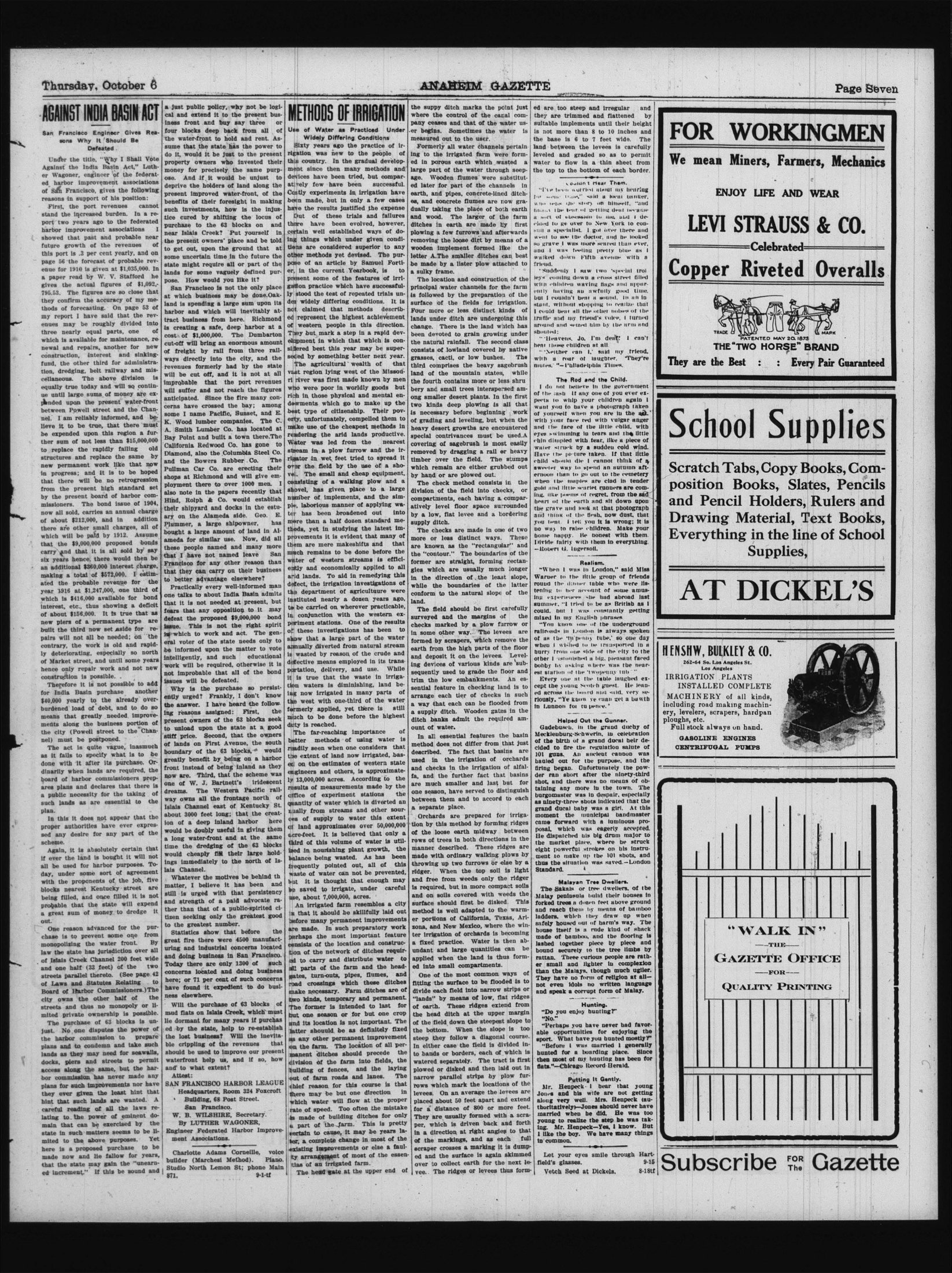
Searchable text
AGAINST INDIA BASIN ACT
San Francisco Engineer Gives Reasons Why It Should Be Defeated
Under the title, "Why I Shall Vote Against the India Basin Act," Luther Wagoner, engineer of the federated harbor improvement associations of San Francisco, gives the following reasons in support of his position:
First, the port revenues cannot stand the increased burden. In a report two years ago to the federated harbor improvement associations I showed that past and probable near future growth of the revenues of this port is .3 per cent yearly, and on page 56 the forecast of probable revenue for 1910 is given at $1,035,000. In a paper read by W. V. Stafford he gives the actual figures of $1,092,-795.53. The figures are so close that they confirm the accuracy of my methods of forecasting. On page 53 of my report I have said that the revenues may be roughly divided into three nearly equal parts, one of which is available for maintenance, renewal and repairs, another for new construction, interest and sinking fund, the other third for administration, dredging, belt railway and miscellaneous. The above division is equally true today and will continue until large sums of money are expended upon the present waterfront between Powell street and the Channel. I am reliably informed, and believe it to be true, that there must be expended upon this region a further sum of not less than $15,000,000 to replace the rapidly falling old structures and replace the same by new permanent work like that now in progress; and it is to be hoped a just public policy, why not be logical and extend it to the present business front and buy say three or four blocks deep back from all of the water-front to hold and rent. Assume that the state has the power to do it, would it be just to the present property owners who invested their money for precisely the same purpose. And if it would be unjust to deprive the holders of land along the present improved water-front, of the benefits of their foresight in making such investments, how is the injustice cured by shifting the locus of purchase to the 63 blocks on and near Islais Creek? Put yourself in the present owners' place and be told to get out, upon the ground that at some uncertain time in the future the state might require all or part of the lands for some vaguely defined purpose. How would you like it?
San Francisco is not the only place at which business may be done.Oakland is spending a large sum upon its harbor and which will inevitably attract business from here. Richmond is creating a safe, deep harbor at a cost of $1,000,000. The Dumbarton cut-off will bring an enormous amount of freight by rail from three railways directly into the city, and the revenues formerly had by the state will be cut off, and it is not at all improbable that the port revenues will suffer and not reach the figures anticipated. Since the fire many concerns have crossed the bay; among some I name Pacific, Sunset, and E.K. Wood lumber companies. The C.A. Smith Lumber Co. has located at Bay Point and built a town there.The California Redwood Co. has gone to Diamond, also the Columbia Steel Co. and the Bowers Rubber Co. The Pullman Car Co. are erecting their METHODS OF USE OF WATER AS PRESSURE
Sixty years ago the rigation was new to this country. In the moment since then many devices have been tried actively few have been Costly experiments in been made, but in one have the results justified.
Out of these trials there have been even certain well established things which underlords are considered other methods yet devise of an article by er, in the current Year present some of theigation practice which ly stood the test of reder widely differing co not claimed that med ed represent the high of western people in They but mark a step elpment in which tha siffered best this year seded by something b.
The agricultural vast region lying west river was first made who were poor in work rich in those physical dowments which go to best type of citizenship erry, unfortunately, co make use of the cheap rendering the arid la Water was led from stream in a plow furigator in wet feet tr over the field by the ve. The small and c
The above division is equally true today and will so continue until large sums of money are expanded upon the present waterfront between Powell street and the Channel. I am reliably informed, and believe it to be true, that there must be expended upon this region a further sum of not less than $15,000,000 to replace the rapidly failing old structures and replace the same by new permanent work like that now in progress; and it is to be hoped that there will be no retrogression from the present high standard set by the present board of harbor commissioners. The bond issue of 1904, now all sold, carries an annual charge of about $212,000, and in addition there are other small charges, all of which will be paid by 1912. Assume that the $9,000,000 proposed bonds carry and that it is all sold by six years hence, there would then be an additional $360,000 interest charge, making a total of $572,000. I estimated the probable revenue for the year 1916 at $1,247,000, one third of which is $416,000 available for bond interest, etc., thus showing a deficit of about $156,000. It is true that as new pliers of a permanent type are built the third now set aside for repairs will not all be needed; on the contrary, the work is old and rapidly deteriorating, especially so north of Market street, and until some years hence only repair work and not new construction is possible.
Therefore it is not possible to add for India Basin purchase another $40,000 yearly to the already overburdened load of debt, and to do so means that greatly needed improvements along the business portion of the city (Powell street to the Channel) must be postponed.
The act is quite vague, inasmuch as it fails to specify what is to be done with it after its purchase. Ordinarily when lands are required, the board of harbor commissioners prepares plans and declares that there is a public necessity for the taking of such lands as are essential to the plan.
In this it does not appear that the proper authorities have ever expressed any desire for any part of the scheme.
Again, it is absolutely certain that if ever the land is bought it will not all be used for harbor purposes. Today, under some sort of agreement with the proponents of the job, five blocks nearest Kentucky street are being filled, and once filled it is not will be cut off, and it is not at all improbable that the port revenues will suffer and not reach the figures anticipated. Since the fire many concerns have crossed the bay; among some I name Pacific, Sunset, and E. K. Wood lumber companies. The C. A. Smith Lumber Co. has located at Bay Point and built a town there. The California Redwood Co. has gone to Diamond, also the Columbia Steel Co. and the Bowers Rubber Co. The Pullman Car Co. are erecting their shops at Richmond and will give employment there to over 1000 men. I also note in the papers recently that Hind, Rolph & Co. would establish their shipyard and docks in the estuary on the Alameda side. Geo. E. Plummer, a large shipowner, has bought a large amount of land in Alameda for similar use. Now, did all these people named and many more that I have not named leave San Francisco for any other reason than that they can carry on their business to better advantage elsewhere?
Practically every well-informed man one talks to about India Basin admits that it is not needed at present, but fears that any opposition to it may defeat the proposed $9,000,000 bond issue. This is not the right spirit in which to work and act. The general voter of the state needs only to be informed upon the matter to vote intelligently, and such educational work will be required, otherwise it is not improbable that all of the bond issues will be defeated.
Why is the purchase so persistently urged? Frankly, I don't know the answer. I have heard the following reasons assigned: First, the present owners of the 63 blocks seek to unload upon the state at a good stiff price. Second, that the owners of lands on First Avenue, the south boundary of the 63 blocks, would greatly benefit by being on a harbor front instead of being inland as they now are. Third, that the scheme was one of W. J. Bartnett's iridescent dreams. The Western Pacific railway owns all the frontage north of Islais Channel east of Kentucky St. about 3000 feet long; that creation of a deep inland harbor here would be doubly useful in giving them a long water-front and at the same time the dredging of the 63 blocks would cheaply fill their large holdings immediately to the north of Islais Channel.
Whatever the motives be behind the matter, I believe it has been and still is urged with that persistence will be cut off, and it is not at all improbable that the port revenues will suffer and not reach the figures anticipated. Since the fire many concerns have crossed the bay; among some I name Pacific, Sunset, and E. K. Wood lumber companies. The C. A. Smith Lumber Co. has located at Bay Point and built a town there.The California Redwood Co. has gone to Diamond, also the Columbia Steel Co. and the Bowers Rubber Co. The Pullman Car Co. are erecting their shops at Richmond and will give employment there to over 1000 men. I also note in the papers recently that Hind, Rolph & Co. would establish their shipyard and docks in the estuary on the Alameda side. Geo. E. Plummer, a large shipowner, has bought a large amount of land in Alameda for similar use. Now, did all these people named and many more that I have not named leave San Francisco for any other reason than that they can carry on their business to better advantage elsewhere?
Practically every well-informed man one talks to about India Basin admits that it is not needed at present, but fears that any opposition to it may defeat the proposed $9,000,000 bond issue. This is not the right spirit in which to work and act. The general voter of the state needs only to be informed upon the matter to vote intelligently, and such educational work will be required, otherwise it is not improbable that all of the bond issues will be defeated.
Why is the purchase so persistently urged? Frankly, I don't know the answer. I have heard the following reasons assigned: First, the present owners of the 63 blocks seek to unload upon the state at a good stiff price. Second, that the owners of lands on First Avenue, the south boundary of the 63 blocks, would greatly benefit by being on a harbor front instead of being inland as they now are. Third, that the scheme was one of W. J. Bartnett's iridescent dreams. The Western Pacific railway owns all the frontage north of Islais Channel east of Kentucky St. about 3000 feet long; that creation of a deep inland harbor here would be doubly useful in giving them a long water-front and at the same time the dredging of the 63 blocks would cheaply fill their large holdings immediately to the north of Islais Channel.
Whatever the motives be behind the matter, I believe it has been and still is urged with that persistence will be cut off, and it is not at all improbable that the port revenues will suffer and not reach the figures anticipated. Since the fire many concerns have crossed the bay; among some I name Pacific, Sunset, and E. K. Wood lumber companies. The C. A. Smith Lumber Co. has located at Bay Point and built a town there.The California Redwood Co. has gone to Diamond, also the Columbia Steel Co. and the Bowers Rubber Co. The Pullman Car Co. are erecting their shops at Richmond and will give employment there to over 1000 men. I also note in the papers recently that Hind, Rolph & Co. would establish their shipyard and docks in the estuary on the Alameda side. Geo. E. Plummer, a large shipowner, has bought a large amount of land in Alameda for similar use. Now, did all these people named and many more that I have not named leave San Francisco for any other reason than that they can carry on their business to better advantage elsewhere?
Practically every well-informed man one talks to about India Basin admits that it is not needed at present, but fears that any opposition to it may defeat the proposed $9,000,000 bond issue. This is not the right spirit in which to work and act. The general voter of the state needs only to be informed upon the matter to vote intelligently, and such educational work will be required, otherwise it is not improbable that all of the bond issues will be defeated.
Why is the purchase so persistently urged? Frankly, I don't know the answer. I have heard the following reasons assigned: First, the present owners of the 63 blocks seek to unload upon the state at a good stiff price. Second, that the owners of lands on First Avenue, the south boundary of the 63 blocks, would greatly benefit by being on a harbor front instead of being inland as they now are. Third, that the scheme was one of W. J. Bartnett's iridescent dreams. The Western Pacific railway owns all the frontage north of Islais Channel east of Kentucky St. about 3000 feet long; that creation of a deep inland harbor here would be doubly useful in giving them a long water-front and at the same time the dredging of the 63 blocks would cheaply fill their large holdings immediately to the north of Islais Channel.
Whatever the motives be behind th
In this it does not appear that the proper authorities have ever expressed any desire for any part of the scheme.
Again, it is absolutely certain that if ever the land is bought it will not all be used for harbor purposes. Today, under some sort of agreement with the proponents of the job, five blocks nearest Kentucky street are being filled, and once filled it is not probable that the state will expend a great sum of money to dredge it out.
One reason advanced for the purchase is to prevent some one from monopolizing the water front. By law the state has jurisdiction over all of Islais Creek Channel 200 feet wide and one half (33 feet) of the two streets parallel thereto. (See page 42 of Laws and Statutes Relating to Board of Harbor Commissioners.) The city owns the other half of the streets and thus no monopoly or limited private ownership is possible.
The purchase of 63 blocks is unjust. No one disputes the power of the harbor commission to prepare plans and to condemn and take such lands as they may need for seawalls, docks, piers and streets to permit access along the same, but the harbor commission has never made any plans for such improvements nor have they ever given the least hint that hint that such lands are wanted. A careful reading of all the laws relating to the power of eminent domain that can be exercised by the state in such matters seems to be limited to the above purposes. Yet here is a proposed purchase to be made now and lie fallow for years, that the state may gain the "unearned increment." If this be sound and way owns all the frontage north of Islais Channel east of Kentucky St. about 3000 feet long; that the creation of a deep inland harbor here would be doubly useful in giving them a long water-front and at the same time the dredging of the 63 blocks would cheaply fill their large holdings immediately to the north of Islais Channel.
Whatever the motives be behind the matter, I believe it has been and still is urged with that persistency and strength of a paid advocate rather than that of a public-spirited citizen seeking only the greatest good to the greatest number.
Statistics show that before the great fire there were 4500 manufacturing and industrial concerns located and doing business in San Francisco. Today there are only 1300 of such concerns located and doing business here; or 71 per cent of such concerns have found it expedient to do business elsewhere.
Will the purchase of 63 blocks of mud flats on Islais Creek, which must lie dormant for many years if purchased by the state, help to re-establish the lost business? Will the inevitable crippling of the revenues that should be used to improve our present waterfront help us, and if so, how and to what extent?
Attest:
SAN FRANCISCO HARBOR LEAGUE
Headquarters, Room 324 Foxcroft
Building, 68 Post Street.
San Francisco.
W. B. WILSHIRE, Secretary.
By LUTHER WAGONER,
Engineer Federated Harbor Improvement Associations.
Charlotte Adams Corneille, voice builder (Marchesi Method). Piano. Studio North Lemon St; phone Main 871.
METHODS OF IRRIGATION
Use of Water as Practiced Under Widely Differing Conditions
Sixty years ago the practice of irrigation was new to the people of this country. In the gradual development since then many methods and devices have been tried, but comparatively few have been successful. Costly experiments in irrigation have been made, but in only a few cases have the results justified the expense.
Out of these trials and failures there have been evolved, however, certain well established ways of doing things which under given conditions are considered superior to any other methods yet devised. The purpose of an article by Samuel Fortier, in the current Yearbook, is to present some of the features of irrigation practice which have successfully stood the test of repeated trials under widely differing conditions. It is not claimed that methods described represent the highest achievement of western people in this direction. They but mark a step in a rapid development in which that which is considered best this year may be superceded by something better next year.
The agricultural wealth of that vast region lying west of the Missouri river was first made known by men who were poor in worldly goods but rich in those physical and mental endowments which go to make up the best type of citizenship. Their poverty, unfortunately, compelled them to make use of the cheapest methods in rendering the arid lands productive. Water was led from the nearest stream in a plow furrow and the irrigator in wet feet tried to spread it over the field by the use of a shovel. The small and cheap equipment, the supply ditch marks the point just where the control of the canal company ceases and that of the water user begins. Sometimes the water is measured out to the user.
Formerly all water channels pertaining to the irrigated farm were formed in porous earth which wasted a large part of the water through seepage. Wooden flumes were substituted later for part of the channels in earth, and pipes, concrete-lined ditches, and concrete flumes are now gradually taking the place of both earth and wood. The larger of the farm ditches in earth are made by first plowing a few furrows and afterwards removing the loose dirt by means of a wooden implement formed like the letter A. The smaller ditches can best be made by a lister plow attached to a sulky frame.
The location and construction of the principal water channels for the farm is followed by the preparation of the surface of the fields for irrigation. Four more or less distinct kinds of lands under ditch are undergoing this change. There is the land which has been devoted to grain growing under the natural rainfall. The second class consists of lowland covered by native grasses, cacti, or low bushes. The third comprises the heavy sagebrush land of the mountain states, while the fourth contains more or less shrubery and small trees interspersed among smaller desert plants. In the first two kinds deep plowing is all that is necessary before beginning work of grading and leveling, but when the heavy desert growths are encountered special contrivances must be used. A covering of sagebrush is most easily removed by dragging a rail or heavy timber over the field. The stumps which remain are either grubbed out by hand or are plowed out.
ed are too steep and irregular and they are trimmed and flattened by suitable implements until their height is not more than 8 to 10 inches and the base is 6 to 7 feet wide. The land between the levees is carefully leveled and graded so as to permit water to flow in a thin sheet from the top to the bottom of each border.
Couldn't Hear Them.
"I've been worried about my hearing for some time," said a local banker, who tells the story on himself, "and he beat at getting deaf because a sort of obsession to me, and I decided to go over to New York to consult a specialist. I got over there and went to see the doctor, and he looked so grave I was more scared than ever, and I was feeling pretty blue as I walked down Fifth avenue with a friend."
"Suddenly I saw two 'special troops' coming down a cross street filled with children waving flags and apparently having an awfully good time, but I couldn't hear a sound. In an instant, without stopping to realize that I could beat all the other noises of the traffic and my friend's voice, I turned around and seized him by the arm and shouted:
"Heavens. Jo, I'm dear! I can't heat those children at all."
"Neither can I," said my friend, with a roar of laughter. "They're mutexes." — Philadelphia Times.
The Rod and the Child.
I do not believe in the government of the ash if any one of you ever expects to whip your children again I want you to have a photograph taken of yourself when you are in the act with your face red with vulgar anger and the face of the little child, with eyes swimming in tears and the little chin dimpled with fear, like a piece of water struck by a sudden cold wind. Have the picture taken. If that little child should die I cannot think of a sweeter way to spend an autumn afternoon than to go out to the cemetery."
ri river was first made known by men who were poor in worldly goods but rich in those physical and mental endowments which go to make up the best type of citizenship. Their poverty, unfortunately, compelled them to make use of the cheapest methods in rendering the arid lands productive. Water was led from the nearest stream in a plow furrow and the irrigator in wet feet tried to spread it over the field by the use of a shovel. The small and cheap equipment, consisting of a walking plow and a shovel, has given place to a large number of implements, and the simple, laborious manner of applying water has been broadened out into mere than a half dozen standard methods, yet in studying the latest improvements it is evident that many of them are mere makeshifts and that much remains to be done before the water of western streams is efficiently and economically applied to all arid lands. To aid in remedying this defect, the irrigation investigations of the department of agriculture were instituted nearly a dozen years ago, to be carried on wherever practicable, in conjunction with the western experiment stations. One of the results of these investigations has been to show that a large part of the water annually diverted from natural stream is wasted by reason of the crude and defective means employed in its transportation, delivery, and use. While it is true that the waste in irrigation waters is diminishing, land being now irrigated in many parts of the west with one-third of the water formerly applied, yet there is still much to be done before the highest duty is reached.
The far-reaching importance of better methods of using water is readily seen when one considers that the extent of land now irrigated, based on the estimates of western state engineers and others, is approximately 13,000,000 acres. According to the results of measurements made by the office of experiment stations the quantity of water which is diverted anually from streams and other sources of supply to water this extent of land approximates over 50,000,000 acre-feet. It is believed that only a third of this volume of water is utilized in nourishing plant growth, the balance being wasted. As has been frequently pointed out, all of this waste of water can not be prevented, but it is thought that enough may be saved to irrigate, under careful use, about 7,000,000 acres.
The fourth contains more or less shrubery and small trees interspersed among smaller desert plants. In the first two kinds deep plowing is all that is necessary before beginning work of grading and leveling, but when the heavy desert growths are encountered special contrivances must be used. A covering of sagebrush is most easily removed by dragging a rail or heavy timber over the field. The stumps which remain are either grubbed out by hand or are plowed out.
The check method consists in the division of the field into checks, or compartments, each having a comparatively level floor space surrounded by a low, flat levee and a bordering supply ditch.
The checks are made in one of two more or less distinct ways. These are known as the "rectangular" and the "contour." The boundaries of the former are straight, forming rectangles which are usually much longer in the direction of the least slope, while the boundaries of the latter conform to the natural slope of the land.
The field should be first carefully surveyed and the margins of the checks marked by a plow furrow or in some other way. The levees are formed by scrapers, which remove the earth from the high parts of the floor and deposit it on the levees. Leveling devices of various kinds are subsequently used to grade the floor and trim the low embankments. An essential feature in checking land is to arrange each tier of checks in such a way that each can be flooded from a supply ditch. Wooden gates in the ditch banks admit the required amount of water.
In all essential features the basin method does not differ from that just described. The fact that basins are used in the irrigation of orchards and checks in the irrigation of alfalfa, and the further fact that basins are much smaller and last but for one season, have served to distinguish between them and to accord to each a separate place.
Orchards are prepared for irrigation by this method by forming ridges of the loose earth midway between rows of trees in both directions in the manner described. These ridges are made with ordinary walking plows by throwing up two furrows or else by a ridger. When the top soil is light and free from weeds only the ridger is required, but in more compact soils and on soils covered with weeds the fourth contains more or less shrubery and small trees interspersed among smaller desert plants. In the first two kinds deep plowing is all that is necessary before beginning work of grading and leveling, but when the heavy desert growths are encountered special contrivances must be used. A covering of sagebrush is most easily removed by dragging a rail or heavy timber over the field. The stumps which remain are either grubbed out by hand or are plowed out.
The check method consists in the division of the field into checks, or compartments, each having a comparatively level floor space surrounded by a low, flat levee and a bordering supply ditch.
The checks are made in one of two more or less distinct ways. These are known as the "rectangular" and the "contour." The boundaries of the former are straight, forming rectangles which are usually much longer in the direction of the least slope, while the boundaries of the latter conform to the natural slope of the land.
The field should be first carefully surveyed and the margins of the checks marked by a plow furrow or in some other way. The levees are formed by scrapers, which remove the earth from the high parts of the floor and deposit it on the levees. Leveling devices of various kinds are subsequently used to grade the floor and trim the low embankments. An essential feature in checking land is to arrange each tier of checks in such a way that each can be flooded from a supply ditch. Wooden gates in the ditch banks admit the required amount of water.
In all essential features the basin method does not differ from that just described. The fact that basins are used in the irrigation of orchards and checks in the irrigation of alfalfa, and the further fact that basins are much smaller and last but for one season, have served to distinguish between them and to accord to each a separate place.
Orchards are prepared for irrigation by this method by forming ridges of the loose earth midway between rows of trees in both directions in the manner described. These ridges are made with ordinary walking plows by throwing up two furrows or else by a ridger. When the top soil is light and free from weeds only the ridger is required, but in more compact soils and on soils covered with weeds
quantity of water which is diverted anually from streams and other sources of supply to water this extent of land approximates over 50,000,000 acre-feet. It is believed that only a third of this volume of water is utilized in nourishing plant growth, the balance being wasted. As has been frequently pointed out, all of this waste of water can not be prevented, but it is thought that enough may be saved to irrigate, under careful use, about 7,000,000 acres.
An irrigated farm resembles a city in that it should be skillfully laid out before many permanent improvements are made. In such preparatory work perhaps the most important feature consists of the location and construction of the network of ditches required to carry and distribute water to all parts of the farm and the headgates, turn-outs, pipes, flumes, and road crossings which these ditches make necessary. Farm ditches are of two kinds, temporary and permanent. The former is intended to last for but one season or for but one crop and its location is not important. The latter should be as definitely fixed as any other permanent improvement on the farm. The location of all permanent ditches should precede the division of the farm into fields, the building of fences, and the laying out of farm roads and lanes. The chief reason for this course is that there may be but one direction in which water will flow at the proper rate of speed. Too often the mistake is made of building ditches for only a part of the farm. This is pretty certain to cause, it may be years later, a complete change in most of the existing improvements or else a faulty arrangement of most of the essen-tias of an irrigated farm.
The head gate at the upper end of Orchards are prepared for irrigation by this method by forming ridges of the loose earth midway between rows of trees in both directions in the manner described. These ridges are made with ordinary walking plows by throwing up two furrows or else by a ridger. When the top soil is light and free from weeds only the ridger is required, but in more compact soils and on soils covered with weeds the surface should first be disked. This method is well adapted to the warmer portions of California, Texas, Arizona, and New Mexico, where the winter irrigation of orchards is becoming a fixed practice. Water is then abundant and large quantities can be applied when the land is thus formed into small compartments.
One of the most common ways of fitting the surface to be flooded is to divide each field into narrow strips or "lands" by means of low, flat ridges of earth. These ridges extend from the head ditch at the upper margin of the field down the steepest slope to the bottom. When the slope is too steep they follow a diagonal course. In either case the field is divided into bands or borders, each of which is watered separately. The tract is first plowed or disked and then laid out in narrow parallel strips by plow furrows which mark the locations of the levees. On an average the levees are placed about 50 feet apart and extend for a distance of 800 or more feet. They are usually formed with a scraper, which is driven back and forth in a direction at right angles to that of the markings, and as each full scraper crosses a marking it is dumped and the surface is again skimmed over to collect earth for the next levee. The ridges or levees thus form as ninety-three shots indicated that the grand ducal baby was a girl. At this moment the municipal bandmaster came forward with a luminous proposal, which was eagerly accepted. He dispatched his big drum major to the market place, where he struck eight powerful strokes on his instrument to make up the 101 shots, and thus the situation was saved.-London Standard.
Malayan Tree Dwellers.
The Sakals or tree dwellers, of the Malay peninsula build their houses in forked trees a dozen feet above ground and reach them by means of bamboo ladders, which they draw up when safely housed out of harm's way. The house itself is a rude kind of shack made of bamboo, and the flooring is lashed together piece by piece and bound securely to the tree limbs by rattan. These curious people are rather small and lighter in complexion than the Malays, though much uglier. They have no form of religion at all—not even idols no written language and speak a corrupt form of Malay.
Hunting.
"Do you enjoy hunting?"
"No."
Perhaps you have never had favorable opportunities for enjoying the sport. What have you hunted mostly?
"Before I was married I generally hunted for a boarding place. Since then most of my hunting has been for flats."—Chicago Record-Herald.
Putting It Gently.
Mr. Henpeck I bear that young Jones and his wife are not getting along very well. Mrs. Henpeck (authoritatively)—Jones should never have married when he did. He was too young to realize the step he was taking. Mr. Henpeck—Yes, I know. But I like the boy. We have many things in common.
Let your eyes smile through Hart-field's glasses.
9-15
Vetch Seed at Dickels.
8-18tf
FOR WORKINGMEN
We mean Miners, Farmers, Mechanics
ENJOY LIFE AND WEAR
LEVI STRAUSS & CO.
Celebrated
Copper Riveted Overalls
TRADE PATENTED MAY 20, 1873
THE “TWO HORSE” BRAND
They are the Best : Every Pair Guaranteed
School Supplies
Scratch Tabs, Copy Books, Com-
School Supplies
Scratch Tabs, Copy Books, Composition Books, Slates, Pencils and Pencil Holders, Rulers and Drawing Material, Text Books, Everything in the line of School Supplies,
AT DICKEL'S
HENSHW, BULKLEY & CO.
262-64 So. Los Angeles St.
Los Angeles
IRRIGATION PLANTS
INSTALLED COMPLETE
MACHINERY of all kinds,
including road making machinery, levelers, scrapers, hardpan ploughs, etc.
Full stock always on hand.
GASOLINE ENGINES
CENTRIFUGAL PUMPS
"WALK IN"
THE
GAZETTE OFFICE
FOR
QUALITY PRINTING
Subscribe FOR The Gazette