anaheim-gazette 1910-09-22
Scanned page
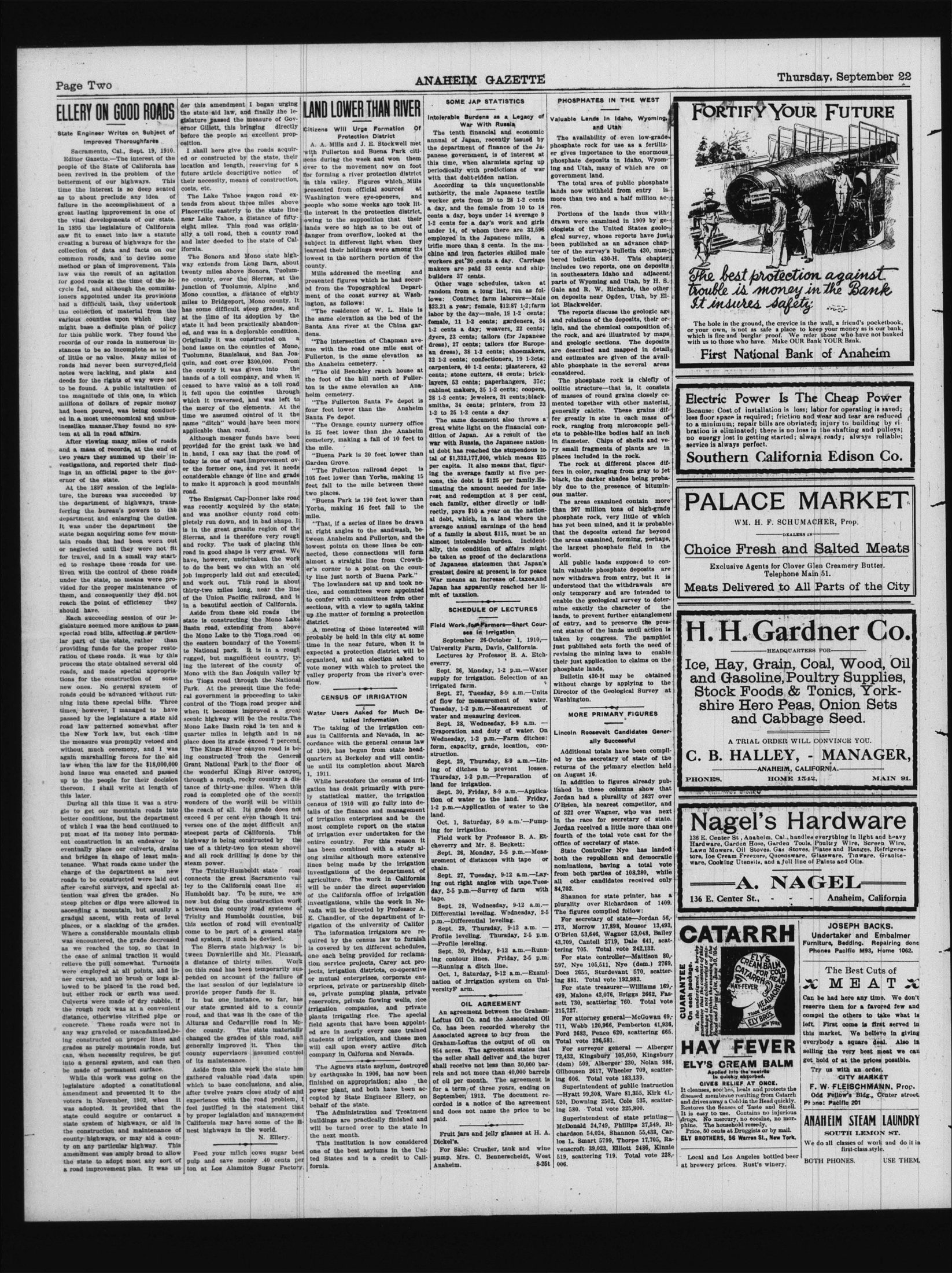
Searchable text
ELLERY ON GOOD ROADS
State Engineer Writes on Subject of Improved Thoroughfare
Sacramento, Cal., Sept. 19, 1910.
Editor Gazette.—The interest of the people of the State of California has been revived in the problem of the betterment of our highways. This time the interest is so deep seated as to about preclude any idea of failure in the accomplishment of a great lasting improvement in one of the vital developments of our state. In 1895 the legislature of California saw fit to enact into law a statute creating a bureau of highways for the collection of data and facts on our common roads, and to devise some method or plan of improvement. This law was the result of an agitation for good roads at the time of the bicycle fad, and although the commissioners appointed under its provisions had a difficult task, they undertook the collection of material from the various counties upon which they might base a definite plan or policy for this public work. They found the records of our roads in numerous instances to be so incomplete as to be of little or no value. Many miles of roads had never been surveyed, field notes were lacking, and plats and deeds for the rights of way were not to be found. A public insitution of the magnitude of this one, in which millions of dollars of repair money had been poured, was being conducted in a most uneconomical and unbusinesslike manner. They found no system at all in road affairs.
After viewing many miles of roads and a mass of records, at the end of two years they summed up their investigations, and reported their findings in an official paper to the governor this amendment I began urging the state aid law, and finally the legislature passed the measure of Governor Gillett, this bringing directly before the people an excellent proposition.
I shall here give the roads acquired or constructed by the state, their location and length, reserving for a future article descriptive notice of their necessity, means of construction, costs, etc.
The Lake Tahoe wagon road extends from about three miles above Placerville easterly to the state line near Lake Tahoe, a distance of fifty-eight miles. This road was originally a toll road, then a county road and later deeded to the state of California.
The Sonora and Mono state highway extends from Long Barn, about twenty miles above Sonora, Tuolumne county, over the Sierras, at the junction of Tuolumne, Alpine and Mono counties, a distance of eighty miles to Bridgeport, Mono county. It has some difficult steep grades, and at the time of its adoption by the state it had been practically abandoned, and was in a deplorable condition. Originally it was constructed on a bond issue on the counties of Mono, Tuolumne, Stanislaus, and San Joaquin, and cost over $300,000. From the county it was given into the hands of a toll company, and when it ceased to have value as a toll road it fell upon the counties through which it traversed, and was left to the mercy of the elements. At the time we assumed control of it the name "ditch" would have been more applicable than road.
Although meager funds have been provided for the great task we had in hand, I can say that the road of today is one of vast improvement over the former one, and yet it needs considerable change of line and grade.
deeds for the rights of way were not to be found. A public intsitution of the magnitude of this one, in which millions of dollars of repair money had been poured, was being conducted in a most uneconomical and unbusinesslike manner. They found no system at all in road affairs.
After viewing many miles of roads and a mass of records, at the end of two years they summed up their investigations, and reported their findings in an official paper to the governor of the state.
At the 1897 session of the legislature, the bureau was succeeded by the department of highways, transferring the bureau's powers to the department and enlarging the duties. It was under the department the state began acquiring some few mountain roads that had been worn out or neglected until they were not fit for travel, and in a small way started to reshape these roads for use. Even with the control of these roads under the state, no means were provided for the proper maintenance of them, and consequently they did not reach the point of efficiency they should have.
Each succeeding session of our legislature seemed more anxious to pass special road bills, affecting particular part of the state, rather than providing funds for the proper restoration of these roads. It was by this process the state obtained several old roads, and made special appropriations for the construction of some new ones. No general system of roads could be advanced without running into these special bills. Three times, however, I managed to have passed by the legislature a state aid road law patterned somewhat after the New York law, but each time the measure was promptly vetoed and without much ceremony, and I was again marshalling forces for the aid law when the law for the $18,000,000 bond issue was enacted and passed up to the people for their decision thereon. I shall write at length of this later.
During all this time it was a struggle to get our mountain roads into better conditions, but the department of which I was the head continued to put most of its money into permanent construction in an endeavor to eventually place our culverts, drains and bridges in shape of least maintenance. What roads came under the charge of the department as new roads to be constructed were laid out after careful surveys, and special attention was given the grades. No hands of a toll company, and when it ceased to have value as a toll road it fell upon the counties through which it traversed, and was left to the mercy of the elements. At the time we assumed control of it the name "ditch" would have been more applicable than road.
Although meager funds have been provided for the great task we had in hand, I can say that the road of today is one of vast improvement over the former one, and yet it needs considerable change of line and grade to make it approach a good mountain road.
The Emigrant Cap-Donner lake road was recently acquired by the state, and was another county road completely run down, and in bad shape. It is in the great granite region of the Sierras, and is therefore very rough and rocky. The task of placing this road in good shape is very great. We have, however, undertaken the work to do the best we can with an old job improperly laid out and executed, and work out. This road is about thirty-two miles long, near the line of the Union Pacific railroad, and is in a beautiful section of California.
Aside from these old roads the state is constructing the Mono Lake Basin road, extending from above the Mono Lake to the Tioga road on the eastern boundary of the Yosemite National park. It is in a rough rugged, but magnificent country, tying the interest of the county of Mono with the San Joaquin valley by the Tioga road through the National Park. At the present time the federal government is proceeding to take control of the Tioga road proper and when it becomes improved a great scenic highway will be the result. The Mono Lake Basin road is ten and a quarter miles in length and in no place does its grade exceed 7 percent.
The Kings River canyon road is being constructed from the General Grant National Park to the floor of the wonderful Kings River canyon, through a rough, rocky country a distance of thirty-one miles. When this road is completed one of the scenic wonders of the world will be within the reach of all. Its grade does not exceed 6 per cent even though it traverses one of the most difficult and steepest parts of California. This highway is being constructed by the use of a thirty-two ton steam shovel and all rock drilling is done by the steam power.
The Trinity-Humboldt state road connects the great Sacramento valley to the California coast line at Humboldt bay. To be sure, we are
During all this time it was a struggle to get our mountain roads into better conditions, but the department of which I was the head continued to put most of its money into permanent construction in an endeavor to eventually place our culverts, drains and bridges in shape of least maintenance. What roads came under the charge of the department as new roads to be constructed were laid out after careful surveys, and special attention was given the grades. No steep pitches or dips were allowed in ascending a mountain, but usually a gradual ascent, with rests of level places, or a slacking of the grades. Where a considerable mountain climb was encountered, the grade decreased as we reached the top, so that in the case of animal traction it would relieve the pull somewhat. Turnouts were employed at all points, and inner curves, and no brush or logs allowed to be placed in the road bed, but either rock or earth was used. Culverts were made of dry rubble, if the rough rock was at a convenient distance, otherwise vitrified pipe or concrete. These roads were not in any way graveled or macadamized, being constructed on proper lines and grades as purely mountain roads, but can, when necessity requires, be put into a general system, and can then be made of permanent surface.
While this work was going on the legislature adopted a constitutional amendment and presented it to the voters in November, 1902, when it was adopted. It provided that the state could acquire or construct a state system of highways, or aid in the construction and maintenance of county highways, or may aid a county on any particular highway. This amendment was amply broad to allow the state to adopt most any sort of a road improvement plan. It was unwonders of the world will be within the reach of all. Its grade does not exceed 6 per cent even though it traverses one of the most difficult and steepest parts of California. This highway is being constructed by the use of a thirty-two ton steam shovel and all rock drilling is done by the steam power.
The Trinity-Humboldt state road connects the great Sacramento valley to the California coast line at Humboldt bay. To be sure, we are now but doing the construction work between the county road systems of Trinity and Humboldt counties, but this section of road will eventually come to be part of a general state road system, if such be devised.
The Sierra state highway is between Downieville and Mt. Pleasant, a distance of thirty miles. Work on this road has been temporarily suspended on account of the failure of the last session of our legislature to provide proper funds for it.
In but one instance, so far, has our state granted aid to a county road, and that was in the case of the Alturas and Cedarville road in Modoc county. The state materially changed the grades of this road, and generally improved it. Then the county supervisors assumed control of its maintenance.
Aside from this work the state has gathered valuable road data upon which to base conclusions, and also, after twelve years close study of and experience with the road problem, I feel justified in the statement that by proper legislation and management California may have some of the finest highways in the world.
N. Ellery.
Feed your milk cows sugar beet pulp and save money. 40 cents per ton at Los Alamitos Sugar Factory.
ANAHEIM GAZETTE
LAND LOWER THAN RIVER
Citizens Will Urge Formation Of Protection District
A. A. Mills and J. E. Stockwell met with Fullerton and Buena Park citizens during the week and won them over to the movement now on foot for forming a river protection district in this valley. Figures which Mills presented from official sources at Washington were eye-openers, and people who some weeks ago took little interest in the protection district, owing to the supposition that their lands were so high as to be out of danger from overflow, looked at the subject in different light when they learned their holdings were among the lowest in the northern portion of the county.
Mills addressed the meeting and presented figures which he had secured from the Topographical Department of the coast survey at Washington, as follows:
"The residence of W. L. Hale is the same elevation as the bed of the Santa Ana river at the China gardens."
"The intersection of Chapman avenue with the road one mile east of Fullerton, is the same elevation as the Anaheim cemetery."
"The old Benchley ranch house at the foot of the hill north of Fullerton is the same elevation as Anaheim cemetery."
"The Fullerton Santa Fe depot is four feet lower than the Anaheim Santa Fe depot."
"The Orange county nursery office is 25 feet lower than the Anaheim cemetery, making a fall of 10 feet to the mile."
"Buena Park is 20 feet lower than Garden Grove."
"The Fullerton railroad depot is located near the river."
SOME JAP STATISTICS
Intolerable Burdens as a Legacy of War With Russia
The tenth financial and economic annual of Japan, recently issued by the department of finance of the Japanese government, is of interest at this time, when alarmists spring up periodically with predictions of war with that debt-ridden nation.
According to this unquestionable authority, the male Japanese textile worker gets from 20 to 28 1-2 cents a day, and the female from 10 to 14 cents a day, boys under 14 average 9 1-2 cents for a day's work and girls under 14, of whom there are 33,596 employed in the Japanese mills, a trifle more than 8 cents. In the machine and iron factories skilled male workers get 30 cents a day. Carriage makers are paid 33 cents and shipbuilders 37 cents.
Other wage schedules, taken at random from a long list, run as follows: Contract farm laborers—Male $23.21 a year; female, $12.87 1-2; farm labor by the day—male, 19 1-2 cents; female, 11 1-2 cents; gardeners, 34 1-2 cents a day; weavers, 22 cents; dyers, 23 cents; tailors (for Japanese dress), 27 cents; tailors (for European dress), 38 1-2 cents; shoemakers, 32 1-2 cents; confectioners, 19 1-2cts; carpenters, 40 1-2 cents; plasterers, 42 cents; stone cutters, 48 cents; bricklayers, 53 cents; paperhangers, 37c; cabinet makers, 35 1-2 cents; coopers, 28 1-2 cents; jewelers, 31 cents; blacksmiths, 34 cents; printers, from 23 1-2 to 25 1-2 cents a day.
The same document also throws a great white light on the financial condition of Japan. As a result of the war with Russia, the Japanese national debt has reached the stupendous total of $1,332,177,000, which means $25 per capita. It also means that, figuring the average family at five per centage land in Idaho, Wyoming, and Utah
The availability of even low-grade phosphate rock for use as a fertilizer gives importance to the enormous phosphate deposits in Idaho, Wyoming and Utah, many of which are on government land.
The total area of public phosphate lands now withheld from entry is more than two and a half million acres.
Portions of the lands thus withdrawn were examined in 1909 by geologists of the United States geological survey, whose reports have just been published as an advance chapter of the survey's bulletin 430, numbered bulletin 430-H. This chapter includes two reports, one on deposits in southeastern Idaho and adjacent parts of Wyoming and Utah, by H. S. Gale and R. W. Richards, the other on deposits near Ogden, Utah, by Ellot Blackwelder.
The reports discuss the geologic age and relations of the deposits, their origin, and the chemical composition of the rock, and are illustrated by maps and geologic sections. The deposits are described and mapped in detail and estimates are given of the available phosphate in the several areas considered.
The phosphate rock is chiefly of oolitic structure—that is, it consists of masses of round grains closely cemented together with other material generally calcite. These grains differ greatly in size in each mass of rock, ranging from microscopic pellets to pebble-like bodies half an inch in diameter. Chips of shells and very small fragments of plants are in places included in the rock.
The rock at different places differs in color, ranging from gray to jet
The phosphate rock is chiefly of oolitic structure—that is, it consists of masses of round grains closely cemented together with other material, generally calcite. These grains differ greatly in size in each mass of rock, ranging from microscopic pellets to pebble-like bodies half an inch in diameter. Chips of shells and very small fragments of plants are in places included in the rock.
The rock at different places differs in color, ranging from gray to jet black, the darker shades being probably due to the presence of bituminous matter.
The areas examined contain more than 267 million tons of high-grade phosphate rock, very little of which has yet been mined, and it is probable that the deposits extend far beyond the areas examined, forming, perhaps, the largest phosphate field in the world.
All public lands supposed to contain valuable phosphate deposits are now withdrawn from entry, but it is understood that the withdrawals are only temporary and are intended to enable the geological survey to determine exactly the character of the lands, to prevent further entanglement of entry, and to preserve the present status of the lands until action is taken by congress. The pamphlet just published sets forth the need of revising the mining laws to enable their just application to claims on the phosphate lands.
Bulletin 430-H may be obtained without charge by applying to the Director of the Geological Survey at Washington.
MORE PRIMARY FIGURES
Lincoln Roosevelt Candidates Generally Successful
Additional totals have been compiled by the secretary of state of the returns of the primary election held on August 16.
In addition to figures already published in these columns show that Jordan had a plurality of 2627 over O'Brien, his nearest competitor, and of 322 over Wagner, who was next in the race for secretary of state. Jordan received a little more than one fourth of the total vote cast for the office of secretary of state.
State Controller Nye has landed both the republican and democratic nominations, having a total vote from both parties of 108,280, while all other candidates received only 84,702.
Shannon for state printer, has a
The Agnews state asylum, destroyed by earthquake in 1906, has now been finished on appropriation; also the power plant, and both have been accepted by State Engineer Ellery, on behalf of the state.
The Administration and Treatment buildings are practically finished and will be turned over to the state in the next month.
This institution is now considered one of the best asylums in the United States and is a credit to California.
OIL AGREEMENT
An agreement between the Graham-Loftus Oil Co. and the Associated Oil Co. has been recorded whereby the Associated agrees to buy from the Graham-Loftus the output of oil on 954 acres. The agreement states that the seller shall deliver and the buyer shall receive not less than 30,000 barrels and not more than 40,000 barrels of oil per month. The agreement is for a term of three years, ending on September, 1913. The document recorded is a notice of the agreement and does not name the price to be paid.
Fruit jars and jelly glasses at H. A. Dickel's.
For Sale: Crusher, tank and wine pump. Mrs. C. Bennerscheidt, West Anaheim.
Oct. 1, Saturday, 8-9 a.m.'—Pumping for irrigation.
Field work by Professor B. A. Etcheverry and Mr. S. Beckett:
Sept. 26, Monday, 2-5 p.m.—Measurement of distances with tape or chain.
Sept. 27, Tuesday, 9-12 a.m.—Laying out right angles with tape.Tuesday, 2-5 p.m.—Survey of farm with tape.
Sept. 28, Wednesday, 9-12 a.m.—Differential leveling. Wednesday, 2-5 p.m.—Differential leveling.
Sept. 29, Thursday, 9-12 a.m.—Profile leveling. Thursday, 2-5 p.m.—Profile leveling.
Sept. 30, Friday, 9-12 a.m.—Running contour lines. Friday, 2-5 p.m.—Running a ditch line.
Oct. 1, Saturday, 9-12 a.m.—Examination of irrigation system on University F arm.
State Controller Nye has landed both the republican and democratic nominations, having a total vote from both parties of 108,280, while all other candidates received only 84,702.
Shannon for state printer, has a plurality over Richardson of 1409. The figures compiled follow:
For secretary of state—Jordan 56,-273, Morrow 17,898, Mouser 13,493, O'Brien 53,646, Wagner 53,048, Bailey 43,709, Cantell 2719, Dale 641, scattering 705. Total vote 242,132.
For state controller—Mattison 80,-597, Nye 105,511, Nye (dem.) 2769, Dees 2655, Sturdevant 570, scattering 881. Total vote 192,983.
For state treasurer—Williams 169,-499, Malone 42,076, Briggs 2662, Fassett 730, scattering 760. Total vote 215,727.
For attorney general—McGowan 69,-711, Webb 120,966, Pemberton 41,936, Ford 2683, Pence 620, scattering 665. Total vote 236,581.
For surveyor general — Alberger 72,432, Kingsbury 105,050, Kingsbury (dem) 509, Alberger 230, Nolan 986, Gilhousen 2617, Wheeler 709, scattering 606. Total vote 183,139.
Superintendent of public instruction — Hyatt 99,308, Ware 81,355, Kirk 41,-520, Downing 2502, Cole 535, scattering 580. Total vote 225,800.
Superintendent of state printing — McDonald 24,749, Phillips 27,549, Richardson 54,024, Shannon 55,433, Carlos L. Smart 5799, Thorpe 17,705, Ravenscroft 39,023, Elliott 2486, Kinnie 519, scattering 719. Total vote 228,
006.
Thursday, September 22
FORTIFY YOUR FUTURE
The best protection against trouble is money in the Bank. It insures safety.
The hole in the ground, the crevice in the wall, a friend's pocketbook, or your own, is not as safe a place to keep your money as is our bank, which is fire and burglar proof. We refer those who have not banked with us to those who have. Make OUR Bank YOUR Bank.
First National Bank of Anaheim
Electric Power Is The Cheap Power
Because: Cost of installation is less; labor for operating is saved; less floor space is required; friction and wear and tear are reduced to a minimum; repair bills are obviated; injury to building by vibration is eliminated; there is no loss in the shafting and pulleys; no energy lost in getting started; always ready; always reliable; service is always perfect.
Southern California Edison Co.
Electric Power Is The Cheap Power
Because: Cost of installation is less; labor for operating is saved;
less floor space is required; friction and wear and tear are reduced
to a minimum; repair bills are obviated; injury to building by vibration is eliminated; there is no loss in the shafting and pulleys;
no energy lost in getting started; always ready; always reliable;
service is always perfect.
Southern California Edison Co.
PALACE MARKET
WM. H. F. SCHUMACHER, Prop.
DEALERS IN
Choice Fresh and Salted Meats
Exclusive Agents for Clover Glen Creamery Butter.
Telephone Main 51.
Meats Delivered to All Parts of the City
H. H. Gardner Co.
HEADQUARTERS FOR
Ice, Hay, Grain, Coal, Wood, Oil
and Gasoline, Poultry Supplies,
Stock Foods & Tonics, Yorkshire Hero Peas, Onion Sets
and Cabbage Seed.
A TRIAL ORDER WILL CONVINCE YOU.
C. B. HALLEY, - MANAGER,
ANAHEIM, CALIFORNIA.
PHONES, HOME 1542, MAIN 91.
Nagel's Hardware
136 E. Center St., Anaheim, Cal., handles everything in light and heavy
Hardware, Garden Hose, Garden Tools, Poultry Wire, Screen Wire,
Lawn Mowers, Oil Stoves, Gas Stoves, Plates and Ranges, Refrigeratore, Ice Cream Freezers, Queensware, Glassware, Tinware, Graniteware, Cooking Utensils, and a full line of Paints and Oils.
A. NAGEL
136 E. Center St., Anaheim, California
Nagel's Hardware
136 E. Center St., Anaheim, Cal., handles everything in light and heavy
Hardware, Garden Hose, Garden Tools, Poultry Wire, Screen Wire,
Lawn Mowers, Oil Stoves, Gas Stoves, Plates and Ranges, Refrigerators,
Ice Cream Freezers, Queensware, Glassware, Tinware, Graniteware, Cooking Utensils, and a full line of Paints and Oils.
A. NAGEL
136 E. Center St., Anaheim, California
CATARRH
GUARANTEE
On each package.
We, the undersigned, do hereby
guarantee that the contents of this
package is not adulterated or misbranded within the meaning of the
Food and Drugs Act, June 30, 1966.
HAY FEVER
ELY'S CREAM BALM
Applied into the nostrils
is quickly absorbed.
GIVES RELIEF AT ONCE.
It cleanses, soothes, heals and protects the
diseased membrane resulting from Catarrh
and drives away a Colb in the Head quickly.
Restores the Senses of Taste and Smell.
It is easy to use. Contains no injurious
drugs. No mercury, no cocaine, no morpheine.
The household remedy.
Price, 50 cents at Druggists or by mail.
ELY BROTHERS, 56 Warren St., New York.
JOSEPH BACKS,
Undertaker and Embalmer
Furniture, Bedding. Repairing done
Phones Pacific M93, Home 1062.
The Best Cuts of MEAT
Can be had here any time. We don't
reserve them for a favored few and
compel the others to take what is
left. First come is first served in
this market. We believe in giving
everybody a square deal. Also is
selling the very best meat we can
get hold of at the prices possible.
Try us with an order.
CITY MARKET
F. W. FLEISCHMANN. Prop.
Odd Fellow's Bldg., Center street.
Phone: Pacific 201
ANAHEIM STEAM LAUNDRY
SOUTH LEMON ST.
We do all classes of work and do it in
first-class style.
BOTH PHONES. USE THEM.