anaheim-gazette 1910-09-15
Scanned page
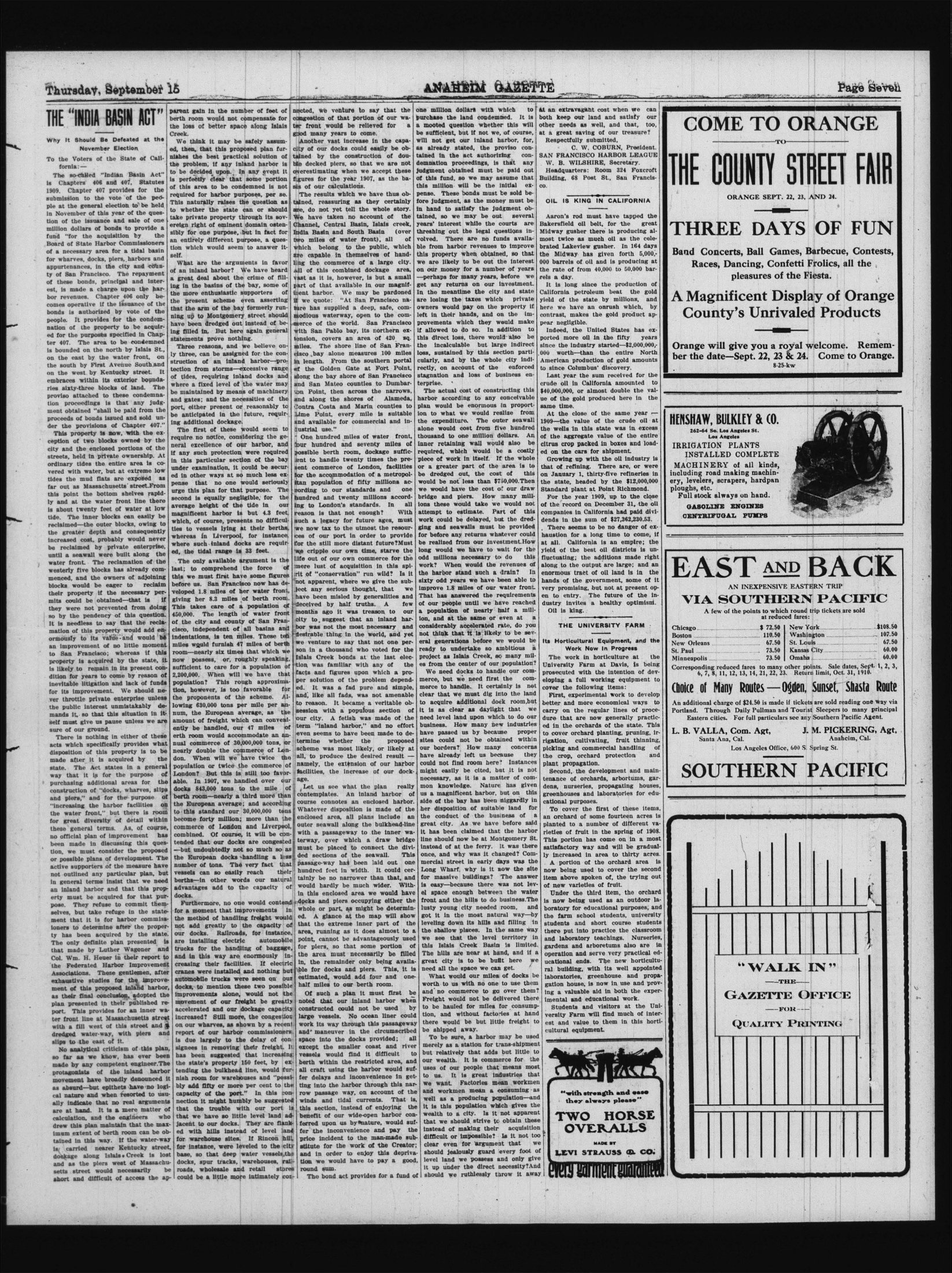
Searchable text
THE "INDIA BASIN ACT"
Why It Should Be Defeated at the November Election
To the Voters of the State of California:
The so-called "Indian Basin Act" is Chapters 406 and 407, Statutes 1909. Chapter 407 provides for the submission to the vote of the people at the general election to be held in November of this year of the question of the issuance and sale of one million dollars of bonds to provide a fund "for the acquisition by the Board of State Harbor Commissioners of a necessary area for a tidal basin for wharves, docks, piers, harbors and appurtenances, in the city and county of San Francisco. The repayment of these bonds, principal and interest, is made a charge upon the harbor revenues. Chapter 406 only becomes operative if the issuance of the bonds is authorized by vote of the people. It provides for the condemnation of the property to be acquired for the purposes specified in Chapter 407. The area to be condemned is bounded on the north by Islais St., on the east by the water front, on the south by First Avenue South and on the west by Kentucky street. It embraces within its exterior boundaries sixty-three blocks of land. The proviso attached to these condemnation proceedings is that any judgment obtained "shall be paid from the proceeds of bonds issued and sold under the provisions of Chapter 407."
This property is now, with the exception of two blocks owned by the city and the enclosed portions of the streets, held in private ownership. At ordinary tides the entire area is covered with water, but at extreme low parent gain in the number of feet of berth room would not compensate for the loss of better space along Islais Creek.
We think it may be safely assumed, then, that this proposed plan furnishes the best practical solution of the problem; if any inland harbor is to be decided upon. In any event it is perfectly clear that some portion of this area to be condemned is not required for harbor purposes, per se. This naturally raises the question as to whether the state can or should take private property through its sovereign right of eminent domain ostensibly for one purpose, but in fact for an entirely different purpose, a question which would seem to answer itself.
What are the arguments in favor of an inland harbor? We have heard a great deal about the crime of filling in the basins of the bay, some of the more enthusiastic supporters of the present scheme even asserting that the arm of the bay formerly running up to Montgomery street should have been dredged out instead of being filled in. But here again general statements prove nothing.
Three reasons, and we believe only three, can be assigned for the construction of an inland harbor—protection from storms—excessive range of tides, requiring inland docks and where a fixed level of the water may be maintained by means of machinery and gates; and the necessities of the port, either present or reasonably to be anticipated in the future, requiring additional dockage.
The first of these would seem to require no notice, considering the general excellence of our harbor, and if any such protection were required in this particular section of the bay under examination, it could be secured in other ways at so much less expense, we venture to congestion of that pier front would be good many years to come.
Another vast increase in city of our docks contained by the considerable decked piers, so overestimating when figures for the year will sit of our calculation.
The results which trained, reassuring are, do not yet tell. We have taken no Channel, Central Bay India Basin and South two miles of water which belong to are capable in their lying the commerce all of this combine vast as it is, however part of that available harbor. We will if we quote: "At time has supplied a modious waterway, merce of the world with San Pablo bay tension, covers an miles. The shore disco bay alone me in length. From thief of the Golden Gate along the bay shore and San Mateo coast Point, then act and along the shore Contra Costa and Lime Point, every and available for industrial use."
This property is now, with the exception of two blocks owned by the city and the enclosed portions of the streets, held in private ownership. At ordinary tides the entire area is covered with water, but at extreme low tides the mud flats are exposed as far out as Massachusetts street. From this point the bottom shelves rapidly and at the water front line there is about twenty feet of water at low tide. The inner blocks can easily be reclaimed—the outer blocks, owing to the greater depth and consequently increased cost, probably would never be reclaimed by private enterprise, until a seawall were built along the water front. The reclamation of the westerly five blocks has already commenced, and the owners of adjoining blocks would be eager to reclaim their property if the necessary permits could be obtained—that is if they were not prevented from doing so by the pendency of this question. It is needless to say that the reclamation of this property would add enormously to its value—and would be an improvement of no little moment to San Francisco; whereas if this property is acquired by the state, it is likely to remain in its present condition for years to come by reason of inevitable litigation and lack of funds for its improvement. We should never throttle private enterprise unless the public interest unmistakably demands it, so that this situation in itself must give us pause unless we are sure of our ground.
There is nothing in either of these acts which specifically provides what disposition of this property is to be made after it is acquired by the state. The Act states in a general way that it is for the purpose of purchasing additional areas for the construction of "docks, wharves, slips and piers," and for the purpose of "increasing the harbor facilities on the water front," but there is room for great diversity of detail within these general terms. As, of course, no official plan of improvement has been made in discussing this question, we must consider the proposed or possible plans of development. The active supporters of the measure have not outlined any particular plan, but in general terms insist that we need an inland harbor and that this property must be acquired for that purpose.
of tides, requiring inland docks and where a fixed level of the water may be maintained by means of machinery and gates; and the necessities of the port, either present or reasonably to be anticipated in the future, requiring additional dockage.
The first of these would seem to require no notice, considering the general excellence of our harbor, and if any such protection were required in this particular section of the bay under examination, it could be secured in other ways at so much less expense that no one would seriously urge this plan for that purpose. The second is equally negligible, for the average height of the tide in our magnificent harbor is but 4.3 feet, which, of course, presents no difficulties to vessels lying at their berths, whereas in Liverpool, for instance, where such inland docks are required, the tidal range is 33 feet.
The only available argument is the last; to comprehend the force of this we must first have some figures before us. San Francisco now has developed 1.8 miles of her waterfront, giving her 8.3 miles of berth room. This takes care of a population of 450,000. The length of water front of the city and county of San Francisco, independent of all basins and indentations, is ten miles. These ten miles would furnish 47 miles of berth room—nearly six times that which we now possess, or, roughly speaking, sufficient to care for a population of 2,200,000. When will we have that population? This rough approximation, however, is too favorable for the proponents of the scheme. Allowing 630,000 tons per mile per annum, the European average, as the amount of freight which can conveniently be handled, our 47 miles of berth room would accommodate an annual commerce of 30,000,000 tons, or nearly double the commerce of London. When will we have twice the population or twice the commerce of London? But this is still too favorable. In 1907, we handled over our docks 843,000 tons to the mile of berth room—nearly a third more than the European average; and according to this standard our 30,000,000 tons become forty million; more than the commerce of London and Liverpool, combined. Of course, it will be contended that our docks are congested—but undoubtedly not so much so as the European docks handling a less number of tons. The very fact that vessels can so easily reach their berths—in other words our natural advantages add to the capacity of docks.
One hundred miles four hundred and one possible berth room to handle twenty sent commerce of our accommodation. It population of London's stricter reason is that not such a legacy for us now tax to the prices of our port in order for the still more diverse life out of our own mere lust of acquaintance of "conservation" not apparent, where defect any serious thing in we venture to say son in a thousand Islals Creek bonds was familiar facts and figures up per solution of the ed. It was a fad and, like all fads, to reason. It became session with a poor city. A fetish term "inland harbour even seems to have termine whether scheme was most all, to produce them namely, the extensive facilities, the increase.
Let us see what contemplates. An course connotes all Whatever disposition enclosed area, all outer seawall along with a passageway terway, over which must be placed to ded sections of the passage-way has been hundred feet in width mainly be no narrow would hardly be new in this enclosed area...
increasing the harbor facilities on the water front," but there is room for great diversity of detail within these general terms. As, of course, no official plan of improvement has been made in discussing this question, we must consider the proposed or possible plans of development. The active supporters of the measure have not outlined any particular plan, but in general terms insist that we need an inland harbor and that this property must be acquired for that purpose. They refuse to commit themselves, but take refuge in the statement that it is for harbor commissioners to determine after the property has been acquired by the state. The only definite plan presented is that made by Luther Wagoner and Col. Wm. H. Heuer in their report to the Federated Harbor Improvement Associations. These gentlemen, after exhaustive studies for the improvement of this proposed inland harbor, as their final conclusion, adopted the plan presented in their published report. This provides for an inner water front line at Massachusetts street with a fill west of this street and a dredged water-way, with piers and slips to the east of it.
No analytical criticism of this plan, so far as we know, has ever been made by any competent engineer. The protagonists of the inland harbor movement have broadly denounced it as absurd—but epithets have no logical nature and when resorted to usually indicate that no real arguments are at hand. It is a mere matter of calculation, and the engineers who drew this plan maintain that the maximum extent of berth room can be obtained in this way. If the water-way is carried nearer Kentucky street, dockage along Islals Creek is lost and as the piers west of Massachusetts street would necessarily be short and difficult of access the ap-
the European average; and according to this standard our 30,000,000 tons become forty million; more than the commerce of London and Liverpool, combined. Of course, it will be contended that our docks are congested—but undoubtedly not so much so as the European docks handling a less number of tons. The very fact that vessels can so easily reach their berths—in other words our natural advantages add to the capacity of docks.
Furthermore, no one would contend for a moment that improvements in the method of handling freight would not add greatly to the capacity of our docks. Railroads, for instance, are installing electric automobile trucks for the handling of baggage, and in this way are enormously increasing their facilities. If electric cranes were installed and nothing but automobile trucks were seen on our docks, to mention these two possible improvements alone, would not the movement of our freight be greatly accelerated and our dockage capacity increased? Still more, the congestion on our wharves, as shown by a recent report of our harbor commissioners, is due largely to the delay of consignees in removing their freight. It has been suggested that increasing the state's property 150 feet, by extending the bulkhead line, would furnish room for warehouses and "possibly add fifty or more per cent to the capacity of the port." In this connection it might humbly be suggested that the trouble with our port is that we have so little level land adjacent to our docks. They are flanked with hills instead of level land for warehouse sites. If Rincon hill for instance, were leveled to the city base, so that deep water vessels, the docks, spur tracks, warehouses, railroads, wholesale and retail stores could be a little more intimately con-
ANAHEIM GAZETTE
connected, we venture to say that the congestion of that portion of our water front would be relieved for a good many years to come.
Another vast increase in the capacity of our docks could easily be obtained by the construction of double decked piers, so that we are not overestimating when we accept these figures for the year 1907, as the basis of our calculations.
The results which we have thus obtained, reassuring as they certainly are, do not yet tell the whole story. We have taken no account of the Channel, Central Basin, Islais creek, India Basin and South Basin (over two miles of water front), all of which belong to the public, which are capable in themselves of handling the commerce of a large city. All of this combined dockage area, vast as it is, however, is but a small part of that available in our magnificent harbor. We may be pardoned if we quote: "At San Francisco nature has supplied a deep, safe, commodious waterway, open to the commerce of the world. San Francisco with San Pablo bay, its northern extension, covers an area of 420 sq. miles. The shore line of San Francisco bay alone measures 100 miles in length. From the southern portal of the Golden Gate at Fort Point, along the bay shore of San Francisco and San Mateo counties to Dumbarton Point, then across the narrows, and along the shores of Alameda, Contra Costa and Marin counties to Lime Point, every mile is suitable and available for commercial and industrial use."
One hundred miles of water front, four hundred and seventy miles of possible berth room, dockage sufficient to handle twenty times the present commerce of London, facilities for the accommodation of a metropolis.
one million dollars with which to purchase the land condemned. It is a mooted question whether this will be sufficient, but if not we, of course, will not get our inland harbor, for, as already stated, the proviso contained in the act authorizing demenation proceedings, is that any judgment obtained must be paid out of this fund, so we may assume that this million will be the initial expense. These bonds must be sold before judgment, as the money must be in hand to satisfy the judgment obtained, so we may be out several years' interest while the courts are threshing out the legal questions involved. There are no funds available from harbor revenues to improve this property when obtained, so that we are likely to be out the interest on our money for a number of years—perhaps for many years, before we get any returns on our investment. In the meantime the city and state are losing the taxes which private owners would pay on the property if left in their hands, and on the improvements which they would make if allowed to do so. In addition to this direct loss, there would also be the incalculable but large indirect loss, sustained by this section particularly, and by the whole city indirectly, on account of the enforced stagnation and loss of business enterprise.
The actual cost of constructing this harbor according to any conceivable plan would be enormous in proportion to what we would realize from the expenditure. The outer seawall alone would cost from five hundred thousand to one million dollars. An inner retaining wall would also be required, which would be a costly piece of work in itself. If the whole or a greater part of the area is to be dredged out, the cost of this
At an extravagant cost when we can both keep our land and satisfy our other needs as well, and that, too, at a great saving of our treasure?
Respectfully submitted,
C. W. COBURN, President.
SAN FRANCISCO HARBOR LEAGUE
W. B. WILSHIRE, Secretary.
Headquarters: Room 324 Foxcroft Building, 68 Post St., San Francisco.
OIL IS KING IN CALIFORNIA
Aaron's rod must have tapped the Bakersfield oil belt, for the great Midway gusher there is producing almost twice as much oil as the celebrated Lakeview gusher. In 164 days the Midway has given forth 5,000,-000 barrels of oil and is producing at the rate of from 40,000 to 50,000 barrels a day.
It is long since the production of California petroleum beat the gold yield of the state by millions, and here we have an onrush which, by contrast, makes the gold product appear negligible.
Indeed, the United States has exported more oil in the fifty years since the industry started—$2,000,000,-000 worth—than the entire North American production of gold amounts to since Columbus' discovery.
Last year the sum received for the crude oil in California amounted to $40,000,000, or almost double the value of the gold produced here in the same time.
At the close of the same year —1909—the value of the crude oil at the wells in this state was in excess of the aggregate value of the entire citrus crop packed in boxes and loaded on the cars for shipment.
Growing up with the oil industry is that of refining. There are, or were on January 1, thirty-five refineries in
along the bay shore of San Francisco and San Mateo counties to Dumbarton Point, then across the narrows, and along the shores of Alameda, Contra Costa and Marin counties to Lime Point, every mile is suitable and available for commercial and industrial use."
One hundred miles of water front, four hundred and seventy miles of possible berth room, dockage sufficient to handle twenty times the present commerce of London, facilities for the accommodation of a metropolitan population of fifty millions according to our standards and one hundred and twenty millionals according to London's standards. In all reason is that not enough? With such a legacy for future ages, must we now tax to the utmost the resources of our port in order to provide for the still more distant future? Must we cripple our own time, starve the life out of our own commerce for the mere lust of acquisition in this spirit of "conservation" run wild? Is it not apparent, where we give the subject any serious thought, that we have been misled by generalities and deceived by half truths. A few months ago it was treason to our city to suggest that an inland harbor was not the most necessary and desirable thing in the world, and yet we venture to say that not one person in a thousand who voted for the Islais Creek bonds at the last election was familiar with any of the facts and figures upon which a proper solution of the problem depended. It was a fad pure and simple, and like all fads, was not amenable to reason. It became a veritable obsession with a populous section of our city. A fetish was made of the term "inland harbor," and no effort even seems to have been made to determine whether the proposed scheme was most likely, or likely at all, to produce the desired result — namely, the extension of our harbor facilities, the increase of our dockage.
Let us see what the plan really contemplates. An inland harbor of course connotes an enclosed harbor. Whatever disposition is made of the enclosed area, all plans include an outer seawall along the bulkhead-line with a passageway to the inner waterway, over which a draw bridge must be placed to connect the divided sections of the seawall. This passage-way has been laid out one hundred feet in width. It could certainly be no narrower than that, and would hardly be much wider. Within this enclosed area we would have stagnation and loss of business enterprise.
The actual cost of constructing this harbor according to any conceivable plan would be enormous in proportion to what we would realize from the expenditure. The outer seawall alone would cost from five hundred thousand to one million dollars. An inner retaining wall would also be required, which would be a costly piece of work in itself. If the whole or a greater part of the area is to be dredged out, the cost of this would be not less than $750,000. Then we would have the cost of our draw bridge and piers. How many millions these would take we would not attempt to estimate. Part of this work could be delayed, but the dredging and seawalls must be provided for before any returns whatever could be realized from our investment.How long would we have to wait for the odd millions necessary to do this work? When would the revenues of the harbor stand such a drain? In sixty odd years we have been able to improve 1.8 miles of our water front. That has answered the requirements of our people until we have reached a population of nearly half a million, and at the same or even at a considerably accelerated rate, do you not think that it is likely to be several generations before we would be ready to undertake so ambitious a project as Islais Creek, so many miles from the center of our population?
We need docks to handle our commerce, but we need first the commerce to handle. It certainly is not clear that we must dig into the land to acquire additional dock room,but it is as clear as daylight that we need level land upon which to do our business. How many new industries have passed us by because proper sites could not be obtained within our borders? How many concerns have already left us because they could not find room here? Instances might easily be cited, but it is not necessary, as it is a matter of common knowledge. Nature has given us a magnificent harbor, but on this side of the bay has been niggardly in her disposition of suitable land for the conduct of the business of a great city. As we have before said it has been claimed that the harbor line should now be at Montgomery St. instead of at the ferry. It was there once, and why was it changed? Commercial street in early days was the Long Wharf, why is it now the site for massive buildings? The answer is easy—because there was not level space enough between the water front and the hills to do business.
Last year the sum received for the crude oil in California amounted to $40,000,000, or almost double the value of the gold produced here in the same time.
At the close of the same year — 1909—the value of the crude oil at the wells in this state was in excess of the aggregate value of the entire citrus crop packed in boxes and loaded on the cars for shipment.
Growing up with the oil industry is that of refining. There are, or were on January 1, thirty-five refineries in the state, headed by the $12,000,000 Standard plant at Point Richmond.
For the year 1909, up to the close of the record on December 31, the oil companies in California had paid dividends in the sum of $27,362,230.53.
There seems to be no danger of exhaustion for a long time to come, if at all. California is an empire; the yield of the best oil districts is unfluctuating; the additions made right along to the output are large; and an enormous tract of oil land is in the hands of the government, some of it very promising, but not at present open to entry. The future of the industry invites a healthy optimism.
Oil is king.
THE UNIVERSITY FARM
Its Horticultural Equipment, and the Work Now In Progress
The work in horticulture at the University Farm at Davis, is being prosecuted with the intention of developing a full working equipment to cover the following items:
First, experimental work to develop better and more economical ways to carry on the regular lines of procedure that are now generally practiced in the orchards of the state. This to cover orchard planting, pruning, irrigation, cultivating, fruit thinning, picking and commercial handling of the crop, orchard protection and plant propagation.
Second, the development and maintenance of orchards, arbortums, gardens, nurseries, propagating houses, greenhouses and laboratories for educational purposes.
To cover the first of these items, an orchard of some fourteen acres is planted to a number of different varieties of fruit in the spring of 1908. This portion has come on in a most satisfactory way and will be gradually increased in area to thirty acres.
A portion of the orchard area is now being used to cover the second item above spoken of, the trying out of new varieties of fruit.
Under the third item, the orchard is now being used as an outdoor
course connotes an enclosed harbor. Whatever disposition is made of the enclosed area, all plans include an outer seawall along the bulkhead-line with a passageway to the inner waterway, over which a draw bridge must be placed to connect the divided sections of the seawall. This passage-way has been laid out one hundred feet in width. It could certainly be no narrower than that, and would hardly be much wider. Within this enclosed area we would have docks and piers occupying either the whole or part, as might be determined. A glance at the map will show that the extreme inner part of the area, running as it does almost to a point, cannot be advantageously used for piers, so that some portion of the area must necessarily be filled in, the remainder only being available for docks and piers. This, it is estimated, would add four and one-half miles to our berth room.
Of such a plan it must first be noted that our inland harbor when constructed could not be used by large vessels. No ocean liner could work its way through this passageway and maneuver in the circumscribed space into the docks provided; all except the smaller coast and river vessels would find it difficult to berth within the restricted area, and all craft using the harbor would suffer delays and inconvenience in getting into the harbor through this narrow passageway, on account of the winds and tidal currents. That is, this section, instead of enjoying the benefit of our wide-open harbor conferred upon us by nature, would suffer the inconvenience and pay the price incident to the man-made substitute for the work of the Creator; and in order to enjoy this deprivation we would have to pay a good, round sum.
The bond act provides for a fund of
side of the bay has been niggardly in her disposition of suitable land for the conduct of the business of a great city. As we have before said it has been claimed that the harbor line should now be at Montgomery St. instead of at the ferry. It was there once, and why was it changed? Commercial street in early days was the Long Wharf, why is it now the site for massive buildings? The answer is easy—because there was not level space enough between the water front and the hills to do business. The lusty young city needed room, and got it in the most natural way—by leveling down its hills and filling in the shallow places. In the same way we see that the level territory in this Islais Creek Basin is limited. The hills are near at hand, and if a great city is to be built here we need all the space we can get.
What would our miles of docks be worth to us with no one to use them and no commerce to go over them? Freight would not be delivered there to be hauled for miles for consumption, and without factories at hand there would be but little freight to be shipped away.
To be sure, a harbor may be used merely as a station for trans-shipment but relatively that adds but little to our wealth. It is commerce for the uses of our people that means most to us. It is great industries that we want. Factories mean workmen and workmen mean a consuming as well as a producing population—and it is this population which gives the wealth to a city. Is it not apparent that we should strive to obtain these instead of making their acquisition difficult or impossible? Is it not too clear even for argument that we should jealously guard every foot of level land we possess and only give it up under the direct necessity? And should we ruthlessly throw it away
cultural purposes.
To cover the first of these items, an orchard of some fourteen acres is planted to a number of different varieties of fruit in the spring of 1908. This portion has come on in a most satisfactory way and will be gradually increased in area to thirty acres.
A portion of the orchard area is now being used to cover the second item above spoken of, the trying out of new varieties of fruit.
Under the third item, the orchard is now being used as an outdoor laboratory for educational purposes, and the farm school students, university students and short course students there put into practice the classroom and laboratory teachings. Nurseries, gardens and arboretums also are in operation and serve very practical educational ends. The new horticultural building, with its well appointed laboratories, greenhouse and propagation house, is now in use and proving a valuable aid in both the experimental and educational work.
Students and visitors at the University Farm will find much of interest and value to them in this horticultural equipment.
COME TO ORANGE
TO
THE COUNTY STREET FAIR
ORANGE SEPT. 22, 23, AND 24.
THREE DAYS OF FUN
Band Concerts, Ball Games, Barbecue, Contests,
Races, Dancing, Confetti Frolics, all the pleasures of the Fiesta.
A Magnificent Display of Orange County’s Unrivaled Products
Orange will give you a royal welcome. Remember the date—Sept. 22, 23 & 24. Come to Orange.
8-25-kw
HENSHAW, BULKLEY & CO.
262-64 So. Los Angeles St.
Los Angeles
IRRIGATION PLANTS
INSTALLED COMPLETE
MACHINERY of all kinds,
including road making machin-
HENSHAW, BULKLEY & CO.
262-64 So. Los Angeles St.
Los Angeles
IRRIGATION PLANTS
INSTALLED COMPLETE
MACHINERY of all kinds,
including road making machinery, levelers, scrapers, hardpan ploughs, etc.
Full stock always on hand.
GASOLINE ENGINES
CENTRIFUGAL PUMPS
EAST AND BACK
AN INEXPENSIVE EASTERN TRIP
VIA SOUTHERN PACIFIC
A few of the points to which round trip tickets are sold at reduced fares:
Chicago $72.50 New York $108.50
Boston 110.50 Washington 107.50
New Orleans 67.50 St. Louis 67.50
St. Paul 73.50 Kansas City 60.00
Minneapolis 73.50 Omaha 60.00
Corresponding reduced fares to many other points. Sale dates, Sept. 1, 2, 3, 6, 7, 8, 11, 12, 13, 14, 21, 22, 23. Return limit, Oct. 31, 1910.
Choice of Many Routes — Ogden, Sunset, Shasta Route
An additional charge of $24.50 is made if tickets are sold reading one way via Portland. Through Daily Pullman and Tourist Sleepers to many principal Eastern cities. For full particulars see any Southern Pacific Agent.
L. B. VALLA, Com. Agt,
Santa Ana, Cal.
J. M. PICKERING, Agt,
Anaheim, Cal.
Los Angeles Office, 600 S. Spring St.
SOUTHERN PACIFIC
"WALK IN"
THE
GAZETTE OFFICE
FOR
QUALITY PRINTING