anaheim-gazette 1910-09-08
Scanned page
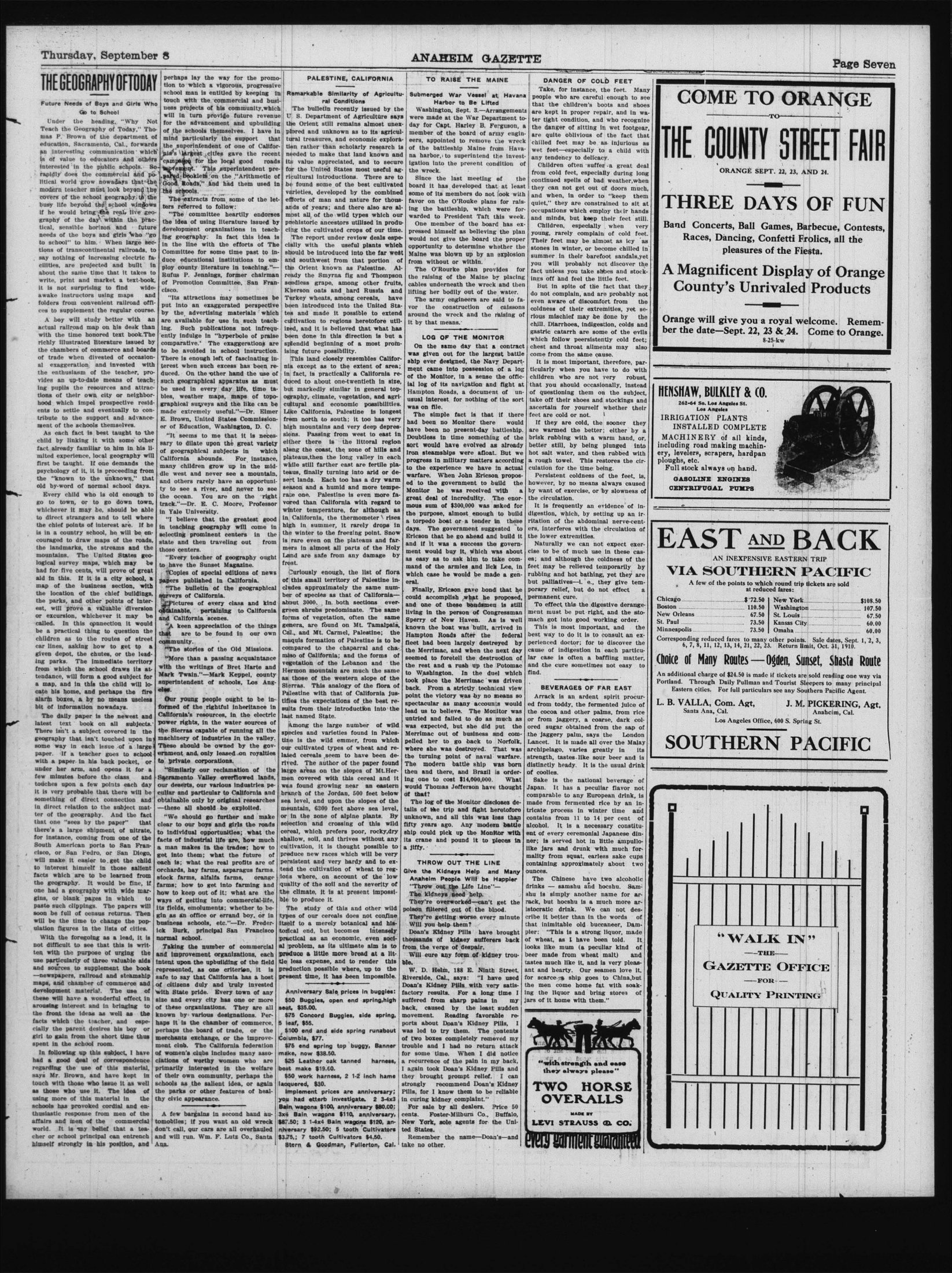
Searchable text
THE GEOGRAPHY OF TODAY
Future Needs of Boys and Girls Who Go to School
Under the heading, "Why Not Teach the Geography of Today," Thomas P. Brown of the department of education, Sacramento, Cal., forwards an interesting communication which is of value to educators and others interested in the public schools. Rapidly does the commercial and political world grow nowadays that the modern teacher must look beyond the covers of the school geography to the busy life beyond the school windows if he would bring the real, live geography of the day within the practical, sensible horizon and future needs of the boys and girls who "go to school" to him. When large sections of transcontinental railroads, to say nothing of increasing electric facilities, are projected and built in about the same time that it takes to write, print and market a text-book, it is not surprising to find wide awake instructors using maps and folders from convenient railroad offices to supplement the regular course.
A boy will study better with an actual railroad map on his desk than with the time honored text book. The richly illustrated literature issued by the chambers of commerce and boards of trade when divested of occasional exaggeration and invested with the enthusiasm of the teacher, provides an up-to-date means of teaching pupils the resources and attractions of their own city or neighborhood which impel prospective residents to settle and eventually to contribute to the support and advancement of the schools themselves.
As each fact is best taught to the child by linking it with some other fact already familiar to him in his limited experience, local geography will first be taught. If one demands the psychology of it, it is proceeding from perhaps lay the way for the promotion to which a vigorous, progressive school man is entitled by keeping in touch with the commercial and business projects of his community, which will in turn provide future revenue for the advancement and upbuilding of the schools themselves. I have in mind particularly the support that the superintendent of one of California's largest cities gave the recent campaign for the local good roads movement. This superintendent prepared booklets on the "Arithmetic of Good Roads," and had them used in the schools.
The extracts from some of the letters referred to follow:
"The committee heartily endorses the idea of using literature issued by development organizations in teaching geography. In fact this idea is in the line with the efforts of The Committee for some time past to induce educational institutions to employ county literature in teaching."—Rufus P. Jennings, former chairman of Promotion Committee, San Francisco.
"Its attractions may sometimes be put into an exaggerated perspective by the advertising materials which are available for use in such teaching. Such publications not infrequently indulge in "hyperbole of praise comparative." The exaggerations are to be avoided in school instruction. There is enough left of fascinating interest when such excess has been reduced. On the other hand the use of such geographical apparatus as must be used in every day life, time tables, weather maps, maps of topographical surveys and the like can be made extremely useful."—Dr. Elmer E. Brown, United States Commissioner of Education, Washington, D.C.
"It seems to me that it is necessary to dilate upon the great variety of geographical subjects in which California abounds. For instance, many children grow up in the middle west and never see a mountain."
PALESTINE, CALIFORNIA
Remarkable Similarity in Condition
The bulletin recently U.S. Department of Atheism still remains plured and unknown at treasures, and ecclesiastical rather than scholarly needed to make that last its value appreciated; for the United States cultural introductions be found some of the varieties, developed by efforts of man and nature years; and the most all of the wild prehistoric ancestors utilizing the cultivated crops.
The report under review usually with the useful should be introduced into and southwest from the Orient known as ready the Smyrna fig tree seedless grape, among Kherson oats and hard Turkey wheats, among been introduced into these trees and made it possible cultivation to regionsized, and it is believed been done in this direct splendid beginning of its using future possibility.
This land closely resides except as to the extent in fact, is practically adapted to about one-twelfth but markedly similar in geography, climate, vegetation cultural and economic Like California, Palestine from north to south; in high mountains and valleys. Passing from west either there is the along the coast, the zone plateaus, then the long while still farther east teas, finally turning in
As each fact is best taught to the child by linking it with some other fact already familiar to him in his limited experience, local geography will first be taught. If one demands the psychology of it, it is proceeding from the "known to the unknown," that old by-word of normal school days.
Every child who is old enough to go to town, or to go down town, whichever it may be, should be able to direct strangers and to tell where the chief points of interest are. If he is in a country school, he will be encouraged to draw maps of the roads, the landmarks, the streams and the mountains. The United States geological survey maps, which may be had for five cents, will prove of great aid in this. If it is a city school, a map of the business section, with the location of the chief buildings, the parks, and other points of interest, will prove a valuable diversion or excursion, whichever it may be called. In this connection it would be a practical thing to question the children as to the routes of street car lines, asking how to get to a given depot, the chutes, or the leading parks. The immediate territory from which the school draws its attendance, will form a good subject for a map, and in this the child will locate his home, and perhaps the fire alarm boxes, a by no means useless bit of information nowadays.
The daily paper is the newest and latest text book on all subjects. There isn't a subject covered in the geography that isn't touched upon in some way in each issue of a large paper. If a teacher goes to school with a paper in his back pocket, or under her arm, and opens it for a few minutes before the class and touches upon a few points each day it is very probable that there will be something of direct connection and in direct relation to the subject matter of the geography. And the fact that one "sees by the paper" that there's a large shipment of nitrate, for instance, coming from one of the South American ports to San Francisco, or San Pedro, or San Diego, will make it easier to get the child to interest himself in those salient facts which are to be learned from the geography. It would be fine, if one had a geography with wide margins, or blank pages in which to duce. On the other hand the use of such geographical apparatus as must be used in every day life, time tables, weather maps, maps of topographical surveys and the like can be made extremely useful."—Dr. Elmer E. Brown, United States Commissioner of Education, Washington, D.C.
"It seems to me that it is necessary to dilate upon the great variety of geographical subjects in which California abounds. For instance, many children grow up in the middle west and never see a mountain, and others rarely have an opportunity to see a river, and never to see the ocean. You are on the right track."—Dr. E. C. Moore, Professor in Yale University.
"I believe that the greatest good in teaching geography will come in selecting prominent centers in the state and then traveling out from those centers.
"Every teacher of geography ought to have the Sunset Magazine.
"Copies of special editions of news papers published in California.
"The bulletin of the geographical surveys of California.
"Pictures of every class and kind obtainable, pertaining to California and California scenes.
"A keen appreciation of the things that are to be found in our own community.
"The stories of the Old Missions.
"More than a passing acquaintance with the writings of Bret Harte and Mark Twain."—Mark Keppel, county superintendent of schools, Los Angeles.
Our young people ought to be informed of the rightful inheritance in California's resources, in the electric power rights, in the water sources of the Sierras capable of running all the machinery of industries in the valley. These should be owned by the government and only leased on royalties to private corporations.
"Similarly our reclamation of the Sacramento Valley overflowed lands, our deserts, our various industries peculiar and particular to California and obtainable only by original researches—these all should be exploited.
"We should go further and make clear to our boys and girls the roads to individual opportunities; what the facts of industrial life are, how much a man makes in the trades; how to get into them; what the future of each is; what the real profits are of orchards, hay farms, asparagus farms, stock farms, alfalfa farms, orange farms; how to get into farming and how to keep out of it; what are the ways of getting into commercial life."
In fact, is practically adapted to about one-twelfth but markedly similar in originogy, climate, vegetation cultural and economic Like California, Palestine from north to south; high mountains and very slions. Passing from either there is the along the coast, the zon plateaus; then the long while still farther east teauas finally turning in sert lands. Each too hot season and a humid and rare one. Palestine is favored than California with winter temperature; for in California, the thermo high in summer; it rains the winter to the freezing is rare even on the plains in almost all parts Land are safe from any frost.
Curiously enough, though of this small territory ocludes approximately three species as that about 3000. In both green shrubs predominates forms of vegetation, often genera are found on Mt. Cal., and Mt. Carmel, Hmaquis formation of Palms compared to the chaparral miso of California; and vegetation of the Lebanon mountain are most as those of the western Sierra. This analogy of Palestine with that of titles the expectations o suits from their introduction last named State.
Among the large num- species and varieties for time is the wild emmer our cultivated types of lazed cereals seem to bring. The author of these large areas on the slope men covered with this was found growing near branch of the Jordan, 5 sea level, and upon them mountain, 6300 feet above or in the zone of alpine selection and crossing cereal, which prefers shallow soil, and thrive cultivation, it is thought produce new races which persistent and very hard tend the cultivation of o lions where, on account quality of the soil and th e climate, it is at pre-ble produce it
something of direct connection and in direct relation to the subject matter of the geography. And the fact that one "sees by the paper" that there's a large shipment of nitrate, for instance, coming from one of the South American ports to San Francisco, or San Pedro, or San Diego, will make it easier to get the child to interest himself in those salient facts which are to be learned from the geography. It would be fine, if one had a geography with wide margins, or blank pages in which to paste such clippings. The papers will soon be full of census returns. Then will be the time to change the population figures in the lists of cities.
With the foregoing as a lead, it is not difficult to see that this is written with the purpose of urging the use particularly of three valuable aids and sources to supplement the book—newspapers, railroad and steamship maps, and chamber of commerce and development material. The use of these will have a wonderful effect in arousing interest and in bringing to the front the ideas as well as the facts which the teacher, and especially the parent desires his boy or girl to gain from the short time thus spent in the school room.
In following up this subject, I have had a good deal of correspondence regarding the use of this material, says Mr. Brown, and have kept in touch with those who issue it as well as those who use it. The idea of using more of this material in the schools has provoked cordial and enthusiastic response from men of the affairs and men of the commercial world. It is my belief that a teacher or school principal can entrench himself strongly in his position, and obtainable only by original researches—these all should be exploited.
"We should go further and make clear to our boys and girls the roads to individual opportunities; what the facts of industrial life are, how much a man makes in the trades; how to get into them; what the future of each is; what the real profits are of orchards, hay farms, asparagus farms, stock farms, alfalfa farms, orange farms; how to get into farming and how to keep out of it; what are the ways of getting into commercial-life, its fields, emoluments; whether to begin as an office or errand boy, or in business schools, etc."—Dr. Frederick Burk, principal San Francisco normal school.
Taking the number of commercial and improvement organizations, each intent upon the upbuilding of the field represented, as one criterion, it is safe to say that California has a host of citizens duly and truly invested with State pride. Every town of any size and every city has one or more of these organizations. They are all known by various designations. Perhaps it is the chamber of commerce, perhaps the board of trade, or the merchants exchange, or the improvement club. The California federation of women's clubs includes many associations of worthy women who are primarily interested in the welfare of their own community, perhaps the schools as the salient idea, or again the parks or other features of healthy civic appearance.
A few bargains in second hand automobiles; if you want an old wreck don't call, our cars are all overhauled and will run. Wm. F. Lutz Co., Santa Ana.
Anniversary Sale prices
$50 Buggies, open end seat, $35.00.
$75 Concord Buggies, 5 leaf, $55.
$100 end and side sprout Columbia, $77.
$75 end spring top bake make, now $38.50.
$25 Leather oak tanner boat make $19.60.
$50 work harness, 2 1/4 laoquered, $30.
Implement prices are you had etterb investigate Bain wagons $100, anniversary 3x4 Bain wagons $110,
$87.50; 3 1-4x4 Bain wagons anniversary $92.50; 5 tooth $3.75; 7 tooth Cultivator Stern & Goodman, Fr
ANAHEIM GAZETTE
PALESTINE, CALIFORNIA
Ramarkable Similarity of Agricultural Conditions
The bulletin recently issued by the U.S. Department of Agriculture says the Orient still remains almost unexplored and unknown as to its agricultural treasures, and economic exploration rather than scholarly research is needed to make that land known and its value appreciated, and to secure for the United States most useful agricultural introductions. There are to be found some of the best cultivated varieties, developed by the combined efforts of man and nature for thousands of years; and there also are almost all of the wild types which our prehistoric ancestors utilized in producing the cultivated crops of our time.
The report under review deals especially with the useful plants which should be introduced into the far west and southwest from that portion of the Orient known as Palestine. Already the Smyrna fig and Thompson seedless grape, among other fruits, Kherson oats and hard Russia and Turkey wheats, among cereals, have been introduced into the United States and made it possible to extend cultivation to regions heretofore utilized, and it is believed that what has been done in this direction is but a splendid beginning of a most promising future possibility.
This land closely resembles California except as to the extent of area; in fact, is practically a California reduced to about one-twentieth in size, but markedly similar in general topography, climate, vegetation, and agricultural and economic possibilities. Like California, Palestine is longest from north to south; it too has very high mountains and very deep depressions. Passing from west to east in either there is the littoral region along the coast, the zone of hills and plateaus, then the long valley in each while still farther east are fertile plateaus, finally turning into arid or de-
TO RAISE THE MAINE
Submerged War Vessel at Havana Harbor to Be Lifted
Washington, Sept. 3.—Arrangements were made at the War Department today for Capt. Harley B. Ferguson, a member of the board of army engineers, appointed to remove the wreck of the battleship Maine from Havana harbor, to superintend the investigation into the present condition of the wreck.
Since the last meeting of the board it has developed that at least some of its members do not look with favor on the O'Rouke plans for raising the battleship, which were forwarded to President Taft this week.
One member of the board has expressed himself as believing the plan would not give the board the proper opportunity to determine whether the Maine was blown up by an explosion from without or within.
The O'Rourke plan provides for the raising of the Maine by placing cables underneath the wreck and then lifting her bodily out of the water.
The army engineers are said to favor the construction of caissons around the wreck and the raising of it by that means.
LOG OF THE MONITOR
On the same day that a contract was given out for the largest battle ship ever designed, the Navy Department came into possession of a log of the Monitor, in a sense the official log of its navigation and fight at Hampton Roads, a document of unusual interest for nothing of the sort was on file.
The simple fact is that if there had been no Monitor there would have been no present-day battleship. Doubtless in time something of the sort would have evolved as already iron steamships were afloat. But we progress in military matters according to the experience we have in actual warfare. When John Eriksen proposes
DANGER OF COLD FEET
Take, for instance, the feet. Many people who are careful enough to see that the children's boots and shoes are kept in proper repair, and in water tight condition, and who recognize the danger of sitting in wet footgear, are quite oblivious of the fact that chilled feet may be as injurious as wet feet—especially to a child with any tendency to delicacy.
Children often suffer a great deal from cold feet, especially during long continued spells of bad weather, when they can not get out of doors much, and when, in order to "keep them quiet," they are constrained to sit at occupations which employ their hands and minds, but keep their feet still.
Children, especially when very young, rarely complain of cold feet. Their feet may be almost as ice as stones in winter, or become chilled in summer in their barefoot sandals, yet you will probably not discover the fact unless you take shoes and stockings off and feel the little feet.
But in spite of the fact that they do not complain, and are probably not even aware of discomfort from the coldness of their extremities, yet serious mischief may be done by the chill. Diarrhoea, indigestion, colds and gastric catarrh are some of the evils which follow persistently cold feet; chest and throat ailments may also come from the same cause.
It is most important, therefore, particularly when you have to do with children who are not very robust, that you should occasionally, instead of questioning them on the subject, take off their shoes and stockings and ascertain for yourself whether their feet are cold or not.
If they are cold, the sooner they are warmed the better; either by a brisk rubbing with a warm hand, or better still, by being plunged into hot salt water, and then rubbed with a rough towel. This restores the circulation for the time being.
In fact, is practically a California reduced to about one-twentieth in size, but markedly similar in general topography, climate, vegetation, and agricultural and economic possibilities. Like California, Palestine is longest from north to south; it too has very high mountains and very deep depressions. Passing from west to east in either there is the littoral region along the coast, the zone of hills and plateaus, then the long valley in each while still farther east are fertile plateaus, finally turning into arid or desert lands. Each too has a dry warm season and a humid and more temperate one. Palestine is even more favored than California with regard to winter temperature, for although as in California, the thermometer rises high in summer, it rarely drops in the winter to the freezing point. Snow is rare even on the plateaus and farmers in almost all parts of the Holy Land are safe from any damage by frost.
Curiously enough, the list of flora of this small territory of Palestine includes approximately the same number of species as that of California—about 3000. In both sections evergreen shrubs predominate. The same forms of vegetation, often the same genera, are found on Mt. Tamalpais, Cal., and Mt. Carmel, Palestine; the maquis formation of Palestine is to be compared to the chaparral and chamao of California; and the forms of vegetation of the Lebanon and the Hermon mountain are much the same as those of the western slope of the Sierra. This analogy of the flora of Palestine with that of California justifies the expectations of the best results from their introduction into the last named State.
Among the large number of wild species and varieties found in Palestine is the wild emmer, from which our cultivated types of wheat and related cereals seem to have been derived. The author of the paper found large areas on the slopes of Mt.Hermen covered with this cereal and it was found growing near an eastern branch of the Jordan, 500 feet below sea level, and upon the slopes of the mountain, 6300 feet above sea level, or in the zone of alpine plants. By selection and crossing of this wild cereal, which prefers poor, rocky,dry shallow, soil, and thrives without any cultivation, it is thought possible to produce new races which will be very persistent and very hardy and to extend the cultivation of wheat to regions where, on account of the low quality of the soil and the severity of the climate, it is at present impossible to produce it.
The simple fact is that if there had been no Monitor there would have been no present-day battleship. Doubtless in time something of the sort would have evolved as already iron steamships were afloat. But we progress in military matters according to the experience we have in actual warfare. When John Ericson proposed to the government to build the Monitor he was received with a great deal of incredulity. The enormous sum of $300,000 was asked for the purpose, almost enough to build a torpedo boat or a tender in these days. The government suggested to Ericson that he go ahead and build it and if it was a success the government would buy it, which was about as easy as to ask him to take command of the armies and lick Lee, in which case he would be made a general.
Finally, Ericson gave bond that he could accomplish what he proposed, and one of these bondsmen is still living in the person of Congressman Sperry of New Haven. As is well known the boat was built, arrived in Hampton Roads after the federal fleet had been largely destroyed by the Merrimac, and when the next day seemed to foretell the destruction of the rest and a rush up the Potomac to Washington. In the duel which took place the Merrimac was driven back. From a strictly technical view point the victory was by no means so spectacular as many accounts would lead us to believe. The Monitor was untried and failed to do as much as was expected, but she did put the Merrimac out of business and compelled her to go back to Norfolk, where she was destroyed. That was the turning point of naval warfare. The modern battle ship was born then and there, and Brazil is ordering one to cost $14,000,000. What would Thomas Jefferson have thought of that?
The log of the Monitor discloses details of the trip and flight heretofore unknown, and all this was less than fifty years ago. Any modern battle ship could pick up the Monitor with its crane and pound it to pieces in a jiffy.
THROW OUT THE LINE
Give the Kidneys Help and Many Anaheim People Will be Happier "Throw out the Life Line"—The Kidneys need help.
children who are not very robust, that you should occasionally, instead of questioning them on the subject, take off their shoes and stockings and ascertain for yourself whether their feet are cold or not.
If they are cold, the sooner they are warmed the better; either by a brisk rubbing with a warm hand, or better still, by being plunged into hot salt water, and then rubbed with a rough towel. This restores the circulation for the time being.
Persistent coldness of the feet, is however, by no means always caused by want of exercise, or by slowness of the circulation.
It is frequently an evidence of indigestion, which, by setting up an irritation of the abdominal nerve-centers, interferes with the circulation of the lower extremities.
Naturally we can not expect exercise to be of much use in these cases; and although the coldness of the feet may be relieved temporarily by rubbing and hot bathing, yet they are but palliatives—i.e., they give temporary relief, but do not effect a permanent cure.
To effect this the digestive derangement must be put right, and the stomach got into good working order.
This is most important, and the best way to do it is to consult an experienced doctor; for to discover the cause of indigestion in each particular case is often a baffling matter, and the cure sometimes not easy to find.
BEVERAGES OF FAR EAST
Arrack is an ardent spirit procured from toddy, the fermented juice of the cocoa and other palms, from rice or from jaggery, a coarse, dark colored sugar obtained from the sap of the jaggery palm, says the London Lancet. It is made all over the Malay archipelago, varies greatly in its strength, tastes like sour beer and is distinctly heady. It is the usual drink of coolies.
Sake is the national beverage of Japan. It has a peculiar flavor not comparable to any European drink, is made from fermented rice by an intricate process in winter time and contains from 11 to 14 per cent of alcohol. It is a necessary constituent of every ceremonial Japanese dinner; is served hot in little ampull-like jars and drunk with much formality from squat, earless sake cups containing approximately about two ounces.
The Chinese have two alcoholic drinks — samshu and hocshu. Samshu is simply another name for ar-
The log of the Monitor discloses details of the trip and fight heretofore unknown, and all this was less than fifty years ago. Any modern battle ship could pick up the Monitor with its crane and pound it to pieces in a jiffy.
THROW OUT THE LINE
Give the Kidneys Help and Many Anaheim People Will be Happier
"Throw out the Life Line"
The kidneys need help.
They're overworked—can't get the poison filtered out of the blood.
They're getting worse every minute.
Will you help them?
Doan's Kidney Pills have brought thousands of kidney sufferers back from the verge of despair.
Will cure any form of kidney trouble.
W. D. Helm, 188 E. Ninth Street, Riverside, Cal., says: "I have used Doan's Kidney Pills with very satisfactory results. For a long time I suffered from sharp pains in my back, caused by the least sudden movement. Reading favorable reports about Doan's Kidney Pills, I was led to try them. The contents of two boxes completely removed my trouble and I had no return attack for some time. When I did notice a recurrence of the pain in my back, I again took Doan's Kidney Pills and they brought prompt relief. I can strongly recommend Doan's Kidney Pills, for I know them to be reliable in curing kidney complaint."
For sale by all dealers. Price 50 cents. Foster-Milburn Co., Buffalo, New York, sole agents for the United States.
Remember the name—Doan's—and take no other.
The Chinese have two alcoholic drinks — samshu and hocshu. Samshu is simply another name for arrack, but hocshu is a much more artistic drink. We can not describe it better than in the words of that inimitable old buccaneer, Dampler: "This is a strong liquor, made of wheat, as I have been told. It looks like mum (a peculiar kind of beer made from wheat malt) and tastes much like it, and is very pleasant and hearty. Our seamen love it, for scarce ship goes to China, but the men come home fat with soaking the liquor and bring stores of jars of it home with them."
COME TO ORANGE
TO
THE COUNTY STREET FAIR
ORANGE SEPT. 22, 23, AND 24.
THREE DAYS OF FUN
Band Concerts, Ball Games, Barbecue, Contests,
Races, Dancing, Confetti Frolics, all the pleasures of the Fiesta.
A Magnificent Display of Orange County’s Unrivaled Products
Orange will give you a royal welcome. Remember the date—Sept. 22, 23 & 24. Come to Orange.
8-25-kw
HENSHAW, BULKLEY & CO.
262-64 So. Los Angeles St.
Los Angeles
IRRIGATION PLANTS
INSTALLED COMPLETE
MACHINERY of all kinds,
including road making machinery,
levelers, scrapers, hardpan ploughs, etc.
Full stock always on hand.
HENSHAW, BULKLEY & CO.
262-64 So. Los Angeles St.
Los Angeles
IRRIGATION PLANTS
INSTALLED COMPLETE
MACHINERY of all kinds,
including road making machinery,
levelers, scrapers, hardpan ploughs, etc.
Full stock always on hand.
GASOLINE ENGINES
CENTRIFUGAL PUMPS
EAST AND BACK
AN INEXPENSIVE EASTERN TRIP
VIA SOUTHERN PACIFIC
A few of the points to which round trip tickets are sold at reduced fares:
Chicago $72.50 New York $108.50
Boston 110.50 Washington 107.50
New Orleans 67.50 St. Louis 67.50
St. Paul 73.50 Kansas City 60.00
Minneapolis 73.50 Omaha 60.00
Corresponding reduced fares to many other points. Sale dates, Sept. 1, 2, 3, 6, 7, 8, 11, 12, 13, 14, 21, 22, 23. Return limit, Oct. 31, 1910.
Choice of Many Routes — Ogden, Sunset, Shasta Route
An additional charge of $24.50 is made if tickets are sold reading one way via Portland. Through Daily Pullman and Tourist Sleepers to many principal Eastern cities. For full particulars see any Southern Pacific Agent.
L. B. VALLA, Com. Agt,
Santa Ana, Cal.
J. M. PICKERING, Agt,
Anahcim, Cal.
Los Angeles Office, 600 S. Spring St.
SOUTHERN PACIFIC
"WALK IN"
THE
GAZETTE OFFICE
FOR
QUALITY PRINTING