anaheim-gazette 1910-09-01
Scanned page
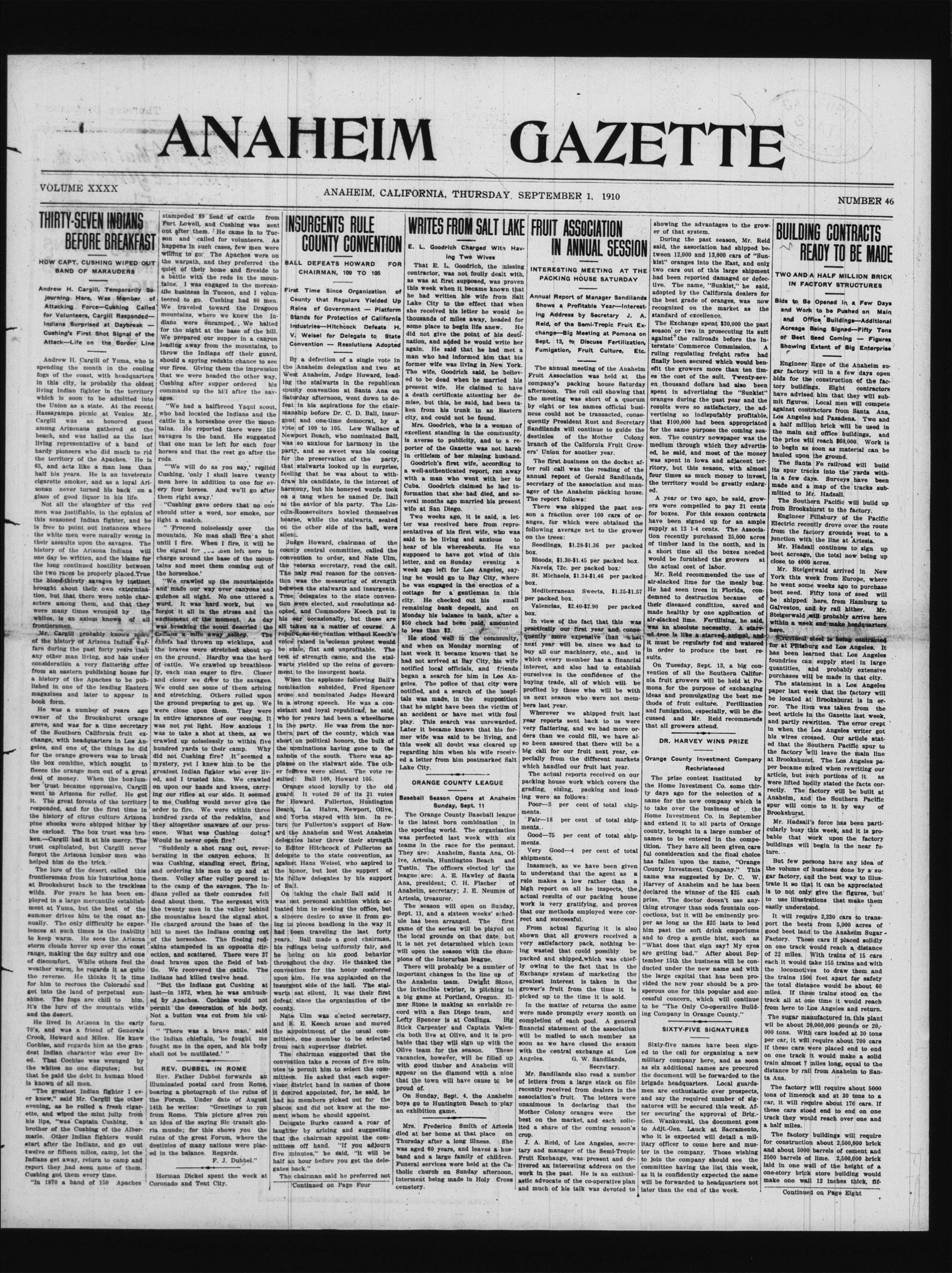
Searchable text
THIRTY-SEVEN INDIANS BEFORE BREAKFAST
HOW CAPT. CUSHING WIPED OUT BAND OF MARAUDERS
Andrew H. Cargill, Temporarily Sojourning Here, Was Member of Attacking Force—Cushing Called for Volunteers, Cargill Responded—Indians Surprised at Daybreak — Cushing's First Shot Signal of the Attack—Life on the Border Line
Andrew H. Cargill of Yuma, who is spending the month in the cooling fogs of the coast, with headquarters in this city, is probably the oldest living Indian fighter in the territory which is soon to be admitted into the Union as a state. At the recent Hassayampa picnic at Venice Mr. Cargill was an honored guest among Arizonans gathered at the beach, and was hailed as the last living representative of a band of hardy pioneers who did much to rid the territory of the Apaches. He is 65, and acts like a man less than half his years. He is an inveterate stampeded 89 head of cattle from Fort Lowell, and Cushing was sent out after them. He came in to Tucson and called for volunteers. As happens in such cases, few men were willing to go: The Apaches were on the warpath, and they preferred the quiet of their home and fireside to a battle with the reds in the mountains. I was engaged in the mercantile business in Tucson, and I volunteered to go. Cushing had 80 men. We traveled toward the Dragoon mountains, where we knew the Indians were encamped. We halted for the night at the base of the hill. We prepared our supper in a canyon leading away from the mountains, to throw the Indians off their guard, should a spying redskin chance to see our fires. Giving them the impression that we were headed the other way, Cushing after supper ordered his command up the hill after the savages.
"We had a halfbreed Yaqui scout, who had located the Indians and the cattle in a horseshoe over the mountains. He reported there were 150 savages in the band. He suggested that one man be left for each four horses and that the rest go after the reds.
"We will do as you say," replied Cushing 'only I shall leave twenty."
logs of the coast, with headquarters in this city, is probably the oldest living Indian fighter in the territory which is soon to be admitted into the Union as a state. At the recent Hassayampa picnic at Venice Mr. Cargill was an honored guest among Arizonaans gathered at the beach, and was hailed as the last living representative of a band of hardy pioneers who did much to rid the territory of the Apaches. He is 65, and acts like a man less than half his years. He is an inveterate cigarette smoker, and as a loyal Arizonaan never turned his back on a glass of good liquor in his life.
Not all the slaughter of the red men was justifiable, in the opinion of this seasoned Indian fighter, and he is free to point out instances where the white men were morally wrong in their assaults upon the savages. The history of the Arizona Indians will one day be written, and the blame for the long continued hostility between the two races be properly placed. True the blood-thirsty savages by instinct brought about their own extermination, but that there were noble characters among them, and that they were many times wronged by the whites, is an axiom known of all frontiersmen.
Mr. Cargill probably knows more of the history of Arizona Indian warfare during the past forty years than any other man living, and has under consideration a very flattering offer from an eastern publishing house for a history of the Apaches to be published in one of the leading Eastern magazines and later to appear in book form.
He was a number of years ago owner of the Brookshurst orange grove, and was for a time secretary of the Southern California fruit exchange, with headquarters in Los Angeles, and one of the things he did for the orange growers was to break the box combine, which sought to fleece the orange men out of a great deal of money. When the box-lumber trust became oppressive, Cargill went to Arizona for relief. He got it. The great forests of the territory responded, and for the first time in the history of citrus culture Arizona pine shoaks were shipped hither by the carload. The box trust was broken.—Cargill had it at his mercy. The trust capitulated, but Cargill never forgot the Arizona lumber men who helped him do the trick.
The lure of the desert called this frontiersman from his luxurious home at Brookshurst back to the trackless wilds. For years he has been employed in a large company that we were headed the other way, Cushing after supper ordered his command up the hill after the savages.
"We had a halfbreed Yaqui scout, who had located the Indians and the cattle in a horseshoe over the mountains. He reported there were 150 savages in the band. He suggested that one man be left for each four horses and that the rest go after the reds.
"We will do as you say," replied Cushing, 'only I shall leave twenty men here in addition to one for every four horses. And we'll go after them right away.'
"Cushing gave orders that no one should utter a word, nor smoke, nor light a match.
"'Proceed noiselessly over the mountain. No man shall fire a shot until I fire. When I fire, it will be the signal for you men left nere to charge around the base of the mountains and meet them coming out of the horseshoe."
"We crawled up the mountainside and made our way over canyons and gulches all night. No one uttered a word. It was hard work, but we forgot it all in the stress and the excitement of the moment. As day was breaking the scout described the Indians a mile away asleep. The chiefs had thrown up wicklups, and the braves were stretched about upon the ground. Hardby was the herd of cattle. We crawled up breathlessly, each man eager to fire. Closer and closer we drew to the savages. We could see some of them arising and stretching. Others rolled upon the ground preparing to get up. We were close upon them. They were in entire ignorance of our comjng. It was not yet light. How anxious I was to take a shot at them, as we crawled up noiselessly to within five hundred yards to their camp. Why did not Cushing fire? It seemed a mystery, yet I knew him to be the greatest Indian fighter who ever lived, and I trusted him. We crawled on upon our hands and knees, carrying our rifles at our side. It seemed to me Cushing would never give the order to fire. We were within three hundred yards of the redskins, and they altogether unaware of our presence. What was Cushing doing? Would he never open fire?
"Suddenly a shot rang out, reverberating in the canyon echoes. It was Cushing, standing erect, firing, and ordering his men to up and at them. Volley after volley poured into the camp of the savages. The Indians yelled as their comrades fell that we were headed the other way, Cushing after supper ordered his command up the hill after the savages.
"We had a halfbreed Yaqui scout, who had located the Indians and the cattle in a horseshoe over the mountains. He reported there were 150 savages in the band. He suggested that one man be left for each four horses and that the rest go after the reds.
"We will do as you say,' replied Cushing, 'only I shall leave twenty men here in addition to one for every four horses. And we'll go after them right away.'"
"Cushing gave orders that no one should utter a word, nor smoke, nor light a match.
"'Proceed noiselessly over the mountain. No man shall fire a shot until I fire. When I fire, it will be the signal for you men left nere to charge around the base of the mountains and meet them coming out of the horseshoe.'"
"We crawled up the mountainside and made our way over canyons and gulches all night. No one uttered a word. It was hard work, but we forgot it all in the stress and the excitement of the moment. As day was breaking the scout described the Indians a mile away asleep. The chiefs had thrown up wicklumps, and the braves were stretched about upon the ground. Hardby was the herd of cattle. We crawled up breathlessly, each man eager to fire. Closer and closer we drew to the savages. We could see some of them arising and stretching. Others rolled upon the ground preparing to get up. We were close upon them. They were in entire ignorance of our comjng. It was not yet light. How anxious I was to take a shot at them, as we crawled up noiselessly to within five hundred yards to their camp. Why did not Cushing fire? It seemed a mystery, yet I knew him to be the greatest Indian fighter who ever lived, and I trusted him. We crawled on upon our hands and knees, carrying our rifles at our side. It seemed to me Cushing would never give the order to fire. We were within three hundred yards of the redskins, and they altogether unaware of our presence. What was Cushing doing? Would he never open fire?'"
"Suddenly a shot rang out, reverberating in the canyon echoes. It was Cushing, standing erect, firing, and ordering his men to up and at them. Volley after volley poured into the camp of the savages. The Indians yelled as their comrades fell that we were headed the other way, Cushing after supper ordered his command up the hill after the savages."
The great forests of the territory responded, and for the first time in the history of citrus culture Arizona pine shooks were shipped hither by the carload. The box trust was broken.—Cargill had it at his mercy. The trust capitulated, but Cargill never forgot the Arizona lumber men who helped him do the trick.
The lure of the desert called this frontiersman from his luxurious home at Brookshurst back to the trackless wilds. For years he has been employed in a large mercantile establishment at Yuma, but the heat of the summer drives him to the coast annually. The only difficulty he experiences at such times is the inability to keep warm. He sees the Arizona storm clouds hover up over the coast range, making the day sultry and one of discomfort. While others feel the weather warm, he regards it as quite the reverse. He thinks it is time for him to recross the Colorado and get into the land of perpetual sunshine. The fogs are chill to him. It's the lure of the mountain wilds and the desert.
He lived in Arizona in the early 70's, and was a friend of Generals Crook, Howard and Miles. He knew Cochise, and regards him as the greatest Indian character who ever lived. That Cochise was wronged by the whites no one disputes; but that he paid the debt in human blood is known of all men.
"The greatest Indian fighter I ever knew," said Mr. Cargill the other evening, as he rolled a fresh cigarette, and wiped the mint julip from his lips, "was Captain Cushing, a brother of the Cushing of the Albermarle. Other Indian fighters would start after the Indians, and go out twelve or fifteen miles, camp, let the Indians get away, return to camp and report they had seen none of them. Cushing got them every time.
"In 1870 a band of 150 Apaches to me. Cushing would never give the order to fire. We were within three hundred yards of the redskins, and they altogether unaware of our presence. What was Cushing doing? Would he never open fire?
"Suddenly a shot rang out, reverberating in the canyon echoes. It was Cushing, standing erect, firing, and ordering his men to up and at them. Volley after volley poured into the camp of the savages. The Indians yelled as their comrades fell dead about them. The sergeant with the twenty men in the valley behind the mountains heard the signal shot. He charged around the base of the hill to meet the Indians coming out of the horseshoe. The fleeing redskins stampeded in an opposite direction, and scattered. There were 37 dead braves upon the field of battle. We recovered the cattle. The Indians had killed twelve head.
"But the Indians got Cushing at last—in 1872, when he was ambushed by Apaches. Cochise would not permit the desecration of his body. Not a button was cut from his uniform.
"'There was a brave man,' said the Indian chieftain, 'he fought me fought me in the open, and his body shall not be mutilated.'"
REV. DUBBEL IN ROME
Rev. Father Dubbel forwards an illuminated postal card from Rome, bearing a photograph of the ruins of the Forum. Under date of August 14th he writes: "Greetings to you from Rome. This picture gives you an idea of the saying Sic transit gloria munde; for this shows you the ruins of the great Forum, where the destinies of many nations were placed in the balance. Regards.
F. J. Dubbel."
Herman Dickel spent the week at Coronado and Tent City.
On taking the chair B was not personal ambition tuited him in seeking the a sincere desire to save to pieces headlong in had been traveling the years. Ball made a good his rulings being uniform he being on his good throughout the day. He conventions for the honor upon him. He was applaud insurgent side of the hall warts sat silent. It was defeat since the organization county.
Nate Ulm was elected and E. E. Keech arose from the appointment of the mittees, one member to from each supervisor district.
The chairman suggested convention take a recess of utes to permit him to select mittees. He asked that visor district hand in name it desired appointed, for, had no members picked on places and did not know ment whom he should apply.
Delegate Burke caused laughter by arising and that the chairman appoint mittees off hand. "If you five minutes," he said, "half an hour before you get gates back."
The chairman said he pro-
INSURGENTS RULE COUNTY CONVENTION
BALL DEFEATS HOWARD FOR CHAIRMAN, 109 TO 105
First Time Since Organization of County that Regulars Yielded Up Reins of Government — Platform Stands for Protection of California Industries—Hitchcock Defeats H. V. Weisel for Delegate to State Convention — Resolutions Adopted
By a defection of a single vote in the Anaheim delegation and two at West Anaheim, Judge Howard, leading the stalwarts in the republican county convention at Santa Ana on Saturday afternoon, went down to defeat in his aspirations for the chairmanship before Dr. C. D. Ball, insurgent and one-time democrat, by a vote of 109 to 105. Lew Wallace of Newport Beach, who nominated Ball, was so anxious for harmony in the party, and so sweet was his cooing for the preservation of the party, that stalwarts looked up in surprise, feeling that he was about to with-
WRITES FROM SALT LAKE
E. L. Goodrich Charged With Having Two Wives
That E. L. Goodrich, the missing contractor, was not foully dealt with, as was at first supposed, was proven this week when it became known that he had written his wife from Salt Lake City to the effect that when she received his letter he would be thousands of miles away, headed for some place to begin life anew. He did not give the point of his destination, and added he would write her again. He said that he had met a man who had informed him that his former wife was living in New York. The wife, Goodrich said, he believed to be dead when he married his present wife. He claimed to have a death certificate attesting her demise, but this, he said, had been taken from his trunk in an Eastern city, and could not be found.
Mrs. Goodrich, who is a woman of excellent standing in the community, is averse to publicity, and to a reporter of the Gazette was not harsh in criticism of her missing husband.
Goodrich's first wife, according to a well-authenticated report, ran away
FRUIT ASSOCIATION IN ANNUAL SESSION
INTERESTING MEETING AT THE PACKING HOUSE SATURDAY
Annual Report of Manager Sandilands Shows a Profitable Year—Interesting Address by Secretary J. A. Reid, of the Semi-Tropic Fruit Exchange—Big Meeting at Pomona on Sept. 13, to Discuss Fertilization, Fumigation, Fruit Culture, Etc.
The annual meeting of the Anaheim Fruit Association was held at the company's packing house Saturday afternoon. The roll call showing that the meeting was short of a quorum by eight or ten names official business could not be transacted, consequently President Rust and Secretary Sandilands will continue to guide the destinies of the Mother Colony branch of the California Fruit Growers' Union for another year.
The first business on the docket after roll call was the reading of the
West Anaheim, Judge Howard, leading the stalwarts in the republican county convention at Santa Ana on Saturday afternoon, went down to defeat in his aspirations for the chairmanship before Dr. C. D. Ball, insurgent and one-time democrat, by a vote of 109 to 105. Lew Wallace of Newport Beach, who nominated Ball, was so anxious for harmony in the party, and so sweet was his cooing for the preservation of the party, that stalwarts looked up in surprise, feeling that he was about to withdraw his candidate, in the interest of harmony, but his honeyed words took on a tang when he named Dr. Ball as the savior of his party. The Lincoln-Roosevelters howled themselves hoarse, while the stalwarts, seated on the other side of the hall, were silent.
Judge Howard, chairman of the county central committee, called the convention to order, and Nate Ulm, the veteran secretary, read the call. The only real reason for the convention was the measuring of strength between the stalwarts and insurgents. True delegates to the state convention were elected, and resolutions adopted, and Commodore Keech put in his ear occasionally, but these are all taken as a matter of course. A Republican convention without Keech's voice raised in solemn protest would be stale, flat and unprofitable. The test of strength came, and the stalwarts yielded up the reins of government to the insurgent hosts.
When the applause following Ball's nomination subsided, Fred Spencer arrose and nominated Judge Howard in a strong speech. He was a consistent and loyal republican, he said, who for years had been a wheelhorse in the party. He was from the northern part of the county, which was short on political honors, the bulk of the nominations having gone to the abolls of the south. There was applause on the stalwart side. The other fellows were silent. The vote resulted: Ball 109, Howard 105.
Orange stood loyally by the old guard. It voted 20 of its 21 votes for Howard. Fullerton, Huntington Beach, La Habra, Newport, Olive, and Yorba stayed with him. In return for Fullerton's support of Howard the Anaheim and West Anaheim delegates later threw their strength to Editor Hitchcock of Fullerton as delegate to the state convention, as against Hans Weisel, who aspired to be honor, but lost the support of his fellow delegates by his support of Ball.
On taking the chair Ball said it believed to be dead when he married his present wife. He claimed to have a death certificate attesting her demise, but this, he said, had been taken from his trunk in an Eastern city, and could not be found.
Mrs. Goodrich, who is a woman of excellent standing in the community, is averse to publicity, and to a reporter of the Gazette was not harsh in criticism of her missing husband.
Goodrich's first wife, according to a well-authenticated report, ran away with a man who went with her to Cuba. Goodrich claimed he had information that she had died, and several months ago married his present wife at San Diego.
Two weeks ago, it is said, a letter was received here from representatives of his first wife, who was said to be living and anxious to hear of his whereabouts. He was supposed to have got wind of this letter, and on Sunday evening a week ago left for Los Angeles, saying he would go to Bay City, where he was engaged in the erection of a cottage for a gentleman in this city. He checked out his small remaining bank deposit, and on Monday his balance in bank, after a $50 check had been paid, amounted to less than $2.
He stood well in the community, and when on Monday morning of last week it became known that he had not arrived at Bay City, his wife notified local officials, and friends began a search for him in Los Angeles. The police of that city were notified, and a search of the hospitals was made, in the supposition that he might have been the victim of an accident or have met with foul play. This search was unrewarded. Later it became known that his former wife was said to be living, and this week all doubt was cleared up regarding him when his wife received a letter from him postmarked Salt Lake City.
ORANGE COUNTY LEAGUE
Baseball Season Opens at Anaheim Sunday, Sept. 11
The Orange County Baseball league is the latest born combination in the sporting world. The organization was perfected last week with six teams in the race for the pennant. They are: Anaheim, Santa Ana, Olive, Artesia, Huntington Beach and Tustin. The officers elected by the league are: A. E. Hawley of Santa Ana, president; C. H. Fischer of Anaheim, secretary; J. E. Neumes of Artesia treasurer.
Fruit Association was held at the company's packing house Saturday afternoon. The roll call showing that the meeting was short of a quorum by eight or tea names official business could not be transacted, consequently President Rust and Secretary Sandilands will continue to guide the destinies of the Mother Colony branch of the California Fruit Growers' Union for another year.
The first business on the docket after roll call was the reading of the annual report of Gerald Sandilands, secretary of the association and manager of the Anaheim packing house. The report follows:
There was shipped the past season a fraction over 100 cars of oranges, for which were obtained the following average net to the grower on the trees:
Seedlings, $1.28-$1.36 per packed box.
Bloods, $1.30-$1.45 per packed box.
Navels, 72c. per packed box:
St. Michaels, $1.34-$1.46 per packed box.
Mediterranean Sweets, $1.35-$1.57 per packed box.
Valencias, $2.40-$2.90 per packed box.
In view of the fact that this was practically our first year and consequently more expensive than what next year will be, since we had to buy all our machinery, etc., and in which every member has a financial interest, and also had to establish ourselves in the confidence of the buying trade, all of which will be profited by those who will be with us next season who were not members last year.
Wherever we shipped fruit last year reports sent back to us were very flattering, and we had more orders than we could fill, we have also been assured that there will be a big call for our fruit next year, especially from the different markets which handled our fruit last year.
The actual reports received on our packing house work which covers the grading, sizing, packing and loading were as follows:
Poor—3 per cent of total shipments.
Fair—18 per cent of total shipments...
Good—75 per cent of total shipments.
Very Good—4 per cent of total shipments.
Inasmuch as we have been given to understand that the agent as a rule makes a low rather than a high report on all he inspects,the actual results of our packing house
On taking the chair Ball said it was not personal ambition which acceded him in seeking the office, but sinoere desire to save it from going to pieces headlong in the way it had been traveling the last forty years. Ball made a good chairman, his rulings being uniformly fair, and being on his good behavior throughout the day. He thanked the convention for the honor conferred upon him. He was applauded on the surgerent side of the hall. The stalarts sat silent. It was their first defeat since the organization of the county.
Nate Ulm was elected secretary, and E. E. Keech arose and moved the appointment of the usual committees, one member to be selected from each supervisor district.
The chairman suggested that the convention take a recess of five minutes to permit him to select the committees. He asked that each supervisor district hand in names of those desired appointed, for, he said, he had no members picked out for the races and did not know at the moment whom he should appoint.
Delegate Burke caused a roar of laughter by arising and suggesting that the chairman appoint the committees off hand. "If you adjourn five minutes," he said, "it will be half an hour before you get the delegates back."
The chairman said he preferred not
Continued on Page Four
Baseball Season Opens at Anaheim Sunday, Sept. 11
The Orange County Baseball league is the latest born combination in the sporting world. The organization was perfected last week with six teams in the race for the pennant. They are: Anaheim, Santa Ana, Olive, Artesia, Huntington Beach and Tustin. The officers elected by the league are: A. E. Hawley of Santa Ana, president; C. H. Fischer of Anaheim, secretary; J. E. Neumes of Artesia, treasurer.
The season will open on Sunday, Sept. 11, and a sixteen weeks' schedule has been arranged. The first game of the series will be played on the local grounds on that date but it is not yet determined which team will open the season with the champions of the Interurban league.
There will probably be a number of important changes in the line up of the Anaheim team. Dwight Stone, the invincible twirler, is pitching in a big game at Portland, Oregon. Elmer Stone is making an enviable record with a San Diego team, and Lefty Spencer is at Coalinga. Big Stick Carpenter and Captain Valencia both live at Olive, and it is probable that they will sign up with the Olive team for the season. These vacancies, however, will be filled up with good timber and Anaheim will appear on the diamond with a nine that the town will have cause to be proud of.
On Sunday, Sept. 4, the Anaheim boys go to Huntington Beach to play an exhibition game.
Mrs. Frederico Smith of Artesia died at her home at that place on Thursday after a long illness. She was aged 60 years, and leaves a husband and a large family of children. Funeral services were held at the Catholic church on Sunday afternoon, interment being made in Holy Cross cemetery.
Poor—3 per cent of total shipments.
Fair—18 per cent of total shipments.
Good—75 per cent of total shipments.
Very Good—4 per cent of total shipments.
Inasmuch, as we have been given to understand that the agent as a rule makes a low rather than a high report on all he inspects, the actual results of our packing house work is very gratifying, and proves that our methods employed were correct and successful.
From actual figuring it is also shown that all growers received a very satisfactory pack, nothing being wasted that could possibly be packed and shipped, which was chiefly owing to the fact that in the Exchange system of marketing the greatest interest is taken in the grower's fruit from the time it is picked up to the time it is sold.
In the matter of returns the same were made promptly every month on completion of each pool. A general financial statement of the association will be mailed to each member as soon as we have closed the season with the central exchange at Los Angeles.
G. W. Sandilands,
Secretary.
Mr. Sandilands also read a number of letters from a large stack on file recently received from dealers in the association's fruit. The letters were unanimous in declaring that the Mother Colony oranges were the best on the market, and each solicited a share of the coming season's crop.
J. A. Reid, of Los Angeles, secretary and manager of the Semi-Tropic Fruit Exchange, was present and delivered an interesting address on the work in the past. He is an enthusiastic advocate of the co-operative plan and much of his talk was devoted to
ZETTE
1910 NUMBER 46
AATION
SESSION
TING AT THE
SATURDAY
Manager Sandilands
Year—InterestSecretary J. A.
Tropic Fruit Exing at Pomona on
Fertilization,
Culture, Etc.
of the Anaheim
is held at the
house Saturday
all showing that
art of a quorum
was official busisacted, conset and Secretary
due to guide the
other Colony
Fruit Growyear.
in the docket afreading of the
showing the advantages to the grower of that system.
During the past season, Mr. Reid said, the association had shipped between 12,000 and 13,000 cars of "Sunkist" oranges into the East, and only two cars out of this large shipment
had been reported damaged or defective. The name, "Sunkist," he said,
adopted by the California dealers for the best grade of oranges, was now
recognized on the market as the standard of excellence.
The Exchange spent $30,000 the past
season or two in prosecuting its suit
against the railroads before the Interstate Commerce Commission. A
ruling regulating freight rates had
finally been secured which would benefit the growers more than ten times the cost of the suit. Twenty-seven thousand dollars had also been spent in advertising the "Sunkist"
oranges during the past year and the results were so satisfactory, the advertising so indlspufably profitable,
that $100,000 had been appropriated
for the same purpose the coming season.
The country newspaper was the medium through which they advertised,
he said, and most of the money was spent in Iowa and adjacent territory,
but this season, with almost four times as much money to invest.
BUILDING CONTRACTS
READY TO BE MADE
TWO AND A HALF MILLION BRICK IN FACTORY STRUCTURES
Bids to Be Opened in a Few Days
and Work to be Pushed on Main
and Office Buildings—Additional
Acreage Being Signed—Fifty Tons
of Beet Seed Coming — Figures
Showing Extent of Big Enterprise
Engineer Egge of the Anaheim sugar factory will in a few days open bids for the construction of the factory buildings. Eight contractors have advised him that they will submit figures. Local men will compete against contractors from Santa Ana, Los Angeles and Pasadena. Two and a half million brick will be used in the main and office buildings, and the price will reach $60,000. Work is to begin as soon as material can be hauled upon the ground.
The Santa Fe railroad will build its spur tracks into the yards with-
In the docket affording reading of the Wald Sandilands,itation and man-packing house.
In the past sea-100 cars of or-ge obtained the to the grower
6 per packed
or packed box.
46 per packed
ents, $1.35-$1.57
0 per packed
that this was near and conse-
than what we had to etc., and in has a financial al- to establish evidence of the which will be will be with where not mem-
ped fruit last to us were had more or-we have al- there will be a next year, es-
rent markets last year.
received on our which covers the ing and load-
of total ship-
of total ship-
of total ship-
cent of total
been given agent as a other than a inspects, the packing house
es the cost of the suit. Twenty-seven thousand dollars had also been spent in advertising the "Sunkist" oranges during the past year and the results were so satisfactory, the advertising so indisputably profitable, that $100,000 had been appropriated for the same purpose the coming season. The country newspaper was the medium through which they advertised, he said, and most of the money was spent in Iowa and adjacent territory, but this season, with almost four times as much money to invest, the territory would be greatly enlarged.
A year or two ago, he said, growers were compelled to pay 21 cents for boxes. For this season contracts have been signed up for an ample supply at 13 1-4 cents. The Association recently purchased 25,000 acres of timber land in the north, and in a short time all the boxes needed would be furnished the growers at the actual cost of labor.
Mr. Reid recommended the use of air-slacked lime for the mealy bug. He had seen trees in Florida, condemned to destruction because of their diseased condition, saved and made healthy by one application of air-slacked lime. Fertilizing, he said, was an absolute necessity. A starved tree is like a starved animal, and it must be regularly fed and watered in order to produce the best results.
On Tuesday, Sept. 13, a big convention of all the Southern California fruit growers will be held at Pomona for the purpose of exchanging ideas and promulgating the best methods of fruit culture. Fertilization and fumigation, especially, will be discussed and Mr. Reid recommends that all growers attend.
DR. HARVEY WINS PRIZE
Orange County Investment Company Rechristened
The prize contest instituted by the Home Investment Co. some thirty days ago for the selection of a name for the new company which is to take over the business of the Home Investment Co. in September and extend it to all parts of Orange county, brought in a large number of names to be entered in the competition. They have all been given careful consideration and the final choice has fallen upon the name, "Orange County Investment Company." This name was suggested by Dr. C. W. Harvey of Anaheim and he has been declared the winner of the $25 cash prize. The doctor doesn't any bids for the construction of the factory buildings. Eight contractors have advised him that they will submit figures. Local men will compete against contractors from Santa Ana, Los Angeles and Pasadena. Two and a half million brick will be used in the main and office buildings, and the price will reach $60,000. Work is to begin as soon as material can be hauled upon the ground.
The Santa Fe railroad will build its spur tracks into the yards within a few days. Surveys have been made and a map of the tracks submitted to Mr. Hadsall.
The Southern Pacific will build up from Brookshurst to the factory.
Engineer Pillsbury of the Pacific Electric recently drove over the route from the factory grounds west to a junction with the line at Artesia.
Mr. Hadsall continues to sign up beet acreage, the total now being up close to 4000 acres.
Mr. Steigerwald arrived in New York this week from Europe, where he went some weeks ago to purchase beet seed. Fifty tons of seed will be shipped here, from Hamburg to Galveston, and by rail hither. Mr. Steigerwald will probably arrive here within a week and make headquarters here.
Structural steel is being contracted for at Pittaburg and Los Angeles. It has been learned that Los Angeles foundries can supply steel in large quantities, and probably extensive purchases will be made in that city.
The statement in a Los Angeles paper last week that the factory will be located at Brookshurst is in error. The item was taken from the beet article in the Gazette last week, and partly rewritten. The error crept in when the Los Angeles writer got his wires crossed. Our article stated that the Southern Pacific spur to the factory will leave the main line at Brookshurst. The Los Angeles paper became mixed when rewriting our article, but such portions of it as were lifted bodily stated the facts correctly. The factory will be built at Anaheim, and the Southern Pacific spur will come to it by way of Brookshurst.
Mr. Hadsall's force has been particularly busy this week, and it is probable that work upon the factory buildings will begin in the near future.
But few persons have any idea of the volume of business done by a sugar factory, and the best way to illustrate it so that it can be appreciated is to not only give the figures, but to use illustrations that show
name for the new company which is to take over the business of the Home Investment Co. in September and extend it to all parts of Orange county, brought in a large number of names to be entered in the competition. They have all been given careful consideration and the final choice has fallen upon the name, "Orange County Investment Company." This name was suggested by Dr. C. W. Harvey of Anaheim and he has been declared the winner of the $25 cash prize. The doctor doesn't use anything stronger than soda fountain concoctions, but it will be eminently proper as long as the $25 lasts to lead him past the soft drink emporiums and to drop a gentle hint, such as "What does that sign say? My eyes are getting bad." After about September 15th the business will be conducted under the new name and with the large capital that has been provided the new year should be a prosperous one for this popular and successful concern, which will continue to be "The Only Co-operative Building Company in Orange County."
SIXTY-FIVE SIGNATURES
Sixty-five names have been signed to the call for organizing a new military company here, and as soon as six additional names are procured the document will be forwarded to the brigade headquarters. Local guardsmen are enthusiastic over prospects, and say the required number of signatures will be secured this week. After securing the approval of Brig.-Gen. Wankowski, the document goes to Adjt.-Gen. Lauck at Sacramento, who it is expected will detail a military officer to come here and muster in the company. Those wishing to join the company should see the committee having the list this week, as it is confidently expected the same will be forwarded to headquarters not later than the end of the week.
Mr. Hadsall's force has been particularly busy this week, and it is probable that work upon the factory buildings will begin in the near future.
But few persons have any idea of the volume of business done by a sugar factory, and the best way to illustrate it so that it can be appreciated is to not only give the figures, but to use illustrations that make them easily understood.
It will require 2,330 cars to transport the beets from 5,000 acres of good beet land to the Anaheim Sugar Factory. These cars if placed solidly on one track would reach a distance of 22 miles. With trains of 15 cars each it would take 155 trains and with the locomotives to draw them and the trains 1500 feet apart for safety the total distance would be about 60 miles. If these trains stood on the track all at one time it would reach from here to Los Angeles and return.
The sugar manufactured in this plant will be about 20,000,000 pounds or 20,-000 tons. With cars loaded at 30 tons per car, it will require about 700 cars if these cars were placed end to end on one track it would make a solid train almost 7 miles long, equal to the distance by rail from Anaheim to Santa Ana.
The factory will require about 5000 tons of limerock and at 30 tons to a car, it will require about 170 cars. If these cars stood end to end on one track they would reach over one and a half miles.
The factory buildings will require for construction about 2,500,000 brick and about 5000 barrels of cement and 2500 barrels of lime. 2,500,000 brick laid in one wall of the height of a one-story brick store building would make one wall 12 inches thick, fif-