anaheim-gazette 1910-08-25
Scanned page
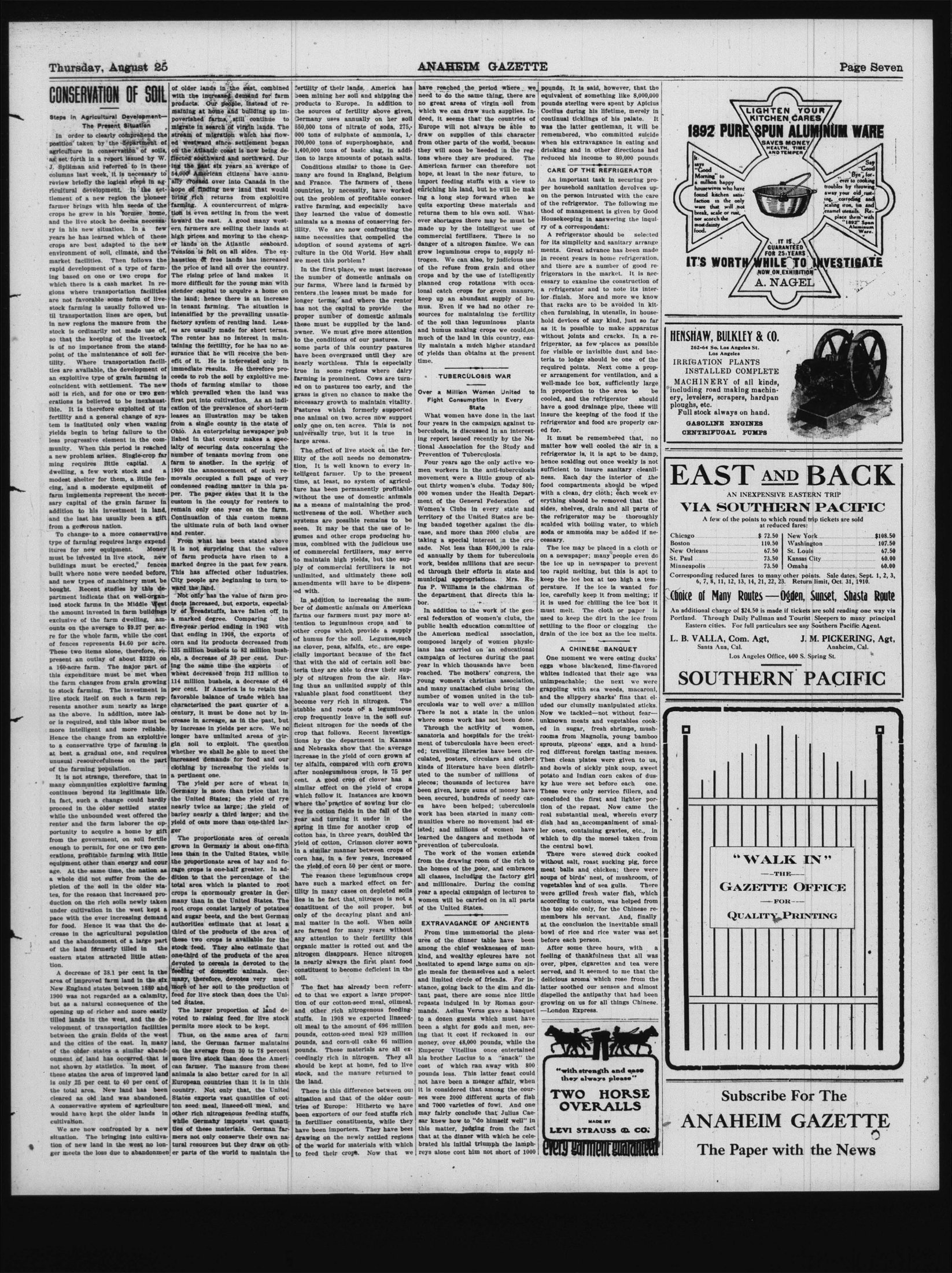
Searchable text
CONSERVATION OF SOIL
Steps in Agricultural Development—The Present Situation
In order to clearly comprehend the position taken by the department of agriculture in conservation of soils, as set forth in a report issued by W. J. Spillman and referred to in these columns last week, it is necessary to review briefly the logical steps in agricultural development. In the settlement of a new region the pioneer farmer brings with him seeds of the crops he grew in his former home, and the live stock he deems necessary in his new situation. In a few years he has learned which of these crops are best adapted to the new environment of soil, climate, and the market facilities. Then follows the rapid development of a type of farming based on one or two crops for which there is a cash market. In regions where transportation facilities are not favorable some form of livestock farming is usually followed until transportation lines are open, but in new regions the manure from the stock is ordinarily not made use of, so that the keeping of the livestock is of no importance from the standpoint of the maintenance of soil fertility. Where transportation facilities are available, the development of an exploitive type of grain farming is coincident with settlement. The new soil is rich, and for one or two generations is believed to be inexhaustible. It is therefore exploited of its fertility and a general change of system is instituted only when waning yields begin to bring failure to the less progressive element in the community. When this period is reached a new problem arises. Single-crop farming requires little capital. A dwelling, a few work stock and a of older lands in the east, combined with the increased demand for farm products. Our people, instead of remaining at home and building up impoverished farms, still continue to migrate in search of virgin lands. The stream of migration which has flowed westward since settlement began on the Atlantic coast is now being deflected southward and northward. During the past six years an average of 54,000 American citizens have annually crossed over into Canada in the hope of finding new land that would bring rich returns from exploitive farming. A countercurrent of migration is even setting in from the west toward the east. A good many western farmers are selling their lands at high prices and moving to the cheaper lands on the Atlantic seaboard. Tension is felt on all sides. The exhaustion of free lands has increased the price of land all over the country. The rising price of land makes it more difficult for the young man with slender capital to acquire a home on the land; hence there is an increase in tenant farming. The situation is intensified by the prevailing unsatisfactory system of renting land. Leases are usually made for short terms. The renter has no interest in maintaining the fertility, for he has no assurance that he will receive the benefit of it. He is interested only in immediate results. He therefore proceeds to rob the soil by exploitive methods of farming similar to those which prevailed when the land was first put into cultivation. As an indication of the prevalence of short-term leases an illustration may be taken from a single county in the state of Ohio. An enterprising newspaper published in that county makes a specialty of securing data concerning the number of tenants moving from one farm to another. In the spring of 1909 the announcement of such re fertility of their land been mining her soil products to Europe; the sources of fertility Germany uses annals 550,000 tons of nitrite 500,000 tons of sulphate 200,000 tons of super 1,400,000 tons of barium to large amounts.
Conditions similar many are found in and France. The countries, by necessity out the problem of native farming, and they learned the way animals as a means utility. We are not same necessities than adoption of sound culture in the Old world we meet this problem.
In the first place, the number of dormant farms. Where renters the leases no longer terms, and has not the capital proper number of these must be supplanted. We must go to the conditions of some parts of this culture have been overgrazed nearly worthless.
True in some regions farming is prominent on to pastures grass is given no necessary growth to Pastures which fills one animal on two only one on, ten acuniversally true, but large areas.
The effect of livelihood of the soil needles it is well known intelligent farmer.
an exploitive type of grain farming is coincident with settlement. The new soil is rich, and for one or two generations is believed to be inexhaustible. It is therefore exploited of its fertility and a general change of system is instituted only when waning yields begin to bring failure to the less progressive element in the community. When this period is reached a new problem arises. Single-crop farming requires little capital. A dwelling, a few work stock and a modest shelter for them, a little fencing, and a moderate equipment of farm implements represent the necessary capital of the grain farmer in addition to his investment in land, and the last has usually been a gift from a generous nation.
To change to a more conservative type of farming requires large expenditures for new equipment. Money must be invested in live stock, new buildings must be erected, fences built where none were needed before, and new types of machinery must be bought. Recent studies by this department indicate that on well-organized stock farms in the Middle West the amount invested in farm buildings exclusive of the farm dwelling, amounts on the average to $9.27 per acre for the whole farm, while the cost of fences represents $4.60 per acre. These two items alone, therefore, represent an outlay of about $2220 on a 160-acre farm. The major part of this expenditure must be met when the farm changes from grain growing to stock farming. The investment in live stock itself on such a farm represents another sum nearly as large as the above. In addition, more labor is required, and this labor must be more intelligent and more reliable. Hence the change from an exploitive to a conservative type of farming is at best a gradual one, and requires unusual resourcefulness on the part of the farming population.
It is not strange, therefore, that in many communities exploitive farming continues beyond its legitimate life. In fact, such a change could hardly proceed in the older settled states while the unbounded west offered the renter and the farm laborer the opportunity to acquire a home by gift from the government, on soil fertile enough to permit, for one or two generations, profitable farming with little equipment other than energy and course. At the same time, the nation as a whole did not suffer from the depletion of the soil in the older states, for the reason that increased pro-
ceeds to rob the soil by exploitive methods of farming similar to those which prevailed when the land was first put into cultivation. As an indication of the prevalence of short-term leases an illustration may be taken from a single county in the state of Ohio. An enterprising newspaper published in that county makes a specialty of securing data concerning the number of tenants moving from one farm to another. In the spring of 1909 the announcement of such removals occupied a full page of very condensed reading matter in this paper. The paper sates that it is the custom in the county for renters to remain only one year on the farm. Continuation of this custom means the ultimate ruin of both land owner and renter.
From what has been stated above it is not surprising that the values of farm products have risen to a marked degree in the past few years. This has affected other industries. City people are beginning to turn toward the land.
Not only has the value of farm products increased, but exports, especially of breadstuffs, have fallen off in a marked degree. Comparing the five-year period ending in 1903 with that ending in 1908, the exports of corn and its products decreased from 135 million bushels to 82 million bushels, a decrease of 39 per cent. During the same time the exports of wheat decreased from 212 million to 114 million bushels, a decrease of 46 per cent. If America is to retain the favorable balance of trade which has characterized the past quarter of a century, it must be done not by increase in acreage, as in the past, but by increase in yields per acre. We no longer have unlimited areas of virgin soil to exploit. The question whether we shall be able to meet the increased demands for food and our clothing by increasing the yields is a pertinent one.
The yield per acre of wheat in Germany is more than twice that in the United States; the yield of rye nearly twice as large; the yield of barley nearly a third larger; and the yield of oats more than one-third larger.
The proportionate area of cereals grown in Germany is about one-fifth less than in the United States, while the proportionate area of hay and forage crops is one-half greater. In addition to that the percentage of the total area which is planted to root crops is enormously greater in Germany than in the United States.
Farming is prominent on to pastures that grass is given no necessary growth to Pastures which feed one animal on two or only one on ten acres universally true, but large areas.
The effect of livestock of the soil needless it is well known intelligent farmer. Uptime, at least, no future has been permitted without the use of it as a means of maintaining productivity of commercial systems are possible seen. It may be that gumes and other crustus, combined with commercial fertility to maintain high yield apply of commercial unlimited, and ultimax amendments will have been with.
In addition to increase of domestic animal farms our farmers tend to leguminous other crops which do humus for the soils as clover, peas, alfalfa specially important because that with the aid of bacteria they are able to apply of nitrogen frozing thus an unlimited valuable plant food become very rich in stubble and roots crop frequently leaves sufficient nitrogen for crop that follows.
Tensions by the department and Nebraska show increase in the yield alfalfa, compared after nonleguminous cent. A good crop similar effect on which follow it. In where the practice ver in cotton fields year and turning in spring in time for cotton has, in three yield of cotton, Critch in a similar manner corn has, in a few yield of corn 50%.
The reason these have such a marklity in many cases lies in he fact that
In fact, such a change could hardly proceed in the older settled states while the unbounded west offered the renter and the farm laborer the opportunity to acquire a home by gift from the government, on soil fertile enough to permit, for one or two generations, profitable farming with little equipment other than energy and course age. At the same time, the nation as a whole did not suffer from the depletion of the soil in the older states, for the reason that increased production on the rich soils newly taken under cultivation in the west kept a pace with the ever increasing demand for food. Hence it was that the decrease in the agricultural population and the abandonment of a large part of the land formerly tilled in the eastern states attracted little attention.
A decrease of 38.1 per cent in the area of improved farm land in the six New England states between 1880 and 1900 was not regarded as a calamity, but as a natural consequence of the opening up of richer and more easily tilled lands in the west, and the development of transportation facilities between the grain fields of the west and the cities of the east. In many of the older states a similar abandonment of land has occurred that is not shown by statistics. In most of these states the area of improved land is only 25 per cent to 40 per cent of the total area. New land has been cleared as old land was abandoned. A conservative system of agriculture would have kept the older lands in cultivation.
We are now confronted by a new situation. The bringing into cultivation of new land in the west no longer meets the loss due to abandonmen
The proportionate area of cereals grown in Germany is about one-fifth less than in the United States, while the proportionate area of hay and forage crops is one-half greater. In addition to that the percentage of the total area which is planted to root crops is enormously greater in Germany than in the United States. The root crops consist largely of potatoes and sugar beets, and the best German authorities estimate that at least a third of the products of the area of these two crops is available for the stock feed. They also estimate that one-third of the products of the area devoted to cereals is devoted to the feeding of domestic animals. Germany, therefore, devotes very much more of her soil to the production of feed for live stock than does the United States.
The larger proportion of land devoted to raising feed for live stock permits more stock to be kept.
Thus, on the same area of farm land, the German farmer maintains on the average from 30 to 78 percent more live stock than does the American farmer. The manure from these animals is also better cared for in all European countries than it is in this country. Not only that, the United States exports vast quantities of cotton seed meal, linseed-oil meal, and other rich nitrogenous feeding stuffs, while Germany imports vast quantities of these materials. German farmers not only conserve their own natural resources but they draw on other parts of the world to maintain the United States; the yield of rye nearly twice as large; the yield of barley nearly a third larger; and the yield of oats more than one-third larger.
The reason these have such a marketility in many cases lies in he fact that constituent of the only of the decaying matter in them are farmed for many any attention to this organic matter is not nitrogen disappears is nearly always that constituent to become soil.
The fact has already led to that we exportation of our cotton-silk and other rich nitrate stuffs. In 1908 we oil meal to the amo- pounds, cotton-seed pounds, and corn-oil pounds. These ma- ceeredingly rich in nitrate should be kept at stock, and the main- land.
There is this different situation and that tries of Europe: been exporters of oats in fertilizer constitute have been importers drawing on the need of the world for ma- to feed their crop-
ANAHEIM GAZETTE
fertility of their lands. America has been mining her soil and shipping the products to Europe. In addition to the sources of fertility above given, Germany uses annually on her soil 550,000 tons of nitrate of soda, 275,000 tons of sulphate of ammonia, 1,200,000 tons of superphosphate, and 1,400,000 tons of basic slag, in addition to large amounts of potash salts.
Conditions similar to those in Germany are found in England, Belgium and France. The farmers of these countries, by necessity, have worked out the problem of profitable conservative farming, and especially have they learned the value of domestic animals as a means of conserving fertility. We are now confronting the same necessities that compelled the adoption of sound systems of agriculture in the Old World. How shall we meet this problem?
In the first place, we must increase the number of domestic animals on our farms. Where land is farmed by renters the leases must be made for longer terms, and where the renter has not the capital to provide the proper number of domestic animals these must be supplied by the landowner. We must give more attention to the conditions of our pastures. In some parts of this country pastures have been overgrazed until they are nearly worthless. This is especially true in some regions where dairy farming is prominent. Cows are turned on to pastures too early, and the grass is given no chance to make the necessary growth to maintain vitality. Pastures which formerly supported one animal on two acres now support only one on ten acres. This is not universally true, but it is true in large areas.
The effect of live stock on the fertility of the soil needs no demonstration. It is well known to every intelligent farmer. Up to the present have reached the period where we need to do the same thing, there are no great areas of virgin soil from which we can draw such supplies. Indeed, it seems that the countries of Europe will not always be able to draw on supplies of this character from other parts of the world, because they will soon be needed in the regions where they are produced. The American farmer can therefore not hope, at least in the near future, to import feeding stuffs with a view to enriching his land, but he will be making a long step forward when he quits exporting these materials and returns them to his own soil. What ever shortages there may be must be made up by the intelligent use of commercial fertilizers. There is no danger of a nitrogen famine. We can grow leguminous crops to supply nitrogen. We can also, by judicious use of the refuse from grain and other crops and by the use of intelligently planned crop rotations with occasional catch crops for green manure, keep up an abundant supply of humus. Even if we had no other resources for maintaining the fertility of the soil than leguminous plants and humus making crops we could, on much of the land in this country, easily maintain a much higher standard of yields than obtains at the present time.
TUBERCULOSIS WAR
Over a Million Women United to Fight Consumption in Every State
What women have done in the last four years in the campaign against tuberculosis, is discussed in an interesting report issued recently by the National Association for the Study and Prevention of Tuberculosis.
Four years ago the only active women workers in the anti-tuberculosis pounds. It is said, however, that the equivalent of something like 8,000,000 pounds sterling were spent by Apicius Coellus during his lifetime, merely in continual ticklings of his palate. It was the latter gentleman, it will be remembered, who committed suicide when his extravagance in eating and drinking and in other directions had reduced his income to 80,000 pounds.
CARE OF THE REFRIGERATOR
An important task in securing proper household sanitation devolves upon the person intrusted with the care of the refrigerator. The following me thod of management is given by Good Housekeeping in answering the inquiry of a correspondent:
A refrigerator should be selected for its simplicity and sanitary arrangement. Great advance has been made in recent years in home refrigeration, and there are a number of good refrigerators in the market. It is necessary to examine the construction of a refrigerator and to note its interior finish. More and more we know that racks are to be avoided in kitchen furnishing, in utensils, in household devices of any kind, just so far as it is possible to make apparatus without joints and cracks. In a refrigerator, as few places as possible for visible or invisible dust and bacteria to lodge should be one of the required points. Next come a proper arrangement for ventilation, and a well-made ice box, sufficiently large in proportion to the area to be cooled, and the refrigerator should have a good drainage pipe; these will insure the keeping of the food if the refrigerator and food are properly cared for.
It must be remembered that, no matter how well cooled the air in a refrigerator is, it is apt to be damp, hence scalding out once weekly is not sufficient to insure sanitary cleanliness.
farming is prominent. Cows are turned on to pastures too early, and the grass is given no chance to make the necessary growth to maintain vitality. Pastures which formerly supported one animal on two acres now support only one on ten acres. This is not universally true, but it is true in large areas.
The effect of live stock on the fertility of the soil needs no demonstration. It is well known to every intelligent farmer. Up to the present time, at least, no system of agriculture has been permanently profitable without the use of domestic animals as a means of maintaining the productiveness of the soil. Whether such systems are possible remains to be seen. It may be that the use of legumes and other crops producing humus, combined with the judicious use of commercial fertilizers, may serve to maintain high yields, but the supply of commercial fertilizers is not unlimited, and ultimately these soil amendments will have to be dispensed with.
In addition to increasing the number of domestic animals on American farms our farmers must pay more attention to leguminous crops and to other crops which provide a supply of humus for the soil. Legumes, such as clover, peas, alfalfa, etc., are especially important because of the fact that with the aid of certain soil bacteria they are able to draw their supply of nitrogen from the air. Having thus an unlimited supply of this valuable plant food constituent they become very rich in nitrogen. The stubble and roots of a leguminous crop frequently leave in the soil sufficient nitrogen for the needs of the crop that follows. Recent investigations by the department in Kansas and Nebraska show that the average increase in the yield of corn grown after alfalfa, compared with corn grown after nonleguminous crops, is 75 percent. A good crop of clover has a similar effect on the yield of crops which follow it. Instances are known where the practice of sowing bur clover in cotton fields in the fall of the year and turning it under in the spring in time for another crop of cotton has, in three years, doubled the yield of cotton. Crimson clover sown in a similar manner between crops of corn has, in a few years, increased the yield of corn 50 per cent or more.
The reason these leguminous crops have such a marked effect on fertility in many cases on depleted soils lies in the fact that nitrogen is not a
TUBERCULOSIS WAR
Over a Million Women United to Fight Consumption in Every State
What women have done in the last four years in the campaign against tuberculosis, is discussed in an interesting report issued recently by the National Association for the Study and Prevention of Tuberculosis.
Four years ago the only active women workers in the anti-tuberculosis movement were a little group of about thirty women's clubs. Today 800,000 women under the Health Department of the General Federation of Women's Clubs in every state and territory of the United States are being banded together against the disease, and more than 2000 clubs are taking a special interest in the crusade. Not less than $500,000 is raised annually by them for tuberculosis work, besides millions that are secured through their efforts in state and municipal appropriations. Mrs. Rufus P. Williams is the chairman of the department that directs this labor.
In addition to the work of the general federation of women's clubs, the public health education committee of the American medical association, composed largely of women physicians has carried on an educational campaign of lectures during the past year in which thousands have been reached. The mothers' congress, the young women's christian association, and many unattached clubs bring the number of women united in the tuberculosis war to well over a million There is not a state in the union where some work has not been done.
Through the activity of women, sanatoria and hospitals for the treatment of tuberculosis have been erected; travelling libraries have been circulated, posters, circulars and other kinds of literature have been distributed to the number of millions of pieces; thousands of lectures have been given, large sums of money have been secured, hundreds of needy cases have been helped; tuberculosis work has been started in many communities where no movement had existed; and millions of women have learned the dangers and methods of prevention of tuberculosis.
The work of the women extends from the drawing room of the rich to the homes of the poor, and embraces all classes, including the factory girl and millionaire. During the coming year a special campaign of lectures to women will be carried out in all parts
er arrangement for ventilation, and a well-made ice box, sufficiently large in proportion to the area to be cooled, and the refrigerator should have a good drainage pipe, these will insure the keeping of the food if the refrigerator and food are properly cared for.
It must be remembered that, no matter how well cooled the air in a refrigerator is, it is apt to be damp, hence scalding out once weekly is not sufficient to insure sanitary cleanliness. Each day the interior of the food compartments should be wiped with a clean, dry cloth; each week everything should be removed that the sides, shelves, drain and all parts of the refrigerator may be thoroughly scalded with boiling water, to which soda or ammonia may be added if necessary.
The ice may be placed in a cloth or on a newspaper; many people even do the ice up in newspaper to prevent too rapid melting, but this is apt to keep the ice box at too high a temperature. If the ice is wanted for ice, carefully keep it from melting; if it is used for chilling the ice box it must melt. The cloth or paper is used to keep the dirt in the ice from settling to the floor or clogging the drain of the ice box as the ice melts.
A CHINESE BANQUET
One moment we were eating ducks' eggs whose blackened, lime-flavored whites indicated that their age was unimpeachable; the next we were grappling with seaweeds, macaroni, and the slippery sharks' fins that eluded our clumsily manipulated sticks. Now we tackled—not without fear—unknown meats and vegetables cooked in sugar, fresh shrimps, mushrooms from Magnolia, young bamboo sprouts, pigeons' eggs, and a hundred different foreign tasting messes. Then clean plates were given to us, and bowls of sickly pink soup, sweet potato and Indian corn cakes of dusky hue were set before each one. These were only service fillers, and concluded the first and lighter portion of the repast. Now came the real substantial meal, wherein every dish had an accompaniment of smaller ones, containing gravies, etc., in which to dip the morsel taken from the central bowl.
There were stewed duck cooked without salt, roast sucking pig, force meat balls and chicken; there were soups of birds' nest, of mushroom, of vegetables and of sea gulls. There were grilled fresh water fish, which
where the practice of sowing bur clover in cotton fields in the fall of the year and turning it under in the spring in time for another crop of cotton has, in three years, doubled the yield of cotton. Crimson clover sown in a similar manner between crops of corn has, in a few years, increased the yield of corn 50 per cent or more.
The reason these leguminous crops have such a marked effect on fertility in many cases on depleted soils lies in he fact that nitrogen is not a constituent of the soil proper, but only of the decaying plant and animal matter in the soil. When soils are farmed for many years without any attention to their fertility this organic matter is rotted out and the nitrogen disappears. Hence nitrogen is nearly always the first plant food constituent to become deficient in the soil.
The fact has already been referred to that we export a large proportion of our cotton-seed meal, oilmeal, and other rich nitrogenous feedingstuffs. In 1908 we exported linseed-oil meal to the amount of 696 million pounds, cotton-seed meal 929 million pounds, and corn-oil cake 66 million pounds. These materials are all exceedingly rich in nitrogen. They all should be kept at home, fed to live stock, and the manure returned to the land.
There is this difference between our situation and that of the older countries of Europe: Hitherto we have been exporters of our feed stuffs rich in fertilizer constituents, while they have been importers. They have been drawing on the newly settled regions of the world for materials with which to feed their crops. Now that we
been secured, hundreds of needy cases have been helped; tuberculosis work has been started in many communities where no movement had existed; and millions of women have learned the dangers and methods of prevention of tuberculosis.
The work of the women extends from the drawing room of the rich to the homes of the poor, and embraces all classes, including the factory girl and millionaire. During the coming year a special campaign of lectures to women will be carried on in all parts of the United States.
EXTRAVAGANCE OF ANCIENTS
From time immemorial the pleasures of the dinner table have been among the chief weaknesses of mankind, and wealthy epicures have not hesitated to spend large sums on single meals for themselves and a select and limited circle of friends. For instance, going back to the dim and distant past, there are some nice little repasts indulged in by Roman gourmands. Aelius Verus gave a banquet to a dozen guests which must have been a sight for gods and men, seeing that it cost if reckoned in our money, over 48,000 pounds, while the Emperor Vitellius once entertained his brother Lucius to a "snack" the cost of which ran away with 800 pounds less. This latter feast could not have been a meager affair, when it is considered that among the courses were 2000 different sorts of fish and 7000 varieties of fowl. And one may fairly conclude that Julius Caesar knew how to "do himself well" in this matter, judging from the fact that at the dinner with which he celebrated his initial triumph the lamphreys alone cost him not short of 1000
LIGHTEN YOUR KITCHEN CARES
1892 PURE SPUN ALUMINUM WARE
SAVES MONEY HEALTH, TIME AND TEMPER
It says "Good Morning" to a million happy housewives who have found kitchen satisfaction in the only ware that will not break, scale or rust, nor scorch the most dainty food.
It is GUARANTEED FOR 25 YEARS
IT'S WORTH WHILE TO INVESTIGATE
NOW ON EXHIBITION
A. NAGEL
HENSHAW, BULKLEY & CO.
262-64 So. Los Angeles St.
Los Angeles
IRRIGATION PLANTS
INSTALLED COMPLETE
MACHINERY of all kinds,
including road making machinery, levelers, scrapers, hardpan ploughs, etc.
Full stock always on hand.
GASOLINE ENGINES
CENTRIFUGAL PUMPS
EAST AND BACK
AN INEXPENSIVE EASTERN TRIP
VIA SOUTHERN PACIFIC
A few of the points to which round trip tickets are sold at reduced fares:
Chicago $72.50 New York $108.50
Boston 110.50 Washington 107.50
New Orleans 67.50 St. Louis 67.50
St. Paul 73.50 Kansas City 60.00
Minneapolis 73.50 Omaha 60.00
Corresponding reduced fares to many other points. Sale dates: Sept. 1, 2, 3, 6, 7, 8, 11, 12, 13, 14, 21, 22, 23. Return limit, Oct. 31, 1910.
Choice of Many Routes — Ogden, Sunset, Shasta Route
An additional charge of $24.50 is made if tickets are sold reading one way via Portland. Through Daily Pullman and Tourist Sleepers to many principal Eastern cities. For full particulars see any Southern Pacific Agent.
L. B. VALLA, Com. Agt,
Santa Ana, Cal.
J. M. PICKERING, Agt,
Anahcim, Cal.
Los Angeles Office, 600 S. Spring St.
SOUTHERN PACIFIC
"WALK IN"
THE
GAZETTE OFFICE
"WALK IN"
THE
GAZETTE OFFICE
FOR
QUALITY PRINTING
Subscribe For The
ANAHEIM GAZETTE
The Paper with the News