anaheim-gazette 1910-08-18
Scanned page
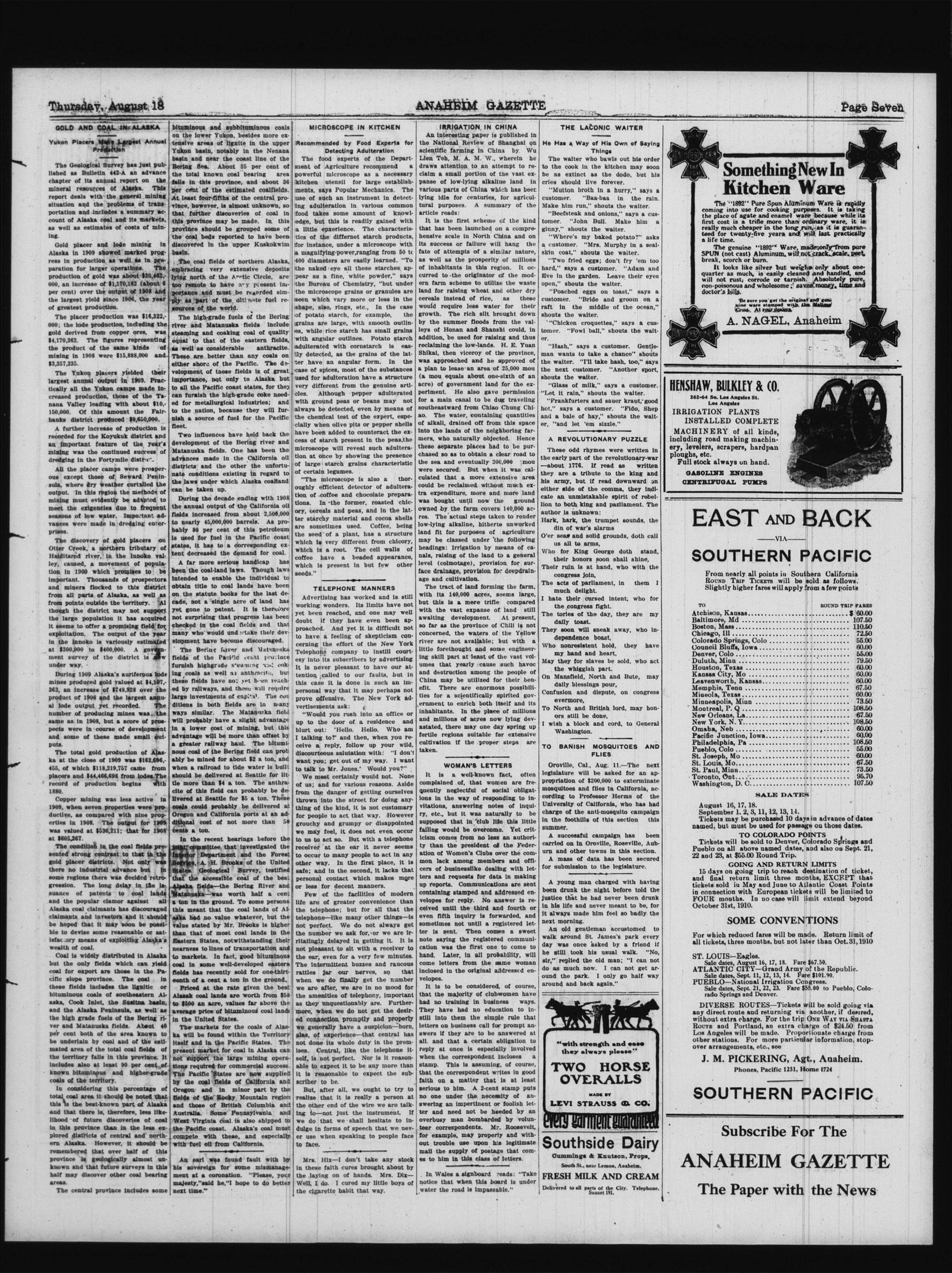
Searchable text
GOLD AND COAL IN ALASKA
Yukon Placers Make Largest Annual Production
The Geological Survey has just published as Bulletin 442-A an advance chapter of its annual report on the mineral resources of Alaska. This report deals with the general mining situation and the problems of transportation and includes a summary account of Alaska coal and its markets, as well as estimates of costs of mining.
Gold placer and lode mining in Alaska in 1909 showed marked progress in production as well as in preparation for larger operations. The production of gold was about $20,463,000, an increase of $1,170,182 (about 6 per cent) over the output of 1908 and the largest yield since 1906, the year of greatest production.
The placer production was $16,322,000; the lode production, including the gold derived from copper ores, was $4,170,363. The figures representing the product of the same kinds of mining in 1908 were $15,888,000 and $3,357,335.
The Yukon placers yielded their largest annual output in 1909. Practically all the Yukon camps made increased production, those of the Tahana Valley leading with about $10,-150,000. Of this amount the Fairbanks district produced $9,650,000.
A further increase of production is recorded for the Koyukuk district and an important feature of the year's mining was the continued success of dredging in the Fortymile district.
All the placer camps were prosperous and subbituminous coals on the lower Yukon, besides more extensive areas of lignite in the upper Yukon basin, notably in the Nenana basin and near the coast line of the Bering Sea. About 35 per cent of the total known coal bearing area falls in this province, and about 36 per cent of the estimated coalfields. At least four-fifths of the central province, however, is almost unknown, so that further discoveries of coal in this province may be made. In this province should be grouped some of the coal beds reported to have been discovered in the upper Kuskokwim basin.
The coal fields of northern Alaska, embracing very extensive deposits lying north of the Arctic Circle, are too remote to have any present importance and must be regarded simply as part of the ultimate fuel resources of the world.
The high-grade fuels of the Bering river and Matanuska fields include steaming and coaking coal of quality equal to that of the eastern fields, as well as considerable anthracite. These are better than any coals on either shore of the Pacific. The development of these fields is of great importance, not only to Alaska but to all the Pacific coast states, for they can furnish the high-grade coke needed for metallurgical industries; and to the nation, because they will furnish a source of fuel for the Pacific fleet.
Two influences have held back the development of the Bering river and Matanuska fields. One has been the advances made in the California oil districts and the other the unfortunate conditions existing in regard to bituminous and subbituminous coals on the lower Yukon, besides more extensive areas of lignite in the upper Yukon basin, notably in the Nenana basin and near the coast line of the Bering Sea. About 35 per cent of the total known coal bearing area falls in this province, and about 36 per cent of the estimated coalfields. At least four-fifths of the central province, however, is almost unknown, so that further discoveries of coal in this province may be made. In this province should be grouped some of the coal beds reported to have been discovered in the upper Kuskokwim basin.
The coal fields of northern Alaska, embracing very extensive deposits lying north of the Arctic Circle, are too remote to have any present importance and must be regarded simply as part of the ultimate fuel resources of the world.
The high-grade fuels of the Bering river and Matanuska fields include steaming and coaking coal of quality equal to that of the eastern fields, as well as considerable anthracite. These are better than any coals on either shore of the Pacific. The development of these fields is of great importance, not only to Alaska but to all the Pacific coast states, for they can furnish the high-grade coke needed for metallurgical industries; and to the nation, because they will furnish a source of fuel for the Pacific fleet.
Two influences have held back the development of the Bering river and Matanuska fields. One has been the advances made in the California oil districts and the other the unfortunate conditions existing in regard to bituminous and subbituminous coals on the lower Yukon, besides more extensive areas of lignite in the upper Yukon basin, notably in the Nenana basin and near the coast line of the Bering Sea. About 35 per cent of the total known coal bearing area falls in this province, and about 36 per cent of the estimated coalfields. At least four-fifths of the central province, however, is almost unknown, so that further discoveries of coal in this province may be made. In this province should be grouped some of the coal beds reported to have been discovered in the upper Kuskokwim basin.
The food expert at Agriculture powerful microscope kitchen utensil features says Popular use of such an insisting adulteration in food takes some edge, but this is rare a little epexperience. Antics of the difference for instance, under a magnifying-power, 400 diameters are even naked eye all appear as a fine, while the Bureau of Chemistry microscope grain seen which vary shape, size, rings, or potato starch, grains are large, wipes while rice starch with angular outline adulterated with colly detected, as there have an angular case of spices most used for adulteration very different from cles. Although p with ground peas always be detected, chemical test ocially when olive pit have been added to process of starch present microscope will revention at once by show large starch grout certain legumes.
largest annual output in 1909. Practically all the Yukon camps made increased production, those of the Tannana Valley leading with about $10,-150,000. Of this amount the Fairbanks district produced $9,650,000.
A further increase of production is recorded for the Koyukuk district and an important feature of the year's mining was the continued success of dredging in the Fortymile district.
All the placer camps were prosperous except those of Seward Peninsula, where dry weather curtailed the output. In this region the methods of mining must evidently be adapted to meet the exigencies due to frequent seasons of low water. Important advances were made in dredging enterprises.
The discovery of gold placers on Otter Creek, a northern tributary of Halditarod river, in the Innoko valley, caused a movement of population in 1909 which promises to be important. Thousands of prospectors and miners flocked to this district from all parts of Alaska, as well as from points outside the territory. Although the district may not support the large population it has acquired it seems to offer a promising field for exploitation. The output of the year in the Innoko is variously estimated at $300,000 to $400,000. A government survey of the district is now under way.
During 1909 Alaska's auriferous lode mines produced gold valued at $4,107,-363, an increase of $749,928 over the product of 1908 and the largest annual lode output yet recorded. The number of producing mines was the same as in 1908, but a score of prospects were in course of development and some of these made small outputs.
The total gold production of Alaska at the close of 1909 was $162,696,-455, of which $118,219,757 came from placers and $44,466,698 from lodes. The record of production begins with 1880.
Copper mining was less active in 1909, when seven properties were productive, as compared with nine properties in 1908. The output for 1909 was valued at $536,211; that for 1908 at $605,267.
The condition in the coal fields presented strong contrast to that in the gold placer districts. Not only was there no industrial advance but in some regions there was decided retrogression. The long delay in the issuance of patents to coal lands importance, not only to Alaska but to all the Pacific coast states, for they can furaish the high-grade coke needed for metallurgical industries; and to the nation, because they will furnish a source of fuel for the Pacific fleet.
Two influences have held back the development of the Bering river and Matanuska fields. One has been the advances made in the California oil districts and the other the unfortunate conditions existing in regard to the laws under which Alaska coalland can be taken up.
During the decade ending with 1908 the annual output of the California oil fields increased from about 2,506,000 to nearly 45,000,000 barrels. As probably 80 per cent of this petroleum is used for fuel in the Pacific coast states, it has to a corresponding extent decreased the demand for coal.
A far more serious handicap has been the coal-land laws. Though laws intended to enable the individual to obtain title to coal lands have been on the statute books for the last decade, not a single acre of land has yet gone to patent. It is therefore not surprising that progress has been checked in the coal fields and that many who would undertake their development have become discouraged.
The Bering fever and Matanuska fields of the Pacific coast province furnish highgrade steaming and cooling coals as well as anthracite, but these fields have not yet been reached by railways, and these will require large investments of capital. The conditions in both fields are in many ways similar. The Matanuska field will probably have a slight advantage in a lower cost of mining, but this advantage will be more than offset by a greater railway haul. The bituminous coal of the Bering field can probably be mined for about $2 a ton, and when a railroad to tide water is built should be delivered at Seattle for little more than $4 a ton. The anthracite of this field can probably be delivered at Seattle for $5 a ton. These coals could probably be delivered at Oregon and California ports at an additional cost of not more than 50 cents a ton.
In the recent hearings before the joint committee that investigated the Interior Department and the Forest Service, A. H. Brooks of the United States Geological Survey, testified that the accessible coal of the best Alaska fields—the Bering River and Matanuska—was worth half a cent used for adulteration very different from cles. Although ppl with ground peas or always be detected, the chemical test ocially when olive ppl have been added to process of starch present microscope will revise at once by shoot of large starch grade of certain legumes.
"The microscopeoughly efficient detection of coffee and oils. In the former ory, cereals and peanut starchy material are sometimes used by the seed of a plant which is very different which is a root." coffee have a b which is present in seeds."
TELEPHONE
Advertising has worked wonders. Yet been reached, doubt if they had proached. And yet to have a feeling cerning the effort Telephone company es into its subscribtion called to this case it is done personal way that i prove offensive. Vertisements ask:
"Would you rush up to the door off blurt out: 'Hello. I talking to?' and receive a reply, follo discourteous salutation want you; get out oo to talk to Mr. Jones.
We most certainly oof us; and for varie from the danger ol thrown into the str thing of the kind, i for people to act th grouchy and grumpy we may feel, it do to us to act so. But receiver at the ear to occur to many po other way. In th safe; and in th se personal contact w or less for decent Few of the fae
Copper mining was less active in 1909, when seven properties were productive, as compared with nine properties in 1908. The output for 1909 was valued at $536,211; that for 1908 at $605,267.
The condition in the coal fields presented strong contrast to that in the gold placer districts. Not only was there no industrial advance but in some regions there was decided retrogression. The long delay in the issuance of patents to coal lands and the popular clamor against all Alaska coal claimants has discouraged claimants and investors and it should be hoped that it may soon be possible to devise some reasonable or satisfactory means of exploiting Alaska's wealth of coal.
Coal is widely distributed in Alaska but the only fields which can yield coal for export are those in the Pacific slope province. The coal in these fields includes the lignitic or bituminous coals of southeastern Alaska, Cook Inlet, the Sunitna basin, and the Alaska Peninsula, as well as the high grade fuels of the Bering river and Matanuska fields. About 40 per cent both of the area known to be underlain by coal and of the estimated area of the total coal fields of the territory falls in this province. It includes also at least 90 per cent of known bituminous and higher-grade coals of the territory.
In considering this percentage of total coal area it should be noted that this is the best-known part of Alaska and that there is, therefore, less likelihood of future discoveries of coal in this province than in the less explored districts of central and northern Alaska. However, it should be remembered that over half of this province is geologically almost unknown and that future surveys in this half may discover other coal bearing areas.
The central province includes some
In the recent hearings before the joint committee that investigated the Interior Department and the Forest Service, A. H. Brooks of the United States Geological Survey, testified that the accessible coal of the best Alaska fields—the Bering River and Matanuska—was worth half a cent a ton in the ground. To some persons this meant that the coal lands of Alaska had no value whatever, but the value stated by Mr. Brooks is higher than that of most coal lands in the Eastern States, notwithstanding their nearness to lines of transportation and to markets. In fact, good bituminous coal in some well-developed eastern fields has recently sold for one-third-eighth of a cent a ton in the ground.
Priced at the rate given the best Alasak coal lands are worth from $50 to $500 an acre, values far above the average price of bituminous coal lands in the United States.
The markets for the coals of Alaska will be found within the Territory itself and in the Pacific States. The present market for coal in Alaska cannot support the large mining operations required for commercial success. The Pacific States are now supplied by the coal fields of California and Oregon and in minor part by the fields of the Rocky Mountain region and those of British Columbia and Australia. Some Pennsylvania and West Virginia coal is also shipped to the Pacific coast. Alaska's coal must compete with these, and especially with fuel oil from California.
An earl was found fault with by his sovereign for some mismanagement at a coronation. "Please, your majesty," said he, "I hope to do better next time."
Few of the facts life are of greater importance to the telephone; but telephone-like man does not perfect. We owe the number we ask ritatingly delayed if not pleasant to sit at the ear, even for a rattles jar our when we do finally we are after, we are the amenities of telegraph as they unquestionably more, when we do ed connection prompt we generally have alas, of experience not done its whole uses. Central, like self, is not perfect able to expect it to fail it is reasonable to scribber to be.
But, after all, we realize that it is not the other end of the thing to—not just we do that we sh dulge in forms of ser use when speaking to face.
Mrs. Hix—I don’t in these faith cures me laying on of b Well, I do. I curee the cigarette habit
MICROSCOPE IN KITCHEN
Recommended by Food Experts for Detecting Adulteration
The food experts of the Department of Agriculture recommend a powerful microscope as a necessary kitchen utensil for large establishments, says Popular Mechanics. The use of such an instrument in detecting adulteration in various common food takes some amount of knowledge, but this is readily gained with a little epoxience. The characteristics of the differnet starch products, for instance, under a microscope with a magnifying-power,ranging from 50 to 400 diameters are easily learned. "To the naked eye all these starches appear as a fine, white powder," says the Bureau of Chemistry, "but under the microscope grains or granules are seen which vary more or less in the shape, size, rings, etc., In the case of potato starch, for example, the grains are large, with smooth outlines, while rice starch has small grains with angular outlines. Potato starch adulterated with cornstarch is easily detected, as the grains of the latter have an angular form. In the case of spices, most of the substances used for adulteration have a structure very different from the genuine articles. Although pepper adulterated with ground peas or beans may not always be detected, even by means of the chemical test of the expert, especially when olive pits or pepper shells have been added to counteract the excess of starch present in the peas,the microscope will reveal such adulteration at once by showing the presence of large starch grains characteristic of certain legumes.
IRRIGATION IN CHINA
An interesting paper is published in the National Review of Shanghai on scientific farming in China by Wu Llen Teh, M. A. M. W., wherein he draws attention to an attempt to reclaim a small portion of the vast expanse of low-lying alkaline land in various parts of China which has beer lying idle for centuries, for agricultural purposes. A summary of the article reads:
It is the first scheme of the kind that has been launched on a comprehensive scale in North China and on its success or failure will hang the fate of attempts of a similar nature, as well as the prosperity of millions of inhabitants in this region. It occurred to-the originator of the modern farm scheme to utilize the waste land for raising wheat and other dry cereals instead of rice, as these would require less water for their growth. The rich silt brought down by the summer floods from the valleys of Honan and Shanshi could, in addition, be used for raising and thus reclaiming the low-lands. H. E. Yuan Shikai, then viceroy of the province, was approached and he approved of a plan to lease an area of 25,000 mou (a mou equals about one-sixth of an acre) of government land for the experiment. He also gave permission for a main canal to be dug traveling southeastward from Chiao Chung Chiao. The water, containing quantities of alkali, drained off from this space into the lands of the neighboring farmers, who naturally objected. Hence these separate places had to be purchased so as to obtain a clear road to the sea and eventually 300,000 mou were secured. But when it was called LAÇONIC WAITER
He Has a Way of His Own of Saying Things
The waiter who bawls out his order to the cook in the kitchen may soon be as extinct as the dodo, but his cries should live forever.
"Mutton broth in a hurry," says a customer. "Baa-baa in the rain. Make him run," shouts the waiter.
"Beefsteak and onions," says a customer. "John Bull. Make him a ginny," shouts the waiter.
"Where's my baked potato?" asks a customer. "Mrs. Murphy in a seal-skin coat," shouts the waiter.
"Two fried eggs; don't fry 'em too hard," says a customer. "Adam and Eve in the garden. Leave their eyes open," shouts the waiter.
"Poached eggs on toast," says a customer. "Bride and groom on a raft in the middle of the ocean," shouts the waiter.
"Chicken croquettes," says a customer. "Fowl ball," shouts the waiter.
"Hash," says a customer. Gentleman wants to take a chance" shouts the waiter. "I'll take hash, too," says the next customer. "Another sport, shouts the waiter."
"Glass of milk," says a customer. "Let it rain," shouts the waiter.
"Frankfurters and sauer kraut," good hot," says a customer. "Fido, Shep and a bale of hay," shouts the waiter, "and let 'em sizzle."
used for adulteration have a structure very different from the genuine articles. Although pepper adulterated with ground peas or beans may not always be detected, even by means of the chemical test of the expert, especially when olive pits or pepper shells have been added to counteract the excess of starch present in the peas, the microscope will reveal such adulteration at once by showing the presence of large starch grains characteristic of certain legumes.
"The microscope is also a thoroughly efficient detector of adulteration of coffee and chocolate preparations. In the former, roasted chicory, cereals and peas, and in the latter starchy material and cocoa shells are sometimes used. Coffee, being the seed of a plant, has a structure which is very different from chicory, which is a root. The cell walls of coffee have a beaded appearance, which is present in but few other seeds."
TELEPHONE MANNERS
Advertising has worked and is still working wonders. Its limits have not yet been reached, and one may well doubt if they have even been approached. And yet it is difficult not to have a feeling of skepticism concerning the effort of the New York Telephone company to instill courtesy into its subscribers by advertising. It is never pleasant to have our attention called to our faults, but in this case it is done in such an impersonal way that it may perhaps not prove offensive. The New York advertisements ask:
"Would you rush into an office or up to the door of a residence and blurt out: 'Hello. Hello. Who am I talking to?' and then, when you receive a reply, follow up your wild, discourteous salutation with: 'I don't want you; get out of my way. I want to talk to Mr. Jones.' Would you?"
We most certainly would not. None of us; and for various reasons. Aside from the danger of getting ourselves thrown into the street for doing anything of the kind, it is not customary for people to act that way. However grouchy and grumpy or disappointed we may feel, it does not even occur to us to act so. But with a telephone receiver at the ear it never seems to occur to many people to act in any other way. In the first place, it is safe; and in the second, it lacks that personal contact which makes more or less for decent manners.
Few of the facilities of modern (a mou equals about one-sixth of an acre) of government land for the experiment. He also gave permission for a main canal to be dug traveling southeastward from Chiao Chung Chiao. The water, containing quantities of alkali, drained off from this space into the lands of the neighboring farmers, who naturally objected. Hence these separate places had to be purchased so as to obtain a clear road to the sea and eventually 300,000 mou were secured. But when it was calculated that a more extensive area could be reclaimed without much extra expenditure, more and more land was bought until now the ground owned by the farm covers 140,000 acres. The actual steps taken to render low-lying alkaline, hitherto unworked land fit for purposes of agriculture may be classed under the following headings: Irrigation by means of canals, raising of the land to a general level (colmotage), provision for surface drainage, provision for deepdrainage and cultivation.
The tract of land forming the farm, with its 140,000 acres, seems large, but this is a mere trifle compared with the vast expanse of land still awaiting development. At present, so far as the province of Chili is not concerned, the waters of the Yellow river are not available; but with a little forethought and some engineering skill part at least of the vast volumes that yearly cause such havoc and destruction among the people of China may be utilized for their benefit. There are enormous possibilities for a scientifically spirited government to enrich both itself and its inhabitants. In the place of millions and millions of acres now lying devastated, there may one day spring up fertile regions suitable for extensive cultivation if the proper steps are taken.
WOMAN'S LETTERS
It is a well-known fact, often complained of, that women are frequently neglectful of social obligations in the way of responding to invitations, answering notes of inquiry, etc., but it was naturally to be supposed that in club life this little failing would be overcome. Yet criticism comes from no less an authority than the president of the Federation of Women's Clubs over the common lack among members and officers of businesslike dealing with letters and requests for data in making up reports. Communications are sent containing stamped and addressed envelopes for reply. No answer is received shouts the waiter.
"Glass of milk," says a customer. "Let it rain," shouts the waiter.
"Frankfurters and sauer kraut; good hot," says a customer. "Fido, Shep and a bale of hay," shouts the waiter, "and let 'em sizzle."
A REVOLUTIONARY PUZZLE
These odd rhymes were written in the early part of the revolutionary-war—about 1776. If read as written they are a tribute to the king and his army, but if read downward on either side of the comma, they indicate an unmistakable spirit of rebellion to both king and parliament. The author is unknown:
Hark, hark, the trumpet sounds, the din of war's alarms
O'er seas and solid grounds, doth call us all to arms,
Who for King George doth stand, their honors soon shall shine,
Their ruin is at hand, who with the congress join,
The acts of parliament, in them I much delight.
I hate their cursed intent, who for the congress fight.
The tories of the day, they are my daily toast.
They soon will sneak away, who independence boast,
Who nonresistant hold, they have my hand and heart,
May they for slaves be sold, who act the whiggish part.
On Mansfield, North and Bute, may daily blessings pour,
Confusion and dispute, on congress evermore,
To North and British lord, may honors still be done,
I wish a block and cord, to General Washington.
TO BANISH MOSQUITOES AND FLIES
Oroville, Cal., Aug. 11.—The next legislature will be asked for an appropriation of $200,000 to exterminate mosquitoes and flies in California, according to Professor Herms of the University of California, who has had charge of the anti-mosquito campaign in the foothills of this section this summer.
A successful campaign has been carried on in Oroville, Roseville, Auburn and other towns in this section.
A mass of data has been secured for submission to the legislature.
A young man charged with having been drunk the night before told the justice that he had never been drunk
thrown into the street for doing anything of the kind, it is not customary for people to act that way. However grouchy and grumpy or disappointed we may feel, it does not even occur to us to act so. But with a telephone receiver at the ear it never seems to occur to many people to act in any other way. In the first place, it is safe; and in the second, it lacks that personal contact which makes more or less for decent manners.
Few of the facilities of modern life are of greater convenience than the telephone; but for all that the telephone—like many other things—is not perfect. We do not always get the number we ask for, or we are irritatingly delayed in getting it. It is not pleasant to sit with a receiver to the ear, even for a very few minutes. The intermittent buzzes and raucous rattles jar our nerves, so that when we do finally get the number we are after, we are in no mood for the amenities of telephony, important as they unquestionably are. Furthermore, when we do not get the desired connection promptly and properly we generally have a suspicion—born, alas, of experience—that central has not done its whole duty in the premises. Central, like the telephone itself, is not perfect. Nor is it reasonable to expect it to be any more than it is reasonable to expect the subscriber to be.
But, after all, we ought to try to realize that it is really a person at the other end of the wire we are talking to—not just the instrument. If we do that we shall hesitate to indulge in forms of speech that we never use when speaking to people face to face.
Mrs. Hix—I don’t take any stock in these faith cures brought about by the laying on of hands. Mrs. Dix—Well, I do. I cured my little boys of the cigarette habit that way.
In Wales a signboard reads: “Take notice that when this board is under water the road is impassable.”
Communications are sent containing stamped and addressed envelopes for reply. No answer is received until the third and fourth or even fifth inquiry is forwarded, and sometimes not until a registered letter is sent. Then comes a sweet note saying the registered communication was the first one to come to hand. Later, in all probability, will come letters from the same woman inclosed in the original addressed envelopes.
It is to be considered, of course, that the majority of clubwomen have had no training in business ways. They have had no education to instill into them the simple rule that letters on business call for prompt answers if they are to be answered at all. and that a certain obligation to reply at once is especially involved when the correspondent incloses a stamp. This is assuming, of course, that the correspondent writes in good faith on a matter that is at least serious to him. A 2-cent stamp puts no one under the necessity of answering an impertinent or foolish letter and need not be heeded by an overbusy man bombarded by volunteer correspondents. Mr. Roosevelt, for example, may properly and without trouble use upon his legitimate mall the supply of postage that comes to him in this class of letters.
A successful campaign has been carried on in Oroville, Roseville, Auburn and other towns in this section.
A mass of data has been secured for submission to the legislature.
A young man charged with having been drunk the night before told the justice that he had never been drunk in his life and never meant to be, for it always made him feel so badly the next morning.
An old gentleman accustomed to walk around St. James’s park every day was once asked by a friend if he still took his usual walk. “No, sir,” replied the old man; “I can not do as much now. I can not get around the park. I only go half way around and back again.”
Something New In Kitchen Ware
The "1892" Pure Spun Aluminum Ware is rapidly coming into use for cooking purposes. It is taking the place of agate and enamel ware because while its first cost is a trifle more than ordinary ware, it is really much cheaper in the long run, as it is guaranteed for twenty-five years and will last practically a life time.
The genuine "1892" Ware, made only from pure SPUN (not cast) Aluminum, will not crack, scale, peel, break, scorch or burn.
It looks like silver but weighs only about one-quarter as much, is easily cleaned and handled, and will not rust; corrode or tarnish. Absolutely pure, non-poisonous and wholesome; saves money, time and doctor's bills.
Be sure you get the original and genuine ware stamped with the Maltese Cross. At your dealers.
A. NAGEL, Anaheim
HENSHAW, BULKLEY & CO.
262-64 So. Los Angeles St.
Los Angeles
IRRIGATION PLANTS
INSTALLED COMPLETE
MACHINERY of all kinds,
including road making machinery, levelers, scrapers, hardpan ploughs, etc.
Full stock always on hand.
GASOLINE ENGINES
EAST AND BACK
VIA
SOUTHERN PACIFIC
From nearly all points in Southern California
ROUND TRIP TICKETS will be sold as follows.
Slightly higher fares will apply from a few points
TO ROUND TRIP FARES
Atchison, Kansas $ 60.00
Baltimore, Md 107.50
Boston, Mass 110.50
Chicago, Ill 72.50
Colorado Springs, Colo 55.00
Council Bluffs, Iowa 60.00
Denver, Colo 55.00
Duluth, Minn 79.50
Houston, Texas 60.00
Kansas City, Mo 60.00
Leavenworth, Kansas 60.00
Memphis, Tenn 67.50
Mineola, Texas 60.00
Minneapolis, Minn 73.50
Montreal, P. Q 108.50
New Orleans, La 67.50
New York, N. Y. 108.50
Omaha, Neb 60.00
Pacific Junction, Iowa 60.00
Philadelphia, Pa 108.50
Pueblo, Colo 55.00
St. Joseph, Mo 60.00
St. Louis, Mo 67.50
St. Paul, Minn 73.50
Toronto, Ont 95.70
Washington, D. C 107.50
SALE DATES
August 16, 17, 18.
September 1, 2, 3, 11, 12, 13, 14.
Tickets may be purchased 10 days in advance of dates named, but must be used for passage on those dates.
TO COLORADO POINTS
Tickets will be sold to Denver, Colorado Springs and Pueblo on all above named dates, and also on Sept. 21,
22 and 23, at $55.00 Round Trip.
GOING AND RETURN LIMITS
15 days on going trip to reach destination of ticket,
and final return limit three months, EXCEPT that tickets sold in May and June to Atlantic Coast Points in connection with European tickets will be limited to FOUR months. In no case will limit extend beyond
August 16, 17, 18.
September 1, 2, 3, 11, 12, 13, 14.
Tickets may be purchased 10 days in advance of dates named, but must be used for passage on those dates.
TO COLORADO POINTS
Tickets will be sold to Denver, Colorado Springs and Pueblo on all above named dates, and also on Sept. 21, 22 and 23, at $55.00 Round Trip.
GOING AND RETURN LIMITS
15 days on going trip to reach destination of ticket, and final return limit three months. EXCEPT that tickets sold in May and June to Atlantic Coast Points in connection with European tickets will be limited to FOUR months. In no case will limit extend beyond October 31st, 1910.
SOME CONVENTIONS
For which reduced fares will be made. Return limit of all tickets, three months, but not later than Oct. 31, 1910.
ST. LOUIS—Eagles.
Sale dates, August 16, 17, 18. Fare $67.50.
ATLANTIC CITY—Grand Army of the Republic.
Sale dates, Sept. 11, 12, 13, 14. Fare $101.90.
PUEBLO—National Irrigation Congress.
Sale dates, Sept. 21, 22, 23. Fare $55.00 to Pueblo, Colorado Springs and Denver.
DIVERSE ROUTES—Tickets will be sold going via any direct route and returning via another, if desired, without extra charge. For the trip ONE WAY VIA SHASTA Route and Portland, an extra charge of $24.50 from Los Angeles will be made. Proportionate charge from other stations. For more particular information, stop-over arrangements, etc., see
J. M. PICKERING, Agt., Anaheim.
Phones, Pacific 1231, Home 1724
SOUTHERN PACIFIC
Subscribe For The ANAHEIM GAZETTE
The Paper with the News