anaheim-gazette 1910-08-18
Scanned page
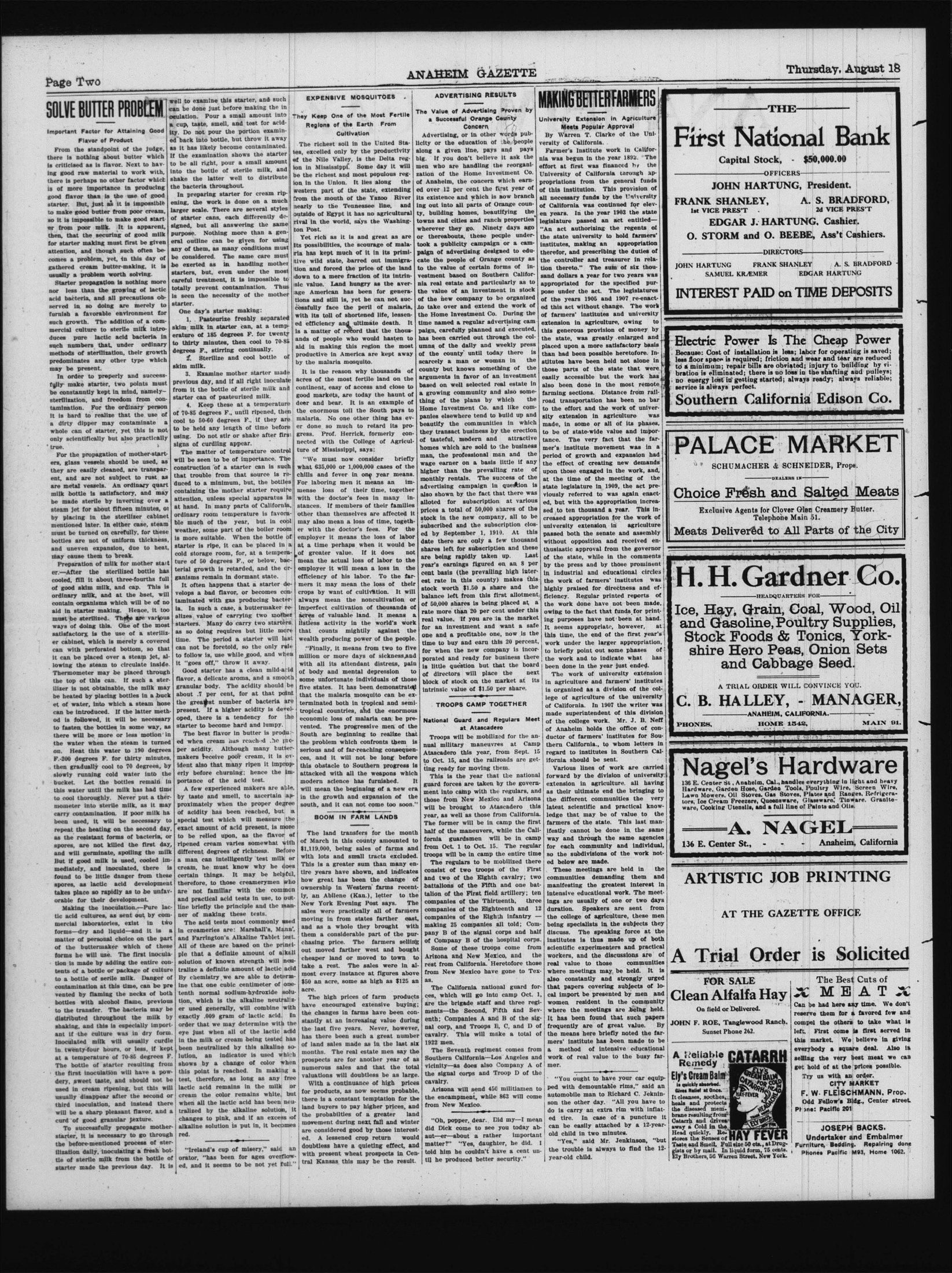
Searchable text
SOLVE BUTTER PROBLEM
Important Factor for Attaining Good Flavor of Product
From the standpoint of the judge, there is nothing about butter which is criticised as is flavor. Next to having good raw material to work with, there is perhaps no other factor which is of more importance in producing good flavor than is the use of good starter. But, just as it is impossible to make good butter from poor cream, so it is impossible to make good starter from poor milk. It is apparent, then, that the securing of good milk for starter making must first be given attention, and though such often becomes a problem, yet, in this day of gathered cream butter-making, it is usually a problem worth solving.
Starter propagation is nothing more nor less than the growing of lactic acid bacteria, and all precautions observed in so doing are merely to furnish a favorable environment for such growth. The addition of a commercial culture to sterile milk introduces pure lactic acid bacteria in such numbers that, under ordinary methods of sterilization, their growth predominates any other type which may be present.
In order to properly and successfully make starter, two points must be constantly kept in mind, namely—sterilization, and freedom from contamination. For the ordinary person it is hard to realize that the use of a dirty dipper may contaminate a whole can of starter, yet this is not only scientifically but also practically true.
For the propagation of mother-starters, glass vessels should be used, as they are easily cleaned, are transparent well to examine this starter, and such can be done just before making the incubation. Pour a small amount into a cup, taste, smell, and test for acidity. Do not pour the portion examined back into bottle, but throw it away as it has likely become contaminated. If the examination shows the starter to be all right, pour a small amount into the bottle of sterile milk, and shake the latter well to distribute the bacteria throughout.
In preparing starter for cream ripening, the work is done on a much larger scale. There are several styles of starter cans, each differently designed, but all answering the same purpose. Nothing more than a general outline can be given for using any of them, as many conditions must be considered. The same care must be exerted as in handling mother starters, but, even under the most careful treatment, it is impossible to totally prevent contamination. Thus is seen the necessity of the mother starter.
One day's starter making:
1. Pasteurize freshly separated skim milk in starter can, at a temperature of 185 degrees F. for twenty to thirty minutes, then cool to 70-85 degrees F., stirring continually.
2. Sterilize and cool bottle of skim milk.
3. Examine mother starter made previous day, and if all right inoculate from it the bottle of sterile milk and starter can of pasteurized milk.
4. Keep these at a temperature of 70-85 degrees F., until ripened, then cool to 50-60 degrees F., if they are to be held any length of time before using. Do not stir or shake after first signs of curdling appear.
The matter of temperature control will be seen to be of importance. The construction of a starter can is such that trouble from that source is re-
EXPENSIVE MARKET
They Keep One of Regions of the Cultivar
The richest soil increases, excelsled only by the Nile Valley, being in Mississippi. The richest and most important in the Union. Western part of the country from the mouth of Tennessee outside of Egypt it rival in the world, cotton Post.
Yet rich as it is its possibilities, therica has kept much active wild state, barbed and forced them down to a mere fragile value. Land hungage American has tensions and still is, yet successfully face the with its toll of show ed efficiency and ula is a matter of record amounts of people who aid in making this productive in America by the malaria mosquito.
It is the reason acres of the most continent, easy of a good markets, are deer and bear. It is the enormous toll malaria. No one o er done so much gross. Prof. Herrie connected with the Culture of Mississippi.
"We must now what 635,000 or 1,000 chills and fever in
In order to properly and successfully make starter, two points must be constantly kept in mind, namely sterilization, and freedom from contamination. For the ordinary person it is hard to realize that the use of a dirty dipper may contaminate a whole can of starter, yet this is not only scientifically but also practically true.
For the propagation of mother-starters, glass vessels should be used, as they are easily cleaned, are transparent, and are not subject to rust as are metal vessels. An ordinary quart milk bottle is satisfactory, and may be made sterile by inverting over a steam jet for about fifteen minutes, or by placing in the sterilizer cabinet mentioned later. In either case, steam must be turned on carefully, for these bottles are not of uniform thickness, and uneven expansion, due to heat, may cause them to break.
Preparation of milk for mother starter. After the sterilized bottle has cooled, fill it about three-fourths full of good skim milk, and cap. This is ordinary milk, and at the bset, will contain organisms which will be of no aid in starter making. Hence, it too must be sterilized. There are various ways of doing this. One of the most satisfactory is the use of a sterilizer cabinet, which is merely a covered can with perforated bottom, so that it can be placed over a steam jet, allowing the steam to circulate inside. Thermometer may be placed through the top of this can. If such a sterilizer is not obtainable, the milk may be heated by placing bottles in a bucket of water, into which a steam hose can be introduced. If the latter method is followed, it will be necessary to fasten the bottles in some way, as there will be more or less motion in the water when the steam is turned on. Heat this water to 190 degrees F., 200 degrees F., for thirty minutes, then gradually cool to 70 degrees, by slowly running cold water into the bucket. Let the bottles remain in this water until the milk has had time to cool thoroughly. Never put a thermometer into sterile milk, as it may carry contamination. If poor milk has been used, it will be necessary to repeat the heating on the second day, as the resistant forms of bacteria, or spores, are not killed the first day, and will germinate, spoiling the milk. But if good milk is used, cooled immediately, and inoculated, there is found to be little danger from these spores, as lactic acid development takes place so rapidly as to be unfavorable for their development.
3. Examine mother starter made previous day, and if all right inoculate from it the bottle of sterile milk and starter can of pasteurized milk.
4. Keep these at a temperature of 70-85 degrees F., until ripened, then cool to 50-60 degrees F., if they are to be held any length of time before using. Do not stir or shake after first signs of curdling appear.
The matter of temperature control will be seen to be of importance. The construction of a starter can is such that trouble from that source is reduced to a minimum, but, the bottles containing the mother starter require attention, unless special apparatus is at hand. In many parts of California, ordinary room temperature is favorable much of the year, but in cool weather, some part of the boiler room is more suitable. When the bottle of starter is ripe, it can be placed in a cold storage room, for, at a temperature of 50 degrees F., or below, bacterial growth is retarded, and the organisms remain in dormant state.
It often happens that a starter develops a bad flavor, or becomes contaminated with gas producing bacteria. In such a case, a buttermaker realizes value of carrying two mother starters. Many do carry two starters as so doing requires but little more time. The period a starter will last cannot be foretold, so the only rule to follow is, use while good, and when it "goes off," throw it away.
Good starter has a clean mild-acid flavor, a delicate aroma, and a smooth granular body. The acidity should be about .7 per cent, for at that point the greatest number of bacteria are present. If a higher acidity is developed, there is a tendency for the starter to become hard and lumpy.
The best flavor in butter is produced when cream has reached the proper acidity. Although many buttermakers receive poor cream, it is evident also that many ripen it improperly before churning; hence the importance of the acid test.
A few experienced makers are able by taste and smell, to ascertain approximately when the proper degree of acidity has been reached, but a special test which will measure the exact amount of acid present, is more to be relied upon, as the flavor of ripened cream varies somewhat with different degrees of richness. Before a man can intelligently test milk or cream, he must know why he does certain things. It may be helpful, therefore, to those creamerymen who are not familiar with the common and practical acid tests in use, to out-
Never put a thermometer into sterile milk, as it may carry contamination. If poor milk has been used, it will be necessary to repeat the heating on the second day, as the resistant forms of bacteria, or spores, are not killed the first day, and will germinate, spoiling the milk. But if good milk is used, cooled immediately, and inoculated, there is found to be little danger from these spores, as lactic acid development takes place so rapidly as to be unfavorable for their development.
Making the inoculation.—Pure lactic acid cultures, as sent out by commercial laboratories, exist in two forms—dry and liquid—and it is a matter of personal choice on the part of the buttermaker which of these forms he will use. The first inoculation is made by adding the entire contents of a bottle or package of culture to a bottle of serile milk. Danger of contamination at this time, can be prevented by flaming the necks of both bottles with alcohol flame, previous to the transfer. The bacteria may be distributed throughout the milk by shaking, and this is especially important if the culture was in dry form. Inoculated milk will usually curdle in twenty-four hours, or less, if kept at a temperature of 70-85 degrees F. The bottle of starter resulting from the first inoculation will have a powdery, sweet taste, and should not be used in cream ripening, but this will usually disappear after the second or third inoculation, and instead there will be a sharp pleasant flavor, and a curd of good granular texture.
To successfully propagate mother-starter, it is necessary to go through the before-mentioned process of sterilization daily, inoculating a fresh bottle of sterile milk from the bottle of starter made the previous day. It is proximately when the proper degree of acidity has been reached, but a special test which will measure the exact amount of acid present, is more to be relied upon, as the flavor of ripened cream varies somewhat with different degrees of richness. Before a man can intelligently test milk or cream, he must know why he does certain things. It may be helpful, therefore, to those creamerymen who are not familiar with the common and practical acid tests in use, to outline briefly the principle and the manner of making these tests.
The acid tests most commonly used in creameries are: Marshall's, Mann', and Farrington's Alkaline Tablet test. All of these are based on the principle that a definite amount of alkali solution of known strength will neutralize a definite amount of lactic acid By chemistry we are able to determine that one cubic centimeter of one-tenth normal sodium-hydroxide solution, which is the alkaline neutralizer used generally, will combine with exactly .009 gram of lactic acid. In order that we may determine with the eye just when all of the lactic acid in the milk or cream being tested has been neutralized by this alkaline solution, an indicator is used which shows by a change of color when this point is reached. In making a test, therefore, as long as any free lactic acid remains in the milk or cream the color remains white, but when all the lactic acid has been neutralized by the alkaline solution, it changes to pink, and if an excess of alkaline solution is put in, it becomes red.
"Ireland's cup of misery," said an orator, "has been for ages overflowed, and it seems to be not yet full."
EXPENSIVE MOSQUITOES
They Keep One of the Most Fertile Regions of the Earth From Cultivation
The richest soil in the United States, excelled only by the productivity of the Nile Valley, is the Delta region in Mississippi. Some day it will be the richest and most populous region in the Union. It lies along the western part of the state, extending from the mouth of the Yazoo River nearly to the Tennessee line, and outside of Egypt it has no agricultural rival in the world, says the Washington Post.
Yet rich as it is and great as are its possibilities, the scourge of malaria has kept much of it in its primitive wild state, barred out immigration and forced the price of the land down to a mere fraction of its intrinsic value. Land hungry as the average American has been for generations and still is, yet he can not successfully face the peril of malaria, with its toll of shortened life, lessened efficiency and ultimate death. It is a matter of record that the thousands of people who would hasten to aid in making this region the most productive in America are kept away by the malaria mosquito.
It is the reason why thousands of acres of the most fertile land on the continent, easy of access and close to good markets, are today the haunt of deer and bear. It is an example of the enormous toll the South pays to malaria. No one other thing has ever done so much to retard its progress. Prof. Herrick, formerly connected with the College of Agriculture of Mississippi, says:
"We must now consider briefly what 635,000 or 1,000,000 cases of the chills and fever in one year means"
ADVERTISING RESULTS
The Value of Advertising Proven by a Successful Orange County Concern
Advertising, or in other words publicity or the education of the people along a given line, pays and pays big. If you don't believe it ask the men who are handling the reorganization of the Home Investment Co. of Anaheim, the concern which earned over 12 per cent the first year of its existence and which is now branching out into all parts of Orange county, building homes, beautifying the towns and cities and ranch properties wherever they go. Ninety days ago or thereabouts, these people undertook a publicity campaign or a campaign of advertising designed to educate the people of Orange county as to the value of certain forms of investment based on Southern California real estate and particularly as to the value of an investment in stock of the new company to be organized to take over and extend the work of the Home Investment Co. During the time named a regular advertising campaign, carefully planned and executed, has been carried out through the columns of the daily and weekly press of the county until today there is scarcely a man or woman in the county but knows something of the arguments in favor of an investment based on well selected real estate in a growing community and also something of the plans by which the Home Investment Co. and like companies elsewhere tend to build up and beautify the communities in which they transact business by the erection of tasteful, modern and attractive homes which are sold to the business man, the professional man and the wage earner on a basis little if any higher than the prevailing rate of
MAKING BETTER FARMERS
University Extension in Agriculture Meets Popular Approval
By Warren T. Clarke of the University of California.
Farmer's Institute work in California was begun in the year 1892. The effort at first was financed by the University of California through appropriations from the general funds of this institution. This provision of all necessary funds by the University of California was continued for eleven years. In the year 1903 the state legislature passed an act entitled—"An act authorizing the regents of the state university to hold farmers' institutes, making an appropriation therefor, and prescribing the duties of the controller and treasurer in relation thereto." The sum of six thousand dollars a year for two years was appropriated for the specified purpose under the act. The legislatures of the years 1905 and 1907 re-enacted this act without change. The work of farmers' institutes and university extension in agriculture, owing to this generous provision of money by the state, was greatly enlarged and placed upon a more satisfactory basis than had been possible heretofore. Institutes have been held not alone in those parts of the state that were easily accessible but the work has also been done in the most remote farming sections. Distance from railroad transportation has been no bar to the effort and the work of university extension in agriculture was made, in some or all of its phases, to be of state-wide value and importance. The very fact that the farmer's institute movement was in a period of growth and expansion had the effect of creating new demands upon those engaged in the work, and,
The land transfers for the month of March in this county amounted to $1,119,000, being sales of farms and with lots and small tracts excluded. This is a greater sum than many entire years have shown, and indicates how great has been the change of ownership in Western farms recently, an Abilene (Kan.), letter to the arguments in favor of an investment based on well selected real estate in a growing community and also something of the plans by which the Home Investment Co. and like companies elsewhere tend to build up and beautify the communities in which they transact business by the erection of tasteful, modern and attractive homes which are sold to the business man, the professional man and the wage earner on a basis little if any higher than the prevailing rate of monthly rentals. The success of the advertising campaign in question is also shown by the fact that there was allotted for subscription at various prices a total of 50,000 shares of the stock in the new company, all to be subscribed and the subscription closed by September 1, 1910. At this date there are only a few thousand shares left for subscription and these are being rapidly taken up. Last year's earnings figured on an 8 per cent basis (the prevailing high interest rate in this county) makes this stock worth $1.50 a share and the balance left from this first allotment of 50,000 shares is being placed at a rate more than 20 per cent under this real value. If you are in the market for an investment and want a safe one and a profitable one, now is the time to buy and earn this 20 percent, for when the new company is incorporated and ready for business there is little question but that the board of directors will place the next block of stock on the market at its intrinsic value of $1.50 per share.
TROOPS CAMP TOGETHER
National Guard and Regulars Meet at Atascadero
Troops will be mobilized for the annual military maneuvers at Camp Atascadero this year, from Sept. 15 to Oct. 15, and the railroads are getting ready for moving them.
This is the year that the national guard forces are taken by the government into camp with the regulars, and those from New Mexico and Arizona will be brought to Atascadero this year, as well as those from California. The former will be in camp the first half of the maneuvers, while the California guardsmen will be in camp from Oct. 1 to Oct. 15. The regular troops will be in camp the entire time.
The regulars to be mobilized there consist of two troops of the First and two of the Eighth cavalry; two battalions of the Fifth and one battalion of the First field artillery; ten easily accessible but the work has also been done in the most remote farming sections. Distance from railroad transportation has been no bar to the effort and the work of university extension in agriculture was made, in some or all of its phases, to be of state-wide value and importance. The very fact that the farmer's institute movement was in a period of growth and expansion had the effect of creating new demands upon those engaged in the work, and at the time of the meeting of the state legislature in 1909, the act previously referred to was again enacted, but with the appropriation increased to ten thousand a year. This increased appropriation for the work of university extension in agriculture passed both the senate and assembly without opposition and received enthusiastic approval from the governor of the state, while in the comments by the press and by those prominent in industrial and educational circles the work of farmers' institutes was highly praised for directness and efficiency. Regular printed reports of the work done have not been made, owing to the fact that funds for printing purposes have not been at hand. It seems appropriate, however, at this time, the end of the first year's work under the larger appropriation, to briefly point out some phases of the work and to indicate what has been done in the year just ended.
The work of university extension in agriculture and farmers' institutes is organized as a division of the college of agriculture of the university of California. In 1907 the writer was made superintendent of this division of the college work. Mr. J. B. Neff of Anaheim holds the office of conductor of farmers' institutes for Southern California., to whom letters in regard to institutes in Southern California should be sent.
Various lines of work are carried forward by the division of university extension in agriculture. All having as their ultimate end the bringing to different communities the very latest scientific and practical knowledge that may be of value to the farmers of the state. This last manifestly cannot be done in the same way and through the same agencies for each community and individual, so the subdivisions of the work noted below are made.
These meetings are held in the communities demanding them and manifesting the greatest interest in intensive educational work. The meet-
BOOM IN FARM LANDS
The land transfers for the month of March in this county amounted to $1,119,000, being sales of farms and with lots and small tracts excluded. This is a greater sum than many entire years have shown, and indicates how great has been the change of ownership in Western farms recently, an Abilene (Kan.), letter to the New York Evening Post says. The sales were practically all of farmers moving in from states farther east, and as a whole they brought with them a considerable part of the purchasing price. The farmers selling out moved farther west and bought cheaper land or moved to town to take a rest. The sales were in almost every instance at figures above $50 an acre, some as high as $125 an acre.
The high prices of farm products have encouraged extensive buying; the changes in farms have been constantly at an increasing value during the last five years. Never, however, has there been such a great number of land sales made as in the last six months. The real estate men say the prospects are for another year of as numerous sales and that the total valuations will doubtless be as large.
With a continuance of high prices for products, as now seems probable, there is a constant temptation for the land buyers to pay higher prices, and the probabilities of a greater land movement during next fall and winter are considered good by those interested. A lessened crop return would doubtless have a quieting effect, and with present wheat prospects in Central Kansas this may be the result.
Oh, popper, dear. Did my—I mean did Dick come to see you today about—er—about a rather important matter? "Yes, daughter, he did. I told him he couldn't have a cent until he produced better security."
"You ought to have your car equipped with demountable rims," said an automobile man to Richard C. Jekninson the other day. "All you have to do is carry an extra rim with inflated tire. In case of a puncture it can be easily attached by a 12-year-old child in two minutes.
"Yes," said Mr. Jenkinson, "but the trouble is always to find the 12-year-old child."
THURSDAY, AUGUST 18
THE
First National Bank
Capital Stock, $50,000.00
OFFICERS
JOHN HARTUNG, President.
FRANK SHANLEY, A. S. BRADFORD,
1st VICE PRES'T 2d VICE PRES'T
EDGAR J. HARTUNG, Cashier.
O. STORM and O. BEEBE, Ass't Cashiers.
DIRECTORS
JOHN HARTUNG FRANK SHANLEY A. S. BRADFORD
SAMUEL KR/EMER EDGAR HARTUNG
INTEREST PAID on TIME DEPOSITS
Electric Power Is The Cheap Power
Because: Cost of installation is less; labor for operating is saved;
less floor space is required; friction and wear and tear are reduced
to a minimum; repair bills are obviated; injury to building by vibration is eliminated; there is no loss in the shafting and pulleys;
no energy lost in getting started; always ready; always reliable;
service is always perfect.
Southern California Edison Co.
PALACE MARKET
SCHUMACHER & SCHNEIDER, Props.
PALACE MARKET
SCHUMACHER & SCHNEIDER, Props.
DEALERS IN
Choice Fresh and Salted Meats
Exclusive Agents for Clover Glen Creamery Butter.
Telephone Main 51.
Meats Delivered to All Parts of the City
H. H. Gardner Co.
HEADQUARTERS FOR
Ice, Hay, Grain, Coal, Wood, Oil and Gasoline, Poultry Supplies,
Stock Foods & Tonics, Yorkshire Hero Peas, Onion Sets and Cabbage Seed.
A TRIAL ORDER WILL CONVINCE YOU.
C. B. HALLEY, - MANAGER,
ANAHEIM, CALIFORNIA.
PHONES, HOME 1542, MAIN 91.
Nagel's Hardware
136 E. Center St., Anaheim, Cal., handles everything in light and heavy Hardware, Garden Hose, Garden Tools, Poultry Wire, Screen Wire, Lawn Mowers, Oil Stoves, Gas Stoves, Plates and Ranges, Refrigerators, Ice Cream Freezers, Queensware, Glassware, Tinware, Graniteware, Cooking Utensils, and a full line of Paints and Oils.
A. NAGEL
136 E. Center St., Anaheim, California
ARTISTIC JOB PRINTING
ARTISTIC JOB PRINTING
AT THE GAZETTE OFFICE
A Trial Order is Solicited
FOR SALE
Clean Alfalfa Hay
On field or Delivered.
JOHN F. ROE, Tanglewood Ranch.
Sunset Phone 262.
The Best Cuts of MEAT
Can be had here any time. We don't reserve them for a favored few and compel the others to take what is left. First come is first served in this market. We believe in giving everybody a square deal. Also in selling the very best meat we can get hold of at the prices possible.
Try us with an order.
CITY MARKET
F. W. FLEISCHMANN, Prop.
Odd Fellow's Bldg., Center street.
Phone: Pacific 201
JOSEPH BACKS,
Undertaker and Embalmer
Furniture, Bedding. Repairing done
Phones Pacific M93, Home 1062.