anaheim-gazette 1910-08-04
Scanned page
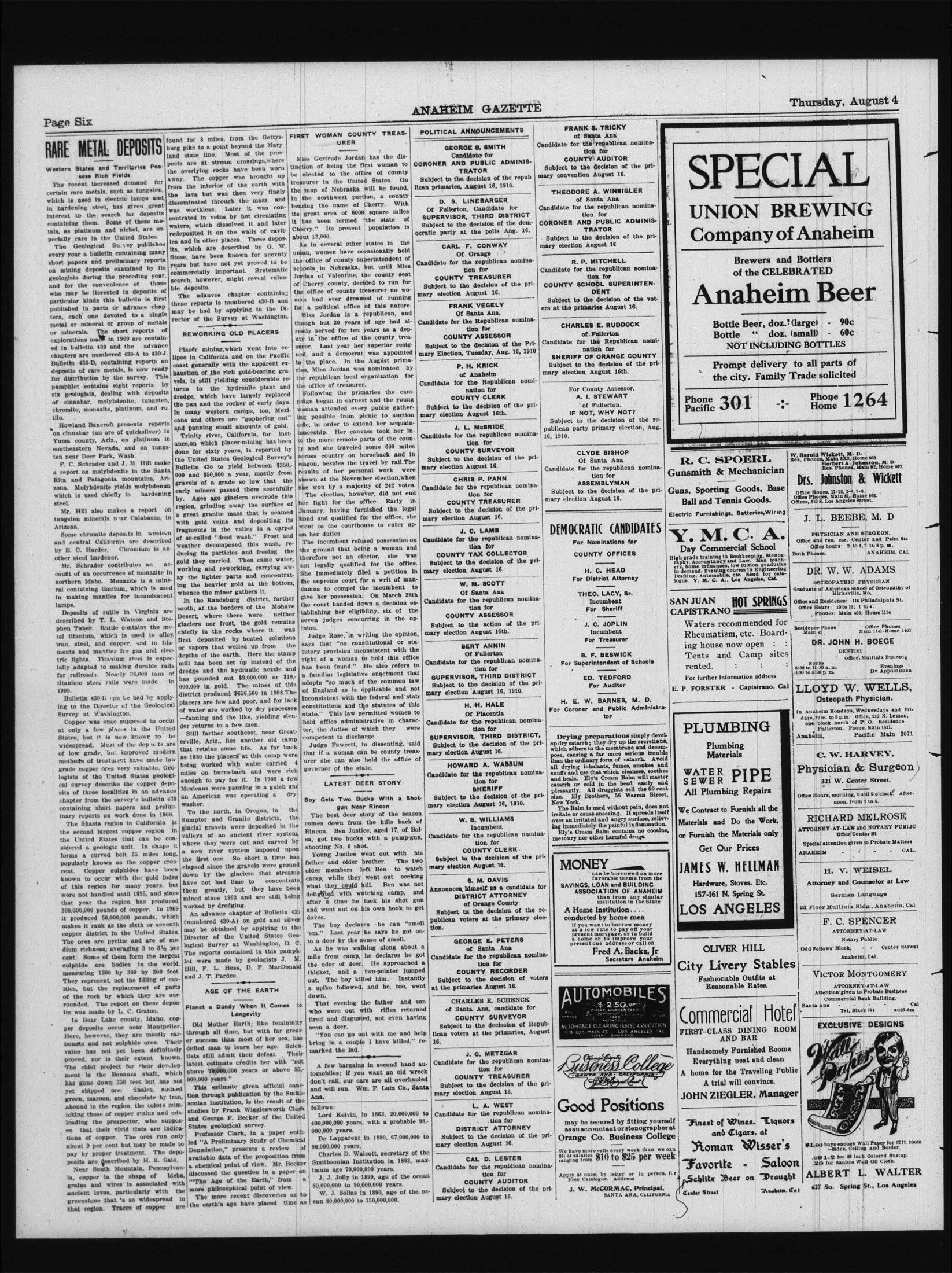
Searchable text
RARE METAL DEPOSITS
Western States and Territories Possess Rich Fields
The recent increased demand for certain rare metals, such as tungsten, which is used in electric lamps and in hardening steel, has given great interest to the search for deposits containing them. Some of these metals, as platinum and nickel, are especially rare in the United States.
The Geological Survey publishes every year a bulletin containing many short papers and preliminary reports on mining deposits examined by its geologists during the preceding year, and for the convenience of those who may be interested in deposits of particular kinds this bulletin is first published in parts or advance chapters, each one devoted to a single metal or mineral or group of metals or minerals. The short reports of explorations made in 1909 are contained in bulletin 430 and the advance chapters are numbered 430-A to 430-J. Bulletin 430-D, containing reports on deposits of rare metals, is now ready for distribution by the survey. This pamphlet contains eight reports by six geologists, dealing with deposits of cinnabar, molybdenite, tungsten, chromite, monazite, platinum, and rutile.
Howland Bancroft presents reports on cinnabar (an ore of quicksilver) in Yuma county, Ariz., on platinum in southeastern Nevada, and on tungsten near Deer Park, Wash.
F. C. Schrader and J. M. Hill make a report on molybdenite in the Santa
found for 8 miles, from the Gettysburg pike to a point beyond the Maryland state line. Most of the prospects are at stream crossings, where the overlying rocks have been worn away. The copper was brought up from the interior of the earth with the lava but was then very finely disseminated through the mass and was worthless. Later it was concentrated in veins by hot circulating waters, which dissolved it and later redeposited it on the walls of cavities and in other places. These deposits, which are described by G. W. Stose, have been known forseevty years but have not yet proved to be commercially important. Systematic search, however, might reveal valuable deposits.
The adavance chapter containing these reports is numbered 430-B and may be had by applying to the Director of the Survey at Washington.
REWORKING OLD PLACERS
Placer mining, which went into eclipse in California and on the Pacific coast generally with the apparent exhaustion of the rich gold-bearing gravels, is still yielding considerable returns to the hydraulic plant and dredge, which have largely replaced the pan and the rocker of early days. In many western camps, too, Mexicans and others are "gophering out" and panning small amounts of gold.
Trinity river, California, for instance, on which placer-mining has been done for sixty years, is reported by the United States Geological Survey's Bulletin 430 to yield between $350,000 and $50,000 a year, mostly from
Howland Bancroft presents reports on cinnabar (an ore of quicksilver) in Yuma county, Arizona, on platinum in southeastern Nevada, and on tungsten near Deer Park, Wash.
F. C. Schrader and J. M. Hill make a report on molybdenite in the Santa Rita and Patagonia mountains, Arizona. Molybdenite yields molybdenum which is used chiefly in hardening steel.
Mr. Hill also makes a report on tungsten minerals near Calabasas, in Arizona.
Some chromite deposits in western and central California are described by E. C. Harder, Chromium is another steel hardener.
Mr. Schrader contributes an account of an occurrence of monazite in northern Idaho. Monazite is a mineral containing thorium, which is used in making mantles for incandescent lamps.
Deposits of rutile in Virginia are described by T. L. Watson and Stephen Taber. Rutile contains the metal titanium, which is used to alloy iron, steel, and copper, and in filaments and mantles for gas and electric lights. Titanium steel is especially adapted to making durable rails for railroads. Nearly 36,000 tons of titanium steel rails were made in 1909.
Bulletin 430-D can be had by applying to the Director of the Geological Survey at Washington.
Copper was once supposed to occur at only a few places in the United States, but it is now known to be widespread. Most of the deposits are of low grade, but improved modern methods of treatment have made low grade copper ores very valuable. Geologists of the United States geological survey describe the copper deposits of three localities in an advance chapter from the survey's bulletin 430 containing short papers and preliminary reports on work done in 1909.
The Shasta region in California is the second largest copper region in the United States that can be considered a geologic unit. In shape it forms a curved belt 35 miles long, popularly known as the copper crescent. Copper sulphides have been known to occur with the gold lodes of this region for many years, but were not handled until 1895, and since hauling of the rich gold veins is still yielding considerable returns to the hydraulic plant and dredge, which have largely replaced the pan and the rocker of early days. In many western camps, too, Mexicans and others are "gophering out" and panning small amounts of gold.
Trinity river, California, for instance, on which placer-mining has been done for sixty years, is reported by the United States Geological Survey's Bulletin 430 to yield between $350,000 and $50,000 a year, mostly from gravels of a grade so low that the early miners passed them scornfully by. Ages ago glaciers overrode this region, grinding away the surface of a great granite mass that is seamed with gold veins and depositing its fragments in the valley in a carpet of so-called "dead wash." Frost and weather decomposed this wash, reducing its particles and freeing the gold they carried. Then came water, working and reworking, carrying away the lighter parts and concentrating the heavier gold at the bottom, whence the miner gathers it.
In the Randsburg district, farther south, at the borders of the Mohave Desert, where there were neither glaciers nor frost, the gold remains chiefly in the rocks where it was first deposited by heated solutions or vapors that welled up from the depths of the earth. Here the stamp mill has been set up instead of the dredge and the hydraulic nozzle and has pounded out $9,000,000 or $10,000,000 in gold. The mines of this district produced $656,560 in 1908.The placers are few and poor, and for lack of water are worked by dry processes—fanning and the like, yielding slender returns to a few men.
Still farther southeast, near Greaterville, Arizona, lies another old camp that retains some life. As far back as 1880 the placers at this camp were being worked with water carried 4 miles on burro-back and were rich enough to pay for it. In 1909 a few Mexicans were panning in a gulch and an American was operating a drywasher.
To the north, in Oregon, in the Sumpter and Granite districts, the glacial gravels were deposited in the valleys of an ancient river system, where they were cut and carved by a new river system imposed upon the first one. So short a time has elapsed since the gravels were ground down by the glaciers that streams have not had time to concentrate them greatly, but they have been mined since 1863 and are still being hauled off the rich gold veins is still yielding considerable returns to the hydraulic plant and dredge, which have largely replaced the pan and the rocker of early days. In many western camps, too, Mexicans and others are "gophering out" and panning small amounts of gold.
Trinity river, California, for instance, on which placer-mining has been done for sixty years, is reported by the United States Geological Survey's Bulletin 430 to yield between $350,000 and $50,000 a year, mostly from gravels of a grade so low that the early miners passed them scornfully by. Ages ago glaciers overrode this region, grinding away the surface of a great granite mass that is seamed with gold veins and depositing its fragments in the valley in a carpet of so-called "dead wash." Frost and weather decomposed this wash, reducing its particles and freeing the gold they carried. Then came water, working and reworking, carrying away the lighter parts and concentrating the heavier gold at the bottom, whence the miner gathers it.
In the Randsburg district, farther south, at the borders of the Mohave Desert, where there were neither glaciers nor frost, the gold remains chiefly in the rocks where it was first deposited by heated solutions or vapors that welled up from the depths of the earth. Here the stamp mill has been set up instead of the dredge and the hydraulic nozzle and has pounded out $9,000,000 or $10,000,000 in gold. The mines of this district produced $656,560 in 1908.The placers are few and poor, and for lack of water are worked by dry processes—fanning and the like, yielding slender returns to a few men.
Still farther southeast, near Greaterville, Arizona, lies another old camp that retains some life. As far back as 1880 the placers at this camp were being worked with water carried 4 miles on burro-back and were rich enough to pay for it. In 1909 a few Mexicans were panning in a gulch and an American was operating a drywasher.
To the north, in Oregon, in the Sumpter and Granite districts, the glacial gravels were deposited in the valleys of an ancient river system where they were cut and carved by a new river system imposed upon the first one. So short a time has elapsed since the gravels were ground down by the glaciers that streams have not had time to concentrate them greatly, but they have been mined since 1863 and are still being hauled off the rich gold veins is still yielding considerable returns to the hydraulic plant and dredge, which have largely replaced the pan and the rocker of early days. In many western camps, too, Mexicans and others are "gophering out" and panning small amounts of gold.
Trinity river, California, for instance, on which placer-mining has been done for sixty years, is reported by the United States Geological Survey's Bulletin 430 to yield between $350,000 and $50,000 a year, mostly from gravels of a grade so low that the early miners passed them scornfully by. Ages ago glaciers overrode this region, grinding away the surface of a great granite mass that is seamed with gold veins and depositing its fragments in the valley in a carpet of so-called "dead wash." Frost and weather decomposed this wash, reducing its particles and freeing the gold they carried. Then came water, working and reworking, carrying away the lighter parts and concentrating the heavier gold at the bottom, whence the miner gathers it.
In the Randsburg district, farther south, at the borders of the Mohave Desert, where there were neither glaciers nor frost,the gold remains chiefly in the rocks where it was first deposited by heated solutions or vapors that welled up from the depths of the earth. Here the stamp mill has been set up instead of the dredge and the hydraulic nozzle and has pounded out $9,000,000 or $10,000,000 in gold. The mines of this district produced $656,560 in 1908.The placers are few and poor,and for lack of water are worked by dry processes—fanning and the like,yielding slender returns to a few men.
Still farther southeast,near Greaterville,Arizona,lies another old camp that retains some life.As far back as 1880the placers at this camp were being worked with water carried 4 miles on burro-back和 were rich enough to pay for it.In 1909a few Mexicans were panning in a gulch和 an American was operating a drywasher.
To the north,in Oregon,in the Sumpter和 Granite districts,the glacial gravels were deposited in the valleys of an ancient river systemwhere they were cut and carved by a new river system imposed uponthe first one.So short a time has elapsed since the gravels were ground downbytheglaciersthatstreamshave not had time to concentratethem greatly,但theyhavebeenminedsince1863andarestillbeinghauledofftherichgoldveinsisstillyieldingconsiderablereturnstothehydraulicplantanddredgewhichhavelargelyreplacedthepanandtherockerofearlydays.Inmanywesterncamps,toworthhesupersonallocationsfromthewagon,believeshouldbesentatethecourtonherdies.Theincumbentrecommendestothecourthandedestablishingherelifeseventjudgesconclusion.JudgeFawcettthatifafwomanurereshancheralsogoalsorgovernoroftheLATEST
Boy Gets Two gun N
The best deer comes down from Rincon.Ben Ju sa,got two bucc shooting No.6 s Young Justice father and older older members camp,while ther what they could deligatedwith
The Shasta region in California is the second largest copper region in the United States that can be considered a geologic unit. In shape it forms a curved belt 35 miles long, popularly known as the copper crescent. Copper sulphides have been known to occur with the gold lodes of this region for many years, but were not handled until 1895, and since that year the region has produced 300,000,000 pounds of copper. In 1909 it produced 50,000,000 pounds, which makes it rank as the sixth or seventh copper district in the United States. The ores are pyritic and are of medium richness; averaging 3 to 3½ per cent. Some of them form the largest sulphide ore bodies in the world, measuring 1200 by 300 by 300 feet. They represent, not the filling of cavities, but the replacement of parts of the rock by which they are surrounded. The report on these deposits was made by L. C. Graton.
In Bear Lake county, Idaho, copper deposits occur near Montpelier. Here, however, they are mostly carbonate and not sulphide ores. Their value has not yet been definiteely proved, nor is their extent known. The chief project for their development is the Bonanza shaft, which has gone down 350 feet but has not yet shipped ore. Shales, stained green, maroon, and chocolate by iron, abound in the region, the colors mimicking those of copper stains and misleading the prospector, who supposes that their vivid tints are indications of copper. The ores run only about 2 per cent but may be made to pay by proper treatment. The deposits are described by H. S. Gale.
Near South Mountain, Pennsylvania, copper in the shape of blebs, grains and wires is associated with ancient lavas, particularly with the greenstone that 's so widespread in that region. Traces of copper are
To the north, in Oregon, in the Sumpter and Granite districts, the glacial gravels were deposited in the valleys of an ancient river system, where they were cut and carved by a new river system imposed upon the first one. So short a time has elapsed since the gravels were ground down by the glaciers that streams have not had time to concentrate them greatly, but they have been mined since 1863 and are still being worked by dredging.
An advance chapter of Bulletin 430 (numbered 430-A) on gold and silver may be obtained by applying to the Director of the United States Geological Survey at Washington, D. C. The reports contained in this pamphlet were made by geologists J. M. Hill, F. L. Hess, D. F. MacDonald and J. T. Pardee.
AGE OF THE EARTH
Planet a Dandy When It Comes to Longevity
Old Mother Earth, like femininity through all time, but with far greater success than most of her sex, has defied man to learn her age. Scientists still admit their defeat. Their latest estimate credits her with "not above 70,000,000 years or above 55,000,000 years."
This estimate given official sanction through publication by the Smithsonian Institution, is the result of the studies by Frank Wigglesworth Clark and George F. Becker of the United States geological survey.
Professor Clark, in a paper entitled "A Preliminary Study of Chemical Denudation," presents a review of available data of the proposition from a chemical point of view. Mr. Becker discussed the question in a paper on "'The Age of the Earth,' from a more philosophical point of view.
The more recent discoveries as to the earth's age have placed time as
Boy Gets Two Gun Nails
The best deer comes down from Rincon. Ben Junsa, got two bucks shooting No. 6 s.
Young Justice father and older older members camp, while they what they could delighted with after a time he and went out on doves.
The boy decelerated 'em." Last year to a deer by the deer.
As he was wile mile from camel the odor of deer thicket, and away out. The boy was a spike followed down.
That evening who were out tired and disguised a deer.
"You can go bring in a couch marked the ladder.
A few bargain tomobiles; if you don't call, our and will run.
Ana.
follows:
Lord Kelvin 400,000,000 years 000,000 years.
De Lapparen 90,000,000 years.
Charles D. V. Smithsonian Institution age 70,000.
J. J. Jolly in 80,000,000 to 99.
W. J. Sollas ean 80,000,000
FIRST WOMAN COUNTY TREASURER
Miss Gertrude Jordan has the distinction of being the first woman to be elected to the office of county treasurer in the United States. On the map of Nebraska will be found, in the northwest portion, a county bearing the name of Cherry. With its great area of 6000 square miles it has been termed "the state of Cherry." Its present population is about 12,000.
As in several other states in the union, women have occasionally held the office of county superintendent of schools in Nebraska, but until Miss Jordan of Valentine, the county seat of Cherry county, decided to run for the office of county treasurer no woman had ever dreamed of running for a political office of this nature.
Miss Jordan is a republican, and though but 30 years of age had already served for ten years as a deputy in the office of the county treasurer. Last year her superior resigned, and a democrat was appointed to the place. In the August primaries, Miss Jordan was nominated by the republican local organization for the office of treasurer.
Following the primaries the campaign began in earnest and the young woman attended every public gathering possible from picnic to auction sale, in order to extend her acquaintanceship. Her canvass took her into the more remote parts of the county and she traveled some 600 miles across country on horseback and in wagon, besides the travel by rail. The results of her personal work were...
Following the primaries the campaign began in earnest and the young woman attended every public gathering possible from picnic to auction sale, in order to extend her acquaintanceship. Her canvass took her into the more remote parts of the county and she traveled some 600 miles across country on horseback and in wagon, besides the travel by rail. The results of her personal work were shown at the November election, when she won by a majority of 242 votes.
The election, however, did not end her fight for the office. Early in January, having furnished the legal bond and qualified for the office, she went to the courthouse to enter upon her duties.
The incumbent refused possession on the ground that being a woman and therefore not an elector, she was not legally qualified for the office. She immediately filed a petition in the supreme court for a writ of mandamus to compel the incumbent to give her possession. On March 28th the court handed down a decision establishing her eligibility, six of the seven judges concurring in the opinion.
Judge Rose, in writing the opinion, says that "no constitutional or statutory provision inconsistent with the right of a woman to hold this office has been found." He also refers to a familiar legislative enactment that adopts "so much of the common law of England as is applicable and not inconsistent with the federal and state constitutions and the statutes of this state." This law permitted women to hold office administrative in character, the duties of which they were competent to discharge.
Judge Fawcett, in dissenting, said that if a woman can be county treasurer she can also hold the office of governor of the state.
LATEST DEER STORY
Boy Gets Two Bucks With a Shotgun Near Rincon
The best deer story of the season comes down from the hills back of Rincon. Ben Justice, aged 17, of Bolsa, got two bucks with a pump-gun, shooting No. 6 shot.
Young Justice went out with his father and older brother. The two older members left Ben to watch camp, while they went out seeking what they could kill. Ben was not delighted with watching camp, and instead hit his shotgun.
of Anaheim
Candidate for the Republican nomination for
COUNTY CLERK
Subject to the decision of the primary election August 16th.
J. L. McBRIDE
Candidate for the republican nomination for
COUNTY SURVEYOR
Subject to the decision of the primary election August 16.
CHRIS P. PANN
Candidate for the republican nomination for
COUNTY TREASURER
Subject to the decision of the primary election August 16.
J. C. LAMB
Candidate for the republican nomination for
COUNTY TAX COLLECTOR
Subject to the decision of the primary election August 16.
W. M. SCOTT
Of Santa Ana
Candidate for the republican nomination for
COUNTY ASSESSOR
Subject to the action of the primary election August 16th.
BERT ANNIN
Of Fullerton
Candidate for the republican nomination for
SUPERVISOR, THIRD DISTRICT
Subject to the decision of the primary election August 16, 1910.
H. H. HALE
Of Placentia
Candidate for the republican nomination for
SUPERVISOR, THIRD DISTRICT,
Subject to the decision of the primary election August 16.
HOWARD A. WASSUM
Candidate for the republican nomination for
SHERIFF
Subject to the decision of the primary election August 16, 1910.
W. B. WILLIAMS
Incumbent
Candidate for the republican nomination for
COUNTY CLERK
Subject to the decision of the primary election August 16.
S. M. DAVIS
Announce himself as a candidate for DISTRICT ATTORNEY
For County Assessor,
A. I. STEWART
of Fullerton.
IF NOT, WHY NOT?
Subject to the decision of the republican party primary election, Aug. 16, 1910.
CLYDE BISHOP
Of Santa Ana
Candidate for the republican nomination for
ASSEMBLYMAN
Subject to the decision of the primary election August 16.
DEMOCRATIC CANDIDATES
For Nominations for
COUNTY OFFICES
H. C. HEAD
For District Attorney
THEO. LACY, Sr.
Incumbent
For Sheriff
J. C. JOPLIN
Incumbent
For Treasurer
B. F. BESWICK
For Superintendent of Schools
ED. TEDFORD
For Auditor
H. E. W. BARNES, M. D.
For Coroner and Public Administrator
Drying preparations simply develop dry catarrh; they dry up the secretions, which adhere to the membrane and decompose, causing a far more serious trouble than the ordinary form of catarrh. Avoid all drying inhalants, fumes, smokes and snuffs and use that which cleanses, soothes and heals. Ely's Cream Balm will master catarrh or cold in the head easily and pleasantly. All druggists sell the 50 cent size. Ely Brothers, 56 Warren Street, New York.
The Balm is used without pain, does not irritate or cause sneezing. It spreads itself over an irritated and angry surface, relieving immediately the painful inflammation.
Ely's Cream Balm contains no cocaine, mercury nor other harmful drugs.
MONEY
can be borrowed on more favorable terms from the SAVINGS, LOAN and BUILDING ASSOCIATION OF ANAHEIM than from any similar
Boy Gets Two Bucks With a Shotgun Near Rincon
The best deer story of the season comes down from the hills back of Rincon. Ben Justice, aged 17, of Bolsa, got two bucks with a pump-gun, shooting No. 6 shot.
Young Justice went out with his father and older brother. The two older members left Ben to watch camp, while they went out seeking what they could kill. Ben was not delighted with watching camp, and after a time he took his shot gun and went out on his own hook to get doves.
The boy declares he can "smell 'em." Last year he says he got onto a deer by the sense of smell.
As he was walking along about a mile from camp, he declares he got the odor of deer. He approached a thicket, and a two-pointer jumped out. The boy killed him. Instantly a spike followed, and he, too, went down.
That evening the father and son who were out with rifles returned tired and disgusted, not even having seen a deer.
"You can go out with me and help bring in a couple I have killed," remarked the lad.
A few bargains in second hand automobiles; if you want an old wreck don't call, our cars are all overhauled and will run. Wm. F. Lutz Co., Santa Ana.
follows:
Lord Kelvin, in 1862, 20,000,000 to 400,000,000 years, with a probable 98,-000,000 years.
De Lapparent in 1890, 67,000,000 to 90,000,000 years.
Charles D. Walcott, secretary of the Smithsonian Institution in 1893, maximum age 70,000,000 years.
J. J. Jolly in 1899, age of the ocean 80,000,000 to 90,000,000 years.
W. J. Sollas in 1890, age of the ocean 80,000,000 to 150,000,000.
W. B. WILLIAMS
Incumbent
Candidate for the republican nomination for
COUNTY CLERK
Subject to the decision of the primary election August 16.
S. M. DAVIS
Announcea himself as a candidate for DISTRICT ATTORNEY of Orange County
Subject to the decision of the republican voters at the primary election.
GEORGE E. PETERS
of Santa Ana
Candidate for the republican nomination for
COUNTY RECORDER
Subject to the decision of voters at the primaries August 16.
CHARLES R. SCHENCK
of Santa Ana, candidate for
COUNTY SURVEYOR
Subject to the decision of Republican voters at the primaries, August 16.
J. C. METZGAR
Candidate for the republican nomination for
COUNTY TREASURER
Subject to the decision of the primary election August 15.
L. A. WEST
Candidate for the republican nomination for
DISTRICT ATTORNEY
Subject to the decision of the primary election August 16.
CAL D. LESTER
Candidate for the republican nomination for
COUNTY AUDITOR
Subject to the decision of the primary election August 15.
MONEY
can be borrowed on more favorable terms from the SAVINGS, LOAN and BUILDING ASSOCIATION OF ANAHEIM than from any similar institution in the State
A Home Institution... conducted by home men
If you want to borrow money at a low rate to pay off your present mortgage or to build a home or to improve your present one address or call on Fred A. Backs, Jr.
Secretary Anaheim
AUTOMOBILES $2.50 U.S.
FULLY GUARANTED
AUTOMOBILE CLEARING HOUSE ASSOCIATION
Business College
Good Positions may be secured by fitting yourself as an accountant or stenographer at Orange Co. Business College
We have more calls every week than we can fill at salaries ranging from $10 to $25 per week
Apply at once, by letter or in person, for Free Catalogue. Address
J. W. McCORMAC, Principal,
SANTA ANA, CALIFORNIA
THURSDAY, August 4
SPECIAL
UNION BREWING
Company of Anaheim
Brewers and Bottlers
of the CELEBRATED
Anaheim Beer
Bottle Beer, doz.! (large) - 90c
Bottle “doz. (small) - 60c
NOT INCLUDING BOTTLES
Prompt delivery to all parts of
the city. Family Trade solicited
Phone Pacific 301 - Phone Home 1264
R. C. SPOERL
Gunsmith & Mechanician
R. C. SPOERL
Gunsmith & Mechanician
Guns, Sporting Goods, Base Ball and Tennis Goods.
Electric Furnishings, Batteries, Wiring
Y. M. C. A.
Day Commercial School
High grade training in Bookkeeping, Stenography, Accountancy and Law. Men teachers, home influences, low tuition, graduates in demand. Evening courses in Engineering Drafting, Automobile, etc. Send for catalogue. Y. M. C. A., Los Angeles, Cal.
SAN JUAN HOT SPRINGS
CAPISTRANO
Waters recommended for Rheumatism, etc. Boarding house now open:
Tents and Camp sites rented.
For further information address
E. P. FORSTER - Capistrano, Cal
PLUMBING
Plumbing Materials
WATER PIPE
All Plumbing Repairs
We Contract to Furnish all the Materials and Do the Work, or Furnish the Materials only
Get Our Prices
JAMES W. HELLMAN
Hardware, Stoves, Etc.
157-161 N. Spring St.
W. Harold Wickett, M.D.
Res. Phones, Main 8X3, Home 863.
Herbert A. Johnston, M.D.
Res. Phones, Main 82, Home 862.
Drs. Johnston & Wickett
Office Hours, 11-12, 2-4, 7-8.
Office Phones, Main 81, Home 861.
Offices, 31D S. Los Angeles Street.
J. L. BEEBE, M.D
PHYSICIAN AND SURGEON.
Office and res. cor. Center and Palm Sts
Office hours: 2 to 4, 7 to 8 p.m.
Both Phones: ANAHEIM, CAL.
DR. W. W. ADAMS
OSTEOPATHIC PHYSICIAN
Graduate of American School of Osteopathy of Kirksville, Mo.
Office and Residence: 116 Philadelphia St.
Office Hours: 10 to 12; 1 to 4.
Phones: Main 463; Home 1134
Residence Phone
Main 42
Office Phones
Main 1141-Home 1401
DR. JOHN H. BOEGE
DENTIST
Office, Mullinix Building
HOURS
8:30 to 11:30 a.m.
Evenings
4:30 to 5:00 p.m.
By Appointment
LLOYD W. WELLS,
Osteopath Physician.
In Anaheim Mondays, Wednesdays and Fridays, 12 m. to 5 p.m. Office, 212 N. Lemon, one block north of P.O. Residence Fullerton. Phone, Main 1811.
Anaheim, Pacific Main 2071
C. W. HARVEY,
Physician & Surgeon
321 W. Center Street.
Office Hours, morning, until 9 o'clock. After noon, from 2 to 5.
RICHARD MELROSE
ATTORNEY-AT-LAW and NOTARY PUBLIC
Office Center 8t
Special attention given to Probate Matters
ANAHEIM - - - - CAL.
H. V. WEISEL
Attorney and Counselor at Law
German Language
We Contract to Furnish all the Materials and Do the Work, or Furnish the Materials only
Get Our Prices
JAMES W. HELLMAN
Hardware, Stoves, Etc.
157-161 N. Spring St.
LOS ANGELES
OLIVER HILL
City Livery Stables
Fashionable Outfits at Reasonable Rates.
Commercial Hotel
FIRST-CLASS DINING ROOM AND BAR
Handsomely Furnished Rooms
Everything neat and clean
A home for the Traveling Public
A trial will convince.
JOHN ZIEGLER, Manager
Finest of Wines, Liquors and Cigars, at Roman Wisser's Favorite - Saloon
Schlitz Beer on Draught
Center Street Anaheim, Cal
RICHARD MELROSE
ATTORNEY-AT-LAW and NOTARY PUBLIC Office Center 8t
Special attention given to Probate Matters
ANAHEIM - CAL.
H. V. WEISEL
Attorney and Counselor at Law
German Language
2d Floor Mullinix Blvd., Anaheim, Cal
F. C. SPENCER
ATTORNEY-AT-LAW
Notary Public
Odd Fellows' Block, Center Street Anaheim, Cal.
VICTOR MONTGOMERY
ATTORNEY-AT-LAW
Attention given to Probate Business Commercial Bank Building.
Santa Ana - Cal
Tel. Black 791 au23-6m
EXCLUSIVE DESIGNS
$1.00 buys enough Wall Paper for 12ft. room—Sides, Ceiling and Border.
091-2 for 36 inch Colored Burlap.
20 for Sanitos Wall Oil Cloth.
ALBERT L. WALTER
627 So. Spring St., Los Angeles