anaheim-gazette 1910-07-28
Scanned page
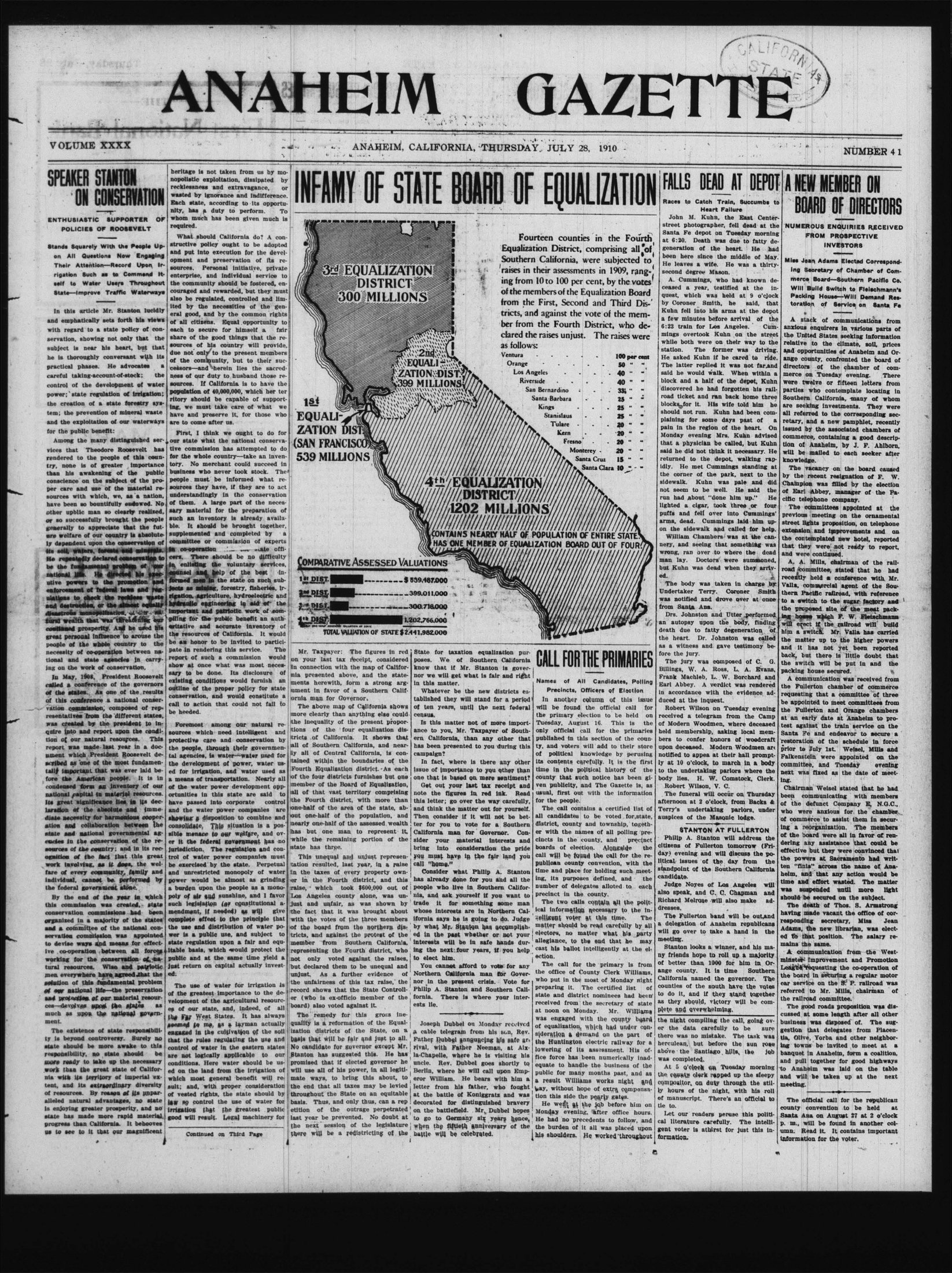
Searchable text
SPEAKER STANTON ON CONSERVATION
ENTHUSIASTIC SUPPORTER OF POLICIES OF ROOSEVELT
Stands Squarely With the People Upon All Questions Now Engaging Their Attention—Record Upon Irrigation Such as to Commend Itself to Water Users Throughout State—Improve Traffic Waterways
In this article Mr. Stanton lucidly and emphatically sets forth his views with regard to a state policy of conservation, showing not only that the subject is near his heart, but that he is thoroughly conversant with its practical phases. He advocates a careful taking-account-of-stock; the control of the development of water power; state regulation of irrigation; the creation of a state forestry system; the prevention of mineral waste and the exploitation of our waterways for the public benefit:
Among the many distinguished services that Theodore Roosevelt has rendered to the people of this country, none is of greater importance than his awakening of the public heritage is not taken from us by monopolistic exploitation, dissipated by recklessness and extravagance, or wasted by ignorance and indifference. Each state, according to its opportunity, has a duty to perform. To whom much has been given much is required.
What should California do? A constructive policy ought to be adopted and put into execution for the development and preservation of its resources. Personal initiative, private enterprise, and individual service to the community should be fostered, encouraged and rewarded, but they must also be regulated, controlled and limited by the necessities of the general good, and by the common rights of all citizens. Equal opportunity to each to secure for himself a fair share of the good things that the resources of his country will provide, due not only to the present members of the community, but to their successors—and herein lies the sacredness of our duty to husband those resources. If California is to have the population of 40,000,000, which her territory should be capable of supporting, we must take care of what we have and preserve it, for those who are to come after us.
First, I think we ought to do for our state what the national conservative commission has attempted to do for the whole country—take an inventory. No merchant could succeed in business who never took stock.
careful taking-account-of-stock; the control of the development of water power; state regulation of irrigation; the creation of a state forestry system; the prevention of mineral waste and the exploitation of our waterways for the public benefit:
Among the many distinguished services that Theodore Roosevelt has rendered to the people of this country, none is of greater importance than his awakening of the public conscience on the subject of proper care and use of the material resources with which we, as a nation, have been so bountifully endowed. No other upbill man so clearly realized, or so successfully brought the people generally to appreciate that the future welfare of our country is absolutely dependent upon the conservation of its soil, waters, forests and minerals. He repeatedly declared conservation to be the fundamental problem of our national life. He directed his executive powers to the promotion and enforcement of federal laws and regulations to check the reckless waste and destruction, or the almost equally disastrous monopolization, of our natural wealth that was threatening our continued prosperity. And he used his great personal influence to arouse the people of the whole country to the necessity of co-operation between national and state agencies in carrying on the work of conservation.
In May, 1908, President Roosevelt called a conference of the governors of the states. As one of the results of this conference a national conservation commission, composed of representatives from the different states, was created by the president to inquire into and report upon the condition of our natural resources. This report was made last year in a document which President Roosevelt described as one of the most fundamentally important that was ever laid before the American people. It is in condensed form an inventory of our national capital in material resources. Its great significance lies in its declaration of the absolute and immediate necessity for harmonious cooperation and collaboration between the state and national governmental agencies in the conservation of the resources of the country; and in its recognition of the fact that this great work involving, as it does, the welfare of every community, family and individual, cannot be performed by the federal government alone.
By the end of the year in which
First, I think we ought to do for our state what the national conservative commission has attempted to do for the whole country—take an inventory. No merchant could succeed in business who never took stock. The people must be informed what resources they have, if they are to act understandingly in the conservation of them. A large part of the necessary material for the preparation of such an inventory is already available. It should be brought together, supplemented and completed by a committee or commission of experts in co-operation with the state officers. There should be no difficulty in enlisting the voluntary services, counsel and help of the best informed men in the state on such subjects as mining, forestry, fisheries, irrigation, agriculture, hydroelectric and hydraulic engineering in aid of the important and patriotic work of compiling for the public benefit an authoritative and accurate inventory of the resources of California. It would be an honor to be invited to participate in rendering this service. The report of such a commission would show at once what was most necessary to be done. Its disclosure of existing conditions would furnish an outline of the proper policy for state conservation, and would constitute a call to action that could not fail to be heeded.
Foremost among our natural resources which need intelligent and protective care and conservation by the people, through their governmental agencies, is water—water used for the development of power, water used for irrigation, and water used as a means of transportation. Nearly all of the water power development opportunities in this state are said to have passed into corporate control and the water power companies are showing a disposition to combine and consolidate. This situation is a possible menace to our welfare, and over it the federal government has no jurisdiction. The regulation and control of water power companies must be exercised by the state. Perpetual and unrestricted monopoly of water power would be almost as grinding a burden upon the people as a monopoly of air and sunshine, and I favor
Mr. Taxpayer: To your last tax re-in connection with this mia presented above moments herewith, for mention in favor of a california man for Governor.
The above map of more clearly than anythe inequality of thie tions of the four districts of California. all of Southern Cali ly all of Central Cattained within the b Fourth Equalization of the four districts to member of the Board all of that vast territhe Fourth district, one-half of the area out one-half of the nearly one-half of thie has but one man while the remaining state has three.
This unequal and station resulted, last in the taxes of even in the Fourth d raise, which took Los Angeles county
Its great significance lies in its declaration of the absolute and immediate necessity for harmonious cooperation and collaboration between the state and national governmental agencies in the conservation of the resources of the country; and in its recognition of the fact that this great work involving, as it does, the welfare of every community, family and individual, cannot be performed by the federal government alone.
By the end of the year in which this commission was created, state conservation commissions had been organized in a majority of the states and a committee of the national conservation commission was appointed to devise ways and means for effective co-operation between all forces working for the conservation of natural resources. Wise and patriotic men everywhere have agreed that the solution of this fundamental problem of our national life—the preservation and protection of our material resources—devolves upon the states as much as upon the national government.
The existence of state responsibility is beyond controversy. Surely no state should be more awake to this responsibility, no state should be more ready to take up the necessary work than the great state of California with its territory of imperial extent, and its extraordinary diversity of resources. By reason of its unparalleled natural advantages, no state is enjoying greater prosperity, and no state has made more rapid material progress than California. It behooves us to see to it that our magnificent have passed into corporate control and the water power companies are showing a disposition to combine and consolidate. This situation is a possible menace to our welfare, and over it the federal government has no jurisdiction. The regulation and control of water power companies must be exercised by the state. Perpetual and unrestricted monopoly of water power would be almost as grinding a burden upon the people as a monopoly of air and sunshine, and I favor such legislation (or constitutional amendment, if needed) as will give complete effect to the principle that the use and distribution of water power is a public use, and subject to state regulation upon a fair and equitable basis, which would protect the public and at the same time yield a just return on capital actually invested.
The use of water for irrigation is of the greatest importance to the development of the agricultural resources of our state, and, indeed, of all the Far West States. It has always seemed to me, as a layman actually engaged in the cultivation of the soil that the rules regulating the use and control of water in the eastern states are not logically applicable to our conditions. Here water should be used on the land from the irrigation of which most general benefit will result; and, with proper consideration of vested rights, the state should by law so control the use of water for irrigation that the greatest public good will result. Legal machinery for
Continued on Third Page
AHEIM GAZE
ANAHEIM, CALIFORNIA, THURSDAY, JULY 28, 1910
INFAMY OF STATE BOARD OF EQUALIZATION
3rd EQUALIZATION DISTRICT
300 MILLIONS
2nd EQUALIZATION DISTRICT
399 MILLIONS
1st EQUALIZATION DISTRICT (SAN FRANCISCO)
539 MILLIONS
Fourteen counties in the Fourth Equalization District, comprising all of Southern California, were subjected to raises in their assessments in 1909, ranging from 10 to 100 per cent, by the votes of the members of the Equalization Board from the First, Second and Third Districts, and against the vote of the member from the Fourth District, who declared the raises unjust. The raises were as follows:
Ventura . . . . . . . . . . . . . . . . . . . . . . . . . . . . . . . . . . . . . . 100 per cent
Orange . . . . . . . . . . . . . . . . . . . . . . . . . . . . . . . . . . . 50 ""
Los Angeles . . . . . . . . . . . . . . . . . . . . . . . . . . . 40 ""
Riverside . . . . . . . . . . . . . . . . . . . . . . 40 ""
San Bernardino. ..... 33"
Santa Barbara. ..... 25"
Kings. ..... 25"
Stanislaus. ..... 25"
Tulare. ..... 20"
Kern. ..... 20"
Fresno. ..... 20"
Monterey. ..... 20"
Santa Cruz. ..... 15"
Santa Clara. ..... 10"
Mr. Taxpayer: The figures in red on your last tax receipt, considered in connection with the map of California presented above, and the statements herewith, form a strong argument in favor of a Southern California man for Governor.
The above map of California shows more clearly than anything else could the inequality of the present proportions of the four equalization districts of California. It shows that all of Southern California, and nearly all of Central California, is contained within the boundaries of the Fourth Equalization district. As each of the four districts furnishes but one member of the Board of Equalization, all of that vast territory comprising the Fourth district, with more than one-half of the area of the state, about one-half of the population, and nearly one-half of the assessed wealth has but one man to represent it, while the remaining portion of the state has three.
This unequal and unjust representation resulted, last year, in a raise in the taxes of every property owner in the Fourth district, and this raise, which took $600,000 out of Los Angeles county alone, was un-
State for taxation equalization purposes. We of Southern California know that if Mr. Stanton is governor we will get what is fair and right in this matter.
Whatever be the new districts established they will stand for a period of ten years, until the next federal census.
Is this matter not of more importance to you, Mr. Taxpayer of Southern California, than any other that has been presented to you during this campaign?
In fact, where is there any other issue of importance to you other than one that is based on mere sentiment?
Get out your last tax receipt and note the figures in red ink. Read this letter; go over the way carefully, and think the matter out for yourself.
Then consider if it will not be better for you to vote for a Southern California man for Governor. Consider your material interests and bring into consideration the pride you must have in the fair land you call "home."
Consider what Philip A. Stanton has already done for you and all the people who live in Southern California, and ask yourself if you want to
CALL FOR THE PRIMARIES
Names of All Candidates, Polling
Precincts, Officers of Elsection
In another column of this issue will be found the official call for the primary election to be held on Tuesday, August 16. This is the only official call for the primaries published in this section of the county, and voters will add to their store of political knowledge by perusing its contents carefully. It is the first time in the political history of the county that such notice has been given publicity, and The Gazette is, as usual, first out with the information for the people.
The call contains a certified list of all candidates to be voted for, state, district, county and township, together with the names of all polling precincts in the county, and precinct boards of election. Alongside the call will be found the call for the republican county convention, with the time and place for holding such meeting, its purposes defined, and the number of delegates allotted to each precinct in the county.
the Fourth district, with more than one-half of the area of the state, about one-half of the population, and nearly one-half of the assessed wealth has but one man to represent it, while the remaining portion of the state has three.
This unequal and unjust representation resulted, last year, in a raise in the taxes of every property owner in the Fourth district, and this raise, which took $600,000 out of Los Angeles county alone, was unjust and unfair, as was shown by the fact that it was brought about with the votes of the three members of the board from the northern districts, and against the protest of the member from Southern California, representing the Fourth district, who not only voted against the raises, but declared them to be unequal and unjust. As a further evidence of the unfairness of this tax raise, the record shows that the State Controller (who is ex-officio member of the board) also voted against it.
The remedy for this gross inequality is a reformation of the Equalization districts of the State, on a basis that will be fair and just to all. No candidate for governor except Mr. Stanton has suggested this. He has promised that if elected governor he will use all of his power, in all legitimate ways, to bring this about, to the end that all taxes may be levied throughout the State on an equitable basis. Thus, and only thus, can a repetition of the outrage perpetrated last year be prevented. No doubt at the next session of the legislature there will be a redistricting of the
Joseph Dubbel on Monday received a cable telegram from his son, Rev. Father Dubbel announcing his safe arrival, with Father Neeman, at Alex-Chapelle, where he is visiting his uncle. Rev. Dubbel goes shortly to Berlin, where he will call upon Emperor William. He bears with him a letter from his father, who fought at the battle of Koniggratz and was decorated for distinguished bravery on the battlefield. Mr. Dubbel hopes to go to Germany six years hence, when the fifty-th anniversary of the battle will be celebrated.
The call contains a certified list of all candidates to be voted for state, district, county and township, together with the names of all polling precincts in the county, and precinct boards of election. Alongside the call will be found the call for the republican county convention, with time and place for holding such meeting, its purposes defined, and the number of delegates allotted to each precinct in the county.
The two calls contain all the political information necessary to the intelligent voter at this time. The matter should be read carefully by all electors, no matter what his party allegiance, to the end that he may cast his ballot intelligently at the election.
The call for the primary is from the office of County Clerk Williams, who put in the most of Monday night preparing it. The certified list of state and district nominees had been received from the secretary of state at noon on Monday. Mr. Williams was engaged with the county board of equalization, which had under consideration a demand on the part of the Huntington electric railway for a lowering of its assessment. His office force has been numerically inadequate to handle the business of the public for many months past, and as a result Williams works night and day, without hope of extra compensation this side the pearly gates.
He went at the job before him on Monday evening, after office hours. He had no precedents to follow, and the burden of it all was placed upon his shoulders. He worked throughout
1910 NUMBER 41
IZATION
in the Fourth
imprising all of
the subjected to
in 1909, rangent, by the votes
alization Board
and Third District, who deThe raises were
FALLS DEAD AT DEPOT
Races to Catch Train, Succumbs to Heart Failure
John M. Kuhn, the East Center-street photographer, fell dead at the Santa Fe depot on Tuesday morning at 6:20. Death was due to fatty degeneration of the heart. He had been here since the middle of May. He leaves a wife. He was a thirty-second degree Mason.
A. Cummings, who had known deceased a year, testified at the inquest, which was held at 9 o'clock by Coroner Smith, he said, that Kuhn fell into his arms at the depot a few minutes before arrival of the 6:23 train for Los Angeles. Cummings overtook Kuhn on the street while both were on their way to the station. The former was driving. He asked Kuhn if he cared to ride. The latter replied it was not far,and said he would walk. When within a block and a half of the depot, Kuhn discovered he had forgotten his railroad ticket and ran back home three blocks for it. His wife told him he should not run. Kuhn had been complaining for some days past of a pain in the region of the heart. On Monday evening Mrs. Kuhn advised that a physician be called, but Kuhn said he did not think it necessary. He returned to the depot, walking rapidly. He met Cummings standing at the corner of the park next to the
A NEW MEMBER ON BOARD OF DIRECTORS
NUMEROUS ENQUIRIES RECEIVED FROM PROSPECTIVE INVESTORS
Miss Jean Adams Elected Corresponding Secretary of Chamber of Commerce Board—Southern Pacific Co.
Will Build Switch to Fleischmann's Packing House—Will Demand Restoration of Service on Santa Fe
A stack of communications from anxious enquirers in various parts of the United States seeking information relative to the climate, soil, prices and opportunities of Anaheim and Orange county, confronted the board of directors of the chamber of commerce on Tuesday evening. There were twelve or fifteen letters from parties who contemplate locating in Southern California, many of whom are seeking investments. They were all referred to the corresponding secretary, and a new pamphlet, recently issued by the associated chambers of commerce, containing a good description of Anaheim, by J. F. Ahlborn, will be mailed to each seeker after knowledge.
The vacancy on the board caused
THE PRIMARIES
Candidates, Polling
ers of Elsction
ann of this issue
official call for
to be held on
6. This is the
for the primaries
section of the counadd to their store
ledge by perusing
ly. It is the first
real history of the
notice has been giThe Gazette is, as
with the information
a certified list of
the voted for state,
township, together
of all polling prey, and precinct
Alongside the
call for the revention, with the
holding such meetdefined, and the
is alloted to each
county.
said he would walk. When within a block and a half of the depot, Kuhn discovered he had forgotten his railroad ticket and ran back home three blocks for it. His wife told him he should not run. Kuhn had been complaining for some days past of a pain in the region of the heart. On Monday evening Mrs. Kuhn advised that a physician be called, but Kuhn said he did not think it necessary. He returned to the depot, walking rapidly. He met Cummings standing at the corner of the park, next to the sidewalk. Kuhn was pale and did not seem to be well. He said the run had about "done him up." He lighted a cigar, took three or four puffs and fell over into Cummings' arms, dead. Cummings laid him upon the sidewalk and called for help.
William Chambers was at the cannery, and seeing that something was wrong, ran over to where the dead man lay. Doctors were summoned, but Kuhn was dead when they arrived.
The body was taken in charge by Undertaker Terry. Coroner Smith was notified and drove over at once from Santa Ana.
Drs. Johnston and Utter performed an autopsy upon the body, finding death due to fatty degeneration of the heart. Dr. Johnston was called as a witness and gave testimony before the jury.
The jury was composed of C. G. Billings, W. A. Ross, L. A. Evans, Frank Machleb, L. W. Borchard and Earl Abbey. A verdict was rendered in accordance with the evidence adduced at the inquest.
Robert Wilson on Tuesday evening received a telegram from the Camp of Modern Woodmen, where deceased held membership, asking local members to confer honors of woodcraft upon deceased. Modern Woodmen are notified to appeal at their hall promptly at 10 o'clock, to march in a body to the undertaking parlors where the body lies. H. W. Comstock, Clerk.
Robert Wilson, V. C.
The funeral will occur on Thursday afternoon at 2 o'clock, from Backs & Terry's undertaking parlors, under auspices of the Masonic lodge.
STANTON AT FULLERTON
Philip A. Stanton will address the citizens of Fullerton tomorrow (Friday) evening and will discuss the political issues of the day from the standpoint of the Southern California candidate.
Judge Noyes of Los Angeles will also speak, and C. C. Chapman and Richard Molson will also speak.
merce on Tuesday evening. There were twelve or fifteen letters from parties who contemplate locating in Southern California, many of whom are seeking investments. They were all referred to the corresponding secretary, and a new pamphlet, recently issued by the associated chambers of commerce, containing a good description of Anaheim, by J. F. Ahlborn, will be mailed to each seeker after knowledge.
The vacancy on the board caused by the recent resignation of F. W. Champion was filled by the election of Earl Abbey, manager of the Pacific telephone company.
The committees appointed at the previous meeting on the ornamental street lights proposition, on telephone extension and improvements and on the contemplated new hotel, reported that they were not ready to report, and were continued.
A. A. Mills, chairman of the railroad committee, stated that he had recently held a conference with Mr. Valla, commercial agent of the Southern Pacific railroad, with reference to a switch to the sugar factory and the proposed site of the meat packing house which F. W. Fleischmann will erect if the railroad will build him a switch. Mr. Valla has carried the matter up to the higher powers and it has not yet been reported back, but there is little doubt that the switch will be put in and the packing house secured.
A communication was received from the Fullerton chamber of commerce requesting that a committee of three be appointed to meet committees from the Fullerton and Orange chambers at an early date at Anaheim to protest against the train service on the Santa Fe and endeavor to secure a restoration of the schedule in force prior to July 1st. Weisel, Mills and Falkenstein were appointed on the committee, and Tuesday evening next was fixed as the date of meeting.
Chairman Weisel stated that he had been communicating with members of the defunct Company E, N.G.C., who were anxious for the chamber of commerce to assist them in securing a reorganization. The members of the board were all in favor of rendering any assistance that could be effective but they were convinced that the powers at Sacramento had written "finis" across the name of Anaheim, and that any action would be time and effort wasted. The matter was suspended until more light should be secured on the subject.
STANTON AT FULLERTON
Philip A. Stanton will address the citizens of Fullerton tomorrow (Friday) evening and will discuss the political issues of the day from the standpoint of the Southern California candidate.
Judge Noyes of Los Angeles will also speak, and C. C. Chapman and Richard Melrose will also make addresses.
The Fullerton band will be out and a delegation of Anaheim republicans will go over to take a hand in the meeting.
Stanton looks a winner, and his many friends hope to roll up a majority of better than 1000 for him in Orange county. It is time Southern California named the governor. The counties of the south have the votes to do it, and if they stand together as they should, victory will be complete and overwhelming.
the night compiling the call, going over the data carefully to be sure there was no mistake. The task was herculean, but before the sun rose above the Santiago hills, the job was completed.
At 5 o'clock on Tuesday morning the county clerk rapped up the sleepy compositor, on duty through the still hours of the night, with his roll of manuscript. There's an official to tie to.
Let our readers peruse this political literature carefully. The intelligent voter is at first for just this information.
of the defunct Company E, N.G.C., who were anxious for the chamber of commerce to assist them in securing a reorganization. The members of the board were all in favor of rendering any assistance that could be effective but they were convinced that the powers at Sacramento had written "finis" across the name of Anaheim, and that any action would be time and effort wasted. The matter was suspended until more light should be secured on the subject.
The death of Thos. S. Armstrong having made vacant the office of corresponding secretary, Miss Jean Adams, the new librarian, was elected to that position. The salary remains the same.
A communication from the Westminster Improvement and Promotion League requesting the co-operation of the board in securing a regular motor car service on the S. P. railroad was referred to Mr. Mills, chairman of the railroad committee.
The good roads proposition was discussed at some length after all other business was disposed of. The suggestion that delegates from Placentia, Olive, Yorba and other neighboring towns be invited to meet at a banquet in Anaheim, form a coalition, and pull together for good highways to Anaheim was laid on the table and will be taken up at the next meeting.
The official call for the republican county convention to be held at Santa Ana on August 27 at 2 o'clock p.m., will be found in another column. Read it. It contains important information for the voter.