anaheim-gazette 1910-07-21
Scanned page
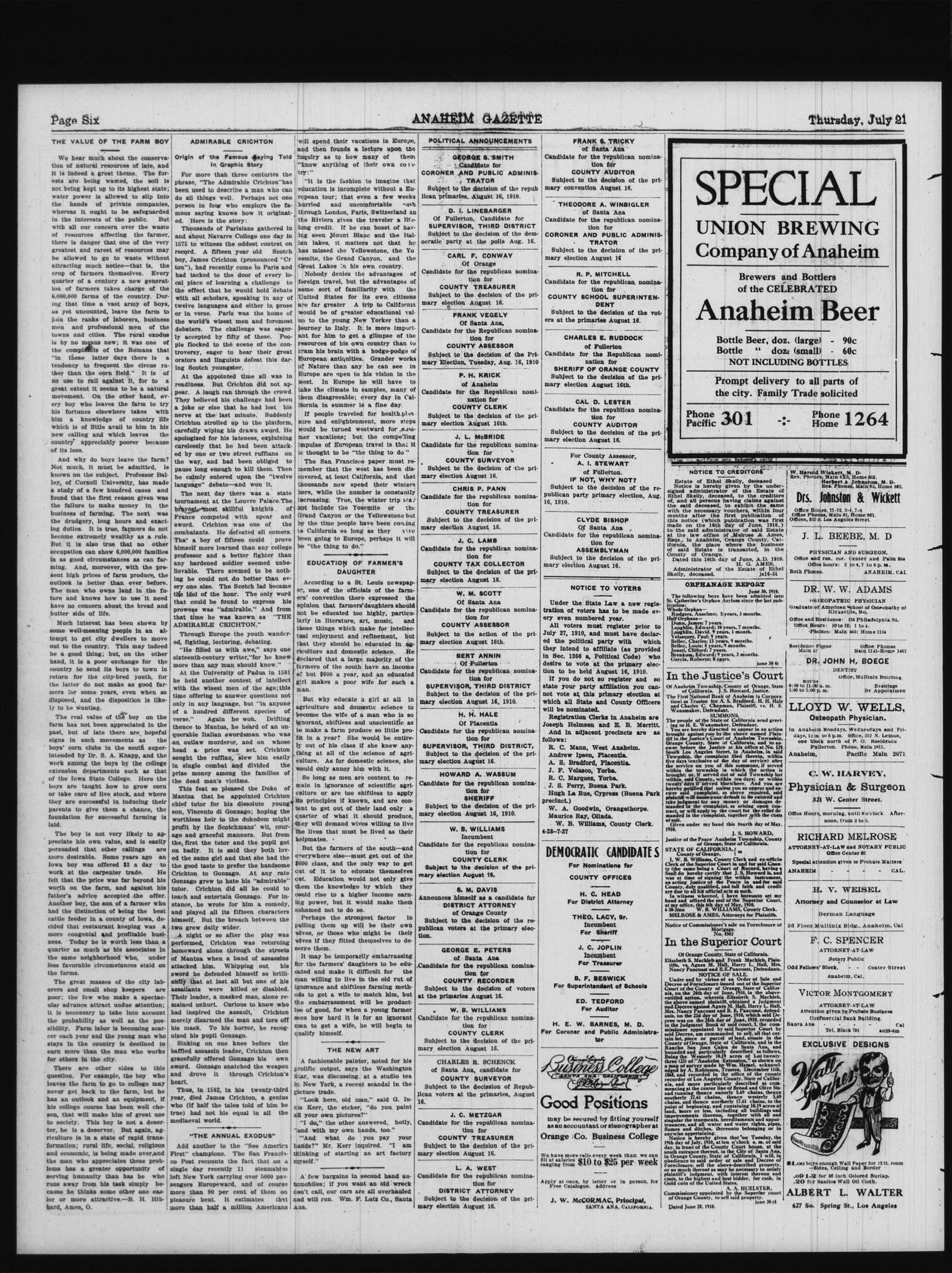
Searchable text
THE VALUE OF THE FARM BOY
We hear much about the conservation of natural resources of late, and it is indeed a great theme. The forests are being wasted, the soil is not being kept up to its highest state; water power is allowed to slip into the hands of private companies, whereas it ought to be safeguarded in the interests of the public. But with all our concern over the waste of resources affecting the farmer, there is danger that one of the very greatest and rarest of resources may be allowed to go to waste without attracting much notice—that is, the crop of farmers themselves. Every quarter of a century a new generation of farmers takes charge of the 6,000,000 farms of the country. During that time a vast army of boys, as yet uncounted, leave the farm to join the ranks of laborers, business men and professional men of the towns and cities. The rural exodus is by no means new; it was one of the complaints of the Romans that "in these latter days there is a tendency to frequent the circus rather than the corn field." It is of no use to rail against it, for to a great extent it seems to be a natural movement. On the other hand, every boy who leaves the farm to try his fortunes elsewhere takes with him a knowledge of country life which is of little avail to him in his new calling and which leaves the country appreciably poorer because of its loss.
And why do boys leave the farm? Not much, it must be admitted, is known on the subject. Professor Baldwin
ADMIRABLE CRICHTON
Origin of the Famous Saying Told In Graphic Story
For more than three centuries the phrase, "The Admirable Crichton" has been used to describe a man who can do all things well. Perhaps not one person in four who employs the famous saying knows how it originated. Here is the story:
Thousands of Parisians gathered in and about Navarre College one day in 1575 to witness the oddest contest on record. A fifteen year old Scotch boy, James Crichton (pronounced "Crion"), had recently come to Paris and had tacked to the door of every local place of learning a challenge to the effect that he would hold debate with all scholars, speaking in any of twelve languages and either in prose or in verse. Paris was the home of the world's wisest men and foremost debaters. The challenge was eagerly accepted by fifty of these. People flocked to the scene of the controversy, eager to hear their great orators and linguists defeat this daring Scotch youngster.
At the appointed time all was in readiness. But Crichton did not appear. A laugh ran through the crowd. They believed his challenge had been a joke or else that he had lost his nerve at the last minute. Suddenly Crichton strolled up to the platform, carefully wiping his drawn sword. He apologized for his lateness, explaining carelessly that he had been attacked by one or two street ruffians on the way, and had been obliged to pause long enough to kill them. Then will spend their vacations and then founds an inquiry as to how "know anything or try:"
"It is the fashion education is incomplete repean tour; that hurried and unthought through London, Pleasant Riviera gives long credit. If he being seen Mount Kailan lakes, it matter has missed the Yemite, the Grand Duchy Great Lakes: in his Nobody denies foreign travel, but some sort of fam United States for are far greater would be of great use to the young journey to Italy.ant for him to get resources of his own cram his brain with European antiquities of Nature than any Europe are open west. In Europe take the climate in them disagreeable; California in summer.
If people travel sure and enlightened would be turned over vacations; but impulse of Europe is thought to be "The San Francisco member that the..."
And why do boys leave the farm? Not much, it must be admitted, is known on the subject. Professor Bailey, of Cornell University, has made a study of a few hundred cases and found that the first reason given was the failure to make money in the business of farming. The next was the drudgery, long hours and exacting duties. It is true, farmers do not become extremely wealthy as a rule. But it is also true that no other occupation can show 6,000,000 families in as good circumstances as can farming. And, moreover, with the present high prices of farm produce, the outlook is better than ever before. The man who owns land in the future and knows how to use it need have no concern about the bread and butter side of life.
Much interest has been shown by some well-meaning people in an attempt to get city dwellers to move out to the country. This may indeed be a good thing; but, on the other hand, it is a poor exchange for the country to send its boys to town in return for the city-bred youth, for the latter do not make as good farmers for some years, even when so disposed, and the disposition is likely to be wanting.
The real value of the boy on the farm has not been appreciated in the past, but of late there are hopeful signs in such movements as the boys' corn clubs in the south superintended by Dr. S. A. Knapp, and the work among the boys by the college extension departments such as that of the Iowa State College. Here the boys are taught how to grow corn or take care of live stock, and where they are successful in inducing their parents to give them a chance, the foundation for successful farming is laid.
The boy is not very likely to appreciate his own value, and is easily persuaded that other callings are more desirable. Some years ago an Iowa boy was offered $3 a day to work at the carpenter trade. He felt that the price was far beyond his worth on the farm, and against his father's advice accepted the offer.
At the appointed time all was in readiness. But Crichton did not appear. A laugh ran through the crowd. They believed his challenge had been a joke or else that he had lost his nerve at the last minute. Suddenly Crichton strolled up to the platform, carefully wiping his drawn sword. He apologized for his lateness, explaining carelessly that he had been attacked by one or two street ruffians on the way, and had been obliged to pause long enough to kill them. Then he calmly entered upon the "twelve language" debate—and won it.
The next day there was a state tournament at the Louvre Palace. The bravest most skillful knights of France competed with spear and sword. Crichton was one of the combatants. He defeated all comers. Tha* a boy of fifteen could prove himself more learned than any college professor and a better fighter than any hardened soldier seemed unbelievable. There seemed to be nothing he could not do better than every one else. The Scotch lad became the idol of the hour. The only word that could be found to express his prowess was "admirable." And from that time he was known as "THE ADMIRABLE CRICHTON."
Through Europe the youth wandered, fighting, lecturing, debating.
"He filled us with awe," says one sixteenth-century writer,"for he knew more than any man should know."
At the University of Padua in 1581 he held another contest of intellect with the wisest men of the age; this time offering to answer questions not only in any language, but "in anyone of a hundred different species of verse." Again he woh. Drifting thence to Mantua, he heard of an unquerable Italian swordsman who was an outlaw murderer, and on whose head a price was set. Crichton sought the ruffian, slew him easily in single combat and divided the prize money among the families of the dead man's victims.
This feat so pleased the Duke of Mantua that he appointed Crichton chief tutor for his dissolute young son, Vincento di Gonzago; hoping the worthless heir to the dukedom might profit by the Scotchmans' wit, courage and graceful manners. But from the first the tutor and the pupil got on badly. It is said they both loved the same girl and that she had the good taste to prefer the handsome Crichton to Gonzago. At any rate Gonzago grew to hate his "admirable" tutor. Crichton did all he could to teach and entertain Gonzago. For in
EDUCATION OF DAUGHTER
According to a sister, one of the officers' convention that opinion that farmer not be educated to early in literature, those things which mutual enjoyment and that they should be cultured and domesticated declared that a large farmer of the souls of but $600 a year girl makes a poor man.
But why educate agriculture and do become the wife of ignorant, shiftless sons if its principles if knighted to get out of quarter of what if they will demand wives that must helpmates.
But the farmers everywhere else—many $600 class, and then out of it is to eat out. Education would them the knowledge could rise to a high
they are successful in inducing their parents to give them a chance, the foundation for successful farming is laid.
The boy is not very likely to appreciate his own value, and is easily persuaded that other callings are more desirable. Some years ago an Iowa boy was offered $3 a day to work at the carpenter trade. He felt that the price was far beyond his worth on the farm, and against his father's advice accepted the offer. Another boy, the son of a farmer who had the distinction of being the best cattle feeder in a county of Iowa, decided that restaurant keeping was a more congenial and profitable business. Today he is worth less than a quarter as much as his associates in the same neighborhood who, under less favorable circumstances staid on the farms.
The great masses of the city laborers and small shop keepers are poor; the few who make a spectacular advance attract undue attention; it is necessary to take into account the probability as well as the possibility. Farm labor is becoming scarcer each year and the young man who stays in the country is destined to earn more than the man who works for others in the city.
There are other sides to this question. For example, the boy who leaves the farm to go to college may never get back to the farm, but he has an outlook and an equipment, if his college course has been well chosen, that will make him of great use to society. This boy is not a deserter, he is a deserver. But again, agriculture is in a state of rapid transformation; rural life, social, religious and economic, is being made over, and the man who appreciates these problems has a greater opportunity of serving humanity than he who runs away from his task simply because he thinks some other one easier or more attractive.—B. H. Hibbard, Ames, O.
"THE ANNUAL EXODUS"
Add another to the "See America First" champions. The San Francisco Post recounts the fact that on a single day recently 11 steamships left New York carrying over 5000 passengers Europeward, and of course more than 90 per cent of them on pleasure bent. It estimates that more than half a million Americans
chief tutor for his dissolute young son, Vincento di Gonzago; hoping the worthless heir to the dukedom might profit by the Scotchmans' wit, courage and graceful manners. But from the first the tutor and the pupil got on badly. It is said they both loved the same girl and that she had the good taste to prefer the handsome Crichton to Gonzago. At any rate Gonzago grew to hate his "admirable" tutor. Crichton did all he could to teach and entertain Gonzago. For instance, he wrote for him a comedy, and played all its fifteen characters himself. But the breach between the two grew daily wider.
A night or so after the play was performed, Crichton was returning homeward alone through the streets of Mantua when a band of assassins attacked him. Whipping out his sword he defended himself so brilliantly that at last all but one of his assailants were killed or disabled. Their leader, a masked man, alone remained unhurt. Curious to know who had inspired the assault, Crichton merely disarmed the man and tore off his mask. To his horror, he recognized his pupil Gonzago.
Sinking on one knee before the baffled assassin leader, Crichton then gracefully offered Gonzago his own sword. Gonzago snatched the weapon and drove it through Crichton's heart.
Thus, in 1582, in his twenty-third year, died James Crichton, a genius who (if half the tales told of him be true) had not his equal in all the mediaeval world.
"A fashionable pair prolific output," says Star, was discussing in New York, a recipient picture trade.
"Look here, old mis Kerr, the etche all your own picture."
"I do," the other hand with my own hands?" Mr. Kerr thinking of starting myself."
ANAHEIM GAZETTE
will spend their vacations in Europe,
and then founds a lecture upon the inquiry as to how many of them "know anything of their own country."
"It is the fashion to imagine that education is incomplete without a European tour; that even a few weeks hurried and uncomfortable rush through London, Paris, Switzerland and the Riviera gives the traveler a lifelong credit. If he can boast of having seen Mount Blanc and the Italian lakes, it matters not that he has missed the Yellowstone, the Yosemite, the Grand Canyon, and the Great Lakes in his own country.
Nobody denies the advantages of foreign travel, but the advantages of some sort of familiarity with the United States for its own citizens are far greater. A trip to California would be of greater educational value to the young New Yorker than a journey to Italy. It is more important for him to get a glimpse of the resources of his own country than to cram his brain with a hodge-podge of European antiquities. Grander works of Nature than any he can see in Europe are open to his vision in the west. In Europe he will have to take the climate in samples, many of them disagreeable; every day in California in summer is a fine day.
If people traveled for health pleasure and enlightenment, more steps would be turned westward for summer vacations; but the compelling impulse of European travel is that it is thought to be "the thing to do."
The San Francisco paper must remember that the west has been disliked by many.
POLITICAL ANNOUNCEMENTS
GEORGE S. SMITH
Candidate for CORONER AND PUBLIC ADMINISTRATOR
Subject to the decision of the republican primaries, August 16, 1910.
D. J. LINEBARGER
Of Fullerton, Candidate for SUPERVISOR, THIRD DISTRICT
Subject to the decision of the democratic party at the polls Aug. 16.
CARL F. CONWAY
Of Orange
Candidate for the republican nomination for COUNTY TREASURER
Subject to the decision of the primary election August 16.
FRANK VEGELY
Of Santa Ana,
Candidate for the Republican nomination for COUNTY ASSESSOR
Subject to the decision of the Primary Election, Tuesday, Aug. 16, 1910
P. H. KRICK
of Anaheim
Candidate for the Republican nomination for COUNTY CLERK
Subject to the decision of the primary election August 16th.
J. L. McBRIDE
Candidate for the republican nomination for COUNTY SURVEYOR
Subject to the decision of the primary election August 16.
FRANK S. TRICKY
of Santa Ana
Candidate for the republican nomination for COUNTY AUDITOR
Subject to the decision of the primary convention August 16.
THEODORE A. WINBIGLER
of Santa Ana
Candidate for the republican nomination for CORONER AND PUBLIC ADMINISTRATOR
Subject to the decision of the primary election August 16
R. P. MITCHELL
Candidate for the republican nomination for COUNTY SCHOOL SUPERINTENDENT
Subject to the decision of the voters at the primaries August 16.
CHARLES E. RUDDOCK
of Fullerton
Candidate for the Republican nomination for SHERIFF OF ORANGE COUNTY
Subject to the decision of the primary election August 16th.
CAL D. LESTER
Candidate for the republican nomination for COUNTY AUDITOR
Subject to the decision of the primary election August 16.
For County Assessor,
A. I. STEWART
of Fullerton.
EDUCATION OF FARMER'S DAUGHTER
According to a St. Louis newspaper, one of the officials of the farmers' convention there expressed the opinion that farmers' daughters should not be educated too highly, particularly in literature, art, music, and those things which make for intellectual enjoyment and refinement, but that they should be educated in agriculture and domestic science. He declared that a large majority of the farmers of the south have an income of but $600 a year, and an educated girl makes a poor wife for such a man.
But why educate a girl at all in agriculture and domestic science to become the wife of a man who is so ignorant, shiftless and unscientific as to make a farm produce so little profit in a year? She would be entirely out of his class if she knew anything at all of the science of agriculture. As for domestic science, she would only annoy him with it.
So long as men are content to remain in ignorance of scientific agriculture or are too shiftless to apply its principles if known, and are content to get out of their land only a quarter of what it should produce, they will demand wives willing to live the lives that must be lived as their helpmates.
But the farmers of the south—and everywhere else—must get out of the $600 class, and the only way to get out of it is to educate themselves out. Education would not only give them the knowledge by which they could rise to a higher income earn-
its principles if known, and are content to get out of their land only a quarter of what it should produce, they will demand wives willing to live the lives that must be lived as their helpmates.
But the farmers of the south—and everywhere else—must get out of the $600 class, and the only way to get out of it is to educate themselves out. Education would not only give them the knowledge by which they could rise to a higher income earning power, but it would make them ashamed not to do so.
Perhaps the strongest factor in pulling them up will be their own wives, or those who might be their wives if they fitted themselves to deserve them.
It may be temporarily embarrassing for the farmers' daughters to be educated and make it difficult for the man willing to live in the old rut of ignorance and shiftless farming methods to get a wife to match him, but the embarrassment will be productive of good, for when a young farmer sees how hard it is for an ignorant man to get a wife, he will begin to qualify himself.
THE NEW ART
A fashionable painter, noted for his prolific output, says the Washington Star, was discussing at a studio tea in New York, a recent scandal in the picture trade.
"Look here, old man," said G. Innis Kerr, the etcher, "do you paint all your own pictures?"
"I do," the other answered, hotly, "and with my own hands, too."
"And what do you pay your hands?" Mr. Kerr inquired. "I am thinking of starting an art factory myself."
A few bargains in second hand automobiles; if you want an old wreck don't call, our cars are all overhauled and will run. Wm. F. Lutz Co., Santa Ana.
SHERIFP
Subject to the decision of the primary election August 16, 1910.
W. B. WILLIAMS
Incumbent
Candidate for the republican nomination for COUNTY CLERK
Subject to the decision of the primary election August 16.
S. M. DAVIS
Announces himself as a candidate for DISTRICT ATTORNEY of Orange County
Subject to the decision of the republican voters at the primary election.
GEORGE E. PETERS
of Santa Ana
Candidate for the republican nomination for COUNTY RECORDER
Subject to the decision of voters at the primaries August 16.
W. B. WILLIAMS
Candidate for the republican nomination for COUNTY CLERK
Subject to the decision of the primary election August 16.
CHARLES R. SCHENCK
of Santa Ana, candidate for COUNTY SURVEYOR
Subject to the decision of Republican voters at the primaries, August 16.
J. C. METZGAR
Candidate for the republican nomination for COUNTY TREASURER
Subject to the decision of the primary election August 16.
L. A. WEST
Candidate for the republican nomination for DISTRICT ATTORNEY
Subject to the decision of the primary election August 16.
DEMOCRATIC CANDIDATE
For Nominations for COUNTY OFFICES
H. C. HEAD
For District Attorney
THEO, LACY, Sr.
Incumbent
For Sheriff
J. C. JOPLIN
Incumbent
For Treasurer
B. F. BESWICK
For Superintendent of Schools
ED. TEDFORD
For Auditor
H. E. W. BARNES, M. D.
For Coroner and Public Administrator
Good Positions
may be secured by fitting yourself as an accountant or stenographer at Orange Co. Business College
We have more calls every week than we can fill at salaries ranging from $10 to $25 per week
Apply at once, by letter or in person, for Free Catalogue. Address
J. W. McCORMAC, Principal,
SANTA ANA, CALIFORNIA.
SPECIAL
UNION BREWING
Company of Anaheim
Brewers and Bottlers
of the CELEBRATED
Anaheim Beer
Bottle Beer, doz. (large) - 90c
Bottle “doz. (small) - 60c
NOT INCLUDING BOTTLES
Prompt delivery to all parts of
the city. Family Trade solicited
Phone Pacific 301 - Phone Home 1264
Prompt delivery to all parts of the city. Family Trade solicited
Phone 301 - Phone 1264
NOTICE TO CREDITORS
Estate of Ethel Skelly, deceased
Notice is hereby given by the under-signed administrator of the Estate of Ethel Skelly, deceased, to the creditors of, and all persons having claims against the said deceased, to exhibit the same with the necessary vouchers, within four months after the first publication of this notice (which publication was first made on the 16th day of June, 1910.) to the said administrator of said Estate at the law office of Melrose & Ames, Esq., in Anaheim, Orange County, California, the place where the business of said Estate is transacted, in the County of Orange.
Dated this 16th day of June, A.D. 1910.
H. G. AMES,
Administrator of the Estate of Ethel Skelly, deceased.
ORPHANAGE REPORT
June 30, 1910.
The following boys have been admitted into St. Catherine's Orphan Asylum since the last publication:
Whole Orphan—
Rodgers, Anselmo; 5 years, 3 months.
Half Orphans—
Dunn, James; 7 years.
Laughlin, Edward; 10 years, 7 months.
Laughlin, David; 9 years, 1 month.
Velasquez, Paul; 9 years.
Bellec, Charles; 13 years, 9 months.
Bellec, Louis; 8 years, 9 months.
Jonati, Clifford; 7 years.
Brenkuss, Edward; 9 years, 3 months.
Garcia, Roberto; 8 years.
june 30-4t
In the Justice’s Court
Of Anaheim Township, County of Orange, State of California. J. S. Howard, Justice.
The First National Bank of Anaheim (Corporation) as Trustee for A. S. Bradford, H. H. Hale and Charles C. Chapman, Plaintiff, vs. H. E. Wanamaker, Defendant.
SUMMONS.
The people of the State of California send greeting to H. E. Wanamaker, Defendant.
You are hereby directed to appear in an action brought against you by the above named plaintiff in the Justice’s Court of Anaheim Township, Orange County, State of California, and to answer before the Justice at his office at No. 12M South Los Angeles Street, in Anaheim in said Township, the complaint filed therein, within five days (exclusive of the day of service) after the service on you of this summons if served within the township in which the action is brought; or, if served out of said Township but within said County, within ten days; or within twenty days if served elsewhere. And you are hereby notified that unless you so appear and answer said complaint, as above required, said plaintiff will assume your default to be entered and take judgment for any money or damages demanded in the complaint, as arising upon contract, or will apply to the court for the relief demanded in the complaint, together with the costs of suit.
Given under my hand this fourth day of May, 1910.
J. S. HOWARD,
Justice of the Peace Anaheim Township, County of Orange, State of California.
STATE OF CALIFORNIA,
County of Orange,
I. W. B. Williams, County Clerk and ex-officio Clerk of the Superior Court in and for said County (the same being a Court of Record, having a Seal) do hereby certify that J. S. Howard is, and was at time of signing the within instrument, an acting Justice of the Peace in and for said County, duly qualified, and full faith and credit are due to all his official acts as such.
In witness whereof, I have hereunto set my name and seal.
W. Harold Wickett, M.D.
Res: Phones, Main 8X3, Home 863.
Herbert A Johnston, M.D.
Res: Phones, Main 82, Home 862.
Drs. Johnston & Wickett
Office Hours: 11-12, 2-4, 7-8
Office Phones: Main 81, Home 861.
Offices: 810 S. Los Angeles Street.
J. L. BEEBE, M.D
PHYSICIAN AND SURGEON.
Office and res. cor. Center and Palm Sts
Office hours: 2 to 4, 7 to 8 p.m.
Both Phones.
ANAHEIM, CAL
DR. W. W. ADAMS
OSTEOPATHIC PHYSICIAN
Graduate of American School of Osteopathy of Kirksville, Mo.
Office and Residence: 116 Philladelphn St.
Office Hours: 10 to 12; 1 to 4.
Phones: Main 463; Home 1134
Residence Pouce
Main s2
Office Phones
Main 1141-Home 1401
DR. JOHN H. BOEGE
DENTIST
Office, Multnix Building
HOURS:
8:30 to 11:30 a.m.
Evenings:
1:30 to 5:00 p.m.
LLOYD W. WELLS,
Osteopath Physician.
In Anaheim Mondays, Wednesdays and Fridays, 12 m to 5 p.m. Office; 212 N. Lemon one block north of P.O. Residence Pullerton. Phone: Main 1811.
Anaheim,
Pacific Main 2071
C. W. HARVEY,
Physician & Surgeon
321 W. Center Street.
Office Hours morning until no clock After noon from 2 to 5.
RICHARD MELROSE
ATTORNEY-AT-LAW and NOTARY PUBLIC
Office Center St
Special attention given to Probate Matters
ANAHEIM -
CAL.
H. V. WEISEL
In the Superior Court
Of Orange County, State of California.
Elizabeth S. Machleb and Frank Machleb, Plaintiffs, vs. Agnes M. Hall, Harry L. Hall, Mrs. Nancy Pancoast and B.E.Pancoast, Defendants.
NOTICE OF SALE.
Under and by virtue of an Order of Sale and Decree of Foreclosure issued out of the Superior Court of the County of Orange, State of California, on the 24th day of June, 1910, in the above-entitled action, wherein Elizabeth S. Machleb, the above named plaintiff, obtained a Judgment and Decree against Agnes M. Hall, Harry L. Hall, Mrs. Nancy Pancoast and B.E.Pancoast, defendants, on the 22d day of June, 1910, which said Decree was on the 24th day of June, 1910, recorded in the Judgment Book of said court, I, the commissioner appointed by said Superior Court by said Decree, am commanded to sell, all that certain lot, piece or parcel of land, situate in the County of Orange, State of California, and in the Rancho San Juan Caion de Santa Ana, and bounded and particularly described as follows.
Being the Westerly 10.19 acres of Lot twenty-three (23) of "Anaheim Extension," as shown on a map of survey made by Wm. Hamel, acknowledged by A. Robinson, Trustee, December 11th, 1868, and recorded in the office of the county recorder of Los Angeles County, State of California, and more particularly described as commencing at the center line of Broad and Olive Sts. and running thence easterly 5.69 chains, thence southerly 17.61 chains, thence westerly 5.69 chains, and thence northerly 17.61 chains, to the point of beginning, and containing 10.19 acres of land, more or less, including all buildings and improvements thereon, together with all and singular the tenements, hereditaments and appurtenances, and all water and water rights, pipes, flumes and ditches, thereunto belonging or in anywise appertaining.
Notice is hereby given that on Tuesday, the 19th day of July, 1910, at ten o'clock a.m. of said day, in front of the County Court house, at the south entrance thereof, in the City of Santa Ana, in Orange County, State of California, I will, in obedience to said order of sale and Decree of Foreclosure, sell the above-described property, or so much thereof as may be necessary to satisfy plaintiff's judgment, with interest thereon and costs, to the highest and best bidder, for cash, in Gold coin of the United States.
A. A. HUELSTER,
Commissioner appointed by the Superior court of Orange County, to sell said property.
Dated June 28, 1910.