anaheim-gazette 1910-07-21
Scanned page
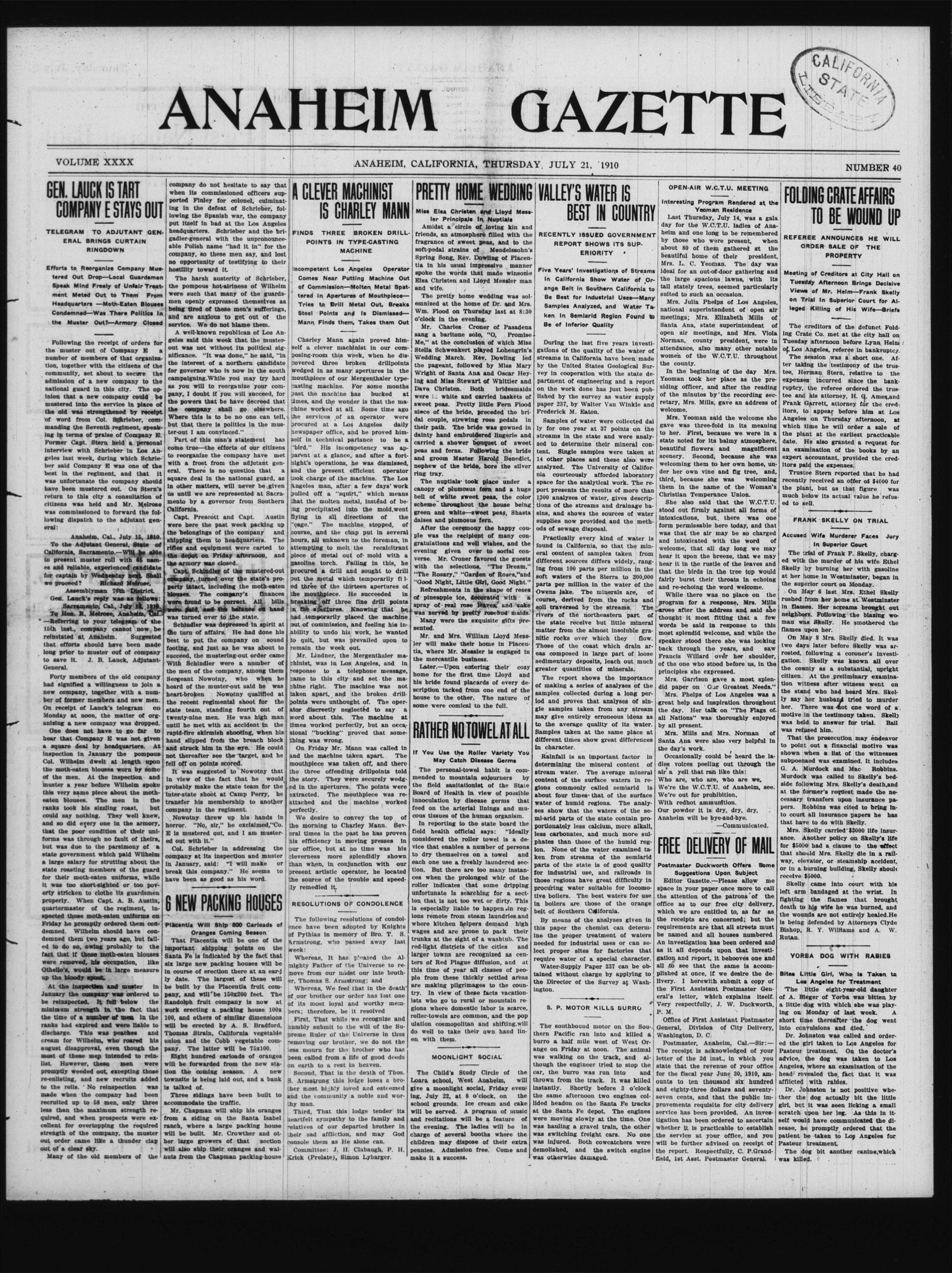
Searchable text
GEN. LAUCK IS TART COMPANY E STAYS OUT
TELEGRAM TO ADJUTANT GENERAL BRINGS CURTAIN RINGDOWN
Efforts to Reorganize Company Mustered Out Drop—Local Guardmen Speak Mind Freely of Unfair Treatment Meted Out to Them From Headquarters —Moth-Eaten Blouses Condemned—Was There Politics in the Muster Out?—Armory Closed
Following the receipt of orders for the muster out of Company E a number of members of that organization, together with the citizens of the community, set about to secure the admission of a new company to the national guard in this city. The opinion that a new company could be mustered into the service in place of the old was strengthened by receipt of word from Col. Schrieber, commanding the Seventh regiment, speaking in terms of praise of Company E. Former Capt. Stern held a personal interview with Schrieber in Los Angeles last week, during which Schrieber said Company E was one of the best in the regiment, and that it company do not hesitate to say that when its commissioned officers supported Finley for colonel, culminating in the defeat of Schrieber, following the Spanish war, the company put itself in bad at the Los Angeles headquarters. Schrieber and the brigadier-general with the unpronounceable Polish name "had it in" for the company, so these men say, and lost no opportunity of testifying to their hostility toward it.
The harsh austerity of Schrieber, the pompous hot-airiness of Wilhelm were such that many of the guardsmen openly expressed themselves as being tired of these men's sufferings, and are anxious to get out of the service. We do not blame them.
A well-known republican of Los Angeles said this week that the muster-out was not without its political significance. "It was done," he said, "in the interest of a northern candidate for governor who is now in the south campaigning. While you may try hard as you will to reorganize your company, I doubt if you will succeed, for the powers that be have decreed that the company shall go elsewhere. Where this is to be no one can tell, but that there is politics in the muster-out I am convinced."
Part of this man's statement has come true—the efforts of our citizens to reorganize the company have met with a frost from the adjutant general. There is no question that a
Anaheim, Cal., July 15, 1910.
To the Adjutant General, State of California, Sacramento.—Will be able to present muster roll with 66 names and reliable, experienced candidate for captain by Wednesday next. Shall we proceed? Richard Melrose,
Assemblyman 76th District.
Gen. Lauck's reply was as follows:
Sacramento, Cal., July 18, 1910.
To Hon. R. Melrose, Anaheim, Cal.
—Referring to your telegram of the 15th inst., company cannot now be reinstated at Anaheim. Suggested that efforts should have been made long prior to muster out of company to save it. J. B. Lauck, Adjutant-General.
Forty members of the old company had signified a willingness to join a new company, together with a number of former members and new men. On receipt of Lauck's telegram on Monday at noon, the matter of organizing a new company was dropped.
One does not have to go far to hear that Company E was not given a square deal by headquarters. At inspection in January the pompous Col. Wilhelm dwelt at length upon the moth-eaten blouses worn by some of the men. At the inspection and muster a year before Wilhelm spoke this very same piece about the moth-eaten blouses. The men in the ranks took his sizzling roast, but could say nothing. They well knew, and so did every one in the armory, that the poor condition of their uniforms was through no fault of theirs, but was due to the parsimony of a state government which paid Wilhelm a large salary for strutting about the state roasting members of the guard for their moth-eaten uniforms, while it was too short-sighted or too poverty stricken to clothe its guardsmen campaigning. While you may try hard as you will to reorganize your company, I doubt if you will succeed, for the powers that be have decreed that the company shall go elsewhere. Where this is to be no one can tell, but that there is politics in the muster-out I am convinced."
Part of this man's statement has come true—the efforts of our citizens to reorganize the company have met with a frost from the adjutant general. There is no question that a square deal in the national guard, as in other matters, will never be given us until we are represented at Sacramento by a governor from Southern California.
Capt. Prescott and Capt. Austin were here the past week packing up the belongings of the company and shipping them to headquarters. The rifles and equipment were carted to the depot on Friday afternoon, and the armory was closed.
Capt. Schindler of the mustered-out company, turned over the state's property intact, including the moth-eaten blouses. The company's finances were found to be correct. All bills were paid, and the balance on hand was turned over to the state.
Schindler was depressed in spirit at the turn of affairs. He had done his best to put the company on sound footing, and just as he was about to succeed, the mustering-out order came With Schindler were a number of the men of the company, among them Sergeant Nowotny, who when he heard of the muster-out said he was heart-broken Nowotny qualified at the recent regimental shoot for the state team, standing fourth out of twenty-nine men. He was high man until he met with an accident in the rapid-fire skirmish shooting, when his hand slipped from the breach block and struck him in the eye. He could not thereafter see the target, and he fell off on points scored.
It was suggested to Nowotny that in view of the fact that he would probably make the state team for the inter-state shoot at Camp Perry, he transfer his membership to another company in the regiment.
Nowotny threw up his hands in horror. "No, sir," he exclaimed, "Co. E is mustered out, and I am mustered out with it."
Col. Schrieber in addressing the company at its inspection and muster in January, said: "I will make or break this company." He seems to have been as good as his word.
We desire to conceive the morning to Charlestown times in the past his efficiency in moving our office, but at no cleverness more spared than when, in conjunction with present artistic operas, the source of the trotly remedied it.
eaten blouses. The men in the ranks took his sizzling roast, but could say nothing. They well knew, and so did every one in the armory, that the poor condition of their uniforms was through no fault of theirs, but was due to the parsimony of a state government which paid Wilhelm a large salary for strutting about the state roasting members of the guard for their moth-eaten uniforms, while it was too short-sighted or too poverty stricken to clothe its guardsmen properly. When Capt. A. B. Austin, quartermaster of the regiment, inspected those moth-eaten uniforms on Friday he promptly ordered them condemned. Wilhelm should have condemned them two years ago, but failed to do so, owing probably to the fact that if these moth-eaten blouses were removed, his occupation, like Othello's, would be in large measure up the bloody spout.
At the inspection and muster in January the company was ordered to be reinspected. It fell below the minimum strength in the fact that the time of a number of men in the ranks had expired and were liable to discharge. This was peaches and cream for Wilhelm, who roared his august disapproval, even though the most of these men intended to reinlist. However, these men were promptly weeded out, excepting those re-enlisting, and new recruits added to the rolls. No reinspection was made when the company had been recruited up to 58 men, only three less than the maximum strength required, and when prospects were excellent for overtopping the required strength of the company, the muster out order came like a thunder clap out of a clear sky.
Many of the old members of the transfer his membership to another company in the regiment.
Nowotny threw up his hands in horror. "No, sir," he exclaimed, "Co. E is mustered out, and I am mustered out with it."
Col. Schrieber in addressing the company at its inspection and muster in January, said: "I will make or break this company." He seems to have been as good as his word.
6 NEW PACKING HOUSES
Placentia Will Ship 800 Carloads of Oranges Coming Season
That Placentia will be one of the important shipping points on the Santa Fe is indicated by the fact that six large new packing houses will be in course of erection there at an early date. The largest of these will be built by the Placentia fruit company, and will be 150x200 feet. The Randolph fruit company is now at work erecting a packing house 100x100, and others of similar dimensions will be erected by A. S. Bradford, Thomas Strain, California vegetable union and the Cobb vegetable company. The latter will be 75x100.
Eight hundred carloads of oranges will be forwarded from the new station the coming season. A new townsite is being laid out, and a bank is talked of.
Three sidings have been built to accommodate the traffic.
Mr. Chapman will ship his oranges from a siding on the Santa Isabel ranch, where a large packing house will be built. Mr. Crowther and other large growers of that section will also ship their oranges and walnuts from the Chapman packing-house.
RESOLUTIONS OF
The following resolution have been adopted of Pythias in memory Armstrong, who passed week:
Whereas, It has pledged mighty Father of the move from our midstier, Thomas S. Armstrong,
Whereas, We feel that of our brother our order of its most loyal andbers; therefore, be it
First, That while we humbly submit to the preme Ruler of the Uremoving our brother less mourn for the bbeen called from a life on earth to a rest in
Second, That in the S. Armstrong this look her most highly loved and the community a thy man.
Third, That this love heartfelt sympathy to relatives of our depart their sad affliction console them as He a Committee: J. H. O Krick (Prelate), Simo
ANAHEIM, CALIFORNIA, THURSDAY, JULY 21, 1910
A CLEVER MACHINIST IS CHARLEY MANN
FINDS THREE BROKEN DRILL-POINTS IN TYPE-CASTING MACHINE
Incompetent Los Angeles Operator Comes Near Putting Machine Out of Commission—Molten Metal Spattered in Apertures of Mouthpiece—Tries to Drill Metal Out, Breaks Steel Points and Is Dismissed—Mann Finds them, Takes them Out
Charley Mann again proved himself a clever machinist in our composing-room this week, when he discovered three broken drillpoints wedged in as many apertures in the mouthpiece of our Mergenthaler type-casting machine. For some months past the machine has bucked at times, and the wonder is that the machine worked at all. Some time ago the services of an operator were procured at a Los Angeles daily newspaper office, and he proved himself in technical parlance to be a "bird." His incompetency was apparent at a glance, and after a fortnight's operations, he was dismissed, and the present efficient operator
PRETTY HOME WEDDING
Miss Elsa Christen and Lloyd Messler Principals In Nuptials
Amidst a circle of loving kin and friends, an atmosphere filled with the fragrance of sweet peas, and to the soft-pedal strains of Mendelssohn's Spring Song, Rev. Dowling of Placentia in his usual impressive manner spoke the words that made winsome Elsa Christen and Lloyd Messler man and wife.
The pretty home wedding was solemnized at the home of Dr. and Mrs. Wm. Flood on Thursday last at 8:30 o'clock in the evening.
Mr. Charles Croner of Pasadena sang a baritone solo, "O, Promise Me," at the conclusion of which Miss Stella Schwenkert played Lohengrin's Wedding March. Rev. Dowling led the pageant, followed by Miss Mary Wright of Santa Ana and Oscar Heying and Miss Stewart of Whittier and Dave Christen. Both bridesmaids were in white and carried baskets of sweet peas. Pretty little Fern Flood niece of the bride, preceded the bridal couple, strewing rose pedals in their path. The bride was gowned in dainty hand embroidered lingerie and carried a shower bouquet of sweet peas and ferns. Following the bride and groom Master Harold Benedict, nephew of the bride, bore the silver ring tray.
VALLEY'S WATER IS BEST IN COUNTRY
RECENTLY ISSUED GOVERNMENT REPORT SHOWS ITS SUPERIORITY
Five Years' Investigations of Streams In California Show Water of Orange Belt in Southern California to Be Best for Industrial Uses—Many Samples Analyzed, and Water Taken In Semiarid Region Found to Be of Inferior Quality
During the last five years investigations of the quality of the water of streams in California have been made by the United States Geological Survey in cooperation with the state department of engineering and a report on the work done has just been published by the survey as water supply paper 237, by Walter Van Winkle and Frederick M. Eaton.
Samples of water were collected daily for one year at 37 points on the streams in the state and were analyzed to determine their mineral content. Single samples were taken at 14 other places and these also were analyzed. The University of California courteously afforded laboratory
mouthpiece of our Mergenthaler typecasting machine. For some months past the machine has bucked at times, and the wonder is that the machine worked at all. Some time ago the services of an operator were procured at a Los Angeles daily newspaper office, and he proved himself in technical parlance to be a "bird." His incompetency was apparent at a glance, and after a fortnight's operations, he was dismissed, and the present efficient operator took charge of the machine. The Los Angeles man, after a few days' work pulled off a "squirt," which means that the molten metal, instead of being precipitated into the mold, went flying in all directions of the "cage." The machine stopped, of course, and the chap put in several hours, all unknown to the foreman, in attempting to melt the recalcitrant piece of metal out of mold with a gasoline torch. Failing in this, he procured a drill and sought to drill out the metal which temporarily filled three of the thirteen apertures of the mouthpiece. He succeeded in breaking off three fine drill points in the apartures. Knowing that he had temporarily placed the machine out of commission, and feeling his inability to undo his work, he wanted to quit, but was prevailed upon to remain the week out.
Mr. Lindner, the Mergenthaler machinist, was in Los Angeles, and in response to a telephone message, came to this city and set the machine right. The machine was not taken apart, and the broken drillpoints were unthought of. The operator discreetly neglected to say a word about this. The machine at times worked perfectly, but an occasional "bucking" proved that something was wrong.
On Friday Mr. Mann was called in and the machine taken apart. The mouthpiece was taken off, and there the three offending drillpoints told the story. They were securely wedged in the apertures. The points were extracted. The mouthpiece was reattached and the machine worked perfectly.
We desire to convey the top of the morning to Charley Mann. Several times in the past he has proven his efficiency in moving presses in our office, but at no time was his cleverness more splendidly shown than when, in conjunction with our present artistic operator, he located the source of the trouble and speedily remedied it.
RATHER NOT TOWEL AT ALL
If You Use the Roller Variety You May Catch Disease Germs
The personal-towel habit is commended to mountain sojourners by the field sanitationist of the State Board of Health in view of possible innoculation by disease germs that feed on the arterial linings and mucous tissues of the human organism.
In reporting to the state board the field health official says: "Ideally considered the roller towel is a device that enables a number of persons to dry themselves on a towel and each one use a freshly laundered section. But there are too many instances when the prolonged whir of the roller indicates that some dripping unfortunate is searching for a section that is not found."
Wright of Santa Ana and Oscar Heyling and Miss Stewart of Whittier and Dave Christen. Both bridesmaids were in white and carried baskets of sweet peas. Pretty little Fern Flood niece of the bride, preceded thebridal couple, strewing rose pedals in their path. The bride was gowned in dainty hand embroidered lingerie and carried a shower bouquet of sweet peas and ferns. Following the bride and groom Master Harold Benedict, nephew of the bride, bore the silver ring tray.
The nuptials took place under a canopy of plumosus fern and a huge bell of white sweet peas, the color scheme throughout the house being green and white—sweet peas, Shasta daisies and plumosus fern.
After the ceremony the happy couple was the recipient of many congratulations and well wishes, and the evening given over to social converse. Mr. Croner favored the guests with the selections, "The Dream," "The Rosary," "Garden of Roses," and "Good Night, Little Girl, Good Night."
Refreshments in the shape of reses of pineapple ice, decorated with a spray of real rose leaves, and cake was served by pretty rosebud maids.
Many were the exquisite gifts presented.
Mr. and Mrs. William Lloyd Messler will make their home in Placentia, where Mr. Messler is engaged in the mercantile business.
Later.—Upon entering their cozy home for the first time Lloyd and his bride found placards of every description tacked from one end of the house to the other. The nature of some were comical to the full.
Rainfall is an important factor in determining the mineral content of stream water. The average mineral content of the surface waters in regions commonly called semiarid is about four times that of the surface water of humid regions. The analyses show that the waters of the semi-arid parts of the state contain proportionately less calcium, more alkali, less carbonates, and much more sulphates than those of the humid region. None of the water examined taken from streams of the semiarid parts of the state is of good quality for industrial use, and railroads in those regions have great difficulty in procuring water suitable for locomotive boilers. The best waters for use
RESOLUTIONS OF CONDOLENCE
The following resolutions of condolence have been adopted by Knights of Pythias in memory of Bro. T. S. Armstrong, who passed away last week:
Whereas, It has pleased the Almighty Father of the Universe to remove from our midst our late brother, Thomas S. Armstrong; and
Whereas, We feel that in the death of our brother our order has lost one of its most loyal and worthy members; therefore, be it resolved
First, That while we recognize and humbly submit to the will of the Supreme Ruler of the Universe in thus removing our brother, we do not the less mourn for the brother who has been called from a life of good deeds on earth to a rest in heaven.
Second, That in the death of Thos. S. Armstrong this lodge loses a brother most highly loved and esteemed and the community a noble and worthy man.
Third, That this lodge tender its heartfelt sympathy to the family and relatives of our departed brother in their sad affliction, and may God console them as He alone can.
Committee: J. H. Clabaugh, P. H. Krick (Prelate), Simon Lybarger.
The Child's Study Circle of the Loara school, West Anaheim, will give a moonlight social, Friday evening, July 22, at 8 o'clock, on the school grounds. Ice cream and cake will be served. A program of music and recitations will be a feature of the evening. The ladies will be in charge of several booths where the children may dispose of their extra pennies. Admission free. Come and make it a success.
In reporting to the state board the field health official says: "Ideally considered the roller towel is a device that enables a number of persons to dry themselves on a towel and each one use a freshly laundered section. But there are too many instances when the prolonged whir of the roller indicates that some dripping unfortunate is searching for a section that is not too wet or dirty. This is especially liable to happen in regions remote from steam laundries and where kitchen helpers demand high wages and are prone to pack their trunks at the sight of a washtub. The red-light districts of the cities and larger towns are recognized as centers of Red Plague diffusion, and at this time of year all classes of people from these thickly settled areas are making pilgrimages to the country. In view of these facts vacationists who go to rural or mountain regions where domestic labor is scarce, roller-towels are common, and the population cosmopolitan and shifting will do well to take their own hand linen with them.
MOONLIGHT SOCIAL
The Child's Study Circle of the Loara school, West Anaheim, will give a moonlight social, Friday evening, July 22, at 8 o'clock, on the school grounds. Ice cream and cake will be served. A program of music and recitations will be a feature of the evening. The ladies will be in charge of several booths where the children may dispose of their extra pennies. Admission free. Come and make it a success.
The southbound motor on the Southern Pacific ran into and killed a burro a half mile west of West Orange on Friday at noon. The animal was walking on the track, and although the engineer tried to stop the car, the burro was run into and thrown from the track. It was killed instantly. Shortly before 3 o'clock the same afternoon two engines collided headon on the Santa Fe tracks at the Santa Fe depot. The engines were moving slowly at the time. One was hauling a gravel train, the other was switching freight cars. No one was injured. Both cowcatchers were demolished, and the switch engine was otherwise damaged.
1910 NUMBER 40
WATER IS IN COUNTRY
ED GOVERNMENT OWS ITS SUPRITY
Missions of Streams show Water of Orthern California to industrial Uses—Many used, and Water Tail Region Found to quality
five years investigi-ity of the water of India have been made uses Geological Surveys with the state defering and a report has just been publey as water supply over Van Winkle and were collected da-37 points on the lake and were analytheir mineral con-cles were taken at and these also were diversity of Califorafforded laboratory
OPEN-AIR W.C.T.U. MEETING
Interesting Program Rendered at the Yeoman Residence
Last Thursday, July 14, was a gala day for the W.C.T.U. ladies of Anaheim and one long to be remembered by those who were present, when about 80 of them gathered at the beautiful home of their president, Mrs. L. C. Yeoman. The day was ideal for an out-of-door gathering and the large spacious lawns, with its tall stately trees, seemed particularly suited to such an occasion.
Mrs. Julia Phelps of Los Angeles, national superintendent of open air meetings; Mrs. Elizabeth Mills of Santa Ana, state superintendent of open air meetings, and Mrs. Viola Norman, county president, were in attendance, also many other notable women of the W.C.T.U. throughout the county.
In the beginning of the day Mrs. Yeoman took her place as the presiding officer, and after the reading of the minutes by the recording secretary, Mrs. Mills, gave an address of welcome.
Mrs. Yeoman said the welcome she gave was three-fold in its meaning to her. First, because we were in a state noted for its balmy atmosphere, beautiful flowers and magnificent scenery. Second, because she was welcoming them to her own home, under her own vine and fig tree, and,
FOLDING CRATE AFFAIRS TO BE WOUND UP
REFEREE ANNOUNCES HE WILL ORDER SALE OF THE PROPERTY
Meeting of Creditors at City Hall on Tuesday Afternoon Brings Decisive Views of Mr. Helm—Frank Skelly on Trial In Superior Court for Alleged Killing of His Wife—Briefs
The creditors of the defunct Folding Crate Co. met at the city hall on Tuesday afternoon before Lynn Helm of Los Angeles, referee in bankruptcy.
The session was a short one. After taking the testimony of the trustee, Herman Stern, relative to the expenses incurred since the bankruptcy, the referee ordered the trustee and his attorney, H. G. Ames, and Frank Garrett, attorney for the creditors, to appear before him at Los Angeles on Thursday afternoon, at which time he will order a sale of the plant at the earliest practicable date. He also granted a request for an examination of the books by an expert accountant, provided the creditors paid the expenses.
Trustee Stern reported that he had
with the state deferring and a report
has just been published as water supply
for Van Winkle and
were collected dalling 37 points on the
shore and were analytical their mineral condules were taken at
and these also were
University of Californisco-forded laboratory
technical work. The results of more than
water, gives descriptions and drainage base sources of water
added and the methosal.
The kind of water is so that the mintiples taken from
offers widely, rangper million in the
Sierra to 200,000
in the water of the
minerals are, of
from the rocks and
the streams. The
eastern part of
but little mineral
most insoluble grach which they flow.
at which drain argive part of loose
sels, leach out much
of minerals.
Is the importance of analyses of the
buring a long perpet analysis of sinfrom any stream
irroneous ideas as
ability of its water.
the same place at
great differences
Important factor in
general content of
the average mineral
space waters in related semiarid is
that of the surface
ionos. The analywaters of the sestate contain proclum, more alkali,
and much more sulfide of the humid regater examined table of the semiarid
is of good quality
and railroads in
great difficulty in
table for locomost
waters for use
Yeoman took her place as the presiding officer, and after the reading
of the minutes by the recording secretary, Mrs. Mills, gave an address of welcome.
Mrs. Yeoman said the welcome she gave was three-fold in its meaning to her. First, because we were in a state noted for its balmy atmosphere, beautiful flowers and magnificent scenery. Second, because she was welcoming them to her own home, under her own vine and fig tree, and, third, because she was welcoming them in the name of the Woman's Christian Temperance Union.
She also said that the W.C.T.U. stood out firmly against all forms of intoxications, but there was one form permissable here today, and that was that the air may be so charged and intoxicated with the word of welcome, that all day long we may hear it upon the breeze, that we may hear it in the rustle of the leaves and that the birds in the tree top would fairly burst their throats in echoing and re-echoing the word welcome.
While there was no place on the program for a response, Mrs. Mills arose after the address and said she thought it most fitting that a few words be said in response to this most splendid welcome, and while the speaker stood there she was looking back through the years, and saw Francis Willard over her shoulder, of the one who stood before us, in the principles she expressed.
Mrs. Garrison gave a most splendid paper on "Our Greatest Needs."
Mrs. Phelps of Los Angeles was a great help and inspiration throughout the day. Her talk on "The Flags of All Nations" was thoroughly enjoyed by all present.
Mrs. Mills and Mrs. Norman of Santa Ana were also very helpful in the day's work.
Occasionally could be heard the ladies voices peeling out through the air a yell that ran like this:
Who are, who are, who are we,
We're the W.C.T.U. of Anaheim, see.
We're out for prohibition,
With redhot ammunition.
Our powder it is dry, dry, dry,
Anaheim will be bye-and-bye.
Communicated.
FREE DELIVERY OF MAIL
Postmaster Duckworth Offers Some Suggestions Upon Subject
Editor Gazette.—Please allow me space in your paper once more to call the attention of the patrons of the
expenses incurred since the bankruptcy, the referee ordered the trutee and his attorney, H. G. Ames,and Frank Garrett, attorney for the creditors, to appear before him at Los Angeles on Thursday afternoon, at which time he will order a sale of the plant at the earliest practicable date. He also granted a request for an examination of the books by an expert accountant, provided the creditors paid the expenses.
Trustee Stern reported that he had recently received an offer of $4000 for the plant, but as that figure was much below its actual value he refused to sell.
FRANK SKELLY ON TRIAL
Accused Wife Murderer Faces Jury In Superior Court
The trial of Frank F. Skelly, charged with the murder of his wife Ethel Skelly by burning her with gasoline at her home in Westminster, began in the superior court on Monday.
On May 6 last Mrs. Ethel Skelly rushed from her home at Westminster in flames. Her screams brought out neighbors. Following the blazing woman was Skelly. He smothered the flames upon her.
On May 8 Mrs. Skelly died. It was two days later before Skelly was arrested, following a coroner's investigation. Skelly was known all over the county as a substantial, upright citizen. At the preliminary examination witness after witness went on the stand who had heard Mrs. Skelly say her husband tried to murder her. There was not one word of a motive in the testimony taken. Skelly was held to answer for trial. Ball was refused him.
That the prosecution may endeavor to point out a financial motive was shown when a list of the witnesses subpoenaed was examined. It includes G. A. Murdock and Mac Robbins. Murdock was called to Skelly's bedside following Mrs. Skelly's death,and at the former's request made the necessary transfers upon insurance papers. Robbins was cited to bring in to court all insurance papers he has that have to do with Skelly.
Mrs. Skelly carried $3000 life insurance. Another policy on Skelly's life for $5000 had a clause to the effect that should Mrs. Skelly die in a railway, elevator, or steamship accident, or in a burning building, Skelly should receive $5000.
Skelly came into court with his left arm bandaged at the wrist. In fighting the flames that brought
FREE DELIVERY OF MAIL
Postmaster Duckworth Offers Some Suggestions Upon Subject
Editor Gazette.—Please allow me space in your paper once more to call the attention of the patrons of the office as to our free city delivery, which we are entitled to, as far as the receipts are concerned; but the requirements are that all streets must be named and all houses numbered.
An investigation has been ordered and as it all depends upon that investigation and report, it behooves one and all to see that the same is accomplished at once, if we desire the delivery. I herewith submit a copy of the First Assistant Postmaster General's letter, which explains itself. Very respectfully, J. W. Duckworth, P. M.
Office of First Assistant Postmaster General, Division of City Delivery, Washington, D. C.
Postmaster, Anaheim, Cal.—Sir:—The receipt is acknowledged of your letter of the 2d inst., in which you state that the revenue of your office for the fiscal year June 30, 1910, amounts to ten thousand six hundred and eighty-three dollars and seventy-seven cents, and that the public improvements requisite for city delivery service has been provided. An investigation has been ordered to ascertain whether it is practicable to establish the service at your office, and you will be further advised on receipt of the report. Respectfully, C. P.Grandfield, 1st Asst. Postmaster General.
Mrs. Skelly carried $3000 life insurance. Another policy on Skelly's life for $5000 had a clause to the effect that should Mrs. Skelly die in a railway, elevator, or steamship accident, or in a burning building, Skelly should receive $5000.
Skelly came into court with his left arm bandaged at the wrist. In fighting the flames that brought death to his wife he was burned, and the wounds are not entirely healed. He is being defended by Attorneys Clyde Bishop, R. Y. Williams and A. W. Rutan.
YORBA DOG WITH RABIES
Bites Little Girl, Who Is Taken to Los Angeles for Treatment
The little eight-year-old daughter of A. Bieger of Yorba was bitten by a little dog with which she was playing on Monday of last week. A short time thereafter the dog went into convulsions and died.
Dr. Johnston was called and ordered the girl taken to Los Angeles for Pasteur treatment. On the doctor's advice, the dog was taken to Los Angeles, where an examination of the head revealed the fact that it was afflicted with rabies.
Dr. Johnston is not positive whether the dog actually bit the little girl, but it was seen licking a small scratch upon her leg. As this in itself would have communicated the disease, he promptly ordered that the patient be taken to Los Angeles for Pasteur treatment.
The dog bit another canine, which was killed.