anaheim-gazette 1910-07-14
Scanned page
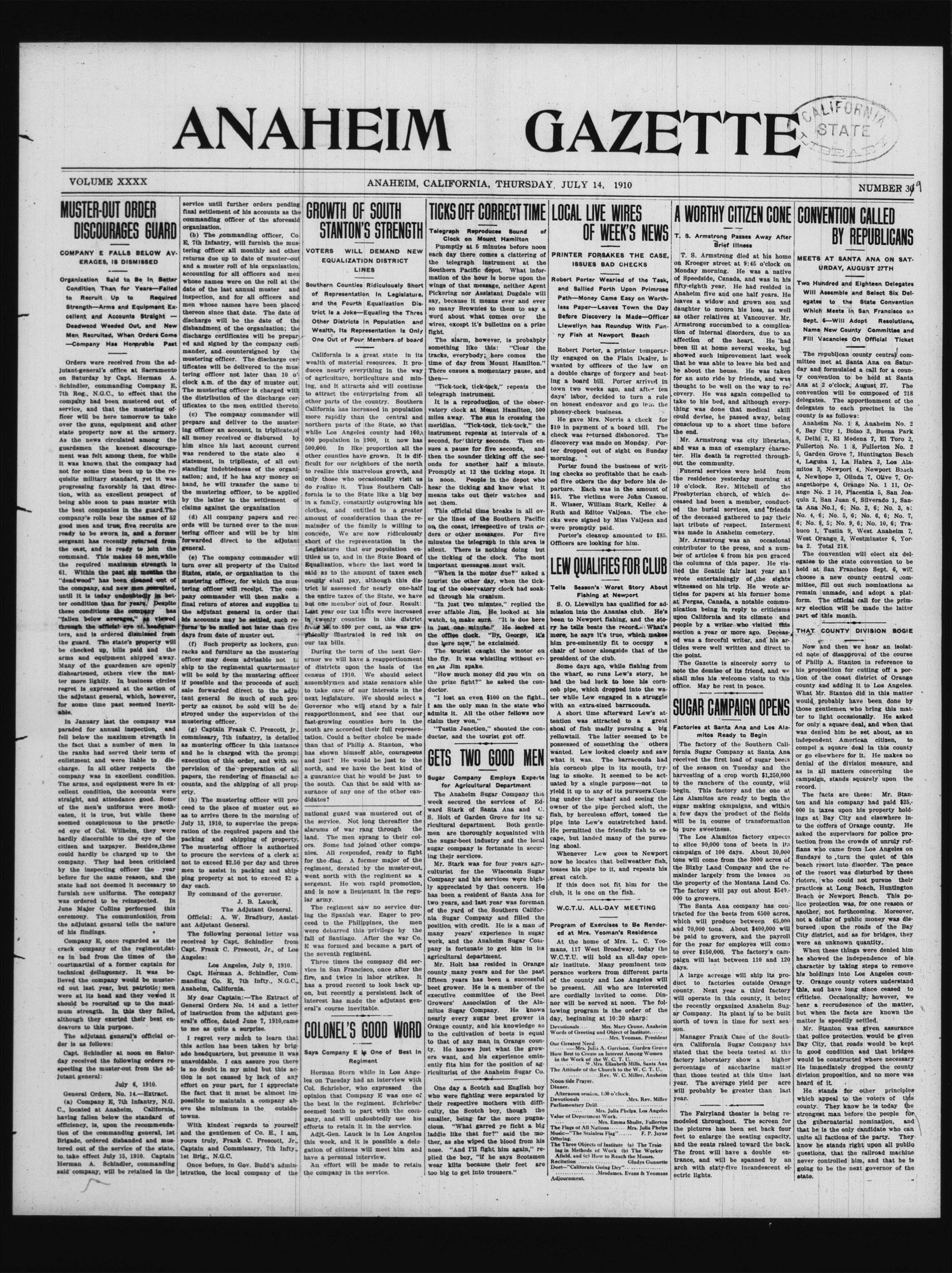
Searchable text
MUSTER-OUT ORDER DISCOURAGES GUARD
COMPANY E FALLS BELOW AVERAGES, IS DISMISSED
Organization Said to Be In Better Condition Than for Years—Failed to Recruit Up to Required Strength—Arms and Equipment Excellent and Accounts Straight — Deadwood Weeded Out, and New Men Recruited, When Orders Come — Company Has Honprable Past
Orders were received from the adjutant-general's office at Sacramento on Saturday by Capt. Herman A. Schindler, commanding Company E, 7th Reg., N.G.C., to effect that the company had been mustered out of service, and that the mustering officer will be here tomorrow to take over the guns, equipment and other state property now at the armory. As the news circulated among the guardsmen the keenest discouragement was felt among them, for while it was known that the company had not for some time been up to the re-service until further orders pending final settlement of his accounts as the commanding officer of the aforesaid organization.
(b) The commanding officer, Co.E, 7th Infantry, will furnish the mustering officer all monthly and other returns due up to date of muster-out and a muster roll of his organization, accounting for all officers and men whose names were on the roll at the date of the last annual muster and inspection, and for all officers and men whose names have been placed thereon since that date. The date of discharge will be the date of the disbandment of the organization; the discharge certificates will be prepared and signed by the company commander, and countersigned by the mustering officer. The discharge certificates will be delivered to the mustering officer not later than 10 o'clock a.m. of the day of muster out. The mustering officer is charged with the distribution of the discharge certificates to the men entitled thereto.
(c) The company commander will prepare and deliver to the mustering officer an account, in triplicate, of all money received or disbursed by him since his last account current was rendered to the state also a statement, in triplicate, of all outstanding indebtedness of the organi-
on Saturday by Capt. Herman A. Schindler, commanding Company E, 7th Reg., N.G.C., to effect that the company had been mustered out of service, and that the mustering officer will be here tomorrow to take over the guns, equipment and other state property now at the armory. As the news circulated among the guardsmen the keenest discouragement was felt among them, for while it was known that the company had not for some time been up to the requisite military standard, yet it was progressing favorably in that direction, with an excellent prospect of being able soon to pass muster with the best companies in the guard. The company's rolls bear the names of 52 good men and true, five recruits are ready to be sworn in, and a former sergeant has recently returned from the east, and is ready to join the command. This makes 58 men, while the required maximum strength is 61. Within the past six months the "deadwood" has been cleaned out of the company, and new men recruited, until it is today undoubtedly in better condition than for years. Despite these conditions the company has "fallen below averages," as viewed through the official eye of headquarters, and is ordered dismissed from the guard. The state's property will be checked up, bills paid and the arms and equipment shipped away. Many of the guardsmen are openly disheartened, others view the matter more lightly. In business circles regret is expressed at the action of the adjutant general, which, however, for some time past seemed inevitable.
In January last the company was paraded for annual inspection, and fell below the maximum strength in the fact that a number of men in the ranks had served their term of enlistment and were liable to discharge. In all other respects the company was in excellent condition. The arms, and equipment were in excellent condition, the accounts were straight, and attendance good. Some of the men's uniforms were moth-eaten, it is true, but while these seemed conspicuous to the practiced eye of Col. Wilhelm, they were hardly discernible to the eye of the citizen and taxpayer. Besides, these could hardly be charged up to the company. They had been criticised by the inspecting officer the year before for the same reason, and the state had not deemed it necessary to furnish new uniforms. The company
(c) The company commander will prepare and deliver to the mustering officer an account, in triplicate, of all money received or disbursed by him since his last account current was rendered to the state also a statement, in triplicate, of all outstanding indebtedness of the organization; and, if he has any money on hand, he will transfer the same to the mustering officer, to be applied by the latter to the settlement of claims against the organization.
(d) All company papers and records will be turned over to the mustering officer and will be by him forwarded direct to the adjutant general.
(e) The company commander will turn over all property of the United States, state, or organization to the mustering officer, for which the mustering officer will receipt. The company commander will then make a final return of stores and supplies to the adjutant general in order that his accounts may be settled, such returns to be mailed not later than five days from date of muster out.
(f) Such property as lockers, gunracks and furniture as the mustering officer may deem advisable not to ship to the regimental quartermaster will be sold by the mustering officer if possible and the proceeds of such sale forwarded direct to the adjutant general. So much of such property as cannot be sold will be destroyed under the supervision of the mustering officer.
(g) Captain Frank C. Prescott, Jr., commissary, 7th infantry, is detailed as mustering officer in this instance and he is charged with the prompt execution of this order, and with supervision of the preparation of all papers, the rendering of financial accounts, and the shipping of all property.
(h) The mustering officer will proceed to the place of muster out so as to arrive there in the morning of July 13, 1910, to supervise the preparation of the required papers and the packing and shipping of property. The mustering officer is authorized to procure the services of a clerk at not to exceed $2.50 per day and three men to assist in packing and shipping property at not to exceed $2 a day each.
By command of the governor.
of agriculture, hating, and it attracts to attract the other parts of California has increased rapidly thither northern parts while Los Angeles 000 population is 500,000. In lieu other counties have facilitated our needs to realize this need only those who do realize it. Fornia is tothe north in a family, consoles clothes, and emount of considerable concordance. We are short of the reelegislature that titles us to, and Equalization, which said as to the county shall pay a trifectet is assessed;the entire taxes but one member Last year our tax in twenty counties from 10 to 100 philically illustrates our tax bills.
During the teeterer we will have of districts upon census of 1910 assemblymen and to take care of next legislature. Governor who wre reapportionment,fast-growing south are accordation. Could a borough than that of Philadelphia has shown himself just? He was north, and we have a guarantee thatthe south. Can assurance of any didates?
national guard w/the service. Noalarums of war land. The memorialors. Some had nies. All respond for the flag. A regiment, derate went north with sergeant. He wand is now a liear army
straight, and attendance good. Some of the men's uniforms were moth-eaten, it is true, but while these seemed conspicuous to the practiced eye of Col. Wilhelm, they were hardly discernible to the eye of the citizen and taxpayer. Besides, these could hardly be charged up to the company. They had been criticised by the inspecting officer the year before for the same reason, and the state had not deemed it necessary to furnish new uniforms. The company was ordered to be reinspected. In June Major Collins performed this ceremony. The communication from the adjutant general tells the nature of his findings.
Company E, once regarded as the crack company of the regiment, dates in bad from the times of the courtmartial of a former captain for technical delinquency. It was believed the company would be mustered out last year, but patriotic men were at its head and they vowed it should be recruited up to the maximum strength. In this they failed, although they exerted their best endeavors to this purpose.
The adjutant general's official order is as follows:
Capt. Schindler at noon on Saturday received the following orders respecting the muster-out from the adjutant general:
July 6, 1910.
General Orders, No. 14.—Extract.
(a) Company E, 7th Infantry, N.G.C., located at Anaheim, California, having fallen below the standard of efficiency, is upon the recommendation of the commanding general, 1st Brigade, ordered disbanded and mustered out of the service of the state, to take effect July 15, 1910. Captain Herman A. Schindler, commanding said company; will be retained in the
(h) The mustering officer will proceed to the place of muster out so as to arrive there in the morning of July 13, 1910, to supervise the preparation of the required papers and the packing and shipping of property. The mustering officer is authorized to procure the services of a clerk at not to exceed $2.50 per day and three men to assist in packing and shipping property at not to exceed $2 a day each.
By command of the governor.
J. B. Lauck,
The Adjutant General.
Official: A. W. Bradbury, Assistant Adjutant General.
The following personal letter was received by Capt. Schindler from Capt. Frank C. Prescott, Jr., of Los Angeles:
Los Angeles, July 9, 1910.
Capt. Herman A. Schindler, Commanding Co. E, 7th Infty., N.G.C., Anaheim, California.
My dear Captain:—The Extract of General Orders No. 14 and a letter of instruction from the adjutant general's office, dated June 7, 1910, came to me as quite a surprise.
I regret very much to learn that this action has been taken by brigade headquarters, but presume it was unavoidable. I can assure you there is no doubt in my mind but this action is not caused by lack of any effort on your part, for I appreciate the fact that it must be almost impossible to maintain a company above the minimum in the outside towns.
With kindest regards to yourself and the gentlemen of Co. E., I am yours truly, Frank C. Prescott, Jr., Captain and Commissary, 7th Inftry, 1st Brig., N.G.C.
Once before, in Gov. Budd's administration, the local company of the
ANAHEIM, CALIFORNIA, THURSDAY. JULY 14, 1910
GROWTH OF SOUTH STANTON'S STRENGTH
VOTERS WILL DEMAND NEW EQUALIZATION DISTRICT LINES
Southern Counties Ridiculously Short of Representation in Legislature, and the Fourth Equalization District is a Joke—Equaling the Three Other Districts in Population and Wealth, Its Representation Is Only One Out of Four Members of board California is a great state in its wealth of material resources. It produces nearly everything in the way of agriculture, horticulture and mining, and it attracts and will continue to attract the enterprising from all other parts of the country. Southern California has increased in population more rapidly than the central and northern parts of the State, so that while Los Angeles county had 160,000 population in 1900, it now has 500,000. In like proportion all the other counties have grown. It is difficult for our neighbors of the north to realize this marvelous growth, and
TICKS OFF CORRECT TIME
Telegraph Reproduces Sound of Clock on Mount Hamilton
Promptly at 5 minutes before noon each day there comes a clattering of the telegraph instrument at the Southern Pacific depot. What information of the hour is borne upon the wings of that message, neither Agent Pickering nor Assistant Dugdale will say, because it means ever and ever so many Brownies to them to say a word about what comes over the wires, except it's bulletins on a prize fight.
The alarm, however, is probably something like this: "Clear the tracks, everybody; here comes the time of day from Mount Hamilton." There ensues a momentary pause, and then—
"Tick-tock, tick-tock," repeats the telegraph instrument.
It is a reproduction of the observatory clock at Mount Hamilton, 500 miles away. The sun is crossing the meridian. "Tick-tock, tick-tock," the instrument repeats at intervals of a second, for thirty seconds. Then enues a pause for five seconds, and then the sounder ticking off the seconds for another half a minute. Promptly at 12 the ticking stops.
LOCAL LIVE WIRES OF WEEK'S NEWS
PRINTER FORSAKES THE CASE, ISSUES BAD CHECKS
Robert Porter Wearied of the Task, and Sallied Forth Upon Primrose Path—Money Came Easy on Worthless Paper—Leaves Town the Day Before Discovery Is Made—Officer Llewellyn has Roundup With Funny Fish at Newport Beach
Robert Porter, a printer temporarily engaged on the Plain Dealer, is wanted by officers of the law on a double charge of forgery and beating a board bill. Porter arrived in town two weeks ago, and after ten days' labor, decided to turn a rule on honest endeavor and go into the phoney-check business.
He gave Mrs. Norris a check for $10 in payment of a board bill. The check was returned dishonored. The discovery was made on Monday. Porter dropped out of sight on Sunday morning.
Porter found the business of writing checks so profitable that he cash-
of agriculture, horticulture and mining, and it attracts and will continue to attract the enterprising from all other parts of the country. Southern California has increased in population more rapidly than the central and northern parts of the State, so that while Los Angeles county had 160,000 population in 1900, it now has 500,000. In like proportion all the other counties have grown. It is difficult for our neighbors of the north to realize this marvelous growth, and only those who occasionally visit us do realize it. Thus Southern California is to the State like a big boy in a family, constantly outgrowing his clothes, and entitled to a greater amount of consideration than the remainder of the family is willing to concede. We are now ridiculously short of the representation in the Legislature that our population entitles us to, and in the State Board of Equalization, where the last word is said as to the amount of taxes each county shall pay, although this district is assessed for nearly one-half the entire taxes of the State, we have but one member out of four. Result: Last year our tax bills were increased in twenty counties in this district from 16 to 100 per cent, as was graphically illustrated in red ink on our tax bills.
During the term of the next Governor we will have a reapportionment of districts upon the basis of the census of 1910. We should select assemblymen and state senators able to take care of our interests in the next legislature. We should select a Governor who will stand by a fair reapportionment, and see that our fast-growing counties here in the south are accorded their full representation. Could a better choice be made than that of Philip A. Stanton, who has shown himself able, courageous and just? He would be just to the north, and we have the best kind of a guarantee that he would be just to the south. Can that be said with assurance of any one of the other candidates?
national guard was mustered out of the service. Not long thereafter the alarums of war rang through the land. The men sprang to their colors. Some had joined other companies. All responded, ready to fight for the flag. A former major of the regiment, derated by the muster-out, went north with the regiment as a sergeant. He won rapid promotion, and is now a lieutenant in the regular army.
"Tick-tock, tick-tock," repeats the telegraph instrument.
It is a reproduction of the observatory clock at Mount Hamilton, 500 miles away. The sun is crossing the meridian. "Tick-tock, tick-tock," the instrument repeats at intervals of a second, for thirty seconds. Then ensues a pause for five seconds, and then the sounder ticking off the seconds for another half a minute. Promptly at 12 the ticking stops. It is noon. People in the depot who hear the ticking and know what it means take out their watches and set them.
This official time breaks in all over the lines of the Southern Pacific on the coast, irrespective of train orders or other messages. For five minutes the telegraph in this area is silent. There is nothing doing but the ticking of the clock. The most important messages must wait.
"When is the motor due?" asked a tourist the other day, when the ticking of the observatory clock had soaked through his cranium.
"In just two minutes," replied the ever affable Jim. He looked at his watch, to make sure. "It is due here in just one minute." He looked at the office clock. "By George, it's due here now," he exclaimed.
The tourist caught the motor on the fly. It was whistling without even as Jim spake.
"How much money did you win on the prize fight?" he asked the conductor.
"I lost an even $100 on the fight.. I am the only man in the state who admits it. All the other fellows now claim they won."
"Tustin Junction," shouted the conductor, and the tourist got off.
GETS TWO GOOD MEN
Sugar Company Employs Experts for Agricultural Department
The Anaheim Sugar Company this week secured the services of Edward Stark of Santa Ana and C. S. Holt of Garden Grove for its agricultural department. Both gentlemen are thoroughly acquainted with the sugar-beet industry and the local sugar company is fortunate in securing their services.
Mr. Stark was for four years agriculturist for the Wisconsin Sugar Company and his services were highly appreciated by that concern. He has been a resident of Santa Ana for a double charge of forgery and seating a board bill. Porter arrived in town two weeks ago, and after ten days' labor, decided to turn a rule on honest endeavor and go into the phoney-check business.
He gave Mrs. Norris a check for $10 in payment of a board bill. The check was returned dishonored. The discovery was made on Monday. Porter dropped out of sight on Sunday morning.
Porter found the business of writing checks so profitable that he cash-ed five others the day before his departure. Each was in the amount of $15. The victims were John Cassou. R. Wisser, William Stark, Keller & Ruth and Editor Valjean. The checks were signed by Miss Valjean and were promptly paid.
Porter's cleanup amounted to $85. Officers are looking for him.
LEW QUALIFIES FOR CLUB
Tells Season's Worst Story About Fishing at Newport
S. O. Llewellyn has qualified for admission into the Ananias club. He's been to Newport fishing, and the story he tells beats the record... What's more, he says it's true, which makes him pre-eminently fit to occupy a chair of honor alongside that of the president of the club.
Some days ago, while fishing from the wharf, so runs Lew's story, he had the bad luck to lose his corncob pipe, which dropped into the water while Lew engaged in a struggle with an extra-sized barracuda.
A short time afterward Lew's attention was attracted to a great shoal of fish madly pursuing a big yellowtail. The latter seemed to be possessed of something the others wanted. Lew looked closely and saw what it was. The barracouda had his corncob pipe in its mouth, trying to smoke. It seemed to be actuated by a single purpose—not to yield it up to any of its pursuers.Coming under the wharf and seeing the owner of the pipe perched aloft, the fish, by herculean effort, tossed the pipe into Lew's outstretched hand. He permitted the friendly fish to escape, but landed many of the pursuing shoal.
Whenever Lew goes to Newport now he locates that bellweather fish, tosses his pipe to it, and repeats his great catch.
If this does not fit him for the club, it is one on the fish.
national guard was mustered out of the service. Not long thereafter the alarums of war rang through the land. The men sprang to their colors. Some had joined other companies. All responded, ready to fight for the flag. A former major of the regiment, derated by the muster-out, went north with the regiment as a sergeant. He won rapid promotion, and is now a lieutenant in the regular army.
The regiment saw no service during the Spanish war. Eager to proceed to the Philippines, the men were debarred this privilege by the fall of Santiago. After the war Co. E was formed and became a part of the seventh regiment.
Three times the company did service in San Francisco, once after the fire, and twice in labor strikes. It has a proud record to look back upon, but recently a persistent lack of interest has made the adjutant general's course inevitable.
COLONEL'S GOOD WORD
Says Company E is One of Best In Regiment
Herman Stern while in Los Angeles on Tuesday had an interview with Col. Schrieber, who expressed the opinion that Company E was one of the best in the regiment. Schrieber seemed loath to part with the company, and will undoubtedly use his efforts to retain it in the service.
Adjt-Gen. Lauck is in Los Angeles this week, and it is possible a delegation of citizens will meet him and have a personal interview.
An effort will be made to retain the company in the service.
week secured the services of Edward Stark of Santa Ana and C.S. Holt of Garden Grove for its agricultural department. Both gentlemen are thoroughly acquainted with the sugar-beet industry and the local sugar company is fortunate in securing their services.
Mr. Stark was for four years agriculturist for the Wisconsin Sugar Company and his services were highly appreciated by that concern. He has been a resident of Santa Ana for two years, and last year was foreman of the yard of the Southern California Sugar Company and filled the position with credit. He is a man of many years' experience in sugar work, and the Anaheim Sugar Company is fortunate to get him in its agricultural department.
Mr. Holt has resided in Orange county many years and for the past fifteen years has been a successful beet grower. He is a member of the executive committee of the Beet Growers' Association of the Alamitos Sugar Company. He knows nearly every sugar beet grower in Orange county, and his knowledge as to the cultivation of beets is equal to that of any man in Orange county. He knows just what the growers want, and his experience eminently fits him for the position of agriculturist of the Anaheim Sugar Co.
One day a Scotch and English boy who were fighting were separated by their respective mothers with difficulty, the Scotch boy, though the smaller, being far the more pugnacious. "What garred ye ficht a big laddie like that for?" said the mother, as she wiped the blood from his nose. "And I'll fight him again," replied the boy, "if he says Scotsmen wear kilts because their feet are too big to get into trousers."
Program of Exercises to Be Rendered at Mrs. Yeoman's Residence
At the home of Mrs. L. C. Yeomans, 117 West Broadway, today the W.C.T.U. will hold an all-day open-air institute. Many prominent temperance workers from different parts of the county and Los Angeles will be present. All who are interested are cordially invited to come. Dinner will be served at noon. The following program is the order of the day, beginning at 10:30 sharp:
Devotionals... Mrs. Mary Crone, Anaheim Words of Greeting and Object of Institute.... Mrs. Yeoman, President Our Greatest Need... Mrs. Julia A. Garrison, Garden Grove How Best to Create an Interest Among Women in the Work of the W.C.T.U.... Mrs. Elizabeth Mills, Santa Ana The Attitude of the Church to the W.C.T.U.... Rev. W. C. Miller, Anaheim Noon-tide Prayer.
Dinner.
Afternoon session, 1:30 o'clock.
Devotionals... Mrs. Rev. Miller Parliamentary Drill.... Mrs. Julia Phelps, Los Angeles Value of Department Work.... Mrs. Emma Shulte, Fullerton The Flags of All Nations... Mrs. Julia Phelps Music—"The Stainless Flag"... F.P.Jayne Offering.
The Three Objects of Institute (a) The Training in Methods of Work (b) The Worker Afield, and (c) How To Reach the Masses.
Recitation... Gladys Gunnette Duet—"California Going Dry".... Mesdames, Evans & Yeomans Adjournment.
WE WIRES
WEEK’S NEWS
RSAKES THE CASE,
BAD CHECKS
Wearied of the Task,
Forth Upon Primrose
Came Easy on WorthLeaves Town the Day
covery Is Made—Officer
as Roundup With FunNewport Beach
er, a printer temporarin the Plain Dealer, is
officers of the law on
thee of forgery and beatrill. Porter arrived in
ks ago, and after ten
decided to turn a rule
leavor and go into the
business.
s. Norris a check for
t of a board bill. The
burned dishonored. The
made on Monday. Porout of sight on Sunday
the business of writprofitable that he cash-
A WORTHY CITIZEN CONE
T. S. Armstrong Passes Away After Brief Illness
T. S. Armstrong died at his home on Kroeger street at 9:45 o'clock on Monday morning. He was a native of Speedside, Canada, and was in his fifty-eighth year. He had resided in Anaheim five and one half years. He leaves a widow and grown son and daughter to mourn his loss, as well as other relatives at Vancouver. Mr. Armstrong succumbed to a complication of internal disorders, due to an affection of the heart. He had been ill at home several weeks, but showed such improvement last week that he was able to leave his bed and be about the house. He was taken for an auto ride by friends, and was thought to be well on the way to recovery. He was again compelled to take to his bed, and although everything was done that medical skill could devise, he passed away, being conscious up to a short time before the end.
Mr. Armstrong was city librarian, and was a man of exemplary character. His death is regretted throughout the community.
Funeral services were held from
CONVENTION CALLED BY REPUBLICANS
MEETS AT SANTA ANA ON SATURDAY, AUGUST 27TH
Two Hundred and Eighteen Delegates Will Assemble and Select Six Delegates to the State Convention Which Meets in San Francisco on Sept. 6—Will Adopt Resolutions, Name New County Committee and Fill Vacancies On Official Ticket
The republican county central committee met at Santa Ana on Saturday and formulated a call for a county convention to be held at Santa Ana at 2 o'clock, August 27. The convention will be composed of 218 delegates. The apportionment of the delegates to each precinct in the county is as follows:
Anaheim No. 1 8, Anaheim No. 2
6, Bay City 1, Bolso 3, Buena Park
8, Delhi 2, El Modena 7, El Toro 2,
Fullerton No. 1 8, Fullerton No. 2
5, Garden Grove 7, Huntington Beach
4, Laguna 1, La Habra 3, Los Alamitos 3, Newport 4, Newport Beach
INFIES FOR CLUB
Worst Story About Newport
Lyn has qualified for addee Ananias club. He's
short fishing, and the stutats the record. What's
it's true, which makes
many fit to occupy a
alongside that of the
club.
Go, while fishing from
our runs Lew's story, he
truck to lose his corndropped into the waengaged in a struggle
sized barracouda.
The afterward Lew's attracted to a great
madly pursuing a big
latter seemed to be
something the others
looked closely and saw
the barracouda had
peep in its mouth, tryIt seemed to be actingle purpose—not to
any of its pursuers.Comwharf and seeing the
pipe perched aloft, the
mean effort, tossed the
outstretched hand.
The friendly fish to essed many of the pursu-
Lew goes to Newport
that bellweather fish,
to it, and repeats his
not fit him for the
on the fish.
for an auto ride by friends, and was thought to be well on the way to recovery. He was again compelled to take to his bed, and although every thing was done that medical skill could devise, he passed away, being conscious up to a short time before the end.
Mr. Armstrong was city librarian, and was a man of exemplary character. His death is regretted throughout the community.
Funeral services were held from the residence yesterday morning at 10 o'clock. Rev. Mitchell of the Presbyterian church, of which deceased had been a member, conducted the burial services, and friends of the deceased gathered to pay their last tribute of respect. Interment was made in Anaheim cemetery.
Mr. Armstrong was an occasional contributor to the press, and a number of articles 6 from his pen graced the columns of this paper. He visited the Seattle fair last year and wrote entertainingly of the sights witnessed on his trip. He wrote articles for papers at his former home at Fergas, Canada, a notable communication being in reply to criticisms upon California and its climate and people by a writer who visited this section a year or more ago. Deceased was a forceful writer, and his articles were well written and direct to the point.
The Gazette is sincerely sorry to note the demise of its friend, and we shall miss his welcome visits to this office. May he rest in peace.
SUGAR CAMPAIGN OPENS
Factories at Santa Ana and Los Alamitos Ready to Begin
The factory of the Southern California Sugar Company at Santa Ana received the first load of sugar beets of the season on Tuesday and the harvesting of a crop worth $1,250,000 to the ranchers of the county, will begin. This factory and the one at Los Alamitos are ready to begin the sugar making campaigns, and within a few days the product of the fields will be in course of transformation to pure sweetness.
The Los Alamitos factory expects to slice 90,000 tons of beets in its campaign of 100 days. About 30,000 tons will come from the 3000 acres of the Bixby Land Company and the remainder largely from the leases on the property of the Montana Land Co. The factory will pay out about $540,000 to growers.
THAT COUNTY DIVISION BOGIE
Now and then we hear an isolated note of disapproval of the course of Philip A. Stanton in reference to his proposition for cutting off a portion of the coast district of Orange county and adding it to Los Angeles. What Mr. Stanton did in this matter would probably have been done by those gentlemen who bring this matter to light occasionally. He asked for only a square deal, and when that was denied him he set about, as an independent American citizen, to compel a square deal in this county or go elsewhere for it. He makes no denial of the division measure, and as in all matters concerning the campaign, stands squarely upon the record.
The facts are these: Mr. Stanton and his company had paid $25,-000 in taxes upon his property holdings at Bay City and elsewhere into the coffers of Orange county. He asked the supervisors for police protection from the crowds of unruly ruffians who came from Los Angeles on Sundays to turn the quiet of this beach resort into disorder. The peace of the resort was disturbed by these rioters, who could not pursue their practices at Long Beach, Huntington Beach or Newport Beach. This po-
Newport goes to Newport that bellweather fish, to it, and repeats his not fit him for the on the fish.
L-DAY MEETING
Exercises to Be Rendered Yeoman's Residence
of Mrs. L. C. Yeoman Broadway, today the hold an all-day open Many prominent temrs from different parts and Los Angeles will all who are interested invited to come. Dinner at noon. The follow is the order of the at 10:30 sharp:
Mrs. Mary Crone, Anaheim and Object of Institute...
Mrs. Yeoman, President
A. Garrison, Garden Grove an Interest Among Women
W. C. T. U...
Mrs. Elizabeth Mills, Santa Ana Church to the W. C. T. U...
Rev. W. C. Miller, Anaheim
1:30 o'clock.
Mrs. Rev. Miller
Mrs. Julia Phelps, Los Angeles at Work...
Mrs. Emma Shulte, Fullerton institutions...
Mrs. Julia Phelps Press Flag"... F. P. Jayne
of Institute (a) The Train of Work (b) The Worker how to Reach the Masses.
Gladys Gunnette Going Dry"
Mesdames, Evans & Yeomans
Los Alamitos are ready to begin the sugar making campaigns, and within a few days the product of the fields will be in course of transformation to pure sweetness.
The Los Alamitos factory expects to slice 90,000 tons of beets in its campaign of 100 days. About 30,000 tons will come from the 3000 acres of the Bixby Land Company and the remainder largely from the leases on the property of the Montana Land Co. The factory will pay out about $540,000 to growers.
The Santa Ana company has contracted for the beets from 6500 acres, which will produce between 65,000 and 70,000 tons. About $400,000 will be paid to growers, and the payroll for the year for employees will come to over $150,000. The factory's campaign will last between 110 and 120 days.
A large acreage will ship its product to factories outside Orange county. Next year a third factory will operate in this county, it being the recently organized Anaheim Sugar Company. Its plant is to be built north of town in time for next season.
Manager Frank Case of the Southern California Sugar Company has stated that the beets tested at the factory laboratory show a higher percentage of saccharine matter than those tested at this time last year. The average yield per acre will probably be greater than last year.
The Fairyland theater is being modeled throughout. The screen for the pictures has been set back four feet to enlarge the seating capacity, and the seats raised toward the back. The front will have a double entrance, and will be spanned by an arch with sixty-five incandescent electric lights.
ton and his company had paid $25,000 in taxes upon his property holdings at Bay City and elsewhere into the coffers of Orange county. He asked the supervisors for police protection from the crowds of unruly rufians who came from Los Angeles on Sundays to turn the quiet of this beach resort into disorder. The peace of the resort was disturbed by these rioters, who could not pursue their practices at Long Beach, Huntington Beach or Newport Beach. This police protection was, for one reason or another, not forthcoming. Moreover, not a dollar of public money was disbursed upon the roads of the Bay City district, and as for bridges, they were an unknown quantity.
When these things were denied him he showed the independence of his character by taking steps to remove his holdings into Los Angeles county. Orange county voters understand this, and have long since ceased to criticise. Occasionally, however, we hear a recrudesence of the matter, but when the facts are known the matter is speedily settled.
Mr. Stanton was given assurance that police protection would be given Bay City, that roads would be kept in good condition and that bridges would be constructed where necessary. He immediately dropped the county division proposition, and no more was heard of it.
He stands for other principles which appeal to the voters of this county. They know he is today the strongest man before the people for the gubernatorial nomination, and that he is the only candidate who can unite all factions of the party. They know he stands right upon all public questions, that the railroad machine never controlled him, and that he is going to be the next governor of the state.