anaheim-gazette 1910-07-07
Scanned page
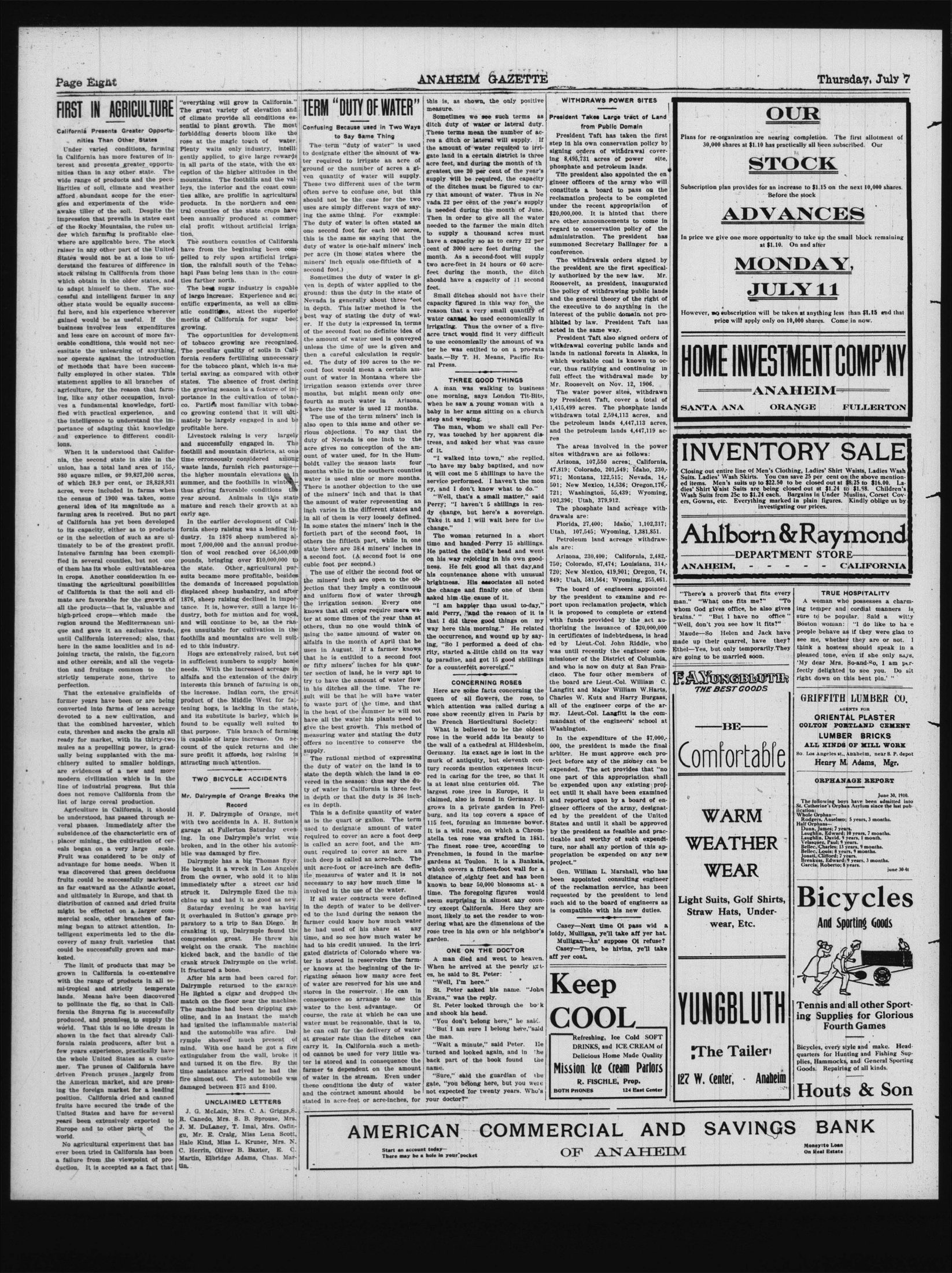
Searchable text
FIRST IN AGRICULTURE
California Presents Greater Opportunities Than Other States
Under varied conditions, farming in California has more features of interest and presents greater opportunities than in any other state. The wide range of products and the peculiarities of soil, climate and weather afford abundant scope for the energies and experiments of the wide awake tiller of the soil. Despite the impression that prevails in states east of the Rocky Mountains, the rules under which farming is profitable elsewhere are applicable here. The stock raiser in any other part of the United States would not be at a loss to understand the features of difference in stock raising in California from those which obtain in the older states, and to adapt himself to them. The successful and intelligent farmer in any other state would be equally successful here, and his experience wherever gained would be as useful. If the business involves less expenditures and less care on account of more favorable conditions, this would not necessitate the unlearning of anything, nor operate against the introduction of methods that have been successfully employed in other states. This statement applies to all branches of agriculture, for the reason that farming, like any other occupation, involves a fundamental knowledge, fortified with practical experience, and the intelligence to understand the importance of adapting that knowledge and experience to different conditions.
When it is understood that California, the second state in size in the union, has a total land area of 155,880 square miles or 99,827,300 acres,
"everything will grow in California." The great variety of elevation and of climate provide all conditions essential to plant growth. The most forbidding deserts bloom like the rose at the magic touch of water. Plenty waits only industry, intelligently applied, to give large rewards in all parts of the state, with the exception of the higher altitudes in the mountains. The foothills and the valleys, the interior and the coast counties alike, are prolific in agricultural products. In the northern and central counties of the state crops have been annually produced at commercial profit without artificial irrigation.
The southern counties of California have from the beginning been compelled to rely upon artificial irrigation, the rainfall south of the Tehachapi Pass being less than in the counties farther north.
The best sugar industry is capable of large increase. Experience and scientific experiments, as well as climatic conditions, attest the superior merits of California for sugar beet growing.
The opportunities for development of tobacco growing are recognized. The peculiar quality of soils in California renders fertilizing unnecessary for the tobacco plant, which is a material saving as compared with other states. The absence of frost during the growing season is a feature of importance in the cultivation of tobacco. Parties most familiar with tobacco growing contend that it will ultimately be largely engaged in and be profitable here.
Livestock raising is very largely and successfully engaged in. The foothill and mountain districts, at one time erroneously considered among waste lands, furnish rich pasturage—the higher mountain elevations in
TERM "DUTY"
Confusing Because to Say
The term "duty" to designate either required to ground or the net tenure quantity of these two differences often serve to cease should not be used in the same way. The duty of water is simply duty of water is per acre (in those miners' inch equivalent foot.) Sometimes even in depth of ground: thus the Nevada is generally in depth. This is best way of stating it. If the duty of the second foot is the amount of water unless the time then a careful ed. The duty of cond foot would count of water in irrigation season months, but much fourth as much where the water.
The use of these also open to serious objections; duty of Nevada acre gives no count of water up boldt valley the months while in
fully employed in other states. This statement applies to all branches of agriculture, for the reason that farming, like any other occupation, involves a fundamental knowledge, fortified with practical experience, and the intelligence to understand the importance of adapting that knowledge and experience to different conditions.
When it is understood that California, the second state in size in the union, has a total land area of 155,980 square miles, or 99,827,200 acres, of which 28.9 per cent, or 28,828,931 acres, were included in farms when the census of 1900 was taken, some general idea of its magnitude as a farming area is received. But no part of California has yet been developed to its capacity, either as to products or in the selection of such as are ultimately to be of the greatest profit. Intensive farming has been exemplified in several counties, but not one of them has its whole cultivatable-area in crops. Another consideration in estimating the agricultural possibilities of California is that the soil and climate are favorable for the growth of all the products—that is, valuable and high-priced crops—which made the region around the Mediterranean unique and gave it an exclusive trade, until California intervened; also, that here in the same localities and in adjoining tracts, the raisin, the fig,corn and other cereals, and all the vegetation and fruitage common to the strictly temperate zone, thrive to perfection.
That the extensive grainfields of former years have been or are being converted into farms of less acreage devoted to a new cultivation, and that the combined harvester, which cuts, threshes and sacks the grain all ready for market, with its thirty-two mules as a propelling power, is gradually being supplanted with the machinery suited to smaller holdings, are evidences of a new and more modern civilization which is in the line of industrial progress. But this does not remove California from the list of large cereal production.
Agriculture in California, it should be understood, has passed through several phases. Immediately after the subsidence.of the characteristic era of placer mining., the cultivation of cereals began on a very large scale. Fruit was considered to be only of advantage for home needs. When it was discovered that green deciduous fruits could be successfully marketed as far eastward as the Atlantic coast, and ultimately in Europe, and that the
TWO BICYCLE ACCIDENTS
Mr. Dalrymple of Orange Breaks the Record
H. F. Dalrymple of Orange, met with two accidents in A. H. Sutton's garage at Fullerton Saturday evening. In one Dalrymple's wrist was broken, and in the other his automobile was damaged by fire.
Dalrymple has a big Thomas flyer. He bought it a wreck in Los Angeles from the owner, who sold it to him immediately after a street car had struck it. Dalrymple fixed the machine up and had it as good as new.
The absence of frost during the growing season is a feature of importance in the cultivation of tobacco. Parties most familiar with tobacco growing contend that it will ultimately be largely engaged in and be profitable here.
Livestock raising is very largely and successfully engaged in. The foothill and mountain districts, at one time erroneously considered among waste lands, furnish rich pasturage—the higher mountain elevations in summer, and the foothills in winter thus giving favorable conditions the year around. Animals in this state mature and reach their growth at an early age.
In the earlier development of California sheep raising was a leading industry. In 1876 sheep numbered almost 7,000,000 and the annual production of wool reached over 56,500,000 pounds, bringing over $10,000,000 to the state. Other agricultural pursuits became more profitable, besides the demands of increased population displaced sheep husbandry, and after 1876, sheep raising declined in importance. It is, however, still a large industry, both for mutton and for wool, and will continue to be, as the ranges unsuitable for cultivation in the foothills and mountains are well suited to this industry.
Hogs are extensively raised, but not in sufficient numbers to supply home needs. With the increased acreage in alfalfa and the extension of the dairy interests this branch of farming is on the increase. Indian corn, the great product of the Middle West for fattening hogs, is lacking in the state, and its substitute is barley, which is found to be equally well suited to that purpose. This branch of farming is capable of large increase. On account of the quick returns and the sure profit it affords, hog raising is attracting much attention.
The rational reason for the duty of water state the depth covered in the seawater of water in China in depth or that eses in depth.
This is a definition as is the quart used to designate required to cover is called an accrual count required to inch deep is called unit acre-foot or its measures of necessary to say involved in the u
Agriculture in California, it should be understood, has passed through several phases. Immediately after the subsidence of the characteristic era of placer mining, the cultivation of cereals began on a very large scale. Fruit was considered to be only of advantage for home needs. When it was discovered that green deciduous fruits could be successfully marketed as far eastward as the Atlantic coast, and ultimately in Europe, and that the distribution of canned and dried fruits might be effected on a larger commercial scale, other branches of farming began to attract attention. Intelligent experiments led to the discovery of many fruit varieties that could be successfully grown and marketed.
The limit of products that may be grown in California is co-extensive with the range of products in all semi-tropical and strictly temperate lands. Means have been discovered to pollinate the fig, so that in California the Smyrna fig is successfully produced, and promissory to supply the world. That this is no idle dream is shown in the fact that already California raisin producers, after but a few years experience, practically have the whole United States as a customer. The prunes of California have driven French prunes largely from the American market, and are pressing the foreign market for a leading position. California dried and canned fruits have secured the trade of the United States and have for several years been extensively exported to Europe and to other parts of the world.
No agricultural experiment that has ever been tried in California has been a failure from the viewpoint of production. It is accepted as a fact that
Record
H. F. Dalrymple of Orange, met with two accidents in A. H. Sutton's garage at Fullerton Saturday evening. In one Dalrymple's wrist was broken, and in the other his automobile was damaged by fire.
Dalrymple has a big Thomas flyer. He bought it a wreck in Los Angeles from the owner, who sold it to him immediately after a street car had struck it. Dalrymple fixed the machine up and had it as good as new.
Saturday evening he was having it overhauled in Sutton's garage preparatory to a trip to San Diego. In cranking it up, Dalrymple found the compression great. He threw his weight on the crank. The machine kicked back, and the handle of the crank struck Dalrymple on the wrist. It fractured a bone.
After his arm had been cared for, Dalrymple returned to the garage. He lighted a cigar and dropped the match on the floor near the machine. The machine had been dripping gasoline, and in an instant the match had ignited the inflammable material and the automobile was afire. Dalrymple showed much present of mind. With one hand he got a fire extinguisher from the wall, broke it and turned it on the fire. By the time assistance arrived he had the fire almost out. The automobile was damaged between $75 and $100.
UNCLAIMED LETTERS
J. G. McLain, Mrs. C. A. Griggs, S. R. Canedo, Mrs. S. B. Sprouse, Mrs. J. M. DuLaney, T. Imai, Mrs. Osfingu, Mr. E. Craig, Miss Lena Scott, Hale Kind, Miss L. Kruner, Mrs. N. C. Herrin, Oliver B. Baxter, E. C. Martin, Elbridge Adams, Chas. Martin.
TERM "DUTY OF WATER"
Confusing Because used in Two Ways to Say Same Thing
The term "duty of water" is used to designate either the amount of water required to irrigate an acre of ground or the number of acres given quantity of water will supply. These two different uses of the term often serve to confuse one, but this should not be the case for the two uses are simply different ways of saying the same thing. For example: The duty of water is often stated as one second foot for each 100 acres, this is the same as saying that the duty of water is one-half miners' inch per acre (in those states where the miners' inch equals one-fiftieth of a second foot.) Sometimes the duty of water is given in depth of water applied to the ground: thus the duty in the state of Nevada is generally about three feet in depth. This latter method is the best way of stating the duty of water. If the duty is expressed in terms of the second foot no definite idea of the amount of water used is conveyed unless the time of use is given and then a careful calculation is required. The duty of 100 acres to the second foot would mean a certain amount of water in Montana where the irrigation season extends over three months, but might mean only one-fourth as much water in Arizona, where the water is used 12 months.
The use of the term miners' inch is also open to this same and other serious objections. To say that the duty of Nevada is one inch to the acre gives no conception of the amount of water used, for in the Humboldt valley the season lasts four months while in the southern counties this is, as shown, the only positive measure.
Sometimes we see such terms as ditch duty of water or lateral duty. These terms mean the number of acres a ditch or lateral will supply. If the amount of water required to irrigate land in a certain district is three acre feet, and during the month of the greatest use 20 per cent of the year's supply will be required, the capacity of the ditches must be figured to carry that amount of water. Thus in Nevada 22 per cent of the year's supply is needed during the month of June. Then in order to give all the water needed to the farmer the main ditch to supply a thousand acres must have a capacity so as to carry 22 per cent of 3000 acre feet during the month. As a second-foot will supply two acre-feet in 24 hours or 60 acre-feet during the month, the ditch should have a capacity of 11 second feet.
Small ditches should not have their capacity figured in this way for the reason that a very small quantity of water cannot be used economically in irrigating. Thus the owner of a five-acre tract would find it very difficult to use economically the amount of water he was entitled to on a pro-rata basis.—By T. H. Means, Pacific Rural Press.
THREE GOOD THINGS
A man was walking to business one morning, says London Tit-Bits, when he saw a young woman with a baby in her arms sitting on a church step and weeping.
The man, whom we shall call Perry, was touched by her apparent distress, and asked her what was cause of it.
"I walked into town," she replied, "to have my baby baptized, and now it will cost me 5 shillings to have the
WITHDRAWS POWER SITES
President Takes Large tract of Land from Public Domain
President Taft has taken the first step in his own conservation policy by signing orders of withdrawal covering 8,495,731 acres of power site, phosphate and petroleum lands.
The president also appointed the engineer officers of the army who will constitute a board to pass on the reclamation projects to be completed under the recent appropriation of $20,000,000. It is hinted that there are other announcements to come in regard to conservation policy of the administration. The president has summoned Secretary Ballinger for a conference.
The withdrawals orders signed by the president are the first specifically authorized by the new law. Mr. Roosevelt, as president, inaugurated the policy of withdrawing public lands and the general theory of the right of the executive to do anything in the interest of the public domain not prohibited by law. President Taft has acted in the same way.
President Taft also signed orders of withdrawal covering public lands and lands in national forests in Alaska, in which workable coal is known to occur, thus ratifying and continuing in full effect the withdrawal made by Mr. Roosevelt on Nov. 12, 1906.
The water power sites, withdrawn by President Taft, cover a total of 1,415,499 acres. The phosphate lands withdrawn total 2,594,113 acres, and the petroleum lands 4,447,113 acres, and the petroleum lands 4,447,119 acres.
The areas involved in the power sites withdrawn are as follows:
Arizona, 107,550 acres; California, 47,819; Colorado, 201,549; Idaho, 230,-
count of water in Montana where the irrigation season extends over three months, but might mean only one-fourth as much water in Arizona, where the water is used 12 months.
The use of the term miners' inch is also open to this same and other serious objections. To say that the duty of Nevada is one inch to the acre gives no conception of the amount of water used, for in the Humboldt valley the season lasts four months while in the southern counties water is used nine or more months. There is another objection to the use of the miners' inch and that is that the amount of water representing an inch varies in the different states and in all of them is very loosely defined. In some states the miners' inch is the fortyth part of the second foot, in others the fiftieth part, while in one state there are 38.4 miners' inches in a second foot. (A second foot is one cubic foot per second.)
The use of either the second foot or the miners' inch are open to the objection that they imply a continuous and uniform flow of water through the irrigation season. Every one knows that all crops require more water at some times of the year than at others, thus no one would think of using the same amount of water on alfalfa in the month of April that he uses in August. If a farmer knows that he is entitled to a second foot or fifty miners' inches for his quarter section of land, he is very apt to try to have the amount of water flow in his ditches all the time. The result will be that he will have water to waste part of the time, and that in the heat of the summer he will not have all the water his plants need to give the best growth. This method of measuring water and stating the duty offers no incentive to conserve the supply.
The rational method of expressing the duty of water on the land is to state the depth which the land is covered in the season: thus say the duty of water in California is three feet in depth or that the duty is 36 inches in depth.
This is a definite quantity of water as is the quart or gallon. The term used to designate amount of water required to cover an acre a foot deep is called an acre foot, and the amount required to cover an acre an inch deep is called an acre-inch. The unit acre-foot or acre-inch are definite measures of water and it is not necessary to say how much time is involved in the use of the water.
If all water contracts were defined
THREE GOOD THINGS
A man was walking to business one morning, says London Tit-Bits, when he saw a young woman with a baby in her arms sitting on a church step and weeping.
The man, whom we shall call Perry, was touched by her apparent distress, and asked her what was cause of it.
"I walked into town," she replied, "to have my baby baptized, and now it will cost me 5 shillings to have the service performed. I haven't the money, and I don't know what to do."
"Well, that's a small matter," said Perry; "I haven't 5 shillings in ready change, but here's a sovereign. Take it and I will wait here for the change."
The woman returned in a short time and handed Perry 15 shillings. He patted the child's head and went on his way rejoicing in his own goodness. He felt good all that day,and his countenance shone with unusual brightness. His associates all noted the change and finally one of them asked him the cause of it.
"I am happier than usual to-day," said Perry, "and the reason of it is that I did three good things on my way here this morning." He related the occurrence, and wound up by saying, "So I performed a deed of charity, started a little child on its way to paradise, and got 15 good shillings for a counterfeit sovereign."
CONCERNING ROSES
Here are some facts concerning the queen of all flowers, the rose, to which attention was called during a rose show recently given in Paris by French Horticultural Society:
What is believed to be the oldest rose in the world adds its beauty to the wall of a cathedral at Hildesheim, Germany. Its exact age is lost in the murk of antiquity, but eleventh century records mention expenses incurred in caring for the tree, so that it is at least nine centuries old. The largest rose tree in Europe, it is claimed, also is found in Germany. It grows in a private garden in Freiburg, and its top covers a space of 115 feet, forming an immense bower. It is a wild rose, on which a Chromatella tea rose was grafted in 1851. The finest rose tree, according to Frenchmen, is found in the marine gardens at Touloum. It is a Banksia, which covers a fifteen-foot wall for a distance of eighty feet and has been known to bear 50,000 blossoms at-a time. The foregoing figures would full effect withdrawal made by Mr. Roosevelt on Nov. 12, 1906.
The water power sites, withdrawn by President Taft, cover a total of 1,415,499 acres. The phosphate lands withdrawn total 2,594,113 acres, and the petroleum lands 4,447,113 acres, and the petroleum lands 4,447,119 acres
The areas involved in the power sites withdrawn are as follows:
Arizona, 107,550 acres; California, 47,819; Colorado, 201,549; Idaho, 230,971; Montana, 122,515; Nevada, 14,-501; New Mexico, 14,536; Oregon, 176,-721; Washington, 55,439; Wyoming, 103,396; Utah, 379,912.
The phosphate land acreage withdrawals are:
Florida, 27,400; Idaho, 1,102,317; Utah, 107,545; Wyoming, 1,381,851.
Petroleum land acreage withdrawals are:
Arizona, 230,400; California, 2,482,-750; Colorado, 87,474; Louisiana, 314,-720; New Mexico, 419,901; Oregon, 74,
849; Utah, 581,564; Wyoming, 255,461.
The board of engineers appointed by the president to examine and report upon reclamation projects, which it is proposed to complete or extend with funds provided by the act authorizing the issuance of $20,000,000 in certificates of indebtedness, is headed by Lieut.-Col. John Riddle who was until recently the engineer commissioner of the District of Columbia,and who is now on duty at San Francisco.The four other members of the board are Lieut.-Col. William C. Langfitt and Major William W.Harts,Cherles W.Kutz and Harry Burgass.all of the engineer corps of the army.Lieut.-Col. Langfitt is the commandant of the engineers' school at Washington.
In the expenditure of the $7,000,-000,the president is made the final arbiter.He must approve each project before any of the money can be expended.The act provides that "no one part of this appropriation shall be expended upon any existing project until it shall have been examined and reported upon by a board of engineer officers of the army,d designated by the president of the United States and until it shall be approved by the president as feasible and practicable and worthy of such expenditure,nor shall any portion of this appropriation be expended on any new project."
Gen. William L. Marshall, who has been appointed consulting engineer of the reclamation service,has been requested by the president to lend
This is a definite quantity of water as is the quart or gallon. The term used to designate amount of water required to cover an acre a foot deep is called an acre foot, and the amount required to cover an acre an inch deep is called an acre-inch. The unit acre-foot or acre-inch are definite measures of water and it is not necessary to say how much time is involved in the use of the water.
If all water contracts were defined in the depth of water to be delivered to the land during the season the farmer could know how much water he had used of his share at any time, and so see how much water he had to his credit unused. In the irrigated districts of Colorado where water is stored in reservoirs the farmer knows at the beginning of the irrigating season how many acre feet of water are reserved for his use and stores in the reservoir. He can in consequence so arrange to use this water to the best advantage. Of course, the rate at which he can use water must be reasonable, that is to, he can call for the delivery of water at greater rate than the ditches can carry it. In California such a method cannot be used for very little water is stored and in consequence the farmer is dependent on the amount of water in the stream. Even under these conditions the duty of water and the contract amount should be stated in acre-feet or acre-inches, for claimed, also is found in Germany. It grows in a private garden in Freiburg, and its top covers a space of 115 feet, forming an immense bower. It is a wild rose, on which a Chromatella tea rose was grafted in 1881. The finest rose tree, according to Frenchmen, is found in the marine-gardens at Toulon. It is a Banksia, which covers a fifteen-foot wall for a distance of eighty feet and has been known to bear 50,000 blossoms at a time. The foregoing figures would seem surprising in almost any country except California. Here they are most likely to set the reader to wondering what are the dimensions of the rose tree in his own or his neighbor's garden.
ONE ON THE DOCTOR
A man died and went to heaven. When he arrived at the pearly gates, he said to St. Peter:
"Well, I'm here."
St. Peter asked his name. "John Evans," was the reply.
St. Peter looked through the book and shook his head.
"You don't belong here," he said.
"But I am sure I belong here," said the man.
"Wait a minute," said Peter. He turned and looked again, and in the back part of the book found the name.
"Sure," said the guardian of the gate, "you belong here, but you were not expected for twenty years. Who's your doctor?"
Casey—Next time Ol pass wid a loidy, Mulligan, ye'll take aff yer hat. Mulligan—An' suppose Ol refuse? Casey—Then, be hivins, ye'll take aff yer coat.
Keep COOL
Refreshing, Ice Cold SOFT DRINKS, and ICE CREAM of Delicious Home Made Quality Mission Ice Cream Parlors
R. FISCHLE, Prop.
BOTH PHONES 124 East Center
AMERICAN COMMERCIAL AND OF ANAHED
OUR
Plans for re-organization are nearing completion. The first allotment of 30,000 shares at $1.10 has practically all been subscribed. Our
STOCK
Subscription plan provides for an increase to $1.15 on the next 10,000 shares. Before the stock
ADVANCES
In price we give one more opportunity to take up the small block remaining at $1.10. On and after
MONDAY,
JULY11
However, no subscription will be taken at anything less than $1.15 and that price will apply only on 10,000 shares. Come in now.
HOME INVESTMENT COMP'NY
ANAHEIM
SANTA ANA ORANGE FULLERTON
INVENTORY SALE
Closing out entire line of Men's Clothing, Ladies' Shirt Waists, Ladies Wash
INVENTORY SALE
Closing out entire line of Men's Clothing, Ladies' Shirt Waists, Ladies Wash Suits. Ladies' Wash Skirts. You can save 25 per cent on the above mentioned items. Men's suits up to $22.50 to be closed out at $8.25 to $16.00. Ladies' Shirt Waist Suits are being closed out at $1.24 to $1.98. Children's Wash Suits from 25c to $1.24 each. Bargains in Under Muslins, Corset Covers, Gowns, etc. Everything marked in plain figures. Kindly oblige us by investigating our prices.
Ahlborn & Raymond
DEPARTMENT STORE
ANAHEIM, CALIFORNIA
“There’s a proverb that fits every man.” “What one fits me?” “To whom God gives office, he also gives brains.’” “But I have no office.” “Well, don’t you see how it fits?”
Maude—So Helen and Jack have made up their quarrel, have they? Ethel—Yes, but only temporarily. They are going to be married soon.
F.A.YUNGBLUTH
THE BEST GOODS
BE
Comfortable
WARM
WEATHER
WEAR
TRUE HOSPITALITY
A woman who possesses a charming temper and cordial manners is sure to be popular. Said a witty Boston woman: "I do like to have people behave as if they were glad to see me, whether they are or not. I think a hostess should speak in a pleased tone, even if she only says, 'My dear Mrs. So-and-So, I am perfectly delighted to see you.' Do sit right down on this bent pin."
GRIFFITH LUMBER CO.
AGENTS FOR
ORIENTAL PLASTER
COLTON PORTLAND CEMENT
LUMBER BRICKS
ALL KINDS OF MILL WORK
So. Los Angeles st., Anaheim, near S. P. depot
Henry M. Adams, Mgr.
ORPHANAGE REPORT
June 30, 1910.
The following boys have been admitted into St. Catherine’s Orphan Asylum since the last publication:
Whole Orphan—
Rodgers, Anselmo; 5 years, 3 months.
Half Orphans—
Dunn, James; 7 years.
Laughlin, Edward; 10 years, 7 months.
Laughlin, David; 9 years, 1 month.
Velasquez, Paul; 9 years.
Bellec, Charles; 13 years, 9 months.
Bellec, Louis; 8 years, 9 months.
Jonati, Clifford; 7 years.
Brenkuss, Edward; 9 years, 3 months.
Garcia, Roberto; 8 years.
june 30-4t
WARM WEATHER WEAR
Light Suits, Golf Shirts, Straw Hats, Underwear, Etc.
YUNGBLUTH
The Tailer
127 W. Center, Anaheim
Bicycles And Sporting Goods
Tennis and all other Sporting Supplies for Glorious Fourth Games
Bicycles, every style and make. Headquarters for Hunting and Fishing Supplies, Hammocks, and General Sporting Goods. Repairing of all kinds.
Houts & Son
AL AND SAVINGS BANK
ANAHEIM
Money to Loan
On Real Estate