anaheim-gazette 1910-07-07
Scanned page
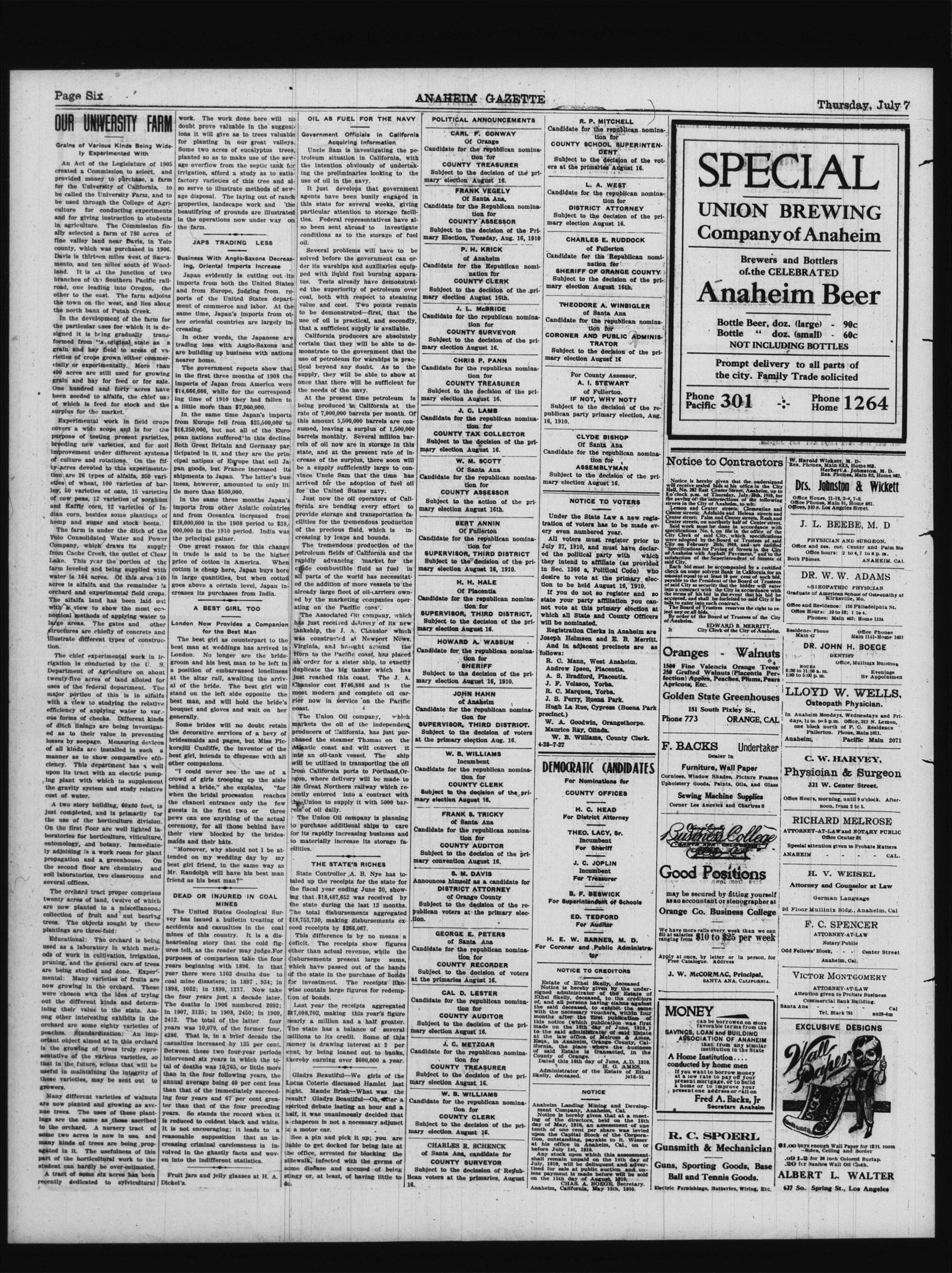
Searchable text
OUR UNWERSITY FARM
Grains of Various Kinds Being Widely Experimented With
An Act of the Legislature of 1905 created a Commission to select, and provided money to purchase, a farm for the University of California, to be called the University Farm, and to be used through the College of Agriculture for conducting experiments and for giving instruction to students in agriculture. The Commission finally selected a farm of 780 acres of fine valley land near Davis, in Yolo county, which was purchased in 1906. Davis is thirteen miles west of Sacramento, and ten miles south of Woodland. It is at the junction of two branches of the Southern Pacific railroad, one leading into Oregon, the other to the east. The farm adjoines the town on the west, and lies along the north bank of Putah Creek.
In the development of the farm for the particular uses for which it is designed it is being gradually transformed from its original state as a grain and hay field to areas of varieties of crops grown either commercially or experimentally. More than 400 acres are still used for growing grain and hay for feed or for sale. One hundred and forty acres have been seeded to alfalfa, the chief use of which is feed for stock and the surplus for the market.
Experimental work in field crops covers a wide scope and is for the purpose of testing present varieties, breeding new varieties, and for soil improvement under different systems of culture and rotations. On the fifty acres devoted to this experimentation work. The work done here will no doubt prove valuable in the suggestions it will give as to trees valuable for planting in our great valleys. Some two acres of eucalyptus trees, planted so as to make use of the sewage overflow from the septic tank for irrigation, afford a study as to satisfactory varieties of this tree and also serve to illustrate methods of sewage disposal. The laying out of ranch properties, landscape work and the beautifying of grounds are illustrated in the operations now under way on the farm.
JAPS TRADING LESS
Business With Anglo-Saxons Decreasing, Oriental Imports Increase
Japan evidently is cutting out its imports from both the United States and from Europe, judging from reports of the United States department of commerce and labor. At the same time, Japan's imports from other oriental countries are largely increasing.
In other words, the Japanese are trading less with Anglo-Saxons and are building up business with nations nearer home.
The government reports show that in the first three months of 1908 the imports of Japan from America were $14,666,666, while for the corresponding time of 1910 they had fallen to a little more than $7,000,000.
In the same time Japan's imports from Europe fell from $25,500,000 to $16,250,000, but not all of the European nations suffered in this decline. Both Great Britain and Germany participated in it, and they are the principal nations of Europe that sell Japan goods, but France increased its work. The work done here will no doubt prove valuable in the suggestions it will give as to trees valuable for planting in our great valleys. Some two acres of eucalyptus trees, planted so as to make use of the sewage overflow from the septic tank for irrigation, afford a study as to satisfactory varieties of this tree and also serve to illustrate methods of sewage disposal. The laying out of ranch properties, landscape work and the beautifying of grounds are illustrated in the operations now under way on the farm.
OIL AS FUEL
Government Office Acquiring
Uncle Sam is living trotheum situation; he intention obeying the preliminary use of oil in the mills. It just develops agents have been this state for several particular attention ties. Federal republic so been sent abroad conditions as to oil.
Several problems solved before the warships are ped with liquid fuel. Tests already ed the superiority coal, both with real value and cost. To be demonstrated use of oil is practiced that a sufficient suction.
California produce certain that they monstrate to the great use of petroleum for technical beyond any supply, they will once that there will be the needs of the mills.
At the present time being produced in rate of 7,000,000 barrels this amount 5,500,000 sumed, leaving a barrels monthly. Reliefs of oil now are state, and at the increase of the surplus be a supply sufficient since Uncle Sam
Experimental work in field crops covers a wide scope and is for the purpose of testing present varieties, breeding new varieties, and for soil improvement under different systems of culture and rotations. On the fifty acres devoted to this experimentation are 26 types of alfalfa, 250 varieties of wheat, 100 varieties of barley, 50 varieties of oats, 15 varieties of cow peas, 12 varieties of sorghum and Kaffir corn, 12 varieties of Indian corn, besides some plantings of hemp and sugar and stock beets.
The farm is under the ditch of the Yolo Consolidated Water and Power Company, which draws its supply from Cache Creek, the outlet of Clear Lake. This year the portion of the farm leveled and being supplied with water is 164 acres. Of this area 140 acres is alfalfa and the remainder is orchard and experimental field crops. The alfalfa land has been laid out with a view to show the most economical methods of applying water to large areas. The gates and other structures are chiefly of concrete and illustrate different types of construction.
The chief experimental work in irrigation is conducted by the U.S. Department of Agriculture on about twenty-five acres of land allotted for uses of the federal department. The major portion of this is in alfalfa with a view to studying the relative efficiency of applying water to various forms of checks. Different kinds of ditch linings are being investigated as to their value in preventing losses by seepage. Measuring devices of all kinds are installed in such a manner as to show comparative efficiency. This department has a well upon its tract with an electric pumping plant with which to supplement the gravity system and study relative cost of water.
A two story building, 60x80 feet, is just completed, and is primarily for the use of the horticulture division. On the first floor are well lighted laboratories for horticulture, viticulture, entomology, and botany. Immediately adjoining is a work room for plant propagation and a greenhouse. On the second floor are chemistry and soil laboratories, two classrooms and several offices.
The orchard tract proper comprises twenty acres of land suitable for growing grain and hay for feed or for sale. One hundred and forty acres have been seeded to alfalfa, the chief use of which is feed for stock and the surplus for the market.
Experimental work in field crops covers a wide scope and is for the purpose of testing present varieties, breeding new varieties, and for soil improvement under different systems of culture and rotations. On the fifty acres devoted to this experimentation are 26 types of alfalfa, 250 varieties of wheat, 100 varieties of barley, 50 varieties of oats, 15 varieties of cow peas, 12 varieties of sorghum and Kaffir corn, 12 varieties of Indian corn, besides some plantings of hemp and sugar and stock beets.
The farm is under the ditch of the Yolo Consolidated Water and Power Company, which draws its supply from Cache Creek, the outlet of Clear Lake. This year the portion of the farm leveled and being supplied with water is 164 acres. Of this area 140 acres is alfalfa and the remainder is orchard and experimental field crops. The alfalfa land has been laid out with a view to show the most economical methods of applying water to large areas. The gates and other structures are chiefly of concrete and illustrate different types of construction.
The chief experimental work in irrigation is conducted by the U.S. Department of Agriculture on about twenty-five acres of land alloted for uses of the federal department. The major portion of this is in alfalfa with a view to studying the relative efficiency of applying water to various forms of checks. Different kinds of ditch linings are being investigated as to their value in preventing losses by seepage. Measuring devices of all kinds are installed in such a manner as to show comparative efficiency. This department has a well upon its tract with an electric pumping plant with which to supplement the gravity system and study relative cost of water.
A two story building, 60x80 feet, is just completed, and is primarily for the use of the horticulture division. On the first floor are well lighted laboratories for horticulture, viticulture, entomology, and botany. Immediately adjoining is a work room for plant propagation and a greenhouse. On the second floor are chemistry and soil laboratories, two classrooms and several offices.
The orchard tract proper comprises twenty acres of land suitable for growing grain and hay for feed or for sale. One hundred and forty acres have been seeded to alfalfa, the chief use of which is feed for stock and the surplus for the market.
Experimental work in field crops covers a wide scope and is for the purpose of testing present varieties, breeding new varieties, and for soil improvement under different systems of culture and rotations. On the fifty acres devoted to this experimentation are 26 types of alfalfa, 250 varieties of wheat, 100 varieties of barley, 50 varieties of oats, 15 varieties of cow peas, 12 varieties of sorghum and Kaffir corn, 12 varieties of Indian corn, besides some plantings of hemp and sugar and stock beets.
The farm is under the ditch of the Yolo Consolidated Water and Power Company, which draws its supply from Cache Creek, the outlet of Clear Lake. This year the portion of the farm leveled and being supplied with water is 164 acres. Of this area 140 acres is alfalfa and the remainder is orchard and experimental field crops. The alfalfa land has been laid out with a view to show the most economical methods of applying water to large areas. The gates and other structures are chiefly of concrete and illustrate different types of construction.
The chief experimental work in irrigation is conducted by the U.S. Department of Agriculture on about twenty-five acres of land alloted for uses of the federal department. The major portion of this is in alfalfa with a view to studying the relative efficiency of applying water to various forms of checks. Different kinds of ditch linings are being investigated as to their value in preventing losses by seepage. Measuring devices of all kinds are installed in such a manner as to show comparative efficiency. This department has a well upon its tract with an electric pumping plant with which to supplement the gravity system and study relative cost of water.
A two story building, 60x80 feet, is just completed, and is primarily for the use of the horticulture division. On the first floor are well lighted laboratories for horticulture, viticulture, entomology, and botany. Immediately adjoining is a work room for plant propagation and a greenhouse. On the second floor are chemistry and soil laboratories, two classrooms and several offices.
The orchard tract proper comprises twenty acres of land suitable for growing grain and hay for feed or for sale. One hundred and forty acres have been seeded to alfalfa, the chief use of which is feed for stock and the surplus for the market.
Experimental work in field crops covers a wide scope and is for the purpose of testing present varieties, breeding new varieties, and for soil improvement under different systems of culture and rotations. On the fifty acres devoted to this experimentation are 26 types of alfalfa, 250 varieties of wheat, 100 varieties of barley, 50 varieties of oats, 15 varieties of cow peas, 12 varieties of sorghum and Kaffir corn, 12 varieties of Indian corn, besides some plantings of hemp and sugar and stock beets.
The farm is under the ditch of the Yolo Consolidated Water and Power Company, which draws its supply from Cache Creek, the outlet of Clear Lake. This year the portion of the farm leveled and being supplied with water is 164 acres. Of this area 140 acres is alfalfa and the remainder is orchard and experimental field crops. The alfalfa land has been laid out with a view to show the most economical methods of applying water to large areas. The gates and other structures are chiefly of concrete and illustrate different types of construction.
The chief experimental work in irrigation is conducted by the U.S. Department of Agriculture on about twenty-five acres of land alloted for uses of the federal department. The major portion of this is in alfalfa with a view to studying the relative efficiency of applying water to various forms of checks. Different kinds of ditch linings are being investigated as to their value in preventing losses by seepage. Measuring devices of all kinds are installed in such a manner as to show comparative efficiency. This department has a well upon its tract with an electric pumping plant with which to supplement the gravity system and study relative cost of water.
A two story building, 60x80 feet, is just completed, and is primarily for the use of the horticulture division. On the first floor are well lighted laboratories for horticulture, viticulture, entomology, and botany. Immediately adjoining is a work room for plant propagation and a greenhouse. On the second floor are chemistry and soil laboratories, two classrooms and several offices.
The orchard tract proper comprises twenty acres of land suitable for growing grain和 hay for feed or for sale. One hundred和四十 acres have been seeded to alfalfa,the chief useof testing present varieties,breeding new varieties,and for soil improvement under different systems.of culture和rotation.Onthe fiftyacres devotedtothisexperimentationare26typesofalfalfa,250varietiesofwheat,100varietiesofbarley,50varietiesofoat,15varietiesofcowpeas,12varietiesof SorghumandKaffir corn,12varietiesofIndian cornbesidessomeplantingsofhempandsugarandstockbees.
The farmisundertheditchoftheYoloconsolidatedWaterandPowerCompanywhichdrawsitssupplyfromEurope fellfrom$25,500,000to$16,250,000butnotalloftheEuropen nations sufferedinthisdeclineBothGreatBritainandGermanyparticipatedinit,andtheyaretheprincipalnationsofEuropethat sellJapangoodsbutFranceincreaseditsshipmentstoJapan.The latter'sbusinesshoweveramounttedonlylittlemorethan$500,000.
Inthe samethreemonthsJapan'simportsfromotherAsiaticcountriesandfromOceanicaincreasedfrom$28,000,000inthe1908periodto$38,
000,000inthe1910period.Inthewidemountedonlylittlemorethan$500,000.
One great reasonforthischangeintradeis saidtobethehigherpriceofcottoninAmerica。WhencottonischeaphereJapanbuyesthereinlargequantitiesbutwhencottongoesaboveacertainlevelJapanincreasesitspurchasesfromIndia.
A BEST GIRL TOO
LondonNowProvidesaCompanionfortheBestMan
Thebest girliscounterparttothebestmanatweddingshasarrivedinLondon.No longerarethebridegroomandhisbestmantobeleftinpositionofembarrassedlonelinessatthealtarrailawaitingthearrivalofthebride.Thebestgirlwillstandontheleftsideoppositethebestman,andwillholdthebride'sbouquetandglovesandwaitonhergenerally.
Somebrideswillno doubtretainthedecorativeservicesofabevyofbridesmaidsandpages,butMissPickersjillCunliffe,the inventorofthebestgirl,intendstodispensewithallothercompanions.
"Icouldneverseetheuseofaf crowdfors troopsroopinguptheaislebehinda bride,"sheexplains,"forwhenthebridalprocessreachesthechancelentranceonlythe few guestsinthefirsttwoorthreepewscanseeanythingoftheactualceremony,forgallosehindhavetheirviewblockedbythebridesmaidsandtheirshirts."
"MoreoverwhyshouldnotIbeattendedonmyweddingdaybymybestgirlfriend,inthesamewayasMr.Randolphwillhavethebestmanfriendashisbestman?"
DEAD OR INJURED IN COAL
StateController.Analyzeupthereceiptsforthefiscalyearendingthat.$18,487,652
A two story building, 60x80 feet, is just completed, and is primarily for the use of the horticulture division. On the first floor are well lighted laboratories for horticulture, viticulture, entomology, and botany. Immediately adjoining is a work room for plant propagation and a greenhouse. On the second floor are chemistry and soil laboratories, two classrooms and several offices.
The orchard tract proper comprises twenty acres of land, twelve of which are now planted to a miscellaneous collection of fruit and nut bearing trees. The objects sought by these plantings are three-fold:
Educational: The orchard is being used as a laboratory in which methods of work in cultivation, irrigation, pruning, and the general care of trees are being studied and done. Experimental: Many varieties of fruits are now growing in the orchard. These were chosen with the idea of trying out the different kinds and determining their value to the state. Among other interesting exhibits in the orchard are some eighty varieties of peaches. Standardization: An important object aimed at in this orchard is the growing of trees truly representative of the various varieties, so that in the future, scolons that will be useful in maintaining the integrity of these varieties, may be sent out to growers.
Many different varieties of walnuts are now planted and growing as avenue trees. The uses of these plantings are the same as those ascribed to the orchard. A nursery tract of some two acres is now in use, and many kinds of trees are being propagated in it. The usefulness of this part of the horticultural work to the student can hardly be over-estimated.
A tract of some six acres has been recently dedicated to sylvicultural the chancel entrance only the few guests in the first two or three pews can see anything of the actual ceremony, for all those behind have their view blocked by the bridesmaids and their hats.
"Moreover, why should not I be attended on my wedding day by my best girl friend, in the same way as Mr. Randolph will have his best man friend as his best man?"
DEAD OR INJURED IN COAL MINES
The United States Geological Survey has issued a bulletin treating of accidents and casualties in the coal mines of this country. It is a disheartening story that the cold figures tell, as the reader may judge. For purposes of comparison take the four years beginning with 1896. In that year there were 1103 deaths due to coal mine disasters; in 1897, 934; in 1898, 1032; in 1899, 1217. Now take the four years just a decade later. The deaths in 1906 numbered 2092; in 1907, 3125; in 1908, 2450; in 1909, 2412. The total of the latter four years was 10,079, of the former four, 4286. That is, in a brief decade the casualties increased by 135 per cent. Between these two four-year periods intervened six years in which the total of deaths was 10,765, or little more than in the four following years, the annual average being 40 per cent less than that of the immediately succeeding four years and 67 per cent greater than that of the four preceding years. So stands the record when it is reduced to coldest black and white. It is not encouraging; it leads to a reasonable supposition that an increasing criminal carelessness is involved in the ghastly facts and woven into the indifferent statistics.
Fruit jars and jelly glasses at H. A. Dickel's.
OIL AS FUEL FOR THE NAVY
Government Officials in California Acquiring Information
Uncle Sam is investigating the petroleum situation in California, with the intention obviously of undertaking the preliminary looking to the use of oil in the navy.
It just develops that government agents have been busily engaged in this state for several weeks, giving particular attention to storage facilities. Federal representatives have also been sent abroad to investigate conditions as to the storage of fuel oil.
Several problems will have to be solved before the government can order its warships and auxillaries equipped with liquid fuel burning apparatus. Tests already have demonstrated the superiority of petroleum over coal, both with respect to steaming value and cost. Two points remain to be demonstrated—first, that the use of oil is practical, and secondly, that a sufficient supply is available.
California producers are absolutely certain that they will be able to demonstrate to the government that the use of petroleum for warships is practical beyond any doubt. As to the supply, they will be able to show at once that there will be sufficient for the needs of the navy.
At the present time petroleum is being produced in California at the rate of 7,000,000 barrels per month. Of this amount 5,500,000 barrels are consumed, leaving a surplus of 1,500,000 barrels monthly. Several million barrels of oil now are in storage in this state, and at the present rate of increase of the surplus, there soon will be a supply sufficiently large to convince Uncle Sam that the time has come.
supply, they will be able to show at once that there will be sufficient for the needs of the navy.
At the present time petroleum is being produced in California at the rate of 7,000,000 barrels per month. Of this amount 5,500,000 barrels are consumed, leaving a surplus of 1,500,000 barrels monthly. Several million barrels of oil now are in storage in this state, and at the present rate of increase of the surplus, there soon will be a supply sufficiently large to convince Uncle Sam that the time has arrived for the adoption of fuel oil for the United States navy.
Just now the oil operators of California are bending every effort to provide storage and transportation facilities for the tremendous production of the precious fluid, which is increasing by leaps and bounds.
The tremendous production of the petroleum fields of California and the rapidly advancing market for the crude combustible fluid as fuel in all parts of the world has necessitated the addition of more vessels to the already large fleet of oil-carriers owned by the marketing companies operating on the Pacific coast.
The Associated Oil company, which has just received delivery of its new tankship, the J. A. Chanslor which was constructed at Newport News, Virginia, and brought around the Horn to the Pacific coast, has placed an order for a sister ship, to exactly duplicate the big tanker which has just reached this coast. The J. A. Chanslor cost $746,886 and is the most modern and complete oil carrier now in service on the Pacific coast.
The Union Oil company, which markets the oil of the independent producers of California, has just purchased the steamer Thomas on the Atlantic coast and will convert it into an oil-tank vessel. The ship will be utilized in transporting the oil from California ports to Portland, Oregon, where delivery will be made to the Great Northern railway which recently entered into a contract with the Union to supply it with 5000 barrels of oil daily.
The Union Oil company is planning to purchase additional ships to care for its rapidly increasing business and to materially increase its storage facilities.
THE STATE'S RICHES
State Controller A. B. Nye has totaled up the receipts for the state for the fiscal year ending June 30, showing that $18,487,652 was received by tion for COUNTY TREASURER
Subject to the decision of the primary election August 16.
J. C. LAMB
Candidate for the republican nomination for COUNTY TAX COLLECTOR
Subject to the decision of the primary election August 16.
W. M. SCOTT
Of Santa Ana
Candidate for the republican nomination for COUNTY ASSESSOR
Subject to the action of the primary election August 16th.
BERT ANNIN
Of Fullerton
Candidate for the republican nomination for SUPERVISOR, THIRD DISTRICT
Subject to the decision of the primary election August 16, 1910.
H. H. HALE
Of Placentia
Candidate for the republican nomination for SUPERVISOR, THIRD DISTRICT,
Subject to the decision of the primary election August 16.
HOWARD A. WASSUM
Candidate for the republican nomination for SHERIFF
Subject to the decision of the primary election August 16, 1910.
JOHN HAHN
of Anaheim
Candidate for the republican nomination for SUPERVISOR, THIRD DISTRICT.
Subject to the decision of voters at the primary election Aug. 16.
W. B. WILLIAMS
Incumbent
Candidate for the republican nomination for COUNTY CLERK
Subject to the decision of the primary election August 16.
FRANK S. TRICKY
of Santa Ana
Candidate for the republican nomination for COUNTY AUDITOR
Subject to the decision of the primary convention August 16.
S. M. DAVIS
Announces himself as a candidate for DISTRICT ATTORNEY of Orange County
For County Assessor,
A. I. STEWART
of Fullerton.
IF NOT, WHY NOT?
Subject to the decision of the republican party primary election, Aug. 16, 1910.
CLYDE BISHOP
Of Santa Ana
Candidate for the republican nomination for ASSEMBLYMAN
Subject to the decision of the primary election August 16.
NOTICE TO VOTERS
Under the State Law a new registration of voters has to be made every even numbered year.
All voters must register prior to July 27, 1910, and must have declared the political party with which they intend to affiliate (as provided in Sec. 1366 a, Political Code) who desire to vote at the primary election to be held August 16, 1910.
If you do not so register and so state your party affiliation you cannot vote at this primary election at which all State and County Officers will be nominated.
Registration Clerks in Anaheim are Joseph Helmsen and E. B. Merritt.
And in adjacent precincts are as follows:
R. C. Mann, West Anaheim.
Andrew Ipsen, Placentia.
A. S. Bradford, Placentia.
J. F. Velasco, Yorba.
R. C. Marquez, Yorba.
J. S. Perry, Buena Park.
Hugh La Rue, Cypress (Buena Park precinct.)
W. A. Goodwin, Orangethorpe.
Maurice Ray, Olinda.
W. B. Williams, County Clerk.
4-28-7-27
DEMOCRATIC CANDIDATES
For Nominations for COUNTY OFFICES
H. C. HEAD
For District Attorney
THEO. LACY, Sr.
Incumbent
For Sheriff
J. C. JOPLIN
Incumbent
For Treasurer
B. F. BESWICK
THE STATE'S RICHES
State Controller A. B. Nye has totaled up the receipts for the state for the fiscal year ending June 30, showing that $18,487,652 was received by the state during the last 12 months. The total disbursements aggregated $18,753,720, making disbursements exceed receipts by $266,067.
This difference is by no means a deficit. The receipts show figures other than actual revenue, while the disbursements present large sums, which have passed out of the hands of the state in the purchase of bonds for investment. The receipts likewise contain large figures for redemption of bonds.
Last year the receipts aggregated $17,098,702, making this year's figure nearly a million and a half greater. The state has a balance of several millions to its credit. Some of this money is drawing interest at 2 per cent, by being loaned out to banks, thereby earning over $600,000 a year.
Gladys Beautiful—We girls of the Lotus Coterie discussed Hamlet last night. Maude Brisk—What was the result? Gladys Beautiful—Oh, after a spirited debate lasting an hour and a half, it was unanimously decided that a chaperon is not a necessary adjunct to a motor car.
See a pin and pick it up; you are liable to get docked for being late at the office, arrested for blocking the sidewalk, infected with the germs of some disease and accused of being stingy or, at least, of having little to do.
FRANK S. TRICKY
of Santa Ana
Candidate for the republican nomination for
COUNTY AUDITOR
Subject to the decision of the primary convention August 16.
S. M. DAVIS
Announces himself as a candidate for DISTRICT ATTORNEY of Orange County
Subject to the decision of the republican voters at the primary election.
GEORGE E. PETERS
of Santa Ana
Candidate for the republican nomination for
COUNTY RECORDER
Subject to the decision of voters at the primaries August 16.
CAL D. LESTER
Candidate for the republican nomination for
COUNTY AUDITOR
Subject to the decision of the primary election August 16.
J. C. METZGAR
Candidate for the republican nomination for
COUNTY TREASURER
Subject to the decision of the primary election August 16.
W. B. WILLIAMS
Candidate for the republican nomination for
COUNTY CLERK
Subject to the decision of the primary election August 16.
CHARLES R. SCHENCK
of Santa Ana, candidate for
COUNTY SURVEYOR
Subject to the decision of Republican voters at the primaries, August 16.
H. C. HEAD
For District Attorney
THEO. LACY, Sr.
Incumbent For Sheriff
J. C. JOPLIN
Incumbent For Treasurer
B. F. BESWICK
For Superintendent of Schools
ED. TEDFORD
For Auditor
H. E. W. BARNES, M. D.
For Coroner and Public Administrator
NOTICE TO CREDITORS
Estate of Ethel Skelly, deceased
Notice is hereby given by the undersigned administrator of the Estate of Ethel Skelly, deceased, to the creditors of, and all persons having claims against the said deceased, to exhibit the same with the necessary vouchers, within four months after the first publication of this notice (which publication was first made on the 16th day of June, 1910.) to the said administrator of said Estate at the law office of Melrose & Ames, Esqs., in Anaheim, Orange County, California, the place where the business of said Estate is transacted, in the County of Orange.
Dated this 16th day of June, A.D. 1910.
H. G. AMES,
Administrator of the Estate of Ethel Skelly, deceased.
NOTICE
Anaheim Landing Mining and Development Company, Anaheim, Cal.
Notice is hereby given that at a meeting of the directors, held on the 18th day of May, 1910, an assessment of one tenth of one cent per share was levied upon the Capital Stock of the Corporation, outstanding, payable to R. Wisser at his office in Anaheim, Cal., on or before July 1st, 1910.
Any stock upon which this assessment shall remain unpaid on the 14th day of July, 1910, will be delinquent and advertised for sale at public auction and unless payment is made before will be sold on the 15th day of August, 1910.
CHAS. A. BOEGE, Secretary.
Anaheim, California, May 18th, 1910.
Thursday, July 7
SPECIAL
UNION BREWING
Company of Anaheim
Brewers and Bottlers
of the CELEBRATED
Anaheim Beer
Bottle Beer, doz. (large) - 90c
Bottle “doz. (small) - 60c
NOT INCLUDING BOTTLES
Prompt delivery to all parts of
the city. Family Trade solicited
Phone Pacific 301 Phone Home 1264
Notice to Contractors
W. Harold Wickett, M. D.
Res, Phones, Main 8X8, Home 863.
Herbert A. Johnston, M. D.
Res, Phones, Main 8X8, Home 863.
Notice to Contractors
Notice is hereby given that the undersigned will receive sealed bids at his office in the City Hall, No. 282 East Center Street, Anaheim, up to 8 o'clock p.m. of Thursday, July 28th, 1910, for the paving of the intersections of the following streets in the City of Anaheim, to-wit:
Lemon and Center streets; Clementine and Center streets; Adelaide and Helena streets and Center street; Palm and Center streets, Resh and Center streets, on northerly half of Center street.
Said work must be done in accordance with specifications No. 4, on file in the office of the City Clerk of said City, which specifications were adopted by the Board of Trustees of said City on February 28th, 1910, and are entitled "Specifications for Paving of Streets in the City of Anaheim with Asphalt Pavement," and to the satisfaction of the Superintendent of Streets of said City.
Each bid must be accompanied by a certified check on some solvent Bank in California for an amount equal to at least 10 per cent of such bid, payable to the President of the Board of Trustees of said City as security that the bidder will enter into a contract with the City in accordance with the terms of his bid in the event that his bid be accepted, and shall be forfeited to said City if he fails to enter into such contract.
The Board of Trustees reserves the right to reject any or all bids.
By order of the Board of Trustees of the City of Anaheim.
EDWARD B. MERRITT,
City Clerk of the City of Anaheim.
Oranges - Walnuts
1500 Fine Valencia Orange Trees;
250 Grafted Walnuts (Placentia Perfection) Apples, Peaches, Plums, Pears Apricots, Etc.
Golden State Greenhouses
151 South Pixley St.
Phone 773 ORANGE, CAL
F. BACKS Undertaker
Dealer in
Furniture, Wall Paper
Cornices, Window Shades, Picture Frames
Upholstery Goods, Paints, Oils, and Glass
Sewing Machine Supplies
Corner Los Angeles and Chartres 8
Good Positions may be secured by fitting yourself
W. Harold Wickett, M.D.
Res. Phones, Main 8X2, Home 863.
Herbert A. Johnston, M.D.
Res. Phones, Main 82, Home 862.
Drs. Johnston & Wickett
Office Hours: 11-12, 2-4, 7-8
Office Phones, Main 81, Home 861.
Offices, 810 S. Los Angeles Street.
J. L. BEEBE, M.D
PHYSICIAN AND SURGEON.
Office and res. cor. Center and Palm Sts
Office hours: 2 to 4, 7 to 8 p.m.
Both Phones.
ANAHEIM, CA.
DR. W. W. ADAMS
OSTEOPATHIC PHYSICIAN
Graduate of American School of Osteopathy of Kirksville, Mo.
Office and Residence: 116 Philadelpnia St.
Office Hours: 10 to 12; 1 to 4.
Phones: Main 463; Home 1134
Residence Phone
Main 42
Office Phones
Main 1141-Home 1401
DR. JOHN H. BOEGE
DENTIST
Office, Mullinix Building
HOURS:
8:30 to 11:30 a.m.
1:30 to 5:00 p.m.
Evenings
By Appointmen
LLOYD W. WELLS,
Osteopath Physician.
In Anaheim Mondays, Wednesdays and Fridays, 12 m. to 5 p.m. Office; 212 N. Lemon, one block north of P.O. Residence Fullerton. Phone, Main 1811.
Anaheim Pacific Main 2071
C. W. HARVEY,
Physician & Surgeon
321 W. Center Street.
Office Hours, morning, until 9 o'clock. Afternoon, from 2 to 5.
RICHARD MELROSE
ATTORNEY-AT-LAW and NOTARY PUBLIC
Office Center St
Special attention given to Probate Matters
ANAHEIM - CAL.
H. V. WEISEL
Attorney and Counselor at Law
German Language
Good Positions
may be secured by fitting yourself as an accountant or stenographer at Orange Co. Business College
We have more calls every week than we can fill at salaries ranging from $10 to $25 per week
Apply at once, by letter or in person, for Free Catalogue. Address
J. W. McCormac, Principal,
SANTA ANA, CALIFORNIA.
MONEY
can be borrowed on more favorable terms from the SAVINGS, LOAN and BUILDING ASSOCIATION OF ANAHEIM than from any similar institution in the State
A Home Institution conducted by home men
If you want to borrow money at a low rate to pay off your present mortgage, or to build a home or to improve your present one address or call on
Fred A. Backs, Jr.
Secretary Anaheim
R. C. SPOERL
Gunsmith & Mechanician
Guns, Sporting Goods, Base Ball and Tennis Goods.
Electric Furnishings, Batteries, Wiring, Etc.
$1.00 buys enough Wall Paper for 12ft. room—Sides, Ceiling and Border
.091-2 for 38 inch Colored Burlap.
.20 for Sanitos Wall Oil Cloth.
ALBERT L. WALTER
627 So. Spring St., Los Angeles