anaheim-gazette 1910-07-07
Scanned page
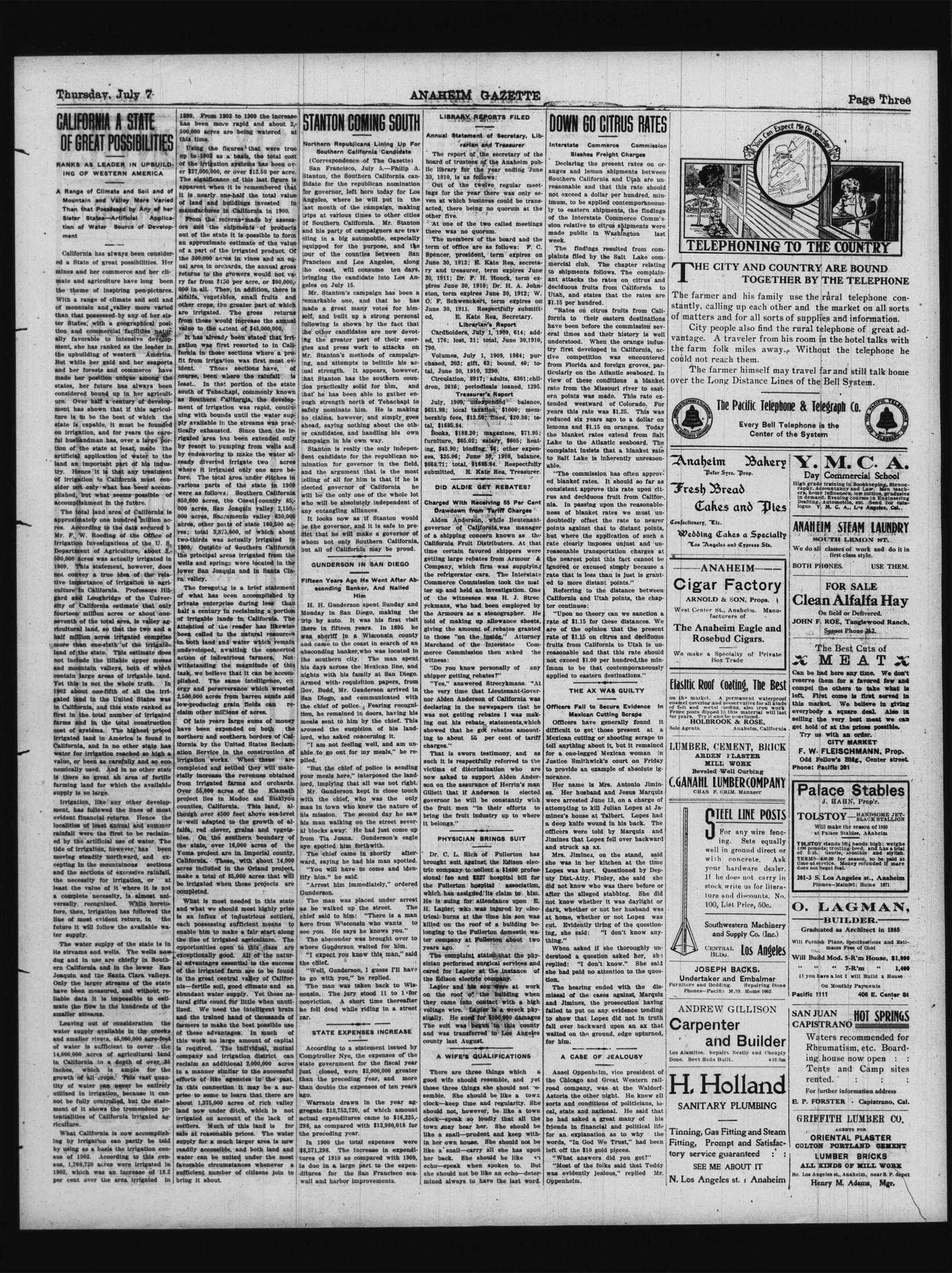
Searchable text
CALIFORNIA A STATE OF GREAT POSSIBILITIES
RANKS AS LEADER IN UPBUILDING OF WESTERN AMERICA
A Range of Climate and Soil and of Mountain and Valley More Varied Than that Possessed by Any of her Sister States—Artificial Application of Water Source of Development
California has always been considered a State of great possibilities. Her mines and her commerce and her climate and agriculture have long been the theme of inspiring pen-pictures. With a range of climate and soil and of mountain and valley more varied than that possessed by any of her sister States, with a geographical position and commercial facilities naturally favorable to intensive development, she has ranked as the leader in the upbuilding of western America. But while her gold and her seaports and her forests and commerce have made her position unique among the states, her future has always been considered bound up in her agriculture. Over half a century of development has shown that if this agriculture is to be the best of which the state is capable, it must be founded on irrigation, and for years the careful husbandman has, over a large portion of the state at least, made the artificial application of water to the land an important part of his industry. Hence it is that any treatment
1899. From 1902 to 1909 the increase has been more rapid and about 2,500,000 acres are being watered at this time.
Using the figures that were true up to 1902 as a basis, the total cost of the irrigation systems has been over $27,000,000, or over $13.50 per acre. The significance of this last figure is apparent when it is remembered that it is nearly one-half the total value of land and buildings invested in manufactures in California in 1900.
From the returns made by assessors and the shipments of products out of the state it is possible to form an approximate estimate of the value of a part of the irrigated product. Of the 300,000 acres in vines and an equal area in orchards, the annual gross returns to the growers would not vary far from $150 per acre, or $90,000 in all. Then, in addition, there is alfalfa, vegetables, small fruits and other crops, the greater part of which are irrigated. The gross returns from these would increase the annual value to the extent of $45,000,000.
It has already been stated that irrigation was first resorted to in California in those sections where a profit from irrigation was first most evident. These sections have, of course, been where the rainfall is least.. In that portion of the state south of Tehachapi, commonly known as Southern California, the development of irrigation was rapid, continuing with bounds until the water supply available in the streams was practically exhausted. Since then the irrigated area has been extended only by resort to pumping from wells and by endeavoring to make the water already diverted irrigate two acres where it irrigated only one acre be-
made her position unique among the states, her future has always been considered bound up in her agriculture. Over half a century of development has shown that if this agriculture is to be the best of which the state is capable, it must be founded on irrigation, and for years the careful husbandman has, over a large portion of the state at least, made the artificial application of water to the land an important part of his industry. Hence it is that any treatment of irrigation in California must consider not only what has been accomplished, but what seems possible of accomplishment in the future.
The total land area of California is approximately one hundred million acres. According to the data secured by Mr. F. W. Roeding of the Office of Irrigation Investigations of the U. S. Department of Agriculture, about 2,500,000 acres was actually irrigated in 1909. This statement, however, does not convey a true idea of the relative importance of irrigation to agriculture in California. Professors Hilgard and Loughridge of the University of California estimate that only fourteen million acres or about one-seventh of the total area, is valley agricultural land, so that the two and a half million acres irrigated comprise more than one-sixth of the irrigable land of the state. This estimate does not include the tillable upper mesas and mountain valleys, both of which contain large areas of irrigable land. Yet this is not the whole truth. In 1902 about one-fifth of all the irrigated land in the United States was in California, and this state ranked as first in the total number of irrigated farms and in the total construction cost of systems. The highest priced irrigated land in America is found in California, and in no other state has water for irrigation reached so high a value, or been as carefully and so economically used. And in no other state is there so great an area of fertile farming land for which the available supply is so large.
Irrigation, like any other development, has followed the lines of most evident financial returns. Hence the localities of least annual and summer rainfall were the first to be reclaimed by the artificial use of water. The tide of irrigation, however, has been moving steadily northward, and excepting in the mountainous sections and the sections of excessive rainfall, the necessity for irrigation, or at least the value of it where it is not a complete necessity, is almost unli-
course, been where the rainfall is least.. In that portion of the state south of Tehachapi, commonly known as Southern California, the development of irrigation was rapid, continuing with bounds until the water supply available in the streams was practically exhausted. Since then the irrigated area has been extended only by resort to pumping from wells and by endeavoring to make the water already diverted irrigate two acres where it irrigated only one acre before. The total area under ditches in various parts of the state in 1909 were as follows: Southern California 850,000 acres, the Coast country 85,000 acres, San Joaquin valley 2,150,000 acres, Sacramento valley 630,000 acres, other parts of state 160,500 acres; total 3,875,000, of which about two-thirds was actually irrigated in 1909. Outside of Southern California the principal areas irrigated from the wells and springs were located in the lower San Joaquin and in Santa Clara valley.
The foregoing is a brief statement of what has been accomplished by private enterprise during less than half a century in reclaiming a portion of irrigable lands in California. The attention of the reader has likewise been called to the natural resources in both land and water which remain undeveloped, awaiting the concerted action of industrious farmers. Notwithstanding the magnitude of this task, we believe that it can be accomplished. The same intelligence, energy and perseverance which wrested 2,500,000 acres from barren sands and low-producing grain fields can reclaim other millions of acres.
Of late years large sums of money have been expended on both the northern and southern borders of California by the United States Reclamation Service in the construction of irrigation works. When these are completed and settled they will materially increase the revenues obtained from irrigated farms and orchards. Over 55,000 acres of the Klamath project lies in Modoc and Siskiyou counties, California. This land, although over 4500 feet above sea-level is well adapted to the growth of alfalfa, red clover, grains and vegetables. On the southern boundary of the state, over 16,000 acres of the Yuma project are in Imperial county, California. These, with about 14,000 acres included in the Orland project, make a total of 85,000 acres that will be irrigated when these projects are completed.
But the chief aim of your meals here," Lord, implying that Mr. Gunderson with the chief, who man in town who his mission. The his man walking al blocks away. He from Tia Juana. say spotted him.
The chief came ward, saying he h "You will have rifled him." he said "Arrest him im Gunderson."
Irrigation, like any other development, has followed the lines of most evident financial returns. Hence the localities of least annual and summer rainfall were the first to be reclaimed by the artificial use of water. The tide of irrigation, however, has been moving steadily northward, and excepting in the mountainous sections and the sections of excessive rainfall, the necessity for irrigation, or at least the value of it where it is not a complete necessity, is almost universally recognized. While heretofore, then, irrigation has followed the line of most evident return, in the future it will follow the available water supply.
The water supply of the state is in its streams and wells. The wells now dug and in use are chiefly in Southern California and in the lower San Joaquin and the Santa Clara valleys. Only the larger streams of the state have been measured, and without reliable data it is impossible to estimate the flow in the hundreds of the smaller streams.
Leaving out of consideration the water supply available in the creeks and smaller rivers, 45,000,000 acre-feet of water is sufficient to cover the 14,000,000 acres of agricultural land in California to a depth of over 28 inches, which is ample for the growth of all crops. This vast quantity of water can never be entirely utilized in irrigation, because it cannot be fully controlled, but the statement of it shows the tremendous potentialities of California irrigated agriculture.
What California is now accomplishing by irrigation can partly be told by using as a basis the irrigation census of 1902. According to this census, 1,768,720 acres were irrigated in 1902, which was an increase of 18.2 per cent over the area irrigated in
What is most needed in this state and what we should most highly prize is an influx of industrious settlers, each possessing sufficient means to enable him to make a fair start along the line of irrigated agriculture. The opportunities open to this class are exceptionally good. All of the natural advantages essential to the success of the irrigated farm are to be found in the great central valley of California—fertile soil, good climate and abundant water supply. Yet these natural gifts count for little when unutilized. We need the intelligent brain and the trained hand of thousands of farmers to make the best possible use of these advantages. In much of this work no large amount of capital is required. The individual, mutual company and irrigation district can reclaim an additional 2,000,000 acres in a manner similar to the successful efforts of like agencies in the past. In this connection it may be a surprise to some to learn that there are about 1,375,000 acres of rich valley land now under ditch, which is not irrigated on account of the lack of settlers. Much of this land is for sale at reasonable prices. The water supply for a much larger area is now readily accessible, and both land and water can be united under the most favorable circumstances whenever a sufficient number of citizens join to bring it about.
STATE EXPENSE
According to a Comptroller Nye, state government just closed, were than the preceding than double the ex-ago.
Warrants drawgregate $18,753,720 actual expenditure 298, as compared with the preceding year.
In 1900 the total $8,271,298. The images of 1910 as due in a large ditures for the wall and harbor in
STANTON COMING SOUTH
Northern Republicans Lining Up For Southern California Candidate
(Correspondence of The Gazette)
San Francisco, July 5.—Philip A. Stanton, the Southern California candidate for the republican nomination for governor, left here today for Los Angeles, where he will put in the last month of the campaign, making trips at various times to other cities of Southern California. Mr. Stanton and his party of campaigners are traveling in a big automobile, especially equipped for the purpose, and the tour of the counties between San Francisco and Los Angeles, along the coast, will consume ten days bringing the candidate into Los Angeles on July 15.
Mr. Stanton's campaign has been a remarkable one, and that he has made a great many votes for himself, and built up a strong personal following is shown by the fact that the other candidates are now devoting the greater part of their energies and press work to attacks on Mr. Stanton's methods of campaigning, and attempts to belittle his actual strength. It appears, however, that Stanton has the southern countrys practically solid for him, and that he has been able to gather enough strength north of Tehachapi to safely nominate him. He is making no claims, however, and simply goes ahead, saying nothing about the other candidates, and handling his own campaign in his own way.
Stanton is really the only independent candidate for the republican nomination for governor in the field, and the argument that is the most
LIBRARY REPORTS FILED
Annual Statement of Secretary, Librarian and Treasurer
The report of the secretary of the board of trustees of the Anaheim public library for the year ending June 30, 1910, is as follows:
Out of the twelve regular meetings for the year there was only seven at which business could be transacted, there being no quorum at the other five.
At one of the two called meetings there was no quorum.
The members of the board and the term of office are as follows: F. C. Spencer, president, term expires on June 30, 1912; E. Kate Rea, secretary and treasurer, term expires June 30, 1911; Dr. F. H. Houck, term expires June 30, 1910; Dr. H. A. Johnston, term expires June 30, 1912; W. O. F. Schwenckert, term expires on June 30, 1911. Respectfully submitted,
E. Kate Rea, Secretary.
Librarian's Report
Cardholders, July 1, 1909, 614; added, 176; lost, 31; total, June 30,1910, 790.
Volumes, July 1, 1909, 1984; purchased, 203; gift, 63; bound, 40; total, June 30, 1910, 2290.
Circulation, 8917; adults, 6301; children, 2616; periodicals loaned, 1295.
Treasurer's Report
July, 1909, unexpended balance,$651.98; local taxation,$1000; membership fees,$13.50; fines,$20.36; total,$1685.84.
Books,$188.20; magazines,$71.95; furniture,$65.02; salary,$605; heating,$45.90; binding,$6; other expenses,$35.06; June 30, 1910, balance,$668.71; total,$1685.84. Respectfully submitted,
E. Kate Rea, Treasurer.
DOWN GO CITRUS RATES
Interstate Commerce Commission
Slashes Freight Charges
Declaring the present rates on oranges and lemon shipments between Southern California and Utah are unreasonable and that this rate should not exceed a dollar per hundred, minimum, to be applied contemporaneously to eastern shipments, the findings of the Interstate Commerce Commission relative to citrus shipments were made public in Washington last week.
The findings resulted from complaints filed by the Salt Lake commercial club. The chapter relating to shipments follows. The complainant attacks the rates on citrus and deciduous fruits from California to Utah, and states that the rates are $1.15 per hundred.
"Rates on citrus fruits from California to their eastern destinations have been before the commission several times and their history is well understood. When the orange industry first developed in California, active competition was encountered from Florida and foreign groves particularly on the Atlantic seaboard. In view of these conditions a blanket rate from the Missouri river to eastern points was made. This rate extended westward of Colorado. For years this rate was $1.25. This was reduced six years ago to a dollar on lemons and $1.15 on oranges. Today the blanket rates extend from Salt Lake to the Atlantic seaboard. The complaint insists that a blanket rate to Salt Lake is inherently unreasonable."
"The commission has often approv-
that Stanton has the southern counties practically solid for him, and that he has been able to gather enough strength north of Tehachapi to safely nominate him. He is making no claims, however, and simply goes ahead, saying nothing about the other candidates, and handling his own campaign in his own way.
Stanton is really the only independent candidate for the republican nomination for governor in the field, and the argument that is the most telling of all for him is that if he is elected governor of California he will be the only one of the whole lot who will be absolutely independent of any entangling alliances.
It looks now as if Stanton would be the governor, and it is safe to predict that he will make a governor of whom not only Southern California, but all of California may be proud.
GUNDERSON IN SAN DIEGO
Fifteen Years Ago He Went After Absconding Banker, And Nailed Him
H. H. Gunderson spent Sunday and Monday in San Diego, making the trip by auto. It was his first visit there in fifteen years. In 1895 he was sheriff in a Wisconsin county and came to the coast in search of an absconding banker, who was located in the southern city. The man spent his days across the Mexican line, and nights with his family at San Diego. Armed with requisition papers, from Gov. Budd, Mr. Gunderson arrived in San Diego, and communicated with the chief of police. Fearing recognition, he remained in doors, having his meals sent to him by the chief. This aroused the suspicion of his landlord, who asked concerning it.
"I am not feeling well, and am unable to go out for my meals," he replied.
"But the chief of police is sending your meals here," interposed the landlord, implying that all was not right.
Mr. Gunderson kept in close touch with the chief, who was the only man in town who knew the nature of his mission. The second day he saw his man walking on the street several blocks away. He had just come up from Tia Juana. Gunderson's eagle eye spotted him forthwith.
The chief came in shortly afterward, saying he had his man spotted.
"You will have to come and identify him." he said.
"Arrest him immediately," ordered Gunderson.
Circulation, 8917; adults, 6301; children, 2616; periodicals loaned, 1295.
Treasurer's Report
July, 1909, unexpended balance, $651.98; local taxation, $1000; membership fees, $13.50; fines, $20.38; total, $1685.84.
Books, $188.20; magazines, $71.95; furniture, $65.02; salary, $605; heating, $45.90; binding, $6; other expenses, $35.06; June 30, 1910, balance, $668.71; total, $1685.84. Respectfully submitted, E. Kate Rea, Treasurer.
DID ALDIE GET REBATES?
Charged With Receiving 55 Per Cent Drawdown from Tariff Charges
Alden Anderson, while Lieutenant-governor of California, was manager of a shipping concern known as the California Fruit Distributors. At that time certain favored shippers were getting large rebates from Armour & Company, which firm was supplying the refrigerator cars. The Interstate Commerce Commission took the matter up and held an investigation. One of the witnesses was H. J. Streckymans, who had been employed by the Armours as a stenographer. He told of making up allowance sheets, giving the amount of rebates granted to those "on the inside." Attorney Marchand of the Interstate Commerce Commission then asked the witness:
"Do you know personally of any shipper getting rebates?"
"Yes," answered Streckymans. "At the very time that Lieutenant-Governor Alden Anderson of California was declaring in the newspapers that he was not getting rebates I was making out his rebate statements, which showed that he got rebates amounting to about 55 per cent of tariff charges."
That is sworn testimony, and as such it is respectfully referred to the victims of discrimination who are now asked to support Alden Anderson on the assurance of Herrin's man Gillett that if Anderson is elected governor he will be constantly with the fruit men "in their efforts to bring the fruit industry up to where it belongs."
PHYSICIAN BRINGS SUIT
Dr. C. L. Rich of Fullerton has brought suit against the Edison electric company to collect a $1400 professional fee and $327 hospital bill for the Fullerton hospital association, which has assigned its claim to him.
view of these conditions a blanket rate from the Missouri river to eastern points was made. This rate extended westward of Colorado. For years this rate was $1.25. This was reduced six years ago to a dollar on lemons and $1.15 on oranges. Today the blanket rates extend from Salt Lake to the Atlantic seaboard. The complaint insists that a blanket rate to Salt Lake is inherently unreasonable.
"The commission has often approved blanket rates. It should so far as consistent approve this rate upon citrus and deciduous fruit from California. In passing upon the reasonableness of blanket rates we must undoubtedly offset the rate to nearer points against that to distant points, but where the application of such a rate clearly imposes unjust and unreasonable transportation charges at the nearest point this fact cannot be ignored or excused simply because a rate that is less than is just is granted to more distant points."
Referring to the distance between California and Utah points, the chapter continues:
"Upon no theory can we sanction a rate of $1.15 for these distances. We are of the opinion that the present rate of $1.15 on citrus and deciduous fruits from California to Utah is unreasonable and that this rate should not exceed $1.00 per hundred,the minimum to be that contemporaneously applied to eastern destinations."
THE AX WAS GUILTY
Officers Fail to Secure Evidence in Mexican Cutting Scrape
Officers have generally found it difficult to get those present at a Mexican cutting or shooting scrape to tell anything about it, but it remained for a one-legged Mexican woman in Justice Smithwick's court on Friday to provide an example of absolute ignorance.
Her name is Mrs. Antonio Jiminez. Her husband and Jesus Marquiz were arrested June 13, on a charge of attempting to kill Julian Lopez at Jaminez's house at Talbert. Lopez had a deep knife wound in his back. The officers were told by Marquiz and Jiminez that Lopez fell over backward and struck an ax.
Mrs. Jiminez, on the stand, said she was in her kitchen at the time Lopez was hurt. Questioned by Deputy Dist-Atty Finley, she said she did not know who was there before or after the alleged stabbing. She did
with the chief, who was the only man in town who knew the nature of his mission. The second day he saw his man walking on the street several blocks away. He had just come up from Tia Juana. Gunderson's eagle aye spotted him forthwith.
The chief came in shortly afterward, saying he had his man spotted. "You will have to come and identify him." he said.
"Arrest him immediately," ordered Gunderson.
The man was placed under arrest as he walked up the street. The chief said to him: "There is a man here from Wisconsin who wants to see you. He says he knows you."
The absconder was brought over to where Gunderson waited for him.
"I expect you know this man," said the chief.
"Well, Gunderson, I guess I'll have to go with you," he replied.
The man was taken back to Wisconsin. The jury stood 11 to 1 for conviction. A short time thereafter he fell dead while riding in a street car.
STATE EXPENSES INCREASE
According to a statement issued by Comptroller Nye, the expenses of the state government for the fiscal year just closed, were $2,000,000 greater than the preceding year, and more than double the expenses of ten years ago.
Warrants drawn in the year aggregate $18,753,720, of which amount actual expenditures came to $16,225,-298, as compared with $13,980,018 for the preceding year.
In 1900 the total expenses were $8,271,298. The increase in expenditures of 1910 as compared with 1909, is due in a large part to the expenditures for the San Francisco seawall and harbor improvements.
PHYSICIAN BRINGS SUIT
Dr. C. L. Rich of Fullerton has brought suit against the Edison electric company to collect a $1400 professional fee and $327 hospital bill for the Fullerton hospital association, which has assigned its claim to him. He is suing for attendance upon E. H. Lapler, who was injured by electrical burns at the time his son was killed on the roof of a building belonging to the Fullerton domestic water company at Fullerton about two years ago.
The complaint states that the physician performed surgical services and cared for Lapler at the instance of the Edison electric company.
Lapler and his son were at work on the roof of the building when they came into contact with a high voltage wire. Lapler is a wreck physically. He sued for $100,000 damages. The suit was begun in this county and was transferred to Los Angeles county last August.
A WIFE'S QUALIFICATIONS
There are three things which a good wife should resemble, and yet those three things she should not resemble. She should be like a town clock—keep time and regularity. She should not, however, be like a town clock—speak so loudly that all the town may hear her. She should be like a snail—prudent and keep within her own house. She should not be like a snail—carry all she has upon her back. She should be like an echo—speak when spoken to. But she should not be like an echo—determined always to have the last word.
Mrs. Jiminez, on the stand, said she was in her kitchen at the time Lopez was hurt. Questioned by Deputy Dist.-Atty. Finley, she said she did not know who was there before or after the alleged stabbing. She did not know whether it was daylight or dark, whether or not her husband was at home, whether or not Lopez was cut. Evidently tiring of the questioning, she said: "I don't know anything."
When asked if she thoroughly understood a question asked her, she replied: "I don't know." She said she had paid no attention to the question.
The hearing ended with the dismissal of the cases against Marquiz and Jiminez, the prosecution having failed to put on any evidence tending to show that Lopez did not in truth fall over backward upon an ax that waited on the ground, edge upturned, for him.
A CASE OF JEALOUSY
Ansel Oppenheim, vice president of the Chicago and Great Western railroad company, was at the Waldorf-Astoria the other night. He knew all sorts and conditions of politicians, local, state and national. He said that he had asked a great many of his friends in financial and political life for an explanation as to why the words, "In God We Trust," had been left off the $10 gold pieces.
“What answers did you get?”
Most of the folks said that Teddy was evidently jealous,” replied Mr. Oppenheim.
CITRUS RATES
Commerce Commission
Freight Charges
The present rates on ordon shipments between
California and Utah are unthat this rate should
dollar per hundred, mincolled contemporaneousshipments, the findings
the Commerce Comm's
citrus shipments were
in Washington last
resulted from comthe Salt Lake comThe chapter relating
follows. The complainrates on citrus and
from California to
that the rates are
citrus fruits from Calieastern destinations
the commission sevtheir history is well
when the orange indusped in California, acon was encountered
and foreign groves, parAtlantic seaboard. In
conditions a blanket
Missouri river to eastmade. This rate exward of Colorado. For
was $1.25. This was
ago to a dollar on
5 on oranges. Today
extend from Salt
atlantic seaboard. The
that a blanket rate
inherently unreason-
TELEPHONING TO THE COUNTRY
THE CITY AND COUNTRY ARE BOUND
TOGETHER BY THE TELEPHONE
The farmer and his family use the rural telephone constantly, calling up each other and the market on all sorts of matters and for all sorts of supplies and information.
City people also find the rural telephone of great advantage. A traveler from his room in the hotel talks with the farm folk miles away. Without the telephone he could not reach them.
The farmer himself may travel far and still talk home over the Long Distance Lines of the Bell System.
The Pacific Telephone & Telegraph Co.
Every Bell Telephone is the
Center of the System
Anaheim Bakery Y. M. C. A.
Peter Syre Prop.
The Pacific Telephone & Telegraph Co.
Every Bell Telephone is the Center of the System
Anaheim Bakery
Peter Syre, Prop.
Fresh Bread
Cakes and Pies
Confectionery, Etc.
Wedding Cakes a Specialty
Los Angeles and Cypress Sts.
ANAHEIM
Cigar Factory
ARNOLD & SON, Props.
West Center St., Anaheim. Manufacturers of
The Anaheim Eagle and Rosebud Cigars.
We make a Specialty of Private Box Trade
Elasitic Roof Coating, The Best
on the market. A permanent waterproof enamel covering and preservative for all kinds of felt and metal roofing, also iron work. Fence posts dipped in this material will last for years. Try it and be convinced.
HOLBROOK & ROSE,
Sole Agents,
Anaheim, California
LUMBER, CEMENT, BRICK
ARDEN FLASTER
MILL WORK
Beveled Well Curbing
C.GANAHL LUMBER COMPANY
CHAS F. GRIM. Manager
STEEL LINE POSTS
For any wire fencing. Sets equally well in ground direct or with concrete. Ask your hardware dealer. If he does not carry in stock write us for literature and discounts. No.
Y. M. C. A.
Day Commercial School
High grade training in Bookkeeping, Stenography, Accountancy and Law. Men teachers, home influences, low tuition, graduates in demand. Evening courses in Engineering Drafting, Automobile, etc. Send for catalogue. Y. M. C. A., Los Angeles, Cal.
ANAHEIM STEAM LAUNDRY
SOUTH LEMON ST.
We do all classes of work and do it in first-class style.
BOTH PHONES. USE THEM.
FOR SALE
Clean Alfalfa Hay
On field or Delivered.
JOHN F. ROE, Tanglewood Ranch,
Sunset Phone 262.
The Best Cuts of MEAT
Can be had here any time. We don't reserve them for a favored few and compel the others to take what is left. First come is first served in this market. We believe in giving everybody a square deal. Also is selling the very best meat we can get hold of at the prices possible.
Try us with an order.
CITY MARKET
F. W. FLEISCHMANN, Prop.
Odd Fellow's Bldg., Center street
Phone: Pacific 201
Palace Stables
J. HAHN, Prop'r.
TOLSTOY — HANDSOME JET-BLACK STALLION
Will make the season of 1910 at Palace Stables, Anaheim.
TOLSTOY stands 165 feet high; weighs 1,200 pounds; trouting-bred, and has a trial of 2:15. Gentle, sensible and stylish.
TERMS—$20.00 for season, to be paid at time of service. Money refunded if mare does not beget foal.
201-3 S. Los Angeles st., Anaheim
Phones—Main 891; Home 1671
STEEL LINE POSTS
For any wire fencing. Sets equally well in ground direct or with concrete. Ask your hardware dealer. If he does not carry in stock write us for literature and discounts. No. 100, List Price, 50c.
Southwestern Machinery and Supply Co. (Inc.)
CENTRAL BLDG.
Los Angeles
JOSEPH BACKS,
Undertaker and Embalmer
Furniture and Bedding. Repairing Done
Phones—Pacific M.93. Home 1062
ANDREW GILLISON
Carpenter and Builder
Los Alamitos, repairs. Nestly and Cheaply
Done. Beet Beds Built.
H. Holland
SANITARY PLUMBING
Tinning, Gas Fitting and Steam Fitting, Prompt and Satisfactory service guaranteed:
SEE ME ABOUT IT
N. Los Angeles st.; Anaheim
J. HAHN, Prop'r.
TOLSTOY — HANDSOME JET-BLACK STALLION
Will make the season of 1910 at Palace Stables, Anaheim
TOLSTOY stands 18½ hands high; weighs 1200 pounds; trotting-bred, and has a trial of 2:15. Gentle, sensible and stylish.
TERMS—$20.00 for season, to be paid at time of service. Money refunded if mare does not beget foal.
201-3 S. Los Angeles st., Anaheim
Phones—Main&1; Home 1671
O. LAGMAN,
BUILDER.
Graduated as Architect in 1885
Will Furnish Plans, Specifications and Estimates Free of Cost
Will Build Mod. 5-R'm House, $1,000
" " " 7-R'm " 1,400
If you have a lot I will Build a House.
On Monthly Payments
Pacific 1111 406 E. Center St
SAN JUAN CAPISTRANO
Hot Springs
Waters recommended for Rheumatism, etc. Boarding house now open:
Tents and Camp sites rented.
For further information address
E. P. FORSTER - Capistrano, Cal.
GRIFFITH LUMBER CO.
AGENTS FOR ORIENTAL PLASTER COLTON PORTLAND CEMENT LUMBER BRICKS
ALL KINDS OF MILL WORK
So. Los Angeles st., Anaheim, near S. P. depot
Henry M. Adams, Mgr.