anaheim-gazette 1910-06-16
Scanned page
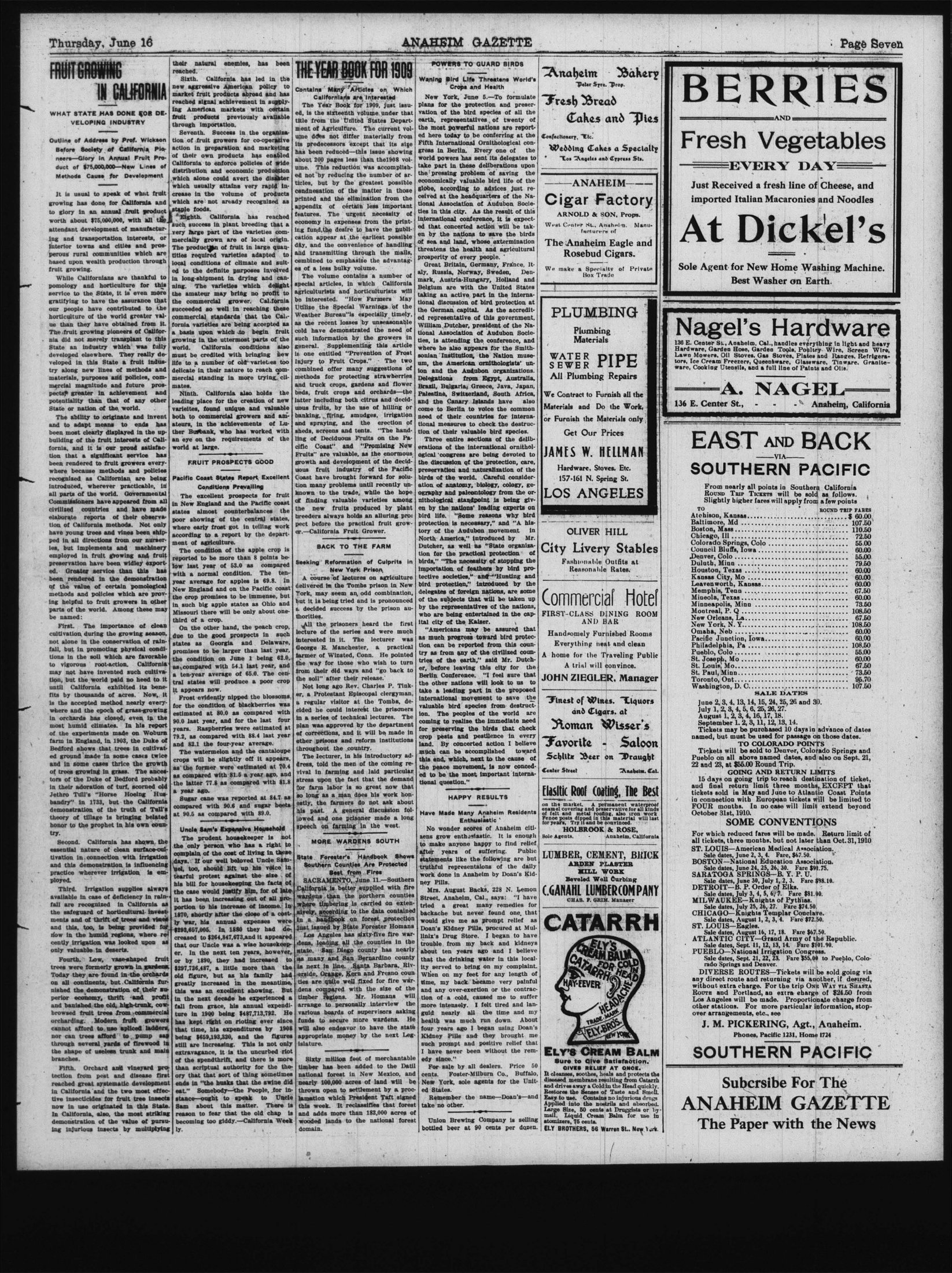
Searchable text
FRUIT GROWING IN CALIFORNIA
WHAT STATE HAS DONE FOR DEVELOPING INDUSTRY
Outline of Address by Prof. Wickson Before Society of California Pioneers—Glory in Annual Fruit Product of $75,000,000—New Lines of Methods Cause for Development
It is usual to speak of what fruit growing has done for California and to glory in an annual fruit product worth about $75,000,000, with all the attendant development of manufacturing and transportation interests, or interior towns and cities and prosperous rural communities which are based upon wealth production through fruit growing.
While Californians are thankful to pomology and horticulture for this service to the State, it is even more gratifying to have the assurance that our people have contributed to the horticulture of the world greater value than they have obtained from it. The fruit growing pioneers of California did not merely transplant to this State an industry which was fully developed elsewhere. They really developed in this State a fruit industry along new lines of methods and materials, purposes and policies, commercial magnitude and future prospects, greater in achievement and potentiality than that of any other State or nation of the world.
The ability to originate and invent and to adapt means to ends has been most clearly displayed in the upbuilding of the fruit interests of California, and it is our proud satisfaction that a significant service has been rendered to fruit growers everywhere because methods and policies their natural enemies, has been reached.
Sixth. California has led in the new aggressive American policy to market fruit products abroad and has reached signal achievement in supplying American markets with certain fruit products previously available through importation.
Seventh. Success in the organization of fruit growers for co-operative action in preparation and marketing of their own products has enabled California to enforce policies of wide distribution and economic production which alone could avert the disaster which usually attains very rapid increase in the volume of products which are not already recognized as staple foods.
Eighth. California has reached such success in plant breeding that a very large part of the varieties commercially grown are of local origin. The production of fruit in large quantities required varieties adapted to local conditions of climate and suited to the definite purposes involved in long-shipment in drying and canning. The varieties which delight the amateur may bring no profit to the commercial grower. California succeeded so well in reaching these commercial standards that the California varieties are being accepted as a basis upon which to begin fruit growing in the uttermost parts of the world. California conditions also must be credited with bringing new life to a number of old varieties too delicate in their nature to reach commercial standing in more trying climates.
Ninth. California also holds the leading place for the creation of new varieties, found unique and valuable both to commercial growers and amateurs, in the achievements of Luther Burbank, who has worked with an eye on the requirements of the world at large.
FRUIT PROSPECTS GOOD
The ability to originate and invent and to adapt means to ends has been most clearly displayed in the upbuilding of the fruit interests of California, and it is our proud satisfaction that a significant service has been rendered to fruit growers everywhere because methods and policies recognized as Californian are being introduced, wherever practicable, in all parts of the world. Governmental Commissioners have appeared from all civilized countries and have made elaborate reports of their observation of California methods. Not only have young trees and vines been shipped in all directions from our nurseries, but implements and machinery employed in fruit growing and fruit preservation have been widley exported. Greater service than this has been rendered in the demonstration of the value of certain pomological methods and policies which are proving helpful to fruit growers in other parts of the world. Among these may be named:
First. The importance of clean cultivation during the growing season, not alone in the conservation of rainfall, but in promoting physical conditions in the soil which are favorable to vigorous root-action. California may not have invented such cultivation, but the world paid no heed to it until California exhibited its benefits by thousands of acres. Now, it is the accepted method nearly everywhere and the epoch of grass-growing in orchards has closed, even in the most humid climates. In his report of the experiments made on Woburn farm in England, in 1903, the Duke of Bedford shows that trees in cultivated ground made in some cases twice and in some cases thrice the growth of trees growing in grass. The ancestors of the Duke of Bedford probably in their adoration of turf, scorned old Jethro Tull’s “Horse Hoeing Husbandry” in 1733, but the California demonstration of the truth of Tull’s theory of tillage is bringing belated honor to the prophet in his own country.
Second. California has shown the essential nature of clean surface-cultivation in connection with irrigation and this demonstration is influencing practice wherever irrigation is employed.
Third. Irrigation supplies always available in case of deficiency in rain-materials, purposes and policies, commercial magnitude and future prospects greater in achievement and potentiality than that of any other State or nation of the world.
FRUIT PROSPECTS GOOD
Pacific Coast States Report Excellent Conditions Prevailing
The excellent prospects for fruit in New England and the Pacific coast states almost counterbalances the poor showing of the central states, where early frost got in telling work according to a report by the department of agriculture.
The condition of the apple crop is reported to be more than 8 points below last year of 53.0 as compared with a normal condition. The ten-year average for apples is 69.8. In New England and on the Pacific coast the crop promises to be immense, but in such big apple states as Ohio and Missouri there will be only about one-third of a crop.
On the other hand, the peach crop, due to the good prospects in such states as Georgia and Delaware, promises to be larger than last year, the condition on June 1 being 62.0, as compared with 54.1 last year, and a ten-year average of 65.0. The central states will produce a poor crop it appears now.
Frost evidently nipped the blossoms, for the condition of blackberries was estimated at 80.0 as compared with 90.0 last year, and for the last four years. Raspberries were estimated at 79.2, as compared with 88.4 last year and 82.1 the four-year average.
The watermelon and the cantaloupe crops will be slightly off it appears, as the former were estimated at 70.4 as compared with 81.5 a year ago, and the latter 77.8 as compared with 81.8 a year ago.
Sugar cane was reported at 84.7 as compared with 90.6 and sugar beets at 90.5 as compared with 89.0.
Uncle Sam's Expensive Household
The prudent housekeeper is not the only person who has a right to complain of the cost of living in these days. If our well beloved Uncle Samuel, too, should lift up his voice in tearful protest against the size of his bill for housekeeping the facts of the case would justify him, for of late it has been increasing out of all pro-mercial standing in more trying climates.
Ninth. California also holds the leading place for the creation of new varieites, found unique and valuable both to commercial growers and amateurs, in the achievements of Luther Burbank, who has worked with an eye on the requirements of the world at large.
BACK TO SEEKING REFORMATION
A course of lecture delivered in the Topeka York, may seem arduous but it is being tried as a decided success thorities.
All the prisoners lecture of the series interested in it. George E. Manchester farmer of Winsted, the way for those from their old ways to the soil" after their release.
Not long ago Reverend a Protestant Epistle could be interdicted he could intec- in a series of techni- plan was approved for corrections, and other prisons and throughout the county.
The lecturer, in his dress, told the memorial in farming stress upon the fact for farm labor is so long as a man estly, the farmers his past. A general lowed and one pri- speech on farming.
MORE WARD
State Forester's Southern Counties
Best fro- SACRAMENTO
California is better wardens than the
bandry” in 1733, but the California demonstration of the truth of Tull’s theory of tillage is bringing belated honor to the prophet in his own country.
Second. California has shown the essential nature of clean surface cultivation in connection with irrigation and this demonstration is influencing practice wherever irrigation is employed.
Third. Irrigation supplies always available in case of deficiency in rainfall are recognized in California as the safeguard of horticultural investments and of thrift of trees and vines and this, too, is being provided for now in the humid regions, where recently irrigation was looked upon as only valuable in deserts.
Fourth. Low, vase-shaped fruit trees were formerly grown in gardens. Today they are found in the orchards on all continents, but California furnished the demonstration of their superior economy, thrift and profit and banished the old, high-trunk, cowbrowsed fruit trees from commercial orcharding. Modern fruit growers cannot afford to use spliced ladders, nor can trees afford to pump gas through several yards of firewood in the shape of useless trunk and main branches.
Fifth. Orchard and vineyard protection from pest and disease first reached great systematic development in California and the two most effective insecticides for fruit tree insects now in use originated in this State. In California, also, the most striking demonstration of the value of pursuing injurious insects by multiplying sugar cane was reported at 89.1 as compared with 90.6 and sugar beets at 90.5 as compared with 89.0.
Uncle Sam's Expensive Household
The prudent housekeeper is not the only person who has a right to complain of the cost of living in these days. If our well beloved Uncle Samuel, too, should lift up his voice in tearful protest against the size of his bill for housekeeping the facts of the case would justify him, for of late it has been increasing out of all proportion to his increase of income. In 1870, shortly after the close of a costly war, his annual expenses were $293,657,005. In 1880 they had decreased to $264,847,673,and it appeared that our Uncle was a wise housekeeper. In the next ten years, however, or by 1890, they had increased to $297,736,487,a little more than the old figure,but as his family had greatly increased in the meantime,this was an excellent showing. But in the next decade he experienced a fall from grace,his annual expenditure in 1900 being $487,713,792. He has kept right on rioting ever since that time,his expenditures by 1908 being $659,193,320,and the figures still are increasing. This is not only extravagance,it is the uncurbed riot of the spendthrift,and there is more than scriptual authority for the theory that that sort of thing sometimes ends in "the husks that the swine did eat." Somebody—the People,for instance—ought to speak to Uncle Sam about this matter. There is reason to fear that the old chap is becoming too giddy.-California Weekly.
THE YEAR BOOK FOR 1909
Contains Many Articles on Which Californians are Interested
The Year Book for 1909, just issued, is the sixteenth volume under that title from the United States Department of Agriculture. The current volume does not differ materially from its predecessors except that its size has been reduced—this issue showing about 200 pages less than the 1908 volume. This reduction was accomplished not by reducing the number of articles, but by the greatest possible condensation of the matter in those printed and the elimination from the appendix of certain less important features. The urgent necessity of economy in expenses from the printing fund, the desire to have the publication appear at the earliest possible day, and the convenience of handling and transmitting through the malls, combined to emphasize the advantages of a less bulky volume.
The volume contains a number of special articles, in which California agriculturists and horticulturists will be interested. "How Farmers May Utilize the Special Warnings of the Weather Bureau" is especially timely, as the recent losses by unseasonable cold have demonstrated the need of such information by the growers in general. Supplementing this article is one entitled "Prevention of Frost Injury to Fruit Crops." The two combined offer many suggestions of methods for protecting strawberries and truck crops, gardens and flower beds, fruit crops and orchards—the latter including both citrus and deciduous fruits, by the use of hilling or banking, firing, smudges, irrigation and spraying, and the erection of sheds, screens and tents. "The handling of Deciduous Fruits on the Pacific Coast" and "Promising New Fruits" are valuable, as the enormous growth and development of the deciduous fruit industry of the Pacific
POWERS TO GUARD BIRDS
Waning Bird Life Threatens World's Crops and Health
New York, June 5.—To formulate plans for the protection and preservation of the bird species of all the earth, representatives of twenty of the most powerful nations are reported here today to be conferring at the Fifth International Ornithological congress in Berlin. Every one of the world powers has sent its delegates to take part in these deliberations upon the pressing problem of saving the economically valuable bird life of the globe, according to advices just received at the headquarters of the National Association of Audubon Societies in this city. As the result of this international conference, it is expected that concerted action will be taken by the nations to save the birds of sea and land, whose extermination threatens the health and agricultural prosperity of every people.
Great Britain, Germany, France, Italy, Russia, Norway, Sweden, Denmark, Austria-Hungary, Holland and Belgium are with the United States taking an active part in the international discussion of bird protection at the German capital. As the accredited representative of this government, William Dutcher, president of the National Association of Audubon Societies, is attending the conference, and where he also appears for the Smithsonian Institution, the Nation museum, the American ornithologists' union and the Audubon organizations. Delegations from Egypt, Australia, Brasil, Bulgaria, Greece, Java, Japan, Palestine, Switzerland, South Africa, and the Canary Islands have also come to Berlin to voice the common need of their countries for international measures to check the destruction of their valuable bird species.
Three entire sections of the deliberations of the international ornithological congress are being devoted to the discussion of the protection, care, preservation and naturalization of the
methods for protecting strawberries and truck crops, gardens and flower beds, fruit crops and orchards—the latter including both citrus and deciduous fruits, by the use of hilling or banking, firing, smudges, irrigation and spraying, and the erection of sheds, screens and tents. "The handling of Deciduous Fruits on the Pacific Coast" and "Promising New Fruits" are valuable, as the enormous growth and development of the deciduous fruit industry of the Pacific Coast have brought forward for solution many problems until recently unknown to the trade, while the hope of finding valuable varieties among the new fruits produced by plant breeders always holds an alluring prospect before the practical fruit grower—California Fruit Grower.
BACK TO THE FARM
Seeking Reformation of Culprits in New York Prison
A course of lectures on agriculture delivered in the Tombs prison in New York, may seem an odd combination, but it is being tried and is pronounced a decided success by the prison authorities.
All the prisoners heard the first lecture of the series and were much interested in it. The lecturer was George E. Manchester, a practical farmer of Winsted, Conn. He pointed the way for those who wish to turn from their old ways and "go back to the soil" after their release.
Not long ago Rev. Charles P. Tinker, a Protestant Episcopal clergyman, a regular visitor at the Tombs, decided he could interest the prisoners in a series of technical lectures. The plan was approved by the department of corrections, and it will be made in other prisons and reform institutions throughout the country.
The lecturer, in his introductory address, told the men of the coming revival in farming and laid particular stress upon the fact that the demand for farm labor is so great now that so long as a man does his work honestly, the farmers do not ask about his past. A general discussion followed and one prisoner made a long speech on farming in the west.
MORE WARDENS SOUTH
State Forester's Handbook Shows Southern Counties Are Protected Best from Fires
SACRAMENTO, June 11.—Southern California is better supplied with fire wardens than the northern counties
Delegations from Egypt, Australia, Brazil, Bulgaria, Greece, Java, Japan, Palestine, Switzerland, South Africa, and the Canary Islands have also come to Berlin to voice the common need of their countries for international measures to check the destruction of their valuable bird species.
Three entire sections of the deliberations of the international ornithological congress are being devoted to the discussion of the protection, care, preservation and naturalization of the birds of the world. Careful consideration of anatomy, biology,cology, geography and paleontology from the ornithological standpoint is being given by the nations' leading experts on bird life. "Some reasons why bird protection is necessary," and "A history of the Audubon movement in North America," introduced by Mr. Dutcher, as well as "State organization for the practical protection of birds," "The necessity of stopping the importation of feathers by bird protective societies," and "Hunting and bird protection," introduced by the delegates of foreign nations, are some of the subjects that will be taken up by the representatives of the nations, who are being entertained in the capital city of the Kaiser.
"Americans may be assured that as much progress toward bird protection can be reported from this country as from any of the civilized countries of the earth," said Mr. Dutcher, before leaving this city for the Berlin Conference. "I feel sure that the other nations will look to us to take a leading part in the proposed international movement to save the valuable bird species from destruction. The peoples of the world are coming to realize the immediate need for preserving the birds that check crop pests and pestilence in every land. By concerted action I believe much can be accomplished toward this end, which next to the cause of the peace movement, is now conceded to be the most important international question."
HAPPY RESULTS
Have Made Many Anaheim Residents Enthusiastic
No wonder scores of Anaheim citizens grow enthusiastic. It is enough to make anyone happy to find relief after years of suffering. Public statements like the following are but truthful representations of the daily work done in Anaheim by Doan's Kidney Pills.
Mrs. August Backs, 228 N. Lemon Street, Anaheim, Cal., says: "I have
MORE WARDENS SOUTH
State Forester's Handbook Shows Southern Counties Are Protected Best from Fires
SACRAMENTO, June 11.—Southern California is better supplied with fire wardens than the northern counties where timbering is carried on extensively, according to the data contained in a handbook on forest protection just issued by State Forester Homans.
Los Angeles has sixty-five fire wardens, leading all the counties in the state. San Diego county has nearly as many and San Bernardino county is next in line. Santa Barbara, Riverside, Orange, Kern and Fresno counties are quite well fixed for fire wardens compared with the size of the timber regions. Mr. Homans will arrange to personally interview the various boards of supervisors asking funds to secure more wardens. He will also endeavor to have the state appropriate money by the next Legislature.
Sixty million feet of merchantable timber has been added to the Datal national forest in New Mexico, and nearly 100,000 acres of land will be thrown open to settlement by a proclamation which President Taft signed this week. It reclassifies that forest and adds more than 183,000 acres of wooded lands to the national forest domain.
Have Made Many Anaheim Residents Enthusiastic
No wonder scores of Anaheim citizens grow enthusiastic. It is enough to make anyone happy to find relief after years of suffering. Public statements like the following are but truthful representations of the daily work done in Anaheim by Doan’s Kidney Pills.
Mrs. August Backs, 228 N. Lemon Street, Anaheim, Cal., says: "I have tried a great many remedies for backache but never found one that would give me as prompt relief as Doan’s Kidney Pills, procured at Mullinix’s Drug Store. I began to have trouble from my back and kidneys about ten years ago and I believe that the drinking water in this locality served to bring on my complaint. When on my feet for any length of time, my back became very painful and any over-exertion or the contraction of a cold, caused me to suffer more intensely. I felt tired and languid nearly all the time and my health was much run down. About four years ago I began using Doan’s Kidney Pills and they brought me such prompt and positive relief that I have never been without the remedy since."
For sale by all dealers. Price 50 cents. Foster-Milburn Co., Buffalo, New York, sole agents for the United States.
Remember the name—Doan’s—and take no other.
Union Brewing Company is selling bottled beer at 90 cents per dozen.
BERRIES
AND
Fresh Vegetables
EVERY DAY
Just Received a fresh line of Cheese, and imported Italian Macaronies and Noodles
At Dickel's
Sole Agent for New Home Washing Machine.
Best Washer on Earth.
Nagel's Hardware
136 E. Center St., Anaheim, Cal., handles everything in light and heavy
Hardware, Garden Hose, Garden Tools, Poultry Wire, Screen Wire,
Lawn Mowers, Oil Stoves, Gas Stoves, Plates and Ranges, Refrigerators,
Ice Cream Freezers, Queensware, Glassware, Tinware, Graniteware, Cooking Utensils, and a full line of Paints and Oils.
A. NAGEL
136 E. Center St., - - Anaheim, California
EAST AND BACK
VIA
SOUTHERN PACIFIC
EAST AND BACK
VIA
SOUTHERN PACIFIC
From nearly all points in Southern California
ROUND TRIP TICKETS will be sold as follows.
Slightly higher fares will apply from a few points
TO ROUND TRIP FARES
Atchison, Kansas $60.00
Baltimore, Md 107.50
Boston, Mass 110.50
Chicago, Ill 72.50
Colorado Springs, Colo 55.00
Council Bluffs, Iowa 60.00
Denver, Colo 55.00
Duluth, Minn 79.50
Houston, Texas 60.00
Kansas City, Mo 60.00
Leavenworth, Kansas 60.00
Memphis, Tenn 67.50
Mineola, Texas 60.00
Minneapolis, Minn 73.50
Montreal, P.Q 108.50
New Orleans, La 67.50
New York, N.Y. 108.50
Omaha, Neb 60.00
Pacific Junction, Iowa 60.00
Philadelphia, Pa 108.50
Pueblo, Colo 55.00
St. Joseph, Mo 60.00
St. Louis, Mo 67.50
St. Paul, Minn 73.50
Toronto, Ont 95.70
Washington, D.C. 107.50
SALE DATES
June 2, 3, 4, 13, 14, 15, 24, 25, 26 and 30.
July 1, 2, 3, 4, 5, 6, 25, 26, 27.
August 1, 2, 3, 4, 16, 17, 18.
September 1, 2, 3, 11, 12, 13, 14.
Tickets may be purchased 10 days in advance of dates named but must be used for passage on those dates.
TO COLORADO POINTS
Tickets will be sold to Denver, Colorado Springs and Pueblo on all above named dates, and also on Sept. 21,
22 and 23, at $55.00 Round Trip.
GOING AND RETURN LIMITS
15 days on going trip to reach destination of ticket,
and final return limit three months. EXCEPT that tickets sold in May and June to Atlantic Coast Points in connection with European tickets will be limited to FOUR months. In no case will limit extend beyond October 31st, 1910.
SOME CONVENTIONS
For which reduced fares will be made. Return limit of all tickets, three months. but not later than Oct.31,1910
ST. LOUIS—American Medical Association.
Sale dates, June 2, 3, 4. Fare,$67.50.
BOSTON—National Education Association.
Sale dates, June 24, 25, 26, 30. Fare$94.75.
SARATOGA SPRINGS—B.Y.P.U.
Sale dates, June 30, July 1, 2, 3. Fare$98.10.
DETROIT—B.P.Order of Elks.
Sale dates, July 3, 4, 5, 67.7. Fare$81.00.
SOME CONVENTIONS
For which reduced fares will be made. Return limit of all tickets, three months, but not later than Oct. 31, 1910
ST. LOUIS—American Medical Association.
Sale dates, June 2, 3, 4. Fare, $67.50.
BOSTON—National Education Association.
Sale dates, June 24, 25, 26, 30. Fare $91.75.
SARATOGA SPRINGS—B. Y. P. U.
Sale dates, June 30, July 1, 2, 3. Fare $98.10.
DETROIT—B. P. Order of Elks.
Sale dates, July 3, 4, 5, 6, 7. Fare $81.00.
MILWAUKEE—Knights of Pythias.
Sale dates, July 25, 26, 27. Fare $74.50.
CHICAGO—Knights Templar Conclave.
Sale dates, August 1, 2, 3, 4. Fare $72.50.
ST. LOUIS—Eagles.
Sale dates, August 16, 17, 18. Fare $67.50.
ATLANTIC CITY—Grand Army of the Republic.
Sale dates, Sept. 11, 12, 13, 14. Fare $101.90.
PUEBLO—National Irrigation Congress.
Sale dates, Sept. 21, 22, 23. Fare $55.00 to Pueblo, Colorado Springs and Denver.
DIVERSE ROUTES—Tickets will be sold going via any direct route and returning via another, if desired, without extra charge. For the trip ONE WAY via SHASTA Route and Portland, an extra charge of $24.50 from Los Angeles will be made. Proportionate charge from other stations. For more particular information, stop-over arrangements, etc., see
J. M. PICKERING, Agt., Anaheim.
Phones, Pacific 1231, Home 1724
SOUTHERN PACIFIC
Subcrsibe For The ANAHEIM GAZETTE
The Paper with the News