anaheim-gazette 1910-06-02
Scanned page
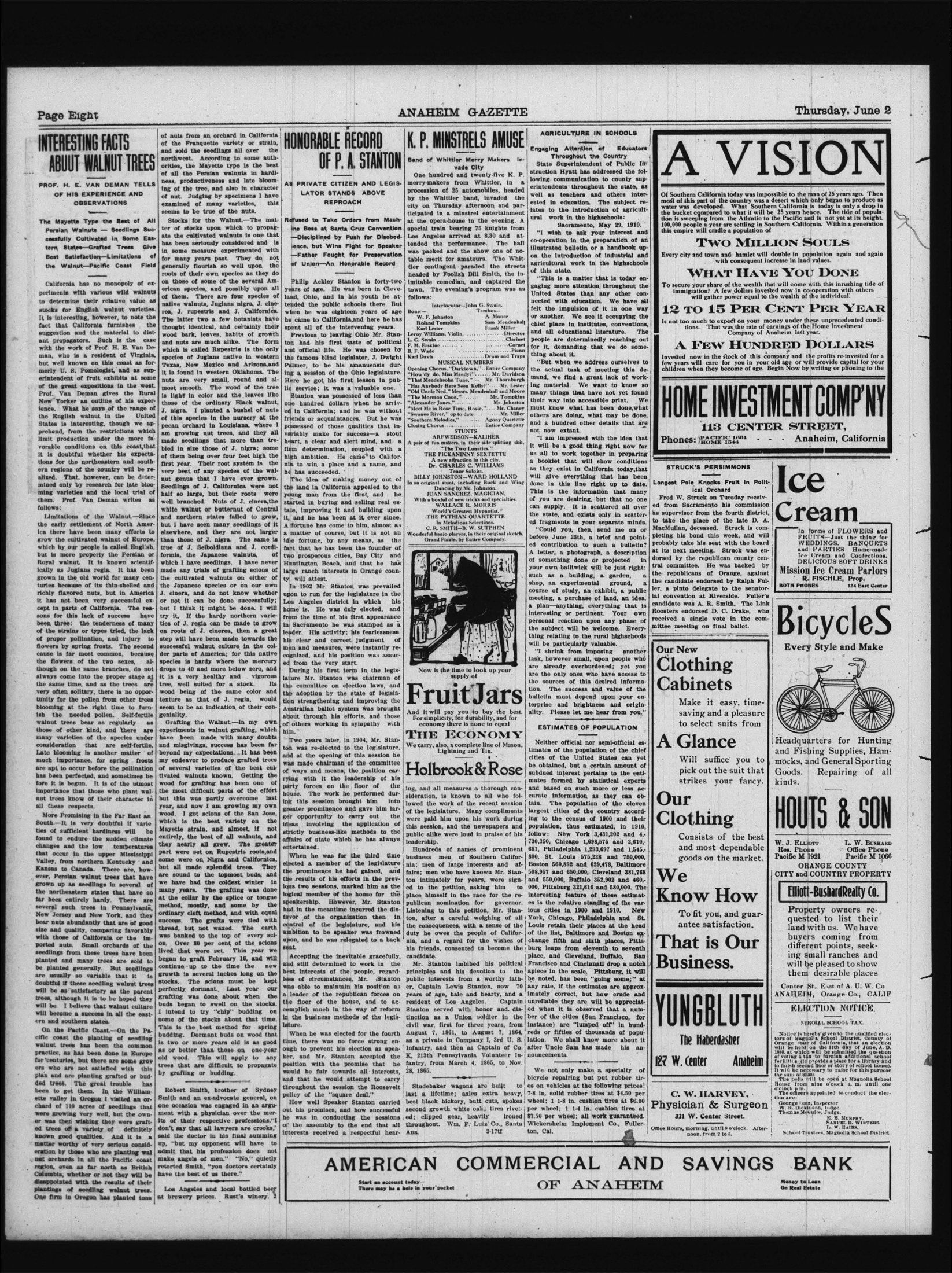
Searchable text
INTERESTING FACTS ABUUT WALNUT TREES
PROF. H. E. VAN DEMAN TELLS OF HIS EXPERIENCE AND OBSERVATIONS
The Mayette Type the Best of All Persian Walnuts — Seedlings Successfully Cultivated in Some Eastern States—Grafted Trees Give Best Satisfaction—Limitations of the Walnut—Pacific Coast Field
California has no monopoly of experiments with various wild walnuts to determine their relative value as stocks for English walnut varieties. It is interesting, however, to note the fact that California furnishes the suggestion and the material to distant propagators. Such is the case with the work of Prof. H. E. Van Deman, who is a resident of Virginia, but well known on this coast as formerly U. S. Pomologist, and as superintendent of fruit exhibits at some of the great expositions in the west. Prof. Van Deman gives the Rural New Yorker an outline of his experience. What he says of the range of the English walnut in the United States is interesting, though we prehend, from the restrictions which limit production under the more favorable conditions on this coast, that it is doubtful whether his expectations for the northeastern and southern regions of the country will be relied upon from an orchard in California of the Franquette variety or strain, and sold the seedlings all over the northwest. According to some authorities, the Mayette type is the best of all the Persian walnuts in hardiness, productiveness and late blooming of the tree, and also in character of nut. Judging by specimens I have examined of many varieties, this seems to be true of the nuts.
Stocks for the Walnut. The matter of stocks upon which to propagate the cultivated walnuts is one that has been seriously considered and is in some measure experimented with for many years past. They do not generally flourish so well upon the roots of their own species as they do on those of some of the several American species, and possibly upon all of them. There are four species of native walnuts, Juglans nigra, J. cinerea, J. rupestris and J. Californica. The latter two a few botanists have thought identical, and certainly their wood bark, leaves, habits of growth and nuts are much alike. The form which is called Rupestris is the only species of Juglans native in western Texas, New Mexico and Arizona, and it is found in western Oklahoma. The nuts are very small, round and almost smooth. The wood of the tree is light in color and the leaves like those of the ordinary Black walnut, J. nigra. I planted a bushel of nuts of this species in the nursery at the pecan orchard in Louisiana, where I am growing nut trees, and they all made seedlings that more than trebled in size those of J. nigra; some of them being over four feet high the first year. Their root system is the very best of any species of the wal-
HONORABLE RECEIVED OF P. A.
AS PRIVATE CITIZEN LATOR STANDS REPROACH
Refused to Take Order fine Boss at Santa Clara—Disciplined by Presidence, but Wins Fight—Father Fought for Union—An Honorable Receiving
Philip Ackley Stanton years of age. He was land, Ohio, and in his tended the public school when he was eighteen he came to California, spent all of the interview.
Previous to leaving ton had his first task and official life. He was the famous blind legislator Palmer, to be his aning a session of the O'Reilly Here he got his first service; it was a Stanton was possessed one hundred dollars wived in California; and his friends or acquaintance possessed of those quariably make for such heart, a clear and alert firm determination, coe high ambition. He cannia to win a place and he has succeeded.
Limitations of the Walnut—Since the early settlement of North America there have been many efforts to grow the cultivated walnut of Europe, which by our people is called English, but is more properly the Persian or Royal walnut. It is known scientifically as Juglans regia. It has been grown in the old world for many centuries because of its thin-shelled and richly flavored nuts, but in America it has not been very successful except in parts of California. The reasons for this lack of success have been three: the tenderness of many of the strains or types tried, the lack of proper pollination, and injury to flowers by spring frosts. The second cause is far most common, because the flowers of the two sexes, although on the same branches, do not always come into the proper stage at the same time, and as the trees are very often solitary, there is no opportunity for the pollen from other trees blooming at the right time to furnish the needed pollen. Self-fertile walnut trees bear as regularly as those of other kind, and there are many varieties of the species under consideration that are self-fertile. Late blooming is another matter of much importance, for spring frosts are apt to occur before the pollination has been perfected, and sometimes be fore it is begun. It is of the utmost importance that those who plant walnut trees know of their character in all these respects.
More Promising in the Far East an South.—It is very doubtful if varieties of sufficient hardiness will be found to endure the sudden climate changes and the low temperatures that occur in the upper Mississippi Valley, from northern Kentucky and Kansas to Canada. There are, however, Persian walnut trees that have grown up as seedlings in several of the northeastern states that have so far been entirely hardy. These nuts are very small, round and almost smooth. The wood of the tree is light in color and the leaves like those of the ordinary Black walnut, J. nigra. I planted a bushel of nuts of this species in the nursery at the pecan orchard in Louisiana, where I am growing nut trees, and they all made seedlings that more than trebled in size those of J. nigra; some of them being over four feet high the first year. Their root system is the very best of any species of the walnut genus that I have ever grown. Seedlings of J. Californica were not half so large, but their roots were well branched. Nuts of J. cinera,the white walnut or butternut of Central and northern states failed to grow, but I have seen many seedlings of it elsewhere, and they are not larger than those of J. nigra. The same is true of J. Selboldiana and J. cordiformis, the Japanese walnuts, of which I have seedlings. I have never made any trials of grafting scions of the cultivated walnuts on either of the Japanese species or on our own J. cinera, and do not know whether or not it can be done successfully; but I think it might be done. I will try it. If the hardy northern varieties of J. regia can be made to grow on roots of J. cinerea, then a great step will have been made towards the successful walnut culture in the colder parts of America; for this native species is hardy where the mercury drops to 40 and more below zero, and it is a very healthy and vigorous tree, well suited for a stock. Its wood being of the same color and texture as that of J. regia, would seem to be an indication of their congeniality.
Grafting the Walnut.—In my own experiments in walnut grafting, which have been made with many doubts and misgivings, success has been far beyond my expectations. It has been my endeavor to produce grafted trees of several varieties of the best cultivated walnuts known. Getting the wood for grafting has been one of the most difficult parts of the effort but this was partly overcome last year, and now I am growing my own wood. I got scions of the San Jose, which is the best variety on the Mayette strain, and almost, if not entirely, the best of all walnuts, and they nearly all grew. The greater part were set on Rupestris roots,and some were on Nigra and California, but all made splendid trees. They are sound to the topmost buds, and we have had the coldest winter in many years. The grafting was done at the collar by the splice or tongue nuts are very small, round and almost smooth. The wood of the tree is light in color and the leaves like those of the ordinary Black walnut, J. nigra. I planted a bushel of nuts of this species in the nursery at the pecan orchard in Louisiana, where I am growing nut trees, and they all made seedlings that more than trebled in size those of J. nigra; some of them being over four feet high the first year. Their root system is the very best of any species of the walnut genus that I have ever grown. Seedlings of J. Californica were not half so large, but their roots were well branched. Nuts of J. cinera,the white walnut or butternut of Central and northern states failed to grow, but I have seen many seedlings of it elsewhere, and they are not larger than those of J. nigra. The same is true of J. Selboldiana and J. cordiformis, the Japanese walnuts, of which I have seedlings. I have never made any trials of grafting scions of the cultivated walnuts on either of the Japanese species or on our own J. cinera, and do not know whether or not it can be done successfully; but I think it might be done. I will try it. If the hardy northern varieties of J. regia can be made to grow on roots of J. cinerea, then a great step will have been made towards the successful walnut culture in the colder parts of America; for this native species is hardy where the mercury drops to 40 and more below zero, and it is a very healthy and vigorous tree, well suited for a stock. Its wood being of the same color and texture as that of J. regia, would seem to be an indication of their congeniality.
Grafting the Walnut.—In my own experiments in walnut grafting, which have been made with many doubts and misgivings, success has been far beyond my expectations. It has been my endeavor to produce grafted trees of several varieties of the best cultivated walnuts known. Getting the wood for grafting has been one of the most difficult parts of the effort but this was partly overcome last year, and now I am growing my own wood. I got scions of the San Jose, which is the best variety on the Mayette strain, and almost, if not entirely, the best of all walnuts, and they nearly all grew. The greater part were set on Rupestris roots,and some were on Nigra and California, but all made splendid trees. They are sound to the topmost buds, and we have had the coldest winter in many years. The grafting was done at the collar by the splice or tongue nuts are very small, round and almost smooth. The wood of the tree is light in color and the leaves like those of the ordinary Black walnut, J. nigra. I planted a bushel of nuts of this species in the nursery at the pecan orchard in Louisiana, where I am growing nut trees, and they all made seedlings that more than trebled in size those of J. nigra; some of them being over four feet high the first year. Their root system is the very best of any species of the walnut genus that I have ever grown. Seedlings of J. Californica were not半 so large,but their roots were well branched.NutsofJ.cinera,thewhitewalnutorbutternutofCentralandnorthernstatesfailedtogrowbutIhaveseenmanyseedlingsofitelsewhere,andtheyarenotlargerthantheseofJ.nigra;someofthembeingoverfourfeethighthefirstyear.TheirrootsystemistheverybestofanyspeciesofthewalntgenusthatIhaveevergrown.SeedlingsofJ.Californicawerenot半solarge,bbuttheirrootswerewellbranched.NutsofJ.cinera,thewhitewalnutorbutternutofCentralandnorthernstatesfailedtogrowbutIhaveseenmanyseedlingsofitelsewhere,andtheyarenotlargerthantheseofJ.nigra;someofthembeingoverfourfeethighthefirstyear.TheirrootsystemistheverybestofanyspeciesofthewalntgenusthatIhaveevergrown.SeedlingsofJ.Californicawerenot半solarge,bbuttheirrootswerewellbranched.NutsofJ.cinera,thewhitewalnutorbutternutofCentralandnorthernstatesfailedtogrowbutIhaveseenmanyseedlingsofitelsewhere,andtheyarenotlargerthantheseofJ.nigra;someofthembeingoverfourfeethighthefirstyear.TheirrootsystemistheverybestofanyspeciesofthewalntgenusthatIhaveevergrown.SeedlingsofJ.Californicawerenot半solarge,bbuttheirrootswerewellbranched.NutsofJ.cinera,thewhitewalnutorbutternutofCentralandnorthernstatesfailedtogrowbutIhaveseenmanyseedlingsofitelsewhere,andtheyarenotlargerthantheseofJ.nigra;someofthembeingoverfourfeethighthefirstyear.TheirrootsystemistheverybestofanyspeciesofthewalntgenusthatIhaveevergrown.SeedlingsofJ.Californicawerenot半solarge,bbuttheirrootswerewellbranched.NutsofJ.cinera,thewhitewalnutorbutternutofCentralandnorthernstatesfailedtogrowbutIhaveseenmanyseedlingsofitelsewhere,andtheyarenotlargerthantheseofJ.nigra;someofthembeingoverfourfeethighthefirstyear.TheirrootsystemistheverybestofanyspeciesofthewalntgenusthatIhaveevergrown.SeedlingsofJ.Californicawerenot半solarge,bbuttheirrootswerewellbranched.NutsOfJ.cinera,thewhitewalnutorbutternutofCentralandnorthernstatesfailedtogrowbutIhaveseenmanyseedlingsofitelsewhere,andtheyarenotlargerthantheseofJ.nigra;someofthembeingoverfourfeethighthefirstyear.Theirroot系统是theverybestofanyspeciesofthewalntgenusthatIhaveevergrown.SeedlingsofJ.Californicawerenot半solarge,bbuttheirrootswerewellbranched.NutsOfJ.cinera,the白色walnutorbutternutofCentralandnorthernstatesfailedtogrowbutIhaveseenmanyseedlingsofitelsewhere,andtheyarenotlargerthantheseofJ.nigra;someofthembeingoverfourfeethighthefirstyear.Theirroot系统是theverybestofanyspeciesofthewalntgenusthatIhaveevergrown.SeedlingsofJ.Californicawerenot半solarge,bbuttheirrootswerewellbranched.NutsOfJ.cinera,the白色walnutorbutternutofCentralandnorthernstatesfailedtogrowbutIhaveseenmanyseedlingsofitelsewhere,andtheyarenotlargerthantheseofJ.nigra;someofthembeingoverfourfeethighthefirstyear.Theirroot系统是theverybestofanyspeciesofthewalntgenusthatIhaveevergrown.SeedlingsofJ.Californicawerenot半solarge,bbuttheirrootswerewellbranched.NutsOfJ.cinera,the白色walnutorbutternutofCentralandnorthernstatesfailedtogrowbutIhaveseenmanyseedlingsofitelsewhere,andtheyarenotlargerthantheseofJ.nigra;someofthembeingoverfourfeethighthefirstyear.Theirroot系统是theverybestofanyspeciesofthewalntgenusthatIhaveevergrown.SeedlingsofJ.Californicawerenot半solarge,bbuttheirrootswerewellbranched.NutsOfJ.cinera,the白色walnutorbutternut.ofCentralandnorthernstatesfailedtogrowbutIhaveseenmanyseedlings-ofitelsewhere,andtheyarenotlargerthantheseofJ.nigra;someofthembeingoverfourfeethighthefirstyear.Theirroot系统是theverybestofanyspeciesofthewalntgenusthatIhaveevergrown.Seedlings Of J.Californicawere not半so large,bbuttheirrootswerewellbranched.NutsOfJ.cinera,the白色walnutorbutternut.ofCentralandnorthernstatesfailedtogrowbutIhaveseenmanyseedlings-ofitelsewhere,andtheyarenotlargerthantheseofJ.nigra;someofthembeingoverfourfeethighthefirstyear.Theirroot系统是theverybestofanyspeciesOfTheWalnut Width: 120mm Height: 80mm Depth: 30mm Thickness: 5mm Color: White Texture: Hardwood Grain Type: Semi-Hardwood Nut Type: Sweet Nut Size: Small Nut Weight: 100-150 grams Nut Purity: High Nut Quality: Medium Nut Quality: Low Nut Quality: Dried Nut Quality: Fresh Nut Quality: Moist Nut Quality: Dry Nut Quality: Salt Nut Quality: Peanut Nut Quality: Cashew Nut Quality: Cherry Nut Quality: Pear Nut Quality: Apple Nut Quality: Plum Nut Quality: Pear Nut Quality: Grape Nut Quality: Cherry Nut Quality: Pear Nut Quality: Peanut Nut Quality: Cashew Nut Quality: Cherry Nut Quality: Pear Nut Quality: Grape Nut Quality: Cherry Nut Quality: Pear Nut Quality: Peanut Nut Quality: Cashew Nut Quality: Cherry Nut Quality: Pear Nut Quality: Grape Nut Quality: Cherry Nut Quality: Pear Nut Quality: Peanut Nut Quality: Cashew NutQuality: Cherry Nut Quality: Pear Nut Quality: Grape Nut Quality: Cherry Nut Quality: Pear Nur
More Promising in the Far East and South.—It is very doubtful if varieties of sufficient hardiness will be found to endure the sudden climate changes and the low temperatures that occur in the upper Mississippi Valley, from northern Kentucky and Kansas to Canada. There are, however, Persian walnut trees that have grown up as seedlings in several of the northeastern states that have so far been entirely hardy. There are several such trees in Pennsylvania, New Jersey and New York, and they bear nuts abundantly that are of good size and quality, comparing favorably with those of California or the imported nuts. Small orchards of the seedlings from these trees have been planted and many trees are sold to be planted generally. But seedlings are usually so variable that it is doubtful if these seedling walnut trees will be as satisfactory as the parent trees, although it is to be hoped they will be. I believe that walnut culture will become a success in all the eastern and southern states.
On the Pacific Coast.—On the Pacific coast the planting of seedling walnut trees has been the common practice, as has been done in Europe for centuries, but there are some growers who are not satisfied with this plan and are planting grafted or budded trees. The great trouble has been to get them. In the Williamette valley in Oregon I visited an orchard of 110 acres of seedlings that were growing very well, but the owner was then wishing they were grafted trees of a variety of definitely known good qualities. And it is a matter worthy of very serious consideration by those who are planting walnut orchards in all the Pacific coast region, even as far north as British Columbia, whether or not they will be disappointed with the results of their plantings of seedling walnut trees. One firm in Oregon has planted tons but this was partly overcome last year, and now I am growing my own wood. I got scions of the San Jose, which is the best variety on the Mayette strain, and almost, if not entirely, the best of all walnuts, and they nearly all grew. The greater part were set on Rupestris roots, and some were on Nigra and Californica, but all made splendid trees. They are sound to the topmost buds, and we have had the coldest winter in many years. The grafting was done at the collar by the splice or tongue method, mostly, and some by the ordinary cleft method, and with equal success. The grafts were tied with thread, but not waxed. The earth was banked to the top of every soil. Over 80 per cent of the scions lived that were set. This year we began to graft February 16, and will continue up to the time the new growth is several inches long on the stocks. The scions must be kept perfectly dormant. Last year our grafting was done about when the buds began to swell on the stocks. I intend to try "chip" budding on some of the stocks about that time. This is the best method for spring budding. Dormant buds on wood that is two or more years old is as good as or better than those on one-year old wood. This will apply to any trees that are difficult to propagate by grafting or budding.
Robert Smith, brother of Sydney Smith and an ex-advocate general, on one occasion was engaged in an argument with a physician over the merits of their respective professions." I don't say that all lawyers are crooks," said the doctor in his final summing up, "but my opponent will have to admit that his profession does not make angels of men." "No," quietly retorted Smith, "you doctors certainly have the best of us there."
Los Angeles and local bottled beer at brewery prices. Rust's winery.
HONORABLE RECORD OF P. A. STANTON
AS PRIVATE CITIZEN AND LEGISLATOR STANDS ABOVE REPROACH
Refused to Take Orders from Machine Boss at Santa Cruz Convention—Disciplined by Push for Disobedience, but Wins Fight for Speaker—Father Fought for Preservation of Union—An Honorable Record
Philip Ackley Stanton is forty-two years of age. He was born in Cleveland, Ohio, and in his youth he attended the public schools there. But when he was eighteen years of age he came to California, and here he has spent all of the intervening years.
Previous to leaving Ohio Mr. Stanton had his first taste of political and official life. He was chosen by the famous blind legislator, J. Dwight Palmer, to be his amanuensis during a session of the Ohio legislature. Here he got his first lesson in public service; it was a valuable one.
Stanton was possessed of less than one hundred dollars when he arrived in California; and he was without friends or acquaintances. But he was possessed of those qualities that invariably make for success—a stout heart, a clear and alert mind, and a firm determination, coupled with a high ambition. He came to California to win a place and a name, and he has succeeded.
K. P. MINSTRELS AMUSE
Band of Whittier Merry Makers Invade City
One hundred and twenty-five K. P. merry-makers from Whittier, in a procession of 25 automobiles, headed by the Whittier band, invaded the city on Thursday afternoon and participated in a minstrel entertainment at the opera-house in the evening. A special train bearing 75 knights from Los Angeles arrived at 8:30 and attended the performance. The hall was packed and the show one of notable merit for amateurs. The Whittier contingent paraded the streets headed by Foolish Bill Smith, the imitable comedian, and captured the town. The evening's program was as follows:
Interlocutor—John G. Swain,
Boner—Tambos—
W. F. Johnston A. Moore
Roland Tompkins Sam Mendenhall
Karl Lester Frank Miller
Leroy Williams, Violin Director
L. C. Swain Clarinet
F. M. Erskine Cornet
B. F. Wade Piano
Karl Davis Drum and Traps
MUSICAL NUMBERS
Opening Chorus,"Darktown," Entire Company
"How'dy do, Miss Mandy?" Mr. Davidson
"That Mendelsohn Tune," Mr. Thornburgh
"Has Anybody Here Seen Kelly?" Mr. Lester
"Old Uncle Ned," Messrs. Mendenhall and Moore
"The Mormon Coon," Mr. Tompkins
"Alexander Jones," Mr. Johnston
"Meet Me in Rose Time, Rosie," Mr. Chaney
"Swanee River," up to date Mr. Miller
"Southern Melodies," Agony Quartette
Closing Chorus Entire Company
STUNTS
ARFWEDSON—KALIHER
A pair of fun makers, in their side-splitting skit,
"The Two Lunatics."
THE PICKANINNY SEXTETTE
A new attraction in this city.
Dr. CHARLES C. WILLIAMS
Tenor Soloist.
AGRICULTURE IN SCHOOLS
Engaging Attention of Educators Throughout the Country
State Superintendent of Public Instruction Hyatt has addressed the following communication to county superintendents throughout the state, as well as teachers and others interested in education. The subject relates to the introduction of agricultural work in the highschools:
Sacramento, May 29, 1910.
"I wish to ask your interest and co-operation in the preparation of an illustrated bulletin or a handbook upon the introduction of industrial and agricultural work in the highschools of this state.
“This is a matter that is today engaging more attention throughout the United States than any other connected with education. We have all felt the impulsion of it in one way or another. We see it occupying the chief place in institutes, conventions, and all educational literature. The people are determinedly reaching out for it, demanding that we do something about it.
“But when we address ourselves to the actual task of meeting this demand, we find a great lack of working material. We want to know so many things that have not yet found their way into accessible print. We must know what has been done, what others are doing, what may be done, and a hundred other details that are not now extant."
"I am impressed with the idea that it will be a good thing right now for us all to work together in preparing a booklet that will show conditions as they exist in California today, that
Here he got his first lesson in public service; it was a valuable one.
Stanton was possessed of less than one hundred dollars when he arrived in California; and he was without friends or acquaintances. But he was possessed of those qualities that invariably make for success—a stout heart, a clear and alert mind, and a firm determination, coupled with a high ambition. He came to California to win a place and a name, and he has succeeded.
The idea of making money out of the land in California appealed to the young man from the first, and he started in buying and selling real estate, improving it and building upon it, and he has been at it ever since. A fortune has come to him, almost as a matter of course, but it is not an idle fortune, by any means, as the fact that he has been the founder of two prosperous cities, Bay City and Huntington Beach, and that he has large ranch interests in Orange county will attest.
In 1902 Mr. Stanton was prevailed upon to run for the legislature in the Los Angeles district in which his home is. He was duly elected, and from the time of his first appearance in Sacramento he was stamped as a leader. His activity; his fearlessness his clear and correct judgment of men and measures, were instantly recognized, and his position was assured from the very start.
During his first term in the legislature Mr. Stanton was chairman of the committee on election laws, and the adoption by the state of legislation strengthening and improving the Australian ballot system was brought about through his efforts, and those of others working in sympathy with him.
Two years later, in 1904, Mr. Stanton was re-elected to the legislature, and at the opening of this session he was made chairman of the committee of ways and means, the position carrying with it the leadership of his party forces on the floor of the house. The work he performed during this session brought him into greater prominence and gave him larger opportunity to carry out the ideas involving the application of strictly business-like methods to the affairs of state which he has always entertained.
When he was for the third time elected a member of the legislature the prominence he had gained, and the results of his efforts in the previous two sessions, marked him as the logical member of the house for the
Now is the time to look up your supply of Fruit Jars
And it will pay you to buy the best. For simplicity, for durability, and for economy there is none to equal THE ECONOMY
We carry, also, a complete line of Mason, Lightning and Tin.
Holbrook & Rose
ing, and all measures a thorough consideration, is known to all who followed the work of the recent session of the legislature. Many compliments were paid him upon his work during this session, and the newspapers and public alike were loud in praise of his leadership.
Hundreds of names of prominent business men of Southern California; men of large interests and affairs; men who have known Mr. Stanton intimately for years, were signed to the petition asking him to place himself in the race for the mand, we find a great lack of working material. We want to know so many things that have not yet found their way into accessible print. We must know what has been done, what others are doing, what may be done, and a hundred other details that are not now extant.
"I am impressed with the idea that it will be a good thing right now for us all to work together in preparing a booklet that will show conditions as they exist in California today, that will give everything that has been done in this line right up to date. This is the information that many of you are desiring, but that no one can supply. It is scattered all over the state, and exists only in scattered fragments in your separate minds."
"Could you then, send me on or before June 25th, a brief and pointed contribution to such a bulletin? A letter, a photograph, a description of something done or projected in your own bailiwick will be just right: such as a building, a garden, a shop, an experimental ground, a course of study, an exhibit, a public meeting, a purchase of land, an idea, a plan—anything, everything that is interesting or pertinent. Your own personal reaction upon any phase of the subject will be welcome. Everything relating to the rural highschools will be particularly valuable.
"I shrink from imposing another task, however small, upon people who are already overburdened; yet you are the only ones who have access to the sources of this desired information. The success and value of the bulletin must depend upon your enterprise and brightness and originality. Please let me hear from you."
ing this session brought him into greater prominence and gave him larger opportunity to carry out the ideas involving the application of strictly business-like methods to the affairs of state which he has always entertained.
When he was for the third time elected a member of the legislature the prominence he had gained, and the results of his efforts in the previous two sessions, marked him as the logical member of the house for the speakership. However, Mr. Stanton had in the meantime incurred the disfavor of the organization then in control of the legislature, and his ambition to be speaker was frowned upon, and he was relegated to a back seat.
Accepting the inevitable gracefully, and still determined to work in the best interests of the people, regardless of circumstances, Mr. Stanton was able to maintain his position as a leader of the republican forces on the floor of the house, and to accomplish much in the way of reform in the business methods of the legislature.
When he was elected for the fourth time, there was no force strong enough to prevent his election as speaker, and Mr. Stanton accepted the position with the promise that he would be fair towards all interests, and that he would attempt to carry throughout the session the Roosevelt policy of the "square deal."
How well Speaker Stanton carried out his promises, and how successful he was in conducting the sessions of the assembly to the end that all interests received a respectful hear-
lowed the work of the recent session of the legislature. Many compliments were paid him upon his work during this session, and the newspapers and public alike were loud in praise of his leadership.
Hundreds of names of prominent business men of Southern California; men of large interests and affairs; men who have known Mr. Stanton intimately for years, were signed to the petition asking him to place himself in the race for the republican nomination for governor. Listening to this petition, Mr. Stanton, after a careful weighing of all the consequences, with a sense of duty he owes the people of California, and a regard for the wishes of his friends, consented to become the candidate.
Mr. Stanton imbibed his political principles and his devotion to the public interests from a worthy father, Captain Lewis Stanton, now 70 years of age, hale and hearty, and a resident of Los Angeles. Captain Stanton served with honor and distinction as a Union soldier in the civil war, first for three years, from August 7, 1861, to August 7, 1864, as a private in Company I, 3rd U.S. Infantry, and then as Captain of Co.K, 213th Pennsylvania Volunteer Infantry, from March 4, 1865, to Nov. 28, 1865.
Studebaker wagons are built to last a lifetime; axles extra heavy, best black hickory, butt cuts, spokes second growth white oak; tires riveted; clipped gear, heavily ironed throughout. Wm. F. Lutz Co., Santa Ana.
3-17tf
The population of the eleven largest cities of the country according to the census of 1900 and their population, thus estimated, in 1910, follow: New York 3,431,202 and 4,-730,350, Chicago 1,698,575 and 2,610,-681, Philadelphia 1,293,697 and 1,545,-800, St. Louis 575,238 and 750,000, Boston 560,892 and 629,478, Baltimore 508,957 and 650,000, Cleveland 381,768 and 550,000, Buffalo 352,902 and 460,-000, Pittsburg 321,616 and 580,000. The interesting feature of these estimates is the relative standing of the various cities in 1900 and 1910. New York, Chicago, Philadelphia and St. Louis retain their places at the head of the list, Baltimore and Boston exchange fifth and sixth places, Pittsburg leaps from eleventh to seventh place, and Cleveland, Buffalo, San Francisco and Cincinnati drop a notch apiece in the scale. Pittsburg, it will be noted, has been "going some;" at any rate, if the estimates are approximately correct, but how crude and unreliable they are will be appreciated when it is observed that a number of the cities (San Francisco, for instance) are "lumped off" in hundreds or fiftyes of thousands of population. We shall know more about it after Uncle Sam has made his announcements.
We not only make a specialty of bicycle repairing but put rubber tires on vehicles at the following prices: 7-8 in. solid rubber tires at $4.50 per wheel; 1 1-8 in. cushion tires at $6.00 per wheel; 1 1-4 in. cushion tires at $7.50 per wheel; all work guaranteed. Wickersheim Implement Co., Fullerton, Cal.
AMERICAN COMMERCIAL AND OF ANAHEIM
Thursday, June 2
A VISION
Of Southern California today was impossible to the man of 25 years ago. Then most of this part of the country was a desert which only began to produce as water was developed. What Southern California is today is only a drop in the bucket compared to what it will be 25 years hence. The tide of population is sweeping from the Atlantic to the Pacific and is not yet at its height. 100,000 people a year are settling in Southern California. Within a generation this empire will cradle a population of
TWO MILLION SOULS
Every city and town and hamlet will double in population again and again with consequent increase in land values.
WHAT HAVE YOU DONE
To secure your share of the wealth that will come with this intrushing tide of immigration? A few dollars invested now in cooperation with others will gather power equal to the wealth of the individual.
12 TO 15 PER CENT PER YEAR
Is not too much to expect on your money under these unprecedented conditions. That was the rate of earnings of the Home Investment Company of Anaheim last year.
A FEW HUNDRED DOLLARS
Invested now in the stock of this company and the profits re-invested for a few years will care for you in your old age or will provide capital for your children when they become of age. Begin Now by writing or phoning to the
HOME INVESTMENT COMP'NY
113 CENTER STREET,
Phones: PACIFIC 1061
HOME 1544 Anaheim, California
STRUCK'S PERSIMMONS
HOME INVESTMENT COMP’NY
113 CENTER STREET,
Phones: PACIFIC 1061 HOME 1544 Anaheim, California
STRUCK'S PERSIMMONS
Longest Pole Knocks Fruit in Political Orchard
Fred W. Struck on Tuesday received from Sacramento his commission as supervisor from the fourth district, to take the place of the late D. A. MacMullan, deceased. Struck is completing his bond this week, and will probably take his seat with the board at its next meeting. Struck was endorsed by the republican county central committee. He was backed by the republicans of Orange, against the candidate endorsed by Ralph Fuller, a pinto delegate to the senatorial convention at Riverside. Fuller's candidate was A. R. Smith, The Link Roosters endorsed D. C. Drake, who received a single vote in the committee meeting on final ballot.
Ice Cream
In forms of FLOWERS and FRUITS—Just the thing for WEDDINGS. BANQUETS and PARTIES Home-made Ice Cream and Confections. DELICIOUS SOFT DRINKS
Mission Ice Cream Parlors
R. FISCHLE, Prop.
BOTH PHONES 124 East Center
Our New Clothing Cabinets
Make it easy, time-saving and a pleasure to select suits from
A Glance
Will suffice you to pick out the suit that strikes your fancy.
Our Clothing
Consists of the best and most dependable goods on the market.
We Know How
BicycleS
Every Style and Make
Headquarters for Hunting and Fishing Supplies, Hammocks, and General Sporting Goods. Repairing of all kinds.
HOUTS & SON
W. J. ELLIOTT L. W. BUSHARD
Res. Phone Office Phone
Pacific M 1921 Pacific M 1066
ORANGE COUNTY
CITY and COUNTRY PROPERTY
Elliott-BushardRealty Co.
Our Clothing
Consists of the best and most dependable goods on the market.
We Know How
To fit you, and guarantee satisfaction.
That is Our Business.
YUNGBLUTH
The Haberdasher
127 W. Center Anabeim
C. W. HARVEY,
Physician & Surgeon
321 W. Center Street.
Office Hours, morning, until 9 o'clock. Afternoon, from 2 to 5.
HOUTS & SON
W. J. ELLIOTT L. W. BUSHARD
Res. Phone Office Phone
Pacific M 1921 Pacific M 1066
ORANGE COUNTY
CITY and COUNTRY PROPERTY
Elliott-BushardRealty Co.
Property owners requested to list their land with us. We have buyers coming from different points, seeking small ranches and will be pleased to show them desirable places
Center St., East of A. U. W. Co.
ANAHEIM, Orange Co., CALIF
ELECTION NOTICE.
SPRING SCHOOL TAX.
Notice is hereby given to the qualified electors of Magnolia School District, County of Orange, State of California, that an election will be held on the 11th day of June, A. D. 1910, at which will be submitted the question of voting a tax to furnish additional school facilities (to provide a place for a library and to finish second floor or story of school house). It will be necessary to raise for this purpose the sum of $1000.
The polls will be open at Magnolia School House from nine o'clock a.m. until one o'clock p.m.
The officers appointed to conduct the election are:
George Lezz, Inspector
W. R. Dickinson, Judge.
Thomas McGuire, Judge.
E. B. Murphy.
SAMUEL D. WINTERS.
L. W. RAINS,
School Trustees, Magnolia School District.