anaheim-gazette 1910-05-26
Scanned page
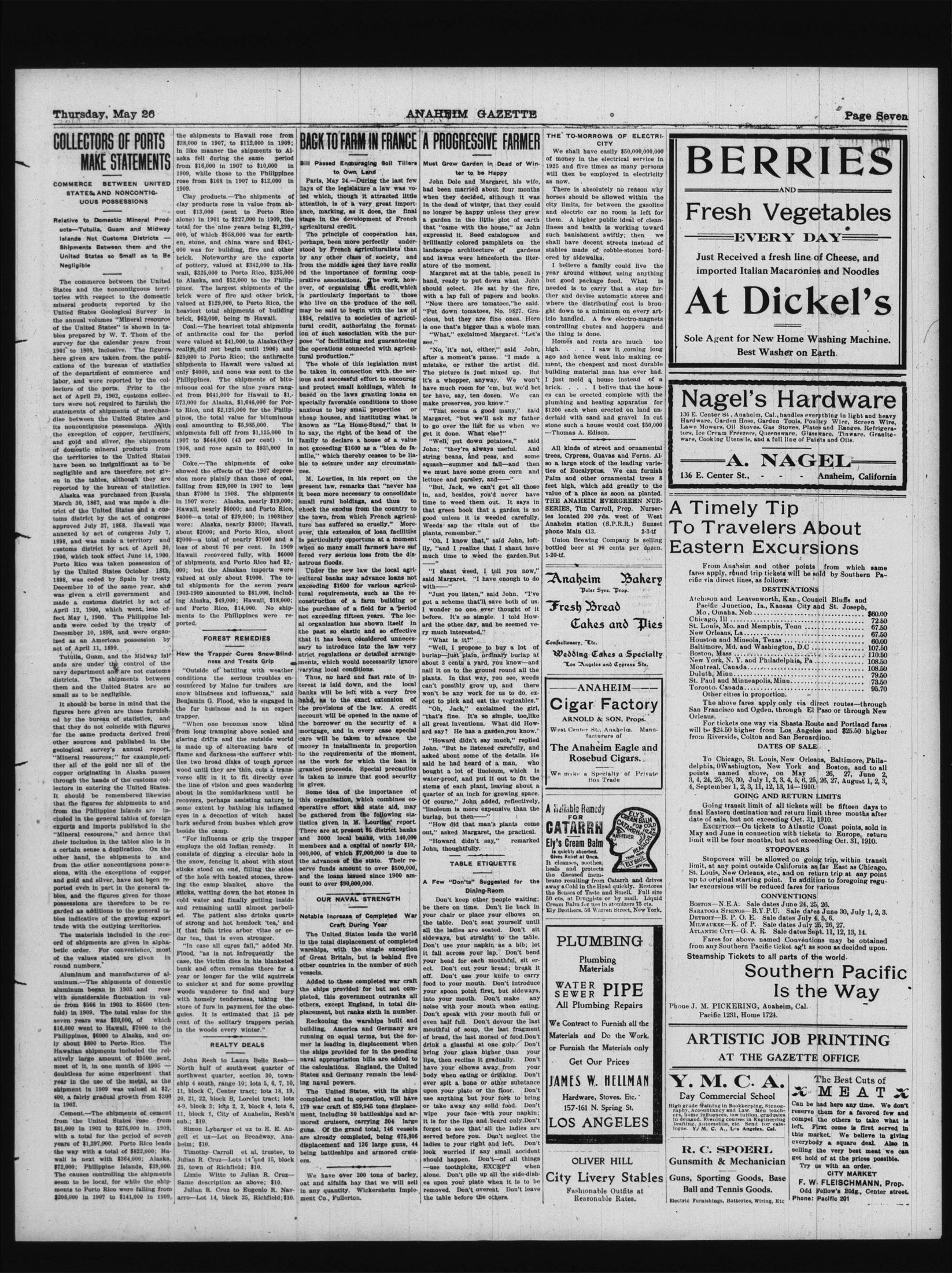
Searchable text
COLLECTORS OF PORTS MAKE STATEMENTS
COMMERCE BETWEEN UNITED STATES AND NONCONTIGUOUS POSSESSIONS
Relative to Domestic Mineral Products—Tutuilla, Guam and Midway Islands Not Customs Districts — Shipments Between them and the United States so Small as to Be Negligible
The commerce between the United States and the noncontiguous territories with respect to the domestic mineral products reported by the United States Geological Survey in the annual volumes "Mineral resource of the United States" is shown in tables prepared by W. T. Thom of the survey for the calendar years from 1901 to 1909, inclusive. The figures here given are taken from the publications of the bureaus of statistics of the department of commerce and labor, and were reported by the collectors of the ports. Prior to the act of April 29, 1902, customs collectors were not required to furnish the statements of shipments of merchandise between the United States and its noncontiguous possessions. With the exception of copper, fertilizers, and gold and silver, the shipments of domestic mineral products from the territories to the United States have been so insignificant as to be negligible and are therefore not given to the shipments to Hawaii rose from $38,000 in 1907, to $112,000 in 1909; In like manner the shipments to Alaska fell during the same period from $16,000 in 1907 to $10,000 in 1909, while those to the Philippines rose from $168 in 1907 to $12,000 in 1909.
Clay products.—The shipments of clay products rose in value from about $13,000 (sent to Porto Rico alone) in 1901 to $227,000 in 1909, the total for the nine years being $1,299,000, of which $958,000 was for earthen, stone, and china ware and $341,000 was for building, fire and other brick. Noteworthy are the exports of pottery, valued at $342,000 to Hawaii, $325,000 to Porto Rico, $235,000 to Alaska, and $52,000 to the Philippines. The largest shipments of the brick were of fire and other brick, valued at $129,000, to Porto Rico, the heaviest total shipments of building brick, $63,000, being to Hawaii.
Coal.—The heaviest total shipments of anthracite coal for the period were valued at $41,000 to Alaska (they really did not begin until 1906) and $25,000 to Porto Rico; the anthracite shipments to Hawaii were valued at only $4000, and none was sent to the Philippines. The shipments of bituminous coal for the nine years ranged from $641,000 for Hawaii to $1,573,000 for Alaska, $1,646,000 for Porto Rico, and $2,125,000 for the Philippines, the total value for bituminous coal amounting to $5,985,000. The shipments fell off from $1,135,000 in 1907 to $644,000 (43 per cent) in 1908, and rose again to $935,000 in 1909.
Coke.—The shipments of coke showed the effects of the 1907 depressions.
of the department of commerce and labor, and were reported by the collectors of the ports. Prior to the act of April 29, 1902, customs collectors were not required to furnish the statements of shipments of merchandise between the United States and its noncontiguous possessions. With the exception of copper, fertilizers, and gold and silver, the shipments of domestic mineral products from the territories to the United States have been so insignificant as to be negligible and are therefore not given in the tables, although they are reported by the bureau of statistics.
Alaska was purchased from Russia March 30, 1867, and was made a district of the United States and a customs district by the act of congress approved July 27, 1868. Hawaii was annexed by act of congress July 7, 1898, and was made a territory and customs district by act of April 30, 1900, which took effect June 14, 1900. Porto Rico was taken possession of by the United States October 18th, 1898, was ceded by Spain by treaty December 10 of the same year, and was given a civil government and made a customs district by act of April 12, 1900, which went into effect May 1, 1900. The Philippine Islands were ceded by the treaty of December 10, 1898, and were organized as an American possession by act of April 11, 1899.
Tutuilla, Guam, and the Midway Islands are under the control of the navy department and are not customs districts. The shipments between them and the United States are so small as to be negligible.
It should be borne in mind that the figures here given are those furnished by the bureau of statistics, and that they do not coincide with figures for the same products derived from other sources and published in the geological survey's annual report, "Mineral resources;" for example, neither all of the gold nor all of the copper originating in Alaska passes through the hands of the customs collectors in entering the United States. It should be remembered likewise that the figures for shipments to and from the Philippine Islands are included in the general tables of foreign exports and imports published in the "Mineral resources," and hence that their inclusion in the tables also is in a certain sense a duplication. On the other hand, the shipments to and from the other noncontiguous possessions, with the exceptions of copper and gold and silver, have not been reported even in part in the general tables, and the figures given for those Philippines. The shipments of bituminous coal for the nine years ranged from $641,000 for Hawaii to $1,-573,000 for Alaska, $1,646,000 for Puerto Rico, and $2,125,000 for the Philippines, the total value for bituminous coal amounting to $5,985,000. The shipments fell off from $1,135,000 in 1907 to $644,000 (43 per cent) in 1908, and rose again to $935,000 in 1909.
Coke.—The shipments of coke showed the effects of the 1907 depression more plainly than those of coal, falling from $29,000 in 1907 to less than $7000 in 1908. The shipments in 1907 were: Alaska, nearly $19,000; Hawaii, nearly $6000; and Porto Rico, $4000—a total of $29,000; in 1908 they were: Alaska, nearly $3000; Hawaii, about $2000; and Porto Rico, about $2000—a total of nearly $7000 and a loss of about 76 per cent. In 1909 Hawaii recovered fully, with $6000 of shipments, and Porto Rico had $2,-000; but the Alaskan imports were valued at only about $1000. The total shipments for the seven years 1903-1909 amounted to $81,000, including Alaska, $49,000; Hawaii, $18,000; and Porto Rico, $14,000. No shipments to the Philippines were reported.
FOREST REMEDIES
How the Trapper Cures Snow-Blindness and Treats Grip
"Outside of battling with weather conditions the serious troubles encountered by Maine fur traders are snow blindness and influenza," said Benjamin G. Flood, who is engaged in the fur business and is an expert trapper.
"When one becomes snow blind from long tramping above scaled and glaring drifts and the outside world is made up of alternating bars of flame and darkness—the sufferer whitles two broad disks of tough spruce wood until they are thin, cuts a transverse slit in it to fit directly over the line of vision and goes wandering about in the semidarkness until he recovers, perhaps assisting nature to some extent by bathing his inflamed eyes in a decoction of witch hazel bark secured from bushes which grow beside the camp.
"For influenza or grip the trapper employs the old Indian remedy. It consists of digging a circular hole in the snow, fencing it about with stout sticks stood on end, filling the sides of the hole with heated stones, throwing the camp blanket above the sticks, wetting down the hot stones in gold water and finally getting inside only."
that the figures for shipments to and from the Philippine Islands are included in the general tables of foreign exports and imports published in the "Mineral resources," and hence that their inclusion in the tables also is in a certain sense a duplication. On the other hand, the shipments to and from the other noncontiguous possessions, with the exceptions of copper and gold and silver, have not been reported even in part in the general tables, and the figures given for those possessions are therefore to be regarded as additions to the general tables indicative of the growing export trade with the outlying territories.
The materials included in the record of shipments are given in alphabetic order. For convenience, most of the values stated are given in round numbers.
Aluminum and manufactures of aluminum.—The shipments of domestic aluminum began in 1903 and rose with considerable fluctuation in value from $566 in 1903 to $5600 (tenfold) in 1909. The total value for the seven years was $30,000, of which $16,000 went to Hawaii, $7000 to the Philippines, $6000 to Alaska, and only about $800 to Porto Rico. The Hawaiian shipments included the relatively large amount of $9500 sent, most of it, in one month of 1905 — doubtless for some experiment that year in the use of the metal, as the shipment in 1909 was valued at $2,-400, a fairly gradual growth from $300 in 1903.
Cement.—The shipments of cement from the United States rose from $81,000 in 1903 to $276,000 in 1909, with a total for the period of seven years of $1,297,000. Porto Rico leads the way with a total of $822,000; Hawaii is next with $364,000; Alaska, $72,000; Philippine Islands, $39,000. The causes controlling the shipments seem to be local, for while the shipments to Porto Rico were falling from $208,000 in 1907 to $141,000 in 1909, recovers, perhaps assisting nature to some extent by bathing his inflamed eyes in a decoction of witch hazel bark secured from bushes which grow beside the camp.
"For influenza or grip the trapper employs the old Indian remedy. It consists of digging a circular hole in the snow, fencing it about with stout sticks stood on end, filling the sides of the hole with heated stones, throwing the camp blanket above the sticks, wetting down the hot stones in cold water and finally getting inside and remaining until almost parboiled. The patient also drinks quarts of strong and hot hemlock 'tea,' and if that falls tries arbor vitae or cedar tea, that is even stronger.
"In case all cures fail," added Mr. Flood, "as is not infrequently the case, the victim dies in his blanketed bunk and often remains there for a year or longer for the wild squirrels to snicker at and for some prowling woods wanderer to find and bury with homely tenderness, taking the store of furs in payment for the obsequies. It is estimated that 15 per cent of the solitary trappers perish in the woods every winter."
REALTY DEALS
John Resh to Laura Belle Resh—North half of southwest quarter of northwest quarter, section 30, township 4 south, range 10; lots 5, 6, 7, 10, 11, block C, Center tract; lots 18, 19, 20, 21, 22, block B, Lorelei tract; lots 4-9, block 3; lots 2, 3, block 4, lots 6, 11, block 1, City of Anaheim, Resh's sub.; $10.
Simon Lybarger et ux to E. E. Angell et ux—Lot on Broadway, Anaheim; $10.
Timothy Carroll et al., trustee, to Julian R. Cruz—Lots 14 and 15, block 25, town of Richfield; $10.
Lizzie Witte to Julian R. Cruz—Same description as above; $10.
Julian R. Cruz to Eugenio R. Navarro—Lot 14, block 25, Richfield;$10.
BACK TO FARM IN FRANCE
Bill Passed Encouraging Soil Tillers to Own Land
Paris, May 24.—During the last few days of the legislature a law was voted which, though it attracted little attention, is of a very great importance, marking, as it does, the final stage in the development of French agricultural credit.
The principle of cooperation has, perhaps, been more perfectly understood by French agriculturalists than by any other class of society, and from the middle ages they have realized the importance of forming cooperative associations. The work, however, of organizing that credit, which is particularly important to those who live on the produce of the soil, may be said to begin with the law of 1894, relative to societies of agricultural credit, authorizing the formation of such association with the purpose "of facilitating and guaranteeing the operations connected with agricultural production."
The whole of this legislation must be taken in connection with the serious and successful effort to encourage and protect small holdings, which is based on the laws granting loans on specially favorable conditions to those anxious to buy small properties or cheap houses, and instituting what is known as "Le Home-Stead," that is to say, the right of the head of the family to declare a house of a value not exceeding $1600 as a "bien de famille," which thereby ceases to be liable to seizure under any circumstances.
A PROGRESSIVE FARMER
Must Grow Garden in Dead of Winter to be Happy
John Dole and Margaret, his wife, had been married about four months when they decided, although it was in the dead of winter, that they could no longer be happy unless they grew a garden in the little plot of earth that "came with the house," as John expressed it. Seed catalogues and brilliantly colored pamphlets on the landscape architecture of gardens and lawns were henceforth the literature of the moment.
Margaret sat at the table, pencil in hand, ready to put down what John should select. He sat by the fire, with a lap full of papers and books. "Now there are tomatoes," he said. "Put down tomatoes, No. 9827. Gracious, but they are fine ones. Here is one that's bigger than a whole man." "What," exclaimed Margaret. "Let's see."
"No, it's not, either," said John, after a moment's pause. "I made a mistake, or rather the artist did. The picture is just mixed up. But it's a whopper, anyway. We won't have much room for 'em, but we'd better have, say, ten dozen. We can make preserves, you know."
"That seems a good many," said Margaret, "but we'll ask my father to go over the list for us when we get it done. What else?"
"Well, put down potatoes," said John; "they're always useful. And string beans, and peas, and some squash—summer and fall—and then we must have some green corn and THE TO-MORROWS OF ELECTRICITY
We shall have easily $50,000,000,000 of money in the electrical service in 1925 and five times as many persons will then be employed in electricity as now.
There is absolutely no reason why horses should be allowed within the city limits, for between the gasoline and electric car no room is left for them. A higher public ideal of cleanliness and health is working toward such banishment swiftly; then we shall have decent streets instead of stables made of cobble-stones bordered by sidewalks.
I believe a family could live the year around without using anything but good package food. What is needed is to carry that a step further and devise automatic stores and where the distributing cost is brought down to a minimum on every article handled. A few electro-magnets controlling chutes and hoppers and the thing is done.
Homes and rents are much too high. I saw it coming long ago and hence went into making cement, the cheapest and most durable building material man has ever had. I just mold a house instead of a brick. I belive that the houses can be erected complete with the plumbing and heating apparatus for $1200 each when erected on land underlaid with sand and gravel In cut stone such a house would cost $50,000—Thomas A. Edison.
All kinds of street and ornamental trees, Cypress, Guavas and Ferns. Also a large stock of the leading varieties of Eucalyptus. We can furnish
and successful effort to encourage and protect small holdings, which is based on the laws granting loans on specially favorable conditions to those anxious to buy small properties or cheap houses, and instituting what is known as "Le Home-Stead," that is to say, the right of the head of the family to declare a house of a value not exceeding $1600 as a "bien de famille," which thereby ceases to be liable to seizure under any circumstances.
M. Lourties, in his report on the present law, remarks that "never has it been more necessary to consolidate small rural holdings, and thus to check the exodus from the country to the town, from which French agriculture has suffered so cruelly." Moreover, this extension of loan facilities is particularly opportune at a moment when so many small farmers have suffered very serious loss from the disastrous floods.
Under the new law the local agricultural banks may advance loans not exceeding $1600 for various agricultural requirements, such as the reconstruction of a farm building or the purchase of a field for a period not exceeding fifteen years. The local organization has shown itself in the past so elastic and so effective that it has been considered unnecessary to introduce into the law very strict regulations or detailed arrangements, which would necessarily ignore varying local conditions.
Thus, no hard and fast rate of interest is laid down, and the local banks will be left with a very free hand, as to the exact extension of the provisions of the law. A credit account will be opened in the name of the borrower on the security of a mortgage, and in every case special care will be taken to advance the money in installments in proportion to the requirements of the moment, as the work for which the loan is granted proceeds. Special precaution is taken to insure that good security is given.
Some idea of the importance of this organization, which combines cooperative effort and state aid, may be gathered from the following statistics given in M. Lourties' report. There are at present 95 district banks and 3000 local banks, with 140,000 members and a capital of nearly $10,000,000, of which $7,000,000 is due to the advances of the state. Their reserve funds amount to over $500,000, and the loans issued since 1900 amount to over $90,900,000.
It's a whopper, anyway. We won't have much room for 'em, but we'd better have, say, ten dozen. We can make preserves, you know."
"That seems a good many," said Margaret, "but we'll ask my father to go over the list for us when we get it done. What else?"
"Well, put down potatoes," said John; "they're always useful. And string beans, and peas, and some squash—summer and fall—and then we must have some green corn and lettuce and parsley, and——"
"But, Jack, we can't get all those in, and besides, you'd never have time to weed them out. It says in that green book that a garden is no good unless it is weeded carefully. Weeds' sap the vitals out of the plants, remember."
"Oh, I know that," said John, loftily, "and I realize that I shant have much time to weed the garden. But——"
"I shant weed, I tell you now," said Margaret. "I have enough to do with——"
"Just you listen," said John. "I've got a scheme that'll save both of us. I wonder no one ever thought of it before. It's so simple. I told Howard the other day, and he seemed very much interested."
"What is it?"
"Well, I propose to buy a lot of burlap—just plain, ordinary burlap at about 3 cents a yard, you know—and nail it on to the ground round all the plants. In that way, you see, weeds can't possibly grow up, and there won't be any work for us to do, except to pick and eat the vegetable."
"Oh, Jack," exclaimed the girl, "that's fine. It's so simple, too, like all great inventions. What did Howard say? He has a garden, you know."
"Howard didn't say much," replied John. "But he listened carefully, and asked about some of the details. He said he had heard of a man, who bought a lot of linoleum, which is water-proof, and put it out to fit the stems of each plant, leaving about a quarter of an inch for growing space. Of course," John added, reflectively, "linoleum is more expensive than the burlap, but then——"
"How did that man's plants come out," asked Margaret, the practical.
"Howard didn't say," remarked John, thoughtfully.
TABLE ETIQUETTE
A Few "Don'ts" Suggested for the Dining-Room
Don't keep other people waiting:
OUR NAVAL STRENGTH
Notable Increase of Completed War Craft During Year
The United States leads the world in the total displacement of completed warships, with the single exception of Great Britain, but is behind five other countries in the number of such vessels.
Added to these completed war craft the ships provided for but not completed, this government outranks all others, except England, in total displacement, but ranks sixth in number.
Reckoning the warships built and building, America and Germany are running on equal terms, but the former is leading in displacement when the ships provided for in the pending naval appropriation bills are added to the calculations. England, the United States and Germany remain the leading naval powers.
The United States, with its ships completed and in operation, will have 179 war craft of 829,945 tons displacement, including 50 battleships and armored cruisers, carrying 204 large guns. Of the grand total, 146 vessels are already completed, being 675,306 displacement and 136 large guns, 44 being battleships and armored cruisers.
We have over 200 tons of barley, oat and alfalfa hay that we will sell in any quantity. Wickersheim Implement Co., Fullerton.
Of course," John added, reflectively,
"linoleum is more expensive than the burlap, but then——"
"How did that man's plants come out," asked Margaret, the practical.
"Howard didn't say," remarked John, thoughtfully.
TABLE ETIQUETTE
A Few "Don'ts" Suggested for the Dining-Reom
Don’t keep other people waiting; be there on time. Don’t lie back in your chair or place your elbows on the table. Don’t seat yourself until all the ladies are seated. Don’t sit sideways, but straight to the table. Don’t use your napkin as a bib; let it fall across your lap. Don’t bend your head for each mouthful, sit erect. Don’t cut your bread; break it off. Don’t use your knife to carry food to your mouth. Don’t introduce your spoon point first, but sideways, into your mouth. Don’t make any noise with your mouth when eating. Don’t speak with your mouth full or even half full. Don’t devour the last mouthful of soup, the last fragment of bread, the last morsel of food. Don’t drink a glassful at one gulp. Don’t bring your glass higher than your lips, then recline it gradually. Don’t have your elbows away from your body when eating or drinking. Don’t ever spit a bone or other substance upon your plate or the floor. Don’t use anything but your fork to bring or take away any solid food. Don’t wipe your face with your napkin; it is for the lips and beard only. Don't forget to see that all the ladies are served before you. Don't neglect the ladies to your right and left. Don't look worried if any small accident should happen. Don't—of all things—use toothpicks, EXCEPT when alone. Don't pile up all the side-dishes upon your plate when it is to be removed. Don't overeat. Don't leave the table before the others.
BERRIES
AND
Fresh Vegetables
EVERY DAY
Just Received a fresh line of Cheese, and imported Italian Macaronies and Noodles
At Dickel's
Sole Agent for New Home Washing Machine.
Best Washer on Earth.
Nagel's Hardware
136 E. Center St., Anaheim, Cal., handles everything in light and heavy
Hardware, Garden Hose, Garden Tools, Poultry Wire, Screen Wire,
Lawn Mowers, Oil Stoves, Gas Stoves, Plates and Ranges, Refrigerators,
Ice Cream Freezers, Queensware, Glassware, Tinware, Graniteware, Cooking Utensils, and a full line of Paints and Oils.
A. NAGEL
Nagel’s Hardware
136 E. Center St., Anaheim, Cal., handles everything in light and heavy
Hardware, Garden Hose, Garden Tools, Poultry Wire, Screen Wire,
Lawn Mowers, Oil Stoves, Gas Stoves, Plates and Ranges, Refrigerators,
Ice Cream Freezers, Queensware, Glassware, Tinware, Graniteware, Cooking Utensils, and a full line of Paints and Oils.
A. NAGEL
136 E. Center St., Anaheim, California
A Timely Tip
To Travelers About Eastern Excursions
From Anaheim and other points from which same fares apply, round trip tickets will be sold by Southern Pacific via direct lines, as follows:
DESTINATIONS
Attison and Leavenworth, Kan., Council Bluffs and
Pacific Junction, Ia., Kansas City and St. Joseph,
Mo., Omaha, Neb. $60.00
Chicago, Ill. 72.50
St. Louis, Mo. and Memphis, Tenn. 67.50
New Orleans, La. 67.50
Houston and Mineola, Texas 60.00
Baltimore, Md. and Washington, D.C. 107.50
Boston, Mass. 110.50
New York, N.Y. and Philadelphia, Pa. 108.50
Montreal, Canada 108.50
Duluth, Minn. 79.50
St. Paul and Minneapolis, Minn. 73.50
Toronto, Canada 95.70
Other cities in proportion.
The above fares apply only via direct routes—through San Francisco and Ogden, through El Paso or through New Orleans.
For tickets one way via Shasta Route and Portland fares will be $24.50 higher from Los Angeles and $25.50 higher from Riverside, Colton and San Bernardino.
DATES OF SALE
To Chicago, St. Louis, New Orleans, Baltimore, Philadelphia, Washington, New York and Boston, and to all points named above, on May 26, 27, June 2, 3, 4, 24, 25, 26, 30, July 1, 2, 3, 4, 5, 6, 25, 26, 27, August 1, 2, 3, 4, September 1, 2, 3, 11, 12, 13, 14—1910.
GOING AND RETURN LIMITS
Going transit limit of all tickets will be fifteen days to final Eastern destination and return limit three months after date of sale, but not exceeding Oct. 31, 1910.
EXCEPTION—On tickets to Atlantic Coast points, sold in May and June in connection with tickets to Europe, return limit will be four months, but not exceeding Oct. 31, 1910.
STOPOVERS
Stopovers will be allowed on going trip within transit limit at any point outside California as far East as Chicago,
St. Louis, New Orleans, etc., and on return trip at any point up to original starting point.
CONVENTIONS
Going transit limit of all tickets will be fifteen days to final Eastern destination and return limit three months after date of sale, but not exceeding Oct. 31, 1910.
Exception—On tickets to Atlantic Coast points, sold in May and June in connection with tickets to Europe, return limit will be four months, but not exceeding Oct. 31, 1910.
STOPOVERS
Stopovers will be allowed on going trip, within transit limit, at any point outside California as far East as Chicago, St. Louis, New Orleans, etc., and on return trip at any point up to original starting point. In addition to foregoing regular excursions will be reduced fares for various
CONVENTIONS
Boston—N.E.A. Sale dates June 24, 25, 26.
Saratoga Springs—B.Y.P.U. Sale dates June 30, July 1, 2, 3.
Detroit—B. P. O. E. Sale dates July 4, 5, 6.
Milwaukee—K. of P. Sale dates July 25, 26, 27.
Atlantic City—G. A. R. Sale dates Sept. 11, 12, 13, 14.
Fares for above named Conventions may be obtained from any Southern Pacific ticket ag't as soon as decided upon.
Steamship Tickets to all parts of the world.
Southern Pacific Is the Way
Phone J. M. PICKERING, Anaheim, Cal.
Pacific 1231, Home 1724.
ARTISTIC JOB PRINTING
AT THE GAZETTE OFFICE
Y. M. C. A.
Day Commercial School
High grade training in Bookkeeping, Stenography, Accountancy and Law. Men teachers, home influences, low tuition, graduates in demand. Evening courses in Engineering Drafting, Automobile, etc. Send for catalogue. Y/ M. C. A., Los Angeles, Cal.
R. C. SPOERL
Gunsmith & Mechanician
Guns, Sporting Goods, Base Ball and Tennis Goods.
Electric Furnishings, Batteries, Wiring, Etc.
The Best Cuts of MEAT
Can be had here any time. We don't reserve them for a favored few and compel the others to take what is left. First come is first served in this market. We believe in giving everybody a square deal. Also in selling the very best meat we can get hold of at the prices possible.
Try us with an order.
CITY MARKET
F. W. FLEISCHMANN, Prop.
Odd Fellow's Bldg., Center street.
Phone: Pacific 201