anaheim-gazette 1910-05-12
Scanned page
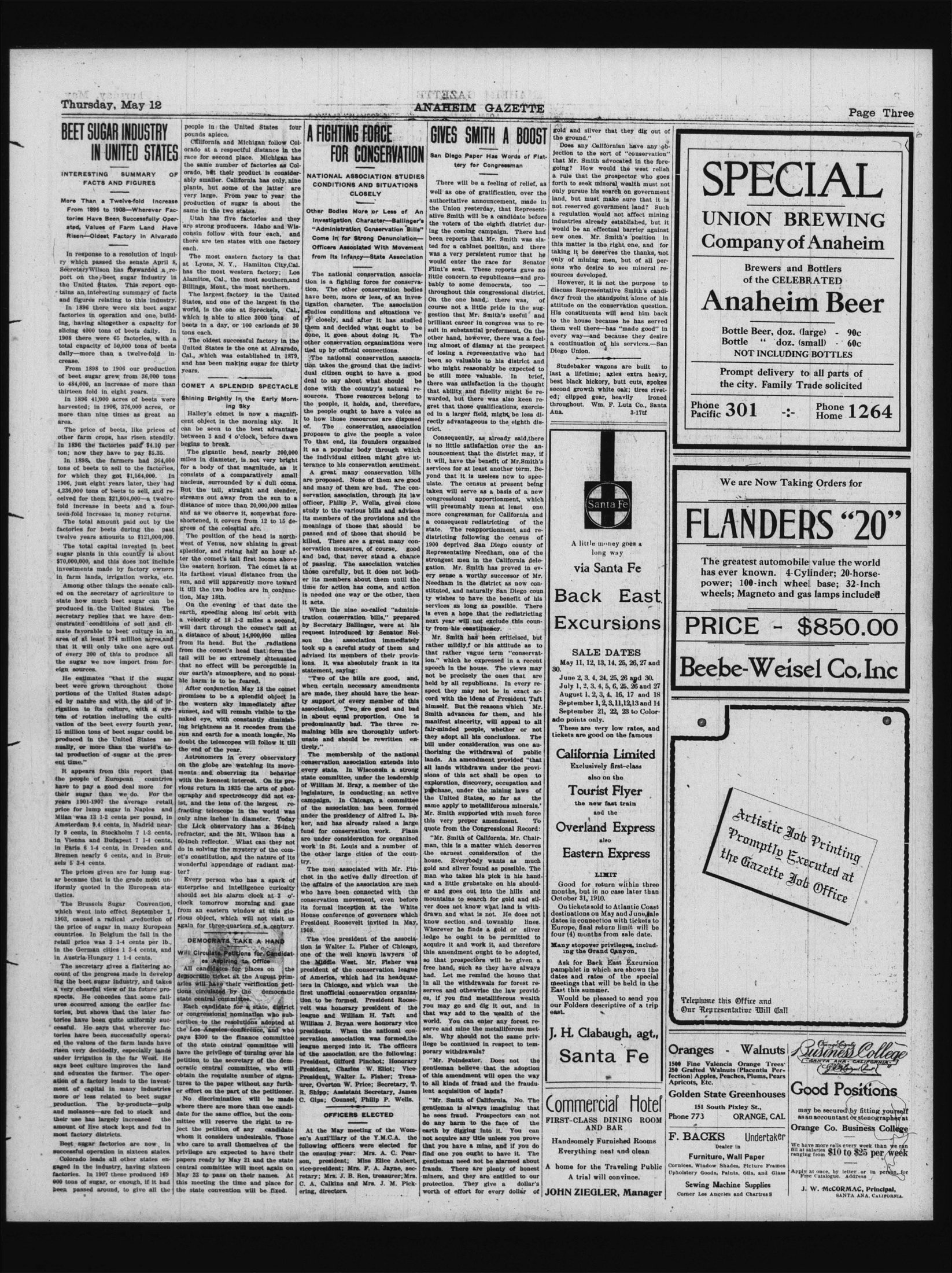
Searchable text
BEET SUGAR INDUSTRY IN UNITED STATES
INTERESTING SUMMARY OF FACTS AND FIGURES
More Than a Twelve-fold Increase From 1896 to 1908—Wherever Factories Have Been Successfully Operated, Values of Farm Land Have Risen—Oldest Factory in Alvarado
In response to a resolution of inquiry which passed the senate April 8, Secretary Wilson has forwarded a report on the beet sugar industry in the United States. This report contains an interesting summary of facts and figures relating to this industry.
In 1896 there were six beet sugar factories in operation and one building, having altogether a capacity for slicing 4000 tons of beets daily. In 1908 there were 65 factories, with a total capacity of 50,000 tons of beets daily—more than a twelve-fold increase.
From 1898 to 1906 our production of beet sugar grew from 36,000 tons to 484,000, an increase of more than thirteen fold in eight years.
In 1896 41,000 acres of beets were harvested; in 1906, 376,000 acres, or more than nine times as great an area.
The price of beets, like prices of other farm crops, has risen steadily. In 1896 the factories paid $4.10 per ton; now they have to pay $5.35.
In 1898, the farmers had 364,000 tons of beets to sell to the factories, for which they got $1,564,000 people in the United States four pounds apiece.
California and Michigan follow Colorado at a respectful distance in the race for second place. Michigan has the same number of factories as Colorado, but their product is considerably smaller. California has only nine plants, but some of the latter are very large. From year to year the production of sugar is about the same in the two states.
Utah has five factories and they are strong producers. Idaho and Wisconsin follow with four each, and there are ten states with one factory each.
The most eastern factory is that at Lyons, N. Y., Hamilton City, Cal. has the most western factory; Los Alamitos, Cal., the most southern,and Billings, Mont., the most northern.
The largest factory in the United States, and one of the largest in the world, is the one at Spreckels, Cal., which is able to slice 3000 tons of beets in a day, or 100 carloads of 30 tons each.
The oldest successful factory in the United States is the one at Alvarado, Cal., which was established in 1879, and has been making sugar for thirty years.
COMET A SPLENDID SPECTACLE
Shining Brightly In the Early Morning Sky
Halley's comet is now a magnificent object in the morning sky. It can be seen to the best advantage between 3 and 4 o'clock, before dawn begins to break.
The gigantic head, nearly 200,000 miles in diameter, is not very bright for a body of that magnitude, as it consists of a comparatively small
of beet sugar grew from 36,000 tons to 484,000, an increase of more than thirteen fold in eight years.
In 1896 41,000 acres of beets were harvested; in 1906, 376,000 acres, or more than nine times as great an area.
The price of beets, like prices of other farm crops, has risen steadily. In 1896 the factories paid $4.10 per ton; now they have to pay $5.35.
In 1898, the farmers had 364,000 tons of beets to sell to the factories, for which they got $1,564,000. In 1906, just eight years later, they had 4,236,000 tons of beets to sell, and received for them $21,604,000—a twelve-fold increase in beets and a fourteen-fold increase in money returns.
The total amount paid out by the factories for beets during the past twelve years amounts to $121,000,000.
The total capital invested in beet sugar plants in this country is about $70,000,000, and this does not include investments made by factory owners in farm lands, irrigation works, etc.
Among other things the senate called on the secretary of agriculture to state how much beet sugar can be produced in the United States. The secretary replies that we have demonstrated conditions of soil and climate favorable to beet culture in an area of at least 274 million acres, and that it will only take one acre out of every 200 of this to produce all the sugar we now import from foreign sources.
He estimates "that if the sugar beet were grown throughout those portions of the United States adapted by nature and with the aid of irrigation to its culture, with a system of rotation including the cultivation of the beet every fourth year, 15 million tons of beet sugar could be produced in the United States annually, or more than the world's total production of sugar at the present time."
It appears from this report that the people of European countries have to pay a good deal more for their sugar than we do. For the years 1901-1907 the average retail price for lump sugar in Naples and Milan was 13 1-2 cents per pound, in Amsterdam 9.4 cents, in Madrid nearly 9 cents, in Stockholm 7 1-2 cents, in Vienna and Budapest 7 1-4 cents, in Paris 6 1-4 cents, in Dresden and Bremen nearly 6 cents, and in Brussels 5 3-4 cents.
The prices given are for lump sugar because that is the grade most uniformly quoted in the European statistics.
COMET A SPLENDID SPECTACLE
Shining Brightly In the Early Morning Sky
Halley's comet is now a magnificent object in the morning sky. It can be seen to the best advantage between 3 and 4 o'clock, before dawn begins to break.
The gigantic head, nearly 200,000 miles in diameter, is not very bright for a body of that magnitude, as it consists of a comparatively small nucleus, surrounded by a dull coma. But the tail, straight and slender, streams out away from the sun to a distance of more than 20,000,000 miles and as we observe it, somewhat foreshortened, it covers from 12 to 15 degrees of the celestial arc.
The position of the head is northwest of Venus, now shining in great splendor, and rising half an hour after the comet's tail first looms above the eastern horizon. The comet is at its farthest visual distance from the sun, and will apparently move toward it till the two bodies are in conjunction, May 18th.
On the evening of that date the earth, speeding along its orbit with a velocity of 18 1-2 miles a second, will dart through the comet's tail at a distance of about 14,000,000 miles from its head. But the radiations from the comet's head that form the tail will be so extremely attenuated that no effect will be perceptible in our earth's atmosphere, and no possible harm is to be feared.
After conjunction May 18 the comet promises to be a splendid object in the western sky immediately after sunset, and will remain visible to the naked eye, with constantly diminishing brightness as it recedes from the sun and earth for a month longer. No doubt the telescopes will follow it till the end of the year.
Astronomers in every observatory on the globe are watching its movements and observing its behavior with the keenest interest. On its previous return in 1835 the arts of photography and spectroscopy did not exist, and the lens of the largest refracting telescope in the world was only nine inches in diameter. Today the Lick observatory has a 36-inch refractor, and the Mt. Wilson has a 60-inch reflector. What can they not do in solving the mystery of the comet's constitution, and the nature of its wonderful appendage of radiant matter?
Every person who has a spark of enterprise and intelligence curiosity should set his alarm clock at 3 o'clock.
A great many are proposed. No and many of their servation associate officer, Philip P. study to the various members of its meanings of those passed and of those killed. There are servation measure and bad, that need of passing. They those carefully taken up a careful advised its members. It was abolition statement saying:
"Two of the men when certain needs are made, they satisfy support of every association. Two in about equal predominantly basling bills are unate and should tirely."
The membership conservation assists every state. In state committee, of William M. Braig legislature, is co-campaign. In City of the association under the president ker, and has already fund for conservatives under consider work in St. Louis the other large city try.
The men associated chot in the activi
years 1901-1907 the average retail price for lump sugar in Naples and Milan was 13 1-2 cents per pound, in Amsterdam 9.4 cents, in Madrid nearly 9 cents, in Stockholm 7 1-2 cents, in Vienna and Budapest 7 1-4 cents, in Paris 6 1-4 cents, in Dresden and Bremen nearly 6 cents, and in Brussels 5 3-4 cents.
The prices given are for lump sugar because that is the grade most uniformly quoted in the European statistics.
The Brussels Sugar Convention, which went into effect September 1, 1903, caused a radical reduction of the price of sugar in many European countries. In Belgium the fall in the retail price was 3 1-4 cents per lb., in the German cities 1 3-4 cents, and in Austria-Hungary 1 1-4 cents.
The secretary gives a flattering account of the progress made in developing the beet sugar industry, and takes a very cheerful view of its future prospects. He concedes that some failures occurred among the earlier factories, but shows that the later factories have been quite uniformly successful. He says that wherever factories have been successfully operated the values of the farm lands have risen very decidedly, especially lands under irrigation in the far West. He says beet culture improves the land and educates the farmer. The operation of a factory leads to the investment of capital in many industries more or less related to beet sugar production. The by-products—pulp and molasses—are fed to stock and their use has largely increased the amount of live stock kept and fed in most factory districts.
Beet sugar factories are now in successful operation in sixteen states.
Colorado leads all other states engaged in the industry, having sixteen factories. In 1907 these produced 169 000 tons of sugar, or enough, if it had been passed around, to give all the list, and the lens of the largest refracting telescope in the world was only nine inches in diameter. Today the Lick observatory has a 36-inch refractor, and the Mt. Wilson has a 60-inch reflector. What can they not do in solving the mystery of the comet's constitution, and the nature of its wonderful appendage of radiant matter?
Every person who has a spark of enterprise and intelligence curiosity should set his alarm clock at 3 o'clock tomorrow morning and gaze from an eastern window at this glorious object, which will not visit us again for three quarters of a century.
DEMOCRATS TAKE A HAND
Will Circulate Petitions for Candidates Aspiring to Office
All candidates for places on the democratic ticket at the August primaries will have their verification petitions circulated by the democratic state central committee.
Each candidate for a state, district or congressional nomination who subscribes to the resolutions adopted at the Los Angeles conference, and who pays $300 to the finance committee of the state central committee will have the privilege of turning over his petition to the secretary of the democratic central committee, who will obtain the requisite number of signatures to the paper without any further effort on the part of the petitioner.
No discrimination will be made where there are more than one candidate for the same office, but the committee will reserve the right to reject the petition of any candidate whom it considers undesirable. Those who care to avail themselves of the privilege are expected to have their papers ready by May 21 and the state central committee will meet again on May 23 to pass on their names. At this meeting the time and place for the state convention will be fixed.
OFFICERS
At the May meeting's Auxiliary officers are enuing year: son, president; vice-president; Mr retary; Mrs. J. B. C. A. Calkins and ering, directors.
A FIGHTING FORCE FOR CONSERVATION
NATIONAL ASSOCIATION STUDIES CONDITIONS AND SITUATIONS CLOSELY
Other Bodies More or Less of An Investigation Character—Ballinger's "Administration Conservation Bills"
Come In for Strong Denunciation—Officers Associated With Movement from Its Infancy—State Association
The national conservation association is a fighting force for conservation. The other conservation bodies have been, more or less, of an investigation character. The association studies conditions and situations very closely, and after it has studied them and decided what ought to be done, it goes about doing it. The other conservation organizations were tied up by official connections.
The national conservation association takes the ground that the individual citizen ought to have a good deal to say about what should be done with the country's natural resources. Those resources belong to the people, it holds, and, therefore, the people ought to have a voice as to how those resources are disposed of. The conservation association proposes to give the people a voice To that end, its founders organized it as a popular body through which the individual citizen might give utterance to his conservation sentiment. A great many conservation bills
GIVES SMITH A BOOST
San Diego Paper Has Words of Flattery for Congressman
There will be a feeling of relief, as well as one of gratification, over the authoritative announcement, made in the Union yesterday, that Representative Smith will be a candidate before the voters of the eighth district during the coming campaign. There had been reports that Mr. Smith was slated for a cabinet position, and there was a very persistent rumor that he would enter the race for Senator Flint's seat. These reports gave no little concern to republicans—and probably to some democrats, too throughout this congressional district. On the one hand, there was, of course not a little pride in the suggestion that Mr. Smith's useful and brilliant career in congress was to result in substantial preferment. On the other hand, however, there was a feeling almost of dismay at the prospect of losing a representative who had been so valuable to his district and who might reasonably be expected to be still more valuable. In brief, there was satisfaction in the thought that ability and fidelity might be rewarded, but there was also keen regret that those qualifications, exercised in a larger field, might be less directly advantageous to the eighth district.
Consequently, as already said, there is no little satisfaction over the announcement that the district may, if it will, have the benefit of Mr. Smith's services for at least another term. Gold and silver that they dig out of the ground."
Does any Californian have any objection to the sort of "conservation" that Mr. Smith advocated in the foregoing? How would the west relish a rule that the prospector who goes forth to seek mineral wealth must not only pursue his search on government land, but must make sure that it is not reserved government land? Such a regulation would not affect mining industries already established, but it would be an effectual barrier against new ones. Mr. Smith's position in this matter is the right one, and for taking it he deserves the thanks, not only of mining men, but of all persons who desire to see mineral resources developed.
However, it is not the purpose to discuss Representative Smith's candidacy from the standpoint alone of his attitude on the conservation question. His constituents will send him back to the house because he has served them well there—has "made good" in every way—and because they desire a continuation of his services. San Diego Union.
Studebaker wagons are built to last a lifetime; axles extra heavy, best black hickory, butt cuts, spokes second growth white oak; tires riveted; clipped gear, heavily ironed throughout. Wm. F. Lutz Co., Santa Ana. 3-17tf
A great many conservation bills are proposed. None of them are good and many of them are bad. The conservation association, through its law officer, Philip P. Wells, gives close study to the various bills and advises its members of the provisions and the meanings of those that should be passed and of those that should be killed. There are a great many conservation measures, of course, good and bad, that never stand a chance of passing. The association watches those carefully, but it does not bother its members about them until the time for action has come, and action is needed one way or the other, then it acts.
When the nine so-called "administration conservation bills," prepared by Secretary Ballinger, were at his request introduced by Senator Nelson the association immediately took up a careful study of them and advised its members of their provisions. It was absolutely frank in its statement, saying:
"Two of the bills are good, and when certain necessary amendments are made, they should have the hearty support of every member of this association. Two are good and bad in about equal proportion. One is predominantly bad. The three remaining bills are thoroughly unfortunate and should be rewritten entirely."
The membership of the national conservation association extends into every state. In Wisconsin a strong state committee, under the leadership of William M. Bray, a member of the legislature, is conducting an active campaign. In Chicago, a committee of the association has been formed under the presidency of Alfred L. Baker, and has already raised a large fund for conservation work. Plans are under consideration for organized work in St. Louis and a number of the other large cities of the country.
The men associated with Mr. Pinchot in the active daily direction of the affairs of the association are men who have been connected with the conservation movement even before deal to say about what should be done with the country's natural resources. Those resources belong to the people, it holds, and therefore, the people ought to have a voice as to how those resources are disposed of. The conservation association proposes to give the people a voice To that end, its founders organized it as a popular body through which the individual citizen might give utterance to his conservation sentiment.
A little money goes a long way via Santa Fe Back East Excursions SALE DATES May 11, 12, 13, 14, 25, 26, 27 and 30. June 2, 3, 4, 24, 25, 26 and 30. July 1, 2, 3, 4, 5, 6, 25, 26 and 27 August 1, 2, 3, 4, 16, 17 and 18 September 1, 2, 3, 11, 12, 13 and 14 September 21, 22, 23 to Colorado points only.
These are very low rates, and tickets are good on the famous California Limited Exclusively first-class also on the Tourist Flyer the new fast train and the Overland Express also Eastern Express LIMIT Good for return within three months, but in no case later than October 31, 1910.
campaign. In Chicago, a committee of the association has been formed under the presidency of Alfred L. Baker, and has already raised a large fund for conservation work. Plans are under consideration for organized work in St. Louis and a number of the other large cities of the country.
The men associated with Mr. Pinchot in the active daily direction of the affairs of the association are men who have been connected with the conservation movement, even before its formal inception at the White House conference of governors which President Roosevelt invited in May, 1908.
The vice president of the association is Walter L. Fisher of Chicago, one of the well known lawyers of the Middle West. Mr. Fisher was president of the conservation league of America, which had its headquarters in Chicago, and which was the first unofficial conservation organization to be formed. President Roosevelt was honorary president of the league and William H. Taft and William J. Bryan were honorary vice presidents. When the national conservation association was formed, the league merged into it. The officers of the association are the following: President, Gifford Pinchot; Honorary President, Charles W. Eliot; Vice-President, Walter L. Fisher; Treasurer, Overton W. Price; Secretary, T. R. Shipp; Assistant Secretary, James C. Gips; Counsel, Philip P. Wells.
OFFICERS ELECTED
At the May meeting of the Women's Auxiliary of the Y.M.C.A. the following officers were elected for the ensuing year: Mrs. A. C. Pearson, president; Miss Elice Aubert, vice-president; Mrs. F. A. Jayne, secretary; Mrs. J. B. Rea, treasurer; Mrs. C. A. Calkins and Mrs. J. M. Pickering, directors.
Mr. Smith of California. Mr. Chairman, this is a matter which deserves the earnest consideration of the house. Everybody wants as much gold and silver found as possible. The man who takes his pick in his hand and a little grubstake on his shoulder and goes out into the hills and mountains to search for gold and silver does not know what land is withdrawn and what is not. He does not know section and township lines. Wherever he finds a gold or silver ledge he ought to be permitted to acquire it and work it, and therefore this amendment ought to be adopted, so that prospectors will be given a free hand, such as they have always had. Let me remind the house that in all the withdrawals for forest reserves and otherwise the law provides, if you find metalliferous wealth you may go and dig it out, and in that way add to the wealth of the world. You can enter any forest reserve and mine the metalliferous metals. Why should not the same privilege be continued in respect to temporary withdrawals?
Mr. Poindexter. Does not the gentleman believe that the adoption of this amendment will open the way to all kinds of fraud and the fraudulent acquisition of lands?
Mr. Smith of California. No. The gentleman is always imagining that he sees fraud. Prospectors can not do any harm to the face of the earth by digging into it. You cannot acquire any title unless you prove that you have a mine, and if you do find one you ought to have it. The gentleman need not be alarmed about frauds. There are plenty of honest miners, and they are entitled to our protection. They give a dollar's worth of effort for every dollar of
SPECIAL
UNION BREWING
Company of Anaheim
Brewers and Bottlers
of the CELEBRATED
Anaheim Beer
Bottle Beer, doz. (large) - 90c
Bottle “doz. (small) - 60c
NOT INCLUDING BOTTLES
Prompt delivery to all parts of
the city. Family Trade solicited
Phone Pacific 301 - Phone Home 1264
We are Now Taking Orders for
FLANDERS "20"
The greatest automobile value the world has ever known. 4-Cylinder; 20-horsepower; 100-inch wheel base; 32-Inch wheels; Magneto and gas lamps included
PRICE - $850.00
Beebe-Weisel Co., Inc
Artistic Job Printing
Promptly Executed at
the Gazette Job Office
Artistic Job Printing
Promptly Executed at
the Gazette Job Office
Telephone this Office and
Our Representative Will Call
Oranges - Walnuts
1500 Fine Valencia Orange Trees
250 Grafted Walnuts (Placentia Perfection) Apples, Peaches, Plums, Pears Apricots, Etc.
Golden State Greenhouses
151 South Pixley St.
Phone 773 ORANGE, CAL
F. BACKS Undertaker
Dealer in
Furniture, Wall Paper
Cornices, Window Shades, Picture Frames
Upholstery Goods, Pallets, Oils, and Glass
Sewing Machine Supplies
Corner Los Angeles and Chartres S
Good Positions
may be secured by fitting yourself as an accountant or stenographer at Orange Co. Business College
We have more calls every week than we can fill at salaries ranging from $10 to $25 per week
Apply at once, by letter or in person, for Free Catalogue. Address
J. W. McCORMAC, Principal,
SANTA ANA, CALIFORNIA.