anaheim-gazette 1910-03-03
Scanned page
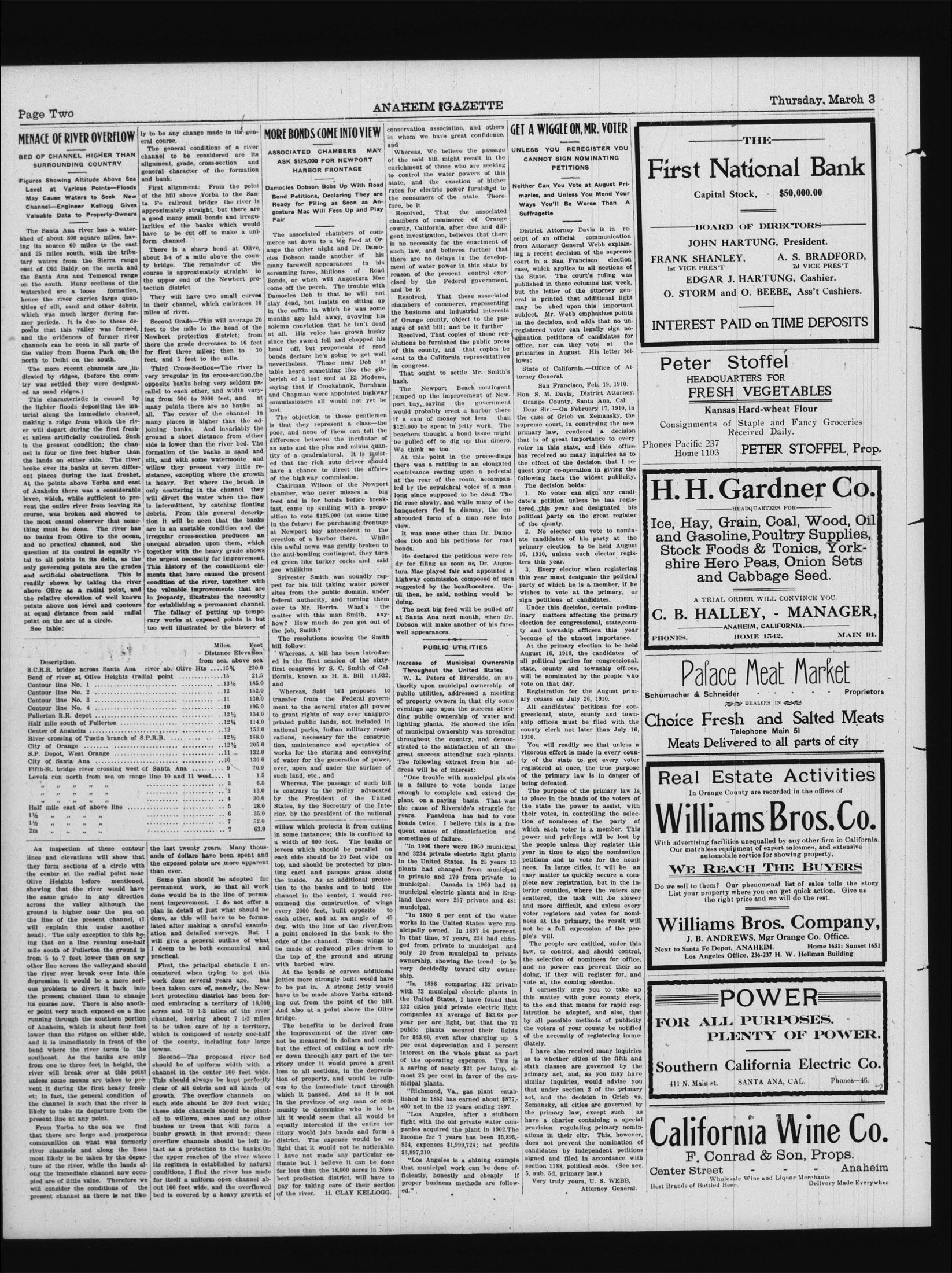
Searchable text
MENACE OF RIVER OVERFLOW
BED OF CHANNEL HIGHER THAN SURROUNDING COUNTRY
Figures Showing Altitude Above Sea Level at Various Points—Floods May Cause Waters to Seek New Channel—Engineer Kellogg Gives Valuable Data to Property-Owners
The Santa Ana river has a watershed of about 800 square miles, having its source 60 miles to the east and 25 miles south, with the tributary waters from the Sierra range east of Old Baldy on the north and the Santa Ana and Temescal range on the south. Many sections of the watershed are a loose formation, hence the river carries large quantities of silt, sand and other debris, which was much larger during former periods. It is due to these deposits that this valley was formed, and the evidences of former river channels can be seen in all parts of the valley from Buena Park on the north to Delhi on the south.
The more recent channels are indicated by ridges, (before the country was settled they were designated as sand ridges.) This characteristic is caused by the lighter floods depositing the material along the immediate channel, making a ridge from which the river will depart during the first freshet unless artificially controlled. Such is the present condition; the channel is four or five feet higher than the lands on either side. The river broke over its banks at seven different places during the last freshetly to be any change made in its general course.
The general conditions of a river channel to be considered are its alignment, grade, cross-section and general character of the formation and bank.
First alignment: From the point of the hill above Yorba to the Santa Fe railroad bridge the river is approximately straight, but there are a good many small bends and irregularities of the banks which would have to be cut off to make a uniform channel.
There is a sharp bend at Olive, about 3-4 of a mile above the county bridge. The remainder of the course is approximately straight to the upper end of the Newbert protection district.
They will have two small curves in their channel, which embraces 10 miles of river.
Second Grade—This will average 20 feet to the mile to the head of the Newbert protection district; from there the grade decreases to 16 feet for first three miles; then to 10 feet, and 5 feet to the mile.
Third Cross-Section—the river is very irregular in its cross-section, the opposite banks being very seldom parallel to each other, and width varying from 500 to 2000 feet, and at many points there are no banks at all. The center of the channel in many places is higher than the adjoining banks. And invariably the ground a short distance from either side is lower than the river bed. The formation of the banks is sand and silt, and with some watermouthe and willow they present very little resistance exerting where the growth
MORE BONDS COME INTO
ASSOCIATED CHAMBERSHIP ASK $125,000 FOR NEW HARBOR FRONTAGE
Damocles Dobson Bobs Up W Bond Petitions, Declaring That Ready for Filing as Soon gostura Mac Will Fess Up Fair
The associated chambers merce sat down to a big fee change the other night and Damocles Dobson made another many farewell appearances screaming farce, Millions of Bonds, or when will Angos come off the perch. The trot Damocles Dob is that he stay dead, but insists on sitting in the coffin in which he months ago laid away, avoid solemn conviction that he at all. His voice has grown since the sword fell and chest head off, but proponents bonds declare he's going to nevertheless. Those near table heard something like berish of a lost soul at El saying that if Crookshank, and Chapman were appointed commissioners all would not lost.
The objection to these is that they represent a poor, and none of them can difference between the in an auto and the plus and minus of a quadralateral. It ed that the rich auto driver have a chance to direct
This characteristic is caused by the lighter floods depositing the material along the immediate channel, making a ridge from which the river will depart during the first freshet unless artificially controlled. Such is the present condition; the channel is four or five feet higher than the lands on either side. The river broke over its banks at seven different places during the last freshet, At the points above Yorba and east of Anaheim there was a considerable levee, which, while sufficient to prevent the entire river from leaving its course, was broken and showed to the most casual observer that something must be done. The river has no banks from Olive to the ocean, and no practical channel, and the question of its control is equally vital to all points in its delta, as the only governing points are the grades and artificial obstructions. This is readily shown by taking the river above Olive as a radial point, and the relative elevation of well known points above sea level and contours at equal distance from said radial point on the arc of a circle.
See table:
| Description | Miles. | Feet |
| :--- | :---: | :---: |
| S.C.R.R. bridge across Santa Ana river ab. Olive Hts | 15% | 230.0 |
| Bend of river at Olive Heights (radial point) | 15 | 21.5 |
| Contour line No. 1 | 13½ | 185.0 |
| Contour line No. 2 | 12 | 152.0 |
| Contour line No. 3 | 11 | 130.0 |
| Contour line No. 4 | 10 | 105.0 |
| Fullerton R.R. depot | 12½ | 154.0 |
| Half mile south of Fullerton | 12¼ | 114.0 |
| Center of Anaheim | 12 | 152.0 |
| River crossing of Tustin branch of S.P.R.R. | 12½ | 168.0 |
| City of Orange | 12½ | 205.0 |
| S.P. Depot, West Orange | 11 | 132.0 |
| City of Santa Ana | 10 | 130.0 |
| Fifth-St. bridge river crossing west of Santa Ana | 9 | 70.0 |
| Levels run north from sea on range line 10 and 11 west... | 1 | 1.5 |
| " " " " " " " " " " " " " " " " " " " " " " " " " " " " " " " " " " " " " " " " " " " " " " " " " " " "
| " " " " " " " " " " " " " " " " " " " " " " " " " " " " " " " " " ..." | 2 | 6.5 |
| " " " " " " " ..." | 3 | 13.0 |
| " ..." ..." ..." ..." ..." ..." ..." ..." ..." ..." ..." ..." ..." ..." ..." ..." ..." ..." ..." ..." ..." ..." ..." ..." ..." ..." ..." ..." ..." ..." ..." ..." ..." ..." ..." ..." ..." ..." ..." ..." ..." ..." ..." ..." ..." ..." ..." ..." ..."
| Half mile east of above line | 5 | 28.0 |
| 1½ ..... ..... ..... ..... ..... ..... ..... ..... ..... ..... ..... ..... ..... ..... ..... ..... ..... ..... ..... ..... ..... ..... ..... ..... ..... ..... ..... ..... ..... ..... ..... ..... ..... ..... ..... ..... ..... ..... ..... ..... ..... ..... ..... ..... ..... ..... ..... ..... ....|
| 1½ ..... ..... ..... ..... ..... ..... ..... ..... ..... ..... ..... ..... ..... ..... ..... ..... ..... ..... ..... ..... ..... ..... ....|
| 2m ..... ..... ..... ..... .... | 7 | 63.0 |
An inspection of these contour lines and elevations will show that they form sections of a circle with the center at the radial point near Olive Heights before mentioned, showing that the river would have the same grade in any direction very irregular in its cross-section, the opposite banks being very seldom parallel to each other, and width varying from 500 to 2000 feet, and at many points there are no banks at all. The center of the channel in many places is higher than the adjoining banks. And invariably the ground a short distance from either side is lower than the river bed. The formation of the banks is sand and silt, and with some watermouthe and willow they present very little resistance, excepting where the growth is heavy. But where the brush is only scattering in the channel they will divert the water when the flow is intermittent, by catching floating debris. From this general description it will be seen that the banks are in an unstable condition and the irregular cross-section produces an unequal abrasion upon them, which together with the heavy grade shows the urgent necessity for improvement. This history of the constituent elements that have caused the present condition of the river, together with the valuable improvements that are in jeopardy, illustrates the necessity for establishing a permanent channel.
The fallacy of putting up temporary works at exposed points is but too well illustrated by the history of
Miles. Feet Distance Elevation from sea above sea
S.C.R.R. bridge across Santa Ana river ab. Olive Hts.....15%.....230.0
Bend of river at Olive Heights (radial point).....15.....21.5
Contour line No. 1.....13½.....185.0
Contour line No. 2.....12.....152.0
Contour line No. 3.....11.....130.0
Contour line No. 4.....10.....105.0
Fullerton R.R. depot.....12½.....154.0
Half mile south of Fullerton.....12¼.....114.0
Center of Anaheim.....12.....152.0
River crossing of Tustin branch of S.P.R.R.. . . . . . . . . . . . . . . . . . . . . . . . . . . . . . . . . . . . . . . . . . . . . . . . . . . . . . . . . . . . . . .
City of Orange.....12½.....205.0
S.P. Depot, West Orange.....11.....132.0
City of Santa Ana.....10.....130.0
Fifth-St. bridge river crossing west of Santa Ana.....9.....70.0
Levels run north from sea on range line 10 and 11 west....1....1.5
"..."..."..."..."..."..."..."..."..."..."..."..."..."..."..."
""..."..."..."..."..."..."..."
""..."..."..."..."..."
""..."..."..."
""..."..."
""..."
""..."
""..."
""..."
""..."
""..."
""..."
""..."
""..."
""..."
""..."
""..."
""..."
""..."
""..."
""..."
""..."
""..."
""..."
""..."
""..."
""..."
""..."
""..."
""..."
""..."
""..."
""..."
"""...
"""...
"""...
"""...
"""...
"""...
"""...
"""...
"""...
"""...
"""...
"""...
"""...
"""...
"""...
"""...
"""...
"""...
"""...
"""...
"""...
"""...
"""...
"""...
"""...
"""...
"""...
"""...
"""...
"""...
"""...
"""...
"""...
"""...
"""...
"""...
"""...
"""...
"""...
"""...
"""...
"""...
"""...
"""...
"""...
""""
"" ...
"" ...
"" ...
"" ...
"" ...
"" ...
"" ...
"" ...
"" ...
"" ...
"" ...
"" ...
"" ...
"" ...
"" ...
"" ...
"""
"""
"""
"""
"""
"""
"""
"""
"""
"""
"""
"""
"""
"""
"""
"""
"""
"""
"""
"""
"""
"""
"""
"""
"""
"""
"""
"""
"""
"""
"""
"""
"""
"""
"""
"""
"""
"""
"""
"""
"""
"""
"""
"""
"""
"""
"""
"""
"""
"""
"""
"""
"""
"""
."""
"
"
"
"
"
"
"
"
"
"
"
"
"
"
"
"
"
"
"
"
"
"
"
"
"
"
"
"
"
"
"
"
"
"
"
"
"
"
"
"
"
"
"
"
"
"
"
"
"
"
"
"
"
"
"
"
"
An inspection of these contour lines and elevations will show that they form sections of a circle with the center at the radial point near Olive Heights before mentioned, showing that the river would have the same grade in any direction very irregular in its cross-section, the opposite banks being very seldom parallel to each other, and width varying from 500 to 2000 feet, and at many points there are no banks at all. The center of the channel in many places is higher than the adjoining banks. And invariably the ground a short distance from either side is lower than the river bed. The formation of the banks is sand and silt, and with some watermouthe and willow they present very little resistance, excepting where the growth is heavy. But where the brush is only scattering in the channel they will divert the water when the flow is intermittent, by catching floating debris. From this general description it will be seen that the banks are in an unstable condition and the irregular cross-section produces an unequal abrasion upon them, which together with the heavy grade shows the urgent necessity for improvement. This history of the constituent elements that have caused the present condition of the river, together with the valuable improvements that are in jeopardy, illustrates the necessity for their protection against erosion and pollution.
Some plan should be adopted for permanent work, so that all work done would be in the line of permature which protects it from being washed away by a width of 600 feet. The levees which should be placed each side should be 20 feet wide, and should be protected against erosion and pollution.
Some plan should be adopted for permanent work, so that all work done would be in the line of permature which protects it from being washed away by a width of 600 feet. The levees which should be placed each side should be 20 feet wide, and should be protected against erosion and pollution.
Some plan should be adopted for permanent work, so that all work done would be in the line of permature which protects it from being washed away by a width of 600 feet. The levees which should be placed each side should be 20 feet wide, and should be protected against erosion and pollution.
Some plan should be adopted for permanent work, so that all work done would be in the line of permature which protects it from being washed away by a width of 600 feet. The levees which should be placed each side should be
An inspection of these contour lines and elevations will show that they form sections of a circle with the center at the radial point near Olive Heights before mentioned, showing that the river would have the same grade in any direction across the valley although the ground is higher near the sea on the line of the present channel, (I will explain this under another head). The only exception to this being that on a line running one-half mile south of Fullerton the ground is from 5 to 7 feet lower than on any other line across the valley, and should the river ever break over into this depression it would be a more serious problem to divert it back into the present channel than to change its course now. There is also another point very much exposed on a line running through the southern portion of Anaheim, which is about four feet lower than the ridges on either side, and it is immediately in front of the bend where the river turns to the southeast. As the banks are only from one to three feet in height, the river will break over at this point unless some means are taken to prevent it during the first heavy freshet; in fact, the general condition of the channel is such that the river is likely to take its departure from the present line at any point.
From Yorba to the sea we find that there are large and prosperous communities on what was formerly river channels and along the lines most likely to be taken by the departure of the river, while the lands along the immediate channel now occupied are of little value. Therefore we will consider the conditions of the present channel as there is not like-
the last twenty years. Many thousands of dollars have been spent and the exposed points are more apparent than ever.
Some plan should be adopted for permanent work, so that all work done would be in the line of permanent improvement. I do not offer a plan in detail of just what should be done, as this will have to be formulated after making a careful examination and detailed surveys. But I will give a general outline of what I deem to be both economical and practical.
First, the principal obstacle I encountered when trying to get this work done several years ago, has been taken care of, namely, the Newbert protection district has been formed embracing a territory of 18,000 acres and 10 1-2 miles of the river channel, leaving about 7 1-2 miles to be taken care of by a territory, which is composed of nearly one-half of the county, including four large towns.
Second—The proposed river bed should be of uniform width with a channel in the center 100 feet wide. This should always be kept perfectly clear of all debris and all kinds of growth. The overflow channels on each side should be 300 feet wide; these side channels should be planted to willows, canes and any other bushes or trees that will form a bushy growth in that ground; these overflow channels should be left intact as a protection to the banks. On the upper reaches of the river where its regimen is established by natural conditions, I find the river has made for itself a uniform open channel about 100 feet wide, and the overflowed bed is covered by a heavy growth of
willow which protects it from some instances; this is a width of 600 feet. The levees which should be placed each side should be 20 feet top, and should be protecting cacti and pampas from inside. As an addition to the banks and to channel in the center, I commend the construction every 2000 feet, built upon each other, and at an angle deg. with the line of the point enclosed in the bank edge of the channel. They be made of redwood pile with barbed wire.
At the bends or curves jetties more strongly built to be put in. A strong jettie have to be made above Yorba ing out from the point And also at a point above bridge.
The benefits to be derived from the improvement of these not be measured in dollars but the effect of cutting er down through any part ritory under it would provide loss to all sections, in this section of property, and wors us to the immediate tru which it passed. And as in the province of any munity to determine which hit it would seem that are equally interested if these ritory would join hands with district. The expense would light that it would not be I have not made any pro timate but I believe it for less than the 18,000 a bert protection district, pay for taking care of of the river. H. CLAY
RE BONDS COME INTO VIEW
ASSOCIATED CHAMBERS MAYASK $125,000 FOR NEWPORT HARBOR FRONTAGE
Docles Dobson Bobs Up With Road and Petitions, Declaring They are ready for Filing as Soon as Anostura Mac Will Fess Up and Play Air
The associated chambers of commerce sat down to a big feed at Orde the other night and Dr. Damon Dobson made another of his many farewell appearances in his faming farce, Millions of Road Beds, or when will Angostura Mac be off the perch. The trouble with Docles Dob is that he will not die dead, but insists on sitting up the coffin in which he was some months ago laid away, avowing his common conviction that he isn't dead all. His voice has grown husky since the sword fell and chopped his head off, but proponents of road bills declare he's going to get well evertheless. Those near Dob at the heard something like the gibbish of a lost soul at El Modena, saying that if Crookshank, Burnham and Chapman were appointed highway commissioners all would not yet be objection to these gentlemen that they represent a class—their, and none of them can tell the difference between the incubator of auto and the plus and minus quantity of a quadralateral. It is insist that the rich auto driver should have a chance to direct the affairs conservation association, and others in whom we have great confidence, and
Whereas, We believe the passage of the said bill might result in the enrichment of those who are seeking to control the water powers of this state, and the exaction of higher rates for electric power furnished to the consumers of the state. Therefore, be it
Resolved, That the associated chambers of commerce of Orange county, California, after due diligent investigation, believes that there is no necessity for the enactment of such law, and believes further that there are no delays in the development of water power in this state by reason of the present control exercised by the Federal government, and be it
Resolved, That these associated chambers of commerce, representing the business and industrial interests of Orange county, object to the passage of said bill; and be it further
Resolved, That copies of these resolutions be furnished the public press of this county, and that copies be sent to the California representatives in congress.
That ought to settle Mr. Smith's hash.
The Newport Beach contingent jumped up the improvement of Newport bay, saying the government would probably erect a harbor there if a sum of money not less than $125,000 be spent in jetty work. The beachers thought a bond issue might be pulled off to dig up this dinero. We think so too.
At this point in the proceedings there was a rattling in an elongated contrivance resting upon a pedestal
GET A WIGGLE ON, MR. VOTER
UNLESS YOU REREGISTER YOU CANNOT SIGN NOMINATING PETITIONS
Neither Can You Vote at August Primaries, and Unless You Mend Your Ways You'll Be Worse Than A Suffragette
District Attorney Davis is in receipt of an official communication from Attorney General Webb explaining a recent decision of the supreme court in a San Francisco election case, which applies to all sections of the State. The court's ruling was published in these columns last week, but the letter of the attorney general is printed that additional light may be shed upon this important subject. Mr. Webb emphasizes points in the decision, and adds that no unregistered voter can legally sign nomination petitions of candidates for office, nor can they vote at the primaries in August. His letter follows:
State of California.—Office of Attorney General.
San Francisco, Feb. 19, 1910.
Hon. S. M. Davis, District Attorney,
Orange County, Santa Ana, Cal.
Dear Sir:—On February 17, 1910, in the case of Grieb vs. Zemansky, the supreme court, in construing the new primary law, rendered a decision that is of great importance to every voter in this state, and this office has received so many inquiries as to the effect of the decision that I request your co-operation in giving the
The objection to these gentlemen that they represent a class—the war, and none of them can tell the difference between the incubator of auto and the plus and minus quantity of a quadralateral. It is insistent that the rich auto driver should have a chance to direct the affairs of the highway commission.
Chairman Wilson of the Newport Chamber, who never misses a big bid and is for bonds before breakout, came up smiling with a proposition to vote $125,000 (at some time in the future) for purchasing frontage on Newport bay antecedent to the section of a harbor there. While as awful news was gently broken to the anti-bonding contingent, they turned green like turkey cocks and said he whilikins.
Sylvester Smith was soundly raped for his bill taking water power lines from the public domain, under federal authority, and turning them over to Mr. Herrin. What's the matter with this man Smith, anyway? How much do you get out of the job, Smith?
The resolutions sousing the Smith will follow:
Whereas, A bill has been introduced in the first session of the sixty-first congress by S. C. Smith of California, known as H. R. Bill 11,932, and Whereas, Said bill proposes to transfer from the Federal government to the several states all power grant rights of way over unappropriated public lands, not included in national parks, Indian military reservations, necessary for the construction, maintenance and operation of works for the storing and conveying of water for the generation of power, ever upon and under the surface of such land, etc., and Whereas, The passage of such bill contrary to the policy advocated by the President of the United States, by the Secretary of the Interior, by the president of the national allow which protects it from cutting at some instances; this is confined to width of 600 feet. The banks or beves which should be parallel on each side should be 20 feet wide on top, and should be protected by planting cacti and pampas grass along the inside. As an additional protection to the banks and to hold the channel in the center, I would rec-
The Newport Beach contingent jumped up the improvement of Newport bay, saying the government would probably erect a harbor there if a sum of money not less than $125,000 be spent in jetty work. The beachers thought a bond issue might be pulled off to dig up this dinero. We think so too.
At this point in the proceedings there was a rattling in an elongated contrivance resting upon a pedestal at the rear of the room, accompanied by the sepulchral voice of a man long since supposed to be dead. The lid rose slowly, and while many of the banqueters fled in dismay, the enshrouded form of a man rose into view.
It was none other than Dr. Damocles Dob and his petitions for road bonds.
He declared the petitions were ready for filing as soon as Dr. Angostura Mac played fair and appointed a highway commission composed of men suggested by the bondboosters. Until then, he said, nothing would be doing.
The next big feed will be pulled off at Santa Ana next month, when Dr. Dobson will make another of his farewell appearances.
PUBLIC UTILITIES
Increase of Municipal Ownership Throughout the United States
W. L. Peters of Riverside, an authority upon municipal ownership of public utilities, addressed a meeting of property owners in that city some evenings ago upon the success attending public ownership of water and lighting plants. He showed the idea of municipal ownership was spreading throughout the country, and demonstrated to the satisfaction of all the great success attending such plants. The following extract from his address will be of interest:
"One trouble with municipal plants is a failure to vote bonds large enough to complete and extend the plant on a paying basis. That was the cause of Riverside's struggle for years. Pasadena has had to vote bonds twice. I believe this is a frequent cause of dissatisfaction and sometimes of failure.
In 1906 there were 1050 municipal and 3234 private electric light plants in the United States. In 25 years 13 plants had changed from municipal to private and 170 from private to municipal. Canada in 1960 had 80 municipal electric plants and in England there were 267 private and 481 hash.
San Francisco, Feb. 19, 1910.
Hon. S. M. Davis, District Attorney, Orange County, Santa Ana, Cal.
Dear Sir:—On February 17, 1910, in the case of Grieb vs. Zemansky, the supreme court, in construing the new primary law, rendered a decision that is of great importance to every voter in this state, and this office has received so many inquiries as to the effect of the decision that I request your co-operation in giving the following facts the widest publicity.
The decision holds:
1. No voter can sign any candidate's petition unless he has registered this year and designated his political party on the great register of the county.
2. No elector can vote to nominate candidates of his party at the primary election to be held August 16, 1910, unless such elector registers this year.
3. Every elector when registering this year must designate the political party of which he is a member, if he wishes to vote at the primary, or sign petitions of candidates.
Under this decision, certain preliminary matters affecting the primary election for congressional, state,county and township officers this year become of the utmost importance.
At the primary election to be held August 16, 1910, the candidates of all political parties for congressional, state, county and township offices will be nominated by the people who vote on that day.
Registration for the August primary ceases on July 26, 1910.
All candidates' petitions for congressional, state, county and township offices must be filed with the county clerk not later than July 16, 1910.
You will readily see that unless a vigorous effort is made in every county of the state to get every voter registered at once, the true purpose of the primary law is in danger of being defeated.
The purpose of the primary law is to place in the hands of the voters of the state the power to assist, with their votes, in controlling the selection of nominees of the party of which each voter is a member. This power and privilege will be lost by the people unless they register this year in time to sign the nomination petitions and to vote for the nominees. In large cities, it will be an easy matter to quickly secure a complete new registration, but in the interior counties, where the voters are scattered, the task will be slower
allow which protects it from cutting in some instances; this is confined to the width of 600 feet. The banks or trees which should be parallel on each side should be 20 feet wide on top, and should be protected by planting cacti and pampas grass along the inside. As an additional protection to the banks and to hold the channel in the center, I would recommend the construction of wings every 2000 feet, built opposite to each other, and at an angle of 45 degrees with the line of the river, from a point enclosed in the bank to the edge of the channel. These wings to be made of redwood piles driven to the top of the ground and strung with barbed wire.
At the bends or curves additional settles more strongly built would have to be put in. A strong jetty would have to be made above Yorba extending out from the point of the hill. And also at a point above the Olive Bridge.
The benefits to be derived from the improvement of the river cannot be measured in dollars and cents but the effect of cutting a new river down through any part of the territory under it would prove a great loss to all sections, in the depreciation of property, and would be ruinous to the immediate tract through which it passed. And as it is not on the province of any man or community to determine who is to be built it would seem that all would be equally interested if the entire territory would join hands and form a district. The expense would be so slight that it would not be noticeable.
I have not made any particular estimate but I believe it can be done for less than the 18,000 acres in Newport protection district, will have to pay for taking care of their section of the river. H. CLAY KELLOGG.
"In 1906 there were 1050 municipal and 3234 private electric light plants in the United States. In 25 years 13 plants had changed from municipal to private and 170 from private to municipal. Canada in 1960 had 80 municipal electric plants and in England there were 297 private and 481 municipal.
In 1800 6 per cent of the water works in the United States were municipally owned. In 1897 54 percent. In that time, 97 years, 224 had changed from private to municipal and only 20 from municipal to private ownership, showing the trend to be very decidedly toward city ownership.
In 1898 comparing 132 private with 73 municipal electric plants in the United States, I have found that 132 cities paid private electric light companies an average of $83.68 per year per arc light, but that the 73 public plants secured their lights for $63.60, even after charging up 5 per cent depreciation and 5 percent interest on the whole plant as part of the operating expenses. This is a saving of nearly $21 per lamp, almost 25 per cent in favor of the municipal plants.
Richmond, Va., gas plant established in 1852 has earned about $877,400 net in the 12 years ending 1897.
Los Angeles, after a stubborn fight with the old private water companies acquired the plant in 1902.The income for 7 years has been $5,895,934, expenses $1,999,724; net profits $3,897,210.
Los Angeles is a shining example that municipal work can be done efficiently, honestly and cheaply if proper business methods are followed."
"In 1906 there were 1050 municipal and 3234 private electric light plants in the United States. In 25 years 13 plants had changed from municipal to private and 170 from private to municipal. Canada in 1960 had 80 municipal electric plants and in England there were 297 private and 481 municipal."
"In 1800 6 per cent of the water works in the United States were municipally owned. In 1897 54 percent. In that time, 97 years, 224 had changed from private to municipal and only 20 from municipal to private ownership, showing the trend to be very decidedly toward city ownership."
"In 1898 comparing 132 private with 73 municipal electric plants in the United States, I have found that 132 cities paid private electric light companies an average of $83.68 per year per arc light, but that the 73 public plants secured their lights for $63.60, even after charging up 5 per cent depreciation and 5 percent interest on the whole plant as part of the operating expenses. This is a saving of nearly $21 per lamp, almost 25 per cent in favor of the municipal plants."
"Richmond, Va., gas plant established in 1852 has earned about $877,400 net in the 12 years ending 1897."
"Los Angeles, after a stubborn fight with the old private water companies acquired the plant in 1902.The income for 7 years has been $5,895,934, expenses $1,999,724; net profits $3,897,210."
"Los Angeles is a shining example that municipal work can be done efficiently, honestly and cheaply if proper business methods are followed."
THURSDAY, MARCH 3
THE First National Bank
Capital Stock, $50,000.00
BOARD OF DIRECTORS
JOHN HARTUNG, President.
FRANK SHANLEY, 1st VICE PRES'T A. S. BRADFORD,
2d VICE PRES'T
EDGAR J. HARTUNG, Cashier.
O. STORM and O. BEEBE, Ass't Cashiers.
INTEREST PAID on TIME DEPOSITS
Peter Stoffel
HEADQUARTERS FOR
FRESH VEGETABLES
Kansas Hard-wheat Flour
Consignments of Staple and Fancy Groceries
Received Daily.
Phones Pacific 237 Home 1103 PETER STOFFEL, Prop.
HEADQUARTERS FOR
FRESH VEGETABLES
Kansas Hard-wheat Flour
Consignments of Staple and Fancy Groceries
Received Daily.
Phones Pacific 237
Home 1103 PETER STOFFEL, Prop.
H. H. Gardner Co.
HEADQUARTERS FOR
Ice, Hay, Grain, Coal, Wood, Oil
and Gasoline, Poultry Supplies,
Stock Foods & Tonics, Yorkshire Hero Peas, Onion Sets
and Cabbage Seed.
A TRIAL ORDER WILL CONVINCE YOU.
C. B. HALLEY, - MANAGER,
ANAHEIM, CALIFORNIA.
PHONES. HOME 1542. MAIN 91.
Palace Meat Market
Schumacher & Schneider Proprietors
DEALEPS IN
Choice Fresh and Salted Meats
Telephone Main 51
Meats Delivered to all parts of city
Real Estate Activities
In Orange County are recorded in the offices of
Williams Bros. Co.
With advertising facilities unequalled by any other firm in California.
Our matchless equipment of expert salesmen, and extensive
automobile service for showing property,
WE REACH THE BUYERS
Do we sell to them? Our phenomenal list of sales tells the story
List your property where you can get quick action. Give us
the right price and we will do the rest.
Williams Bros. Co.
With advertising facilities unequalled by any other firm in California.
Our matchless equipment of expert salesmen, and extensive automobile service for showing property.
WE REACH THE BUYERS
Do we sell to them? Our phenomenal list of sales tells the story
List your property where you can get quick action. Give us
the right price and we will do the rest.
Williams Bros. Company,
J. B. ANDREWS, Mgr Orange Co. Office.
Next to Santa Fe Depot, ANAHEIM. Home 1631; Sunset 1651
Los Angeles Office, 236-237 H. W. Hellman Building
POWER
FOR ALL PURPOSES.
PLENTY OF POWER.
Southern California Electric Co.
411 N. Main st. SANTA ANA, CAL. Phones—46.
California Wine Co.
F. Conrad & Son, Props.
Center Street Anaheim
Wholesale Wine and Liquor Merchants
Best Brands of Bottled Beer. Delivery Made Everywhere