anaheim-gazette 1910-02-03
Scanned page
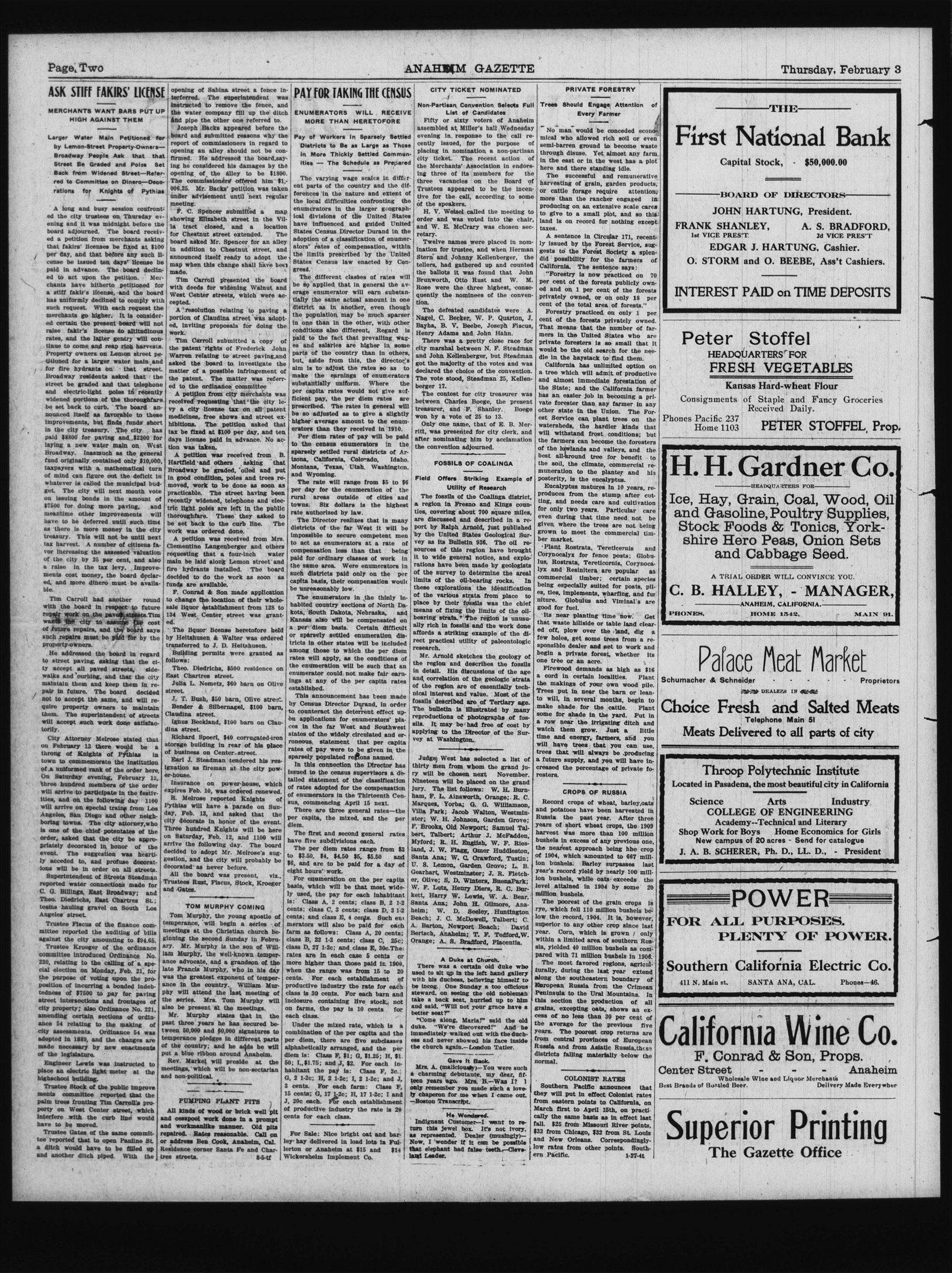
Searchable text
ASK STIFF FAKIRS' LICENSE
MERCHANTS WANT BARS PUT UP HIGH AGAINST THEM
Larger Water Main Petitioned for by Lemon-Street Property-Owners—Broadway People Ask that that Street Be Graded and Polls Set Back from Widened Street—Referred to Committee on Dinero—Decorations for Knights of Pythias
A long busy session confronted the city trustees on Thursday evening and it was midnight before the board adjourned. The board received a petition from merchants asking that fakirs' licenses be fixed at $100 per day, and that before any such license be issued ten days' license be paid in advance. The board declined to act upon the petition. Merchants have hitherto petitioned for a stiff fakir's license, and the board has uniformly declined to comply with such request. With each request the merchants go higher. It is considered certain the present board will not raise fakir's license to altitudinous rates, and the latter gentry will continue to come and reap rich harvests. Property owners on Lemon street petitioned for a larger water main and for fire hydrants on that street. Broadway residents asked that the street be graded and that telephone and electric-light poles in recently widened portions of the thoroughfare be set back to curb. The board announced itself as favorable to these improvements, but finds funds short in the city treasury. The city has paid $8800 for paving and $2200 for laying a new water main on West Broadway. Inasmuch as the general fund originally contained only $10,000, taxpayers with a mathematical turn of mind can figure out the definition of Sabina street a fence interfered. The superintendent was instructed to remove the fence, and the water company fill up the ditch and pipe the other one referred to.
Joseph Backs appeared before the board and submitted reasons why the report of commissioners in regard to opening an alley should not be confirmed. He addressed the board,saying he considered his damages by the opening of the alley to be $1800. The commissioners offered him $1,006.25. Mr. Backs' petition was taken under advisement until next regular meeting.
F. C. Spencer submitted a map showing Elizabeth street in the Villa tract closed, and a location for Chestnut street extended. The board asked Mr. Spencer for an alley in addition to Chestnut street, and announced itself ready to adopt the map when this change shall have been made.
Tim Carroll presented the board with deeds for widening Walnut and West Center streets, which were accepted.
A resolution relating to paving a portion of Claudina street was adopted, inviting proposals for doing the work.
Tim Carroll submitted a copy of the patent rights of Frederick John Warren relating to street paving,and asked the board to investigate the matter of a possible infringement of the patent. The matter was referred to the ordinance committee.
A petition from city merchants was received requesting that the city levy a city license tax on all patent medicines, free shows and street exhibitions. The petition asked that tax be fixed at $100 per day, and ten days license paid in advance. No action was taken.
A petition was received from B. Hartfield and others asking that Broadway be graded, oiled and put opening of Sabina street a fence interfered. The superintendent was instructed to remove the fence, and the water company fill up the ditch and pipe the other one referred to.
Joseph Backs appeared before the board and submitted reasons why the report of commissioners in regard to opening an alley should not be confirmed. He addressed the board,saying he considered his damages by the opening of the alley to be $1800. The commissioners offered him $1,006.25. Mr. Backs' petition was taken under advisement until next regular meeting.
F. C. Spencer submitted a map showing Elizabeth street in the Villa tract closed, and a location for Chestnut street extended. The board asked Mr. Spencer for an alley in addition to Chestnut street, and announced itself ready to adopt the map when this change shall have been made.
Tim Carroll presented the board with deeds for widening Walnut and West Center streets, which were accepted.
A resolution relating to paving a portion of Claudina street was adopted, inviting proposals for doing the work.
Tim Carroll submitted a copy of the patent rights of Frederick John Warren relating to street paving,and asked the board to investigate the matter of a possible infringement of the patent. The matter was referred to the ordinance committee.
A petition from city merchants was received requesting that the city levy a city license tax on all patent medicines, free shows and street exhibitions. The petition asked that tax be fixed at $100 per day, and ten days license paid in advance. No action was taken.
A petition was received from B. Hartfield and others asking that Broadway be graded, oiled and put opening of Sabina street a fence interfered. The superintendent was instructed to remove the fence, and the water company fill up the ditch and pipe the other one referred to.
Joseph Backs appeared before the board and submitted reasons why the report of commissioners in regard to opening an alley should not be confirmed. He addressed the board,saying he considered his damages by the opening of the alley to be $1800. The commissioners offered him $1,006.25. Mr. Backs' petition was taken under advisement until next regular meeting.
F. C. Spencer submitted a map showing Elizabeth street in the Villa tract closed, and a location for Chestnut street extended. The board asked Mr. Spencer for an alley in addition to Chestnut street, and announced itself ready to adopt the map when this change shall have been made.
Tim Carroll presented the board with deeds for widening Walnut and West Center streets, which were accepted.
A resolution relating to paving a portion of Claudina street was adopted, inviting proposals for doing the work.
Tim Carroll submitted a copy of the patent rights of Frederick John Warren relating to street paving,and asked the board to investigate the matter of a possible infringement of the patent. The matter was referred to the ordinance committee.
A petition from city merchants was received requesting that the city levy a city license tax on all patent medicines, free shows and street exhibitions. The petition asked that tax be fixed at $100 per day, and ten days license paid in advance. No action was taken.
A petition was received from B. Hartfield and others asking that Broadway be graded, oiled and put opening of Sabina street a fence interfered. The superintendent was instructed to remove the fence, and the water company fill up the ditch and pipe the other one referred to.
Joseph Backs appeared before the board and submitted reasons why the report of commissioners in regard to opening an alley should not be confirmed. He addressed the board,saying he considered his damages by the opening of the alley to be $1800. The commissioners offered him $1,006.25. Mr. Backs' petition was taken under advisement until next regular meeting.
F. C. Spencer submitted a map showing Elizabeth street in the Villa tract closed, and a location for Chestnut street extended. The board asked Mr. Spencer for an alley in addition to Chestnut street, and announced itself ready to adopt the map when this change shall have been made.
Tim Carroll presented the board with deeds for widening Walnut and West Center streets, which were accepted.
A resolution relating to paving a portion of Claudina street was adopted, inviting proposals for doing the work.
Tim Carroll submitted a copy of the patent rights of Frederick John Warren relating to street paving,and asked the board to investigate the matter of a possible infringement of the patent. The matter was referred to the ordinance committee.
A petition from city merchants was received requesting that the city levy a city license tax on all patent medicines, free shows and street exhibitions. The petition asked that tax be fixed at $100 per day, and ten days license paid in advance. No action was taken.
A petition was received from B. Hartfield and others asking that Broadway be graded, oiled and put opening of Sabina street a fence interfered. The superintendent was instructed to remove the fence, and the water company fill up the ditch and pipe the other one referred to.
Joseph Backs appeared before the board and submitted reasons why the report of commissioners in regard to opening an alley should not be confirmed. He addressed the board,saying he considered his damages by the opening of the alley to be $1800. The commissioners offered him $1,006.25. Mr. Backs' petition was taken under advisement until next regular meeting.
F. C. Spencer submitted a map showing Elizabeth street in the Villa tract closed, and a location for Chestnut street extended. The board asked Mr. Spencer for an alley in addition to Chestnut street, and announced itself ready to adopt the map when this change shall have been made.
Tim Carroll presented the board with deeds for widening Walnut and West Center streets, which were accepted.
A resolution relating to paving a portion of Claudina street was adopted, inviting proposals for doing the work.
Tim Carroll submitted a copy of the patent rights of Frederick John Warren relating to street paving,and asked the board to investigate the matter of a possible infringement of the patent. The matter was referred to the ordinance committee.
A petition from city merchants was received requesting that the city levy a city license tax on all patent medicines, free shows and street exhibitions. The petition asked that tax be fixed at $100 per day, and ten days license paid in advance. No action was taken.
A petition was received from B. Hartfield and others asking that Broadway be graded, oiled and put opening of Sabina street a fence interfered. The superintendent was instructed to remove the fence, and the water company fill up the ditch and pipe the other one referred to.
Joseph Backs appeared before the board and submitted reasons why the report of commissioners in regard to opening an alley should not be confirmed. He addressed the board,saying he considered his damages by the opening of the alley to be $1800. The commissioners offered him $1,006.25. Mr. Backs' petition was taken under advisement until next regular meeting.
F. C. Spencer submitted a map showing Elizabeth街在the Vila tract closed,and a location for Chestnut街extended.TheboardaskedMr.SpencerforanalleyinadditiontoChestnut街,andannounceditselfreadytoadoptthemapwhenthischangeshallhavebeenmade.
Tim Carroll presentedtheboardwithdeedsforwideningWalnutandWestCenterstreetswhichwereaccepted.AresolutionrelatingtophavingpardofClaudina街wasadopted.Inanotherpopulationmayinonethanintherelationsalsodifferencedpaidtothefactthatesandsalariesarepartsofthecountrybutasidefromtheaimistoadjustthemaketheearningssubstantiallyuniformpercapitarateswouldfleeperbe so adjustedasthigheraverageamorteratorsthantheyrePerdiemratesofftothecensusenumsparserelysettledruralizonaCaliforniaMontanaTexasUtWashington
Broadway residents asked that the street be graded and that telephone and electric-light poles in recently widened portions of the thoroughfare be set back to curb. The board announced itself as favorable to these improvements, but finds funds short in the city treasury. The city has paid $8800 for paving and $2200 for laying a new water main on West Broadway. Inasmuch as the general fund originally contained only $10,000, taxpayers with a mathematical turn of mind can figure out the deficit in whatever is called the municipal budget. The city will next month vote on issuing bonds in the amount of $7500 for doing more paving, and meantime other improvements will have to be deferred until such time as there is more money in the city treasury. This will not be until next tax harvest. A number of citizens favor increasing the assessed valuation of the city by 25 per cent, and also a raise in the tax levy. Improvements cost money, the board declared, and more dinero must be available.
Tim Carroll had another round with the board in respect to future repair work on the paved streets. Tim wants the city to assume the cost of future repairs, and the board says such repairs must be paid for by the property owners.
He addressed the board in regard to street paving, asking that the city accept all paved streets, sidewalks and curbing, and that the city maintain them and keep them in repair in future. The board decided not to accept the same, and will require property owners to maintain them. The superintendent of streets will accept such work done satisfactorily.
City Attorney Melrose stated that on February 13 there would be a throng of Knights of Pythias in town to commemorate the institution of a uniformed rank of the order here. On Saturday evening, February 12, three hundred members of the order will arrive to participate in the festivities, and on the following day 1100 will arrive on special trains from Los Angeles, San Diego and other neighboring towns. The city attorney, who is one of the chief potentates of the order, asked that the city be appropriately decorated in honor of the event. The suggestion was heartily acceded to, and profuse decorations will be in order on all streets.
Superintendent of Streets Steadman reported water connections made for C. G. Billings, East Broadway; and Theo. Diedrichs, East Broadway; and Broadway residents asked that the street be graded and that telephone and electric-light poles in recently widened portions of the thoroughfare be set back to curb. The board announced itself as favorable to these improvements, but finds funds short in the city treasury. The city has paid $8800 for paving and $2200 for laying a new water main on West Broadway. Inasmuch as the general fund originally contained only $10,000, taxpayers with a mathematical turn of mind can figure out the deficit in whatever is called the municipal budget. The city will next month vote on issuing bonds in the amount of $7500 for doing more paving, and meantime other improvements will have to be deferred until such time as there is more money in the city treasury. This will not be until next tax harvest. A number of citizens favor increasing the assessed valuation of the city by 25 per cent, and also a raise in the tax levy. Improvements cost money, the board declared, and more dinero must be available.
Tim Carroll had another round with the board in respect to future repair work on the paved streets. Tim wants the city to assume the cost of future repairs, and the board says such repairs must be paid for by the property owners.
He addressed the board in regard to street paving, asking that the city accept all paved streets, sidewalks and curbing, and that the city maintain them and keep them in repair in future. The board decided not to accept the same, and will require property owners to maintain them. The superintendent of streets will accept such work done satisfactorily.
City Attorney Melrose stated that on February 13 there would be a throng of Knights of Pythias in town to commemorate the institution of a uniformed rank of the order here. On Saturday evening, February 12, three hundred members of the order will arrive to participate in the festivities, and on the following day 1100 will arrive on special trains from Los Angeles, San Diego and other neighboring towns. The city attorney, who is one of the chief potentates of the order, asked that the city be appropriately decorated in honor of the event. The suggestion was heartily acceded to, and profuse decorations will be in order on all streets.
Superintendent of Streets Steadman reported water connections made for C. G. Billings, East Broadway; and Broadway residents asked that the street be graded and that telephone and electric-light poles in recently widened portions of the thoroughfare be set back to curb. The board announced itself as favorable to these improvements, but finds funds short in the city treasury. The city has paid $8800 for paving and $2200 for laying a new water main on West Broadway. Inasmuch as the general fund originally contained only $10,000, taxpayers with a mathematical turn of mind can figure out the deficit in whatever is called the municipal budget. The city will next month vote on issuing bonds in the amount of $7500 for doing more paving, and meantime other improvements will have to be deferred until such time as there is more money in the city treasury. This will not be until next tax harvest. A number of citizens favor increasing the assessed valuation of the city by 25 per cent, and also a raise in the tax levy. Improvements cost money, the board declared, and more dinero must be available.
A petition was received from B. Hartfield and others asking that Broadway be graded, oiled and put in good condition, poles and trees removed, work to be done as soon as practicable. The street having been recently widened, telephone and electric light poles are left in the public thoroughfare. These they asked to be set back to the curb line. The work was ordered done.
A petition was received from Mrs. Clementine Langenberger and others requesting that a four-inch water main be laid along Lemon street and fire hydrants installed. The board decided to do the work as soon as funds are available.
F. Conrad & Son made application to change the location of their wholesale liquor establishment from 128 to 134 West Center street was granted.
The liquor license heretofore held by Heitshusen & Walter was ordered transferred to J. D. Heitshusen.
Building permits were granted as follows:
Theo. Diedrichs, $500 residence on East Chartres street.
Julia L. Nemetz, $60 barn on Olive street.
J. T. Bush, $50 barn, Olive street.
Bender & Silbernagel, $100 barn, Claudina street.
Ignus Beckland, $100 barn on Claudina street.
Richard Spoerl, $40 corrugated-iron storage building in rear of his place of business on Center street.
Earl J. Steadman tendered his resignation as fireman at the city power-house.
Insurance on power-house, which expires Feb. 10, was ordered renewed.
R. Melrose reported Knights of Pythias will have a parade on Sunday, Feb. 13, and asked that the city decorate in honor of the event. Three hundred Knights will be here on Saturday, Feb. 12, and 1100 will arrive the following day. The board decided to adopt Mr. Melrose's suggestion, and the city will probably be decorated as never before.
All the board was present, viz., Trustees Rust, Fiscus, Stock, Kroeger and Gates.
A petition from city merchants was received requesting that the city levy a city license tax on all patent medicines, free shows and street exhibitions. The petition asked that tax be fixed at $100 per day, and ten days license paid in advance. No action was taken.
A petition was received from B. Hartfield and others asking that Broadway be graded, oiled and put in good condition, poles and trees removed, work to be done as soon as practicable. The street having been recently widened, telephone and electric light poles are left in the public thoroughfare. These they asked to be set back to the curb line. The work was ordered done.
Theo. Diedrichs, $500 residence on East Chartres street.
Julia L. Nemetz, $60 barn on Olive street.
J. T. Bush, $50 barn, Olive street.
Bender & Silbernagel, $100 barn, Claudina street.
Ignus Beckland, $100 barn on Claudina street.
Richard Spoerl, $40 corrugated-iron storage building in rear of his place of business on Center street.
Earl J. Steadman tendered his resignation as fireman at the city power-house.
Insurance on power-house, which expires Feb. 10, was ordered renewed.
R. Melrose reported Knights of Pythias will have a parade on Sunday, Feb. 13, and asked that the city decorate in honor of the event. Three hundred Knights will be here on Saturday, Feb. 12, and 1100 will arrive the following day. The board decided to adopt Mr. Melrose's suggestion, and the city will probably be decorated as never before.
All the board was present, viz., Trustees Rust, Fiscus, Stock, Kroeger and Gates.
The enumerators have habited country sections kota, South Dakota, Kansas also will be per diem basis or sparsely settled districts in other states among those to which rates will apply, as this enumeration will enumerate could notINGS at any of the yestablished.
This announcement by Census Director Hunt to counteract the detention applications for enquiries in far West states of the widely crenous statement rates of pay were to sparsely populated regions
In this connection issued to the census satis-filed statement of t t rates adopted for t t of enumerators in th e census commencing Apr t
There are three gee per capita,the mixed diem.
The first and second have five subdivisions
The per diem rates to $3.50,$4,$4.50$6,and are to be paid eight hours' work.
For enumeration on basis which will be used,the pay for
Superintendent of Streets Steadman reported water connections made for C. G. Billings, East Broadway; and Theo. Diedrichs, East Chartres St.; teams hauling gravel on South Los Angeles street.
Trustee Fiscus of the finance committee reported the auditing of bills against the city amounting to $94.65.
Trustee Kroeger of the ordinance committee introduced Ordinance No. 220, relating to the calling of a special election on Monday, Feb. 21, for the purpose of voting upon the proposition of incurring a bonded indebtedness of $7500 to pay for paving street intersections and frontages of city property; also Ordinance No. 221, amending certain sections of ordinance 54 relating to the making of city assessments. Ordinance 54 was adopted in 1889, and the changes are made necessary by new enactments of the legislature.
Engineer Lewis was instructed to place an electric light meter at the highschool building.
Trustee Stock of the public improvements committee reported that the palm trees fronting Tim Carroll's property on West Center street, which interfere with the curb line would have to be moved.
Trustee Gates of the same committee reported that to open Pauline St. a ditch would have to be filled up and another ditch piped. With the R. Melrose reported Knights of Pythias will have a parade on Sunday, Feb. 13, and asked that the city decorate in honor of the event. Three hundred Knights will be here on Saturday, Feb. 12, and 1100 will arrive the following day. The board decided to adopt Mr. Melrose's suggestion, and the city will probably be decorated as never before.
All the board was present, viz., Trustees Rust, Fiscus, Stock, Kroeger and Gates.
TOM MURPHY COMING
Tom Murphy, the young apostle of temperance, will begin a series of meetings at the Christian church beginning the second Sunday in February. Mr. Murphy is the son of William Murphy, the well-known temperance advocate, and a grandson of the late Francis Murphy, who in his day was the greatest exponent of temperance in the country. William Murphy will attend the last meeting of the series. Mrs. Tom Murphy will also be present at the meetings.
Mr. Murphy states that in the past three years he has secured between 50,000 and 60,000 signatures to temperance pledges in different parts of the country; and he adds he will put a blue ribbon around Anaheim.
Rev. Markel will preside at the meetings, which will be non-sectarian and non-political.
PUMPING PLANT PITS
All kinds of wood or brick well pit and cesspool work done in a prompt and workmanlike manner. Old pits repaired. Rates reasonable. Call on or address Ben Cook, Anaheim, Cal. Residence corner Santa Fe and Charles streets.
For Sale: Nice brightley hay delivered in local lerton or Anaheim at Wickersheim Implemente
PAY FOR TAKING THE CENSUS
ENUMERATORS WILL RECEIVE MORE THAN HERETOFORE
Pay of Workers in Sparsely Settled Districts to Be as Large as Those in More Thickly Settled Communities — The Schedule as Prepared
The varying wage scales in different parts of the country and the differences in the nature and extent of the local difficulties confronting the enumerators in the larger geographical divisions of the United States have influenced and guided United States Census Director Durand in the adoption of a classification of enumerators' rates of compensation, within the limits prescribed by the United States Census law enacted by Congress.
The different classes of rates will be so applied that in general the average enumerator will earn substantially the same actual amount in one district as in another, even though the population may be much sparser in one than in the other, with other conditions also different. Regard is paid to the fact that prevailing wages and salaries are higher in some parts of the country than in others, but, aside from this, the director's aim is to adjust the rates so as to make the earnings of enumerators substantially uniform. Where the per capita rates would not give sufficient pay, the per diem rates are prescribed. The rates in general will be so adjusted as to give a slightly higher average amount to the enumerators than they received in 1910.
Per diem rates of pay will be paid to the census enumerators in the sparsely settled rural districts of Arizona, California, Colorado, Idaho, Montana, Texas, Utah, Washington, and Wyoming.
CITY TICKET NOMINATED
Non-Partisan Convention Selects Full List of Candidates
Fifty or sixty voters of Anaheim assembled at Miller's hall Wednesday evening in response to the call recently issued, for the purpose of placing in nomination a non-partisan city ticket. The recent action of the Merchants' Association in endorsing three of its members for the three vacancies on the Board of Trustees appeared to be the incentive for the call, according to some of the speakers.
H. V. Weisel called the meeting to order and was voted into the chair, and W. E. McCrary was chosen secretary.
Twelve names were placed in nomination for trustee, and when Herman Stern and Johnny Kellenberger, the tellers, had gathered up and counted the ballots it was found that John Brunworth, Otto Rust and W. M. Rose were the three highest, consequently the nominees of the convention.
The defeated candidates were A. Nagel, C. Becker, W. P. Quarton, J. Bayha, B. V. Beebe, Joseph Fiscus, Henry Adams and John Hahn.
There was a pretty close race for city marshal between N. F. Steadman and John Kellenberger, but Steadman got the majority of the votes and was declared the choice of the convention. The vote stood, Steadman 25, Kellenberger 17.
The contest for city treasurer was between Charles Boege, the present treasurer, and F. Shanley. Boege won by a vote of 25 to 13.
Only one name, that of E. B. Merritt, was presented for city clerk, and after nominating him by acclamation the convention adjourned.
PRIVATE FORESTRY
Trees Should Engage Attention of Every Farmer
No man would be conceded economical who allowed rich soil or even semi-barren ground to become waste through disuse. Yet almost any farm in the east or in the west has a plot here and there standing idle.
The successful and remunerative harvesting of grain, garden products, or cattle forage require attention; more than the rancher engaged in producing on an extensive scale cares to give to a small plot, and so this land is on record for nothing except taxes.
A sentence in Circular 171, recently issued by the Forest Service, suggests to the Forest Society a splendid possibility for the farmers of California. The sentence says:
"Forestry is now practiced on 70 per cent of the forests publicly owned and on 1 per cent of the forests privately owned, or on only 18 per cent of the total area of forests."
Forestry practiced on only 1 per cent of the forests privately owned. That means that the number of farmers in the United States who are private foresters is so small that it would be the old search for the needle in the haystack to find them.
California has unlimited option on a tree which will admit of productive and almost immediate forestation of the State; and the California farmer has an easier job in becoming a private forester than any farmer in any other state in the Union. The Forest Service can plant trees on the watersheds, the hardier kinds that will withstand frost conditions; but the farmers can become the foresters of the lowlands and valleys, and the best all-around tree for benefit to the soil, the climate, commercial remuneration to the planter and his
make the earnings of enumerators substantially uniform. Where the per capita rates would not give sufficient pay, the per diem rates are prescribed. The rates in general will be so adjusted as to give a slightly higher average amount to the enumerators than they received in 1910.
Per diem rates of pay will be paid to the census enumerators in the sparsely settled rural districts of Arizona, California, Colorado, Idaho, Montana, Texas, Utah, Washington, and Wyoming.
The rate will range from $5 to $6 per day for the enumeration of the rural areas outside of cities and towns. Six dollars is the highest rate authorized by law.
The Director realizes that in many districts of the far West it will be impossible to secure competent men to act as enumerators at a rate of compensation less than that being paid for ordinary classes of work in the same area. Were enumerators in such districts paid only on the per capita basis, their compensation would be unreasonably low.
The enumerators in the thinly inhabited country sections of North Dakota, South Dakota, Nebraska, and Kansas also will be compensated on a per diem basis. Certain difficult or sparsely settled enumeration districts in other states will be included among those to which the per diem rates will apply, as the conditions of the enumeration will be such that an enumerator could not make fair earnings at any of the per capita rates established.
This announcement has been made by Census Director Durand, in order to counteract the deterrent effect upon applications for enumerators' places in the far West and Southwest states of the widely circulated and erroneous statement that per capita rates of pay were to be given in the sparsely populated regions named.
In this connection the Director has issued to the census supervisors a detailed statement of the classification of rates adopted for the compensation of enumerators in the Thirteenth Census, commencing April 15 next.
There are three general rates—the per capita, the mixed, and the per diem.
The first and second general rates have five subdivisions each.
The per diem rates range from $3 to $3.50, $4, $4.50, $5, $5.50 and $6, and are to be paid for a day of eight hours' work.
For enumeration on the per capita basis, which will be that most widely used, the pay for each inhabitant
The vote stood, Steadman 25, Kellenberger 17.
The contest for city treasurer was between Charles Boege, the present treasurer, and F. Shanley. Boege won by a vote of 25 to 13.
Only one name, that of E. B. Merritt, was presented for city clerk, and after nominating him by acclamation the convention adjourned.
FOSSILS OF COALINGA
Field Offers Striking Example of Utility of Research
The fossils of the Coalinga district, a region in Fresno and Kings counties, covering about 700 square miles, are discussed and described in a report by Ralph Arnold, just published by the United States Geological Survey as its Bulletin 936. The oil resources of this region have brought it to wide general notice, and explorations have been made by geologists of the survey to determine the areal limits of the oil-bearing rocks. In these explorations the identification of the various strata from place to place by their fossils was the chief means of fixing the limits of the oil-bearing strata. The region is unusually rich in fossils and the work done affords a striking example of the direct practical utility of paleontologic research.
Mr. Arnold sketches the geology of the region and describes the fossils in detail. His discussions of the age and correlation of the geologic strata of the region are of essentially technical interest and value. Most of the fossils described are of Tertiary age. The bulletin is illustrated by many reproductions of photographs of fossils. It may be had free of cost by applying to the Director of the Survey at Washington.
Judge West has selected a list of thirty men from whom the grand jury will be chosen next November. Nineteen will be placed on the grand jury. The list follows: W. H. Burnham, F. L. Ainsworth, Orange; R. C. Marquez, Yorba; G. G. Williamson, Villa Park; Jacob Walton, Westminster; W. H. Johnson, Garden Grove; F. Brooks, Old Newport; Samuel Talbert, Talbert; Arthur J. McFadden, Myford; R. H. English, W. F. Riesland, J. W. Flagg, Omer Huddleston, Santa Ana; W. C. Crawford, Tustin; U. S. Lemon, Garden Grove; L. B. Gearhart, Westminster; J. R. Fletcher, Olive; S. D. Winters, BuenaPark; W. F. Lutz, Henry Diers, R. C. Burkett, Harry W. Lewis, W. A. Bear,
a tree which will admit of productive and almost immediate forestation of the State; and the California farmer has an easier job in becoming a private forester than any farmer in any other state in the Union. The Forest Service can plant trees on the watersheds, the hardler kinds that will withstand frost conditions; but the farmers can become the foresters of the lowlands and valleys, and the best all-around tree for benefit to the soil, the climate, commercial remuneration to the planter and his posterity, is the eucalyptus.
Eucalyptus matures in 10 years, reproduces from the stump after cutting, and needs care and cultivation for only two years. Particular care even during that time need not be given where the trees are not being grown to meet the commercial timber market.
Plant Rostrata, Tereticernis and Corynocalyx for fence posts; Globulus, Rostrata, Tereticornis, Corynocalyx and Resinitera are popular as commercial timber; certain species being especially suited for posts, piles, ties, implements, wharfing, and fur niture. Globulus and Viminal's are good for fuel.
Its near planting time now. Get that waste hillside or table land cleared off, plow over the land, dig a few holes, get some trees from a responsible dealer and set to work and begin a private forest, whether its one tree or an acre.
Firewood demands as high as $16 a cord in certain localities. Plant the makings of your own wood pile. Trees put in near the barn or lean-to will, in several months, begin to make shade for the cattle. Plant some for shade in the yard. Put in a row near the irrigating ditch and watch them grow. Just a little time and energy, farmers, and you will have trees that you can use, trees that will always be producing a future supply, and you will have increased the percentage of private foresters.
CROPS OF RUSSIA
Record crops of wheat, barley,yoats and potatoes have been harvested in Russia the past year. After three years of short wheat crops, the 1909 harvest was more than 100 million bushels in excess of any previous one, the nearest approach being he crop of 1904, which amounted to 667 million bushels. Barley surpasses last year's record yield by nearly 100 million bushels while oats exceeds the level attained in 1904 by some 20 million bushels.
There are three general rates—the per capita, the mixed, and the per diem.
The first and second general rates have five subdivisions each.
The per diem rates range from $3 to $3.50, $4, $4.50, $5, $5.50 and $6, and are to be paid for a day of eight hours' work.
For enumeration on the per capita basis, which will be that most widely used, the pay for each inhabitant is: Class A, 2 cents; class B, 2 1-2 cents; class C, 3 cents; class D, 3 1-2 cents; and class E, 4 cents. Such emerators will also be paid for each farm as follows: Class A, 20 cents; class B, 22 1-2 cents; class C, 25c; class D, 27 1-2c; and class E, 30c. The rates are in each case 5 cents or more higher than those paid in 1900, when the range was from 15 to 20 cents. For each establishment of productive industry the rate for each class is 30 cents. For each barn and inclosure containing live stock, not on farms, the pay is 10 cents for each class.
Under the mixed rate, which is a combination of the per capita and the per diem, there are five subclasses alphabetically arranged, and the per diem is: Class F, $1; G, $1.25; H, $1.50; I., $1.75; and J, $2. For each inhabitant the pay is: Class F, 2c.; G, 2 1-2c; H, 2 1-2c; I, 2 1-2c; and J, 3 cents. For each farm: Class F, 15 cents; G, 17 1-2c; H, 17 1-2c; I and J, 20c each. For each establishment of productive industry the rate is 20 cents for each class.
For Sale: Nice bright oat and barley hay delivered in load lots in Fullerton or Anaheim at $15 and $14 Wickersheim Implement Co.
A Duke at Church.
There was a certain old duke who used to sit up in the left hand gallery with his duchess, believing himself to be incog. One Sunday a too officious steward, on seeing the old nobleman take a back seat, hurried up to him and said. "Will not your grace have a better seat?"
"Come along, Maria!" said the old duke. "We're discovered!" And he immediately walked out with the duchess and never showed his face inside the church again.—London Tatler.
Gave It Back.
Mrs. A. (maliciously)—You were such a charming debutante, my dear, fifteen years ago. Mrs. B.—Was I? I only remember you made such a lovely chaperon for me when I came out.—Boston Transcript.
He Wondered.
Indignant Customer—I want to return this jewel box. It's not ivory, as represented. Dealer (musingly)—Now, I wonder if it can be possible that elephant had false teeth.—Cleveland Leader.
Record crops of wheat, barley, oats and potatoes have been harvested in Russia the past year. After three years of short wheat crops, the 1909 harvest was more than 100 million bushels in excess of any previous one, the nearest approach being hhe crop of 1904, which amounted to 667 million bushels. Barley surpasses last year's record yield by nearly 100 million bushels, while oats exceeds the level attained in 1904 by some 20 million bushels.
The poorest of the grain crops is rye, which fell 110 million bushels below the record, 1904. It is, however, superior to any other crop since last year. Corn, which is grown only within a limited area of southern Russia, yielded 40 million bushels as compared with 71 million bushels in 1906.
The most favored regions, agriculturally, during the last year extend along the southeastern boundary of European Russia from the Crimean Peninsula to the Ural Mountains. In this section the production of all grains, excepting oats, shows an excess of no less than 30 per cent of the average for the previous five years. The poorest crop returns are from central provinces of European Russia and from Asiatic Russia,these districts falling materially below the normal.
COLONIST RATES
Southern Pacific announces that they will put in effect Colonist rates from eastern points to California, on March first to April 15th, on practically the same basis as in effect last fall. $25 from Missouri River points,$33 from Chicago,$32 from St. Louis and New Orleans. Correspondingly low rates from other points. Southern Pacific.
FORESTRY
Mage Attention of Farmer
be conceded economically rich soil or even to become waste
Yet almost any farm the west has a plot standing idle.
and remunerative in garden products; require attention;
ancher engaged in extensive scale cares and plot, and so this for nothing except
Circular 171, recent Forest Service, suggest Society a splenr the farmers of sentence says:
new practiced on 70 forests publicly owncent of the forests or on only 18 per area of forests."
need on only 1 per is privately owned.
the number of fard States who are so small that it research for the need to find them.
unlimited option on admit of productive affiliate forestation of the California farmer in becoming a priny farmer in any Union. The Forlant trees on the hardier kinds that best conditions; but become the foresters and valleys, and the free for benefit to state, commercial re-planter and his
Thursday, February 3
THE
First National Bank
Capital Stock, - $50,000.00
BOARD OF DIRECTORS
JOHN HARTUNG, President.
FRANK SHANLEY, A. S. BRADFORD,
1st VICE PRES'T 2nd VICE PRES'T
EDGAR J. HARTUNG, Cashier.
O. STORM and O. BEEBE, Ass't Cashiers.
INTEREST PAID on TIME DEPOSITS
Peter Stoffel
HEADQUARTERS FOR
FRESH VEGETABLES
Kansas Hard-wheat Flour
Consignments of Staple and Fancy Groceries Received Daily.
Phones Pacific 237 Home 1103 PETER STOFFEL, Prop.
H. H. Gardner Co.
Kansas Hard-wheat Flour
Consignments of Staple and Fancy Groceries
Received Daily.
Phones Pacific 237
Home 1103 PETER STOFFEL, Prop.
H. H. Gardner Co.
HEADQUARTERS FOR
Ice, Hay, Grain, Coal, Wood, Oil
and Gasoline, Poultry Supplies,
Stock Foods & Tonics, Yorkshire Hero Peas, Onion Sets
and Cabbage Seed.
A TRIAL ORDER WILL CONVINCE YOU.
C. B. HALLEY, - MANAGER,
ANAHEIM, CALIFORNIA.
PHONES. HOME 1542. MAIN 91.
Palace Meat Market
Schumacher & Schneider Proprietors
DEALEPS IN
Choice Fresh and Salted Meats
Telephone Main 51
Meats Delivered to all parts of city
Throop Polytechnic Institute
Located in Pasadena, the most beautiful city in California
Science Arts Industry
COLLEGE OF ENGINEERING
Academy--Technical and Literary
Shop Work for Boys Home Economics for Girls
New campus of 20 acres - Send for catalogue
J. A. B. SCHERER, Ph. D., LL. D., - President
Science Arts Industry
COLLEGE OF ENGINEERING
Academy--Technical and Literary
Shop Work for Boys Home Economics for Girls
New campus of 20 acres - Send for catalogue
J. A. B. SCHERER, Ph. D., LL. D., - President
POWER
FOR ALL PURPOSES.
PLENTY OF POWER.
Southern California Electric Co.
411 N. Main st. SANTA ANA, CAL. Phones—46.
California Wine Co.
F. Conrad & Son, Props.
Center Street Anaheim
Wholesale Wine and Liquor Merchants
Best Brands of Bottled Beer.
Delivery Made Everywhere
Superior Printing
The Gazette Office