anaheim-gazette 1910-01-27
Scanned page
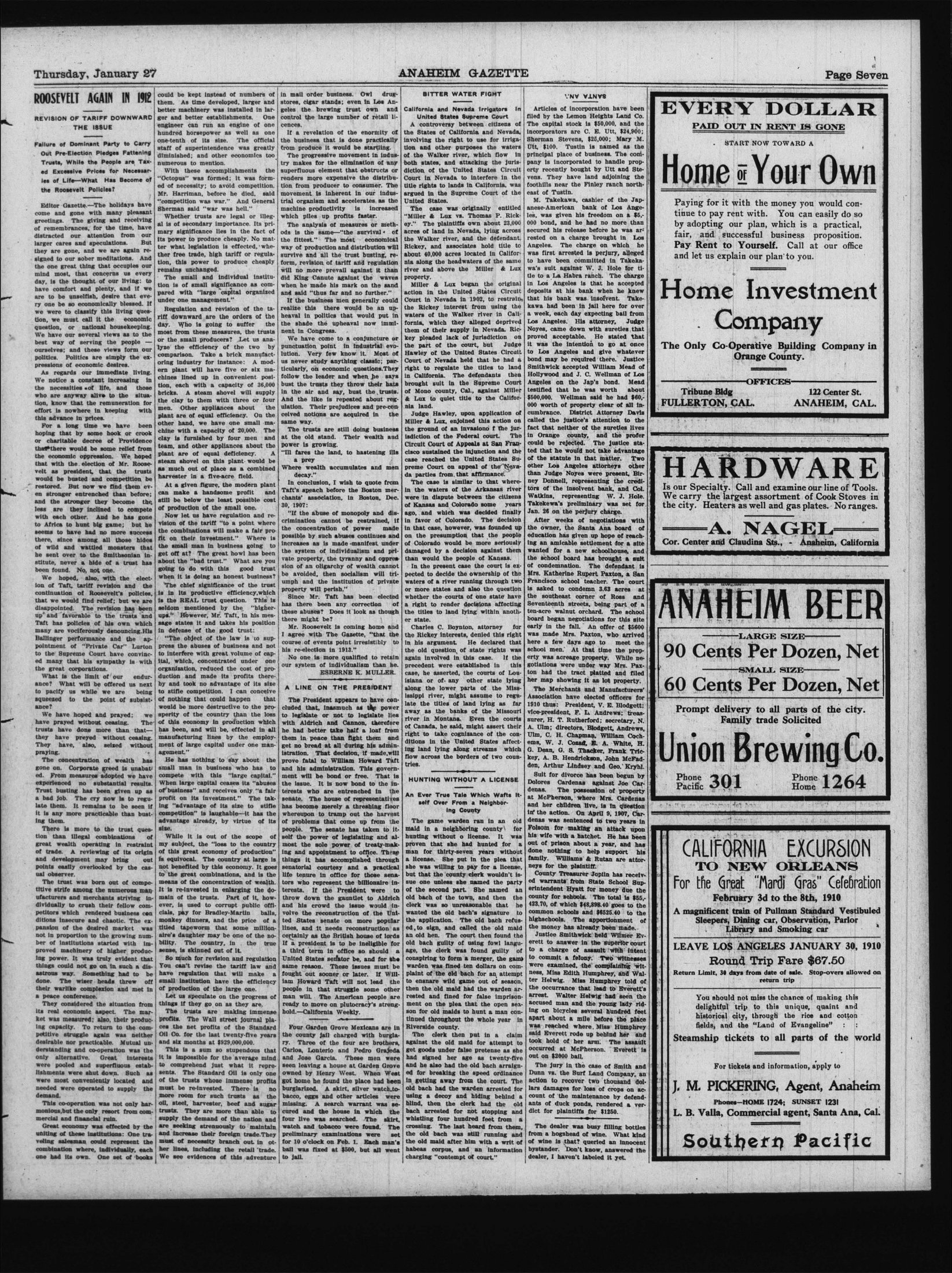
Searchable text
ROOSEVELT AGAIN IN 1912
REVISION OF TARIFF DOWNWARD THE ISSUE
Failure of Dominant Party to Carry Out Pre-Election Pledges Fattening Trusts, While the People are Taxed Excessive Prices for Necessaries of Life—What Has Become of the Roosevelt Policies?
Editor Gazette.—The holidays have come and gone with many pleasant greetings. The giving and receiving of remembrances, for the time, have distracted our attention from our larger cares and speculations. But they are gone, and we are again resigned to our sober meditations. And the one great thing that occupies our mind most, that concerns us every day, is the thought of our living: to have comfort and plenty, and if we are to be unselfish, desire that every one be so economically blessed. If we were to classify this living question, we must call it the economic question, or national housekeeping. We have our several views as to the best way of serving the people — ourselves; and these views form our politics. Politics are simply the expressions of economic desires.
As regards our immediate living. We notice a constant increasing in the necessities of life, and those who are anyway alive to the situation, know that the remuneration for effort is nowhere in keeping with this advance in prices.
For a long time we have been hoping that by some hook or crook or charitable decree of Providence that there would be some relief from the economic oppression. We hoped that with the election of Mr. Roosevelt as president, that the trusts could be kept instead of numbers of them. As time developed, larger and better machinery was installed in larger and better establishments. One engineer can run an engine of one hundred horsepower as well as one tenth of its size. The official staff of superintendence was greatly diminished; and other economics too numerous to mention.
With these accomplishments the "Octopus" was formed; it was formed of necessity; to avoid competition. Mr. Harriman, before he died, said "competition was war." And General Sherman said "war was hell."
Whether trusts are legal or illegal is of secondary importance. Its primary significance lies in the fact of its power to produce cheaply. No matter what legislation is effected, whether free trade, high tariff or regulation, this power to produce cheaply remains unchanged.
The small and individual institution is of small significance as compared with "large capital organized under one management."
Regulation and revision of the tariff downward are the orders of the day. Who is going to suffer the most from these measures, the trusts or the small producers? Let us analyze the efficiency of the two by comparison. Take a brick manufacturing industry for instance: A modern plant will have five or six machines lined up in convenient position, each with a capacity of 36,000 bricks. A steam shovel will supply the clay to them with three or four men. Other appliances about the plant are of equal efficiency. On the other hand, we have one small machine with a capacity of 20,000. The clay is furnished by four men and team, and other appliances about the plant are of equal deficiency. A steam shovel on this plant would be as much out of place as a combined mail order business stores, cigar stands; even lashes the brewing truth control the large number cences.
If a revelation of the business that is done from produce it would be difficult for the progressive movement makes for the elimination of superfluous element that renders more expensive from producer to consumer movement is inherent in trial organism and accelerate machine productivity which piles up profits.
The analysis of measures is the same—"the fittest." The most way of production and die survive and all the trust form, revision of tariff will no more prevail against King Canute again when he made his mark and said "thus far and thus."
If the business men get realize this there would be heaval in politics that cast the shade the upheavage in Congress.
We have come to a punctuation point in litigation. Very few know us never study anything ticularly, on economic or follow the leader and wust the trusts they thrill in the air and say, but And the like is repeatedulation. Their prejudiceceived notions are acquired same way.
The trusts are still dull at the old stand. The power is growing.
"Ill fares the land, to a prey Where wealth accumulates decay."
We notice a constant increasing in the necessities of life, and those who are anyway alive to the situation, know that the remuneration for effort is nowhere in keeping with this advance in prices.
For a long time we have been hoping that by some hook or crook or charitable decree of Providence that there would be some relief from the economic oppression. We hoped that with the election of Mr. Roosevelt as president, that the trusts would be busted and competition be restored. But now we find them even stronger entrenched than before; and the stronger they become the less are they inclined to compete with each other. And he has gone to Africa to hunt big game; but he seems to have had no more success there, since among all those hides of wild and wattled monsters that he sent over to the Smithsonian Institute, never a hide of a trust has been found. No, not one.
We hoped, also, with the election of Taft, tariff revision and the continuation of Roosevelt's policies, that we would find relief; but we are disappointed. The revision has been up and favorable to the trusts and Taft has policies of his own which many are vociferously denouncing. His Ballinger performance and the appointment of "Private Car" Lurton to the Supreme Court have convinced many that his sympathy is with the great corporations.
What is the limit of our endurance? What will be offered us next to pacify us while we are being squeezed to the point of subsistance?
We have hoped and prayed; we have prayed without ceasing. The trusts have done more than that—they have preyed without ceasing. They have, also, seized without praying.
The concentration of wealth has gone on. Corporate greed is unabated. From measures adopted we have experienced no substantial results. Trust busting has been given up as a bad job. The cry now is to regulate them. It remains to be seen if it is any more practicable than busting them.
There is more to the trust question than illegal combinations of great wealth operating in restraint of trade. A reviewing of its origin and development may bring out points easily overlooked by the casual observer.
The trust was born out of competitive strife among the numerous manufacturers and merchants striving in chines lined up in convenient position, each with a capacity of 36,000 bricks. A steam shovel will supply the clay to them with three or four men. Other appliances about the plant are of equal efficiency. On the other hand, we have one small machine with a capacity of 20,000. The clay is furnished by four men and team, and other appliances about the plant are of equal deficiency. A steam shovel on this plant would be as much out of place as a combined harvester in a five-acre field.
At a given figure, the modern plant can make a handsome profit and still be below the least possible cost of production of the small one.
Now let us have regulation and revision of the tariff "to a point where the combinations will make a fair profit on their investment." Where is the small man in business going to get off at? The great howl has been about the "bad trust." What are you going to do with this good trust when it is doing an honest business?
The chief significance of the trust is in its productive efficiency, which is the REAL trust question. This is seldom mentioned by the "higher-ups." However, Mr. Taft, in his message states it and takes his position in defense of the good trust:
"The object of the law is to suppress the abuses of business and not to interfere with great volume of capital, which, concentrated under one organization, reduced the cost of production and made its profits thereby and took no advantage of its size to stifle competition. I can conceive of nothing that could happen that would be more destructive to the prosperity of the country than the loss of this economy in production which has been, and will be, effected in all manufacturing lines by the employment of large capital under one management."
He has nothing to say about the small man in business who has to compete with this "large capital." When large capital ceases its "abuses of business" and receives only "a fair profit on its investment." The taking "advantage of its size to stifle competition" is laughable—it has the advantage already, by virtue of its size.
While it is out of the scope of my subject, the "loss to the country of this great economy of production" is equivocal. The country at large is not benefited by this economy. It goes to the great combinations, and is the means of the concentration of wealth. It is re-invested in enlarging the domain of the trusts. Part of it, how follow the leader and we bust the trusts they thrill in the air and say, but And the like is repeatedulation. Their prejudice celved notions are acquired same way.
The trusts are still dull at the old stand. Their power is growing.
"Ill fares the land, to a prey Where wealth accumulates decay."
In conclusion, I wish Taft's speech before the chants' association, in 30, 1907:
“If the abuse of monochromination cannot be avoided by concentration of possible by such abuses increases as is made mute by system of individual vate property, the tyranny of an oligarchy of people be avoided, then social umph and the institutional property will perish.”
Since Mr. Taft has has there been any cases abuses? Does it have might be?
Mr. Roosevelt is committed I agree with The Gaze course of events point in his re-election in 1913."
No one is more qualified our system of individuals ESBERNE
The trust was born out of competitive strife among the numerous manufacturers and merchants striving individually to crush their fellow competitors which rendered business conditions insecure and chaotic. The expansion of the desired market was not in proportion to the growing number of institutions started with improved machinery of higher producing power. It was truly evident that things could not go on in such a disastrous way. Something had to be done. The wiser heads threw off their warlike complexion and met in a peace conference.
They considered the situation from its real economic aspect. The market was measured; also, their producing capacity. To return to the competitive struggle again was neither desirable nor practicable. Mutual understanding and co-operation was the only alternative. Great interests were pooled and superfluous establishments were shut down. Such as were most conveniently located and needed were operated to supply the demand.
This co-operation was not only harmonious, but the only resort from commercial and financial ruin.
Great economy was effected by the uniting of these institutions: One traveling salesman could represent the combination where, individually, each one had its own. One set of books
While it is out of the scope of my subject, the "loss to the country of this great economy of production" is equivocal. The country at large is not benefited by this economy. It goes to the great combinations, and is the means of the concentration of wealth. It is re-invested in enlarging the domain of the trusts. Part of it, however, is used to corrupt public officials, pay for Bradley-Martin balls, monkey dinners, and the price of a titled tapeworm that some millionaire's daughter may be one of the nobility. The country, in the true sense, is skinned out of it.
So much for revision and regulation You can't revise the tariff law and have regulation that will make a small institution have the efficiency of production of the large one.
Let us speculate on the progress of things if they go on as they are.
The trusts are making immense profits. The Wall street journal places the net profits of the Standard Oil Co. for the last twenty-five years and six months at $929,000,000.
This is a sum so stupendous that it is impossible for the average mind to comprehend just what it represents. The Standard Oil is only one of the trusts whose immense profits must be re-invested. There is no more room for such trusts as the oil, steel, harvester, beef and sugar trusts. They are more than able to supply the demand of the nation and are seeking strenuously to maintain and increase their foreign trade. They must of necessity branch out in other lines, including the retail trade. We see evidences of this adventure
Four Garden Grove Mills the county jail chargedry. Three of the four Carlos, Lonterio and Jose Garcia. They seen leaving a house at owned by Henry West, got home he found the burglarized. A skirt, s bacco, eggs and other missing. A search was cured and the house four live was searched watch and tobacco were preliminary examination for 10 o'clock on Feb. 1 ball was fixed at $500, to jail.
in mail order business. Owl drugstores, cigar stands; even in Los Angeles the brewing trust own and control the large number of retail licences.
If a revelation of the enormity of the business that is done practically from produce it would be startling.
The progressive movement in industry makes for the elimination of any superfluous element that obstructs or renders more expensive the distribution from producer to consumer. The movement is inherent in our industrial organism and accelerates as the machine productivity is increased which piles up profits faster.
The analysis of measures or methods is the same—"the survival of the fittest." The most economical way of production and distribution will survive and all the trust busting, reform, revision of tariff and regulation will no more prevail against it than did King Canute against the waves when he made his mark on the sand and said "thus far and no further."
If the business men generally could realize this there would be an upheaval in politics that would put in the shade the upheaval now imminent in Congress.
We have come to a conjuncture or punctuation point in industrial evolution. Very few know it. Most of us never study anything classic; particularly, on economic questions. They follow the leader and when he says bust the trusts they throw their hats in the air and say, bust the trusts. And the like is repeated about regulation. Their prejudices and pre-conceived notions are acquired in the same way.
The trusts are still doing business at the old stand. Their wealth and power is growing.
"Ill fares the land, to hastening illis a prey"
Where wealth accumulates and men decay."
follow the leader and when he says bust the trusts they throw their hats in the air and say, bust the trusts. And the like is repeated about regulation. Their prejudices and pre-conceived notions are acquired in the same way.
The trusts are still doing business at the old stand. Their wealth and power is growing.
"Ill fares the land, to hastening lills a prey"
Where wealth accumulates and men decay."
In conclusion, I wish to quote from Taft's speech before the Boston merchants' association, in Boston, Dec. 30, 1907:
"If the abuse of monopoly and discrimination cannot be restrained, if the concentration of power made possible by such abuses continues and increases as is made manifest under the system of individualism and private property, the tyranny and oppression of an oligarchy of wealth cannot be avoided, then socialism will triumph and the institution of private property will perish."
Since Mr. Taft has been elected has there been any correction of these abuses? Does it look as though there might be?
Mr. Roosevelt is coming home and I agree with The Gazette, "that the course of events point irresistibly to his re-election in 1913."
No one is more qualified to retain our system of individualism than he. ESBERNE K. MULLER.
A LINE ON THE PRESIDENT
The President appears to have concluded that, inasmuch as the power to legislate or not to legislate lies with Aldrich and Cannon, therefore he had better take half a loaf from them in peace than fight them and get no bread at all during his administration. That decision, if made, will prove fatal to William Howard Taft and his administration. This government will be bond or free. That is the issue. It is now bond to the interests who are entrenched in the senate. The house of representatives has become merely a threshing floor whereupon to tramp out the harvest of problems that come up from the people. The senate has taken to itself the power of legislating and almost the sole power of treaty-making and appointment to office. These things it has accomplished through senatorial courtesy and a practical life tenure in office for those senators who represent the billionaire interests. If the President were to throw down the gauntlet to Aldrich in California. The defendants then brought suit in the Supreme Court of Mono county, Cal., against Miller & Lux to quiet title to the California land.
Judge Hawley, upon application of Miller & Lux, enjoined this action on the ground of an invasion f the jurisdiction of the Federal court. The Circuit Court of Appeals at San Francisco sustained the injunction and the case reached the United States Supreme Court on appeal of the Nevada parties from that affirmance.
The case is similar to that wherein the waters of the Arkansas river were in dispute between the citizens of Kansas and Colorado some years ago, and which was decided finally in favor of Colorado. The decision in that case, however, was founded up on the presumption that the people of Colorado would be more seriously damaged by a decision against them than would the people of Kansas.
In the present case the court is expected to decide the ownership of the waters of a river running through two or more states and also the question whether the courts of one state have a right to render decisions affecting the titles to land lying within another state.
Charles C. Boynton, attorney for the Rickey interests, denied this right in his argument. He declared that the old question of state rights was again involved in this case. If the precedent were established in this case, he asserted, the courts of Louisiana or of any other state lying along the lower parts of the Mississippi river, might assume to regulate the titles of land lying as far away as the banks of the Missouri river in Montana. Even the courts of Canada, he said, might assert their right to take cognizance of the conditions in the United States affecting land lying along streams which flow across the borders of two countries.
HUNTING WITHOUT A LICENSE
An Ever True Tale Which Wafts Itself Over From a Neighboring County
The game warden ran in an old maid in a neighboring county for hunting without o license. It was proven that she had hunted for a man for thirty-seven years without a license. She put in the plea that she was willing to pay for a license, but that the county clerk wouldn't issue one unless she named the party of the second part. She named an old bach of the town, and then the Hollywood and J. C. Wellman of Los Angeles on the Jap's bond. Mead testified that he was worth about $500,000. Wellman said he had $60,000 worth of property clear of all incumbrance. District Attorney Davis called the justice's attention to the fact that neither of the sureties lives in Orange county, and the profer could be rejected. The justice stated that he would not take advantage of the statute in that matter. Two other Los Angeles attorneys other than Judge Noyes were present, Birney Donnell, representing the creditors of the insolvent bank, and Col. Watkins, representing W. J. Hole. Takekewa's preliminary was set for Jan. 26 on the perjury charge.
After weeks of negotiations with the owner, the Santa Ana board of education has given up hope of reaching an amicable settlement for a site wanted for a new schoolhouse, and the school board has brought a suit of condemnation. The defendant is Mrs. Katherine Rupert Paxton, a San Francisco school teacher. The court is asked to condemn 3.63 acres at the southeast corner of Ross and Seventeenth streets, being part of a ten-acre walnut orchard. The school board began negotiations for this site early in the fall. An offer of $5600 was made Mrs. Paxton, who arrived here a few days ago to meet the school men. At that time the property was acreage property. While negotiations were under way Mrs. Paxton had the tract platted and filed her map showing it as lot property.
The Merchants and Manufacturers' Association have elected officers for 1910 thus: President, V. E. Blodgett; vice-president, F. L. Andrews; treasurer, H. T. Rutherford; secretary, N. A. Ulm; directors, Blodgett, Andrews, Ulm, C. H. Chapman, William Cochems, W. J. Cozad, E. A. White, H. G. Dean, G. S. Thacker, Frank Trickey, A. B. Hendrickson, John McFadden, Arthur Lindsey and Geo. Kryhl.
Suit for divorce has been begun by Dolores Cardenas against Joe Cardenas. The possession of property at McPherson, where Mrs. Cardenas and her children live, is in question in the action. On April 9, 1907, Cardenas was sentenced to two years in Folsom for making an attack upon his wife with a hatchet. He has been out of prison about a year, and has done nothing to help support his family. Williams & Rutan are attorneys for the plaintiff.
County Treasurer Joplin has received warrants from State School Superintendent Hyatt for money due the county for schools. The total is $55.-
Four Garden Grove Mexicans are in the county jail charged with burglary. Three of the four are brothers, Carlos, Lonterio and Pedro Grajeda and Jose Garcia. These men were seen leaving a house at Garden Grove owned by Henry West. When West got home he found the place had been burglarized. A skirt, silver watch, tobacco, eggs and other articles were missing. A search warrant was secured and the house in which the four live was searched. The skirt, watch and tobacco were found. The preliminary examinations were set for 10 o'clock on Feb. 1. Each man's ball was fixed at $500, but all went to jail.
The game warden ran in an old maid in a neighboring county for hunting without a license. It was proven that she had hunted for a man for thirty-seven years without a license. She put in the plea that she was willing to pay for a license, but that the county clerk wouldn't issue one unless she named the party of the second part. She named an old bach of the town, and then the clerk was so unreasonable that he wanted the old bach's signature to the application. The old bach refused, to sign, and called the old maid an old hen. The court then found the old bach guilty of using fowl language, the clerk was found guilty of conspiring to form a merger, the game warden was fined ten dollars on complaint of the old bach for an attempt to ensnare wild game out of season, then the old maid had the warden arrested and fined for false imprisonment on the plea that the open season for old maids to hunt a man continued throughout the whole year in Riverside county.
The clerk then put in a claim against the old maid for attempt to get goods under false pretense as she had signed her age as twenty-five and he also had the old bach arraigned for breaking the speed ordinance in getting away from the court. The old bach had the warden arrested for using a decoy and hiding behind a blind, then the clerk had the old bach arrested for not stopping and whistling four hundred feet from a crossing. The last heard from them, the old bach was still running and the old maid after him with a writ of habeas corpus, and an information charging "contempt of court."
The dealer was busy filling bottles from a hogshead of wine. What kind of wine is that? queried an innocent bystander. Don't know, answered the dealer, I haven't labeled it yet.
County Treasurer Joplin has received warrants from State School Superintendent Hyatt for money due the county for schools. The total is $55,-423.70, of which $48,898.40 goes to the common schools and $6525.40 to the highschools. The apportionment of the money has already been made.
Justice Smithwick held Wilmer Everett to answer in the superior court to a charge of assault with intent to commit a felony. Two witnesses were examined, the complaining witness, Miss Edith Humphrey, and Walter Helwig. Miss Humphrey told of the occurrence that lead to Everett's arrest. Walter Helwig had seen the accused man and the young lady riding on bicycles several hundred feet apart about a mile before the place was reached where Miss Humphrey said Everett rode up behind her and took hold of her arm. The assault occurred at McPherson. Everett is out on $2000 bail.
The jury in the case of Smith and Dunn vs. the Surf Land Company, an action to recover two thousand dollars damages for loss of crops on account of the maintenance by defendants of duck ponds, rendered a verdict for plaintiffs for $1250.
The dealer was busy filling bottles from a hogshead of wine. What kind of wine is that? queried an innocent bystander. Don't know, answered the dealer, I haven't labeled it yet.
EVERY DOLLAR
PAID OUT IN RENT IS GONE
START NOW TOWARD A
Home of Your Own
Paying for it with the money you would continue to pay rent with. You can easily do so by adopting our plan, which is a practical, fair, and successful business proposition.
Pay Rent to Yourself. Call at our office and let us explain our plan to you.
Home Investment Company
The Only Co-Operative Building Company in Orange County.
OFFICES
Tribune Bldg
FULLERTON, CAL.
122 Center St.
ANAHEIM, CAL.
OFFICES
Tribune Bldg 122 Center St.
FULLERTON, CAL. ANAHEIM, CAL.
HARDWARE
Is our Specialty. Call and examine our line of Tools.
We carry the largest assortment of Cook Stoves in
the city. Heaters as well and gas plates. No ranges.
A. NAGEL
Cor. Center and Claudina Sts., - Anaheim, California
ANAHEIM BEER
LARGE SIZE
90 Cents Per Dozen, Net
SMALL SIZE
60 Cents Per Dozen, Net
Prompt delivery to all parts of the city.
Family trade Solicited
Union Brewing Co.
Phone 301 Phone 1264
Pacific Home
CALIFORNIA EXCURSION
TO NEW ORLEANS
For the Great "Mardi Gras" Celebration
February 3d to the 8th, 1910
CALIFORNIA EXCURSION
TO NEW ORLEANS
For the Great "Mardi Gras" Celebration
February 3d to the 8th, 1910
A magnificent train of Pullman Standard Vestibuled Sleepers, Dining car, Observation, Parlor Library and Smoking car
LEAVE LOS ANGELES JANUARY 30, 1910
Round Trip Fare $67.50
Return Limit, 30 days from date of sale. Stop-overs allowed on return trip
You should not miss the chance of making this delightful trip to this unique, quaint and historical city, through the rice and cotton fields, and the "Land of Evangeline":
Steamship tickets to all parts of the world
For tickets and information, apply to
J. M. PICKERING, Agent, Anaheim
Phones—HOME | 724; SUNSET | 123|
L. B. Valla, Commercial agent, Santa Ana, Cal.
Southern Pacific