anaheim-gazette 1910-01-20
Scanned page
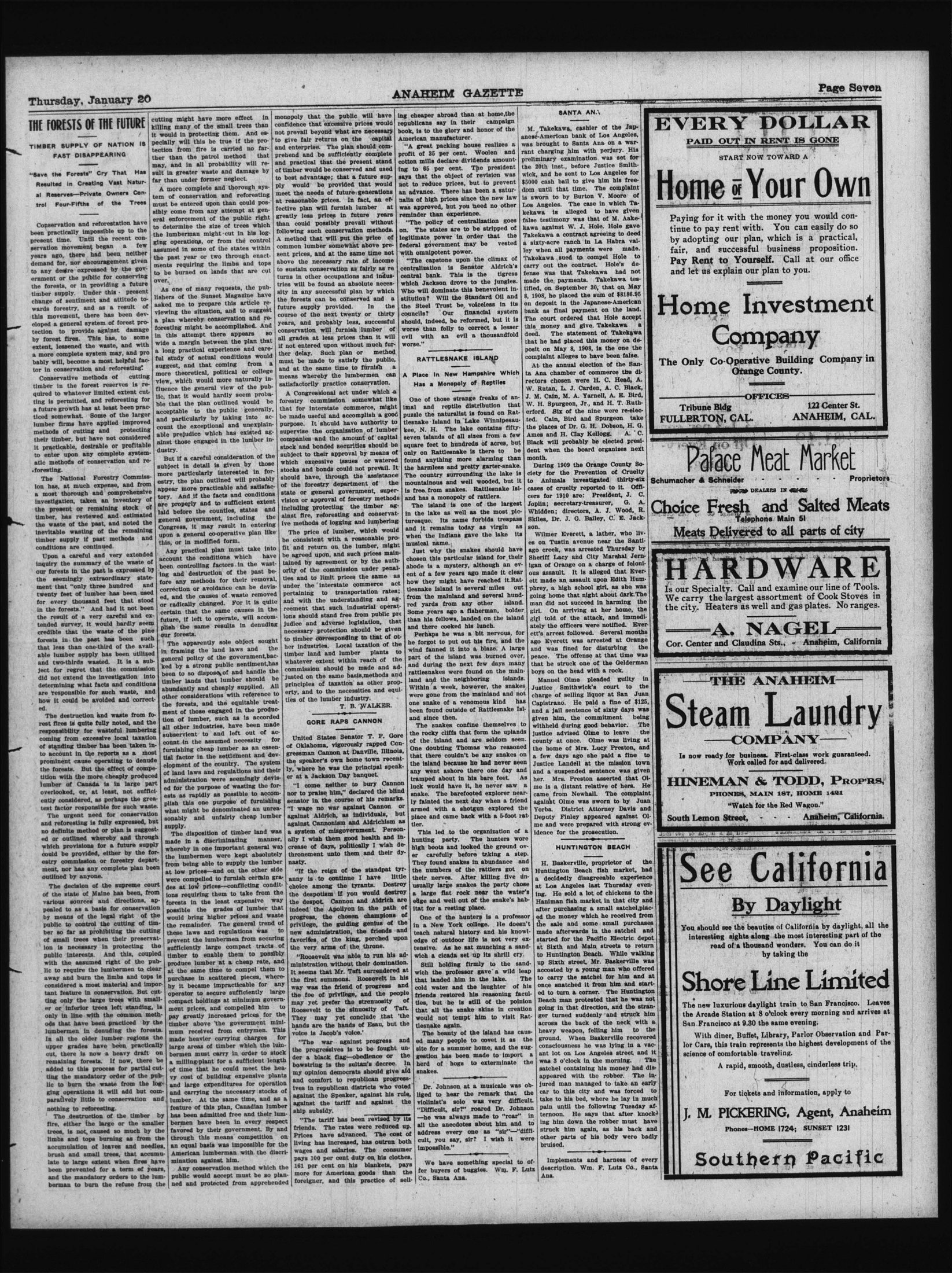
Searchable text
THE FORESTS OF THE FUTURE
TIMBER SUPPLY OF NATION IS FAST DISAPPEARING
"Save the Forests" Cry That Has Resulted in Creating Vast Natural Reserves—Private Owners Control Four-Fifths of the Trees
Conservation and reforestation have been practically impossible up to the present time. Until the recent conservation movement began a few years ago, there had been neither demand for, nor encouragement given to any desire expressed by the government or the public for conserving the forests, or in providing a future timber supply. Under this present change of sentiment and attitude towards forestry, and as a result of this movement, there has been developed a general system of forest protection to provide against damage by forest fires. This has, to some extent, lessened the waste, and with a more complete system may, and probably will, become a most helpful factor in conservation and reforesting.
Conservative methods of cutting timber in the forest reserves is required to whatever limited extent cutting is permitted, and reforesting for a future growth has at least been practiced somewhat. Some of the larger lumber firms have applied improved methods of cutting and protecting their timber, but have not considered it practicable, desirable or profitable to enter upon any complete systematic methods of conservation and reforesting.
Cutting might have more effect in killing many of the small trees than it would in protecting them. And especially will this be true if the protection from fire is carried no further than the patrol method that may, and in all probability will result in greater waste and damage by far than under former neglect.
A more complete and thorough system of conservation and reforesting must be entered upon than could possibly come from any attempt at general enforcement of the public right to determine the size of trees which the lumberman might cut in his logging operations, or from the control assumed in some of the states within the past year or two through enactments requiring the limbs and tops to be burned on lands that are cut over.
As one of many requests, the publishers of the Sunset Magazine have asked me to prepare this article reviewing the situation, and to suggest a plan whereby conservation and reforesting might be accomplished. And in this attempt there appears so wide a margin between the plan that a long practical experience and careful study of actual conditions would suggest, and that coming from a more theoretical, political or college view, which would more naturally influence the general view of the public, that it would hardly seem probable that the plan outlined would be acceptable to the public generally, and particularly by taking into account the exceptional and unexplainable prejudice which has existed against those engaged in the lumber industry.
But if a careful consideration of the subject in detail is given by those more particularly interested in for monopoly that the public confidence that excessive not prevail beyond what they give fair returns on the enterprise. The plan prehend and be sufficient and practical that the price of timber would be conservative to best advantage; that simply would be provided meet the needs of future at reasonable prices. In effective plan will furnish greatly less prices in favor than could possibly precede following such conservation. A method that will put common lumber somewhat sent prices, and at the same above the necessary rate to sustain conservation as turns in other occupation tries will be found an ability in any successful plan the forests can be conserved future supply provided. Course of the next twenty years, and probably less conservation will furnish all grades at less prices if not entered upon without delay. Such plan must be made to satisfy and at the same time to means whereby the lumber satisfactorily practice co-
A Congressional act uprofforing forestry commission said that for interstate commerce be made useful and accountable. It should have supervise the organization companies and the amount stock and bonded securities subject to their approval which excessive issues stocks and bonds could
Conservative methods of cutting timber in the forest reserves is required to whatever limited extent cutting is permitted, and reforesting for a future growth has at least been practiced somewhat. Some of the larger lumber firms have applied improved methods of cutting and protecting their timber, but have not considered it practicable, desirable or profitable to enter upon any complete systematic methods of conservation and reforesting.
The National Forestry Commission has, at much expense, and from a most thorough and comprehensive investigation, taken an inventory of the present or remaining stock of timber, has reviewed and estimated the waste of the past, and noted the inevitable wasting of the remaining timber supply if past methods and conditions are continued.
Upon a careful and very extended inquiry the summary of the waste of our forests in the past is expressed by the seemingly extraordinary statement that "only three hundred and twenty feet of lumber has been used for every thousand feet that stood in the forests." And had it not been the result of a very careful and extended survey, it would hardly seem credible that the waste of the pine forests in the past has been such that less than one-third of the available lumber supply has been utilized and two-thirds wasted. It is a subject for regret that the commission did not extend the investigation into determining what facts and conditions are responsible for such waste, and how it could be avoided and corrected.
The destruction and waste from forest fires is quite fully noted, and the responsibility for wasteful lumbering coming from excessive local taxation of standing timber has been taken into account in the reports as a most prominent cause operating to denude the forests. But the effect of competition with the more cheaply produced lumber of Canada is in large part overlooked, or, at least, not sufficiently considered, as perhaps the greatest factor responsible for such waste.
The urgent need for conservation and reforesting is fully expressed, but no definite method or plan is suggested or outlined whereby and through which provisions for a future supply could be provided, either by the forestry commission or forestry department, nor has any complete plan been outlined by anyone.
The decision of the supreme court of the state of Maine has been, from more theoretical political view, which would more naturally influence the general view of the public, that it would hardly seem probable that the plan outlined would be acceptable to the public generally, and particularly by taking into account the exceptional and unexplainable prejudice which has existed against those engaged in the lumber industry.
But if a careful consideration of the subject in detail is given by those more particularly interested in forestry, the plan outlined will probably appear more practicable and satisfactory. And if the facts and conditions are properly and to sufficient extent laid before the counties, states and general government, including the Congress, it may result in entering upon a general co-operative plan like this, or in modified form.
Any practical plan must take into account the conditions which have been controlling factors in the wasting and destruction of the past before any methods for their removal, correction or avoidance can be devised, and the causes of waste removed or radically changed. For it is quite certain that the same causes in the future, if left to operate, will accomplish the same results in denuding our forests.
The apparently sole object sought in framing the land laws and the general policy of the government, backed by a strong public sentiment, has been to so dispose of and handle the timber lands that lumber should be abundantly and cheaply supplied. All other considerations with reference to the forests, and the equitable treatment of those engaged in the production of lumber, such as is accorded all other industries, have been made subservient to and left out of account in the assumed necessity for furnishing cheap lumber as an essential factor in the settlement and development of the country. The system of land laws and regulations and their administration were seemingly devised for the purpose of wasting the forests as rapidly as possible to accomplish this one purpose of furnishing what might be denominated an unreasonably and unfairly cheap lumber supply.
The disposition of timber land was made in a discriminating manner, whereby in one important general way the lumbermen were kept absolutely from being able to supply the lumber at low prices—and on the other side were compelled to furnish certain grades at low prices—conflicting conditions requiring them to take from the means whereby the lumber satisfactorily practice conservation.
A Congressional act uprooted forestry commission said that for interstate commerce be made useful and accountable. It should have supervise the organization companies and the among stock and bonded securities subject to their approval which excessive issued stocks and bonds could should have, through that of the forestry department state or general governorship or approval of forms including protecting thataint fire, reforestation sive methods of logging sale.
The price of lumber, be consistent with a refit and return on the contract agreed upon, and sustained by agreement or order of the commissionaries and to limit prices under the interstate order pertaining to transport and with the understandment that such indulgences should stand free from justice and adverse legal necessary protection she to timber corresponding her industries. Local timber land and lumber whatever extent within commission should be justified on the same basis principles of taxationerty, and to the necessities of the lumber industry.
T. B.
GORE RAPS C
United States Senate of Oklahoma, vigorousgressman Cannon at Dthe speaker's own homely, where he was thener at a Jackson Day b
"I come neither nor to praise him," descent senator in the course "I wage no war against Aldrich, as if against Cannonism and a system of misgovernalty I wish them good crease of days, politi thronement unto them nasty.
"If the reign of thanny is to continue choice among the tyhe despotism if you
The urgent need for conservation and reforesting is fully expressed, but no definite method or plan is suggested or outlined whereby and through which provisions for a future supply could be provided, either by the forestry commission or forestry department, nor has any complete plan been outlined by anyone.
The decision of the supreme court of the state of Maine has been, from various sources and directions, appealed to as a basis for conservation by means of the legal right of the public to control the cutting of timber so far as prohibiting the cutting of small trees when their preservation is necessary in protecting the public interests. And this, coupled with the assumed right of the public to require the lumbermen to clear away and burn the limbs and tops is considered a most material and important feature in conservation. But cutting only the large trees with smaller or inferior trees left standing, is only in line with the common methods that have been practiced by the lumbermen in denuding the forests. In all the older lumber regions the upper grades have been practically cut, there is now a heavy draft on remaining forests. If now, there be added to this process for partial cutting the mandatory order of the public to burn the waste from the logging operations it will add but comparatively little to conservation and nothing to reforesting.
The destruction of the timber by fire, either the large or the smaller trees, is not caused so much by the limbs and tops burning as from the accumulation of leaves and needles, brush and small trees, that accumulate to large extent when fires have been prevented for a term of years, and the mandatory orders to the lumberman to burn the refuse from the plish this one purpose of furnishing what might be denominated an unreasonably and unfairly cheap lumber supply.
The disposition of timber land was made in a discriminating manner, whereby in one important general way the lumbermen were kept absolutely from being able to supply the lumber at low prices—and on the other side were compelled to furnish certain grades at low prices—conflicting conditions requiring them to take from the forests in the least expensive way possible the grades of lumber that would bring higher prices and waste the remainder. The general trend of these laws and regulations was to prevent the lumbermen from securing sufficiently large compact tracts of timber to enable them to possibly produce lumber at a cheap rate, and at the same time to compel them to purchase in scattered pieces, whereby it became impracticable for any operator to secure sufficiently large compact holdings at minimum government prices, and compelled him to pay greatly increased prices for the timber above the government minimum received from entrymen. This made heavier carrying charges for large areas of timber which the lumbermen must carry in order to stock a milling-plant for a sufficient length of time that he could meet the heavy cost of building expensive plants and large expenditures for operation and carrying the necessary stocks of lumber. At the same time, and as a feature of this plan, Canadian lumber has been admitted free and their lumbermen have been in every respect favored by their government. By and through this means competition on an equal basis was impossible for the American lumberman with the discrimination against him.
Any conservation method which the public would accept must be so planned and protected from apprehended
"I wage no war against Aldrich, as I against Cannonism and a system of misgovernance I wish them good crease of days, political thronement unto them nasty.
"If the reign of theanny is to continue my choice among the types despotism if you despot. Cannon indeed the Apollyon progress, the chosen privilege, the guiding new administration, favorites of the king, the very arms of thieves.
"Roosevelt was abdministration without It seems that Mr. Taft the first summons. Way was the friend of the foe of privilege may yet prefer the Roosevelt to the sin. They may yet co- hands are the hands voice is Jacob's voice.
"The war against the progressives is der a black flag—bowstring is the sum my opinion democracy and comfort to rep lives in republican disgain against the Speaker against the tariff ship subsidy.
"The tariff has been friends. The rates Prices have advanced living has increased wages and salaries pays 100 per cent d 161 per cent on his more for American foreigner, and this
ANAHEIM GAZETTE
monopoly that the public will have confidence that excessive prices would not prevail beyond what are necessary to give fair returns on the capital and enterprise. The plan should comprehend and be sufficiently complete and practical that the present stand of timber would be conserved and used to best advantage; that a future supply would be provided that would meet the needs of future generations at reasonable prices. In fact, an effective plan will furnish lumber at greatly less prices in future years than could possibly prevail without following such conservation methods.
A method that will put the price of common lumber somewhat above present prices, and at the same time not above the necessary rate of income to sustain conservation as fairly as reurns in other occupations and industries will be found an absolute necessity in any successful plan by which the forests can be conserved and a future supply provided. In the course of the next twenty or thirty years, and probably less, successful conservation will furnish lumber of all grades at less prices than it will if not entered upon without much further delay. Such plan or method must be made to satisfy the public, and at the same time to furnish a means whereby the lumbermen can satisfactorily practice conservation.
A Congressional act under which a forestry commission somewhat like that for interstate commerce, might be made useful and accomplish a good purpose. It should have authority to supervise the organization of lumber companies and the amount of capital stock and bonded securities should be subject to their approval by means of which excessive issues or watered stocks and bonds could not prevail. It is important that the monopoly be maintained with careful management.
SANTA AN.
M. Takekawa, cashier of the Japanese-American bank of Los Angeles, was brought to Santa Ana on a warrant charging him with perjury. His preliminary examination was set for the 20th inst., before Justice Smithwick, and he sent to Los Angeles for $5000 cash bail to give him his freedom until that time. The complaint is sworn to by Burton V. Moore of Los Angeles. The case in which Takekawa is alleged to have given false testimony was that of M. Aakekawa against W. J. Hole. Hole gave Takekawa a contract agreeing to deed a sixty-acre ranch in La Habra valley when all payments were made. Takekawa sued to compel Hole to carry out the contract. Hole's defense was that Takekawa had not made the payments. Takekawa testified, on September 30, that on May 8, 1908, he placed the sum of $8186.95 on deposit in the Japanese-American bank as final payment on the land. The court ordered that Hole accept this money and give. Takekawa a deed. The statement of Takekawa that he had placed this money on deposit on May 8, 1908, is the one the complaint alleges to have been false.
At the annual election of the Santa Ana chamber of commerce the directors chosen were H. C. Head, A. W. Rutan, L. J. Carden, A. C. Black, J. M. Cain, M. A. Yarnell, A. E. Bird, W. H. Spurgeon, Jr., and H. T. Rutherford. Six of the nine were re-elected. Cain, Bird and Spurgeon take the places of Dr. G. H. Dobson, H. G. Ames and H. Clay Kellogg. A. C. Black will probably be elected president when the board organizes next month.
During 1909 the Orange County Society for the Prevention of Cruelty
A Congressional act under which a forestry commission somewhat like that for interstate commerce, might be made useful and accomplish a good purpose. It should have authority to supervise the organization of lumber companies and the amount of capital stock and bonded securities should be subject to their approval by means of which excessive issues or watered stocks and bonds could not prevail. It should have, through the assistance of the forestry department of the state or general government, supervision or approval of forestry methods including protecting the timber against fire, reforesting and conservative methods of logging and lumbering.
The price of lumber, which would be consistent with a reasonable profit and return on the lumber, might be agreed upon, and such prices maintained by agreement or by the authority of the commission under penalties and to limit prices the same as under the interstate commerce act pertaining to transportation rates; and with the understanding and agreement that such industrial operations should stand free from public prejudice and adverse legislation, that necessary protection should be given to timber corresponding to that of other industries. Local taxation of the timber land and lumber plants to whatever extent within reach of the commission should be made and adjusted on the same basis, methods and principles of taxation as other property, and to the necessities and equities of the lumber industry.
T. B. WALKER.
GORE RAPS CANNON
United States Senator T. P. Gore of Oklahoma, vigorously rapped Congressman Cannon at Danville, Illinois, the speaker's own home town recently, where he was the principal speaker at a Jackson Day banquet.
"I come neither to bury Cannon nor to praise him," declared the blind senator in the course of his remarks. "I wage no war against Cannon or against Aldrich, as individuals, but against Cannonism and Aldrichism as a system of misgovernment. Personally I wish them good health and increase of days, politically I wish depronement unto them and their dynasty.
"If the reign of the standpat tyranny is to continue I have little choice among the tyrants. Destroy the despotism if you would destroy A Place In New Hampshire Which Has a Monopoly of Reptiles
One of those strange freaks of animal and reptile distribution that puzzle the naturalist is found on Rattlesnake Island in Lake Winnipesaukee, N. H. The lake contains fifty-seven islands of all sizes from a few square feet to hundreds of acres, but only on Rattlesnake is there to be found anything more alarming than the harmless and pretty garter-snake. The country surrounding the lake is mountainous and well wooded, but it is free from snakes. Rattlesnake Island has a monopoly of rattlers.
The island is one of the largest in the lake as well as the most picturesque. Its name forbids trespass and it remains today as virgin as when the Indians gave the lake its musical name.
Just why the snakes should have chosen this particular island for their abode is a mystery, although an event of a few years ago made it clear how they might have reached it. Rattlesnake Island is several miles out from the mainland and several hundred yards from any other island. Some years ago a fisherman, bolder than his fellows, landed on the island and there cooked his lunch.
Perhaps he was a bit nervous, for he forgot to put out his fire, and the wind fanned it into a blaze. A large part of the island was burned over, and during the next few days many rattlesnakes were found on the mainland and the neighboring islands. Within a week, however, the snakes were gone from the mainland and not one snake of a venomous kind has been found outside of Rattlesnake Island since then.
The snakes confine themselves to the rocky cliffs that form the uplands of the island and are seldom seen. One doubting Thomas who reasoned that there couldn't be any snakes on the island because he had never seen any went ashore there one day and tramped about in his bare feet. As luck would have it, he never saw a snake. The barefooted explorer nearly fainted the next day when a friend armed with a shotgun explored the place and came back with a 5-foot ratler.
This led to the organization of a hunting party. The hunters wore high boots and looked the ground over carefully before taking a step. They found snakes in abundance and the numbers of the rattlers got on their nerves. After killing five unusually large snakes the party chose a large flat rock near the water's edge and swallowed it.
During 1909 the Orange County Society for the Prevention of Cruelty to Animals investigated thirty-six cases of cruelty reported to it. Officers for 1910 are: President, J. C. Joplin; secretary-treasurer, G. A. Whidden; directors, A. J. Wood, R. Skiles, Dr. J. G. Bailey, C. E. Jackson.
Wilmer Everett, a lather, who lives on Tustin avenue near the Santiago creek, was arrested Thursday by Sheriff Lacy and City Marshal Jernigan of Orange on a charge of felonious assault. It is alleged that Everett made an assault upon Edith Humphrey, a high school girl, as she was going home that night about dark.The man did not succeed in harming the girl. On arriving at her home, the girl told of the attack, and immediately the officers were notified. Everett's arrest followed. Several months ago Everett was arrested at Orange and was fined for disturbing the peace. The offense at that time was that he struck one of the Gelderman boys on the head with a rock.
Manuel Olme pleaded guilty in Justice Smithwick's court to the charge of selling liquor at San Juan Capitrano. He paid a fine of $125, and a jail sentence of sixty days was given him, the commitment being withheld during good behavior. The justice advised Olme to leave the county at once. Olme was living at the home of Mrs. Lucy Preston, and a few days ago she paid a fine to Justice Landell at the mission town and a suspended sentence was given her. Mrs. Preston asserted that Olme is a distant relative of hers. He came from Newhall. The complaint against Olme was sworn to by Juan Yorba. District Attorney Davis and Deputy Finley appeared against Olme and were prepared with strong evidence for the prosecution.
HUNTINGTON BEACH
H. Baskerville, proprietor of the Huntington Beach fish market, had a decidedly disagreeable experience at Los Angeles last Thursday evening. He sold a lot of chickens to
"I wage no war against Cannon or against Aldrich, as individuals, but against Cannonism and Aldrichism as a system of misgovernment. Personally I wish them good health and increase of days, politically I wish deprenement unto them and their dynasty.
"If the reign of the standpat tyranny is to continue I have little choice among the tyrants. Destroy the despotism if you would destroy the despot. Cannon and Aldrich are indeed the Apollyon in the path of progress, the chosen champions of privilege, the guiding genius of the new administration, the friends and favorites of the king, perched upon the very arms of the throne.
"Roosevelt was able to run his administration without their domination. It seems that Mr. Taft surrendered at the first summons. Roosevelt in his way was the friend of progress and the foe of privilege, and the people may yet prefer the strenuosity of Roosevelt to the sinuosity of Taft. They may yet conclude that 'the hands are the hands of Esau, but the voice is Jacob's voice.'
"The war against progress and the progressives is to be fought under a black flag—obedience or the bowstring is the sultan's decree. In my opinion democrats should give aid and comfort to republican progressives in republican districts who voted against the Speaker, against his rule, against the tariff and against the ship subsidy.
"The tariff has been revised by its friends. The rates were reduced up. Prices have advanced. The cost of living has increased, has outrun both wages and salaries. The consumer pays 100 per cent duty on his clothes, 161 per cent on his blankets, pays more for American goods than the foreigner, and this practice of sell-ly fainted the next day when a friend armed with a shotgun explored the place and came back with a 5-foot ratler.
This led to the organization of a hunting party. The hunters wore high boots and looked the ground over carefully before taking a step. They found snakes in abundance and the numbers of the rattlers got on their nerves. After killing five unusually large snakes the party chose a large flat rock near the water's edge and well out of the snake's habitat for a resting place.
One of the hunters is a professor in a New York college. He doesn't teach natural history and his knowledge of outdoor life is not very extensive. As he sat munching a sandwich a cicada set up its shrill cry.
Still holding firmly to the sandwich the professor gave a wild leap that landed him in the lake. The cold water and the laughter of his friends restored his reasoning faculties, but he is still of the poinion that all the snake skins in creation would not tempt him to visit Rattlesnake again.
The beauty of the island has caused many people to covet it as the site for a summer home, and the suggestion has been made to import a herd of hogs to exterminate the snakes.
Dr. Johnson at a musicale was obliged to hear the remark that the violinist's solo was very difficult. "Difficult, sir?" roared Dr. Johnson—he was always made to "roar" in all the anecdotes about him and to address every one as "sir"—"difficult, you say, sir? I wish it were impossible."
We have something special to offer buyers of buggies. Wm. F. Lutz Co., Santa Ana.
H. Baskerville, proprietor of the Huntington Beach fish market, had decidedly disagreeable experience at Los Angeles last Thursday evening. He sold a lot of chickens to the Haniman fish market in that city and after purchasing a small satchel, placed the money which he received from the sale and some small purchases made afterwards in the satchel and started for the Pacific Electric depot at Sixth and Main streets to return to Huntington Beach. While walking up Sixth street, Mr. Baskerville was accosted by a young man who offered to carry the satchel for him and at once snatched it from him and started to turn a corner. The Huntington Beach man protested that he was not going in that direction, and the stranger turned suddenly and struck him across the back of the neck with a heavy weapon, felling him to the ground. When Baskerville recovered consciousness he was lying in a vacant lot on Los Angeles street and it was 3 o'clock in the morning. The satchel containing his money had disappeared with the robber. The injured man managed to take an early car to this city and was forced to take to his bed, where he lay in much pain until the following Tuesday afternoon. He says that after knocking him down the robber must have struck him again, as his back and other parts of his body were badly bruised.
Implements and harness of every description. Wm. F. Lutz Co., Santa Ana.
EVERY DOLLAR
PAID OUT IN RENT IS GONE
START NOW TOWARD A
Home of Your Own
Paying for it with the money you would continue to pay rent with. You can easily do so by adopting our plan, which is a practical, fair, and successful business proposition.
Pay Rent to Yourself. Call at our office and let us explain our plan to you.
Home Investment Company
The Only Co-Operative Building Company in Orange County.
OFFICES
Tribune Bldg
FULLERTON, CAL.
122 Center St.
ANAHEIM, CAL.
Palace Meat Market
OFFICES
Tribune Bldg 122 Center St.
FULLERTON, CAL. ANAHEIM, CAL.
Paface Meat Market
Schumacher & Schneider Proprietors
DEALEPS IN
Choice Fresh and Salted Meats
Telephone Main 51
Meats Delivered to all parts of city
HARDWARE
Is our Specialty. Call and examine our line of Tools.
We carry the largest assortment of Cook Stoves in
the city. Heaters as well and gas plates. No ranges.
A. NAGEL
Cor. Center and Claudina Sts., Anaheim, California
THE ANAHEIM
Steam Laundry COMPANY
Is now ready for business. First-class work guaranteed.
Work called for and delivered.
HINEMAN & TODD, PROP'RS,
PHONES, MAIN 187, HOME 1421
“Watch for the Red Wagon.”
South Lemon Street, Anaheim, California.
See California
"Watch for the Red Wagon."
South Lemon Street, Anaheim, California.
See California
By Daylight
You should see the beauties of California by daylight, all the interesting sights along the most interesting part of the read of a thousand wonders. You can do it by taking the
Shore Line Limited
The new luxurious daylight train to San Francisco. Leaves the Arcade Station at 8 o'clock every morning and arrives at San Francisco at 9:30 the same evening.
With diner, Buffet, Library, Parlor Observation and Parlor Cars, this train represents the highest development of the science of comfortable traveling.
A rapid, smooth, dustless, cinderless trip.
For tickets and information, apply to
J. M. PICKERING, Agent, Anaheim
Phones—HOME | 724; SUNSET | 123|
Southern Pacific