anaheim-gazette 1910-01-13
Scanned page
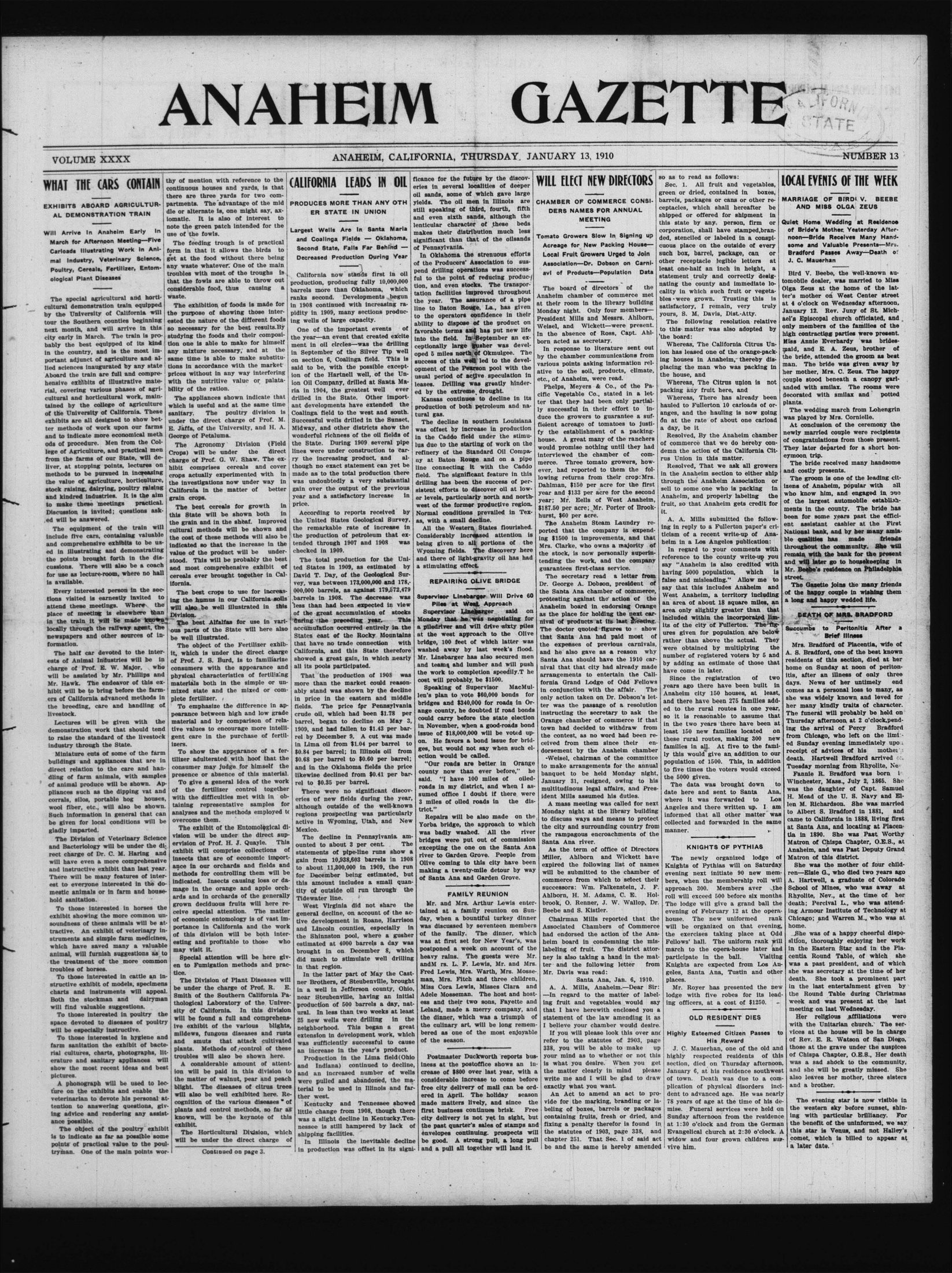
Searchable text
WHAT THE CARS CONTAIN
EXHIBITS ABOARD AGRICULTURAL DEMONSTRATION TRAIN
Will Arrive in Anaheim Early In March for Afternoon Meeting—Five Carloads Illustrating Work in Animal Industry, Veterinary Science, Poultry, Cereals, Fertilizer, Entomological Plant Diseases
The special agricultural and horticultural demonstration train equipped by the University of California will tour the Southern counties beginning next month, and will arrive in this city early in March. The train is probably the best equipped of its kind in the country, and is the most important adjunct of agriculture and allied sciences inaugurated by any state Aboard the train are full and comprehensive exhibits of illustrative material, covering various phases of agricultural and horticultural work, maintained by the college of agriculture of the University of California. These exhibits are all designed to show better methods of work upon our farms and to indicate more economical methods of procedure. Men from the College of Agriculture, and practical men from the farms of our State, will deliver, at stopping points, lectures on methods to be pursued in increasing thy of mention with reference to the continuous houses and yards, is that there are three yards for two compartments. The advantage of the middle or alternate is, one might say, axiomatic. It is also of interest to note the green patch intended for the use of the fowls.
The feeding trough is of practical form in that it allows the birds to get at the food without there being any waste whatever. One of the main troubles with most of the troughs is that the fowls are able to throw out considerable food, thus causing a waste.
The exhibition of foods is made for the purpose of showing those interested the nature of the different foods so necessary for the best results. By studying the foods and their composition one is able to make for himself any mixture necessary, and at the same time is able to make substitutions in accordance with the market prices without in any way interfering with the nutritive value or palatability of the ration.
The appliances shown indicate that which is useful and at the same time sanitary. The poultry division is under the direct charge of Prof. M. E. Jaffa, of the University, and H. A. George of Petaluma.
The Agronomy Division (Field Crops) will be under the direct charge of Prof. G. W. Shaw. The exhibit comprises cereals and cover crops actually experimented with in
Aboard the train are full and comprehensive exhibits of illustrative material, covering various phases of agricultural and horticultural work, maintained by the college of agriculture of the University of California. These exhibits are all designed to show better methods of work upon our farms and to indicate more economical methods of procedure. Men from the College of Agriculture, and practical men from the farms of our State, will deliver, at stopping points, lectures on methods to be pursued in increasing the value of agriculture, horticulture, stock raising, dairying, poultry raising and kindred industries. It is the aim to make these meetings practical. Discussion is invited; questions asked will be answered.
The equipment of the train will include five cars, containing valuable and comprehensive exhibits to be used in illustrating and demonstrating the points brought forth in the discussions. There will also be a coach for use as lecture-room, where no hall is available.
Every interested person in the sections visited is earnestly invited to attend these meetings. Where the place of meeting is elsewhere than in the train it will be made known locally through the railway agent, the newspapers and other sources of information.
The half car devoted to the interests of Animal Industries will be in charge of Prof. E. W. Major, who will be assisted by Mr. Phillips and Mr. Hawk. The endeavor of this exhibit will be to bring before the farmers of California advanced methods in the breeding, care and handling of livestock.
Lectures will be given with the demonstration work that should tend to raise the standard of the livestock industry through the State.
Miniature cuts of some of the farm buildings and appliances that are in direct relation to the care and handling of farm animals, with samples of animal produce will be shown. Appliances such as the dipping vat and corrals, silos, portable hog houses, wool fiber, etc., will also be shown. Such information in general that can be given for local conditions will be gladly imparted.
The Division of Veterinary Science and Bacteriology will be under the direct charge of Dr. C. M. Haring and will have even a more comprehensive and instructive exhibit than last year. There will be many features of interest to everyone interested in the domestic animals or in farm and household sanitation.
The appliances shown indicate that which is useful and at the same time sanitary. The poultry division is under the direct charge of Prof. M. E. Jaffa, of the University, and H. A. George of Petaluma.
The Agronomy Division (Field Crops) will be under the direct charge of Prof. G. W. Shaw. The exhibit comprises cereals and cover crops actually experimented with in the investigations now under way in California in the matter of better grain crops.
The best cereals for growth in this State will be shown both in the grain and in the sheaf. Improved cultural methods will be shown and the cost of these methods will also be indicated so that the increase in the value of the product will be understood. This will be probably the best and most comprehensive exhibit of cereals ever brought together in California.
The best crops to use for increasing the humus in our California soils will also be well illustrated in this Division.
The best Alfalfas for use in various parts of the State will here also be well illustrated.
The object of the Fertilizer exhibit, which is under the direct charge of Prof. J. S. Burd, is to familiarize consumers with the appearance and physical characteristics of fertilizing materials both in the simple or unmixed state and the mixed or complete fertilizer.
To emphasize the difference in appearance between high and low grade material and by comparison of relative values to encourage more intelligent care in the purchase of fertilizers.
To show the appearance of a fertilizer adulterated with hoof that the consumer may judge for himself the presence or absence of this material.
To give a general idea of the work of the fertilizer control together with the difficulties met with in obtaining representative samples for analyses and the methods employed to overcome them.
The exhibit of the Entomological division will be under the direct supervision of Prof. H. J. Quayle. This exhibit will comprise collections of insects that are of economic importance in our orchards and fields and methods for controlling them will be indicated. Insects causing loss or damage in the orange and apple orchards and in orchards of the generally prices without in any way interfering with the nutritive value or palatability of the ration.
The appliances shown indicate that which is useful and at the same time sanitary. The poultry division is under the direct charge of Prof. M. E. Jaffa, of the University, and H. A. George of Petaluma.
The Agronomy Division (Field Crops) will be under the direct charge of Prof. G. W. Shaw. The exhibit comprises cereals and cover crops actually experimented with in the investigations now under way in California in the matter of better grain crops.
The best cereals for growth in this State will be shown both in the grain and in the sheaf. Improved cultural methods will be shown and the cost of these methods will also be indicated so that the increase in the value of the product will be understood. This will be probably the best and most comprehensive exhibit of cereals ever brought together in California.
The best crops to use for increasing the humus in our California soils will also be well illustrated in this Division.
The best Alfalfas for use in various parts of the State will here also be well illustrated.
The object of the Fertilizer exhibit, which is under the direct charge of Prof. J. S. Burd, is to familiarize consumers with the appearance and physical characteristics of fertilizing materials both in the simple or unmixed state and the mixed or complete fertilizer.
To emphasize the difference in appearance between high and low grade material and by comparison of relative values to encourage more intelligent care in the purchase of fertilizers.
To show the appearance of a fertilizer adulterated with hoof that the consumer may judge for himself the presence or absence of this material.
To give a general idea of the work of the fertilizer control together with the difficulties met with in obtaining representative samples for analyses and the methods employed to overcome them.
The exhibit of the Entomological division will be under the direct supervision of Prof. H. J. Quayle. This exhibit comprises cereals and cover crops actually experimented with in the investigations now under way in California in the matter of better grain crops.
The best cereals for growth in this State will be shown both in the grain and in the sheaf. Improved cultural methods will be shown and the cost of these methods will also be indicated so that the increase in the value of the product will be understood. This will be probably the best and most comprehensive exhibit of cereals ever brought together in California.
The best crops to use for increasing the humus in our California soils will also be well illustrated in this Division.
The best Alfalfas for use in various parts of the State will here also be well illustrated.
The object of the Fertilizer exhibit, which is under the direct charge of Prof. J. S. Burd, is to familiarize consumers with the appearance and physical characteristics of fertilizing materials both in the simple or unmixed state and the mixed or complete fertilizer.
To emphasize the difference in appearance between high and low grade material and by comparison of relative values to encourage more intelligent care in the purchase of fertilizers.
To show the appearance of a fertilizer adulterated with hoof that the consumer may judge for himself the presence or absence of this material.
To give a general idea of the work of the fertilizer control together with the difficulties met with in obtaining representative samples for analyses and the methods employed to overcome them.
The exhibit of the Entomological division will be under the direct supervision of Prof. H. J. Quayle. This exhibit comprises cereals and cover crops actually experimented with in the investigations now under way in California in the matter of better grain crops.
The best cereals for growth in this State will be shown both in the grain and in sheaf. Improved cultural methods will be shown and the cost of these methods will also be indicated so that the increase in value of the product will be understood. This will be probably the best and most comprehensive exhibit of cereals ever brought together in California.
The best crops to use for increasing the humus in our California soils will also be well illustrated in this Division.
The best Alfalfas for use in various parts of the State will here also be well illustrated.
The object of the Fertilizer exhibit, which is under the direct charge of Prof. J. S. Burd, is to familiarize consumers with the appearance and physical characteristics of fertilizing materials both in the simple or unmixed state and the mixed or complete fertilizer.
To emphasize the difference in appearance between high and low grade material and by comparison of relative values to encourage more intelligent care in their purchase of fertilizers.
To show the appearance of a fertilizer adulterated with hoof that the consumer may judge for himself the presence or absence of this material.
To give a general idea of the work of the fertilizer control together with the difficulties met with in obtaining representative samples for analyses and their methods employed to overcome them.
The exhibit of the Entomological division will be under the direct supervision of Prof. H. J. Quayle. This exhibit comprises cereals and cover crops actually experimented with in their investigations now under way in California in their matter of better grain crops.
The best cereals for growth in this State will be shown both in the grain and sheaf. Improved cultural methods will be shown and the cost of these methods will also be indicated so that they increase pests due to no exact state made as to them; was undoubtedly a gain over their output year and a satisfactory price.
According to report on United States Oversee, remarkable rate production permitted through 1907 checked in 1909.
The total products stated States in 1909, David T. Day, of thisvey, was between 1700000 barrels, as barrels in 1908. Less than had been done during preceding accumulation occurred States east of them that have no trade California, and this showed a great gain all its pools participated.
That these products more than they may stand was shownin pricein each field.The pricecrude oilwhich hadbarrel,beganto do1909,andhadfallenrelby December 9.in Lima oil from $0.84 per barrel;in$0.68 per barreltoandinthe Oklahomalikewise declinedfromrelto$0.35perba
There were noeriesofnewfieldsalthoughoutside oregions prospectingactiveinWyomingMexico.
The declineinountedtoabout3statementsofpipegainfrom109386toabout1130000forDecemberbehindthisamountincluityofoutsideoilTidewaterline.
The Division of Veterinary Science and Bacteriology will be under the direct charge of Dr. C. M. Haring and will have even a more comprehensive and instructive exhibit than last year. There will be many features of interest to everyone interested in the domestic animals or in farm and household sanitation.
To those interested in horses the exhibit showing the more common unsoundness of these animals will be attractive. An exhibit of veterinary instruments and simple farm medicines, which have saved many a valuable animal, will furnish suggestions as to the treatment of the more common troubles of horses.
To those interested in cattle an instructive exhibit of models, specimens charts and instruments will appeal. Both the stockman and dairyman will find valuable suggestions.
To those interested in poultry the space devoted to diseases of poultry will be especially instructive.
To those interested in hygiene and farm sanitation the exhibit of bacterial cultures, charts, photographs, literature and sanitary appliances will show the most recent ideas and best pictures.
A phonograph will be used to lecture on the exhibits and enable the veterinarian to devote his personal attention to answering questions, giving advice and rendering any assistance possible.
The object of the poultry exhibit is to indicate as far as possible some points of practical value to the poultryman. One of the main points wor-
The exhibit of the Entomological division will be under the direct supervision of Prof. H. J. Quayle. This exhibit will comprise collections of insects that are of economic importance in our orchards and fields and methods for controlling them will be indicated. Insects causing loss or damage in the orange and apple orchards and in orchards of the generally grown deciduous fruits will here receive special attention. The matter of economic entomology is of vast importance in California and the work of this division will be both interesting and profitable to those who may visit it.
Special attention will be given to Fumigation methods and practice.
The Division of Plant Diseases will be under the charge of Prof. R. E. Smith of the Southern California Pathological Laboratory of the University of California. In this division will be found a full and comprehensive exhibit of the various blights, mildews, fungous diseases and rusts and smuts that attack cultivated plants. Methods of control of these troubles will also be shown here.
A considerable amount of attention will be paid in this division to the matter of walnut, pear and peach blight. The diseases of citrus trees will also be well exhibited here. Recognition of the various diseases of plants and control methods, so far as known, will be the keynote of this exhibit.
The Horticultural Division, which will be under the direct charge of
Continued on page 3.
ANAHEIM, CALIFORNIA, THURSDAY. JANUARY 13, 1910
CALIFORNIA LEADS IN OIL
PRODUCES MORE THAN ANY OTHER STATE IN UNION
Largest Wells Are In Santa Maria and Coalinga Fields — Oklahoma, Second State, Falls Far Behind — Decreased Production During Year
California now stands first in oil production, producing fully 10,000,000 barrels more than Oklahoma, which ranks second. Developments begun in 1908 continued with increasing rapidity in 1909, many sections producing wells of large capacity.
One of the important events of the year—an event that created excitement in oil circles—was the drilling in September of the Silver Tip well on section 6, Coalinga field. This is said to be, with the possible exception of the Hartnell well, of the Union Oil Company, drilled at Santa Maria in 1904, the greatest well ever drilled in the State. Other important developments have extended the Coalinga field to the west and south. Successful wells drilled in the Sunset, Midway, and other districts show the wonderful richness of the oil fields of the State. During 1909 several pipe lines were under construction to carry the increasing product, although no exact statement can yet be made as to the total production there
ficiency for the future by the discoveries in several localities of deeper oil sands, some of which gave large yields. The oil men in Illinois are still speaking of third, fourth, fifth and even sixth sands, although the lenticular character of these beds makes their distribution much less significant than that of the oilsands of Pennsylvania.
In Oklahoma the strenuous efforts of the Producers' Association to suspend drilling operations was successful to the point of reducing production, and even stocks. The transportation facilities improved throughout the year. The assurance of a pipe line to Baton Rouge, La., has given to the operators confidence in their ability to dispose of the product on favorable terms and has put new life into the field. In September an exceptionally large gusher was developed 5 miles north of Okmulgee. The success of this well led to the development of the Pearson pool with the usual period of active speculation in leases. Drilling was greatly hindered by the extreme drought.
Kansas continues to decline in its production of both petroleum and natural gas.
The decline in southern Louisiana was offset by increase in production in the Caddo field under the stimulus due to the starting of work on the refinery of the Standard Oil Company at Baton Rouge and on a pipe line connecting it with the Caddo field. The significant feature in this
WILL ELECT NEW DIRECTORS
CHAMBER OF COMMERCE CONSIDERS NAMES FOR ANNUAL MEETING
Tomato Growers Slow In Signing up Acreage for New Packing House—Local Fruit Growers Urged to Join Association—Dr. Dobson on Carnival of Products—Population Data
The board of directors of the Anaheim chamber of commerce met at their room in the library building Monday night. Only four members—President Mills and Messrs. Ahlborn, Weisel, and Wickett—were present. In the absence of Ross, Capt. Ahlborn acted as secretary.
In response to literature sent out by the chamber communications from various points asking information relative to the soil, products, climate, etc., of Anaheim, were read.
Phelps, Meyers & Co., of the Pacific Vegetable Co., stated in a letter that they had been only partially successful in their effort to induce the growers to guarantee a sufficient acreage of tomatoes to justify the establishment of a packing house. A great many of the ranchers would promise nothing until they had interviewed the chamber of commerce. Three tomato growers, however, had reported to them the fol-
According to reports received by the United States Geological Survey, the remarkable rate of increase in the production of petroleum that extended through 1907 and 1908 was checked in 1909.
The total production for the United States in 1909, as estimated by David T. Day, of the Geological Survey, was between 173,000,000 and 178,000,000 barrels, as against 179,572,479 barrels in 1908. The decrease was less than had been expected in view of the great accumulation of stocks during the preceding year. This accumulation occurred entirely in the States east of the Rocky Mountains that have no trade connection with California, and this State therefore showed a great gain, in which nearly all its pools participated.
That the production of 1908 was more than the market could reasonably stand was shown by the decline in price in the eastern and middle fields. The price for Pennsylvania crude oil, which had been $1.78 per barrel, began to decline on May 3, 1909, and had fallen to $1.43 per barrel by December 9. A cut was made in Lima oil from $1.04 per barrel to $0.84 per barrel; in Illinois oil from $0.68 per barrel to $0.60 per barrel; and in the Oklahoma fields the price likewise declined from $0.41 per barrel to $0.35 per barrel.
There were no significant discoveries of new fields during the year, although outside of the well-known regions prospecting was particularly active in Wyoming, Utah, and New Mexico.
The decline in Pennsylvania amounted to about 3 per cent. The statements of pipe-line runs show a gain from 10,938,603 barrels in 1908 to about 11,300,000 in 1909, the run for December being estimated, but this amount includes a small quantity of outside oil run through the Tidewater line.
usual period of active speculation in leases. Drilling was greatly hindered by the extreme drought.
Kansas continues to decline in its production of both petroleum and natural gas.
The decline in southern Louisiana was offset by increase in production in the Caddo field under the stimulus due to the starting of work on the refinery of the Standard Oil Company at Baton Rouge and on a pipeline connecting it with the Caddo field. The significant feature in this drilling has been the success of persistent efforts to discover oil at lower levels, particularly north and northwest of the former productive region. Normal conditions prevailed in Texas, with a small decline.
All the Western States flourished. Considerably increased attention is being given to all portions of the Wyoming fields. The discovery here and there of light-gravity oil has had a stimulating effect.
REPAIRING OLIVE BRIDGE
Supervisor Linebarger Will Drive 60 Piles at West Approach
Supervisor Linebarger said on Monday that he was negotiating for a piledriver and will drive sixty piles at the west approach to the Olive bridge, 100 feet of which latter was washed away by last week's flood. Mr. Linebarger has also secured men and teams and lumber and will push the work to completion speedily. He cost will probably be $1500.
Speaking of Supervisor MacMullen's plan to vote $60,000 bonds for bridges and $340,000 for roads in Orange county, he doubted if road bonds could carry before the state election in November, when a good-roads bond issue of $18,000,000 will be voted upon. He favors a bond issue for bridges, but would not say when such election would be called.
"Our roads are better in Orange county now than ever before," he said. "I have 100 miles of oiled roads in my district, and when I assumed office I doubt if there were 3 miles of oiled roads in the district."
Repairs will be also made on the Yorba bridge, the approach to which was badly washed. All the river bridges were put out of commission excepting the one on the Santa Ana river to Garden Grove. People from Olive coming to this city have been making a twenty-mile detour by way of Santa Ana and Garden Grove.
FAMILY REUNION
Phelps, Meyers & Co., of the Pacific Vegetable Co., stated in a letter that they had been only partially successful in their effort to induce the growers to guarantee a sufficient acreage of tomatoes to justify the establishment of a packing-house. A great many of the ranchers would promise nothing until they had interviewed the chamber of commerce. Three tomato growers, however, had reported to them the following returns from their crop: Mrs. Dahlman, $150 per acre for the first year and $133 per acre for the second year; Mr. Eells of West Anaheim, $187.50 per acre; Mr. Porter of Brookhurst, $60 per acre.
The Anaheim Steam Laundry reported that the company is expending $1500 in improvements, and that Mrs. Clarke, who owns a majority of the stock, is now personally superintending the work, and the company guarantees first-class service.
The secretary read a letter from Dr. George A. Dobson, president of the Santa Ana chamber of commerce, protesting against the action of the Anaheim board in endorsing Orange as the place for holding the next carnival of products at its last meeting. The doctor quoted figures to show that Santa Ana had paid most of the expenses of previous carnivals, and he also gave as a reason why Santa Ana should have the 1910 carnival that that city had already made arrangements to entertain the California Grand Lodge of Odd Fellows in conjunction with the affair. The only action taken on Dr. Dobson's letter was the passage of a resolution instructing the secretary to ask the Orange chamber of commerce if that town had decided to withdraw from the contest, as no word had been received from them since their endorsement by the Anaheim chamber.
Weisel, chairman of the committee to make arrangements for the annual banquet to be held Monday night, January 31, resigned, owing to his multitudinous legal affairs, and President Mills assumed his duties.
A mass meeting was called for next Monday night at the library building to discuss ways and means to protect the city and surrounding country from the rampagous encroachments of the Santa Ana river.
As the term of office of Directors Miller, Ahlborn and Wickett have expired the following list of names will be submitted to the chamber of commerce from which to select their successors: Wm. Falkenstein, J. F. Ahlborn, H. M. Adams, C. E. Hol
A mass meeting was called for next Monday night at the library building to discuss ways and means to protect the city and surrounding country from the rampagous encroachments of the Santa Ana river.
As the term of office of Directors Miller, Ahlborn and Wickett have expired the following list of names will be submitted to the chamber of commerce from which to select their successors: Wm. Falkenstein, J. F. Ahlborn, H. M. Adams, C. E. Holbrook, O. Renner, J. W. Wallop, Dr. Beebe and S. Kistler.
Chairman Mills reported that the Associated Chambers of Commerce had endorsed the action of the Anaheim board in condemning the mislabeling of fruit. The district attorney is also taking a hand in the matter and the following letter from Mr. Davis was read:
Santa Ana, Jan. 6, 1910.
A. A. Mills, Anaheim.—Dear Sir:
In regard to the matter of labeling fruit and vegetables would say that I have herewith enclosed you a statement of the law amending it as I believe your chamber would desire.
If you will please look this over and refer to the statutes of 2903, page 338, you will be able to make up your mind as to whether or not this is what you desire. When you get the matter clearly in mind please write me and I will be glad to draw exactly what you want.
An Act to amend an act to provide for the marking, branding or labeling of boxes, barrels or packages containing fruits, fresh or dried, and fixing a penalty therefor is found in the statutes of 1903, page 338, and chapter 251. That Sec. 1 of said act be and the same is hereby amended
FAMILY REUNION
Mr. and Mrs. Arthur Lewis entertained at a family reunion on Sunday, when a bountiful turkey dinner was discussed by seventeen members of the family. The dinner, which was at first set for New Year's, was postponed a week on account of the heavy rains. The guests were Mr. and Mrs. L. F. Lewis, Mr. and Mrs. Fred Lewis, Mrs. Warth, Mrs. Mosseman, Mrs. Fitch and three children, Miss Cora Lewis, Misses Clara and Adele Mosseman. The host and hostess and their two sons, Fayette and Leland, made a merry company, and the dinner, which was a triumph of the culinary art, will be long remembered as one of the most enjoyable of the season.
Postmaster Duckworth reports business at the postoffice shows an increase of $800 over last year, with a considerable increase to come before free city delivery of mail can be ordered in April. The holiday season made matters lively, and since the first business continues brisk. Free city delivery is not yet in sight, but the past quarter's sales of stamps and envelopes continuing prospects will be good. A strong pull, a long pull and a pull all together will land it.
ZETTE
1910 NUMBER 13
NEW DIRECTORS
COMMERCE CONSIDERED FOR ANNUAL MARKING
Now In Signing up Packing House—ers Urged to Join Dobson on Carni-Population Data
Directors of the of commerce met the library building by four members—Al Messrs. Ahlborn,ett—were present. Ross, Capt. Ahletary.
Literature sent out communications from using information related products, climate, were read.
& Co., of the Pa., stated in a letter been only partial their effort to in-quo guarantee a suffruticosa tomatoes to justi-ment of a packing many of the ranchers being until they had chamber of com-mato growers, how-to them the fol-so as to read as follows:
Sec. 1. All fruit and vegetables, green or dried, contained in boxes, barrels, packages or cans or other receptacles, which shall hereafter be shipped or offered for shipment in this state by any person, firm or corporation, shall have stamped,bran-ded, stenciled or labeled in a conspicuous place on the outside of every such box, barrel, package, can or other receptacle legible letters at least one-half an inch in height, a statement truly and correctly designating the county and immediate locality in which such fruit or vegetables were grown. Trusting this is satisfactory, I remain, very truly yours, S. M. Davis, Dist.-Atty.
The following resolution relative to this matter was also adopted by 'the board:
Whereas, The California Citrus Union has leased one of the orange-packing houses in Anaheim, thereby displacing the man who was packing in the house, and
Whereas, The Citrus union is not packing any fruit here, and
Whereas, There has already been hauled to Fullerton 10 carloads of oranges, and the hauling is now going on at the rate of about one carload a day, be it
Resolved, By the Anaheim chamber of commerce that we do hereby condemn the action of the California Citrus Union in this matter.
Resolved That we ask all growers in the Anaheim section to either ship
LOCAL EVENTS OF THE WEEK
MARRIAGE OF BIRDV. BEEBE AND MISS OLGA ZEUS
Quiet Home Wedding at Residence of Bride's Mother Yesterday Afternoon—Bride Receives Many Handsome and Valuable Presents—Mrs. Bradford Passes Away—Death of J. C. Mauerhan
Bird V. Beebe, the well-known automobile dealer, was married to Miss Olga Zeus at the home of the latter's mother on West Center street at 4 o'clock on Wednesday afternoon, January 12. Rev. Juny of St. Michael's Episcopal church officiated, and only members of the families of the high contracting parties were present. Miss Annie Everhardy was bridesmaid, and E. A. Zeus, brother of the bride, attended the groom as best man. The bride was given away by her mother, Mrs. C. Zeus. The happy couple stood beneath a canopy garlanded with smilax. The rooms were decorated with smilax and potted plants.
The wedding march from Lohengrin was played by Mrs. Cornielle.
At conclusion of the ceremony the newly married couple were recipients of congratulations from those present. They later departed for a short honeymoon trip.
The bride received many handsome and costly presents.
Whereas, The Citrus union is not packing any fruit here, and
Whereas, There has already been hauled to Fullerton 10 carloads of oranges, and the hauling is now going on at the rate of about one carload a day, be it
Resolved, By the Anaheim chamber of commerce that we do hereby condemn the action of the California Citrus Union in this matter.
Resolved, That we ask all growers in the Anaheim section to either ship through the Anaheim Association or sell to some one who is packing in Anaheim, and properly labeling the fruit, so that Anaheim gets credit for it.
A. A. Mills submitted the following in reply to a Fullerton paper's criticism of a recent write-up of Anaheim in a Los Angeles publication:
In regard to your comments with reference to the county write-up you say "Anaheim is also credited with having 5000 population, which is false and misleading." Allow me to say that this includes Anaheim and West Anaheim, a territory including an area of about 18 square miles, an area only slightly greater than that included within the incorporated limits of the city of Fullerton. The figures given for population are below rather than above the actual. They were obtained by multiplying the number of registered voters by 5 and by adding an estimate of those that have come in later.
Since the registration of two years ago there have been built in Anaheim city 150 houses, at least, and there have been 275 families added to the rural routes in one year, so it is reasonable to assume that in the two years there have been at least 150 new families located on these rural routes, making 300 new families in all. At five to the family this would give an addition to our population of 1500. This, in addition to five times the voters would exceed the 5000 given.
The data was brought down to date here and sent to Santa Ana, where it was forwarded to Los Angeles and there written up. I am informed that all other matter was collected and forwarded in the same manner.
KNIGHTS OF PYTHIAS
The newly organized lodge of Knights of Pythias will on Saturday evening next initiate 90 new members, when the membership roll will approach 300. Members aver the roll will exceed 500 before six months
couple stood beneath a canopy garlanded with smilax. The rooms were decorated with smilax and potted plants.
The wedding march from Lohengrin was played by Mrs. Cornielle.
At conclusion of the ceremony the newly married couple were recipients of congratulations from those present. They later departed for a short honeymoon trip.
The bride received many handsome and costly presents.
The groom is one of the leading citizens of Anaheim, popular with all who know him, and engaged in one of the largest automobile establishments in the county. The bride has been for some years past the efficient assistant cashier at the First National bank, and by her many amiable qualities has made friends throughout the community. She will remain with the bank for the present and will later go to housekeeping in Mr. Beebe’s residence on Philadelphia street.
The Gazette joins the many friends of the happy couple in wishing them a long and happy wedded life.
DEATH OF MRS. BRADFORD
Succumbs to Peritonitis After a Brief Illness
Mrs. Bradford of Placentia, wife of A. S. Bradford, one of the best known residents of this section, died at her home on Sunday at noon of peritonitis, after an illness of only three days. News of her untimely end comes as a personal loss to many, as she was widely known and loved for her many kindly traits of character.
The funeral will probably be held on Thursday afternoon at 2 o'clock,pending the arrival of Percy Bradford from Chicago, who left on the limited Sunday evening immediately upon receipt of advices of his mother death. Hartwell Bradford arrived on Tuesday morning from Rhyolite, New Fannie R. Bradford was born in Winchester, Mass., July 2, 1865. She was the daughter of Capt. Samuel H. Mead of the U.S. Navy and Ellen M. Richardson. She was married to Albert S. Bradford in 1881, and came to California in 1888, living first at Santa Ana, and locating at Placentia in 1890. She was Past Worthy Matron of Chispa Chapter, O.E.S., at Anaheim, and was Past Deputy Grand Matron of this district.
She was the mother of four children—Elsie G., who died two years ago A. Hartwell, a graduate of Colorado School of Mines, who was away at Rhyolite, Nev., at the time of her
KNIGHTS OF PYTHIAS
The newly organized lodge of Knights of Pythias will on Saturday evening next initiate 90 new members, when the membership roll will approach 300. Members aver the roll will exceed 500 before six months. The lodge will give a grand ball the evening of February 12 at the opera-house. The new uniformed rank will be organized on that evening, the exercises taking place at Odd Fellows' hall. The uniform rank will march to the opera-house later and participate in the ball. Visiting Knights are expected from Los Angeles, Santa Ana, Tustin and other places.
Mr. Royer has presented the new lodge with five robes for its leading officers, at a cost of $1250.
OLD RESIDENT DIES
Highly Esteemed Citizen Passes to His Reward
J. C. Mauerhan, one of the old and highly respected residents of this section, died on Thursday afternoon, January 6, at his residence southwest of town. Death was due to a complication of physical disorders incident to advanced age. He was nearly 78 years of age at the time of his demise. Funeral services were held on Sunday afternoon from the residence at 1:30 o'clock and from the German Evangelical church at 2:30 o'clock. A widow and four grown children survive him.
The evening star is now visible in the western sky before sunset, shining with particular brilliancy. For the benefit of the uninformed, we say this star is Venus, and not Halley's comet, which is billed to appear at a later date.