anaheim-gazette 1909-12-30
Scanned page
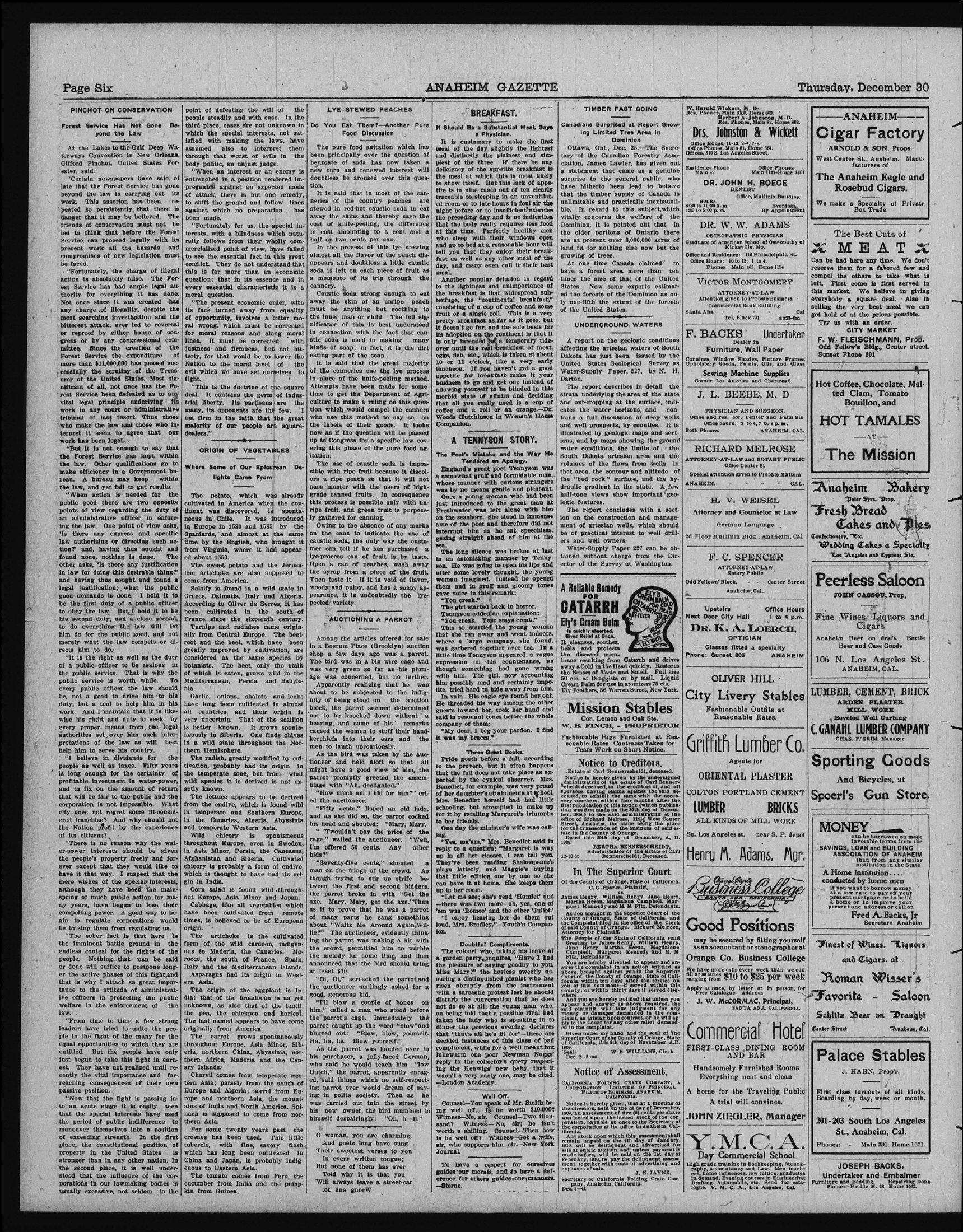
Searchable text
PINCHOT ON CONSERVATION
Forest Service Has Not Gone Beyond the Law
At the Lakes-to-the-Gulf Deep Waterways Convention in New Orleans, Gifford Pinchot, United States Forester, said:
"Certain newspapers have said of late that the Forest Service has gone beyond the law in carrying out its work. This assertion has been repeated so persistently, that there is danger that it may be believed. The friends of conservation must not be led to think that before the Forest Service can proceed legally with its present work all the hazards and compromises of new legislation must be faced.
"Fortunately, the charge of illegal action is absolutely false. The Forest Service has had ample legal authority for everything it has done. Not once since it was created has any charge of illegality, despite the most searching investigation and the bitterest attack, ever led to reversal or reproof by either house of congress or by any congressional committee. Since the creation of the Forest Service the expenditure of more than $11,000,000 has passed successfully the scrutiny of the Treasurer of the United States. Most significant of all, not once has the Forest Service been defeated as to any vital legal principle underlying its work in any court or administrative tribunal of last resort. Thus those who make the law and those who interpret it seem to agree that our work has been legal.
"But it is not enough to say that the Forest Service has kept within point of defeating the will of the people steadily and with ease. In the third place, cases are not unknown in which the special interests, not satisfied with making the laws, have assumed also to interpret them through that worst of evils in the body politic, an unjust judge.
"When an interest or an enemy is entrenched in a position rendered impregnable against an expected mode of attack, there is but one remedy, to shift the ground and follow lines against which no preparation has been made.
"Fortunately for us, the special interests, with a blindness which naturally follows from their wholly commercialized point of view, have failed to see the essential fact in this great conflict. They do not understand that this is far more than an economic question; that in its essence and in every essential characteristic it is a moral question.
"The present economic order, with its face turned away from equality of opportunity, involves a bitter moral wrong, which must be corrected for moral reasons and along moral lines. It must be corrected with justness and firmness, but not bitterly, for that would be to lower the Nation to the moral level of the evil which we have set ourselves to fight.
"This is the doctrine of the square deal. It contains the germ of industrial liberty. Its partisans are the many, its opponents are the few. I am firm in the faith that the great majority of our people are square-dealers."
ORIGIN OF VEGETABLES
more than $11,000,000 has passed successfully the scrutiny of the Treasurer of the United States. Most significant of all, not once has the Forest Service been defeated as to any vital legal principle underlying its work in any court or administrative tribunal of last resort. Thus those who make the law and those who interpret it seem to agree that our work has been legal.
"But it is not enough to say that the Forest Service has kept within the law. Other qualifications go to make efficiency in a Government bureau. A bureau may keep within the law, and yet fail to get results.
"When action is needed for the public good there are two opposite points of view regarding the duty of an administrative officer in enforcing the law. One point of view asks, 'Is there any express and specific law authorizing or directing such action?' and having thus sought and found none, nothing is done. The other asks, 'Is there any justification in law for doing this desirable thing?' and having thus sought and found a legal justification, what the public good demands is done. I hold it to be the first duty of a public officer to obey the law. But I hold it to be his second duty, and a close second, to do everything the law will let him do for the public good, and not merely what the law compels or directs him to do.
"It is the right as well as the duty of a public officer to be zealous in the public service. That is why the public service is worth while. To every public officer the law should be, not a goad to drive him to his duty, but a tool to help him in his work. And I maintain that it is likewise his right and duty to seek by every proper means from the legal authorities set over him such interpretations of the law as will best help him to serve his country.
"I believe in dividends for the people as well as taxes. Fifty years is long enough for the certainty of profitable investment in water-power, and to fix on the amount of return that will be fair to the public and the corporation is not impossible. What city does not regret some ill-considered franchise? And why should not the Nation profit by the experience of its citizens?
"There is no reason why the water-power interests should be given the people's property freely and forever except that they would like to Nation to the moral level of the evil which we have set ourselves to fight.
"This is the doctrine of the square deal. It contains the germ of industrial liberty. Its partisans are the many, its opponents are the few. I am firm in the faith that the great majority of our people are square-dealers."
ORIGIN OF VEGETABLES
Where Some of Our Epicurean Delights Came From
The potato, which was already cultivated in America when the continent was discovered, is spontaneous in Chile. It was introduced in Europe in 1580 and 1585 by the Spaniards, and almost at the same time by the English, who brought it from Virginia, where it had appeared about 1550.
The sweet potato and the Jerusalem artichoke are also supposed to come from America.
Salsify is found in a wild state in Greece, Dalmatia, Italy and Algeria. According to Oliver de Serres, it has been cultivated in the south of France since the sixteenth century.
Turnips and radishes came originally from Central Europe. The beetroot and the beet, which have been greatly improved by cultivation, are considered as the same species by botanists. The beet, only the stalk of which is eaten, grows wild in the Mediterranean, Persia and Babylonia.
Garlic, onions, shalots and leeks have long been cultivated in almost all countries, and their origin is very uncertain. That of the scallion is better known. It grows spontaneously in Siberia. One finds chives in a wild state throughout the Northern Hemisphere.
The radish, greatly modified by cultivation, probably had its origin in the temperate zone, but from what wild species it is derived is not exactly known.
The lettuce appears to be derived from the endive, which is found wild in temperate and Southern Europe, in the Canaries, Algeria, Abyssinia and temperate Western Asia.
Wild chicory is spontaneous throughout Europe, even in Sweden, in Asia Minor, Persia, the Caucasus, Afghanistan and Siberia. Cultivated chicory is probably a form of endive,
Among the armenians in a Boerum Plain shop a few days. The bird was in was very green age was concern.
Apparently re-about to be suity of being still block, the parrot not to be knocked hearing, and so caused the woman kerchiefs into men to laugh u.
As the bird w tioneer and he might have a g parrot promptly blage with "Ah,
"How much ad ed the auctioneer?
"Fifty cents," and as she did his head and sh
"Twouldn't cage," wailed th I'm offered 50 bids?"
is long enough for the certainty of profitable investment in water-power, and to fix on the amount of return that will be fair to the public and the corporation is not impossible. What city does not regret some ill-considered franchise? And why should not the Nation profit by the experience of its citizens?
"There is no reason why the water-power interests should be given the people's property freely and forever except that they would like to have it that way. I suspect that the mere wishes of the special interests, although they have been the mainspring of much public action for many years, have begun to lose their compelling power. A good way to begin to regulate corporations would be to stop them from regulating us.
"The sober fact is that here is the imminent battle ground in the endless contest for the rights of the people. Nothing that can be said or done will suffice to postpone longer the active phases of this fight, and that is why I attach so great importance to the attitude of administrative officers in protecting the public welfare in the enforcement of the law.
"From time to time a few strong leaders have tried to unite the people in the fight of the many for the equal opportunities to which they are entitled. But the people have only just begun to take this fight in earnest. They have not realized until recently the vital importance and far-reaching consequences of their own passive position.
"Now that the fight is passing into an acute stage it is easily seen that the special interests have used the period of public indifference to maneuver themselves into a position of exceeding strength. In the first place, the constitutional position of property in the United States is stronger than in any other nation. In the second place, it is well understood that the influence of the corporations in our lawmaking bodies is usually excessive, not seldom to the temperate zone, but from what wild species it is derived is not exactly known.
The lettuce appears to be derived from the endive, which is found wild in temperate and Southern Europe, in the Canaries, Algeria, Abyssinia and temperate Western Asia.
Wild chicory is spontaneous throughout Europe, even in Sweden, in Asia Minor, Persia, the Caucasus, Afghanistan and Siberia. Cultivated chicory is probably a form of endive, which is thought to have had its origin in India.
Corn salad is found wild throughout Europe, Asia Minor and Japan.
Cabbage, like all vegetables which have been cultivated from remote times, is believed to be of European origin.
The artichoke is the cultivated form of the wild cardoon, indigenous to Maderia, the Canaries, Morocco, the south of France, Spain, Italy and the Mediterranean islands.
Asparagus had its origin in Western Asia.
The origin of the eggplant is India; that of the broadbean is as yet unknown, as also that of the lentil, the pea, the chickpea and haricot. The last named appears to have come originally from America.
The carrot grows spontaneously throughout Europe, Asia Minor, Siberia, northern China, Abyssinia, northern Africa, Maderia and the Canary Islands:
Chervil comes from temperate western Asia; parsely from the south of Europe and Algeria; sorrel from Europe and northern Asia, the mountains of India and North America. Spinach is supposed to come from northern Asia.
For some twenty years past the crosnes has been used. This little tubercle, with fine, savory flesh which has long been cultivated in China and Japan, is probably indigenous to Eastern Asia.
The tomato comes from Peru, the cucumber from India and the pumpkin from Guinea.
ANAHEIM GAZETTE
LYE STEWED PEACHES
Do You Eat Them?—Another Pure Food Discussion
The pure food agitation which has been principally over the question of benzoate of soda has now taken a new turn and renewed interest will doubtless be aroused over this question.
It is said that in most of the canneries of the country peaches are stewed in red-hot caustic soda to eat away the skins and thereby save the cost of knife-peeling, the difference in cost amounting to a cent and a half or two cents per can.
In the process of this lye stewing almost all the flavor of the peach disappears and doubtless a little caustic soda is left on each piece of fruit as a memento of its trip through the cannery.
Caustic soda strong enough to eat away the skin of an unripe peach must be anything but soothing to the inner man or child. The full significance of this is best understood in connection with the fact that caustic soda is used in making many kinds of soap; in fact, it is the dirt eating part of the soap.
It is said that the great majority of the canneries use the lye process in place of the knife-peeling method. Attempts have been made for some time to get the Department of Agriculture to make a ruling on this question which would compel the canners who use this method to say so on the labels of their goods. It looks now as if the question will be passed up to Congress for a specific law covering this phase of the pure food agitation.
BREAKFAST.
It Should Be a Substantial Meal, Saye a Physician.
It is customary to make the first meal of the day slightly the lightest and distinctly the plainest and simplest of the three. If there be any deficiency of the appetite breakfast is the meal at which this is most likely to show itself. But this lack of appetite is in nine cases out of ten clearly traceable to sleeping in an unventilated room or to late hours in foul air the night before or to insufficient exercise the preceding day and is no indication that the body really requires less food at this time. Perfectly healthy men who sleep with their windows open and go to bed at a reasonable hour will tell you that they enjoy their breakfast as well as any other meal of the day, and many even call it their best meal.
Another popular delusion in regard to the lightness and unimportance of the breakfast is that widespread subterfuge, the "continental breakfast," consisting of a cup of coffee and some fruit or a single roll. This is a very pretty breakfast as far as it goes, but it doesn't go far, and the sole basis for its adoption on the continent is that it is only intended as a temporary tide-over until the real breakfast of meat, eggs, fish, etc., which is taken at about 10 or 11 o'clock, like a very early luncheon. If you haven't got a good appetite for breakfast make it your business to go and get one instead of allowing yourself to be blinded in this morbid state of affairs and deciding that all you really need is a cup of coffee and a roll or an orange.—Dr. Woods Hutchinson in Woman's Home Companion.
A TENNYSON STORY.
The Post's Mistake and the Way He TIMBER FAST GOING
Canadians Surprised at Report Showing Limited Tree Area in Dominion
Ottawa, Ont., Dec. 25.—The Secretary of the Canadian Forestry Association, James Lawler, has given out a statement that came as a genuine surprise to the general public, who have hitherto been lead to believe that the timber supply of Canada is unlimited and practically inexhaustible. In regard to this subject, which vitally concerns the welfare of the Dominion, it is pointed out that in the older portions of Ontario there are at present over 8,000,000 acres of land fit for nothing else now but the growing of trees.
At one time Canada claimed to have a forest area more than ten times the size of that of the United States. Now some experts estimated the forests of the Dominion as only one-fifth the extent of the forests of the United States.
UNDERGROUND WATERS
A report on the geologic conditions affecting the artesian waters of South Dakota has just been issued by the United States Geological Survey as Water-Supply Paper, 227, by N. H. Darton.
The report describes in detail the strata underlying the area of the state and out-cropping at the surface, indicates the water horizons, and contains a full discussion of deep wells and well prospects, by counties. It is illustrated by geologic maps and sections, and by maps showing the ground water conditions, the limits of the South Dakota artesian area and the
It is said that the great majority of the canneries use the lye process in place of the knife-peeling method. Attempts have been made for some time to get the Department of Agriculture to make a ruling on this question which would compel the canners who use this method to say so on the labels of their goods. It looks now as if the question will be passed up to Congress for a specific law covering this phase of the pure food agitation.
The use of caustic soda is impossible with ripe fruit because it discolors a ripe peach so that it will not pass muster with the users of high-grade canned fruits. In consequence this process is possible only with unripe fruit, and green fruit is purposefully gathered for canning.
Owing to the absence of any marks on the cans to indicate the use of caustic soda, the only way the customer can tell if he has purchased a lye-process can of fruit is by taste. Open a can of peaches, wash away the syrup from a piece of the fruit. Then taste it. If it is void of flavor, woody and pulpy, and has a soapy appearance, it is undoubtedly the lye-peeled variety.
AUCTIONING A PARROT
Among the articles offered for sale in a Boerum Place (Brooklyn) auction shop a few days ago was a parrot. The bird was in a big wire cage and was very green so far as his plumage was concerned, but no further.
Apparently realizing that he was about to be subjected to the indignity of being stood on the auction block, the parrot seemed determined not to be knocked down without a hearing, and some of his remarks caused the women to stuff their handkerchiefs into their ears and the men to laugh uproariously.
As the bird was taken by the auctioneer and held aloft so that all might have a good view of him, the parrot promptly greeted the assemblage with "Ah, deelighted."
"How much am I bid for him?" crieed the auctioneer.
"Fifty cents," lisped an old lady, and as she did so, the parrot cocked his head and shouted: "Mary, Mary."
"'Twouldn't pay the price of the cage,' wailed the auctioneer. "Well, I'm offered 50 cents. Any other bids?"
"Seventy-five cents," shouted a man on the fringe of the crowd.
A TENNYSON STORY.
The Poet's Mistake and the Way He Tendered an Apology.
England's great poet Tennyson was a somewhat gruff and formidable man, whose manner with curious strangers was by no means gentle and pleasant.
Once a young woman who had been just introduced to the great man at Freshwater was left alone with him on the seashore. She stood in immense awe of the poet and therefore did not interrupt him as he sat speechless, gazing straight ahead of him at the sea.
The long silence was broken at last in an astonishing manner by Tennyson. He was going to open his lips and utter some lovely thought, the young woman imagined. Instead he opened them and in gruff and gloomy tones gave voice to this remark:
"You creak."
The girl started back in horror.
Tennyson added an explanation:
"You creak. Your stays creak."
This so startled the young woman that she ran away and went indoors, where a large company, she found, was gathered together over tea. In a little time Tennyson appeared, a vague expression on his countenance, as though something had gone wrong with him. The girl, now accounting him possibly mad and certainly impolite, tried hard to hide away from him.
In vain. His eagle eye found her out. He threaded his way among the other guests toward her, took her hand and said in resonant tones before the whole company of them:
"My dear, I beg your pardon. I find it was my braces."
Three Great Books.
Pride goeth before a fall, according to the proverb, but it often happens that the fall does not take place as expected by the cynical observer. Mrs. Benedict, for example, was very proud of her daughter's attainments at school. Mrs. Benedict herself had had little schooling, but attempted to make up for it by retailing Margaret's triumphs to her friends.
One day the minister's wife was calling.
"Yes, ma'am," Mrs. Benedict said in reply to a question; "Margaret is way up in all her classes, I can tell you. They've been reading Shakespeare's plays latterly, and Maggie's buying United States Geological Survey as Water-Supply Paper, 227, by N. H. Darton.
The report describes in detail the strata underlying the area of the state and out-cropping at the surface, indicates the water horizons, and contains a full discussion of deep wells and well prospects, by counties. It is illustrated by geologic maps and sections, and by maps showing the ground water conditions, the limits of the South Dakota artesian area and the volumes of the flows from wells in that area, the contour and altitude of the "bed rock" surface, and the hydraulic gradient in the state. A few half-tone views show important geologic features.
The report concludes with a section on the construction and management of artesian wells, which should be of practical interest to well drillers and well owners.
Water-Supply Paper 227 can be obtained without charge from the Director of the Survey at Washington.
A Reliable Remedy FOR CATARRH Ely's Cream Balm
is quickly absorbed. Gives Relief at Once.
It cleanses, soothes, heals and protects the diseased membrane resulting from Catarrh and drives away a Cold in the Head quickly. Restores the Senses of Taste and Smell. Full size 50 cts. at Druggists or by mail. Liquid Cream Balm for use in atomizers 75 cts. Ely Brothers, 56 Warren Street, New York.
Mission Stables
Cor. Lemon and Oak Sts.
W. B. FINCH, - PROPRIETOR
Fashionable Rigs Furnished at Reasonable Rates Contracts Taken for Team Work on Short Notice.
Notice to Creditors.
Estate of Carl Bennerscheldt, deceased.
Notice is hereby given by the undersigned administratrix of the estate of Carl Bennerscheldt deceased, to the creditors of, and all persons having claims against the said deceased, to exhibit the same with the necessary vouchers, within four months after the first publication of this notice (which publication was first made on the 30th day of December, 1909), to the said administrator at the office of Richard Melrose, 112% West Center Street, Anaheim, same being the place for the transaction of the business of said estate in the County of Orange.
Dated this 30th day of December, A. D. 1909.
BERTHA BENNERSCHEIDT,
Administrator of the Estate of Carl Bennerscheldt, Deceased.
parrot promptly greeted the assemblage with "Ah, deelighted."
"How much am I bid for him?" cried the auctioneer.
"Fifty cents," lisped an old lady, and as she did so, the parrot cocked his head and shouted: "Mary, Mary."
"'Twouldn't pay the price of the cage,' wailed the auctioneer. 'Well, I'm offered 50 cents. Any other bids?'"
"Seventy-five cents," shouted a man on the fringe of the crowd. As though trying to stir up strife between the first and second bidders, the parrot broke in with "Get the axe. Mary, Mary, get the axe." Then as if to prove that he was a parrot of many parts he sang something about "Waltz Me Around Again, Willie?" The auctioneer, evidently thinking the parrot was making a hit with the crowd, permitted him to warble the melody for some time, and then announced that the bird should bring at least $10.
"Io, Oi," screeched the parrot and the auctioneer smilingly asked for a good, generous bid.
"I'll blow a couple of bones on him," called a man who stood before the parrot's cage. Immediately the parrot caught up the word "blow" and blurted out: "Blow, blow, yourself. Ha, ha, ha. Blow yourself."
As the parrot was handed over to his purchaser, a jolly-faced German, who said he would teach him "low Dutch," the parrot, apparently enraged, said things which no self-respecting parrot ever would dream of saying in polite society. Then as he was carried out into the street by his new owner, the bird mumbled to himself despairingly: "Oh, h—ll."
O woman, you are charming,
And poets long have sung
Their sweetest verses to you
In every written tongue;
But none of them has ever
Told why it is that you
Will always leave a street-car
ot dne gnorW
that the rail does not take place as expected by the cynical observer. Mrs. Benedict, for example, was very proud of her daughter's attainments at school. Mrs. Benedict herself had little schooling, but attempted to make up for it by retailing Margaret's triumphs to her friends.
One day the minister's wife was calling.
"Yes, ma'am," Mrs. Benedict said in reply to a question; "Margaret is way up in all her classes, I can tell you. They've been reading Shakespeare's plays latterly, and Maggie's buying that little edition one by one so she can have it at home. She keeps them up in her room.
"Let me see; she's read 'Hamlet' and —there was two more—oh, yes, one of 'em was 'Romeo' and the other 'Juliet.'"
"I enjoy hearing her do them out loud, Mrs. Bradley,"—Youth's Companion.
Doubtful Compliments.
The colonel who, taking his leave at a garden party, inquires, "Have I had the pleasure of saying goodby to you, Miss Mary?" the hostess sweetly assuring a distinguished pianist who has risen abruptly from the instrument with a sarcastic protest lest he should disturb the conversation that he does not do so at all; the young man who, on being told that a possible rival had taken the lady who is speaking in to dinner the previous evening, declares that "that's all he's fit for"—these are decided instances of this class of bad compliment, while for a well meant but lukewarm one poor Newman Noggs' reply to the collector's query respecting the Kenwigs' new baby, that it wasn't a very nasty one, may be cited.—London Academy.
Well Off.
Counsel—You speak of Mr. Smith being well off. Is he worth $10,000? Witness—No, sir; Counsel—Two thousand? Witness—No, sir; he isn't worth a shilling. Counsel—Then how is he well off? Witness—Got a wife, sir, who supports him, sir.—New York Journal.
To have a respect for ourselves guides our morals, and to have a reference for others guides our manners.—Sterne.
Notice of Assessment.
CALIFORNIA FOLDING CRATE COMPANY, A CORPORATION. LOCATION OF PRINCIPAL PLACE OF BUSINESS. ANAHEIM, CALIFORNIA.
Notice is hereby given, that at a meeting of the directors, held on the 2d day of December, 1909, an assessment of five (6) cents per share was levied upon the issued stock of the corporation, payable at once to the Secretary of the corporation at its office in Anaheim, California.
Any stock upon which this assessment shall remain unpaid on the 4th day of January, 1910 will be delinquent and advertised for sale at public auction, and unless payment is made before, will be sold on the 1st day of February, 1910, to pay the delinquent assessment, together with costs of advertising and expenses of sale.
J. E. JAYNE,
Secretary of California Folding Crate Company, Anaheim, California.
Dec. 9-4t
THURSDAY, DECEMBER 30
FAST GOING
Surprised at Report Showlimited Tree Area in
Dominion
t., Dec. 25.—The SecreCanadian Forestry Assosus Lawler, has given out
that came as a genuine
the general public, who
been lead to believe
supply of Canada is
and practically inexhaustiward to this subject, which
warns the welfare of the
is pointed out that in
portions of Ontario there
at over 8,000,000 acres of
nothing else now but the
nees.
Canada claimed to
area more than ten
of that of the United
some experts estimatof the Dominion as onthe extent of the forests
States.
ROUND WATERS
In the geologic conditions
artesian waters of South
must been issued by the
Geological Survey as
Paper, 227, by N. H.
describes in detail the
wing the area of the state
ing at the surface, inditer horizons, and condiscussion of deep wells
pects, by counties. It is
geologic maps and sectmaps showing the ground
ons, the limits of the
artesian area and the
W. Harold Wickett, M. D.
Res. Phones, Main 8X8, Home 863.
Herbert A. Johnston, M. D.
Res. Phones, Main 82, Home 862.
Drs. Johnston & Wickett
Office Hours, 11-12, 2-4, 7-8.
Office Phones, Main 81, Home 861.
Offices, 310 S. Los Angeles Street.
Residence Phone
Main 42
Office Phones
Main 1141-Home 1401
DR. JOHN H. BOEGE
DENTIST
Office, Mullinix Building
HOURS
8:30 to 11:30 a.m.
1:30 to 5:00 p.m.
Evenings
By Appointment
DR. W. W. ADAMS
OSTEOPATHIC PHYSICIAN
Graduate of American School of Osteopathy of Kirksville, Mo.
Office and Residence: 116 Philadelphia St.
Office Hours: 10 to 12; 1 to 4.
Phones: Main 463; Home 1134
VICTOR MONTGOMERY
ATTORNEY-AT-LAW
Attention given to Probate Business
Commercial Bank Building.
Santa Ana Cal.
Tel. Black 791 au23-6m
F. BACKS Undertaker
Dealer in
Furniture, Wall Paper
Cornices, Window Shades, Picture Frames
Upholstery Goods, Paints, Oils, and Glass
Sewing Machine Supplies
Corner Los Angeles and Chartres S
J. L. BEEBE, M. D
PHYSICIAN AND SURGEON.
Office and res. cor. Center and Palm Sts
Office hours: 2 to 4,7 to 8 p.m.
Both Phones.
ANAHEIM CAL.
RICHARD MELROSE
ATTORNEY-AT-LAW and NOTARY PUBLIC
ANAHEIM
Cigar Factory
ARNOLD & SON, Props.
West Center St., Anaheim. Manufacturers of
The Anaheim Eagle and Rosebud Cigars.
We make a Specialty of Private Box Trade.
The Best Cuts of MEAT
Can be had here any time. We don't reserve them for a favored few and compel the others to take what is left. First come is first served in this market. We believe in giving everybody a square deal. Also in selling the very best meat we can get hold of at the prices possible.
Try us with an order.
CITY MARKET
F. W. FLEISCHMANN, Prop.
Odd Fellow's Bldg., Center street
Sunset Phone 201
Hot Coffee, Chocolate, Malted Clam, Tomato Bouillon, and HOT TAMALES
AT——The Mission
Sewing Machine Supplies
Corner Los Angeles and Chartres S
J. L. BEEBE, M. D
PHYSICIAN AND SURGEON.
Office and res. cor. Center and Palm Sts
Office hours: 2 to 4,7 to 8 p.m.
Both Phones.
RICHARD MELROSE
ATTORNEY-AT-LAW and NOTARY PUBLIC
Office Center St
Special attention given to Probate Matters
ANAHEIM.
H. V. WEISEL
Attorney and Counselor at Law
German Language
2d Floor Mullinix Bldg., Anaheim, Cal
F. C. SPENCER
ATTORNEY-AT-LAW
Notary Public
Odd Fellows' Block,
Center Street
Anaheim, Cal.
Upstairs Office Hours
Next Door City Hall 1 to 4 p.m.
DR. K. A. LOERCH,
OPTICIAN
Glasses fitted a specialty
Phone: Sunset 806 ANAHEIM
OLIVER HILL
City Livery Stables
Fashionable Outfits at Reasonable Rates.
Griffith Lumber Co.
Agents for ORIENTAL PLASTER
COLTON PORTLAND CEMENT
LUMBER BRICKS
ALL KINDS OF MILL WORK
So. Los Angeles st. near S. P. depot
Henry M. Adams, Mgr.
Hot Coffee, Chocolate, Malted Clam, Tomato Bouillon, and HOT TAMALES AT THE Mission
Anaheim Bakery
Peter Syre, Prop.
Fresh Bread Cakes and Pies
Confectionery, Etc.
Wedding Cakes a Specialty Los Angeles and Express Sts.
Peerless Saloon
JOHN CASSOU, Prop.
Fine Wines, Liquors and Cigars
Anaheim Beer on draft. Bottle Beer and Case Goods
106 N. Los Angeles St.
ANAHEIM, CAL.
LUMBER, CEMENT, BRICK
ARDEN PLASTER MILL WORK
Beveled Well Curbing
C.GANAHL LUMBER COMPANY
CHAS. F.'GRIM. Manager
Sporting Goods And Bicycles, at Spoerl's Gun Store.
MONEY can be borrowed on more favorable terms from the SAVINGS, LOAN and BUILDING ASSOCIATION OF ANAHEIM than from any similar institution in the State.
ORIENTAL PLASTER
COLTON PORTLAND CEMENT
LUMBER BRICKS
ALL KINDS OF MILL WORK
So. Los Angeles st. near S. P. depot
Henry M. Adams, Mgr.
Business College
SANTA ANA CALIFORNIA
Good Positions
may be secured by fitting yourself as an accountant or stenographer at Orange Co. Business College
We have more calls every week than we can fill at salaries ranging from $10 to $25 per week
Apply at once, by letter or in person, for Free Catalogue. Address
J. W. McCORMAC, Principal,
SANTA ANA, CALIFORNIA.
Commercial Hotel
FIRST-CLASS DINING ROOM AND BAR
Handsomely Furnished Rooms Everything neat and clean
A home for the Traveling Public A trial will convince.
JOHN ZIEGLER, Manager
Y.M.C.A.
Day Commercial School
High grade training in Bookkeeping, Stenography, Accountancy and Law. Men teachers, home influences, low tuition, graduates in demand. Evening courses in Engineering Drafting, Automobile, etc. Send for catalogue. Y. M. C. A., Los Angeles, Cal.
And Bicycles, at Spoerl's Gun Store.
MONEY
can be borrowed on more favorable terms from the SAVINGS, LOAN and BUILDING ASSOCIATION OF ANAHEIM than from any similar institution in the State
A Home Institution... conducted by home men
If you want to borrow money at a low rate to pay off your present mortgage, or to build a home or to improve your present one address or call on Fred A. Backs, Jr.
Secretary Anaheim
Finest of Wines, Liquors and Tigars, at Roman Wisser's Favorite - Saloon Schlitz Beer on Draught Center Street Anaheim, Cal.
Palace Stables
J. HAHN, Prop'r.
First class turnouts of all kinds. Boarding by day, week or month.
201-203 South Los Angeles St., Anaheim, Cal.
Phones: Main 391, Home 1671.
JOSEPH BACKS,
Undertaker and Embalmer
Furniture and Bedding. Repairing Done Phones—Pacific M. 98 Home 1062.