anaheim-gazette 1909-12-16
Scanned page
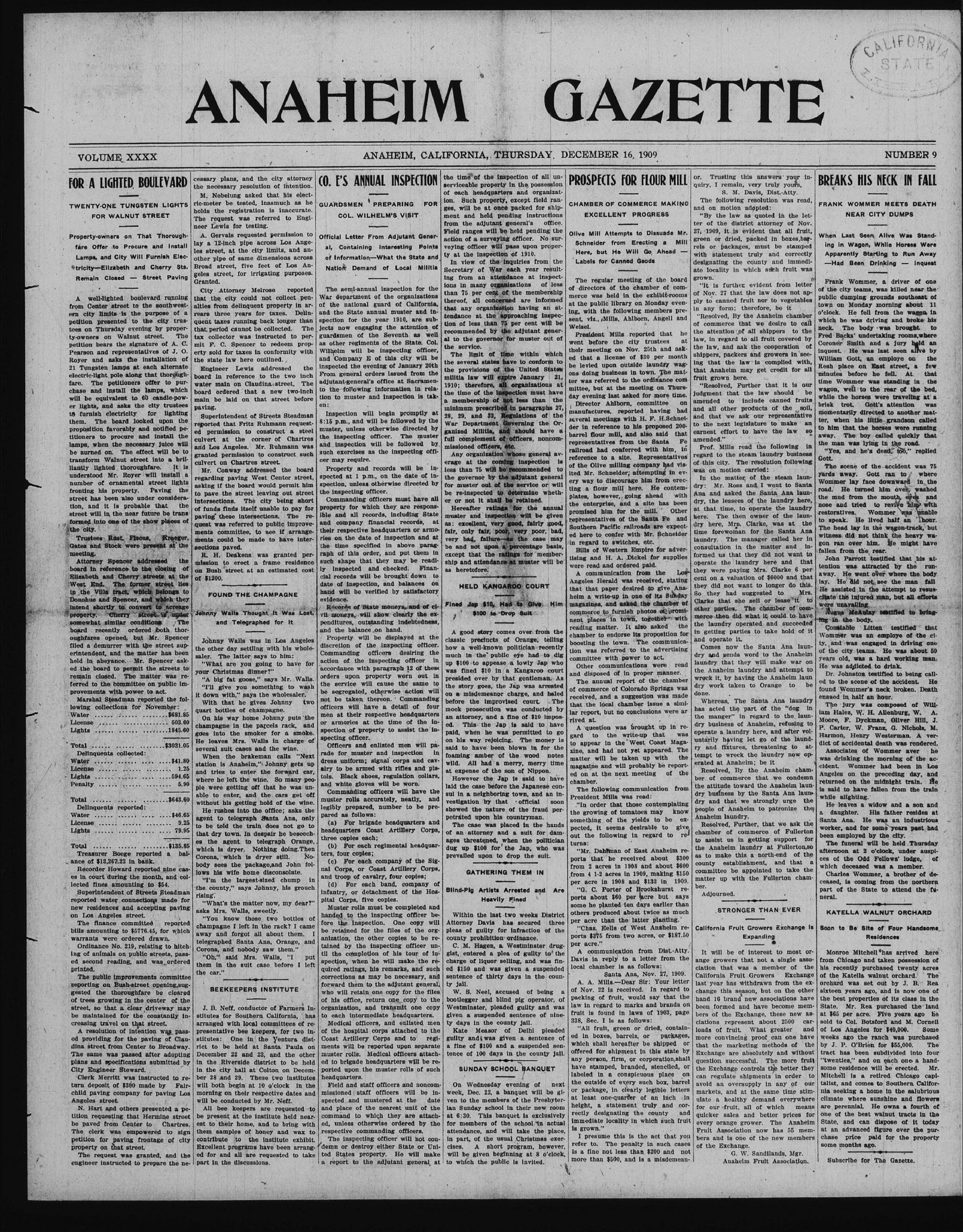
Searchable text
FOR A LIGHTED BOULEVARD
TWENTY-ONE TUNGSTEN LIGHTS FOR WALNUT STREET
Property owners on That Thoroughfare Offer to Procure and Install Lamps, and City Will Furnish Electricity—Elizabeth and Cherry Sts. Remain Closed — Street Paving
A well-lighted boulevard running from Center street to the southwestern city limits is the purpose of a petition presented to the city trustees on Thursday evening by property owners on Walnut street. The petition bears the signature of A. C. Pearson and representatives of J. O. Royer and asks the installation of 21 Tungsten lamps at each alternate electric-light pole along that thoroughfare. The petitioners offer to purchase and install the lamps, which will be equivalent to 60 candle-power lights, and asks the city trustees to furnish electricity for lighting them. The board looked upon the proposition favorably and notified petitioners to procure and install the lamps, when the necessary juice will be aired on. The effect will be to transform Walnut street into a bril-
cessary plans, and the city attorney the necessary resolution of intention.
M. Nebelung asked that his electric-meter be tested, inasmuch as he holds the registration is inaccurate. The request was referred to Engineer Lewis for testing.
A. Gervais requested permission to lay a 12-inch pipe across Los Angeles street, at the city limits, and another pipe of same dimensions across Broad street, five feet of Los Angeles street, for irrigating purposes. Granted.
City Attorney Melrose reported that the city could not collect penalties from delinquent property in arrears three years for taxes. Delinquent taxes running back longer than that period cannot be collected. The tax collector was instructed to permit F. C. Spencer to redeem property sold for taxes in conformity with the state law here outlined.
Engineer Lewis addressed the board in reference to the two inch water main on Claudina street. The board ordered that a new two-inch main be laid on that street before paving.
Superintendent of Streets Steadman reported that Fritz Ruhmann requested permission to construct a steel culvert at the corner of Chartres and Los Angeles. Mr. Ruhmann was granted permission to construct such
21 Tungsten lamps at each alternate electric-light pole along that thoroughfare. The petitioners offer to purchase and install the lamps, which will be equivalent to 60 candle-power lights, and asks the city trustees to furnish electricity for lighting them. The board looked upon the proposition favorably and notified petitioners to procure and install the lamps, when the necessary juice will be aurned on. The effect will be to transform Walnut street into a brilliantly lighted thoroughfare. It is understood Mr. Royer will install a number of ornamental street lights fronting his property. Paving the street has been also under consideration, and it is probable that the street will in the near future be transformed into one of the show places of the city.
Trustees Rust, Fiscus, Kroeger, Gates and Stock were present at the meeting.
Attorney Spencer addressed the board in reference to the closing of Elizabeth and Cherry streets at the West End. The former street lies in the Villa tract, which belongs to Donohue and Spencer, and which they intend shortly to convert to acreage property. Cherry street is under somewhat similar conditions. The board recently ordered both thoroughfares opened, but Mr. Spencer fled a demurrier with the street superintendent, and the matter has been held in abeyance. Mr. Spencer asked the board to permit the streets to remain closed. The matter was referred to the committee on public improvements with power to act.
Marshal Steadman reported the following collections for November:
Water ... $681.85
License ... $503.60
Lights ... $1845.60
Total ... $3031.05
Delinquents collected:
Water ... $41.80
License ... 1.25
Lights ... $594.65
Penalty ... 5.90
Total ... $643.60
Delinquents reported:
Water ... $46.65
License ... 9.25
Lights ... 79.95
Total ... $135.85
Treasurer Boege reported a balance of $13,267.23 in bank.
Recorder Howard reported nine cas-
Lights ...594.65
Penalty ...5.90
Total ...$643.60
Delinquents reported:
Water ...$46.65
License ...9.25
Lights ...79.95
Total ...$135.85
Treasurer Boege reported a balance of $13,267.23 in bank.
Recorder Howard reported nine cases in court during the month, and collected fines amounting to $54.
Superintendent of Streets Steadman reported water connections made for new residences and accepting paving on Los Angeles street.
The finance committee reported bills amounting to $5776.45, for which warrants were ordered drawn.
Ordinance No. 219, relating to hitching of animals on public streets, passed second reading, and was ordered printed.
The public improvements committee reporting on Bush-street opening,suggested the thoroughfare be cleared of trees growing in the center of the street, so that a clear driveway may be maintained for the constantly increasing travel on that street.
A resolution of intention was passed providing for the paving of Claudina street from Center to Broadway. The same was passed after adopting plans and specifications submitted by City Engineer Steward.
Clerk Merritt was instructed to return deposit of $300 made by Fairchild paving company for paving Los Angeles street.
N. Hart and others presented a petition requesting that Hermine street be paved from Center to Chartres. The clerk was empowered to sign petition for paving frontage of city property on that street.
The request was granted, and the engineer instructed to prepare the ne-
ANAHEIM, CALIFORNIA, THURSDAY. DECEMBER 16, 1909
CO. E'S ANNUAL INSPECTION
GUARDSMEN PREPARING FOR COL. WILHELM'S VISIT
Official Letter From Adjutant General, Containing Interesting Points of Information—What the State and Nation Demand of Local Militia
The semi-annual inspection for the War department of the organizations of the national guard of California, and the State annual muster and inspection for the year 1910, are subjects now engaging the attention of guardsmen of the Seventh as well as other regiments of the State. Col. Wilhelm will be inspecting officer, and Company E of this city will be inspected the evening of January 20th. From general orders issued from the adjutant-general's office at Sacramento to the following information in relation to muster and inspection is taken:
Inspection will begin promptly at 8:15 p.m., and will be followed by the muster, unless otherwise directed by the inspecting officer. The muster and inspection will be followed by such exercises as the inspecting officer may require.
the time of the inspection of all un-serviceable property in the possession of each headquarters and organization. Such property, except field ranges, will be at once packed for shipment and held pending instructions from the adjutant general's office. Field ranges will be held pending the action of a surveying officer. No surveying officer will pass upon property at the inspection of 1910.
In view of the inquiries from the Secretary of War each year resulting from an attendance at inspections in many organizations of less than 75 per cent of the membership thereof, all concerned are informed that any organization having an attendance at the approaching inspection of less than 75 per cent will be recommended by the adjutant general to the governor for muster out of the service.
The limit of time within which the several states have to conform to the provisions of the United States militia law will expire January 21, 1910; therefore, all organizations at the time of the inspection must have a membership of not less than the minimum prescribed in paragraphs 27, 28, 29, and 32, Regulations of the War Department Governing the Organized Militia, and should have a full complement of officers, noncommissioned officers, etc.
Any organization whose general aviation has several meetings with H. F. H.Schnurder in reference to his proposed barrel flour mill, and also said that representatives from the Santa Ana railroad had conferred with him, reference to a site. Representative
Inspection will begin promptly at 8:15 p.m., and will be followed by the muster, unless otherwise directed by the inspecting officer. The muster and inspection will be followed by such exercises as the inspecting officer may require.
Property and records will be inspected at 1 p.m., on the date of inspection, unless otherwise directed by the inspecting officer.
Commanding officers must have all property for which they are responsible and all records, including State and company financial records, at their respective headquarters or armories on the date of inspection and at the time specified in above paragraph of this order, and put them in such shape that they may be readily inspected and checked. Financial records will be brought down to date of inspection, and balances on hand will be verified by satisfactory evidence.
Records of State moneys, and of civil moneys, will show clearly the expenditures, outstanding indebtedness, and the balance on hand.
Property will be displayed at the discretion of the inspecting officer. Commanding officers desiring the action of the inspecting officer in accordance with paragraph 12 of these orders upon property worn out in the service will cause the same to be segregated, otherwise action will not be taken thereon. Commanding officers will have a detail of four men at their respective headquarters or armories at the time of the inspection of property to assist the inspecting officer.
Officers and enlisted men will parade for muster and inspection in dress uniform; signal corps and cavalry to be armed with rifles and pistols. Black shoes, regulation collars, and white gloves will be worn.
Commanding officers will have the muster rolls accurately, neatly, and legibly prepared, number to be prepared as follows:
(a) For brigade headquarters and headquarters Coast Artillery Corps, three copies each;
(b) For each regimental headquarters, four copies;
(c) For each company of the Signal Corps, or Coast Artillery Corps,
the several states have to conform to the provisions of the United States militia law will expire January 21, 1910; therefore, all organizations at the time of the inspection must have a membership of not less than the minimum prescribed in paragraphs 27, 28, 29, and 32. Regulations of the War Department Governing the Organized Militia, and should have a full complement of officers, noncommissioned officers, etc.
Any organization whose general average at the coming inspection is less than 75 will be recommended to the governor by the adjutant general for muster out of the service or will be re-inspected to determine whether or not it shall be retained.
Hereafter ratings for the annual muster and inspection will be given as: excellent, very good, fairly good, fair, only fair, poor, very poor, bad, very bad, failure—as the case may be and not upon a percentage basis, except that the ratings for membership and attendance at muster will be as heretofore.
HELD KANGAROO COURT
Fined Jap $10, Had to Give Him $100 to Drop Suit
A good story comes over from the classic precincts of Orange, telling how a well-known politician recently much in the public eye had to dig up $100 to appease a lowly Jap who was fined $10 in a Kangaroo court presided over by that gentleman. As the story goes, the Jap was arrested on a misdemeanor charge, and haled before the improvised court. The mock prosecution was conducted by an attorney, and a fine of $10 imposed. This the Jap is said to have paid, when he was permitted to go on his way rejoicing. The money is said to have been blown in for the foaming amber of the wood notes wild. All had a merry, merry time at expense of the son of Nippon.
However the Jap is said to have laid the case before the Japanese consul in a neighboring town, and an investigation by that official soon showed the nature of the fraud perpetrated upon his countryman.
The case was placed in the hands of an attorney and a suit for damages threatened, when the politician dug up $100 for the Jap, who was prevailed upon to drop the suit.
Director Ahlborn, committee manufactures, reported having several meetings with H. F. H.Schnur in reference to his proposed barrel flour mill, and also said that representatives from the Santa Ana railroad had conferred with him. Reference to a site. Representative of the Olive milling company had visited Mr. Schneider; attempting in every way to discourage him from erecting a flour mill here. He contended plates, however, going ahead with the enterprise, and a site has been promised him for the mill. Other representatives of the Santa Fe and Southern Pacific railroads are expected here to confer with Mr. Schneider in regard to switches, etc.
Bills of Western Empire for advertising and H. A. Dickel for supplies were read and ordered paid.
A communication from the Los Angeles Herald was received, stating that that paper desired to give Arnheim a write-up in one of its Sunday magazines, and asked the chamber commerce to furnish photos of prominent places in town, together with reading matter. It also asked the chamber to endorse its proposition to boosting the town. The communication was referred to the advertising committee with power to act.
Other communications were received and disposed of in proper manner.
The annual report of the chamber of commerce of Colorado Springs was received, and a suggestion was made that the local chamber issue a similar report, but no conclusions were arrived at.
A question was brought up in regard to the write-up that would appear in the West Coast Magazine, and had not yet appeared. The matter will be taken up with the magazine and will probably be reported on at the next meeting of the chamber.
The following communication from President Mills was read:
"In order that those contemplating the growing of tomatoes may know something of the yields to be expected, it seems desirable to get out the following in regard to turns:
"Mr. Dahlman of East Anaheim reports that he received about $3 from 2 acres in 1908 and about $6 from 2 acres in 1908."
many peoters was unget off
the wine.
asks the Ana, only
not go to
be beseeching Orange,
doing. Then
will. NoJohn folso isolate.
chump in
his grouch
my dear?"
bottles of
ck? I came
the them. I
orange, and
them."
"I put
before I left
STUTE
Farmers Innoria, has
tees of refor two intentura distriPaula on
the other
to be held
on December
institutes
back in the
dates and
eff.
quested to
held nearbring with
and wax to
exhibit.
seen arranged to take
farmers Innoria, has
tees of refor two intentura distriPaula on
the other
to be held
on December
institutes
back in the
dates and
eff.
quested to
held nearbring with
and wax to
exhibit.
seen arranged to take
farmers Innoria, has
tees of refor two intentura distriPaula on
the other
to be held
on December
institutes
back in the
dates and
eff.
quested to
held nearbring with
and wax to
exhibit.
seen arranged to take
farmers Innoria, has
tees of refor two intentura distriPaula on
the other
to be held
on December
institutes
back in the
dates and
eff.
quested to
held nearbring with
and wax to
exhibit.
seen arranged to take
farmers Innoria, has
tees of refor two intentura distriPaula on
the other
to be held
on December
institutes
back in the
dates and
quested to
held nearbring with
and wax to
exhibit.
seen arranged to take
farmers Innoria, has
tees of refor two intentura distriPaula on
the other
to be held
on December
institutes back in the dates and eff.
requested to held near-bring with and wax to exhibit. Seen arranged to take
The inspecting officer will not condemn or destroy either State or United States property. He will make a report to the adjutant general at black shoes, regulation collars, and white gloves will be worn.
Commanding officers will have the muster rolls accurately, neatly, and legibly prepared, number to be prepared as follows:
(a) For brigade headquarters and headquarters Coast Artillery Corps, three copies each;
(b) For each regimental headquarters, four copies;
(c) For each company of the Signal Corps, or Coast Artillery Corps, and troop of cavalry, four copies;
(d) For each band, company of infantry, or detachment of the Hospital Corps, five copies.
Muster rolls must be completed and handed to the inspecting officer before the inspection. One copy will be retained for the files of the organization, the other copies to be retained by the inspecting officer until the completion of his tour of inspection, when he will make the required ratings, his remarks, and such corrections as may be necessary, and forward them to the adjutant general, who will retain one copy for the files of his office, return one copy to the organization, and transmit one copy to each intermediate headquarters.
Medical officers, and enlisted men of the hospital corps attached to the Coast Artillery Corps and to regiments will be reported upon separate muster rolls. Medical officers attached to brigade headquarters will be reported upon the muster rolls of such headquarters.
Field and staff officers and noncommissioned staff officers will be inspected and mustered at the date and place of the nearest unit of the command to which they are attached, unless otherwise ordered by the respective commanding officers.
The inspecting officer will not condemn or destroy either State or United States property. He will make a report to the adjutant general at Black shoes, regulation collars, and white gloves will be worn.
Commanding officers will have the muster rolls accurately, neatly, and legibly prepared, number to be prepared as follows:
(a) For brigade headquarters and headquarters Coast Artillery Corps, three copies each;
(b) For each regimental headquarters, four copies;
(c) For each band, company of infantry, or detachment of the Hospital Corps, five copies.
Muster rolls must be completed and handed to the inspecting officer before the inspection. One copy will be retained for the files of the organization, the other copies to be retained by the inspecting officer until the completion of his tour of inspection, when he will make the required ratings, his remarks, and such corrections as may be necessary, and forward them to the adjutant general, who will retain one copy for the files of his office, return one copy to the organization, and transmit one copy to each intermediate headquarters.
Medical officers, and enlisted men of the hospital corps attached to the Coast Artillery Corps and to regiments will be reported upon separate muster rolls. Medical officers attached to brigade headquarters will be reported upon the muster rolls of such headquarters.
Field and staff officers and noncommissioned staff officers will be inspected and mustered at the date and place of the nearest unit of the command to which they are attached, unless otherwise ordered by the respective commanding officers.
However the Jap is said to have laid the case before the Japanese consul in a neighboring town, and an investigation by that official soon showed the nature of the fraud perpetrated upon his countryman.
The case was placed in the hands of an attorney and a suit for damages threatened, when the politician dug up $100 for the Jap, who was prevailed upon to drop the suit.
GATHERING THEM IN
Blind-Pig Artists Arrested and Are Heavily Fined
Within the last two weeks District Attorney Davis has secured three pleas of guilty for infraction of the county prohibition ordinance.
C. M. Hagen, a Westminster druggist, entered a plea of guilty to the charge of liquor selling, and was fined $150 and was given a suspended sentence of thirty days in the county jail.
W. S. Neel, accused of being a bootlegger and blind pig operator, of Westminster, pleaded guilty and was given a suspended sentence of ninety days in the county jail.
Kate Measor of Delhi pleaded guilty and was given a sentence of a fine of $100 and a suspended sentence of 100 days in the county jail.
SUNDAY SCHOOL BANQUET
On Wednesday evening of next week, Dec. 22, a banquet will be given to the members of the Presbyterian Sunday school in their new room at 6:30. This banquet is exclusively for members of the school in actual attendance, and will take place in part, of the usual Christmas exercises. A short program, however, will be given beginning at 8 o'clock, to which the public is invited.
AZETTE
BER 16, 1909
ECTS FOR FLOUR MILL
OF COMMERCE MAKING
CELLENT PROGRESS
Attempts to Dissuade Mr.
He Will Go Ahead —
For Canned Goods
Regular meeting of the board
of the chamber of commmerce held in the exhibit-rooms
atic library on Monday eventhe following members preMills, Ahlborn, Angell and
Mills reported that he
are the city trustees at
ing on Nov. 25th and asklicense of $30 per month
upon outside laundry wagbusiness in town. The matferred to the ordinance comat the meeting on Thursing last asked for more time.
Ahlborn, committee on
ses, reported having had
settings with H. F. H.Schnelrence to his proposed 200er mill, and also said that
divides from the Santa Fe
had conferred with him, in
a site. Representatives
or. Trusting this answers your inquiry, I remain, very truly yours,
S. M. Davis, Dist.-Atty.
The following resolution was read,
and on motion adopted:
"By the law as quoted in the leteter of the district attorney of Nov.
27, 1909, it is evident that all fruit,
green or dried, packed in boxes, barrels or packages, must be stamped
with statement truly and correctly
designating the county and immediate locality in which such fruit was grown.
"It is further evident from letter
of Nov. 27 that the law does not apply to canned fruit nor to vegetables
in any form; therefore, be it
"Resolved, By the Anaheim chamber
of commerce that we desire to call
the attention of all shippers to the
law, in regard to all fruit covered by
the law, and ask the cooperation of
shippers, packers and growers in seeing that the law is complied with,
that Anaheim may get credit for all
fruit grown here.
"Resolved, Further that it is our
judgment that the law should be
amended to include canned fruits
and all other products of the soil,
and that we ask our representative
to the next legislature to make an
earnest effort to have the law so amended."
Prof. Mills read the following in
regard to the steam laundry business
BREAKS HIS NECK IN FALL
FRANK WOMMER MEETS DEATH
NEAR CITY DUMPS
When Last Seen Alive Was Standing in Wagon, While Horses Were
Apparently Starting to Run Away
—Had Been Drinking — Inquest
Frank Wommer, a driver of one
of the city teams, was killed near the
public dumping grounds southeast of
town on Monday morning about 11 o'clock. He fell from the wagon in
which he was driving and broke his neck. The body was brought to Fred Backs' undertaking rooms, where Coroner Smith and a jury hold an inquest. He was last seen alive by William Gott, an employee on the Resh place on East street, a few minutes before he fell. At that time Wommer was standing in the wagon, well to the rear of the bed, while the horses were travelling at a brisk trot. Gott's attention was momentarily directed to another matter, when his little grandson called to him that the horses were running away. The boy called quickly that the man was lying in the road.
"Yes, and he's dead, too," replied Gott.
upon outside laundry wagbusiness in town. The matter referred to the ordinance compiled at the meeting on Thursday last asked for more time.
Ahlborn, committee on
ties, reported having had
setings with H. F. H.Schnelference to his proposed 200year mill, and also said that
drives from the Santa Fe
had conferred with him in
a site. Representatives
of the mill company had visschneider; attempting in evidiscourage him from ereccur mill here. He contemvever, going ahead with
arise, and a site has been
aimed for the mill. Other
drives of the Santa Fe and
Pacific railroads are expectcited confer with Mr. Schneider
to switches, etc.
Western Empire for advertion of H. A. Dickel for supplies
and ordered paid.
Communication from the Losherald was received, stating
paper desired to give Anate-up in one of its Sunday
days and asked the chamber of
to furnish photos of promissions in town, together with
matter. It also asked the
endorse its proposition for
the town. The communicareferred to the advertising
with power to act.
Communications were read
ed of in proper manner.
Equal report of the chamber
office of Colorado Springs was
and a suggestion was made
local chamber issue a simibut no conclusions were ar
Conon was brought up in require the write-up that was
in the West Coast Magahad not yet appeared. The
will be taken up with the
and will probably be reportthe next meeting of the
owing communication from
Mills was read:
or that those contemplating
ing of tomatoes may know
of the yields to be exseems desirable to give
following in regard to re-
man of East Anaheim rehe received about $300
res in 1908 and about $600
Resolved, Further that it is our judgment that the law should be amended to include canned fruits and all other products of the soil,
and that we ask our representative to the next legislature to make an earnest effort to have the law so amended."
Prof. Mills read the following in regard to the steam laundry business of this city. The resolution following was on motion carried:
In the matter of the steam laudry: Mr. Ross and I went to Santa Ana and asked the Santa Ana laundry, the lessees of the laundry here, at that time, to operate the laundry here. The then owner of the laundry here, Mrs. Clarke, was at the time forewoman for the Santa Ana laundry. The manager called her in consultation in the matter and informed us that they did not want to operate the laundry here and that they were paying Mrs. Clarke 6 per cent on a valuation of $6000 and that they did not want to longer do this. So they had suggested to Mrs. Clarke that she sell or lease it to other parties. The chamber of commerce then did what it could to have the laundry operated and succeeded in getting parties to take hold of it and operate it.
Comes now the Santa Ana laundry and sends word to the Anaheim laundry that they will make war on the Anaheim laundry and attempt to wreck it, by having the Anaheim laundry work taken to Orange to be done.
Whereas, The Santa Ana laundry has acted the part of the "dog in the manger" in regard to the laundry business of Anaheim, refusing to operate a laundry here, and after voluntarily having let go of the laundry and fixtures, threatening to attempt to wreck the laundry now operated at Anaheim; be it
Resolved, By the Anaheim chamber of commerce that we condemn the attitude toward the Anaheim laundry business by the Santa Ana laundry and that we strongly urge the people of Anaheim to patronize the Anaheim laundry.
Resolved, Further, that we ask the chamber of commerce of Fullerton to assist us in getting support for the Anaheim laundry at Fullerton, so as to make this a north-end of the county establishment, and that a committee he appointed to take the Resh place on East street, a few minutes before he fell. At that time Wommer was standing in the wagon, well to the rear of the bed, while the horses were travelling at a brisk trot. Gott's attention was momentarily directed to another matter, when his little grandson called to him that the horses were running away. The boy called quickly that the man was lying in the road.
"Yes, and he's dead, too," replied Gott.
The scene of the accident was 75 yards away. Gott ran to where Wommer lay face downward in the road. He turned him over, washed the mud from the mouth, even and nose and tried to revive him with restoratives. Wommer was unable to speak. He lived half an hour. The head lay in the wagon-track, but witness did not think the heavy wagon ran over him. He might have fallen from the rear.
John Parrott testified that his attention was attracted by the runaway. He went over where the body lay. He did not see the man fall. He assisted in the attempt to resuscitate the injured man, but all efforts were unavailing.
Augus McAulay testified to bring-in the body.
Comtable Litten testified that Wommer was an employee of the city, and was engaged in driving one of the city teams. He was about 50 years old, was a hard working man. He was addicted to drink.
Dr. Johnston testified to being called to the scene of the accident. He found Wommer's neck broken. Death ensued in half an hour.
The jury was composed of William Hales, W. H. Allenburg, W. A. Moore, F. Dyckman, Oliver Hill, J. P. Carter, W. Franz, G. Nichols, M. Harmon, Henry Westerman. A verdict of accidental death was rendered.
Associates of Wommer aver he was drinking the morning of the accident. Wommer had been in Los Angeles on the preceding day, and returned on the midnight train. He is said to have fallen from the train while alighting.
He leaves a widow and a son and a daughter. His father resides at Santa Ana. He was an industrious worker, and for some years past had been employed by the city.
The funeral will be held Thursday afternoon at 2 o'clock, under auspices of the Odd Fellows' lodge, of which deceased was a member.
Following communication from Mills was read:
or that those contemplating
ing of tomatoes may know
of the yields to be expeats desirable to give
following in regard to reman of East Anaheim rehe received about $300
acres in 1908 and about $600
acres in 1909, making $150
in 1908 and $133 in 1909.
Porter of Brookshurst reat $60 per acre but says
planted ten days earlier than
produced about twice as much
than the latter planting.
Cells of West Anaheim refrom two acres, or $187.50
Communication from Dist.-Atty.
reply to a letter from the
number is as follows:
Santa Ana, Nov. 27, 1909.
Mills.—Dear Sir: Your letter
is received. In regard to
fruit, would say that the
ward to marks and brands on
bound in laws of 1903, page
11 is as follows:
cit, green or dried, containees, barrels, or packages,
will hereafter be shipped or
shipment in this state by
mil, firm, or corporation, shall
hoped, branded, stenciled, or
be a conspicuous place on
one of every such box, barrel
e, in clearly legible letters
one-quarter of an inch in
statement truly and corsignating the county and
locality in which such fruit
needs this is the act that you
The penalty in such cases
not less than $200 and not
$500, and is a misdemean-
Stronger Than Ever
California Fruit Growers Exchange Is Expanding
It will be of interest to most orange growers that not a single association that was a member of the California Fruit Growers Exchange last year has withdrawn from the exchange this season, but on the other hand 16 brand new associations have been formed and have become members of the Exchange, these new asciations represent about 2500 car-loads of fruit. What greater and more convincing proof can one have that the marketing methods of the Exchange are absolutely and without question successful. The more fruit the Exchange controls the better they can regulate shipments in order to avoid an oversupply in any of our markets, and at the same time stimulate a healthy demand everywhere for our fruit, all of which means quicker sales and better prices for every orange grower. The Anaheim Fruit Association now has 55 members and is one of the new members of the Exchange.
G. W. Sandilands, Mgr.
Anaheim Fruit Association.
Monroe Mitchell has arrived here from Chicago and taken possession of his recently purchased twenty acres of the Katella walnut orchard. The orchard was set out by J. B. Rea sixteen years ago, and is now one of the best properties of its class in the State. Mr. Rea purchased the land at $65 per acre. Five years ago he sold to Col. Botsford and M. Cornell of Los Angeles for $40,000. Some weeks ago the ranch was purchased by J. P. O'Brien for $55,000. The tract has been subdivided into four "twenties," and on each one a handsome residence will be erected. Mr. Mitchell is a retired Chicago capitalist, and comes to Southern California seeking a home in the salubrious climate where sunshine and flowers are perennial. He owns a fourth of one of the best walnut tracts in the State, and can dispose of it today at an advanced figure over the purchase price paid for the property some months ago.
Subscribe for The Gazette.