anaheim-gazette 1909-12-02
Scanned page
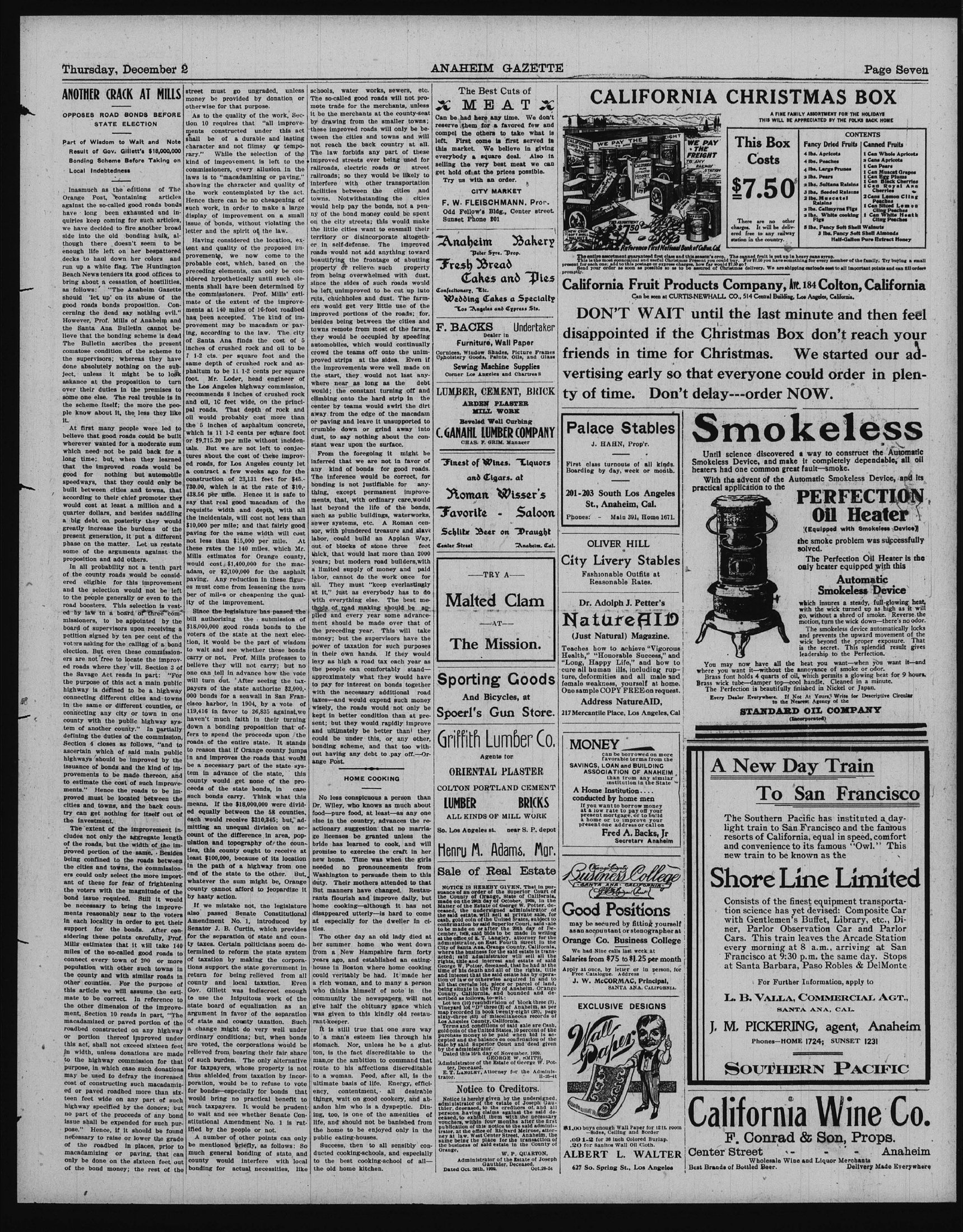
Searchable text
ANOTHER CRACK AT MILLS
OPPOSES ROAD BONDS BEFORE STATE ELECTION
Part of Wisdom to Wait and Note Result of Gov. Gillett's $18,000,000 Bonding Scheme Before Taking on Local Indebtedness
Inasmuch as the editions of The Orange Post, containing articles against the so-called good roads bonds have long been exhausted and inquiries keep coming for such articles, we have decided to fire another broad side into the old bonding hulk, although there doesn't seem to be enough life left on her bespattered decks to haul down her colors and run up a white flag. The Huntington Beach News tenders its good offices to bring about a cessation of hostilities, as follows: "The Anaheim Gazette should 'let up' on its abuse of the good roads bonds proposition. Concerning the dead say nothing evil." However, Prof. Mills of Anaheim and the Santa Ana Bulletin cannot believe that the bonding scheme is dead. The Bulletin ascribes the present comatose condition of the scheme to the supervisors; whereas they have done absolutely nothing on the subject, unless it might be to look askance at the proposition to turn over their duties in the premises to some one else. The real trouble is in the scheme itself; the more the people know about it, the less they like it.
At first many people were led to believe that good roads could be built wherever wanted for a moderate sum which need not be paid back for a long time; but when they learned street must go ungraded, unless money be provided by donation or otherwise for that purpose.
As to the quality of the work, Section 10 requires that "all improvements constructed under this act shall be of a durable and lasting character and not flimsy or temporary." While the selection of the kind of improvement is left to the commissioners, every allusion in the laws is to "macadamizing or paving," showing the character and quality of the work contemplated by the act. Hence there can be no cheapening of such work, in order to make a large display of improvement on a small issue of bonds, without violating the letter and the spirit of the law.
Having considered the location, extent and quality of the proposed improvements, we now come to the probable cost, which, based on the preceding elements, can only be considered hypothetically until such elements shall have been determined by the commissioners. Prof. Mills' estimate of the extent of the improvements at 140 miles of 16-foot roadbed has been accepted. The kind of improvement may be macadam or paving, according to the law. The city of Santa Ana finds the cost of 5 inches of crushed rock and oil to be 7 1-2 cts. per square foot and the same depth of crushed rock and asphaltum to be 11 1-2 cents per square foot. Mr. Loder, head engineer of the Los Angeles highway commission, recommends 8 inches of crushed rock and oil, 10 feet wide, on the principal roads. That depth of rock and oil would probably cost more than the 5 inches of asphaltum concrete, which is 11 1-2 cents per square foot or $9,715.20 per mile without incidentals. But we are not left to conjectures about the cost of these improv-
done absolutely nothing on the subject, unless it might be to look askance at the proposition to turn over their duties in the premises to some one else. The real trouble is in the scheme itself; the more the people know about it, the less they like it.
At first many people were led to believe that good roads could be built wherever wanted for a moderate sum which need not be paid back for a long time; but, when they learned that the improved roads would be good for nothing but automobile speedways, that they could only be built between cities and towns, that according to their chief promoter they would cost at least a million and a quarter dollars, and besides saddling a big debt on posterity they would greatly increase the burdens of the present generation, it put a different phase on the matter. Let us restate some of the arguments against the proposition and add others.
In all probability not a tenth part of the county roads would be considered eligible for this improvement and the selection would not be left to the people generally or even to the road boosters. This selection is vested by law in a board of three commissioners, to be appointed by the board of supervisors upon receiving a petition signed by ten per cent of the voters asking for the calling of a bond election. But even these commissioners are not free to locate the improved roads where they will. Section 3 of the Savage Act reads in part: "For the purpose of this act a main public highway is defined to be a highway connecting different cities and towns in the same or different counties, or connecting any city or town in one county with the public highway system of another county." In partially defining the duties of the commission, Section 4 closes as follows, "and to ascertain which of said main public highways should be improved by the issuance of bonds and the kind of improvements to be made thereon, and to estimate the cost of such improvements." Hence the roads to be improved must be located between the cities and towns, and the back country can get nothing for itself out of the investment.
The extent of the improvement includes not only the aggregate length of the roads, but the width of the improved portion of the same. Besides being confined to the roads between the cities and towns, the commission-
same depth of crushed rock and asphaltum to be 11 1-2 cents per square foot. Mr. Loder, head engineer of the Los Angeles highway commission, recommends 8 inches of crushed rock and oil, 10 feet wide, on the principal roads. That depth of rock and oil would probably cost more than the 5 inches of asphaltum concrete, which is 11 1-2 cents per square foot or $9,715.20 per mile without incidentals. But we are not left to conjectures about the cost of these improved roads, for Los Angeles county let a contract a few weeks ago for the construction of 23,131 feet for $45.730.00, which is at the rate of $10,-438.56 per mile. Hence it is safe to say that real good macadam of the requisite width and depth, with all the incidentals, will cost not less than $10,000 per mile; and that fairly good paving for the same width will cost not less than $15,000 per mile. At these rates the 140 miles, which Mr. Mills estimates for Orange county, would cost $1,400,000 for the macadam, or $2,100,000 for the asphalt paving. Any reduction in these figures must come from lessening the number of miles or cheapening the quality of the improvement.
Since the legislature has passed the bill authorizing the submission of $18,000,000 good roads bonds to the voters of the state at the next election, it would be the part of wisdom to wait and see whether these bonds carry or not. Prof. Mills professes to believe they will not carry; but no one can tell in advance how the vote will turn out. After seeing the taxpayers of the state authorize $2,000,000 bonds for a seawall in San Francisco harbor, in 1904, by a vote of 119,416 in favor to 26,835 against, we haven't much faith in their turning down a bonding proposition that offers to spend the proceeds upon the roads of the entire state. It stands to reason that if Orange county jumps in and improves the roads that would be a necessary part of the state system in advance of the state, this county would get none of the proceeds of the state bonds, in case such bonds carry. Think what this means. If the $18,000,000 were divided equally between the 58 counties, each would receive $310,345; but, admitting an unequal division on account of the difference in area, population and topography of the counties, this county ought to receive at least $100,000, because of its location in the path of a highway from one
From the foot inferred that we any kind of b bonding is not thing, except ments, that, will last beyond th such as public sewer systems; sor, with plunge labor, could b out of blocks thick, that would years; but mod a limited supply labor cannot do all. They must at it," just as with everything thods of road plied and ever ment should b preceding money; but th power of taxation in their own levy as high a people can approximately t pay for interest with the neces taxes—and wou wisely, the roa kept in better sent; but they and ultimately could be under bonding scheme out having any ange Post.
HOM
provements to be made thereon, and to estimate the cost of such improvements.” Hence the roads to be improved must be located between the cities and towns, and the back country can get nothing for itself out of the investment.
The extent of the improvement includes not only the aggregate length of the roads, but the width of the improved portion of the same. Besides being confined to the roads between the cities and towns, the commissioners could only select the more important of these for fear of frightening the voters with the magnitude of the bond issue required. Still it would be necessary to bring the improvements reasonably near to the voters in each locality in order to get their support for the bonds. After considering these points carefully, Prof. Mills estimates that it will take 140 miles of the so-called good roads to connect every town of 200 or more population with other such towns in the county and with similar roads in other counties. For the purpose of this article we will assume the estimate to be correct. In reference to the other dimension of the improvement, Section 10 reads in part, “The macadamized or paved portion of the roadbed constructed on any highway or portion thereof improved under this act, shall not exceed sixteen feet in width, unless donations are made to the highway commission for that purpose, in which case such donations may be used to defray the increased cost of constructing such macadamized or paved roadbed more than sixteen feet wide on any part of such highway specified by the donors; but no part of the proceeds of any bond issue shall be expended for such purpose.” Hence, if it should be found necessary to raise or lower the grade of the roadbed in places, prior to macadamizing or paving, that can only be done on the sixteen feet out of the bond money; the rest of the
item in advance of the state, this county would get none of the proceeds of the state bonds, in case such bonds carry. Think what this means. If the $18,000,000 were divided equally between the 58 counties, each would receive $310,345; but, admitting an unequal division on account of the difference in area, population and topography of the counties, this county ought to receive at least $100,000, because of its location in the path of a highway from one end of the state to the other. But, whatever the sum might be, Orange county cannot afford to jeopardize it by hasty action.
If we mistake not, the legislature also passed Senate Constitutional Amendment No. 1, introduced by Senator J. B. Curtin, which provides for the separation of state and county taxes. Certain politicians seem determined to reform the state system of taxation by making the corporations support the state government in return for being relieved from all county and local taxation. Even Gov. Gillett was indiscreet enough to use the inipuitous work of the state board of equalization as an argument in favor of the separation of state and county taxation. Such a change might do very well under ordinary conditions; but, when bonds are voted, the corporations would be relieved from bearing their fair share of such burden. The only alternative for taxpayers, whose property is not thus shielded from taxation by incorporation, would be to refuse to vote for bonds—especially for bonds that would bring no practical benefit to such taxpayers. It would be prudent to wait and see whether Senate Constitutional Amendment No. 1 is ratified by the people or not.
A number of other points can only be mentioned briefly, as follows: So much general bonding of state and county would interfere with local bonding for actual necessities, like
No less conscientious Dr. Wiley, who food—pure food else in the county actionary suggestive licenses be bride has learned promise to exercise new home. This needed no Washington to duty. Their men But manners herants flourish at home cooking disappeared utterly at especially ties.
The other day her summer life from a New York years ago, and house in Boston could veritably a rich woman, who thinks his community they give half the was given to herrant-keeper.
It is still true to a man's essex stomach. Norton, is the face man, or the ambi route to his a woman.
ultimate basis encyment, content things, wait oneandon him whining, too, is one life, and shouldthe home to b public eating-h
Success, they ducted cooking to the best othe old home
ANAHEIM GAZETTE
The Best Cuts of MEAT
Can be had here any time. We don't reserve them for a favored few and compel the others to take what is left. First come is first served in this market. We believe in giving everybody a square deal. Also in selling the very best meat we can get hold of at the prices possible.
Try us with an order.
CITY MARKET
F. W. FLEISCHMANN, Prop.
Odd Fellow's Bldg., Center street
Sunset Phone 201
Anaheim Bakery
Peter Syre, Prop.
Fresh Bread
Cakes and Pies
Confectionery, Inc.
Wedding Cakes a Specialty
Los Angeles and Express Sts.
F. BACKS Undertaker
Dealer in
Furniture, Wall Paper
Cornices, Window Shades, Picture Frames
Upholstery Goods, Paints, Oils, and Glass
Sewing Machine Supplies
Corner Los Angeles and Chartres S
LUMBER, CEMENT, BRICK
ARDEN PLASTER
MILL WORK
Beveled Well Curbing
C.GANAHL LUMBER COMPANY
CHAS. F. GRIM. Manager
CALIFORNIA Fruit Pro
Can be seen at CUR
DON'T WAIT disappointed if the friends in time for vertising early so ty of time. Don't
Palace Stables
J. HAHN, Prop'.
the improvements were well made on the start, they would not last anywhere near as long as the debt would; the constant turning off and climbing onto the hard strip in the center by teams would swirl the dirt away from the edge of the macadam or paving and leave it unsupported to crumble down or grind away into dust, to say nothing about the constant wear upon the surface.
From the foregoing it might be inferred that we are not in favor of any kind of bonds for good roads. The inference would be correct, for bonding is not justifiable for anything, except permanent improvements, that, with ordinary care, would last beyond the life of the bonds, such as public buildings, waterworks, sewer systems, etc. A Roman sensor, with plundered treasure and slave labor, could build an Applan Way, out of blocks of stone three feet thick, that would last more than 2000 years; but modern road builders, with a limited supply of money and paid labor, cannot do the work once for all. They must "keep everlastingly at it," just as everybody has to do with everything else. The best methods of road making should be applied and every year some advancement should be made over that of the preceding year. This will take money; but the supervisors have the power of taxation for such purposes in their own hands. If they would levy as high a road tax each year as the people can comfortably stand—approximately what they would have to pay for interest on bonds together with the necessary additional road taxes—and would expend such money wisely, the roads would not only be kept in better condition than at present; but they would rapidly improve and ultimately be better than they could be under this, or any other, bonding scheme, and that too without having any debt to pay off. Orange Post.
HOME COOKING
No less conspicuous a person than Dr. Wiley, who knows as much about food—pure food, at least—as any one else in the country, advances the reactionary suggestion that no marriage licenses be granted unless the bride has learned to cook, and will promise to exercise the craft in her new home. Time was when the girls needed no pronouncements from
Sewing Machine Supplies
Corner Los Angeles and Chartres 8
LUMBER, CEMENT, BRICK
ARDEN PLASTER
MILL WORK
Beveled Well Curbing
C.GANAHL LUMBER COMPANY
CHAS. F. GRIM. Manager
Finest of Wines. Liquors and Cigars. at Roman Wisser's Favorite - Saloon
Schlitz Beer on Draught
Center Street
Anabeim. Cal.
TRY A—
Malted Clam
AT—
The Mission.
Sporting Goods
And Bicycles, at Spoerl's Gun Store.
Griffith Lumber Co.
Agents for ORIENTAL PLASTER
COLTON PORTLAND CEMENT
LUMBER BRICKS
ALL KINDS OF MILL WORK
So. Los Angeles st. near S. P. depot
Henry M. Adams, Mgr.
vertising early so ty of time. Don'
Palace Stables
J. HAHN, Prop'r.
First class turnouts of all kinds.
Boarding by day, week or month.
201-203 South Los Angeles St., Anaheim, Cal.
Phones: Main 391, Home 1671.
OLIVER HILL
City Livery Stables
Fashionable Outfits at Reasonable Rates.
Dr. Adolph J. Petter's NatureAID
(Just Natural) Magazine.
Teaches how to achieve "Vigorous Health," "Honorable Success," and "Long, Happy Life," and how to cure all human ills, including rupture, deformities and all male and female weakness, yourself at home. One sample COPY FREE on request.
Address NatureAID,
217 Mercantile Place, Los Angeles, Cal.
MONEY
can be borrowed on more favorable terms from the SAVINGS, LOAN and BUILDING ASSOCIATION OF ANAHEIM than from any similar institution in the State.
A Home Institution... conducted by home men
If you want to borrow money at a low rate to pay off your present mortgage, or to build a home or to improve your present one address or call on Fred A. Backs, Jr.
Secretary Anaheim
HOME COOKING
No less conspicuous a person than Dr. Wiley, who knows as much about food—pure food, at least—as any one else in the country, advances the reactionary suggestion that no marriage licenses be granted unless the bride has learned to cook, and will promise to exercise the craft in her new home. Time was when the girls needed no pronouncements from Washington to persuade them to this duty. Their mothers attended to that But manners have changed. Restaurants flourish and improve daily, but home cooking—although it has not disappeared utterly—is hard to come at especially for the dweller in cities.
The other day an old lady died at her summer home who went down from a New Hampshire farm forty years ago, and established an eating-house in Boston where home cooking could veritably be had. It made her a rich woman, and to many a person who thinks himself of note in the community the newspapers will not give half the obituary space which was given to this kindly old restaurant-keeper.
It is still true that one sure way to a man's esteem lies through his stomach. Nor, unless he be a glutton, is the fact discreditable to the man, or the ambition to command that route to his affections discreditable to a woman. Food, after all, is the ultimate basis of life. Energy, efficiency, contentment, all desirable things, wait on good cookery, and abandon him who is a dyspeptic. Dining, too, is one of the amenities of life, and should not be banished from the home to be enjoyed only in the public eating-houses.
Success, then to all sensibly conducted cooking-schools, and especially to the best cooking-school of all—the old home kitchen.
COLTON PORTLAND CEMENT
LUMBER BRICKS
ALL KINDS OF MILL WORK
So. Los Angeles st. near S. P. depot
Henry M. Adams, Mgr.
Sale of Real Estate
NOTICE IS HEREBY GIVEN, That in pursuance of an order of the Superior Court of the County of Orange, State of California, made on the 29th day of October, 1909, in the Matter of the Estate of George W. Potter, deceased, the undersigned administrator of the said estate, will sell at private sale, for cash, gold coin of the United States, subject to confirmation by said Superior Court, said sale to be made on or after the 20th day of December, 1909, said bids to be made in writing at the office of K. T. Langley, attorney for the administrator, on East Fourth Street in the City of Santa Ana, Orange County, California, where the business for the said estate is transacted; said administrator will sell all the rights, title and interest and estate of said George W. Potter, deceased, that he had at the time of his death and all of the rights, title and interest that the said estate has by operation of law or otherwise acquired in and to all that certain lot, piece or parcel of land, being situated in the City of Anaheim. Orange County, California, and bounded and described as follows: to-wit:
Lot ten (10) resubdivision of block three (3), Vineyard lot "D" three (3) of Anaheim, as per map recorded in book twenty-eight (28), page sixty-three (63) of miscellaneous records of Los Angeles County, California.
Terms and conditions of said sale are Cash, gold coin of the United States. 10 percent of the purchase money to be paid when bid is accepted and the balance on confirmation of the Sale by said Superior Court and deed given by the administrator.
Dated this 16th day of November, 1909.
GEORGE W. SMITH,
Administrator of the Estate of George W. Potter, Deceased.
E. T. LANGLEY, Attorney for the Administrator.
Notice to Creditors.
Notice is hereby given by the undersigned, administrator of the estate of Joseph Gauthier, deceased, to the creditors of, and all persons having claims against the said deceased, to exhibit them with the necessary vouchers, within four months after the first publication of this notice to the said administrator, at the office of Richard Melrose, attorney at law, West Center Street, Anaheim, the same being the place for the transaction of the business of said estate in the County of Orange,
W. P. QUARTON,
Administrator of the Estate of Joseph Gauthier, Deceased.
Dated Oct. 28th, 1909.
Oct. 28-5t
$1,00 buys enough Wall Paper for 12 tt. room—Sides, Ceiling and Border
.091-2 for 38 inch Colored Burlap.
.20 for Sanitos Wall Oil Cloth.
ALBERT L. WALTER
627 So. Spring St., Los Angeles
CALIFORNIA CHRISTMAS BOX
A FINE FAMILY ASSORTMENT FOR THE HOLIDAYS
THIS WILL BE APPRECIATED BY THE FOLKS BACK HOME
This Box Costs
$7.50
There are no other charges. It will be delivered free to any railway station in the country.
CONTENTS
Fancy Dried Fruits
4 Ibs. Apricots
4 Ibs. Peaches
4 Ibs. Large Prunes
2 Ibs. Pears
2 Ibs. Sultana Raisins
3 Ibs. Seeded Raisins
2 Ibs. Muscatel Raisins
2 Ibs. Calmyrna Figs
2 Ibs. White cooking Figs
Canned Fruits
1 Can Whole Apricots
2 Cans Apricots
1 Can Pearls
1 Can Muscat Grapes
1 Can Egg Plums
1 Can Black Cherries
1 Can Royal Ann Cherries
2 Cans Lemon Cling Peaches
1 Can Sliced Lemon Cling Peaches
1 Can White Heath Cling Peaches
5 Ibs. Fancy Soft Shell Walnuts
3 Ibs. Fancy Soft Shell Almonds
Half-Gallon Pure Extract Honey
California Fruit Products Company, 184 Colton, California
Can be seen at CURTIS-NEWHALL CO., 514 Central Building, Los Angeles, California.
DON'T WAIT until the last minute and then feel pointed if the Christmas Box don't reach your time for Christmas. We started our ad-ing early so that everyone could order in plen-time. Don't delay---order NOW.
Smokeless
Until science discovered a way to construct the Automatic
Smokeless
Until science discovered a way to construct the Automatic Smokeless Device, and make it completely dependable, all oil heaters had one common great fault—smoke.
With the advent of the Automatic Smokeless Device, and its practical application to the PERFECTION Oil Heater
(Equipped with Smokeless Device)
the smoke problem was successfully solved.
The Perfection Oil Heater is the only heater equipped with this
Automatic Smokeless Device
which insures a steady, full-glowing heat, with the wick turned up as high as it will go, without a shred of smoke. Reverse the motion, turn the wick down—there's no odor.
The smokeless device automatically locks and prevents the upward movement of the wick beyond the proper exposure. That is the secret. This splendid result gives leadership to the Perfection.
You may now have all the heat you want—when you want it—and where you want it—without the annoyance of smoke or odor.
Brass font holds 4 quarts of oil, which permits a glowing heat for 9 hours. Brass wick tube—damper top—cool handle. Cleaned in a minute.
The Perfection is beautifully finished in Nickel or Japan.
Every Dealer Everywhere. If Not At Yours, Write for Descriptive Circular to the Nearest Agency of the STANDARD OIL COMPANY (Incorporated)
A New Day Train To San Francisco
The Southern Pacific has instituted a day-light train to San Francisco and the famous resorts of California, equal in speed, comfort and convenience to its famous "Owl." This new train to be known as the
To San Francisco
The Southern Pacific has instituted a daylight train to San Francisco and the famous resorts of California, equal in speed, comfort and convenience to its famous "Owl." This new train to be known as the
Shore Line Limited
Consists of the finest equipment transportation science has yet devised: Composite Car with Gentlemen's Buffet, Library, etc., Diner, Parlor Observation Car and Parlor Cars. This train leaves the Arcade Station every morning at 8 a.m., arriving at San Francisco at 9:30 p.m. the same day. Stops at Santa Barbara, Paso Robles & DelMonte
For Further Information, apply to
L. B. VALLA, COMMERCIAL AGT.,
SANTA ANA, CAL.
J. M. PICKERING, agent, Anaheim
Phones—HOME [724]; SUNSET [231]
SOUTHERN PACIFIC
California Wine Co.
F. Conrad & Son, Props.
Center Street - Anaheim
Wholesale Wine and Liquor Merchants
Best Brands of Bottled Beer.
Delivery Made Everywhere