anaheim-gazette 1909-11-18
Scanned page
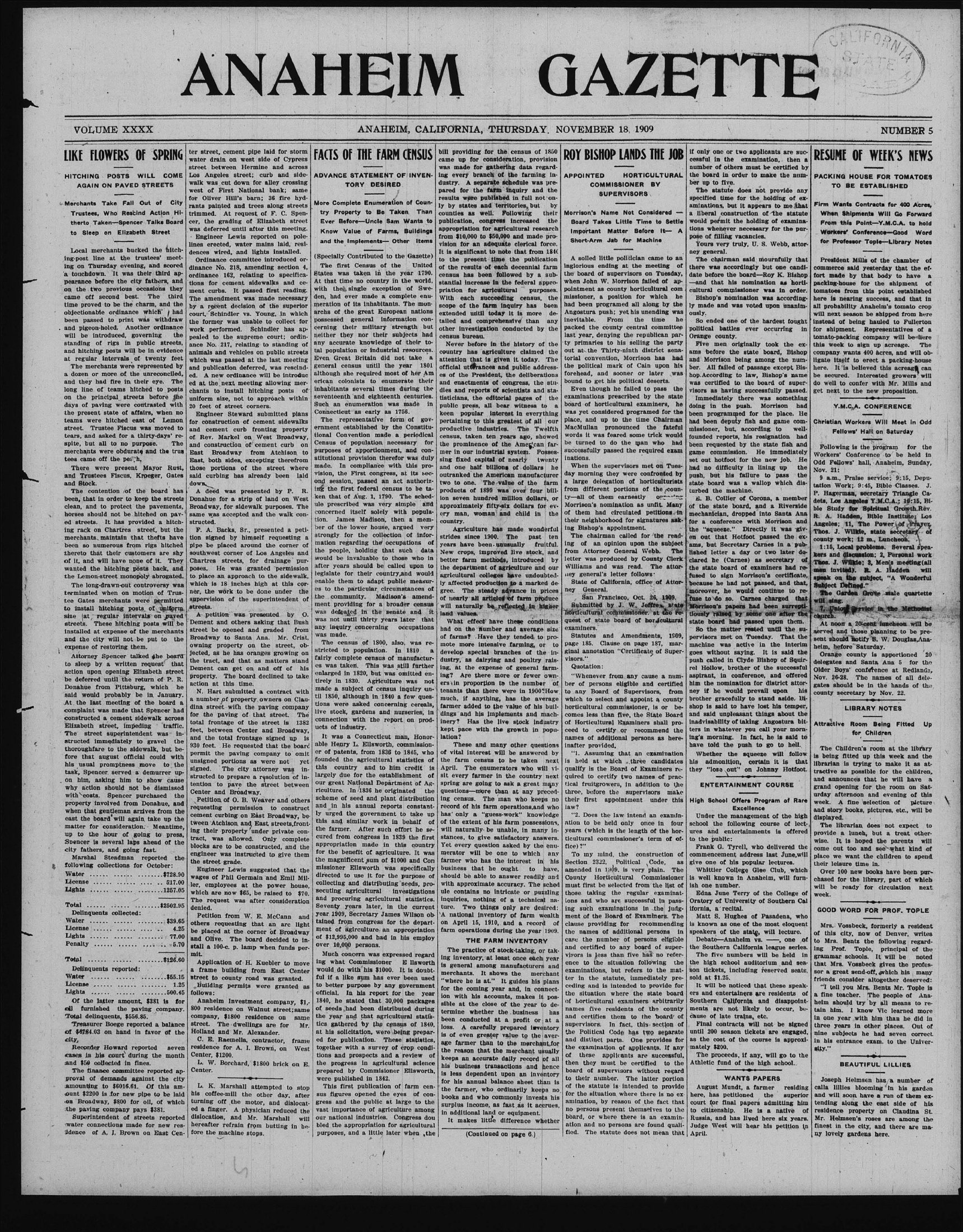
Searchable text
LIKE FLOWERS OF SPRING
HITCHING POSTS WILL COME AGAIN ON PAVED STREETS
Merchants Take Fall Out of City Trustees, Who Rescind Action Hitherto Taken—Spencer Talks Board to Sleep on Elizabeth Street
Local merchants bucked the hitching-post line at the trustees' meeting on Thursday evening, and scored a touchdown. It was their third appearance before the city fathers, and on the two previous occasions they came off second best. The third time proved to be the charm, and the objectionable ordinance which had been passed to print was withdraw and pigeon-holed. Another ordinance will be introduced, governing the standing of rigs in public streets, and hitching posts will be in evidence at regular intervals of twenty feet.
The merchants were represented by a dozen or more of the unreconciled, and they had fire in their eye. The long line of teams hitched to posts on the principal streets before the days of paving were contrasted with the present state of affairs, when no teams were hitched east of Lemon street. Trustee Fiscus was moved to tears, and asked for a thirty-days' respite, but all to no purpose. The merchants were obdurate and the trusses came off the pavement street, cement pipe laid for storm water drain on west side of Cypress street between Hermine and across Los Angeles street; curb and sidewalk was cut down for alley crossing west of First National bank; same for Oliver Hill's barn; 36 fire hydrants painted and trees along streets trimmed. At request of F. C. Spencer, the grading of Elizabeth street was deferred until after this meeting.
Engineer Lewis reported on pole-lines erected, water mains laid, residences wired, and lights installed.
Ordinance committee introduced ordinance No. 218, amending section 4, ordinance 162, relating to specifications for cement sidewalks and cement curbs. It passed first reading. The amendment was made necessary by a recent decision of the superior court, Schindler vs. Young, in which the former was unable to collect for work performed. Schindler has appealed to the supreme court; ordinance No. 217, relating to standing of animals and vehicles on public streets which was passed at the last meeting and publication deferred, was rescinded. A new ordinance will be introduced at the next meeting allowing merchants to install hitching posts of uniform size, not to approach within 20 feet of street corners.
Engineer Steward submitted plans for construction of cement sidewalks and cement curb fronting property of Rev. Markel on West Broadway, and construction of cement curb on East Broadway from Atchison to East both sides exceeding those from ter street, cement pipe laid for storm water drain on west side of Cypress street between Hermine and across Los Angeles street; curb and sidewalk was cut down for alley crossing west of First National bank; same for Oliver Hill's barn; 36 fire hydrants painted and trees along streets trimmed. At request of F. C. Spencer, the grading of Elizabeth street was deferred until after this meeting.
Engineer Lewis reported on pole-lines erected, water mains laid, residences wired, and lights installed.
Ordinance committee introduced ordinance No. 218, amending section 4, ordinance 162, relating to specifications for cement sidewalks and cement curbs. It passed first reading. The amendment was made necessary by a recent decision of the superior court, Schindler vs. Young, in which the former was unable to collect for work performed. Schindler has appealed to the supreme court; ordinance No. 217, relating to standing of animals and vehicles on public streets which was passed at the last meeting and publication deferred, was rescinded. A new ordinance will be introduced at the next meeting allowing merchants to install hitching posts of uniform size, not to approach within 20 feet of street corners.
Engineer Steward submitted plans for construction of cement sidewalks and cement curb fronting property of Rev. Markel on West Broadway, and construction of cement curb on East Broadway from Atchison to East both sides exceeding those from ter street, cement pipe laid for storm water drain on west side of Cypress street between Hermine and across Los Angeles street; curb and sidewalk was cut down for alley crossing west of First National bank; same for Oliver Hill's barn; 36 fire hydrants painted and trees along streets trimmed. At request of F. C. Spencer, the grading of Elizabeth street was deferred until after this meeting.
Engineer Lewis reported on pole-lines erected, water mains laid, residences wired, and lights installed.
Ordinance committee introduced ordinance No. 218, amending section 4, ordinance 162, relating to specifications for cement sidewalks and cement curbs. It passed first reading. The amendment was made necessary by a recent decision of the superior court, Schindler vs. Young, in which the former was unable to collect for work performed. Schindler has appealed to the supreme court; ordinance No. 217, relating to standing of animals and vehicles on public streets which was passed at the last meeting and publication deferred, was rescinded. A new ordinance will be introduced at the next meeting allowing merchants to install hitching posts of uniform size, not to approach within 20 feet of street corners.
Engineer Steward submitted plans for construction of cement sidewalks and cement curb fronting property of Rev. Markel on West Broadway, and construction of cement curb on East Broadway from Atchison to East both sides exceeding those from ter street, cement pipe laid for storm water drain on west side of Cypress street between Hermine and across Los Angeles street; curb and sidewalk was cut down for alley crossing west of First National bank; same for Oliver Hill's barn; 36 fire hydrants painted and trees along streets trimmed. At request of F. C. Spencer, the grading of Elizabeth street was deferred until after this meeting.
Engineer Lewis reported on pole-lines erected, water mains laid, residences wired, and lights installed.
Ordinance committee introduced ordinance No. 218, amending section 4, ordinance 162, relating to specifications for cement sidewalks and cement curbs. It passed first reading. The amendment was made necessary by a recent decision of the superior court, Schindler vs. Young, in which the former was unable to collect for work performed. Schindler has appealed to the supreme court; ordinance No. 217, relating to standing of animals and vehicles on public streets which was passed at the last meeting and publication deferred, was rescinded. A new ordinance will be introduced at the next meeting allowing merchants to install hitching posts of uniform size, not to approach within 20 feet of street corners.
Engineer Steward submitted plans for construction of cement sidewalks and cement curb fronting property of Rev. Markel on West Broadway, and construction of cement curb on East Broadway from Atchison to East both sides exceeding those from ter street, cement pipe laid for storm water drain on west side of Cypress street between Hermine and across Los Angeles street; curb and sidewalk was cut down for alley crossing west of First National bank; same for Oliver Hill's barn; 36 fire hydrants painted and trees along streets trimmed. At request of F. C. Spencer, the grading of Elizabeth street was deferred until after this meeting.
Engineer Lewis reported on pole-lines erected, water mains laid, residences wired, and lights installed.
Ordinance committee introduced ordinance No. 218, amending section 4, ordinance 162, relating to specifications for cement sidewalks and cement curbs. It passed first reading. The amendment was made necessary by a recent decision of the superior court, Schindler vs. Young, in which the former was unable to collect for work performed. Schindler has appealed to the supreme court; ordinance No. 217, relating to standing of animals and vehicles on public streets which was passed at the last meeting and publication deferred, was rescinded. A new ordinance will be introduced at the next meeting allowing merchants to install hitching posts of uniform size, not to approach within 20 feet of street corners.
Engineer Steward submitted plans for construction of cement sidewalks and cement curb fronting property of Rev. Markel on West Broadway, and construction of cement curb on East Broadway from Atchison to East both sides exceeding those from ter street, cement pipe laid for storm water drain on west side of Cypress street between Hermine and across Los Angeles street; curb and sidewalk was cut down for alley crossing west of First National bank; same for Oliver Hill's barn; 36 fire hydrants painted and trees along streets trimmed. At request of F. C. Spencer, the grading of Elizabeth街 was deferred until after this meeting.
Engineer Lewis reported on pole-lines erected, water mains laid, residences wired, and lights installed.
Ordinance committee introduced ordinance No. 218, amending section 4, ordinance 162, relating to specifications for cement sidewalks and cement curbs. It passed first reading. The amendment was made necessary by a recent decision of the superior court, Schindler vs. Young, in which the former was unable to collect for work performed. Schindler has appealed to the supreme court; ordinance No. 217, relating to standing of animals and vehicles on public streets which was passed at the last meeting and publication deferred, was rescinded. A new ordinance will be introduced at the next meeting allowing merchants to install hitching posts of uniform size, not to approach within 20 feet of street corners.
Engineer Steward submitted plans for construction of cement sidewalks and cement curb fronting property of Rev. Markel on West Broadway, and construction of cement curb on East Broadway from Atchison to East both sides exceeding those from ter street, cement pipe laid for storm water drain on west side of Cypress street between Hermine and across Los Angeles街头; curb和sidewalk是cut downforalleycrossingwestofFirstNationalbank;sameforOliverHill'sbarn;36firehydrantspaintedandtreesalongstreetstrimmed.AtrequestofF.C.Spencer,thegradingofElizabeth街wasdeferreduntilafterthismeeting.
Engineer Lewis reported on pole-lines erected,water mains laid,residences wired,and lights installed.
Ordinance committee introduced ordinance No. 218,amending section 4,ordinance 162,relating to specifications for cement sidewalks和水泥curb alongstreetswhichwaspassedatthelastmeetingandpublicationdeferredwasrescinded.Anewordinancewillbeintroducedatthenextmeetingallowingmerchantstoinstallhitchingspostsofuniformsizenottoapproachwithin20feetofstreetcorners.
Engineer Steward submitted plans for constructionofcementsidewalksand水泥curbalongstreetswhichwaspassedatthelastmeetingandpublicationdeferredwasrescinded.Anewordinancewillbeintroducedatthenextmeetingallowingmerchantstoinstallhitchingspostsofuniformsizenottoapproachwithin20feetofstreetcorners.
The first Council States was takenAt that time nenwiththesingden,had evermerizationofitsarchsofthegposssessedgenericcerningtheirneithertheynereyamericancolonisinh inhabitantsseventeenthandSuchanenumConnecticutasTherepresentationestablishationalConventionCensusofpopularinstitutionalproblem
The merchants were represented by a dozen or more of the unreconciled, and they had fire in their eye. The long line of teams hitched to posts on the principal streets before the days of paving were contrasted with the present state of affairs, when no teams were hitched east of Lemon street. Trustee Fiscus was moved to tears, and asked for a thirty-days' respite, but all to no purpose. The merchants were obdurate and the trusses came off the perch.
There were present Mayor Rust, and Trustees Fiscus, Kroeger, Gates and Stock.
The contention of the board has been, that in order to keep the streets clean, and to protect the pavements, horses should not be hitched on paved streets. It has provided a hitching rack on Chartres street, but the merchants maintain that thefts have been so numerous from rigs hitched thereto that their customers are shy of it, and will have none of it. They wanted the hitching posts back, and the Lemon-street monopoly abrogated.
The long-drawn-out controversy was terminated when on motion of Trustee Gates merchants were permitted to install hitching posts of uniform size at regular intervals on paved streets. These hitching posts will be installed at expense of the merchants and the city will not be put to the expense of restoring them.
Attorney Spencer talked the board to sleep by a written request that action upon opening Elizabeth street be deferred until the return of P. R. Donahue from Pittsburg, which he said would probably be in January. At the last meeting of the board a complaint was made that Spencer had constructed a cement sidewalk across Elizabeth street, impeding traffic. The street superintendent was instructed immediately to gravel the thoroughfare to the sidewalk, but before that August official could with his usual promptness move to the task, Spencer served a demurrer upon him, asking him to show cause why action should not be dismissed with costs. Spencer purchased the property involved from Donahue, and when that gentleman arrives from the east the board will again take up the matter for consideration. Meantime, up to the hour of going to press, Spencer is several laps ahead of the city fathers, and going fast.
Marshal Steadman reported the following collections for October:
and publication deferred, was rescinded. A new ordinance will be introduced at the next meeting allowing merchants to install hitching posts of uniform size, not to approach within 20 feet of street corners.
Engineer Steward submitted plans for construction of cement sidewalks and cement curb fronting property of Rev. Markel on West Broadway, and construction of cement curb on East Broadway from Atchison to East, both sides, excepting therefrom those portions of the street where said curbing has already been laid down.
A deed was presented by P. R. Donahue for a strip of land on West Broadway, for sidewalk purposes. The same was accepted and the walk constructed.
F. A. Backs, Sr., presented a petition signed by himself requesting a pipe be placed around the corner of southwest corner of Los Angeles and Chartres streets, for drainage purposes. He was granted permission to place an approach to the sidewalk, which is 18 inches high at this corner, the work to be done under the supervision of the superintendent of streets.
A petition was presented by O. Dement and others asking that Bush street be opened and graded from Broadway to Santa Ana. Mr. Crist, owning property on the street, objected, as he has oranges growing on the tract, and that as matters stand Dement can get on and off of his property. The board declined to take action at this time.
N. Hart submitted a contract with a number of property owners on Claudina street with the paving company for the paving of that street. The total frontage of the street is 1382 feet, between Center and Broadway, and the total frontage signed up is 930 feet. He requested that the board permit the paving company to omit unsigned portions as were not yet signed. The city attorney was instructed to prepare a resolution of intention to pave the street between Center and Broadway.
Petition of O. B. Weaver and others requesting permission to construct cement curbing on East Broadway, between Atchison and East streets,fronting their property under private contract, was allowed. Only complete blocks are to be constructed, and the engineer was instructed to give them the street grade.
Engineer Lewis suggested that the general census although she re-american colonists inhabitants se seventeenth and Such an enumeration Connecticut as
The representation establishment national Convention Census of population purposes of a constitutional provision. James began firstken that of Auction prescribed concerned itself James
The census restricted to fairly completed es was taken enlarged in 1830 tirely in 1830 made a subject til 1850, although tions were ass live stock, gar connection wi ducts of industry
It was a Cable Henry Lerder of patents founded this country largely due for our great Nathriculture. In scheme of seeand in his arly urged this this and similar farmer. A cured from co appropriation for the benefitthe magnificent missioner Ellis
Spencer served a demurrier upon him, asking him to show cause why action should not be dismissed with costs. Spencer purchased the property involved from Donahue, and when that gentleman arrives from the east the board will again take up the matter for consideration. Meantime, up to the hour of going to press, Spencer is several laps ahead of the city fathers, and going fast.
Marshal Steadman reported the following collections for October:
Water ... $728.90
License ... 517.00
Lights ... 1257.05
Total ... $2502.95
Delinquents collected:
Water ... $39.65
License ... 4.25
Lights ... 77.00
Penalty ... 5.70
Total ... $126.60
Delinquents reported:
Water ... $55.15
License ... 1.25
Lights ... 500.45
Of the latter amount, $381 is for oil furnished the paving company. Total delinquents, $556.85.
Treasurer Boege reported a balance of $6784.03 on hand in favor of the city.
Recorder Howard reported seven cases in his court during the month and $50 collected in fines.
The finance committee reported approval of demands against the city amounting to $6016.61. Of this amount $2200 is for new pipe to be laid on Broadway, $800 for oil, of which the paving company pays $381.
Superintendent of streets reported water connections made for new residence of A. I. Brown on East Cen-
ANAHEIM, CALIFORNIA, THURSDAY. NOVEMBER 18, 1909
FACTS OF THE FARM CENSUS
ADVANCE STATEMENT OF INVENTORY DESIRED
More Complete Enumeration of Country Property to Be Taken Than Ever Before—Uncle Sam Wants to Know Value of Farms, Buildings and the Implements—Other Items
(Specially Contributed to the Gazette)
The first Census of the United States was taken in the year 1790. At that time no country in the world, with the single exception of Sweden, had ever made a complete enumeration of its inhabitants. The monarchs of the great European nations possessed general information concerning their military strength but neither they nor their subjects had any accurate knowledge of their total population or industrial resources. Even Great Britain did not take a general census until the year 1801 although she required most of her American colonists to enumerate their inhabitants several times during the seventeenth and eighteenth centuries. Such an enumeration was made in Connecticut as early as 1756.
The representative form of government established by the Constitutional Convention made a periodical Census of population necessary for purposes of apportionment, and constitutional provision therefor was duly bill providing for the census of 1850 came up for consideration, provision was made for gathering data regarding every branch of the farming industry. A separate schedule was prepared for the farm inquiry and the results were published in full not only by states and territories but by counties as well. Following their publication, congress increased the appropriation for agricultural research from $10,000 to $50,000 and made provision for an adequate clerical force. It is significant to note that from 1846 to the present time the publication of the results of each decennial farm census has been followed by a substantial increase in the federal appropriation for agricultural purposes. With each succeeding census, the scope of the farm inquiry has been extended until today it is more detailed and comprehensive than any other investigation conducted by the census bureau.
Never before in the history of the country has agriculture claimed the attention that is given it today. The official utterances and public addresses of the President, the deliberations and enactments of congress, the studies and reports of scientists and statisticians, the editorial pages of the public press, all bear witness to a keen popular interest in everything pertaining to this greatest of all our productive industries. The Twelfth census, taken ten years ago, showed the prominence of the American farmer in our industrial system. Possessing fixed capital of nearly twenty
ROY BISHOP LANDS THE JOB
APPOINTED HORTICULTURAL COMMISSIONER BY SUPERVISORS
Morrison's Name Not Considered — Board Takes Little Time to Settle Important Matter Before It— A Short-Arm Jab for Machine
A solled little politician came to an inglorious ending at the meeting on the board of supervisors on Tuesday when John W. Morrison failed of apointment as county horticultural commissioner, a position for which he had been programmed all along by the Angostura push; yet his unending waiver inevitable. From the time he packed the county central committee last year, denying the republican party primaries to his selling the party out at the Thirty-ninth district senatorial convention, Morrison has had the political mark of Cain upon his forehead, and sooner or later was bound to get his political deserts.
Even though he failed to pass the examinations prescribed by the state board of horticultural examiners, he was yet considered programmed for the place, and up to the time Chairman MacMullan pronounced the fateful words it was feared some trick would be turned to do the man who had successfully passed the required examinations.
general census until the year 1801 although she required most of her American colonists to enumerate their inhabitants several times during the seventeenth and eighteenth centuries. Such an enumeration was made in Connecticut as early as 1756.
The representative form of government established by the Constitutional Convention made a periodical Census of population necessary for purposes of apportionment, and constitutional provision therefor was duly made. In compliance with this provision, the First congress, at its second session, passed an act authorizing the first federal census to be taken that of Aug. 1, 1790. The schedule prescribed was very simple and concerned itself solely with population. James Madison, then a member of the lower house, argued very strongly for the collection of information regarding the occupations of the people, holding that such data would be invaluable to those who in after years should be called upon to legislate for their country, and would enable them to adapt public measures to the particular circumstances of the community. Madison's amendment providing for a broader census was defeated in the senate and it was not until thirty years later that any inquiry concerning occupations was made.
The census of 1800, also, was restricted to population. In 1810 a fairly complete census of manufactures was taken. This was still further enlarged in 1820, but was omitted entirely in 1830. Agriculture was not made a subject of census inquiry until 1850, although in 1840 a few questions were asked concerning cereals, live stock, gardens and nurseries, in connection with the report on products of industry.
It was a Connecticut man, Honorable Henry L. Ellsworth, commissioner of patents, from 1836 to 1845, who founded the agricultural statistics of this country and to him credit is largely due for the establishment of our great National Department of Agriculture. In 1836 he originated the scheme of seed and plant distribution and in his annual reports constantly urged the government to take up this and similar work in behalf of the farmer. After such effort he secured from congress in 1839 the first appropriation made in this country for the benefit of agriculture. It was the magnificent sum of $1000 and Commissioner Ellsworth was specifically official utterances and public addresses of the President, the deliberations and enactments of congress, the studies and reports of scientists and statisticians, the editorial pages of the public press, all bear witness to a keen popular interest in everything pertaining to this greatest of all our productive industries. The Twelfth census, taken ten years ago, showed the prominence of the American farmer in our industrial system. Possessing fixed capital of nearly twenty and one half billions of dollars he outranked the American manufacturer two to one. The value of the farm products of 1899 was over four billion seven hundred million dollars, or approximately fifty-six dollars for every man, woman and child in the country.
Agriculture has made wonderful strides since 1900. The past ten years have been unusually fruitful. New crops, improved live stock, and better farm methods, introduced by the department of agriculture and our agricultural colleges have undoubtedly affected production to a marked degree. The steady advance in prices of nearly all articles of farm produce will naturally be reflected in higher land values.
What effect have these conditions had on the number and average size of farms? Have they tended to promote more intensive farming, or to develop special branches of the industry, as dairying and poultry raising, at the expense of general farming? Are there more or fewer owners in proportion to the number of tenants than there were in 1900? How much, if anything, has the average farmer added to the value of his buildings and his implements and machinery? Has the live stock industry kept pace with the growth in population?
These and many other questions of vital interest will be answered by the farm census to be taken next April. The enumerators who will visit every farmer in the country next spring are going to ask a great many questions—more than at any preceding census. The man who keeps no record of his farm operations,and who has' only a "guess-work" knowledge of the extent of his farm possessions, will naturally be unable, in many instances, to give satisfactory answers. Yet every question asked by the enumerator will be one to which any farmer who has the interest in his business that he ought to have.
the political mark of Cain upon his forehead, and sooner or later was bound to get his political deserts.
Even though he failed to pass the examinations prescribed by the state board of horticultural examiners, he was yet considered programmed for the place, and up to the time Chairman MacMullan pronounced the fateful words it was feared some trick would be turned to do the man who had successfully passed the required examinations.
When the supervisors met on Tuesday morning they were confronted by a large delegation of horticulturists from different portions of the county—all of them earnestly opposing Morrison's nomination as unfit. Many of them had circulated petitions in their neighborhood for signatures asking Bishop's appointment.
The chairman called for the reading of an opinion upon the subject from Attorney General Webb. The letter was produced by County Clerk Williams and was read. The attorney general's letter follows:
State of California, office of Attorney General.
San Francisco, Oct. 26, 1909.
Submitted by J. W. Jeffreys state horticultural commissioner. at the request of state board of horticultural examiners.
Statutes and Amendments, 1909 page 185. Clause on page 187, marginal annotation "Certificate of Supervisors."
Quotation:
"Whenever from any cause a number of persons eligible and certified to any Board of Supervisors, from which to select and appoint a county horticultural commissioner, is or becomes less than five, the State Board of Horticultural Examiners shall proceed to certify or recommend the names of additional persons as hereinafter provided,
"1. Assuming that an examination is held at which three candidates qualify is the Board of Examiners required to certify two names of practical fruitgrowers, in addition to three, before the supervisors make their first appointment under this law?
"2. Does the law intend an examination to be held only once in four years (which is the length of the horticultural commissioner's term of office)?"
To my mind, the construction of Section 2322, Political Code, amended in 1909 is very plain.
largely due for the establishment of our great National Department of Agriculture. In 1836 he originated the scheme of seed and plant distribution and in his annual reports constantly urged the government to take up this and similar work in behalf of the farmer. After such effort he secured from congress in 1839 the first appropriation made in this country for the benefit of agriculture. It was the magnificent sum of $1000 and Commissioner Ellsworth was specifically directed to use it for the purpose of collecting and distributing seeds, prosecuting agricultural investigations and procuring agricultural statistics. Seventy years later, in the current year 1909, Secretary James Wilson obtained from congress for the department of agriculture an appropriation of $12,995,000 and had in his employ over 10,000 persons.
Much concern was expressed regarding what Commissioner Ellsworth would do with his $1000. It is doubtful if a like sum has ever been used to better purpose by any government official. In his report for the year 1840, he stated that 30,000 packages of seeds had been distributed during the year and that agricultural statistics gathered by the census of 1840, at his solicitation, were being prepared for publication. These statistics, together with a survey of crop conditions and prospects and a review of the progress in agricultural science prepared by Commissioner Ellsworth, were published in 1842.
This first publication of farm census figures opened the eyes of Congress and the public at large to the vast importance of agriculture among our national industries. Congress doubled the appropriation for agricultural purposes, and a little later when the sit every farmer in the country next spring are going to ask a great many questions—more than at any preceding census. The man who keeps no record of his farm operations, and who has only a "guess-work" knowledge of the extent of his farm possessions, will naturally be unable, in many instances, to give satisfactory answers. Yet every question asked by the enumerator will be one to which any farmer who has the interest in his business that he ought to have, should be able to answer readily and with approximate accuracy. The schedule contains no intricate or puzzling inquiries, nothing of a technical nature. Two things only are desired: A national inventory of farm wealth on April 15, 1910, and a record of farm operations during the year 1909.
THE FARM INVENTORY
The practice of stock-taking, or taking inventory, at least once each year is general among manufacturers and merchants. It shows the merchant "where he is at." It guides his plans for the coming year and, in connection with his accounts, makes it possible at the close of the year to determine whether the business has been conducted at a profit or at a loss. A carefully prepared inventory is of even greater value to the average farmer than to the merchant, for the reason that the merchant usually keeps an accurate daily record of all his business transactions and hence is less dependent upon an inventory for his annual balance sheet than is the farmer, who ordinarily keeps no books and who commonly invests his surplus income, as fast as it accrues, in additional land or equipment.
It makes little difference whether
(Continued on page 6.)
AZETTE
MER 18, 1909
NUMBER 5
TOP LANDS THE JOB
HORTICULTURAL
IMMISSIONER BY
SUPERVISORS
Name Not Considered —
Keeps Little Time to Settle
Matter Before It— A
Jab for Machine
Battle politician came to an
address at the meeting of
supervisors on Tuesday,
W. Morrison failed of apporting county horticultural composition for which he
programmed all along by the
push; yet his unending was
From the time he
county central committee
enjoying the republican partition to his selling the party
Thirty-ninth district senation,
Morrison has had
mark of Cain upon his
and sooner or later was
his political deserts.
He failed to pass the
prescribed by the state
horticultural examiners, he
considered programmed for the
up to the time Chairman
pronounced the fateful
feared some trick would
do the man who had
passed the required exam
if only one or two applicants are successful in the examination, then a
number of others must be certified by
the board in order to make the number up to five.
The statute does not provide any
specified time for the holding of examinations, but it appears to me that
a liberal construction of the statute
would permit the holding of examinations whenever necessary for the purpose of filling vacancies.
Yours very truly, U. S. Webb, attorney general.
The chairman said mournfully that
there was accordingly but one candidate before the board—Roy K. Bishop—and that his nomination as horticultural commissioner was in order.
Bishop's nomination was accordily made and was voted upon unanimously.
So ended one of the hardest fought
political battles ever occurring in
Orange county.
Five men originally took the exams before the state board, Bishop
and Morrison being among the number. All failed of passage except Bishop.According to law, Bishop's name was certified to the board of supervisors as having successfully passed.
Immediately there was something doing in the push. Morrison had been programmed for the place. He had been deputy fish and game commissioner, but, according to well-founded reports, his resignation had been requested by the state fish and game commission. He immediately set out footfall for the new job.
RESUME OF WEEK'S NEWS
PACKING HOUSE FOR TOMATOES
TO BE ESTABLISHED
Firm Wants Contracts for 400 Acres,
When Shipments Will Go Forward
From this Point—Y.M.C.A. to hold
Workers' Conference—Good Word
for Professor Tople—Library Notes
President Mills of the chamber of commerce said yesterday that the effort made by that body to have a packing-house for the shipment of tomatoes from this point established here is nearing success, and that in all probability Anaheim's tomato crop will next season be shipped from here instead of being hauled to Fullerton for shipment. Representatives of a tomato-packing company will be here this week to sign up acreage. The company wants 400 acres, and will oblige itself to erect a packing-house here. It is believed this acreage can be secured. Interested growers will do well to confer with Mr. Mills and get next to the new proposition.
Y.M.C.A. CONFERENCE
Christian Workers Will Meet in Odd Fellows' Hall on Saturday
Following is the program for the Workers' Conference to be held in
supervisors met on Tuesday they were confronted by negation of horticulturists sent portions of the councem earnestly opposing nomination as unfit. Many had circulated petitions in morhood for signatures ask appointment.
Man called for the read-opinion upon the subject Key General Webb. The produced by County Clerk and was read. The attor's letter follows: California, office of Attor-
Francisco, Oct. 26, 1909.
by J. W. Jeffreys state commissioner, at the re-state board of horticultural
and Amendments, 1909,
clause on page 187, martion "Certificate of Superder from any cause a numons eligible and certified
board of Supervisors, from
direct and appoint a county
commissioner, is or behan five, the State Board
nural Examiners shall profirm or recommend the
additional persons as hereded,
saying that an examination which three candidates the Board of Examiners recertify two names of pracowers, in addition to the
the supervisors make appointment under this
the law intend an examinheld only once in four
is the length of the horcommissioner's term of offind, the construction of
2, Political Code, as
1909 is very plain. The
ber. All failed of passage except Bishop.According to law, Bishop's name was certified to the board of supervisors as having successfully passed.
Immediately there was something doing in the push. Morrison had been programmed for the place. He had been deputy fish and game commissioner, but, according to well-founded reports, his resignation had been requested by the state fish and game commission. He immediately set out hotfoot for the new job. He had no difficulty in lining up the push, but his failure to pass the state board was a wallop which disturbed the machine.
E. B. Collier of Corona, a member of the state board, and a Riverside mechanician, dropped into Santa Ana for a conference with Morrison and the "squeeze." Directly it was given out that Hotfoot passed the exams, but Secretary Carnes in a published letter a day or two later declared he (Carnes) as secretary of the state board of examiners had refused to sign Morrison's certificate, because he had not passed, and that, moreover, he would continue to refuse to do so. Carnes charged that Morrison's papers had been surreptitiously raised by some one after the state board had passed upon them.
So the matter rested until the supervisors met on Tuesday. That the machine was active in the interim goes without saying. It is said the push called in Clyde Bishop of Squirrel Hollow, brother of the successful aspirant, in conference, and offered him the nomination for district attorney if he would prevail upon his brother gracefully to stand aside. Bishop is said to have lost his temper, and said unpleasant things about the inadvisability of taking Angostura bitters in whatever you call your morning's morning. In fact, he is said to have told the push to go to hell.
Whether the squeeze will follow his admonition, certain it is that they "lose out" on Johnny Hotfoot.
ENTERTAINMENT COURSE
High School Offers Program of Rare Excellence
Under the management of the high school the following course of lectures and entertainments is offered to the public:
Frank G. Tyrell, who delivered the commencement address last June, will give one of his popular lectures.
Whittier College Glee Club which here. It is believed this acreage can be secured. Interested growers will do well to confer with Mr. Mills and get next to the new proposition.
Y.M.C.A. CONFERENCE
Christian Workers Will Meet in Odd Fellows' Hall on Saturday
Following is the program for the Workers' Conference to be held in Odd Fellows' hall, Anaheim, Sunday, Nov. 21:
9 a.m., Praise service; 9:15, Deputation Work; 9:45, Bible Classes. J. P. Hagerman, secretary Triangle Cadets, Los Angeles Y.M.C.A.; 10:15, Bible Study for Spiritual Growth.Rev. R. A. Hadden, Bible Institute; Los Angeles; 11, The Power of Prayer. Thos. J. Wilkie, state secretary of county work; 12 m., Luncheon.
1:15, Local problems. Several speakers and discussion; 2, Personal work Thos. J. Wilkie; 3, Men's meeting(all men invited). R. A. Hadden will speak on the subject,"A Wonderful Subject Defined."
The Garden Grove male quartette will sing.
7 Union Service in the Methodist church.
At noon a 20-cent luncheon will be served and those planning to be present should notify S. W. Douglas,Anaheim, before Saturday.
Orange county is apportioned 20 delegates and Santa Ana 5 for the Older Boys' conference at Redlands, Nov. 26-28. The names of all delegates should be in the hands of the county secretary by Nov. 22.
LIBRARY NOTES
Attractive Room Being Fitted Up for Children
The Children's room at the library is being fitted up this week and the librarian is trying to make it as attractive as possible for the children, and announces that he will have a grand opening for the room on Saturday afternoon and evening of this week. A fine selection of picture and story books, pictures, etc., will be displayed.
The librarian does not expect to provide a lunch, but a treat otherwise. It is hoped the parents will come out too and see what kind of place we want the children to spend their leisure time in.
ENTERTAINMENT COURSE
High School Offers Program of Rare Excellence
Under the management of the high school the following course of lectures and entertainments is offered to the public:
Frank G. Tyrell, who delivered the commencement address last June, will give one of his popular lectures.
Whittier College Glee Club, which is well known in Anaheim, will furnish one number.
Edna June Terry of the College of Oratory of University of Southern California, a recital.
Matt S. Hughes of Pasadena, who is known as one of the most eloquent speakers of the state, will lecture.
Debate—Anaheim vs. —, one of the Southern California league series.
The five numbers will be held in the high school auditorium and season tickets, including reserved seats, sold at $1.25.
It will be noticed that these speakers and entertainers are residents of Southern California and disappointments are not likely to occur, because of late trains, etc.
Final contracts will not be signed until 200 season tickets are engaged, as the cost of the course is approximately $200.
The proceeds, if any, will go to the Athletic fund of the high school.
WANTS PAPERS
August Mundt, a farmer residing here, has petitioned the superior court for final papers admitting him to citizenship. He is a native of Russia, and has lived here six years. Judge West will hear his petition in April.
GOOD WORD FOR PROF. TOPLE
Mrs. Vossbeck, formerly a resident of this city, now of Denver, writes to Mrs. Bentz the following regarding Prof. Tople, principal of the grammar schools. It will be noted that Mrs. Vossbeck gives the professor a great send-off, which his many friends consider altogether deserved:
"I tell you Mrs. Bentz Mr. Tople is a fine teacher. The people of Anaheim should try by all means to retain him. I know Vic learned more in one year with him than he did in three years in other places. Out of nine subjects he had seven correct in his entrance exam. to the University."
BEAUTIFUL LILLIES
Joseph Helmsen has a number of calla lilies blooming in his garden and will soon have a run of them extending along the east side of his residence property on Claudina St. Mr. Helmsen's roses are among the finest in the city, and there are many lovely gardens here.