anaheim-gazette 1909-10-14
Scanned page
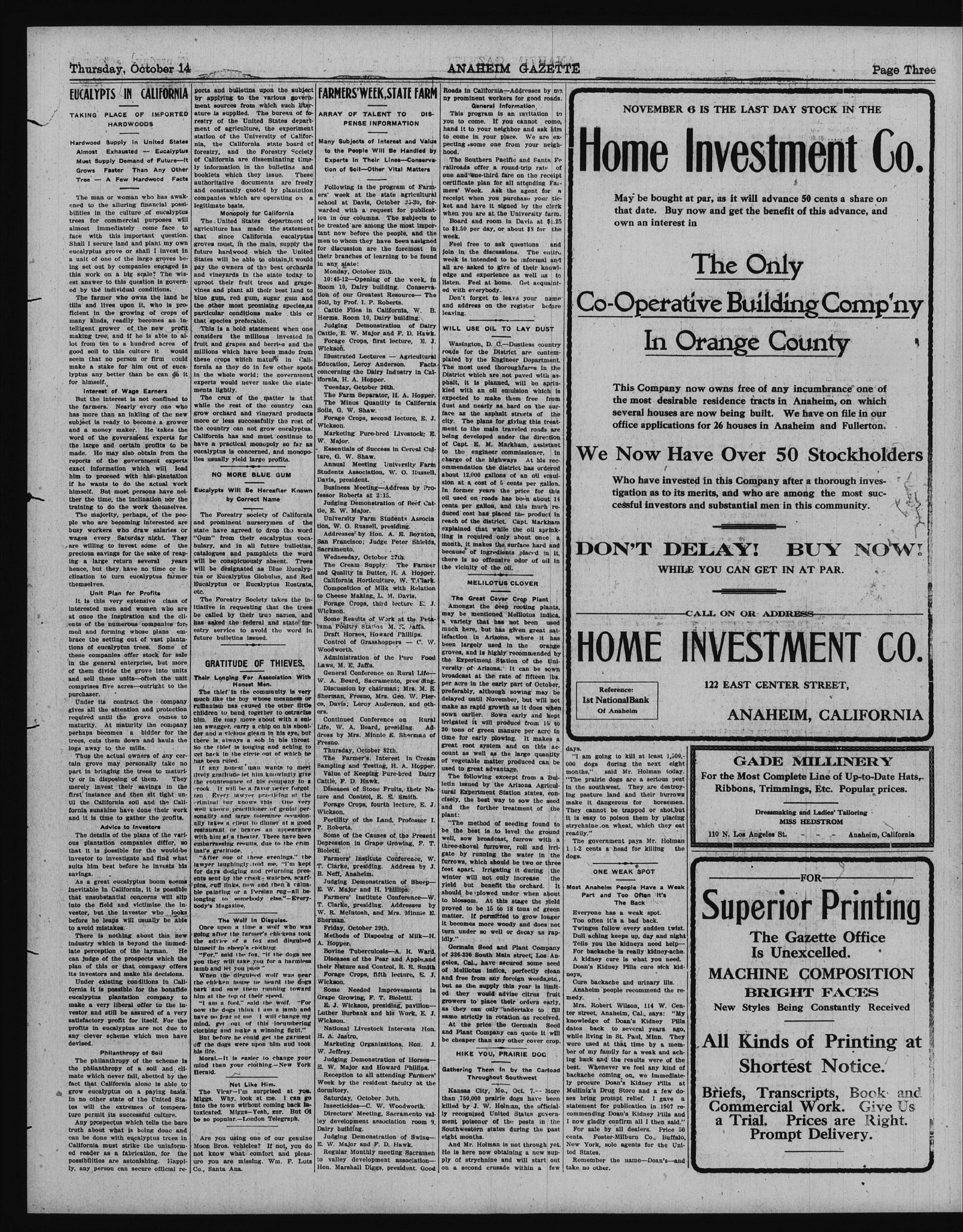
Searchable text
EUCALYPTS IN CALIFORNIA
TAKING PLACE OF IMPORTED HARDWOODS
Hardwood Supply in United States
Almost Exhausted — Eucalyptus
Must Supply Demand of Future—It
Grows Faster Than Any Other Tree — A Few Hardwood Facts
The man or woman who has awakened to the alluring financial possibilities in the culture of eucalyptus trees for commercial purposes will almost immediately come face to face with this important question. Shall I secure land and plant my own eucalyptus grove or shall I invest in a unit of one of the large groves being set out by companies engaged in this work on a big scale? The wisest answer to this question is governed by the individual conditions.
The farmer who owns the land he tills and lives upon it, who is proficient in the growing of crops of many kinds, readily becomes an intelligent grower of the new profit making tree, and if he is able to allot from ten to a hundred acres of good soil to this culture it would seem that no person or firm could make a stake for him out of eucalyptus any better than he can do it for himself.
Interest of Wage Earners
But the interest is not confined to the farmers. Nearly every one who has more than an inkling of the new subject is ready to become a grower and a money maker. He takes the word of the government experts for the large and certain profits to be made. He may also obtain from the ports and bulletins upon the subject by applying to the various government sources from which such literature is supplied. The bureau of forestry of the United States department of agriculture, the experiment station of the University of California, the California state board of forestry, and the Forestry Society of California are disseminating timely information in the bulletins and booklets which they issue. These authoritative documents are freely and constantly quoted by plantation companies which are operating on a legitimate basis.
Monopoly for California
The United States department of agriculture has made the statement that since California eucalyptus groves must, in the main, supply the future hardwood which the United States will be able to obtain, it would pay the owners of the best orchards and vineyards in the state today to uproot their fruit trees and grapevines and plant all their best land to blue gum, red gum, sugar gum and the other most promising species, as particular conditions make this or that species preferable.
This is a bold statement when one considers the millions invested in fruit and grapes and berries and the millions which have been made from these crops which mature in California as they do in few other spots in the whole world; the government experts would never make the statements lightly.
The crux of the matter is that while the rest of the country can grow orchard and vineyard products more or less successfully the rest of the country can not grow eucalyptus. California has and must continue to have a practical monopoly so far as eucalyptus is concerned, and monopolies usually yield large profits.
make a stake for him out of eucalyptus any better than he can do it for himself.
Interest of Wage Earners
But the interest is not confined to the farmers. Nearly every one who has more than an inkling of the new subject is ready to become a grower and a money maker. He takes the word of the government experts for the large and certain profits to be made. He may also obtain from the reports of the government experts exact information which will lead him to proceed with his plantation if he wants to do the actual work himself. But most persons have neither the time, the inclination nor the training to do the work themselves.
The majority, perhaps, of the people who are becoming interested are busy workers who draw salaries or wages every Saturday night. They are willing to invest some of the precious savings for the sake of reaping a large return several years hence, but they have no time or inclination to turn eucalyptus farmer themselves.
Unit Plan for Profits
It is this very extensive class of interested men and women who are at once the inspiration and the clients of the numerous companies formed and forming whose plans embrace the setting out of vast plantations of eucalyptus trees. Some of these companies offer stock for sale in the general enterprise, but more of them divide the grove into units and sell these units—often the unit comprises five acres—outright to the purchaser.
Under its contract the company gives all the attention and protection required until the grove comes to maturity. At maturity the company perhaps becomes a bidder for the trees, cuts them down and hauls the logs away to the mills.
Thus the actual owners of any certain grove may personally take no part in bringing the trees to maturity or in disposing of them. They merely invest their savings in the first instance and then sit tight until the California soil and the California sunshine have done their work and it is time to gather the profits.
Advice to Investors
The details of the plans of the various plantation companies differ, so that it is possible for the would-be investor to investigate and find what suits him best before he invests his formia as they do in few other spots in the whole world; the government experts would never make the statements lightly.
The crux of the matter is that while the rest of the country can grow orchard and vineyard products more or less successfully the rest of the country can not grow eucalyptus. California has and must continue to have a practical monopoly so far as eucalyptus is concerned, and monopolies usually yield large profits.
NO MORE BLUE GUM
Eucalypts Will Be Hereafter Known by Correct Name
The Forestry society of California and prominent nurserymen of the state have agreed to drop the word "Gum" from their eucalyptus vocabulary, and in all future bulletins, catalogues and pamphlets the word will be conspicuously absent. Trees will be designated as Blue Eucalyptus or Eucalyptus Globulus, and Red Eucalyptus or Eucalyptus Rostrata, etc.
The Forestry Society takes the initiative in requesting that the trees be called by their true names, and has asked the federal and state forestry service to avoid the word in future bulletins issued.
GRATITUDE OF THIEVES.
Their Longing For Association With Honest Men.
The thief in the community is very much like the boy whose meanness or ruffianism has caused the other little children to band together to ostracize him. He may move about with a sulen swagger, carry a chip on his shoulder and a vicious gleam in his eye, but there is always a sob in his throat. So the thief is longing and aching to get back in the circle out of which he has been ruled.
If any honest man wants to meet lively gratitude let him knowingly give the countenance of his company to a crook. It will be a favor never forgotten. Every lawyer practicing at the criminal bar knows this. One very well known practitioner of genial personality and large tolerance occasionally takes a client to dinner at a good restaurant or braves an appearance with him at a theater. There have been embarrassing results, due to the criminal's gratitude.
"After one of these evenings," the lawyer laughingly told me, "I'm kept for dang dang and returning press."
merely invest their savings in the first instance and then sit tight until the California soil and the California sunshine have done their work and it is time to gather the profits.
Advice to Investors
The details of the plans of the various plantation companies differ, so that it is possible for the would-be investor to investigate and find what suits him best before he invests his savings.
As a great eucalyptus boom seems inevitable in California, it is possible that unsubstantial concerns will slip into the field and victimize the investor, but the investor who looks before he leaps will usually be able to avoid mistakes.
There is nothing about this new industry which is beyond the immediate perception of the layman. He can judge of the prospects which the plan of this or that company offers its investors and make his decisions.
Under existing conditions in California it is possible for the bonafide eucalyptus plantation company to make a very liberal offer to the investor and still be assured of a very satisfactory profit for itself. For the profits in eucalyptus are not due to any clever scheme which men have devised.
Philanthropy of Soil
The philanthropy of the scheme is the philanthropy of a soil and climate which never fail, abetted by the fact that California alone is able to grow eucalyptus on a paying basis. In no other state of the United States will the extremes of temperature permit its successful culture.
Any prospectus which tells the bare truth about what is being done and can be done with eucalyptus trees in California must strike the uninformed reader as a fabrication, for the possibilities are astonishing. Happily, any person can secure official re-
lively gratitude let him knowingly give the countenance of his company to a crook. It will be a favor never forgotten. Every lawyer practicing at the criminal bar knows this. One very well known practitioner of genial personality and large tolerance occasionally takes a client to dinner at a good restaurant or braves an appearance with him at a theater. There have been embarrassing results, due to the criminal's gratitude.
"After one of these evenings," the lawyer laughingly told me, "I'm kept for days dodging and returning presents sent by the crook—watches, scarf pins, cuff links, now and then a valuable painting or a Persian rug—all belonging to somebody else."—Everybody's Magazine.
The Wolf in Disguise.
Once upon a time a wolf who was going after the farmer's chickens took the advice of a fox and disgusted himself in sheep's clothing.
"For," said the fox, "if the dogs see you they will take you for a harmless lamb and let you pass."
When the disguised wolf was near the chicken house he heard the dogs bark and saw them running toward him at the top of their speed.
"I am a fool," said the wolf. "For now the dogs think I am a lamb and have no fear of me. I will change my mind, get out of this incumbering clothing and make a winning fight."
But before he could get the garment off the dogs were upon him and took his life.
Moral.—It is easier to change your mind than your clothing.—New York Herald.
Not Like Him.
The Vicar—I'm surprised at you. Miggs. Why, look at me. I can go into the town without coming back intoxicated. Miggs—Yesh, zur. But Ol be so popular.—London Telegraph.
Are you using one of our genuine Moon Bros. vehicles? If not, you do not know what comfort and pleasure you are missing. Wm. F. Lutz Co., Santa Ana.
FARMERS' WEEK, STATE FARM
ARRAY OF TALENT TO DISPENSE INFORMATION
Many Subjects of Interest and Value to the People Will Be Handled by Experts in Their Lines—Conservation of Soil—Other Vital Matters
Following is the program of Farmers' week at the state agricultural school at Davis, October 25-30, forwarded with a request for publication in our columns. The subjects to be treated are among the most important now before the people, and the men to whom they have been assigned for discussion are the foremost in their branches of learning to be found in any state:
Monday, October 25th.
10:45-12—Opening of the week, in Room 10, Dairy building. Conservation of our Greatest Resource—The Soil, by Prof. I. P. Roberts.
Cattle Flies in California, W. B. Herms. Room 10, Dairy building.
Judging Demonstration of Dairy Cattle, E. W. Major and F. D. Hawk.
Forage Crops, first lecture, E. J. Wickson.
Illustrated Lectures — Agricultural Education, Leroy Anderson. Fact concerning the Dairy Industry in California, H. A. Hopper.
Tuesday, October 26th.
The Farm Separator, H. A. Hopper.
The Minus Quantity in California Solls, G. W. Shaw.
Forage Crops, second lecture, E. J. Wickson.
Marketing Pure-bred Livestock; E. W. Major.
Essentials of Success in Cereal Culture, G. W. Shaw.
Roads in California—Addresses by many prominent workers for good roads.
General Information
This program is an invitation to you to come. If you cannot come, hand it to your neighbor and ask him to come in your place. We are expecting some one from your neighborhood.
The Southern Pacific and Santa Fe railroads offer a round-trip rate of one and one-third fare on the receipt certificate plan for all attending Farmers' Week. Ask the agent for a receipt when you purchase your ticket and have it signed by the clerk when you are at the University farm.
Board and room in Davis at $1.25 to $1.50 per day, or about $8 for the week.
Feel free to ask questions and join in the discussions. The entire week is intended to be informal and all are asked to give of their knowledge and experience as well as to listen. Feel at home. Get acquainted with everybody.
Don't forget to leave your name and address on the register before leaving.
WILL USE OIL TO LAY DUST
Wasington, D. C.—Dustless country roads for the District are contemplated by the Engineer Department. The most used thoroughfares in the District which are not paved with asphalt, it is planned, will be sprinkled with an oil emulsion which is expected to make them free from dust and nearly as hard on the surface as the asphalt streets of the city. The plans for giving this treatment to the main traveled roads are being developed under the direction of Capt. E. M. Markham, assistant to the engineer commissioner, in charge of the highways.
Education, Leroy Anderson. Facts concerning the Dairy Industry in California, H. A. Hopper.
Tuesday, October 26th.
The Farm Separator, H. A. Hopper.
The Minus Quantity in California Soils, G. W. Shaw.
Forage Crops, second lecture, E. J. Wickson.
Marketing Pure-bred Livestock; E. W. Major.
Essentials of Success in Cereal Culture, G. W. Shaw.
Annual Meeting University Farm Students Association, W. O. Russell, Davis, president.
Business Meeting—Address by Professor Roberts at 2:15.
Judging Demonstration of Beef Cattle, E. W. Major.
University Farm Students Association, W. O. Russell, presiding.
Addresses by Hon. A. E. Boynton, San Francisco; Judge Peter Shields, Sacramento.
Wednesday, October 27th.
The Cream Supply: The Farmer and Quality in Butter, H. A. Hopper.
California Horticulture, W. T. Clark.
Composition of Milk with Relation to Cheese Making, L. M. Davis.
Forage Crops, third lecture, E. J. Wickson.
Some Results of Work at the Petaluma Poultry Station M. E. Jaffa.
Draft Horses, Howard Phillips.
Control of Grasshoppers — C. W. Woodworth.
Administration of the Pure Food Laws, M. E. Jaffa.
General Conference on Rural Life—W. A. Beard, Sacramento, presiding.
Discussion by chairman; Mrs. M. E. Sherman, Fresno, Mrs. Geo. W. Pierce, Davis; Leroy Anderson, and others.
Continued Conference on Itural Life, W. A. Beard, presiding. Address by Mrs. Minnie E. Sherman of Fresno.
Thursday, October 82th.
The Farmer's Interest in Cream Sampling and Testing, H. A. Hopper.
Value of Keeping Pure-bred Dairy Cattle, F. D. Hawk.
Diseases of Stone Fruits, their Nature and Control, R. E. Smith.
Forage Crops, fourth lecture, E. J. Wickson.
Fertility of the Land, Professor I. P. Roberts.
Some of the Causes of the Present Depression in Grape Growing, F. T. Bioletti.
Farmers' Institute Conference, W. T. Clarke, presiding. Address by J.
The most used thoroughfares in the District which are not paved with asphalt, it is planned, will be sprinkled with an oil emulsion which is expected to make them free from dust and nearly as hard on the surface as the asphalt streets of the city. The plans for giving this treatment to the main traveled roads are being developed under the direction of Capt. E. M. Markham, assistant to the engineer commissioner, in charge of the highways At his recommendation the district has ordered about 12,000 gallons of an oil emulsion at a cost of 5 cents per gallon.In former years the price for this oil used on roads has been about 14 cents per gallon, and this much reduced cost has placed the product in reach of the district.Capt. Markham explained that while the oil sprinkling is required only about once a month, it makes the surface hard and because of ingredients placed in it there is no offensive odor of oil in the vicinity of the oil.
MELILOTUS CLOVER
The Great Cover Crop Plant
Amongst the deep rooting plants, may be mentioned Melilotus indica,a variety that has not been used much here, but has given great satisfaction in Arizona, where it has been largely used in the orange groves,and is highly recommended by the Experiment Station of the University of Arizona.'It can be sown broadcast at the rate of fifteen lbs.per acre in the early part of October, preferably although sowing may be delayed until November,but will not make as rapid growth as it does when sown earlier.Sown early and kept irrigated it will produce from 15 to 20 tons of green manure per acre in time for early plowing.It makes a great root system and on this account as well as the large quantity of vegetable matter produced can be used to great advantage.
The following excerpt from a Bulletin issued by the Arizona Agricultural Experiment Station states,crisisely,the best way to sow the seed and the further treatment of the plant:
"The method of seeding found to be the best is to level the ground well,sow broadcast,furrow with a three-shovel furrower,roll and irrigate by running the water in the furrows,which should be two or three feet apart.Irrigating it during the days."
"I am going to kill at least 1,500 000 dogs during the next eight months," said Mr. Holman today.
"The prairie dogs are a serious pest in the southwest They are destroying pasture land and their burrow make it dangerous for horsemen They cannot be trapped or shot,because it is easy to poison them by placing strychnine on wheat,which they eat readily."
The government pays Mr. Holman 1-1-2 cents a head for killing these dogs."
Value of Keeping Pure-bred Dairy Cattle, F. D. Hawk.
Diseases of Stone Fruits, their Nature and Control, R. E. Smith.
Forage Crops, fourth lecture, E. J. Wickson.
Fertility of the Land, Professor I. P. Roberts.
Some of the Causes of the Present Depression in Grape Growing, F. T. Bioletti.
Farmers' Institute Conference, W. T. Clarke, presiding. Address by J. B. Neff, Anaheim.
Judging Demonstration of Sheep—E. W. Major and H. Phillips.
Farmers' Institute Conference—W. T. Clarke, presiding. Addresses by W. R. McIntosh, and Mrs. Minnie E. Sherman.
Friday, October 29th.
Methods of Disposing of Milk—H. A. Hopper.
Bovine Tuberculosis—A. K. Ward.
Diseases of the Pear and Apple,and their Nature and Control, R. E. Smith.
Forage Crops, fifth lecture, E. J. Wickson.
Some Needed Improvements in Grape Growing, F. T. Bioletti.
E. J. Wickson, presiding, pavillon—Luther Burbank and his Work, E. J. Wickson.
National Livestock Interests Hon. H. A. Jastro,
Marketing Organizations, Hon. J. W. Jeffrey.
Judging Demonstration of Horses—E. W. Major and Howard Phillips.
Reception to all attending Farmers' Week by the resident faculty at the dormitory.
Saturday, October 30th.
Insecticides—C. W. Woodworth.
Directors' Meeting, Sacramento valley development association room 9, Dairy building.
Judging Demonstration of Swine—E. W. Major and F. D. Hawk.
Regular Monthly meeting Sacramen to valley development association—Hon. Marshall Diggs, president.
The following excerpt from a Bulletin issued by the Arizona Agricultural Experiment Station states, concisely, the best way to sow the seed and the further treatment of the plant:
"The method of seeding found to be the best is to level the ground well, sow broadcast, furrow with a three-shovel furrower, roll and irrigate by running the water in the furrows, which should be two or three feet apart. Irrigating it during the winter will not only increase the yield but benefit the orchard. It should be plowed under when about to blossom. At this stage the yield proved to be 15 to 18 tons of green matter. If permitted to grow longer it becomes more woody and does not turn under so well or decay as rapidly."
Germain Seed and Plant Company of 326-330 South Main street, Los Angeles, Cal., have secured some seed of Melilotus indica, perfectly clean and free from any foreign weeds, etc., but as the supply this year is limited they would advise citrus fruit growers to place their orders early, as they can only undertake to fill same strictly in rotation as received.
At the price the Germain Seed and Plant Company can quote it will be cheaper than any other cover crop.
HIKE YOU, PRAIRIE DOC
Gathering Them In by the Carload Throughout Southwest
Kansas City, Mo., Oct. 7.-More than 750,000 prairie dogs have been killed by J. W. Holman, the officially recognized United States government poisonor of the pests in the Southwestern states during the past eight months.
And Mr. Holman is not through yet. He is here now obtaining a new supply of strychnine and will start out on a second crusade within a few months.
"The prairie dogs are a serious pest in the southwest. They are destroying pasture land and their burrow make it dangerous for horsemen. They cannot be trapped or shot, but it is easy to poison them by placing strychnine on wheat, which they easily readily."
The government pays Mr. Holman 1 1-2 cents a head for killing these dogs.
ONE WEAK SPOT
Most Anaheim People Have a Weak Part and Too Often It's The Back
Everyone has a weak spot.
Too often it's a bad back.
Twinges follow every sudden twist.
Dull aching keeps up, day and night.
Tells you the kidneys need help.
For backache is really kidney-achievement.
A kidney cure is what you need.
Doan's Kidney Pills cure sick kidneys,
Cure backache and urinary illies.
Anaheim people recommend the remedy.
Mrs. Robert Wilson, 114 W. Center street, Anaheim, Cal., says: "My knowledge of Doan's Kidney Pills dates back to several years ago while living in St. Paul, Minn. They were used at that time by a member of my family for a weak and aching back and the results were of the best. Whenever we feel any kind of backache coming on, we immediately procure Doan's Kidney Pills and Mullinix's Drug Store and a few doses bring prompt relief. I gave statement for publication in 1907 recommending Doan's Kidney Pills and I now gladly confirm all I then said."
For sale by all dealers. Price 5 cents.
Foster-Milburn Co., Buffalo New York, sole agents for the United States.
Remember the name—Doan's—and take no other.
NOVEMBER 6 IS THE LAST DAY STOCK IN THE
Home Investment Co.
May be bought at par, as it will advance 50 cents a share on that date. Buy now and get the benefit of this advance, and own an interest in
The Only
Co-Operative Building Comp'ny
In Orange County
This Company now owns free of any incumbrance one of the most desirable residence tracts in Anaheim, on which several houses are now being built. We have on file in our office applications for 26 houses in Anaheim and Fullerton.
This Company now owns free of any incumbrance one of the most desirable residence tracts in Anaheim, on which several houses are now being built. We have on file in our office applications for 26 houses in Anaheim and Fullerton.
Now Have Over 50 Stockholders
Who have invested in this Company after a thorough investigation as to its merits, and who are among the most successful investors and substantial men in this community.
DON'T DELAY! BUY NOW!
WHILE YOU CAN GET IN AT PAR.
CALL ON OR ADDRESS
HOME INVESTMENT CO.
122 EAST CENTER STREET,
ANAHEIM, CALIFORNIA
GADE MILLINERY
For the Most Complete Line of Up-to-Date Hats,
Ribbons, Trimmings, Etc. Popular prices.
Dressmaking and Ladies' Tailoring
MISS HEDSTROM
110 N. Los Angeles St. - Anaheim, California
FOR Superior Printing
The Gazette Office Is Unexcelled.
MACHINE COMPOSITION BRIGHT FACES
New Styles Being Constantly Received
All Kinds of Printing at Shortest Notice.
Briefs, Transcripts, Book and Commercial Work. Give Us a Trial. Prices are Right. Prompt Delivery.