anaheim-gazette 1909-10-07
Scanned page
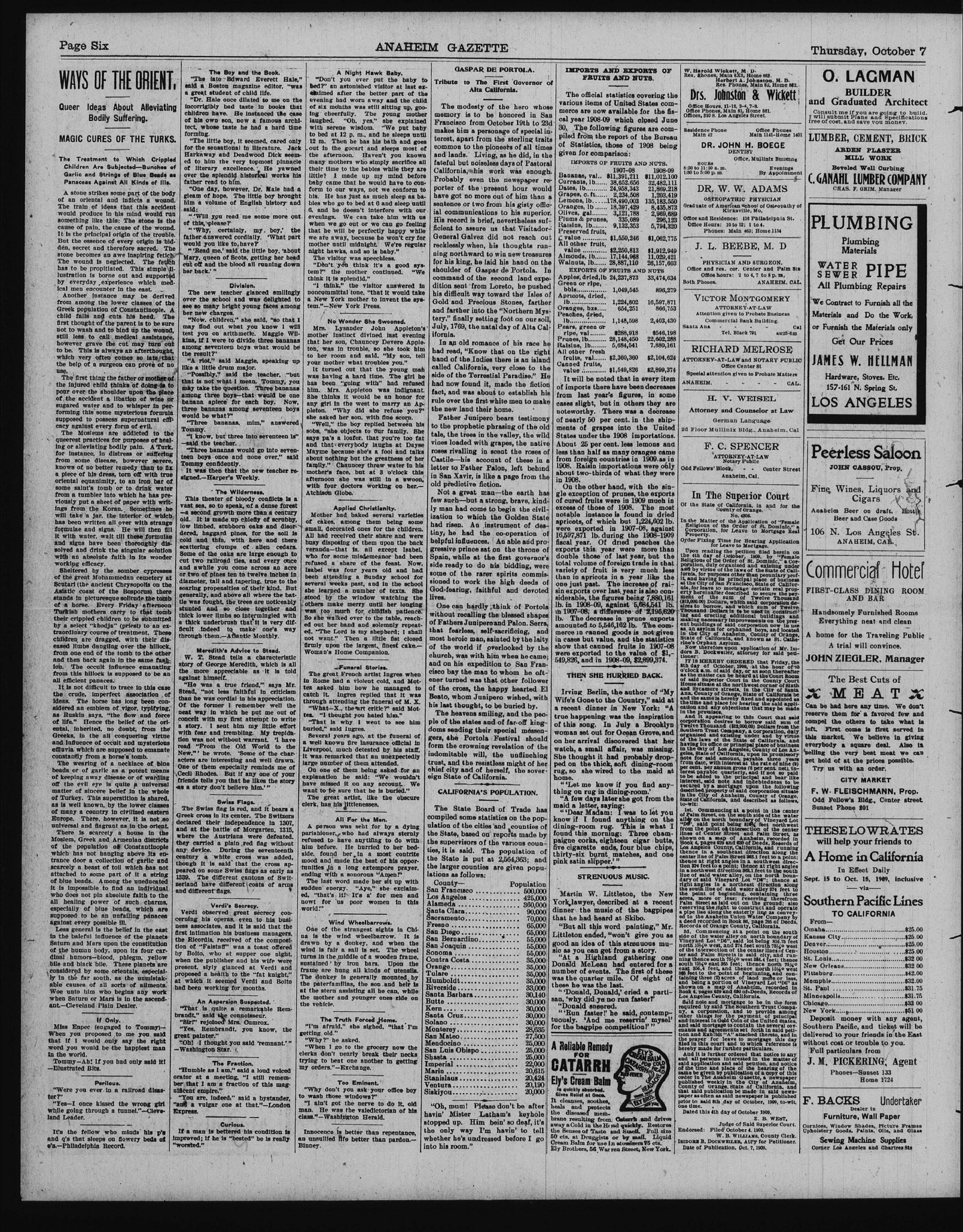
Searchable text
WAYS OF THE ORIENT.
Queer Ideas About Alleviating Bodily Suffering.
MAGIC CURES OF THE TURKS.
The Treatment to Which Crippled Children Are Subjected—Bunches of Garlic and Strings of Blue Beads as Panaceas Against All Kinds of Ills.
A stone strikes some part of the body of an oriental and inflicts a wound. The train of ideas that this accident would produce in his mind would run something like this: The stone is the cause of pain, the cause of the wound. It is the principal origin of the trouble. But the essence of every origin is hidden, secret and therefore sacred. The stone becomes an awake inspiring fetish. The wound is neglected. The fetish has to be propitiated. This simple illustration is borne out and supported by everyday experience which medical men encounter in the east.
Another instance may be derived from among the lower classes of the Greek population of Constantinople. A child falls and cuts his head. The first thought of the parent is to be sure not to wash and to bind up the wound, still less to call medical assistance, however grave the cut may turn out to be. This is always an afterthought, which very often comes so late that the help of a surgeon can prove of no use.
The first thing the father or mother of the injured child thinks of doing is to pour over the shoulder upon the place of the accident a libation of wine or sugared water and to whisper in performing this some mysterious formula supposed to possess supernatural efficacy against every form of evil.
The Moslems are addicted to the queerest practices for purposes of healing or alleviating bodily pain. A Turk, for instance, in distress or suffering...
The first thing the father or mother of the injured child thinks of doing is to pour over the shoulder upon the place of the accident a libation of wine or sugared water and to whisper in performing this some mysterious formula supposed to possess supernatural efficacy against every form of evil.
The Moslems are addicted to the queerest practices for purposes of healing or alleviating bodily pain. A Turk, for instance, in distress or suffering from some disease, however severe, knows of no better remedy than to fix a piece of his dress, torn off with true oriental equanimity, to an iron bar of some saint's tomb or to drink water from a tumbler into which he has previously put a sheet of paper with writings from the Koran. Sometimes he will take a jar, the interior of which has been written all over with strange formulae and signs. He will then fill it with water, wait till these formulae and signs have been thoroughly dissolved and drink the singular solution with an absolute faith in its wonder working efficacy.
Sheltered by the somber cypresses of the great Mohammedan cemetery at Scutarl (the ancient Chrysopolis on the Asiatic coast of the Bosporus) there stands in picturesque solitude the tomb of a horse. Every Friday afternoon Turkish mothers carry to that tomb their crippled children to be submitted by a select "khodja" (priest) to an extraordinary course of treatment. These children are dragged, with their diseased limbs dangling over the hillock, from one end of the tomb to the other and then back again in the same fashion. The occult influence emanating from this hillock is supposed to be an all efficient panacea.
It is not difficult to trace in this case the crude, imperfect association of ideas. The horse has long been considered an emblem of vigor, typifying, as Ruskin says, "the flow and force of life." Hence the belief of the oriental, inherited, no doubt, from the Greeks, in the all conquering virtue and influence of occult and mysterious effluvia which are supposed to emanate constantly from a horse's tomb.
The wearing of a necklace of blue beads or of garlic as a potent means of keeping away disease or of warding off the evil eye is quite a universal matter of sincere belief in the whole of Turkey. This superstition is shared, as is well known, by the lower classes of many a country in civilized eastern Europe. There, however, it is not so universal and flagrant as in the orient.
There is scarcely a house in the Moslem, Greek and Armenian districts of the population of Constantinople which has not hanging above its entrance door a collection of garlic and scarcely a beast of toll which has not like a little drum major.
"Possibly," said the teacher, "but that is not what I mean. Tommy, you may take the question. Three bananas among three boys—that would be one banana apiece for each boy. Now, three bananas among seventeen boys would be what?"
"Three bananas, mim," answered Tommy.
"I know, but three into seventeen is" —said the teacher.
"Three bananas would go into seventeen boys once and none over," said Tommy confidently.
It was then that the new teacher resigned.—Harper's Weekly.
The Wilderness.
This theater of bloody conflicts is a vast sea, so to speak, of a dense forest—a second growth more than a century old. It is made up chiefly of scrubby, low limbed, stubborn oaks and disordered, haggard pines, for the soil is cold and thin, with here and there scattering clumps of allen cedars. Some of the oaks are large enough to cut two railroad ties, and every once and awhile you come across an acre or two of pines ten to twelve inches in diameter, tall and tapering, true to the soaring propensities of their kind. But generally, and above all where the battle was fought, the trees are noticeably stunted and so close together and thick lower limbs so intermingled with a thick underbrush that it is very difficult indeed to make one's way through them.—Atlantic Monthly.
Meredith's Advice to Stead.
W. T. Stead tells a characteristic story of George Meredith, which is all the more appreciable as it is told against himself.
"He was a true friend," says Mr. Stead, "not less faithful in criticism than he was cordial in his appreciation. Of the former I remember well the neat way in which he put me out of conceit with my first attempt to write a story. I sent him my little effort with fear and trembling. My trepidation was not without warrant. I have read 'From the Old World to the New,'' he wrote. 'Some of the characters are interesting and well drawn. One of them especially reminds me of Cecil Rhodes. But if any one of your friends tells you that he likes the story as a story don't believe him.'"
Swiss Flags.
The Swiss flag is red, and it bears a Greek cross in its center. The Switzers declared their independence in 1307, and at the battle of Morgarten, 1315, where the Austrians were defeated. They carried a plain red flag without any device. During the seventeenth century a white cross was added, though it is said that the cross appeared on some Swiss flags as early as
It turned out that was having a hail has been "going him. Mrs. Apples She thinks it won any girl in the wpleton. "Why did she asked her son?
"Well," the boy sobs, "she objected says pa's a loafer and that everybody Mayme because she about nothing but family." Chaunced mother's face, but afternoon she woke with four doctors Atchison Globe.
Applied
Mother had ballet of cakes, among small, decorated ones All had received busy disposing of veranda—that is, who for some milk refused a share Isabel was four been attending several weeks pass she learned a nut stood by the wid others make merma was too much foil So she walked over ed out her hand ed. "The Lord is not want." Then firmly upon the la Woman's Home C
Funeral
The great French in Rome had a violet tez asked him he catch it. Ingres through attending "What-X., the tez." "I thought you That is why I buried," said Ingre Several years ago a well known fire Liverpool, much de it was remarked the large number of th On one of them explanation he sa have missed it one want to be sure th The great artist clerk, has his littler
All For
A parson was se parishioner, who refused to have any him before. He side, found her f mood and made th tunities in a long
of keeping away disease or of warding off the evil eye is quite a universal matter of sincere belief in the whole of Turkey. This superstition is shared, as is well known, by the lower classes of many a country in civilized eastern Europe. There, however, it is not so universal and flagrant as in the orient.
There is scarcely a house in the Moslem, Greek and Armenian districts of the population of Constantinople which has not hanging above its entrance door a collection of garlic and scarcely a beast of toll which has not attached to some part of it a string of blue beads. Among the uneducated it is impossible to find an individual who does not pin absolute faith to the all healing power of such charms, especially of blue beads, which are supposed to be an unfailing panacea against every possible ill.
Less general is the belief in the east in the baleful influence of the planets Saturn and Mars upon the constitution of the human body, upon its four cardinal humors—blood, phlegm, yellow bile and black bile. These planets are considered by some orientals, especially in the far south, as the unmistakable causes of all sorts of ailments. Woe unto him who begins any work when Saturn or Mars is in the ascendant.—Cleveland Plain Dealer.
If Only.
Miss Enpec (engaged to Tommy)—When you proposed to me you said that if I would only say the right word you would be the happiest man in the world.
Tommy—Ah! If you had only said it!—Illustrated Bits.
Perilous.
"Were you ever in a railroad disaster?"
"Yes—I once kissed the wrong girl while going through a tunnel."—Cleveland Leader.
It's the fellow who minds his p's and q's that sleeps on flowery beds of e's.—Philadelphia Record.
Swiss Flags.
The Swiss flag is red, and it bears a Greek cross in its center. The Switzers declared their independence in 1307, and at the battle of Morgarten, 1315, where the Austrians were defeated, they carried a plain red flag without any device. During the seventeenth century a white cross was added, though it is said that the cross appeared on some Swiss flags as early as 1339. The different cantons of Switzerland have different coats of arms and different flags.
Verdi's Secrecy.
Verdi observed great secrecy concerning his operas, even to his business associates, and it is said that the first intimation his business managers, the Ricordis, received of the composition of "Falstaff" was a toast offered by Bolto, who at supper one night, when the publisher and his wife were present, slyly glanced at Verdi and proposed a health to the "fat knight," at which it seemed Verdi and Bolto had been working for months.
An Aspersion Suspected.
"That is quite a remarkable Rembrandt," said the connoisseur.
"Sir!" rejoined Mrs. Cumrox.
"Yes, Rembrandt, you know, the great painter."
"Oh! I thought you said 'remnant.'"—Washington Star.
The Fraction.
"Humble as I am," said a loud voiced orator at a meeting. "I still remember that I am a fraction of this magnificent empire."
"You are, indeed," said a bystander, "and a vulgar one at that."—London Express.
Curious.
If a man is bettered his condition is improved; if he is "bested" he is really "worsted."
ANAHEIM GAZETTE
A Night Hawk Baby.
"Don't you ever put the baby to bed?" an astonished visitor at last examined after the better part of the evening had worn away and the child of six months was still sitting up, gooing cheerfully. The young mother laughed. "Oh, yes," she explained with serene wisdom. "We put baby to bed at 12 p.m., and he sleeps until 12 m. Then he has his bath and goes out in the gocart and sleeps most of the afternoon. Haven't you known many mothers who simply sacrifice all their time to the babies while they are little? I made up my mind before baby came that he would have to conform to our ways, not we conform to his. He has just as much sleep as babies who go to bed at 6 and sleep until 6, and he doesn't interfere with our evenings. We can take him with us when we go out or we can go feeling that he will be perfectly happy while we are away, because he won't cry for mother until midnight. We're regular night hawks, and so is baby."
The visitor was speechless.
"Don't you think it's a good system?" the mother continued. "We think it is splendid."
"I think," the visitor answered in noncommittal tone, "that it would take a New York mother to invent the system."—New York Press.
No Wonder She Swooned.
Mrs. Lysander John Appleton's mother instinct divined last evening that her son, Chauncey Devere Appleton, was in trouble, so she took him to her room and said, "My son, tell your mother what troubles you."
It turned out that the young mah was having a hard time. The girl he has been "going with" had refused him. Mrs. Appleton was indignant. She thinks it would be an honor for any girl in the west to marry an Appleton. "Why did she refuse you?" she asked her son, with fine scorn.
Well," the boy replied between his sobs, "she objects to our family. She says pa's a loafer, that you're too fat and that everybody laughs at Dayse Mayme because she's a fool and talks about nothing but the greatness of her
GASPAR DE PORTOLA.
Tribute to The First Governor of Alta California.
The modesty of the hero whose memory is to be honored in San Francisco from October 19th to 23d makes him a personage of special interest, apart from the sterling traits common to the pioneers of all times and lands. Living, as he did, in the fateful but noiseless days of Pastoral California, his work was enough. Probably even the newspaper reporter of the present hour would have got no more out of him than a sentence or two from his gisty official communications to his superior. His record is brief, nevertheless sufficient to assure us that Visitador-General Galvez did not reach out recklessly when, his thoughts running northward to win new treasures for his king, he laid his hand on the shoulder of Gaspar de Portola. In command of the second land expedition sent from Loreto, he pushed his difficult way toward the Isles of Gold and Precious Stones, farther and farther into the "Northern Mystery," finally setting foot on our soil, July, 1769, the natal day of Alta California.
In an old romance of his race he had read, "Know that on the right hand of the Indies there is an island called California, very close to the side of the Terrestrial Paradise." He had now found it, made the fiction fact, and was about to establish his rule over the first white men to make the new land their home.
Father Junipero bears testimony to the prophetic phrasing of the old tale, the trees in the valley, the wild vines loaded with grapes, the native roses rivalling in scent the roses of Castile—his account of those in
IMPORTS AND EXPORTS OF FRUITS AND NUTS.
The official statistics covering the various items of United States commerce are now available for the fiscal year 1908-09 which closed June 30. The following figures are compiled from the report of the Bureau of Statistics, those of 1908 being given for comparison:
IMPORTS OF FRUITS AND NUTS.
1907-08 1908-09
Bananas, val... $11,391,211 $11,012,100
Currants, lb... 38,652,656 32,482,111
Dates, lb... 24,958,343 21,869,218
Grapes, c. ft... 2,234,508 1,203,419
Lemons, lb... 178,490,003 135,183,550
Oranges, lb... 18,397,429 8,435,873
Olives, gal... 3,121,788 2,969,689
Plums & prunes... 335,089 296,123
Raisins, lb... 9,132,353 5,794,320
Preserved fruit,
value ... $1,550,246 $1,062,775
All other fruit,
value ... $2,250,813 $1,912,949
Almonds, lb... 17,144,968 11,029,421
Walnuts, lb... 28,887,110 26,157,603
EXPORTS OF FRUITS AND NUTS.
Apples, dried, lb 24,237,873 33,474,634
Green or ripe,
bbls... 1,049,545 896,279
Apricots, dried,
lb... 1,224,602 16,597,871
Oranges, bxs... 654,251 866,753
Peaches, dried,
lb... 1,148,598 2,403,430
Pears, green or ripe,
val... $288,918 $546,198
Prunes, lb... 28,148,450 22,602,288
Raisins, lb... 5,684,541 7,880,161
All other fresh fruits,
val... $2,360,360 $2,104,624
Canned fruits,
value ... $1,549,826 $2,899,374
It will be noted that in every item of imports there have been decreases from last year's figures; in some cases slight; but in others they are noteworthy. There was a decrease of nearly 50 per cent. in the shipments of grapes into the United States under the 1908 importations. About 25 per cent. less lemons and less than half as many oranges came from foreign countries in 1909 as in
It turned out that the young man was having a hard time. The girl he has been "going with" had refused him. Mrs. Appleton was indignant. She thinks it would be an honor for any girl in the west to marry an Appleton. "Why did she refuse you?" she asked her son, with fine scorn.
"Well," the boy replied between his sobs, "she objects to our family. She says pa's a loafer, that you're too fat and that everybody laughs at Dayse Mayme because she's a fool and talks about nothing but the greatness of her family." Chauncey threw water in his mother's face, but at 3 o'clock this afternoon she was still in a swoon, with four doctors working on her.—Atchison Globe.
Applied Christianity.
Mother had baked several varieties of cakes, among them being some small, decorated ones for the children. All had received their share and were busy disposing of them upon the back veranda—that is, all except Isabel, who for some misdemeanor had been refused a share of the feast. Now, Isabel was four years old and had been attending a Sunday school for several weeks past, and in the school she learned a number of texts. She stood by the window watching the others make merry until her longing was too much for childish patience. So she walked over to the table, reached out her hand and solemnly repeated. "The Lord is my shepherd; I shall not want." Then a little fist closed firmly upon the largest, finest cake.—Woman's Home Companion.
Funeral Stories.
The great French artist Ingres when in Rome had a violent cold, and Mottez asked him how he managed to catch it. Ingres replied that it was through attending the funeral of M. X. "What—X., the art critic?" said Mottez. "I thought you hated him."
That is why I went to see him buried," said Ingres.
Several years ago, at the funeral of a well known fire insurance official in Liverpool, much detested by his staff, it was remarked that an unexpectedly large number of them attended.
On one of them being asked for an explanation he said: "We wouldn't have missed it on any account. We want to be sure that he is buried."
The great artist, like the obscure clerk, has his littlenesses.
All For the Men.
A parson was sent for by a dying parishioner, who had always sternly refused to have anything to do with him before. He hurried to her bedside, found her in a most contrite mood and made the best of his opportunities in a long extempore prayer,
called California, very close to the side of the Terrestial Paradise." He had now found it, made the fiction fact, and was about to establish his rule over the first white men to make the new land their home.
Father Junipero bears testimony to the prophetic phrasing of the old tale, the trees in the valley, the wild vines loaded with grapes, the native roses rivalling in scent the roses of Castile—his account of these in a letter to Father Palon, left behind in San Xavir, is like a page from the old predictive fiction.
Not a great man—the earth has few such—but a strong, brave, kindly man had come to begin the civilization to which the Golden State had risen. An instrument of destiny, he had the co-operation of helpful influences. An able and progressive prince sat on the throne of Spain, while at the first governor's side ready to do his bidding, were some of the rarer spirits commissioned to work the high deeds of God-fearing, faithful and devoted lives.
One can hardly think of Portola without recalling the blessed shapes of Fathers Junipero and Palon. Serra, that fearless, self-sacrificing, and most heroic man, sainted by the laity of the world if overlooked by the church, was with him when he came; and on his expedition to San Francisco bay the man to whom he oftener turned was that other follower of the cross, the happy hearted El Beato, whom Junipero wished, with his last thought, to be buried by.
The heavens smiling, and the people of the states and of far-off kingdoms sending their special messengers, she Portola Festival should form the crowning revelation of the indomitable will, the unflinching trust, and the resistless might of her chief city and of herself, the sovereign State of California.
CALIFORNIA'S POPULATION.
The State Board of Trade has compiled some statistics on the population of the cities and counties of the State, based on reports made by the supervisors of the various counties, it is said. The population of the State is put at 2,564,363; and the larger counties are given popuIt will be noted that in every item of imports there have been decreases from last year's figures, in some cases slight, but in others they are noteworthy. There was a decrease of nearly 50 per cent. in the shipments of grapes into the United States under the 1908 importations. About 25 per cent. less lemons and less than half as many oranges came from foreign countries in 1909 as in 1908. Raisin importations were only about two-thirds of what they were in 1908.
On the other hand, with the single exception of prunes, the exports of cured fruits were in 1909 much in excess of those of 1908. The most notable instance is found in dried apricots, of which but 1,224,602 lb. were exported in 1907-08, against 16,597,871 lb. during the 1908-1909 fiscal year. Of dried peaches the exports this year were more than double those of last year, but the total volume of foreign trade in that variety of fruit is very much less than in apricots in a year like the one just past. The increase of raisin exports over last year is also considerable, the figures being 7,880,161 lb. in 1908-09, against 5,684,541 lb. in 1907-08, a difference of 2,195,620 lb. The decrease in prune exports amounted to 5,546,162 lb. The commerce in canned goods is not given in cases but value, and the statistics show that canned fruits in 1907-08 were exported to the value of $1,-549,826, and in 1908-09,$2,899,374.
THEN SHE HURRIED BACK.
Irving Berlin, the author of "My Wife's Gone to the Country," said at a recent dinner in New York: "A true happening was the inspiration of this song. In July a Brooklyn woman set out for Ocean Grove, and on her arrival discovered that her watch, a small affair, was missing. She thought it had probably dropped on the thick, soft dining-room rug, so she wired to the maid at home.
"Let me know if you find anything on rug in dining-room."
"A few days later she got from the maid a letter, saying:
"Dear Madam: I was to let you know if I found anything on the dining-room rug. This is what I found this morning: Three champagne corks, eighteen cigar butts, five cigarette ends, four blue chips, thirty-six burnt matches, and one pink satin slipper."
explanation he said: "We wouldn't have missed it on any account. We want to be sure that he is buried."
The great artist, like the obscure clerk, has his littlenesses.
All For the Men.
A parson was sent for by a dying parishioner, who had always sternly refused to have anything to do with him before. He hurried to her bedside, found her in a most contrite mood and made the best of his opportunities in a long extempore prayer, ending with a sonorous "Amen!"
The last word made her sit up with sudden energy. "Aye," she exclaimed, "that's it! It's a' for men and nowt for us poor women in this world!"
Wind Wheelbarrows.
One of the strangest sights in China is the wind wheelbarrow. It is drawn by a donkey, and when the wind is fair a sail is set. The wheel turns in the middle of a wooden frame, sustained by iron bars. Upon the frame are hung all kinds of utensils. The donkey is generally mounted by the paterfamilias, the son and heir is at the stern assisting all he can, while the mother and younger ones ride on the vehicle.
The Truth Forced Home.
"I'm afraid," she sighed, "that I'm getting old."
"Why?" he asked.
"When I go to the grocery now the clerks don't nearly break their necks trying to beat one another in getting my orders."—Exchange.
Too Eminent.
"Why don't you ask your office boy to wash those windows?"
"I aln't got the nerve to do it, old man. He was the valedictorian of his class."—Washington Herald.
Innocence is better than repentance, an unsullied life better than pardon.—Binney.
CALIFORNIA'S POPULATION.
The State Board of Trade has compiled some statistics on the population of the cities and counties of the State, based on reports made by the supervisors of the various counties, it is said. The population of the State is put at 2,564,363; and the larger counties are given populations as follows:
County—Population
San Francisco 500,000
Los Angeles 425,000
Alameda 360,000
Santa Clara 90,000
Sacramento 70,000
Fresno 65,000
San Diego 65,000
San Bernardino 55,000
San Joaquin 55,000
Sonoma 55,000
Contra Costa 35,000
Orange 35,000
Tulare 35,000
Humboldt 35,000
Riverside 33,000
Santa Barbara 30,140
Butte 30,000
Kern 30,000
Santa Cruz 30,000
Solano 30,000
Monterey 28,635
San Mateo 27,500
Mendocino 25,000
San Luis Obispo 25,000
Shasta 25,000
Imperial 22,000
Marin 20,615
Stanislaus 20,424
Ventura 20,190
Siskiyou 20,000
"Oh, mum! Please don't be after havin' Mister Latham's keyhole stopped up. Him bein' so deaf, it's the only way I'm havin' to tell whether he's undressed before I go into his room."
STRENUOUS MUSIC.
Martin W. Littleton, the New York lawyer, described at a recent dinner the music of the bagpipes that he had heard at Skibo.
"But all this word painting," Mr. Littleton ended, "won't give you as good an idea of this strenuous music as you can get from a story.
"At a Highland gathering one Donald McLean had entered for a number of events. The first of these was the quarter mile. Of eight of these he was the last.
"'Donald, Donald,' cried a partisan, 'why did ye no run faster?'
'Donald sneered.
'Run faster!' he said, contemptuously. 'And me reservin' myself for the bagpipe competition!'"
THURSDAY, OCTOBER 7
AND EXPORTS OF NUTS.
statistics covering the
of United States commew available for the fis09 which closed June
awing figures are comthe report of the Bureau
those of 1908 being
comparison:
FRUITS AND NUTS.
1907-08 $11,391,211 $11,012,100
... 38,652,656 32,482,111
... 24,958,343 21,869,218
... 2,234,508 1,203,419
... 178,490,003 135,183,550
... 18,397,429 8,435,873
... 3,121,788 2,969,689
... 335,089 296,123
... 9,132,353 5,794,320
... $1,550,246 $1,062,775
... $2,250,813 $1,912,949
... 17,144,968 11,029,421
... 28,887,110 26,157,603
FRUITS AND NUTS.
24,237,873 33,474,634
... 1,049,545 896,279
... 1,224,602 16,597,871
... 654,251 866,753
... 1,148,598 2,403,430
... $288,918 $546,198
... 28,148,450 22,602,288
... 5,684,541 7,880,161
... $2,360,360 $2,104,624
... $1,549,826 $2,899,374
ted that in every item
are have been decreases
car's figures in some
but in others they are
There was a decrease
per cent. in the shippes into the United
the 1908 importations.
cent. less lemons and
as many oranges came
countries in 1909 as in
W. Harold Wickett. M.D.
Res. Phones. Main 8X3. Home 863.
Herbert A. Johnston. M.D.
Res. Phones. Main 82. Home 862.
Drs. Johnston & Wickett
Office Hours. 11-12. 2-4. 7-8.
Office Phones. Main 81. Home 861.
Offices. 310 S. Los Angeles Street.
Residence Phone Main 42 Office Phones Main 1141-Home 1401
DR. JOHN H. BOEGE
DENTIST
Office, Mullinix Building
HOURS
8:30 to 11:30 a.m.
1:30 to 5:00 p.m.
Evenings By Appointment
DR. W. W. ADAMS
OSTEOPATHIC PHYSICIAN
Graduate of American School of Osteopathy of Kirksville, Mo.
Office and Residence: 116 Philadelphia St.
Office Hours: 10 to 12; 1 to 4.
Phones: Main 463; Home 1134
J. L. BEEBE, M.D.
PHYSICIAN AND SURGEON.
Office and res. cor. Center and Palm Sts
Office hours: 2 to 4.7 to 8 p.m.
Both Phones. ANAHEIM. CAL.
VICTOR MONTGOMERY
ATTORNEY-AT-LAW
Attention given to Probate Business
Commercial Bank Building.
Santa Ana Cal.
Tel. Black 791 au23-6m
RICHARD MELROSE
ATTORNEY-AT-LAW and NOTARY PUBLIC
Office Center St.
Special attention given to Probate Matters
ANAHEIM. - - - CAL.
H. V. WEISEL
Attorney and Counselor at Law
German Language
2d Floor Mullinix Bldg., Anaheim, Cal.
F. C. SPENCER
ATTORNEY-AT-LAW
O. LAGMAN
BUILDER and Graduated Architect
Consult me if you are going to build.
I will submit Plans and Specifications tree of cost. and save you money.
LUMBER, CEMENT, BRICK
ARDEN PLASTER
MILL WORK
Beveled Well Curbing
C.GANAHL LUMBER COMPANY
CHAS. F. GRIM. Manager
PLUMBING
Plumbing Materials
WATER PIPE
SEWER
All Plumbing Repairs
We Contract to Furnish all the Materials and Do the Work,
or Furnish the Materials only
Get Our Prices
JAMES W. HELLMAN
Hardware, Stoves. Etc.
157-161 N. Spring St.
LOS ANGELES
Peerless Saloon
HURRIED BACK.
In the Superior Court
Of the State of California, in and for the County of Orange.
No. 4305.
In the Matter of the Application of "Female Religious of the Order of St. Dominic," a Corporation, duly organized and existing under and by virtue of the laws of the State of California, for purposes other than pecuniary profit, and having its principal place of business at the City of San Francisco, State of California, for leave to mortgage certain real property hereinafter described to secure the payment of the sum of Twelve Thousand ($12,000.00) Dollars, which said corporation desires to borrow, and which sum of Twelve Thousand Dollars is to be used in constructing and erecting additional buildings and making necessary improvements on the present buildings of said corporation now in use as an asylum for orphaned boys, and located in the City of Anaheim, County of Orange, State of California, and known as St. Catheline's Orphan Asylum.
Now therefore upon application of Mr. Isidore B. Dockweiler, attorney for said petitioner:
IT IS HEREBY ORDERED that Friday, the 8th day of October, 1909, at the hour of 10 o'clock a.m. of said day, or as soon thereafter as the matter can be heard at the Court Room of said Superior Court in the County Court House situate at the northwest corner of Sixth and Sycamore streets, in the City of Santa Ana, County of Orange, State of California be and the same is hereby fixed and appointed as the time and place for hearing the said application and any objections that may be made in the premises.
And it appearing to this Court that said corporation desires to borrow said sum of Twelve Thousand ($12,000.00) Dollars from the Southern Trust Company, a corporation, duly organized and existing under and by virtue of the laws of the State of California, and having its office or principal place of business in the City of Los Angeles; County of Los Angeles, State of California, upon its promissory note for said amount, payable three years from date, with interest at the rate of nine (9) per cent. per annum gross (6 per cent. net), interest payable quarterly, and if not so paid to be added to the principal and bear like interest, said note and indebtedness to be secured by a mortgage upon the following described property of said corporation situated in the City of Anaheim, County of Orange, State of California, and described as follows, to-wit:
1st. Commencing at a point in the center of Palm Street, on the south side of the water alley on the north boundary of Vineyard Lot "D6", said point being 816 feet northwest from the point of intersection of the center lines of Center Street and Palm Street, as shown on a map of Anaheim, recorded in Book 4, pages 629 and 630 of Deeds, Records of Los Angeles County, California, and running thence in a southeast direction along the center line of Palm Street 368.1 feet to a point; thence at right angles in a northwest direction 368.1 feet to the south
Peerless Saloon
JOHN CASSOU, Prop.
Fine Wines, Liquors and Cigars
Anaheim Beer on draft. Bottle Beer and Case Goods
106 N. Los Angeles St.
ANAHEIM, CA.
Commercial Hotel
FIRST-CLASS DINING ROOM AND BAR
Handsomely Furnished Rooms Everything neat and clean
A home for the Traveling Public A trial will convince
JOHN ZIEGLER, Manager
The Best Cuts of MEAT
Can be had here any time. We don't reserve them for a favored few and compel the others to take what is left. First come is first served in this market. We believe in giving everybody a square deal. Also in selling the very best meat we can get hold of at the prices possible. Try us with an order.
CITY MARKET
F. W. FLEISCHMANN, Prop.
Odd Fellow's Bldg., Center street
Sunset Phone 201
THESELOWRATES
will help your friends to
A Home in California
In Effect Daily
Littleton, the New described at a recent music of the bagpipes at Skibo.
word painting," Mr. "won't give you as this strenuous muget from a story. and gathering one had entered for a tts. The first of these mile. Of eight of the last.
he said, contemp-me reservin' mysel' competition!"
Commencing at a point in the center of Palm Street, on the south side of the water alley on the north boundary of Vineyard Lot "D6", said lot being 816.75 feet north 15% west, and 774 feet south 75% west of the intersection of the center lines of Center and Palm Streets in said city, and running thence south 75% west 386.4 feet; thence south 15% east 365 feet; thence north 75% east 365.4 feet, and thence north 15% west 386 feet to the point of beginning, containing three (3) acres of land more or less, and being a portion of Vineyard Lot "D6" as shown on a map of Anaheim, recorded in Book 4, pages 629 and 630 of Deeds, Records of Orange County, California.
Said note and mortgage to be in the form required by said The Southern Trust Company, a corporation, and to provide among other things for the payment of principal and interest in Gold Coln of the United States, and said mortgage to contain the several covenants and agreements set forth in said petition and Exhibit "A" attached thereto, and in the prayer for leave to mortgage this day filed in this court and to which reference is hereby made for further particulars.
And it is further ordered that notice to any and all persons interested in the matter of said application and said petition, and notice of the time and place of the hearing of the same be given by publication of a copy of this order in The Anaheim Gazette, a newspaper published weekly in the City of Anaheim, County of Orange, State of California, and that said publication be made in said newspaper as often as said newspaper is published prior to said 8th day of October, 1909, to-wit, one time.
Dated this 4th day of October 1909.
Z. B. WEST,
Judge of Said Superior Court.
Endorsed: Filed October 4. 1909.
W. B. Williams, County Clerk.
Isidore B. Dockweiler, Atty for Petitioner.
Date of Publication, Oct. 7, 1909.
CITY MARKET
F. W. FLEISCHMANN, Prop.
Odd Fellow's Bldg., Center street.
Sunset Phone 201
THESELOWRATES will help your friends to A Home in California
In Effect Daily Sept. 15 to Oct. 15, 1909, inclusive via
Southern Pacific Lines TO CALIFORNIA
From—
Omaha.....$25.00
Kansas City.....$25.00
Denver.....$25.00
Houston.....$25.00
St. Louis.....$32.00
New Orleans.....$32.00
Pittsburg.....$42.00
Memphis.....$32.00
St. Paul.....$31.75
Minneapolis.....$31.75
Chicago.....$33.00
New York.....$51.00
Deposit money with any agent, Southern Pacific, and ticket will be delivered to your friends in the East without cost or trouble to you.
Full particulars from J. M. PICKERING, Agent
Phones—Sunset 133
Home 1724
F. BACKS Undertaker
Dealer in Furniture, Wall Paper
Cornices, Window Shades, Picture Frames Upholstery Goods, Paints, Oils, and Glass
Sewing Machine Supplies
Corner Los Angeles and Chartres Sts