anaheim-gazette 1909-09-23
Scanned page
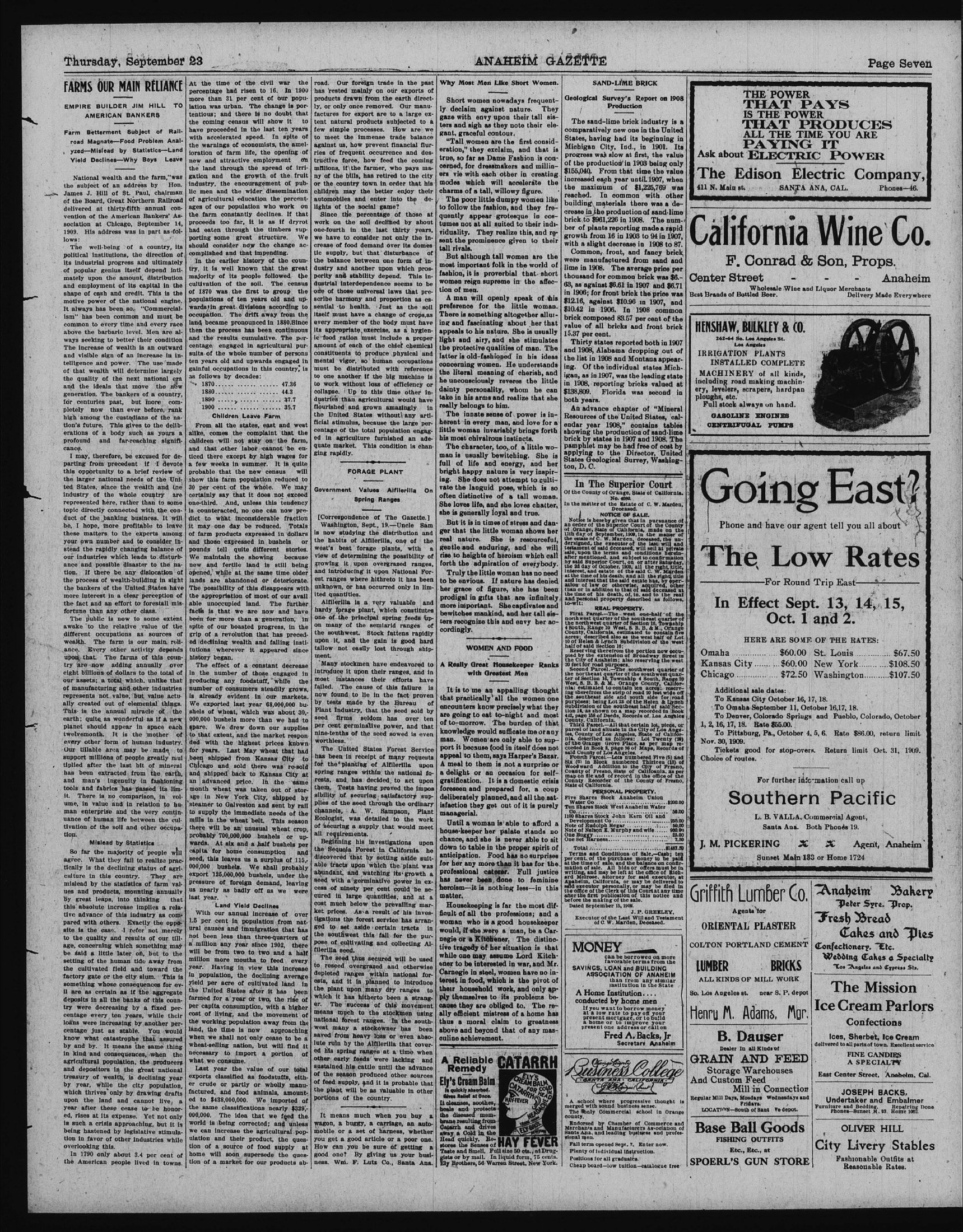
Searchable text
FARMS OUR MAIN RELIANCE
EMPIRE BUILDER JIM HILL TO AMERICAN BANKERS
Farm Betterment Subject of Railroad Magnate—Food Problem Analyzed—Mislead by Statistics—Land Yield Declines—Why Boys Leave
National wealth and the farm,"was the subject of an address by Hon. James J. Hill of St. Paul, chairman of the Board, Great Northern Railroad delivered at thirty-fifth annual convention of the American Bankers' Association at Chicago, September 14, 1909. His address was in part as follows:
The well-being of a country, its political institutions, the direction of its industrial progress and ultimately of popular genius itself depend intimately upon the amount, distribution and employment of its capital in the shape of cash and credit. This is the motive power of the national engine. It always has been so. "Commercialism" has been common and must be common to every time and every race above the barbaric level. Men are always seeking to better their condition. The increase of wealth is an outward and visible sign of an increase in intelligence and power. The use made of that wealth will determine largely the quality of the next national era and the ideals that move the new generation. The bankers of a country, for centuries past, but more completely now than ever before, rank high among the custodians of the nation's future. This gives to the deliberations of a body such as yours a profound and far-reaching significance.
I may, therefore, be excused for de-
At the time of the civil war the percentage had risen to 16. In 1900 more than 31 per cent of our population was urban. The change is portentious; and there is no doubt that the coming census will show it to have proceeded in the last ten years with accelerated speed. In spite of the warnings of economists, the amelioration of farm life, the opening of new and attractive employment on the land through the spread of irrigation and the growth of the fruit industry, the encouragement of public men and the wider dissemination of agricultural education the percentages of our population who work on the farm constantly declines. If that proceeds too far, it is as if dryrot had eaten through the timbers supporting some great structure. We should consider now the change accomplished and that impending.
In the earlier history of the country, it is well known that the great majority of its people followed the cultivation of the soil. The census of 1870 was the first to group the populations of ten years old and upwards in great divisions according to occupation. The drift away from the land became pronounced in 1880.Since then the process has been continuous and the results cumulative. The percentage engaged in agricultural pursuits of the whole number of persons ten years old and upwards engaged in gainful occupations in this country, is as follows by decades:
1870 ... 47.36
1880 ... 44.3
1890 ... 37.7
1900 ... 35.7
Children Leave Farm
From all the states, east and west alike, comes the complaint that the children will not stay on the farm, and that other labor cannot be enticed there except by high wages for road. Our force has rested many products drawn by or only once factures for extent natural production few simple pro-
Since the p-
Since the p-
Since the p-
Since the p-
Since the p-
Since the p-
Since the p-
Since the p-
Since the p-
Since the p-
Since the p-
Since the p-
Since the p-
Since the p-
Since the p-
Since the p-
Since the p-
Since the p-
Since the p-
Since the p-
Since the p-
Since the p-
Since the p-
Since the p-
Since the p-
Since the p-
Since the p-
Since the p-
Since the p-
Since the p-
Since the p-
Since the p-
Since the p-
Since the p-
Since the p-
Since the p-
Since the p-
Since the p-
Since the p-
Since the p-
Since the p-
Since the p-
Since the p-
Since the p-
Since the p-
Since the p-
Since the p-
Since the p-
Since the p-
Since the p-
Since the p-
Since the p-
Since the p-
Since the p-
Since the p-
Since the p-
Since the p-
Since the p-
Since the p-
Since the p-
Since the p-
Since the p-
Since
The use made of that wealth will determine largely the quality of the next national era and the ideals that move the new generation. The bankers of a country, for centuries past, but more completely now than ever before, rank high among the custodians of the nation's future. This gives to the deliberations of a body such as yours a profound and far-reaching significance.
I may, therefore, be excused for departing from precedent if I devote this opportunity to a brief review of the larger national needs of the United States, since the wealth and the industry of the whole country are represented here, rather than to some topic directly connected with the conduct of the banking business. It will be, I hope, more profitable to leave these matters to the experts among your own number and to consider instead the rapidly changing balance of our industries which leads to disturbance and possible disaster to the nation. If there be any dislocation of the process of wealth-building in sight the bankers of the United States have more interest in a clear perception of the fact and an effort to forestall misfortune than any other class.
The public is now to some extent awake to the relative value of the different occupations as sources of wealth. The farm is our main reliance. Every other activity depends upon that. The farms of this country are now adding annually over eight billions of dollars to the total of our assets; a total which, unlike that of manufacturing and other industries represents not value, but value actually created out of elemental things. This is the annual miracle of the earth; quite as wonderful as if a new planet should appear in space each twelvemonth. It is the mother of every other form of human industry. Our tillable area may be made to support millions of people greatly multiplied after the last bit of mineral has been extracted from the earth, and man's ingenuity in fashioning tools and fabrics has passed its limit. There is no comparison, in volume, in value and in relation to human enterprise and the very continuance of human life between the cultivation of the soil and other occupation.
Mislead by Statistics
So far the majority of people will agree. What they fail to realize practically is the declining status of agriculture.
Children Leave Farm
From all the states, east and west alike, comes the complaint that the children will not stay on the farm, and that other labor cannot be enticed there except by high wages for a few weeks in summer. It is quite probable that the new census will show this farm population reduced to 30 per cent of the whole. We may certainly say that it does not exceed one-third. And, unless this tendency is counteracted, no one can now predict to what inconsiderable fraction it may one day be reduced. Totals of farm products expressed in dollars and those expressed in bushels or pounds tell quite different stories. We maintain the showing because new and fertile land is still being opened, while at the same time older lands are abandoned or deteriorate. The possibility of this disappears with the appropriation of most of our available unoccupied land. The further facts is that we are now and have been for more than a generation, in spite of our boasted progress, in the grip of a revolution that has preceded declining wealth and falling institutions wherever it appeared since history began.
The effect of a constant decrease in the number of those engaged in producing any foodstuff, while the number of consumers steadily grows, is already evident in our markets. We exported last year 68,000,000 bushels of wheat, which was about 30,000,000 bushels more than we had to spare. We drew down our supplies to that extent, and the market responded with the highest prices known for years. Last May wheat that had been shipped from Kansas City to Chicago and sold there was re-sold and shipped back to Kansas City at an advanced price. In the same month wheat was taken out of storage in New York City, shipped by steamer to Galveston and sent by rail to supply the immediate needs of the mills in the wheat belt. This season there will be an unusual wheat crop, probably 700,000,000 bushels or upwards. At six and a half bushels per capita for home consumption and seed, this leaves us a surplus of 115,000,000 bushels. We shall probably
has been extracted from the earth,
and man's ingenuity in fashioning tools and fabrics has passed its limit. There is no comparison, in volume, in value and in relation to human enterprise and the very continuance of human life between the cultivation of the soil and other occupation.
Mislead by Statistics
So far the majority of people will agree. What they fail to realize practically is the declining status of agriculture in this country. They are misled by the statistics of farm values and products, mounting annually by great leaps, into thinking that this absolute increase implies a relative advance of this industry as compared with others. Exactly the opposite is the case. I refer not merely to the quality and results of our tillage, concerning which something may be said a little later on, but to the setting of the human tide away from the cultivated field and toward the factory gate or the city slum. This is something whose consequences for evil are as certain as if the aggregate deposits in all the banks of this country were decreasing by a fixed percentage every ten years, while their loans were increasing by another percentage just as stable. You would know what catastrophe that assured by and by. It means the same thing in kind and consequences, when the agricultural population, the producers and depositors in the great national treasury of wealth, is declining year by year, while the city population, which thrives only by drawing drafts upon the land and cannot live a year after these cease to be honored, rises at its expense. Yet not only is such a crisis approaching, but it is being hastened by legislative stimulation in favor of other industries while overlooking this.
In 1790 only about 3.4 per cent of the American people lived in towns.
and shipped back to Kansas City at an advanced price. In the same month wheat was taken out of storage in New York City, shipped by steamer to Galveston and sent by rail to supply the immediate needs of the mills in the wheat belt. This season there will be an unusual wheat crop, probably 700,000,000 bushels or upwards. At six and a half bushels per capita for home consumption and seed, this leaves us a surplus of 115,000,000 bushels. We shall probably export 125,000,000 bushels, under the pressure of foreign demand, leaving us nearly as badly off as we were last year.
Land Yield Declines
With our annual increase of over 1.5 per cent in population from natural causes and immigration that has not been less than three-quarters of a million any year since 1902, there will be from two to two and a half million more mouths to feed every year. Having in view this increase in population, the declining average yield per acre of cultivated land in the United States after it has been farmed for a year or two, the rise of per capita consumption, with a higher cost of living, and the movement of the working population away from the land, the time is now approaching when we shall not only cease to be a wheat-selling nation, but will find it necessary to import a portion of what we consume.
Last year the value of our total exports classified as foodstuffs, either crude or partly or wholly manufactured, and food animals, amounted to $438,000,000. We imported of the same classifications nearly $329,-000,000. The idea that we feed the world is being corrected; and unless we can increase the agricultural population and their product, the question of a source of food supply at home will soon supersede the question of a market for our products ab-
ANAHEIM GAZETTE
In 1900 our population is porous that by ten years despite of the amelioration of present on of irritable fruit of pubination percent work on If that dryrot farmers supra. We change accing. One councile great lived the census up the and upding to from the 1880.Since continuous The perennial purpos persons engaged in country, is 47.36 44.3 37.7 35.7 and west that the farm, be enages for road. Our foreign trade in the past has rested mainly on our exports of products drawn from the earth directly, or only once removed. Our manufactures for export are to a large extent natural products subjected to a few simple processes. How are we to meet the immense trade balance against us, how prevent financial flurries of frequent occurrence and destructive force, how feed the coming millions, if the farmer, who pays many of the bills, has retired to the city or the country town in order that his children may the better enjoy their automobiles and enter into the delights of the social game?
Since the percentage of those at work on the soil declined by about one-fourth in the last thirty years, we have to consider not only the increase of food demand over its domestic supply, but that disturbance of the balance between one form of industry and another upon which prosperity and stability depend. This industrial interdependence seems to be one of those universal laws that prescribe harmony and proportion as essential to health. Just as the soil itself must have a change of crops, as every member of the body must have its appropriate exercise, as a hygienic food ration must include a proper amount of each of the chief chemical constituents to produce physical and mental vigor, so human occupations must be distributed with reference to one another if the big machine is to work without loss of efficiency or collapse. Up to this time other industries than agricultural would have flourished and grown amazingly in the United States without any artificial stimulus, because the large percentage of the total population engaged in agriculture furnished an adequate market. This condition is changing rapidly.
Why Most Men Like Short Women.
Short women nowadays frequently declaim against nature. They gaze with envy upon their tall sisters and sigh as they note their elegant, graceful contour.
"Tall women are the first consideration," they exclaim, and that is true, so far as Dame Fashion is concerned, for dressmakers and milliners vie with each other in creating modes which will accelerate the charms of a tall, willowy figure.
The poor little dumpy women like to follow the fashion, and they frequently appear grotesque in costumes not at all suited to their individuality. They realize this, and resemble the prominence given to their tall rivals.
But although tall women are the most important folk in the world of fashion, it is proverbial that short women reign supreme in the affection of men.
A man will openly speak of his preference for the little woman. There is something altogether alluring and fascinating about her that appeals to his nature. She is usually light and airy, and she stimulates the protective qualities of man. The latter is old-fashioned in his ideas concerning women. He understands the literal meaning of cherish, and he unconsciously reveres the little dainty personality, whom he can take in his arms and realize that she really belongs to him.
The innate sense of power is inherent in every man, and love for a little woman invariably brings forth his most chivalrous instincts.
The character, too, of a little woman is usually bewitching. She is
SAND-LIME BRICK
Geological Survey's Report on 1908 Production
The sand-lime brick industry is comparatively new one in the United States, having had its beginning in Michigan City, Ind., in 1901. Its progress was slow at first, the value of the production in 1903 being only $155,040. From that time the value increased each year until 1907, when the maximum of $1,225,769 was reached. In common with other building materials there was a decrease in the production of sand-lime brick to $961,226 in 1908. The number of plants reporting made a rapid growth from 16 in 1903 to 94 in 1907 with a slight decrease in 1908 to 87.
Common, front, and fancy bricks were manufactured from sand and lime in 1908. The average price per thousand for common brick was $6.63, as against $6.61 in 1907 and $6.71 in 1906; for front brick the price was $12.16, against $10.96 in 1907, and $10.42 in 1906. In 1908 common brick composed 83.57 per cent of the value of all bricks and front bricks 15.37 per cent.
Thirty states reported both in 1907 and 1908, Alabama dropping out on the list in 1908 and Montana appearing. Of the individual states Michigan, as in 1907, was the leading state in 1908, reporting bricks valued at $138,809. Florida was second in both years.
An advance chapter of "Mineral Resources of the United States," contains tables showing the production of sand-lime brick by states in 1907 and 1908. The pamphlet may be had free of cost by applying to the Director, United States Geological Survey, Washington.
FORAGE PLANT
Government Values Alfilerilla On Spring Ranges
[Correspondence of The Gazette.]
Washington, Sept., 19.—Uncle Sam is now studying the distribution and the habits of Alfilerilla, one of the west's best forage plants, with a view of determining the possibility of growing it upon overgrazed ranges, and introducing it upon National Forest ranges where hithreto it has been unknown, or has occurred only in limited quantities.
Alfilerilla is a very valuable and hardy forage plant, which constitutes one of the principal spring feeds upon many of the semiarid ranges of the southwest. Stock fattens rapidly upon it, and the gain is good hard tallow not easily lost through shipment.
Many stockmen have endeavored to introduce it upon their ranges, and in most instances their efforts have failed. The cause of this failure is now found to lie in the fact proven by tests made by the Bureau of Plant Industry, that the seed sold by seed firms seldom has over ten per cent germinal power, and that nine-tenths of the seed sowed is even worthless.
The United States Forest Service has been in receipt of many requests for the planting of Alfilerilla upon spring ranges within the national forests, and has decided to act upon them. Tests having proved the impossibility of securing satisfactory supplies of the seed through the ordinary channels, A. W. Sampson, Plant Ecologist, was detailed to the work of securing a supply that would meet all requirements.
Beginning his investigations upon the Sequoia Forest in California he discovered that by setting aside suitable tracts upon which the plant was concerning women. He understands the literal meaning of cherish, and he unconsciously reveres the little dainty personality, whom he can take in his arms and realize that she really belongs to him.
The innate sense of power is inherent in every man, and love for a little woman invariably brings forth his most chivalrous instincts.
The character, too, of a little woman is usually bewitching. She is full of life and energy, and her bright happy nature is very inspiring. She does not attempt to cultivate the languid pose, which is so often distinctive of a tall woman. She loves life, and she loves chatter, she is generally loyal and true.
But it is in times of stress and danger that the little woman shows her real nature. She is resourceful, gentle and enduring, and she will rise to heights of heroism which call forth the admiration of everybody.
Truly the little woman has no need to be envious. If nature has denied her grace of figure, she has been prodigal in gifts that are infinitely more important. She capivates and bewitches mankind, and her tall sisters recognize this and envy her accordingly.
WOMEN AND FOOD
A Really Great Housekeeper Ranks with Greatest Men
It is to me an appalling thought that practically all the women one encounters know precisely what they are going to eat to-night and most of to-morrow. The burden of that knowledge would sufficate me or any man. Women are only able to support it because food in itself does not appeal to them, says Harper's Bazar.
A meal to them is not a surprise or a delight or an occasion for self-gratification. It is a domestic crisis foreseen and prepared for, a coup deliberately planned, and all the satisfaction they get out of it is purely managerial.
Until a woman is able to afford a house-keeper her palate stands no chance, and she is never able to sit down to table in the proper spirit of anticipation. Food has no surprises for her any more than it has for the professional eater.
In The Superior Court
Of the County of Orange, State of California
No. 4080.
In the matter of the Estate of C. W. Marden Deceased.
NOTICE OF SALE.
Notice is hereby given that in pursuance of an order of the Superior Court of the County of Orange, State of California, made on the 11th day of September, 1909, in the matter of the estate of C. W. Marden, deceased, the undesignated, the executor of the last will and testament of said deceased, will sell at private sale, upon the terms and conditions herein after mentioned, and subject to confirmation by said Superior Court, on or after Saturday the 2d day of October, 1909, all the right title interest, and estate of the said C. W. Marden at the time of his death, and all the right title and interest that the said estate has, by operation of law or otherwise, acquired, other than or in addition to that of said deceased at the time of his death, if, in and to the rest and personal property described as follows:
REAL PROPERTY.
First Parcel.-The west one-half of the northwest quarter of the southeast quarter of Section 16, Township 4 South, Range 10 West, S. B. B., & M., Orange County, California, estimated to contain five acres; described also as the west half of Lok 10 of Helen & Lynch Subdivision of the west half of said Section 16;
Reserving therefrom the portion now occupied by the extension of Broadway Street in the City of Anaheim; also reserving the west 20 feet for road purposes.
Second Parcel.-The southwest quarter of the northeast quarter of the southwest quarter of Section 16, Township 4 South, Range 10 West, S. B. B., & M., Orange County, California; estimated to contain ten acres; reserve therefrom the strip of road 20 feet wide on the southeast side and south side for road purposes; being Lot 25 of the Helen & Lynch Subdivision of the southeast half of said Section 16, as shown on a map recorded in Book 422, page 158 of Deeds, Records of Los Angeles County, California.
Third Parcel.-All that certain lot, pieces or parcel of land situate in the City of Los Angeles County, Los Angeles State of California, described as follows: Lot Twenty (20) of the Orange Grove Place, as per map recorded in Book 8, page 76 of Maps, Records of said County of Los Angeles.
Fourth Parcel.-Lots numbered Five (5) and Six (6) in Block number Thirteen (13) in Woodward Addition to the City of Fresno County of Fresno State of California, as per map on file and record in the office of the County Recorder of the County of Fresno State of California.
PERSONAL PROPERTY.
Five Shares Stock Anaheim Union Water Co.
Ten Shares Stock West Anaheim Water Co.
1100 Shares Stock John Kern Oil and Development Co.
Note of Rudolph Megar
Note of Nelson E. Murphy and wife
One Buggy
One Set Harness
Total $1487.5
Terms and Conditions of Sale.-Cash; ten per cent. of the purchase money to be paid at the time of sale, and the balance on continuation sale. All bids or offers must be
City at the same time of storms that has been caused by railway lines of the season beat crop, or upheaval under the leaving of all requirements.
Beginning his investigations upon the Sequoia Forest in California he discovered that by setting aside suitable tracts upon which the plant was abundant, and watching its growth a seed with a germinative power in excess of ninety per cent could be secured in large quantities, and at a cost much below the prevailing market prices. As a result of his investigations the forest service has arranged to set aside certain tracts in the southwest this fall for the purpose of cultivating and collecting Alfilerilla seed.
The seed thus secured will be used to reseed overgrazed and otherwise depleted ranges within national forests, and it is planned to introduce the plant upon many dry ranges to which it has hitherto been a stranger. The success of this movement means much to the stockmen using national forest ranges. In the southwest many a stockowner has been saved from heavy loss or even absolute ruin by the Alfilerilla that covered his spring ranges at a time when other early feeds were lacking and sustained his cattle until the advance of the season produced other sources of feed supply, and it is probable that the plant will be as valuable in other portions of the country.
It means much when you buy a wagon, a buggy, a carriage, an automobile or a set of harness, whether you get a good article or a poor one. How can you be sure of getting a good one? By giving us your business. Wm. F. Lutz Co., Santa Ana.
A Reliable CATARRH Remedy
Ely's Cream Balm
is quickly absorbed.
Gives Relief at Once.
It cleanses, soothes, heals and protects the diseased membrane resulting from Catarrh and drives away a Cold in the Head quickly.
Restores the Senses of Taste and Smell. Full size 50 cts., at Druggists or by mail. In liquid form, 75 cents.
Ely Brothers, 56 Warren Street, New York.
PERSONAL PROPERTY.
Five Shares Stock Anaheim Union Water Co.
Ten Shares Stock West Anaheim Water Co.
1100 Shares Stock John Kern Oil and Development Co.
Note of Rudolph Megar
Note of Nelson E. Murphy and wife
One Buggy
One Set Harness
Total $1457.5
Terms and Conditions of Sale—Cash; ten per cent. of the purchase money to be paid at the time of sale, and the balance on condition of sale. All bids or offers must be written, and may be left at the office of Richard Melrose, attorney for said executor, or Anaheim, California, or may be delivered to said executor personally, or may be filed in the office of the Clerk of this Court at any time after the first publication of this notice and before the making of the sale.
Dated September 15, 1909.
J. P. GREELEY,
Executor of the Last Will and Testament of C.W. Marden, Deceased.
MONEY
can be borrowed on more favorable terms from the SAVINGS, LOAN AND BUILDING ASSOCIATION OF ANAHEIM than from any similar institution in the State
A Home Institution... conducted by home men
If you want to borrow money at a low rate to pay off your present mortgage, or to build a home or to improve your present one address or call on Fred A. Backs, Jr.
Secretary Anaheim
Business College
A school where progressive thought merged with sound business sense.
The only Commercial school in Orange county.
Endorsed by Chamber of Commerce and Merchants and Manufacturers Association of Santa Ana, and leading business and professional men.
Fall term opened Sept. 7. Enter now.
Plenty of individual instruction.
Positions for all graduates.
Cheap board—low tuition—catalogue free
THE POWER
THAT PAYS
IS THE POWER
THAT PRODUCES
ALL THE TIME YOU ARE
PAYING IT
Ask about ELECTRIC POWER
The Edison Electric Company,
411 N. Main st. SANTA ANA, CAL. Phones—46.
California Wine Co.
F. Conrad & Son, Props.
Center Street Anaheim
Wholesale Wine and Liquor Merchants
Best Brands of Bottled Beer.
Delivery Made Everywhere
HENSHAW, BULKLEY & CO.
262-64 So. Los Angeles St.
Los Angeles
IRRIGATION PLANTS
INSTALLED COMPLETE
MACHINERY of all kinds,
including road making machinery, levelers, scrapers, hardpan ploughs, etc.
Full stock always on hand.
GASOLINE ENGINES
CENTRIFUGAL PUMPS
Going East?
Phone and have our agent tell you all about
The Low Rates
For Round Trip East
In Effect Sept. 13, 14, 15,
Oct. 1 and 2.
HERE ARE SOME OF THE RATES:
Omaha $60.00 St. Louis $67.50
Kansas City $60.00 New York $108.50
Chicago $72.50 Washington $107.50
Additional sale dates:
To Kansas City October 16, 17, 18.
To Omaha September 11, October 16, 17, 18.
To Denver, Colorado Springs and Pueblo, Colorado, October
1, 2, 16, 17, 18. Rate $55.00.
To Pittsburg, Pa., October 4, 5, 6. Rate $86.00, return limit
Nov. 30, 1909.
Tickets good for stop-overs. Return limit Oct. 31, 1909.
Choice of routes.
For further information call up
Southern Pacific
L. B. VALLA, Commercial Agent,
Santa Ana. Both Phones 19.
J. M. PICKERING Agent, Anaheim
Sunset Main 183 or Home 1724
For further information call up
Southern Pacific
L. B. VALLA, Commercial Agent,
Santa Ana. Both Phones 19.
J. M. PICKERING Agent, Anaheim
Sunset Main 183 or Home 1724
Griffith Lumber Co.
Agents for
ORIENTAL PLASTER
COLTON PORTLAND CEMENT
LUMBER BRICKS
ALL KINDS OF MILL WORK
So. Los Angeles st. near S. P. depot
Henry M. Adams, Mgr.
B. Dauser
Dealer in all kinds of
GRAIN AND FEED
Storage Warehouses
And Custom Feed
Mill in Connection
Regular Mill Days, Mondays Wednesdays and Fridays.
LOCATION—South of Sant Fe depot.
Base Ball Goods
FISHING OUTFITS
Etc., Etc., at
SPOERL'S GUN STORE
Anaheim Bakery
Peter Syre, Prop.
Fresh Bread
Cakes and Pies
Confectionery, Etc.
Wedding Cakes a Specialty
Los Angeles and Express Sts.
The Mission Ice Cream Parlors
Confections
Ices, Sherbet, Ice Cream delivered to all parts of town. Excellent service
FINE CANDIES A SPECIALTY
East Center Street, Anaheim, Cal.
JOSEPH BACKS,
Undertaker and Embalmer
Furniture and Bedding. Repairing Done
Phones—Sunset M. 93. Home 1062.
OLIVER HILL
City Livery Stables
Fashionable Outfits at Reasonable Rates.