anaheim-gazette 1909-09-16
Scanned page
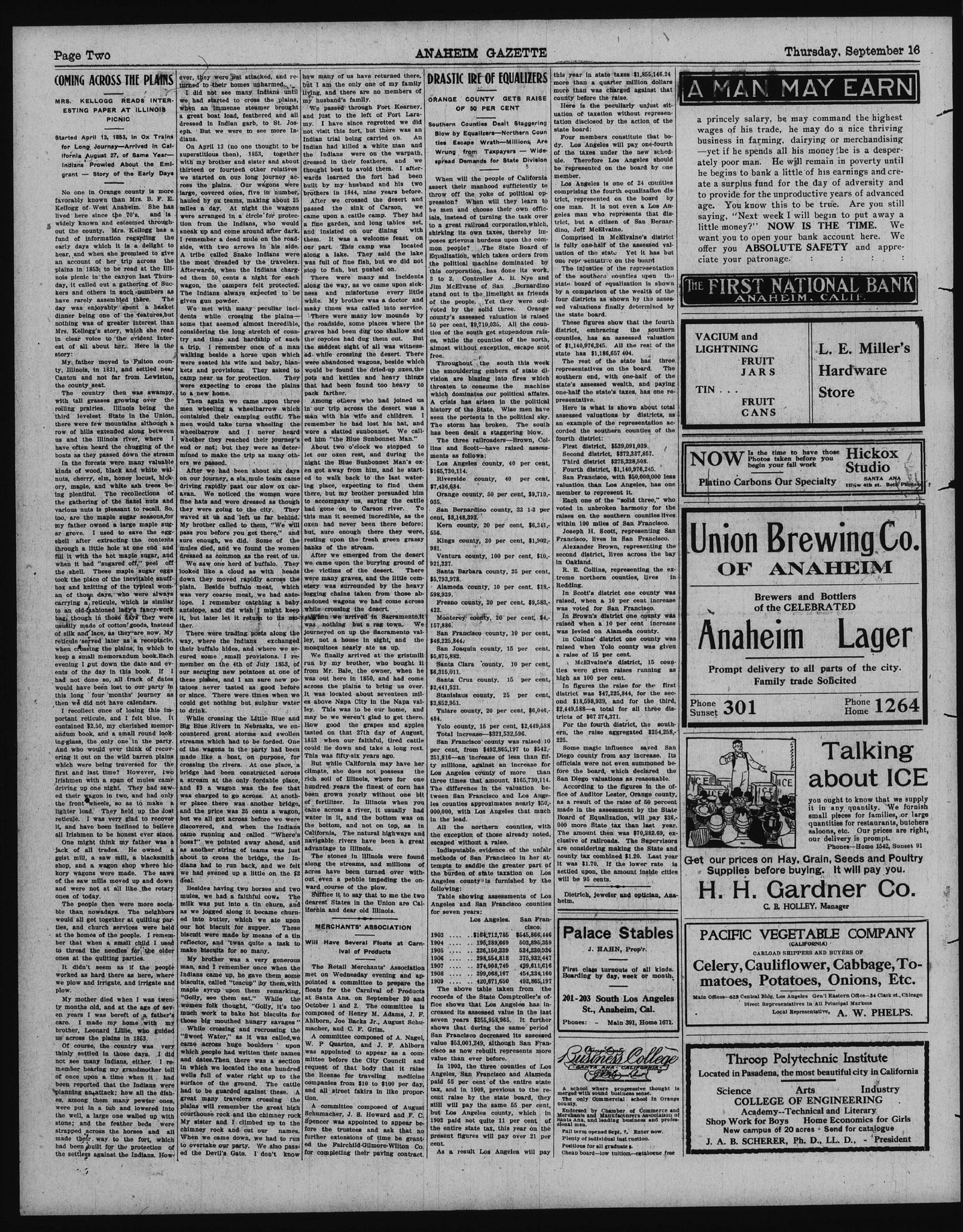
Searchable text
COMING ACROSS THE PLAINS
MRS. KELLOGG READS INTERESTING PAPER AT ILLINOIS PICNIC
Started April 13, 1853, in Ox Trains for Long Journey—Arrived in California August 27, of Same Year—Indians Prowled About the Emigrant — Story of the Early Days
No one in Orange county is more favorably known than Mrs. B. F. E. Kellogg of West Anaheim. She has lived here since the 70's, and is widely known and esteemed throughout the county. Mrs. Kellogg has a fund of information regarding the early days which it is a delight to hear, and when she promised to give an account of her trip across the plains in 1853; to be read at the Illinois picnic in the canyon last Thursday, it called out a gathering of Suckers and others in such numbers as have rarely assembled there. The day was enjoyably spent a basket dinner being one of the features, but nothing was of greater interest than Mrs. Kellogg's story, which she read in clear voice to the evident interest of all about her. Here is the story:
My father moved to Fulton county, Illinois, in 1831, and settled near Canton and not far from Lewiston, the county seat.
The country then was swampy, with tall grasses growing over the rolling prairies. Illinois being the third levelest State in the Union, there were few mountains although a row of hills extended along between us and the Illinois river, where I have often heard the chugging of the boats as they passed down the stream ever, they were not attacked, and returned to their homes unharmed.
I did not see many Indians until we had started to cross the plains, when an immense steamer brought a great boat load, feathered and all dressed in Indian garb, to St. Joseph. But we were to see more Indians.
On April 13 (no one thought to be superstitious then), 1853, together with my brother and sister and about thirteen or fourteen other relatives we started on our long journey across the plains. Our wagons were large, covered ones, five in number, hauled by ox teams, making about 25 miles a day. At night the wagons were arranged in a circle for protection from the Indians, who would sneak up and come around after dark. I remember a dead mule on the roadside, with two arrows in his side. A tribe called Snake Indians were the most dreaded by the travelers. Afterwards, when the Indians charged them 50 cents a night for each wagon, the campers felt protected. The Indians always expected to be given gun powder.
We met with many peculiar incidents while crossing the plains—some that seemed almost incredible, considering the long stretch of country and time and hardship of such a trip. I remember once of a man walking beside a horse upon which were seated his wife and baby, blankets and provisions. They asked to camp near us for protection. They were expecting to cross the plains to a new home.
Then again we came upon three men wheeling a wheelbarrow which contained their camping outfit. The men would take turns wheeling the wheelbarrow and I never heard whether they reached their journey's end or not; but they were as determined to make the trip as many oth- how many of us he but I am the only living, and there is my husband's family.
We passed through and just to the east my. I have since not visit this fort Indian trial being Indian had killed the Indians were dressed in their thought best to adwards learned that built by my husbands in 1844.
After we crossed passed the single came upon a cattle a fine garden, and insisted on them. It was a our part. This one along a lake. T was full of fine f stop to fish, but There were many times was there were made the roadside, some graves had been set the coyotes had on the saddest sight ed while crossing were abandoned would be found pots and kettles that had been for pack farther.
Among others in our trip across man with his wife remember he had wore a slatted sleeved him "the Blue About two o'clock let our oxen res
My father moved to Panton county, Illinois, in 1831, and settled near Canton and not far from Lewiston, the county seat.
The country then was swampy, with tall grasses growing over the rolling prairies. Illinois being the third levelest State in the Union, there were few mountains although a row of hills extended along between us and the Illinois river, where I have often heard the chugging of the boats as they passed down the stream.
In the forests were many valuable kinds of wood, black and white walnuts, cherry, elm, honey locust, hickory, maple, and white ash trees being plentiful. The recollections of the gathering of the hazel nuts and various nuts is pleasant to recall. So, too, are the maple sugar seasons for my father owned a large maple sugar grove. I used to save the eggshell after extracting the contents through a little hole at one end and fill it with the hot maple sugar, and when it had "sugared off," peel off the shell. These maple sugar eggs took the place of the inevitable snuff-box and knitting of the typical woman of those days, who were always carrying a reticule, which is similar to an old-fashioned lady's fancy-work bag, though in those days they were usually made of cotton goods, instead of silk and lace, as they are now. My reticule served later as a receptacle, when crossing the plains, in which to keep a small memorandum book. Each evening I put down the date and events of the day in this book. If I had not done so, all track of dates would have been lost to our party in this long four months' journey as then we did not have calendars.
I recollect once of losing this important reticule, and I felt blue. It contained $2.50, my cherished memorandum book, and a small round looking-glass, the only one in the party. And who would ever think of recovering it out on the wild barren plains which were being traversed for the first and last time? However, two Irishmen with a span of mules came driving up one night. They had sawed their wagon in two, and had only the front wheels, so as to make a lighter load. They held up the lost reticule. I was very glad to recover it, and have been inclined to believe all Irishmen to be honest ever since.
One might think my father was a jack of all trades. He owned a grist mill, a saw mill, a blacksmith shop, and a wagon shop where hic-
were seated his wife and baby, blankets and provisions. They asked to camp near us for protection. They were expecting to cross the plains to a new home.
Then again we came upon three men wheeling a wheelbarrow which contained their camping outfit. The men would take turns wheeling the wheelbarrow and I never heard whether they reached their journey's end or not; but they were as determined to make the trip as many others we passed.
After we had been about six days on our journey, a six mule team came driving rapidly past our slow ox caravan. We noticed the women wore fine hats and were dressed as though they were going to the city. They waved at us and left us far behind. My brother called to them, "We will pass you before you get there," and sure enough, we did. Some of the mules died, and we found the women dressed as common as the rest of us.
We saw one herd of buffalo. They looked like a cloud as with heads down they moved rapidly across the plain. Beside buffalo meat, which was very coarse meat, we had antelope. I remember catching a baby antelope, and did wish I might keep it, but later let it return to its mother.
There were trading posts along the way, where the Indians exchanged their buffalo hides, and where we secured some small provisions. I remembered on the 4th of July 1853, of our securing new potatoes at one of these places, and I am sure new potatoes never tasted as good before or since. There were times when we could get nothing but sulphur water to drink.
While crossing the Little Blue and Big Blue Rivers in Nebraska, we encountered great storms and swollen streams which had to be forded. One of the wagons in the party had been made like a boat, on purpose, for crossing the rivers. At one place, a bridge had been constructed across a stream at the only fordable place, and $3 a wagon was the fee that was charged to go across. At another place there was another bridge, and the price was 25 cents a wagon, but we all got across before we were discovered, and when the Indians came running and called "Where's boss?" we pointed away ahead, and as another string of teams was just about to cross the bridge, the Indians had to run back, and we felt
first and last time. However, two Irishmen with a span of mules came driving up one night. They had sawed their wagon in two, and had only the front wheels, so as to make a lighter load. They held up the lost reticule. I was very glad to recover it, and have been inclined to believe all Irishmen to be honest ever since.
One might think my father was a jack of all trades. He owned a grist mill, a saw mill, a blacksmith shop, and a wagon shop where hickory wagons were made. The saws of the saw mills moved up and down and were not at all like the rotary ones of today.
The people then were more sociable than nowadays. The neighbors would all get together at quilting parties, and church services were held at the homes of the people. I remember that when a small child I used to thread the needles for the older ones at the quilting parties.
It didn't seem as if the people worked as hard there as here, where we plow and irrigate, and irrigate and plow.
My mother died when I was twenty months old, and at the age of seven years I was bereft of a father's care. I made my home with my brother, Leonard Lillie, who guided us across the plains in 1853.
Of course, the country was very thinly settled in those days. I did not see many Indians, either. I remember hearing my grandmother tell of once upon a time when it had been reported that the Indians were planning an attack; how all the dishes, among them many pewter ones, were put in a tub and lowered into the well, a large one walled up with stone; and the feather beds were strapped across the horses and all made their way to the fort, which had been built for the protection of the settlers against the Indians. How-
ANAHEIM GAZETTE
how many of us have returned there,
but I am the only one of my family living, and there are no members of my husband's family.
We passed through Fort Kearney, and just to the left of Fort Laramy. I have since regretted we did not visit this fort, but there was an Indian trial being carried on. An Indian had killed a white man and the Indians were on the warpath, dressed in their feathers, and we thought best to avoid them. I afterwards learned the fort had been built by my husband and his two brothers in 1844, nine years before.
After we crossed the desert and passed the sink of Carson, we came upon a cattle camp. They had a fine garden, and long tables set, and insisted on our dining with them. It was a welcome feast on our part. This camp was located along a lake. They said the lake was full of fine fish, but we did not stop to fish, but pushed on.
There were many sad incidents along the way, as we came upon sickness and misfortune every little while. My brother was a doctor and many times was called into service.
There were many low mounds by the roadside, some places where the graves had been dug too shallow and the coyotes had dug them out. But the saddest sight of all was witnessed while crossing the desert. There were abandoned wagons, beside which would be found the dried-up oxen, the pots and kettles and heavy things that had been found too heavy to pack farther.
Among others who had joined us in our trip across the desert was a man with his wife and children. I remember he had lost his hat, and wore a slatted sunbonnet. We called him "the Blue Sunbonnet Man."
About two o'clock we stopped to let our oxen rest, and during the DRASTIC IRE OF EQUALIZERS ORANGE COUNTY GETS RAISE OF 50 PER CENT
Southern Counties Dealt Staggering Blow by Equalizers—Northern Counties Escape Wrath—Millions Are Wrung from Taxpayers — Widespread Demands for State Division
When will the people of California assert their manhood sufficiently to throw off the yoke of political oppression? When will they learn to be men and choose their own officials, instead of turning the task over to a great railroad corporation, which, shirking its own taxes, thereby imposes grievous burdens upon the common people? The State Board of Equalization, which takes orders from the political machine dominated by this corporation, has done its work, 3 to 2. Controller A. B. Nye and Jim McElvane of San Bernardino stand out in the limelight as friends of the people. Yet they were outvoted by the solid three. Orange county's assessed valuation is raised 50 per cent, $9,710,035. All the counties of the south get stupendous raises, while the counties of the north, almost without exception, escape scot free.
Throughout the south this week the smouldering embers of state division are blazing into fires which threaten to consume the machine which dominates our political affairs. A crisis has arisen in the political history of the State. Wise men have seen the portents in the political sky. The storm has broken. The south has been dealt a staggering blow.
The three railroaders—Brown, Collins and Scott—have raised assessments as follows:
this year in state taxes $1,855,146.24 more than a quarter million dollars more than was charged against that county before the raise.
Here is the peculiarly unjust situation of taxation without representation disclosed by the action of the state board:
Four members constitute that body. Los Angeles will pay one-fourth of the taxes under the new schedule. Therefore Los Angeles should be represented on the board by one member.
Los Angeles is one of 24 counties comprising the fourth equalization district, represented on the board by one man. It is not even a Los Angeles man who represents that district, but a citizen of San Bernardino, Jeff McElvaine.
Comprised in McElvaine's district is fully one-half of the assessed valuation of the state. Yet it has but one representative on the board.
The injustice of the representation of the southern counties upon the state board of equalization is shown by a comparison of the wealth of the four districts as shown by the assessed valuations finally determined by the state board.
These figures show that the fourth district, embracing the southern counties, has an assessed valuation of $1,140,976,245. All the rest of the state has $1,186,657,404.
The rest of the state has three representatives on the board. The southern end, with one-half of the state's assessed wealth, and paying one-half the state's taxes, has one representative.
Here is what is shown about total assessed valuations by districts, as an example of the representation accorded the southern counties of the fourth district:
First district, $539,091,039.
Second district, $372,337,857.
three days came six car wore though They behind: he will and the women of us. They aheads is the which ante-baby keep us mo-ing the changed we se- I re-53, of one of new po-before when we water and have envollen. One been for face, a across place, that anoth-ridge, dragon, were Indians there's, and just be envollen. One been for face, a across place, that anoth-ridge, dragon, were Indians there's, and just be envollen. One been for face, a across place, that anoth-ridge, dragon, were Indians there's, and just be envollen. One been for face, a across place, that anoth-ridge, dragon, were Indians there's, and just be envollen. One been for face, a across place, that anoth-ridge, dragon, were Indians there's, and just be envollen. One been for face, a across place, that anoth-ridge, dragon, were Indians there's, and just be envollen. One been for face, a across place, that anoth-ridge, dragon, were Indians there's, and just be envollen. One been for face, a across place, that anoth-ridge, dragon, were Indians there's, and just be envollen. One been for face, a across place, that anoth-ridge, dragon, were Indians there's, and just be envollen. One been for face, a across place, that anoth-ridge, dragon, were Indians there's, and just be envollen. One been for face, a across place, that anoth-ridge, dragon, were Indians there's, and just be envollen. One been for face, a across place, that anoth-ridge, dragon, were Indians there's, and just be envollen. One been for face, a across place, that anoth-ridge, dragon, were Indians there's, and just be envollen. One been for face, a across place, that anoth-ridge, dragon, were Indians there's, and just be envollen. One been for face,a across place,that anoth-ridge,dragon,were Indians there's,and just be envollen。One been for face,a across place,that anoth-ridge,dragon,were Indians there's,and just be envollen。One been for face,a across place,that anoth-ridge,dragon,were Indians there's,and just be envollen。One been for face,a across place,that anoth-ridge,dragon,were Indians there's,and just be envollen。One been for face,a across place,that anoth-ridge,dragon,were Indians there's,and just be envollen。One been for face,a across place,that anoth-ridge,dragon,were Indians there's,and just be envollen。One been for face,a across place,that anoth-ridge,dragon,were Indians there's,and just be envollen。One been for face,a across place,that anoth-ridge,dragon,were Indians there's,and just be envollen。One been for face,a across place,that anoth-ridge,dragon,were Indians there's,and just be envollen。One been for face,a across place,that anoth-ridge,dragon,were Indians there's,and just be envollen。One been for face,a across place,that anoth-ridge,dragon,were Indians there's,and just be envollen。One been for face,a across place,that anoth-ridge,dragon,were Indians there's,and just be envollen。One been for face,a across place,that anoth-ridge,dragon,were Indians there's,and just be envollen。One been for face,a across place,that anoth-ridge,dragon,were Indians there's,and just be envollen。One been for face,
a across place,that anoth-ridge,dragon,
were Indians there's,
and just be envollen。One been for face,
a across place,
that anoth-ridge,
dragon,
were Indians there's,
and just be envollen。One been for face,
a across place,
that anoth-ridge,
dragon,
were Indians there's,
and just be envollen。One been for face,
a across place,
that anoth-ridge,
dragon,
were Indians there'S,
and just be envollen。One been for face,
a across place,
that anoth-ridge,
dragon,
were Indians there'S,
and just be envollen。One been for face,
a across place,
that anoth-ridge,
dragon,
were Indians there'S,
and just be envollen。One been for face,
a across place,
that anoth-ridge,
dragon,
were Indians there'S,
and just be envollen。One been for face,
a across place,
that anoth-ridge,
dragon,
were Indians there'S,
and just be envollen。One been for face,
a cross place,
that anoth-bridge,
dragon,
were Indians there'S,
and just be envollen。One been for face,
a cross place,
that anoth-bridge,
dragon,
were Indians there'S,
and just be envollen。One been for face,
a cross place,
that anoth-bridge,
dragon,
were Indians there'S,
and just be envollen。One been for face,
a cross place,
that anoth-bridge,
dragon,
were Indians there'S,
and just be envollen。
The stones in Illinois were found along the streams,and millions of acres have been turned into wagons,beside which would be found the dried-up oxen,the pots and kettles and heavy things that had been found too heavy to pack farther.
Among others who had joined us in our trip across the desert was a man with his wife and children.I remember he had lost his hat,and wore a slatted sunbonnet. We called him "the Blue Sunbonnet Man."
About two o'clock we stopped to let our oxen rest,and during the night the Blue Sunbonnet Man's oxen got away from him,and he started to walk back to the last watering place expecting to find themthere but my brother persuaded him to accompany us,saying the cattle had gone on to Carson river.To this man it seemed incredible as the oxen had never been there before;but,sure enough they were,resting upon the fresh green grassy banks of the stream.
After we emerged from the desert we came upon the burying ground of the victims of the desert. There were many graves,and the little cemetery was surrounded by the heavy logging chains taken from those abandoned wagons we had come across while crossing the desert.
When we arrived in Sacramento,它 was nothing but a rag town. We journeyed on up the Sacramento valley,不 a house in sight,and the mosquitoes nearly ate us up.
We finally arrived at the gristmill run by my brother,who bought it from Mr.Bale,the owner,当 he was out here in 1850,and had come across the plains to bring us over. It was located about seventeen miles above Napa City in the Napa valley. This was to be our home,and may be we weren't glad to get there. How good the grapes and apples tasted on that 27th day of August,1853 when our faithful,tired cattle could lie down and take a long rest. This was fifty-six years ago.
But while California may have her climate,she does not possess the rich soil of Illinois where for one hundred years the finest of corn has been grown yearly without one bit of fertilizer.In Illinois when you came across a river,它 usually had water in it,and the bottom was on the bottom,and not on top.as in California.The natural highways and navigable rivers have been a great advantage to Illinois.
The stones in Illinois were found along the streams,and millions of acres have been turned into wagons,beside which would be found the dried-up oxen,the pots and kettles and heavy things that had been found too heavy to pack farther.
Among others who had joined us in our trip across the desert was a man with his wife and children.I remember he had lost his hat,and wore a slatted sunbonnet. We called him "the Blue Sunbonnet Man's oxen got away from him,and he started to walk back to the last watering place expecting to find themthere but my brother persuaded him to accompany us,saying the cattle had gone on to Carson river.To this man it seemed incredible as the oxen had never been there before;but,sure enough they were,resting upon the fresh green grassy banks of the stream.
After we emerged from the desert we came upon the burying ground of the victims of the desert. There were many graves,and the little cemetery was surrounded by the heavy logging chains taken from those abandoned wagons we had come across while crossing the desert.
When we arrived in Sacramento,它 was nothing but a rag town. We journeyed on up the Sacramento valley,不 a house in sight,and the mosquitoes nearly ate us up.
We finally arrived at the gristmill run by my brother,who bought it from Mr.Bale,the owner,当 he was out here in 1850,and had come across the plains to bring us over. It was located about seventeen miles above Napa City in the Napa valley. This was to be our home,and may be we weren't glad to get there. How good the grapes and apples tasted on that 27th day of August,1853 when our faithful,tired cattle could lie down and take a long rest. This was fifty-six years ago.
But while California may have her climate,she does not possess the rich soil of Illinoiswherefor one hundred years the finest of corn has been grown yearly without one bit of fertilizer.In Illinois when you came across a river,它 usually had water in it,and the bottom was on the bottom,and not on top.as in California.The natural highways and navigable rivers have been a great advantage to Illinois.
The stones in Illinois were found along the streams,and millions of acres have been turned into wagons,beside which would be found the dried-up oxen,the pots and kettles and heavy things that had been found too heavy to pack farther.
Among others who had joined us in our trip across the desert was a man with his wife and children.I remember he had lost his hat,and wore a slatted sunbonnet. We called him "the Blue Sunbonnet Man's oxen got away from him,and he started to walk back to the last watering place expecting to find themthere but my brother persuaded him to accompany us,saying the cattle had gone on to Carson river.To this man it seemed incredible as the oxen had never been there before;but,sure enough they were,resting upon the fresh green grassy banks of the stream.
After we emerged from the desert we came upon the burying ground of the victims of the desert. There were many graves,and the little cemetery was surrounded by the heavy logging chains taken from those abandoned wagons we had come across while crossing the desert.
When we arrived in Sacramento,它 was nothing but a rag town. We journeyed on up the Sacramento valley,不 a house in sight,and the mosquitoes nearly ate us up.
We finally arrived at the gristmill run by my brother,who bought it from Mr.Bale,the owner,当 he was out here in 1850,and had come across the plains to bring us over. It was located about seventeen miles above Napa City in the Napa valley. This was to be our home,and may be we weren't glad to get there. How good the grapes and apples tasted on that 27th day of August,1853 when our faithful,tired cattle could lie down and take a long rest. This was fifty-six years ago.
But while California may have her climate,she does not possess the rich soil of Illinoiswherefor one hundred years the finest of corn has been grown yearly without one bit of fertilizer.In Illinois when you came across a river,它 usually had water in it,and the bottom was on the bottom,and not on top.as in California.The natural highways and navigable rivers have been a great advantage to Illinois.
The stones in Illinois were found along the streams,and millions of acres have been turned into wagons,beside which would be found the dried-up oxen,the pots and kettles and heavy things that had been found too heavy to pack farther.
Among others who had joined us in our trip across the desert was a man with his wife and children.I remember he had lost his hat,and wore a slatted sunbonnet. We called him "the Blue Sunbonnet Man's oxen got away from him,and he started to walk back to the last watering place expecting to find themthere but my brother persuaded him to accompany us,saying the cattle had gone on to Carson river.To this man it seemed incredible as the oxen had never been there before;but,sure enough they were,resting upon the fresh green grassy banks of the stream.
After we emerged from the desert we came upon the burying ground of the victims of the desert. There were many graves,and the little cemetery was surrounded by the heavy logging chains taken from those abandoned wagons we had come across while crossing the desert.
When we arrived in Sacramento,它 was nothing but a rag town. We journeyed on up the Sacramento valley,不 a house in sight,and the mosquitoes nearly ate us up.
We finally arrived at the gristmill run by my brother,who bought it from Mr.Bale,the owner,当 he was out here in 1850,and had come across the plains to bring us over. It was located about seventeen miles above Napa City in the Nape valley. This was to be our home,and may be we weren't glad to get there. How good the grapes and apples tasted on that 27th day of August,1853 when our faithful,tired cattle could lie down and take a long rest. This was fifty-six years ago.
But while California may have her climate,she does not possess the rich soil of Illinoiswherefor one hundred years the finest of corn has been grown yearly without one bit of fertilizer.In Illinois when you came across a river,它 usually had water in it,and the bottom was on the bottom,and not on top.as in California.The natural highways and navigable rivers have been a great advantage to Illinois.
The stones in Illinois were found along the streams,and millions of acres have been turned into wagons,beside which would be found the dried-up oxen,the pots and kettles and heavy things that had been found too heavy to pack farther.
Among others who had joined us in our trip across the desert was a man with his wife and children.I remember he had lost his hat,and wore a slatted sunbonnet. We called him "the Blue Sunbonnet Man's oxen got away from him,and he started to walk back to the last watering place expecting to find themthere but my brother persuaded him to accompany us,saying the cattle had gone on to Carson river.To this man it seemed incredible as the oxen had never been there before;but,sure enough they were,resting upon the fresh green grassy banks of the stream.
After we emerged from the desert we came upon the burying ground of the victims of the desert. There were many graves,and the little cemetery was surrounded by the heavy logging chains taken from those abandoned wagons we had come across while crossing the desert.
When we arrived in Sacramento,它 was nothing but a rag town. We journeyed on up the Sacramento valley,不 a house in sight,and the mosquitoes nearly ate us up.
We finally arrived at the gristmill run by my brother,who bought it from Mr.Bale,the owner,当 he was out here in 1850,and had come across the plains to bring us over. It was located about seventeen miles above Napa City in the Nape valley. This was to be our home,and may be we weren't glad to get there. How good the grapes and apples tasted on that 27th day of August,1853 when our faithful,tired cattle could lie down and take a long rest. This was fifty-six years ago.
But while California may have her climate,she does not possess the rich soil of Illinoiswherefor one hundred years the finest of corn has been grown yearly without one bit of fertilizer.In Illinois when you came across a river,它 usually had water in it,and the bottom was on the bottom,and not on top.as in California.The natural highways and navigable rivers have been a great advantage to Illinois.
The stones in Illinois were found alongthe streams,and millionsofacreshavebeenturnedintowagons,besideswhichwouldbefoundthedried-upoxen,thepotsofkettlesandapplestatedonthat27thdayofAugust1853whenourfaithful,tiredcattlecouldliedownandtakealongrestThiswasfifty-sixyearstill
Some magic influence saved San Diego countyfromanyincrease.Itsofficialsweretownevensummedbeforetheboard,Balloonvalleyhasoneperfectleadforthesecond$18998939,andforthethird,$244988—totalforallthreedistrictsof$67274371.
Forthe fourth district,the southern,theraiseaggregated$254258—225.
Some magic influence saved San Diego countyfromanyincrease.Itsofficialsweretownevensummedbeforetheboard,Balloonvalleyhasoneperfectleadforthesecond$18998939,andforthethird,$244988—totalforallthreedistrictsof$67274371.
Forthe fourth district,the southern,theraiseaggregated$254258—225.
Some magic influence saved San Diego countyfromanyincrease.Itsofficialsweretownevensummedbeforetheboard,Balloonvalleyhasoneperfectleadforthesecond$18998939,和forthethird,$244988—totalforallthreedistrictsof$67274371。
Forthe fourth district,the southern,theraiseaggregated$254258—225。
Some magic influence saved San Diego countyfromanyincrease.Itsofficialsweretownevensummedbeforetheboard,Balloonvalleyhasoneperfectleadforthesecond$18998939,和forthethird,$244988—totalforallthreedistrictssuchasgreatthreedistrictssuchasgreatthreedistrictssuchasgreatthreedistrictssuchasgreatthreedistrictssuchasgreatthreedistrictssuchasgreatthreedistrictssuchasgreatthreedistrictssuchasgreatthreedistrictssuchasgreatthreedistrictssuchasgreatthreedistrictssuchasgreatthreedistrictssuchasgreatthreedistrictssuchasgreatthreedistrictssuchasgreatthreedistrictssuchasgreatthreedistrictssuchasgreatthreedistrictssuchasgreatthreedistrictssuchasgreatthreedistrictssuchasgreatthreedistrictssuchasgreatthreedistrictssuchasgreatthreedistrictssuchasgreatthreedistrictssuchasgreatthreedistrictssuchasgreat threedistrictssuchasgreatthreedistrictssuchasgreatthreedistrictssuchasgreatthreedistrictssuchasgreatthreedistrictssuchasgreatthreedistrictssuchasgreat threedistrictssuchasgreat threedistrictssuchasgreat threedistrictssuchasgreat threedistrictssuchasgreat threedistrictssuchasgreat threedistrictssuchasgreat threedistrictssuchasgreat threedistrictssuchasgreat three districtdisntitle
In Scott's district one countywas raisedwhena 10 per cent increasewas voted forSan Diego.co.ukIn Brown's district one countywas raisedwhena 10 per cent increasewas levied onAlameda county.InCollins' district one countywas raisedwhena 10 per cent increasewas levied onAlameda county.InCollins' district one countywas raisedwhena 10 per cent increasewas levied onAlameda county.InCollins' district one countywas raisedwhena 10 per cent increasewas levied onAlameda county.InCollins' district one countywas raisedwhena 10 per cent increasewas levied onAlameda county.InCollins' district one countywas raisedwhena 10 per cent increasewas levied onAlameda county.InCollins' district one countywas raisedwhena 10 per cent increasewas levied onAlameda county.InCollins' district one countywas raisedwhena 10 per cent increasewas levied onAlameda county.InCollins' district one countywas raisedwhena 10 per cent increasewas levied onAlameda county.InCollins' district one countywas raisedwhena 10 per cent increasewas levied onAlameda county.InCollins' district one countywas raisedwhena 10 per cent increasewas levied onAlameda county.InCollins' district one countywas raisedwhena 10 per cent increasewas levied onAlameda county.InCollins' district one countywas raisedwhena 10 per cent increasewas levied onAlameda county.InCollins' district one countywas raisedwhena 10 per cent increasewas levied onAlameda county.InCollins' district one countywas raisedwhena 10 per cent increasewas levied onAlameda county.InCollins' district one countywas raisedwhena 10 per cent increasewas levied onAlameda county.InCollins' district one countywas raisedwhena 10 per cent increasewas levied onAlameda county.InCollins' district one countywas raisedwhena 10 per cent increasewas levied onAlameda county.InCollins' district one countywas raisedwhena 10 per cent increasewas levied onAlameda county.InCollins' district one countywas raisedwhena 10 per cent increasewas levied onAlameda county.InCollins' district one countywas raisedwhena 10 per cent increasewas levied onAlameda county.InCollins' district one countywas raisedwhena 10 per cent increasewas levied onAlameda country.InCollins' district one countywas raisedwhena 10 per cent increasewas levied onAlameda country.InCollins' district one countywas raisedwhena 10 per cent increasewas levivedonAlameda country.InCollins' district one countywas raisedwhena 10 per cent increasewas levivedonAlameda country.InCollins' district one countywas raisedwhena 10 per cent increasewas levivedonAlameda country.InCollins' district one countywas raisedwhena 10 per cent increasewas levivedonAlameda country.InCollins' district one countywas raisedwhena 10 per cent increasewas levivedonAlameda country.InCollins' district one countywas raisedwhena 10 per cent increasewas levivedonAlameda country.InCollins' district one countywas raisedwhena 10 per cent increasewas levivedonAlameda country.InCollins' district one countywas raisedwhena 10 per cent increasewas levivedonAlameda country.InCollins' district one countywas raisedwhena 10 per cent increasewas levivedonAlamedA country.InCollins' district one countywas raisedwhena 10 per cent increasewas levivedonAlamedA country.InCollins' district one CountyWas RaisedByThe Director Of The State And County Tax Combined $1.20.Last yearIt was $1.70.Fifth rate is settled upon all amount included
Some magic influence saved San Diego countyfromanyincrease.Itsofficialsweretownevensummedbeforetheboard,Balloonvalleyhasoneperfectleadforthesecond$18998939,和forthethird,$244988—totalforallthreedistrictsof$67274371。
Forthe fourth district,the southern,theraiseaggregated$254258—225。
Some magic influence saved San Diego countyfromanyincrease.Itsofficialsweretown evensummedbeforetheboard,Balloonvalleyhasoneperfectleadforthesecond$18998939,和forthethird,$244988—totalforallthree districtsof$67274371。
Forthe fourth district,the southern,theraiseaggregated$254258—225。
Some magic influence saved San Diego countyfromanyincrease.Itsofficialsweretown evensummedbeforetheboard,Balloonvalleyhasoneperfectleadforthesecond$18998939,和forthethird,$244988—totalforallthree districtsof$67274371。
Forthe fourth district,the southern,theraiseaggregated$254258—225。
Some magic influence saved San Diego countyfromanyincrease.Itsofficialsweretown evensummedbeforetheboard,Balloonvalleyhasoneperfectleadforthesecond$18998939,和forthethird,$244988—totalforallthree districtsof$67274371。
Forthe fourth district,the southern,theraiseaggregated$254258—225。
Some magic influence saved San Diego countyfromanyincrease.Itsofficialsweretown evensummedbeforetheboard,Balloonvalleyhasoneperfectleadforthesecond$18998939,和forthethird,$244988—totalforallthree districtsof$67274371。
Forthe fourth district,the southern,theraiseaggregated$254258—225。
Some magic influence saved San Diego countyfromanyincrease.Itsofficialsweretown evensummedbeforetheboard,Balloonvalleyhasoneperfectleadforthesecond$18998939,和forthethird,$244988—totalforallthree districtsof$67274371。
Forthe fourth district,the southern,theraiseaggregated$254258—225。
Some magic influence saved San Diego countyfromanyincrease.Itsofficialsweretown evensummedbeforetheboard,Balloonvalleyhasoneperfectleadforthesecond$18998939,和forthethird,$244988—totalforallthree districtsof$67274371)。
Forthe fourth district,the southern,theraiseaggregated$254258—225。
Some magic influence saved San Diego countyfromanyincrease.Itsofficialsweretown evensummedbeforetheboard,Balloonvalleyhasoneperfectleadforthesecond$18998939,和
MERCHANTS' ASSOCIATION
Will Have Several Floats at Carnival of Products
The Retail Merchants' Association met on Wednesday evening and appointed a committee to prepare the floats for the Carnival of Products at Santa Ana. on September 30 and October 1 and 2. The committee is composed of Henry M. Adams, J. F. Ahlborn, Joe Backs Jr., August Schumacher, and C. F. Grim.
A committee composed of A. Nagel, W. P. Quarton, and J. F. Ahlborn was appointed to appear as a committee before the City Council and request of that body that it raise the license for traveling medicine companies from $10 to $100 per day, and all street fakirs in like proportion.
A committee composed of August Schumacher, J. S. Howard and F. C. Spencer was appointed to appear before the trustees and ask that no further extensions of time be granted the Fairchild-Gilmore-Wilton Co. for completing their paving contract.
Los Angeles county of more than three times that amount, $165,730,114. The difference in the valuation between San Francisco and Los Angeles counties approximates nearly $50,-000,000, with Los Angeles that much in the lead.
All the northern counties, with the exception of those already noted, escaped without a raise.
Indisputable evidence of the unfair methods of San Francisco in her attempts to saddle the greater part of the burden of state taxation on Los Angeles county is furnished by the following:
Table showing assessments of Los Angeles and San Francisco counties for seven years:
Los Angeles. San Francisco.
1903 ... $164,712,785 $545,866,446
1904 ... 195,289,669 502,895,359
1905 ... 226,150,339 524,230,936
1906 ... 298,554,818 375,932,447
1907 ... 374,908,749 429,611,616
1908 ... 399,068,167 454,334,160
1909 ... 420,671,650 492,865,197
The above table taken from the records of the State Comptroller's office shows that Los Angeles has increased its assessed value in the last seven years $255,958,965. It further shows that during the same period San Francisco decreased its assessed value $53,001,249, although San Francisco as now rebuilt represents more value than ever before.
In 1903, the three counties of Los Angeles, San Francisco and Alameda paid 55 per cent of the entire state tax, and in 1909, previous to the recent raise by the state board, they still will pay the same 55 per cent, but Los Angeles county, which in 1903 paid not quite 11 per cent of the entire state tax, this year on the present figures will pay over 21 per cent.
As a result Los Angeles will pay
Thursday, September 16
A MAN MAY EARN
a princely salary, he may command the highest wages of his trade, he may do a nice thriving business in farming, dairying or merchandising—yet if he spends all his money he is a desperately poor man. He will remain in poverty until he begins to bank a little of his earnings and create a surplus fund for the day of adversity and to provide for the unproductive years of advanced age. You know this to be true. Are you still saying, "Next week I will begin to put away a little money?" NOW IS THE TIME. We want you to open your bank account here. We offer you ABSOLUTE SAFETY and appreciate your patronage.
THE FIRST NATIONAL BANK
ANAHEIM, CALIF.
VACIUM and LIGHTNING
FRUIT JARS
TIN ...
FRUIT CANS
L. E. Miller's Hardware Store
NOW Is the time to have those Hickox
FRUIT JARS
TIN ...
FRUIT CANS
Hardware Store
NOW Is the time to have those Photos taken before you begin your fall work
Hickox Studio
Platino Carbons Our Specialty
SANTA ANA
111%w 4th st. Both Phone
Union Brewing Co.
OF ANAHEIM
Brewers and Bottlers
of the CELEBRATED
Anaheim Lager
Prompt delivery to all parts of the city.
Family trade Solicited
Phone 301
Home 1264
Talking about ICE
you ought to know that we supply it in any quantity. We furnish small pieces for families, or large quantities for restaurants, butchers saloons, etc. Our prices are right, our delivery is prompt.
Phones—Home 1542, Sunset 91
Get our prices on Hay, Grain, Seeds and Poultry
Supplies before buying. It will pay you.
about ICE
you ought to know that we supply it in any quantity. We furnish small pieces for families, or large quantities for restaurants, butchers saloons, etc. Our prices are right, our delivery is prompt.
Phones—Home 1542, Sunset 91
Get our prices on Hay, Grain, Seeds and Poultry Supplies before buying. It will pay you.
H. H. Gardner Co.
C. B. HOLLEY, Manager
PACIFIC VEGETABLE COMPANY
(CALIFORNIA)
CARLOAD SHIPPERS AND BUYERS OF
Celery, Cauliflower, Cabbage, Tomatoes, Potatoes, Onions, Etc.
Main Offices—625 Central Bldg, Los Angeles Gen'l Eastern Office—34 Clark st., Chicago
Direct Representatives In All Principal Markets
Local Representative, A. W. PHELPS.
Throop Polytechnic Institute
Located in Pasadena, the most beautiful city in California
Science Arts Industry
COLLEGE OF ENGINEERING
Academy--Technical and Literary
Shop Work for Boys Home Economics for Girls
New campus of 20 acres - Send for catalogue
J. A. B. SCHERER, Ph. D., LL. D., - President