anaheim-gazette 1909-09-09
Scanned page
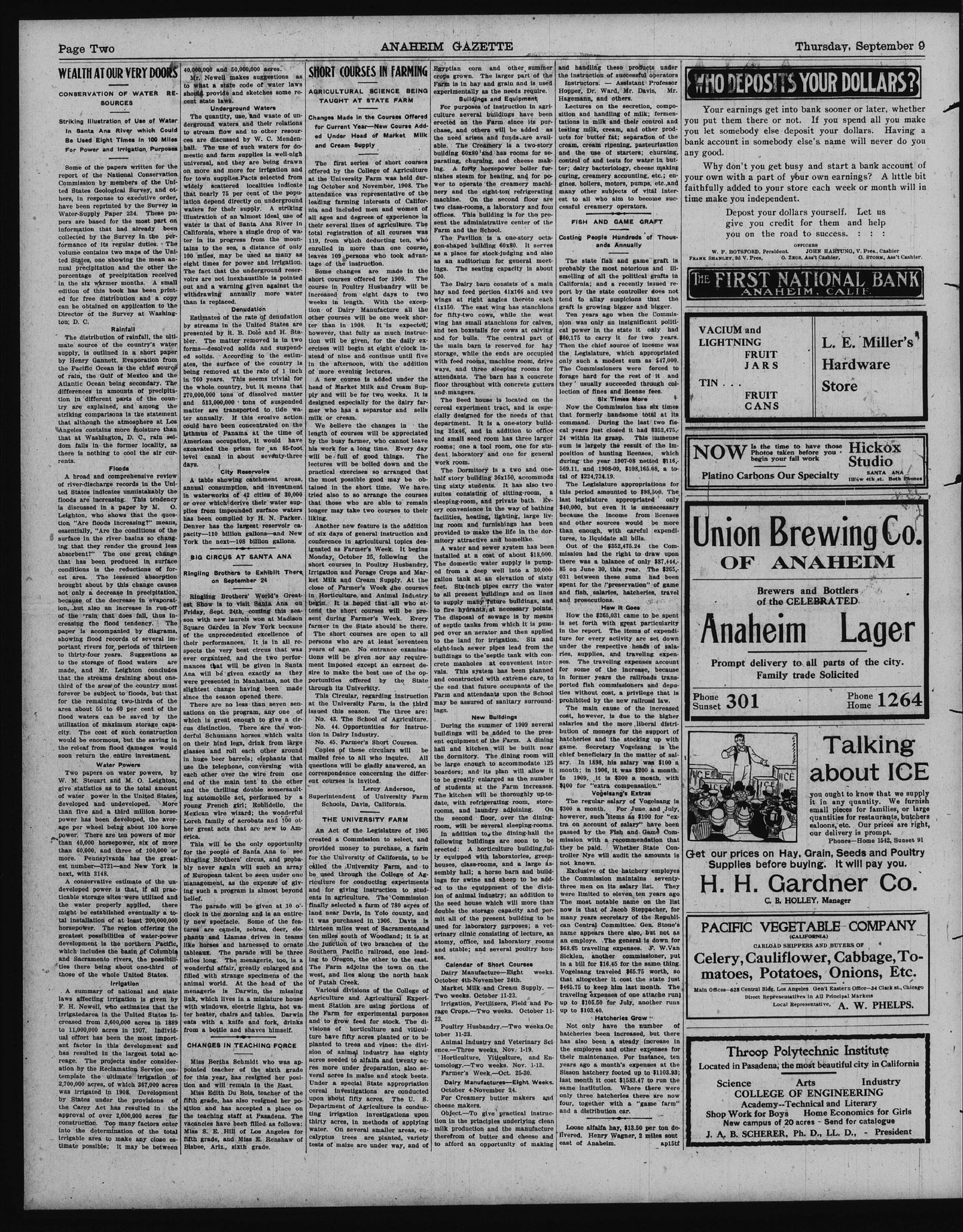
Searchable text
WEALTH AT OUR VERY DOORS
CONSERVATION OF WATER RESOURCES
Striking Illustration of Use of Water
In Santa Ana River which Could Be Used Eight Times in 100 Miles For Power and Irrigation Purposes
Some of the papers written for the report of the National Conservation Commission by members of the United States Geological Survey, and others, in response to executive order, have been reprinted by the Survey in Water-Supply Paper 234. These papers are based for the most part on information that had already been collected by the Survey in the performance of its regular duties. The volume contains two maps of the United States, one showing the mean annual precipitation and the other the percentage of precipitation received in the six warmer months. A small edition of this book has been printed for free distribution and a copy can be obtained on application to the Director of the Survey at Washington; D. C.
Rainfall
The distribution of rainfall, the ultimate source of the country's water supply, is outlined in a short paper by Henry Gannett. Evaporation from the Pacific Ocean is the chief source of rain, the Gulf of Mexico and the Atlantic Ocean being secondary. The differences in amounts of precipitation in different parts of the country are explained, and among the striking comparisons is the statement that although the atmosphere at Los Angeles contains more moisture than that at Washington, D. C., rain seldom falls in the former locality, as there is nothing to cool the air curre-
the Pacific Ocean is the chief source of rain, the Gulf of Mexico and the Atlantic Ocean being secondary. The differences in amounts of precipitation in different parts of the country are explained, and among the striking comparisons is the statement that although the atmosphere at Los Angeles contains more moisture than that at Washington, D. C., rain seldom falls in the former locality, as there is nothing to cool the air currents.
Floods
A broad and comprehensive review of river-discharge records in the United States indicates unmistakably the floods are increasing. This tendency is discussed in a paper by M. O. Leighton, who shows that the question "Are floods increasing?" means, essentially, "Are the conditions of the surface in the river basins so changing that they render the ground less absorbent?" The one great change that has been produced in surface conditions is the reductions of forest area. The lessened absorption brought about by this change causes not only a decrease in precipitation, because of the decrease in evaporation, but also an increase in run-off of the rain that does fall, thus increasing the flood tendency. The paper is accompanied by diagrams, showing flood records of several important rivers for periods of thirteen to thirty-four years. Suggestions as to the storage of flood waters are made, and Mr. Leighton concludes that the streams draining about one-third of the area of the country must forever be subject to floods, but that for the remaining two-thirds of the area about 55 to 60 per cent of the flood waters can be saved by the utilization of maximum storage capacity. The cost of such construction would be enormous, but the saving in the releaf from flood damages would soon return the entire investment.
Water Powers
Two papers on water powers, by W. M. Steuart and M. O. Leighton, give statistics as to the total amount of water power in the United States, developed and undeveloped. More than five and a third million horsepower has been developed, the average per wheel being about 100 horse power. There are ten powers of more than 40,000 horsepower, six of more than 60,000, and three of 100,000 or more. Pennsylvania has the greatest number—3721—and New York is dates, the surface of the country is being removed at the rate of 1 inch in 760 years. This seems trivial for the whole country, but it means that 270,000,000 tons of dissolved matter and 513,000,000 tons of suspended matter are transported to tide water annually. If this erosive action could have been concentrated on the Isthmus of Panama at the time of American occupation, it would have excavated the prism for an 85-foot level canal in about seventy-three days.
City Reservoirs
A table showing catchment areas, annual consumption, and investment in waterworks of 42 cities of 30,000 or over which derive their water supplies from impounded surface waters has been compiled by H. N. Parker. Denver has the largest reservoir capacity—110 billion gallons—and New York the next—108 billion gallons.
BIG CIRCUS AT SANTA ANA
Ringling Brothers to Exhibit There on September 24
Ringling Brothers' World's Greatest Show is to visit Santa Ana on Friday, Sept. 24th, coming this season with new laurels won at Madison Square Garden in New York because of the unprecedented excellence of their performances. It is in all respects the very best circus that was ever organized, and the two performances that will be given in Santa Ana will be given exactly as they were presented in Manhattan, not the slightest change having been made since the season opened there.
There are no less than seven sensations on the program, any one of which is great enough to give a circus distinction. There are the wonderful Schumann horses which waltz on their hind legs, drink from large glasses and roll each other around in huge beer barrels; elephants that use the telephone, conversing with each other over the wire from one end of the main tent to the other and the thrilling double somersaulting automobile act, performed by a young French girl; Roblidello, the Mexican wire wizard; the wonderful Loreh family of acrobats and 100 other great acts that are new to America.
This will be the only opportunity for the people of Santa Ana to see Ringling Brothers' circus, and probably never again will such an array
Two papers on water powers, by W. M. Steuart and M. O. Leighton, give statistics as to the total amount of water power in the United States, developed and undeveloped. More than five and a third million horsepower has been developed, the average per wheel being about 100 horsepower. There are ten powers of more than 40,000 horsepower, six of more than 60,000, and three of 100,000 or more. Pennsylvania has the greatest number—3721—and New York is next, with 3148.
A conservative estimate of the undeveloped power is that, if all practicable storage sites were utilized and the water properly applied, there might be established eventually a total installation of at least 200,000,000 horsepower. The region offering the greatest possibilities of water-power development is the northern Pacific, which includes the basin of Columbia and Sacramento rivers, the possibilities there being about one-third of those of the whole United States.
Irrigation
A summary of national and state laws affecting irrigation is given by F. H. Newell, who estimates that the irrigated area in the United States increased from 3,600,000 acres in 1889 to 11,000,000 acres in 1907. Individual effort has been the most important factor in this development and has resulted in the largest total acreage. The projects under consideration by the Reclamation Service contemplate the ultimate irrigation of 2,700,000 acres, of which 367,000 acres was irrigated in 1908. Development by States under the provisions of the Carey Act has resulted in the approval of over 2,000,000 acres for construction. Too many factors enter into the determination of the total irrigable area to make any close estimate possible; it may be between each other over the wire from one end of the main tent to the other and the thrilling double somersaulting automobile act, performed by a young French girl; Roblidello, the Mexican wire wizard; the wonderful Loreh family of acrobats and 100 other great acts that are new to America.
This will be the only opportunity for the people of Santa Ana to see Ringling Brothers' circus, and probably never again will such an array of European talent be seen under one management, as the expense of giving such a program is almost beyond belief.
The parade will be given at 10 o'clock in the morning and is an entirely new spectacle. Some of the features are camels, zebras, deer, elephants and Llamas driven in teams like horses and harnessed to ornate tableaux. The parade will be three miles long. The menagerie, too, is a wonderful affair, greatly enlarged and filled with strange specimens of the animal world. At the head of the menagerie is Darwin, the missing link, which lives in a miniature house with windows, elcetric lights, hot water heater, chairs and tables. Darwin eats with a knife and fork, drinks from a bottle and shaves himself.
CHANGES IN TEACHING FORCE
Miss Bertha Schmidt who was appointed teacher of the sixth grade for this year, has resigned her position and will remain in the East.
Miss Edith Du Bois, teacher of the fifth grade, has also resigned her position and has accepted a place on the teaching staff at Pasadena. The vacancies have been filled as follows: Miss S. E. Hill of Los Angeles for fifth grade, and Miss E. Renshaw of Bisbee, Ariz., sixth grade.
SHORT COURSES IN FARMING
AGRICULTURAL SCIENCE BEING TAUGHT AT STATE FARM
Changes Made in the Courses Offered for Current Year—New Course Added Under Head of Market Milk and Cream Supply
The first series of short courses offered by the College of Agriculture at the University Farm was held during October and November, 1908. The attendance was representative of the leading farming interests of California and included men and women of all ages and degrees of experience in their several lines of agriculture. The total registration of all courses was 119, from which deducting ten, who enrolled in more than one course, leaves 109 persons who took advantage of the instruction.
Some changes are made in the short courses offered for 1909. The course in Poultry Husbandry will be increased from eight days to two weeks in length. With the exception of Dairy Manufacture all the other courses will be one week shorter than in 1908. It is expected; however, that fully as much instruction will be given, for the daily exercises will begin at eight o'clock instead of nine and continue until five in the afternoon, with the addition of more evening lectures.
A new course is added under the head of Market Milk and Cream Supply and will be for two weeks. It is designed especially for the dairy farmer who has a separator and sells milk or cream.
We believe the changes in the length of courses will be appreciated by the busy farmer, who cannot leave his work for a long time. Every day will be full of good things. The Egyptian corn and other summer crops grown. The larger part of the Farm is in hay and grain and is used experimentally as the needs require.
Buildings and Equipment
For purposes of instruction in agriculture several buildings have been erected on the Farm since its purchase, and others will be added as the need arises and funds are available. The Creamery is a two-story building 60x80 and has rooms for separating, churning, and cheese making. A forty horsepower boiler furnishes steam for heating, and for power to operate the creamery machinery and the eight-ton refrigerating machine. On the second floor are two class-rooms, a laboratory and four offices. This building is for the present the administrative center of the Farm and the School.
The Pavilion is a one-story octagon-shaped building 60x80. It serves as a place for stock-judging and also as an auditorium for general meetings. The seating capacity is about 500.
The Dairy barn consists of a main hay and feed portion 41x166 and two wings at right angles thereto each 41x150. The east wing has stanchions for fifty-two cows, while the west wing has small stanchions for calves, and ten boxstalls for cows at calving and for bulls. The central part of the main barn is reserved for hay storage, while the ends are occupied with feed rooms, machine room, drive ways, and three sleeping rooms for attendants. The barn has a concrete floor throughout with concrete gutters and mangers.
The Seed house is located on the cereal experiment tract, and is especially designed for the needs of that department. It is a one-story building 25x46, and in addition to office and small seed room has three larger rooms; one a tool room, one for student laboratory and one for general handling these products under the instruction of successful operators.
Instructors. — Assistant Professor Hopper, Dr. Ward, Mr. Davls, Mr. Hagemann, and others.
Lectures on the secretion, composition and handling of milk; fermentations in milk and their control and testing milk, cream, and other products for butter fat; separation of the cream, cream ripening, pasteurization and the use of starters; churning, control of and tests for water in butter; dairy bacteriology, cheese making curing, creamery accounting, etc.; engines. boilers, motors, pumps, etc., and many other subjects of vital interest to all who aim to become successful creamery operators.
FISH AND GAME GRAFT
Costing People Hundreds of Thousands Annually
The state fish and game graft is probably the most notorious and ill-smelling of all the political grafts in California; and a recently issued report by the state controller does not tend to allay suspicions that the graft is growing bigger and bigger.
Ten years ago when the Commission was only an insignificant political power in the state it only had $60,175 to carry it for two years. Then the chief source of income was the Legislature, which appropriated only such a modest sum as $47,000. The Commissioners were forced to forage hard for the rest of it and they usually succeeded through collection of fines and license fees.
Six Times More
Now the Commission has six times that formerly handsome total at its command. During the last two fiscal years just closed it had $352,475.24 within its grasp. This immense sum is largely the result of the imposition of hunting licenses, which
in the afternoon, with the addition of more evening lectures.
A new course is added under the head of Market Milk and Cream Supply and will be for two weeks. It is designed especially for the dairy farmer who has a separator and sells milk or cream.
We believe the changes in the length of courses will be appreciated by the busy farmer, who cannot leave his work for a long time. Every day will be full of good things. The lectures will be boiled down and the practical exercises so arranged that the most possible good may be obtained in the short time. We have tried also to so arrange the courses that those who are able to remain longer may take two courses to their liking.
Another new feature is the addition of six days of general instruction and conference in agricultural topics designated as Farmer's Week. It begins Monday, October 25, following the short courses in Poultry Husbandry, Irrigation and Forage Crops and Market Milk and Cream Supply. At the close of Farmer's Week the courses in Horticulture and Animal Industry begin. It is hoped that all who attend the short courses will be present during Farmer's Week. Every farmer in the State should be there.
The short courses are open to all persons who are at least seventeen years of age. No entrance examinations will be given nor any requirement imposed except an earnest desire to make the best use of the opportunities offered by the State through its University.
This Circular, regarding instruction at the University Farm, is the third issued this season. The three are:
No. 43. The School of Agriculture.
No. 44. Opportunities for Instruction in Dairy Industry.
No. 45. Farmer's Short Courses.
Copies of these circulars will be mailed free to all who inquire. All questions will be gladly answered, an correspondence concerning the different courses is invited.
Leroy Anderson, Superintendent of University Farm Schools, Davis, California.
THE UNIVERSITY FARM
An Act of the Legislature of 1905 created a Commission to select, and provided money to purchase, a farm for the University of California, to be called the University Farm, and to with feed rooms, machine room, drive ways, and three sleeping rooms for attendants. The barn has a concrete floor throughout with concrete gutters and mangers.
The Seed house is located on the cereal experiment tract, and is especially designed for the needs of that department. It is a one-story building 25x46, and in addition to office and small seed room has three larger rooms; one a tool room, one for student laboratory and one for general work room.
The Dormitory is a two and one-half story building 36x150, accommodating sixty students. It has also two suites consisting of sitting-room, a sleeping-room, and private bath. Every convenience in the way of bathing facilities, heating, lighting, large living room and furnishings has been provided to make the life in the dormitory attractive and homelike.
A water and sewer system has been installed at a cost of about $18,000. The domestic water supply is pumped from a deep well into a 30,000-gallon tank at an elevation of sixty feet. Six-inch pipes carry the water to all present buildings and on lines to supply many future buildings, and to fire hydrants at necessary points.
The disposal of sewage is by means of septic tanks from which it is pumped over an aerator and then applied to the land for irrigation. Six and eight-inch sewer pipes lead from the buildings to the septic tank with concrete manholes at convenient intervals. This system has been planned and constructed with extreme care, to the end that future occupants of the Farm and attendants upon the School may be assured of sanitary surroundings.
New Buildings
During the summer of 1909 several buildings will be added to the present equipment of the Farm. A dining hall and kitchen will be built near the dormitory. The dining room will be large enough to accommodate 125 boarders; and its plan will allow it to be greatly enlarged as the number of students at the Farm increases. The kitchen will be thoroughly up-to-date, with refrigerating room, storerooms, and laundry adjoining. On the second floor, over the dining-room, will be several sleeping-rooms.
In addition to the dining-hall the following buildings are soon to be erected: A horticulture building fully equipped with laboratories, greenhouses, class-rooms, and a large assembleable barn and build ways, and three sleeping rooms for attendants. The barn has a concrete floor throughout with concrete gutters and mangers.
The Seed house is located on the cereal experiment tract, and is especially designed for the needs of that department. It is a one-story building 25x46, and in addition to office and small seed room has three larger rooms; one a tool room, one for student laboratory and one for general work room.
The Dormitory is a two and one-half story building 36x150, accommodating sixty students. It has also two suites consisting of sitting-room, a sleeping-room, and private bath. Every convenience in the way of bathing facilities, heating, lighting, large living room and furnishings has been provided to make the life in the dormitory attractive and homelike.
A water and sewer system has been installed at a cost of about $18,000. The domestic water supply is pumped from a deep well into a 30,000-gallon tank at an elevation of sixty feet. Six-inch pipes carry the water to all present buildings and on lines to supply many future buildings, and to fire hydrants at necessary points.
The disposal of sewage is by means of septic tanks from which it is pumped over an aerator and then applied to the land for irrigation. Six and eight-inch sewer pipes lead from the buildings to the septic tank with concrete manholes at convenient intervals. This system has been planned and constructed with extreme care, to the end that future occupants of the Farm and attendants upon the School may be assured of sanitary surroundings.
The main cause of the increased cost, however, is due to the higher salaries and the more liberal distribution of moneys for the support of hatcheries and the stocking up with game. Secretary Vogelsang is the chief beneficiary in the matter of salary. In 1898, his salary was $100 a month; in 1906, it was $200 a month. In 1909, it is $300 a month, with $100 for "extra compensation."
Vogelsang's Extras
The regular salary of Vogelsang is $300 a month. For June and July, however, such items as $100 for "extra on account of salary" have been passed by the Fish and Game Commission with a recommendation that they be paid. Whether State Controller Nye will audit the amounts is not known.
Exclusive of the hatchery employees
THE UNIVERSITY FARM
An Act of the Legislature of 1905 created a Commission to select, and provided money to purchase, a farm for the University of California, to be called the University Farm, and to be used through the College of Agriculture for conducting experiments and for giving instruction to students in agriculture. The Commission finally selected a farm of 780 acres of land near Davis, in Yolo county, and it was purchased in 1906. Davis is thirteen miles west of Sacramento, and ten miles south of Woodland; it is at the junction of two branches of the Southern Pacific railroad, one leading to Oregon, the other to the east. The Farm adjoins the town on the west, and lies along the north bank of Putah Creek.
Various divisions of the College of Agriculture and Agricultural Experiment Station are using portions of the Farm for experimental purposes and to grow feed for stock. The divisions of horticulture and viticulture have fifty acres planted or to be planted to trees and vines: the division of animal industry has eighty acres seeded to alfalfa and twenty acres more under preparation, also several acres in maize and stock beets. Under a special State appropriation cereal investigations are conducted upon about fifty acres. The U. S. Department of Agriculture is conducting irrigation investigations upon thirty acres, in methods of applying water. On several smaller areas, eucalyptus trees are planted, variety tests of maize are under way, and of boarders, and its plan will allow to be greatly enlarged as the number of students at the Farm increases. The kitchen will be thoroughly up-to-date, with refrigerating room, store-rooms, and laundry adjoining. On the second floor, over the dining-room, will be several sleeping-rooms.
In addition to the dining-hall the following buildings are soon to be erected: A horticulture building, fully equipped with laboratories, greenhouses, class-rooms, and a large assembly hall; a horse barn and buildings for swine and sheep to be added to the equipment of the division of animal industry; an addition to the seed house which will more than double the storage capacity and permit all of the present building to be used for laboratory purposes; a veterinary clinic consisting of lecture, an atomy, office, and laboratory rooms and stable; and several poultry houses.
Calendar of Short Courses
Dairy Manufacture—Eight weeks. October 4th-November 24th.
Market Milk and Cream Supply. —Two weeks. October 11-23.
Irrigation, Fertilizers, Field and Forage Crops.—Two weeks. October 11-23.
Poultry Husbandry.—Two weeks.October 11-23.
Animal Industry and Veterinary Science.—Three weeks. Nov. 1-19.
Horticulture, Viticulture, and Entomology.—Two weeks. Nov. 1-13.
Farmer's Week.—Oct. 25-30.
Dairy Manufactures—Eight Weeks.
October 4-November 24.
For Creamery butter makers and cheese makers.
Object.—To give practical instruction in the principles underlying clean milk production and the manufacture therefrom of butter and cheese and to afford an opportunity of making
In 1909, it is $300 a month, with $100 for "extra compensation."
Vogelsang's Extras
The regular salary of Vogelsang is $300 a month. For June and July, however, such items as $100 for "extra on account of salary" have been passed by the Fish and Game Commission with a recommendation that they be paid. Whether State Controller Nye will audit the amounts is not known.
Exclusive of the hatchery employes the Commission maintains seventy-three men on its salary list. They were limited to eleven ten years ago. The most notable name on the list now is that of Jacob Steppacher, for many years secretary of the Republican Central Committee. Gen. Stone's name appears there also, but not as an employee. The general is down for $68.65 traveling expenses. F.W.Van Sicklen, another commissioner, put in a bill for $16.45 for the same thing. Vogelsang traveled $65.75 worth, so that altogether it cost the state just $465.75 to keep him last month. The traveling expenses of one attache run up to $105.50 for July, another runs up to $103.40.
Hatcheries Grow
Not only have the number of hatcheries been increased, but there has also been a steady increase in the employees and other expenses for their maintenance. For instance, ten years ago a month's expenses at the Sisson hatchery footed up to $1103.93; last month it cost $1583.47 to run the same institution. Where there were only three hatcheries there are now four, together with a "game farm" and a distribution car.
Loose alfalfa hay, $13.50 per ton delivered. Henry Wagner, 2 miles southeast of Anaheim.
ap15tf
THURSDAY, SEPTEMBER 9
WHO DEPOSITS YOUR DOLLARS?
Your earnings get into bank sooner or later, whether you put them there or not. If you spend all you make you let somebody else deposit your dollars. Having a bank account in somebody else's name will never do you any good.
Why don't you get busy and start a bank account of your own with a part of your own earnings? A little bit faithfully added to your store each week or month will in time make you independent.
Depost your dollars yourself. Let us give you credit for them and help you on the road to success.
OFFICERS
W. F. BOTSFORD, President.
JOHN HARTUNG, V. Pres., Cashier
FRANK SHANLEY, 2d V. Pres,
O. ZEUS, Ass't Cashier,
O. STORM, Ass't Cashier.
THE FIRST NATIONAL BANK
ANAHEIM, CALIF.
VACIUM and LIGHTNING
FRUIT JARS
TIN ...
FRUIT CANS
NOW Is the time to have those Photos taken before you begin your fall work
Union Brewing Co.
OF ANAHEIM
Brewers and Bottlers
of the CELEBRATED
Anaheim Lager
Prompt delivery to all parts of the city.
Family trade Solicited
Phone 301
Sunset 1264
Talking about ICE
you ought to know that we supply it in any quantity. We furnish small pieces for families, or large quantities for restaurants, butchers saloons, etc. Our prices are right, our delivery is prompt.
Phones—Home 1542, Sunset 91
Get our prices on Hay, Grain, Seeds and Poultry Supplies before buying. It will pay you.
Get our prices on Hay, Grain, Seeds and Poultry Supplies before buying. It will pay you.
H. H. Gardner Co.
C. B. HOLLEY, Manager
PACIFIC VEGETABLE COMPANY
(CALIFORNIA)
CARLOAD SHIPPERS AND BUYERS OF
Celery, Cauliflower, Cabbage, Tomatoes, Potatoes, Onions, Etc.
Main Offices—625 Central Blvd., Los Angeles Gen'l Eastern Office—34 Clark st., Chicago
Direct Representatives in All Principal Markets
Local Representative, A. W. PHELPS.
Throop Polytechnic Institute
Located in Pasadena; the most beautiful city in California
Science Arts Industry
COLLEGE OF ENGINEERING
Academy--Technical and Literary
Shop Work for Boys Home Economics for Girls
New campus of 20 acres - Send for catalogue
J. A. B. SCHERER, Ph. D., LL. D., President