anaheim-gazette 1909-09-02
Scanned page
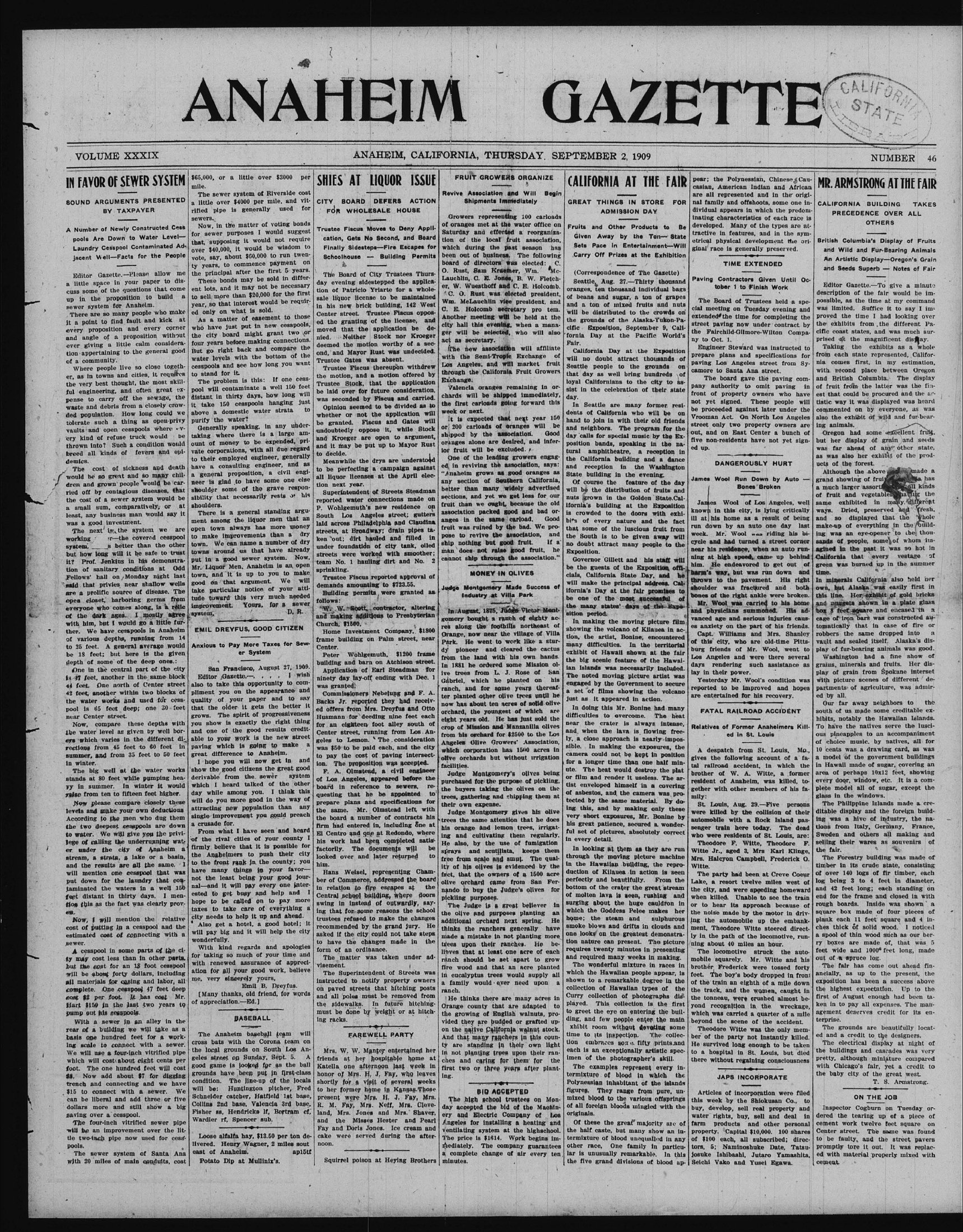
Searchable text
IN FAVOR OF SEWER SYSTEM
SOUND ARGUMENTS PRESENTED BY TAXPAYER
A Number of Newly Constructed Cess pools Are Down to Water Level—Laundry Cesspool Contaminated Adjacent Well—Facts for the People
Editor Gazette.—Please allow me a little space in your paper to discuss some of the questions that come up in the proposition to build a sewer system for Anaheim.
There are so many people who make it a point to find fault and kick at every proposition and every corner and angle of a proposition without ever giving a little calm consideration appertaining to the general good of a community.
Where people live so close together, as in towns and cities, it requires the very best thought, the most skillful engineering, and often great expense to carry off the sewage, the waste and debris from a closely crowded population. How long could we tolerate such a thing as open-privy vaults and open cesspools where every kind of refuse truck would be thrown into? Such a condition would breed all kinds of fevers and epilogies.
$65,000, or a little over $3000 per mile.
The sewer system of Riverside cost a little over $4000 per mile, and vitrified pipe is generally used for sewers.
Now, in the matter of voting bonds for sewer purposes I would suggest that, supposing it would not require over $40,000, it would be wisdom to vote, say, about $60,000 to run twenty years, to commence payment on the principal after the first 5 years.
These bonds may be sold in different lots, and it may not be necessary to sell more than $20,000 for the first year, so that interest would be required only on what is sold.
As a matter of easement to those who have just put in new cesspools, the city board might grant two or four years before making connections. But go right back and compare the water levels with the bottom of the cesspools and see how long you want to stand for it.
The problem is this: If one cesspool will contaminate a well 150 feet distant in thirty days, how long will it take 150 cesspools hanging just above a domestic water strata to purify the water?
Generally speaking, in any undertaking where there is a large amount of money to be expended, private corporations, with all due regard to their employed engineer, generally...
Where people live so close together, as in towns and cities, it requires the very best thought, the most skillful engineering, and often great expense to carry off the sewage, the waste and debris from a closely crowded population. How long could we tolerate such a thing as open-privy vaults and open cesspools where every kind of refuse truck would be thrown into? Such a condition would breed all kinds of fevers and epidemics.
The cost of sickness and death would be so great and so many children and grown people would be carried off by contagious diseases, that the cost of a sewer system would be a small sum, comparatively, or at least, any business man would say it was a good investment.
The next is the system we are working on—the covered cesspool system. It's better than the other but how long will it be safe to trust it? Prof. Jenkins in his demonstration of sanitary conditions at Odd Fellows' hall on Monday night last said that privies near shallow wells are a prolific source of disease. The open closet, harboring germs from everyone who comes along, is a relic of the dark ages. I mostly agree with him, but I would go a little further. We have cesspools in Anaheim of various depths, running from 14 to 25 feet. A general average would be 18 feet; but here is the given depth of some of the deep ones.
One in the central part of the city is 47 feet, another in the same block 44 feet. One north of Center street 42 feet, another within two blocks of the water works and used for cesspool is 65 feet deep; one 30 feet near Center street.
Now, compare these depths with the water level as given by well borers which varies in the different directions from 45 feet to 60 feet in summer, and from 35 feet to 50 feet in winter.
The big well at the water works stands at 80 feet while pumping heavy in summer. In winter it would raise from ten to fifteen feet higher.
Now please compare closely these levels and make your own deductions. According to the men who dug them the two deepest cesspools are down to water. We will give you the privilege of calling the underrunning water under the city of Anaheim a stream, a strata, a lake or a basin, and the results are all the same. I cesspools and see how long you want to stand for it.
The problem is this: If one cesspool will contaminate a well 150 feet distant in thirty days, how long will it take 150 cesspools hanging just above a domestic water strata to purify the water?
Generally speaking, in any undertaking where there is a large amount of money to be expended, private corporations, with all due regard to their employed engineer, generally have a consulting engineer, and as a general proposition, a civil engineer is glad to have some one else shoulder some of the grave responsibility that necessarily rests on his shoulders.
There is a general standing argument among the liquor men that an open town always has more money to make improvements than a dry town. We can name a number of dry towns around us that have already put in a good sewer system. Now, Mr. Liquor Men, Anaheim is an open town, and it is up to you to make good on that argument. We will take particular notice of your attitude toward this very much needed improvement. Yours, for a sewer system,
D. R.
EMIL DREYFUS, GOOD CITIZEN
Anxious to Pay More Taxes for Sewer System
San Francisco, August 27, 1909.
Editor Gazette.
I wish also to take this opportunity to compliment you on the appearance and quality of your paper and to say that the older it gets the better it grows. The spirit of progressiveness you show is exactly the right thing and one of the good results creditable to your work is the new street paving which is going to make a great difference to Anaheim.
I hope you will now get in and show the good citizens the great good derivable from the sewer system which I heard talked of the other day while among you. I think this will do you more good in the way of attracting new population than any single improvement you could preach a crusade for.
From what I have seen and heard of the rival cities of your county I firmly believe that it is possible for the Anaheimers to push their city to the front rank in the county; you have many things in your favor—
Trustee Fiscal motion,
Trustee Stock be laid over
was seconded.
Opinion sees whether or not he be granted.
Undoubtedly and Kroeger and it may be to decide.
Meanwhile he to be perfect all liquor license next year.
Superintendent reported water P. Wohlgemuth South Los Angeles laid across Phi streets, at Bricken out; dirt under foundation streets were team No. 1 h sprinkling.
Trustee Fiscal demands amoBuilding per follows:
W. W. Soo and making a Church, $1500 Home Invent frame building Center.
Peter Wolf building and application ninety day lay was granted.
Commission Backs Jr. rep ed offers from Husmann for an eighteenth Center street, geles to Lem was $50 to be paid the ce ion. The proj
F. A. Olm of Los Angeles board in ref questing that prepare plans the same. M the board a firm had entered El Centro and his work had factorily. Th looked over a him.
stands at 80 feet while pumping heavy in summer. In winter it would raise from ten to fifteen feet higher.
Now please compare closely these levels and make your own deductions. According to the men who dug them the two deepest cesspools are down to water. We will give you the privilege of calling the underrunning water under the city of Anaheim a stream, a strata, a lake or a basin, and the results are all the same. I will mention one cesspool that was put down for the laundry that contaminated the waters in a well 150 feet distant in thirty days. I mention this as the fact was clearly proven.
Now, I will mention the relative cost of putting in a cesspool and the estimated cost of connecting with a sewer.
A cesspool in some parts of the city may cost less than in other parts, but the cost for an 18 foot cesspool will be about forty dollars, including all materials for casing and labor, all complete. One cesspool 47 feet deep cost $2 per foot. It has cost Mr. Hart $150 in the last two years to pump out his cesspools.
With a sewer in an alley in the rear of a building we will take as a basis one hundred feet for a working scale to connect with a sewer. We will use a four-inch vitrified pipe which will cost about eight cents per foot. The one hundred feet will cost $8. Now add about $7 for digging trench and connecting and we have $15 to connect with a sewer. We can be liberal and add three or five dollars more and still show a big saving over a cesspool.
The four-inch vitrified sewer pipe will be an improvement over the little two-inch pipe now used for cesspools.
The sewer system of Santa Ana with 20 miles of main conduits, cost derivable from the sewer system which I heard talked of the other day while among you. I think this will do you more good in the way of attracting new population than any single improvement you could preach a crusade for.
From what I have seen and heard of the rival cities of your county I firmly believe that it is possible for the Angelmers to push their city to the front rank in the county; you have many things in your favor—not the least being your good journal—and it will pay every one interested to get busy and help and I hope to be called on to pay more taxes to take care of everything a city needs to help it up and ahead.
Also get a hotel, a good hotel; it will pay big and it will help the city wonderfully.
With kind regards and apologies for taking so much of your time and with renewed assurance of appreciation for all your good work, believe me, very sincerely yours,
Emil B. Dreyfus.
[Many thanks, old friend, for words of appreciation.—Ed.]
BASEBALL
The Anaheim baseball team will cross bats with the Corona team on the local grounds on South Los Angeles street on Sunday, Sept. 5. A good game is looked for as the ball grounds have been put in first-class condition. The line-up of the locals will be: Huntington pitcher, Fred Schneider catcher, Hatfield 1st base, Collins 2nd base, Valencia 3rd base, Fisher ss, Hendricks lf, Bertram cf, Wardler rf, Spencer sub.
Loose alfalfa hay, $13.50 per ton delivered. Henry Wagner, 2 miles southeast of Anaheim.
Potato Dip at Mullinix's.
ANAHEIM, CALIFORNIA, THURSDAY. SEPTEMBER 2, 1909
SHIES AT LIQUOR ISSUE
CITY BOARD DEFERS ACTION FOR WHOLESALE HOUSE
Trustee Fiscus Moves to Deny Application, Gets No Second, and Board Finally Sidesteps—Fire Escapes for Schoolhouse — Building Permits
The Board of City Trustees Thursday evening sidestepped the application of Patricio Yriarte for a wholesale liquor license to be maintained in his new brick building, 142 West Center street. Trustee Fiscus opposed the granting of the license, and moved that the application be denied. Neither Stock nor Kroeger deemed the motion worthy of a second, and Mayor Rust was undecided. Trustee Gates was absent.
Trustee Fiscus thereupon withdrew the motion, and a motion offered by Trustee Stock, that the application be laid over for future consideration, was seconded by Fiscus and carried.
Opinion seemed to be divided as to whether or not the application will be granted. Fiscus and Gates will undoubtedly oppose it, while Stock and Kroeger are open to argument, and it may be put up to Mayor Rust to decide.
FRUIT GROWERS ORGANIZE
Revive Association and Will Begin Shipments Immediately
Growers representing 100 carloads of oranges met at the water office on Saturday and effected a reorganization of the local fruit association, which during the past season has been out of business. The following board of directors was elected: C. O. Rust, Sam Kraemer, Wm. McLauchlin, C. E. Jones, B. W. Fletcher, W. Wuesthoff and C. E. Holcomb.
C. O. Rust was elected president, Wm. McLauchlin vice president, and C. E. Holcomb secretary pro tem. Another meeting will be held at the city hall this evening, when a manager will be selected, who will also act as secretary.
The new association will affiliate with the Semi-Tropic Exchange of Los Angeles, and will market fruit through the California Fruit Growers Exchange.
Valencia oranges remaining in orchards will be shipped immediately, the first carloads going forward this week or next.
It is expected that next year 150 or 200 carloads of oranges will be shipped by the association. Good oranges alone are desired, and inferior fruit will be excluded.
CALIFORNIA AT THE FAIR
GREAT THINGS IN STORE FOR ADMISSION DAY
Fruits and Other Products to Give Away by the Ton—State Sets Pace in Entertainment—Will Carry Off Prizes at the Exhibition
(Correspondence of The Gazette)
Seattle, Aug. 27.—Thirty thousand oranges, ten thousand individual bags of beans and sugar, a ton of grape and a ton of mixed fruits and nuts will be distributed to the crowds of the grounds of the Alaska-Yukon-Pacific Exposition, September 9, California Day at the Pacific World Fair.
California Day at the Exposition will no doubt attract thousands of Seattle people to the grounds that day as well bring hundreds of loyal Californians to the city to assist in the celebration of their stat day.
In Seattle are many former residents of California who will be on hand to join in with their old friends and neighbors. The program for this day calls for special music by the Exposition bands, speaking in the natural amphitheatre, a reception in the California building and a dance.
Trustee Fiscus thereupon withdrew the motion, and a motion offered by Trustee Stock, that the application be laid over for future consideration, was seconded by Fiscus and carried.
Opinion seemed to be divided as to whether or not the application will be granted. Fiscus and Gates will undoubtedly oppose it, while Stock and Kroeger are open to argument, and it may be put up to Mayor Rust to decide.
Meanwhile the drys are understood to be perfecting a campaign against all liquor licenses at the April election next year.
Superintendent of Streets Steadman reported water connections made on P. Wohlgemuth's new residence on South Los Angeles street; gutters laid across Philadelphia and Claudina streets, at Broadway; drain pipes taken out; dirt hauled and filled in under foundation of city tank, oiled streets were worked with smoother; team No. 1 hauling dirt and No. 2 sprinkling.
Trustee Fiscus reported approval of demands amounting to $723.55.
Building permits were granted as follows:
W. W. Scott, contractor, altering and making additions to Presbyterian Church, $1500.
Home Investment Company, $1800 frame building on Palm street, near Center.
Peter Wohlgemuth, $1200 frame building and barn on Atchison street.
Application of Earl Steadman for ninety day lay-off ending with Dec. 1 was granted.
Commissioners Nebelung and F. A. Backs Jr. reported they had received offers from Mrs. Dreyfus and Otto Husmann for deeding nine feet each for an eighteen foot alley south of Center street, running from Los Angeles to Lemon. The consideration was $50 to be paid each, and the city to pay the cost of paving intersection. The proposition was accepted.
F. A. Olmstead, a civil engineer of Los Angeles, appeared before the board in reference to sewers, requesting that he be appointed to prepare plans and specifications for the same. Mr. Olmstead left with the board a number of contracts his firm had entered in, including one at El Centro and one at Redondo, where his work had been completed satisfactorily. The documents will be looked over and later returned to him.
Los Angeles, and will market fruit through the California Fruit Growers Exchange.
Valencia oranges remaining in orchards will be shipped immediately, the first carloads going forward this week or next.
It is expected that next year 150 or 200 carloads of oranges will be shipped by the association. Good oranges alone are desired, and inferior fruit will be excluded.
One of the leading growers engaged in reviving the association, says: "Anaheim grows as good oranges as any section of Southern California, better than many widely advertised sections, and yet we get less for our fruit than we ought, because the old association packed good and bad oranges in the same carload. Good fruit was ruined by the bad. We propose to revive the association, and ship nothing but good fruit. If a man does not raise good fruit, he cannot ship through the association."
MONEY IN OLIVES
Judge Montgomery Made Success of Industry at Villa Park
In August, 1875, Judge Victor Montgomery bought a ranch of eighty acres along the foothills northeast of Orange, now near the village of Villa Park. He went to work like a sturdy pioneer and cleared the cactus from the land with his own hands. In 1881 he ordered some Mission olive trees from L. J. Rose of San Gabriel, which he planted on his ranch, and for some years thereafter planted other olive trees until he now has about ten acres of solid olive orchard, the youngest of which are eight years old. He has just sold the crop of Mission and Manzanilla olives from his orchard for $2500 to the Los Angeles Olive Growers' Association, which corporation has 1500 acres in olive orchards but without irrigation facilities.
Judge Montgomery's olives being purchased for the purpose of pickling, the buyers taking the olives on the trees, gathering and shipping them at their own expense.
Judge Montgomery gives his olive trees the same attention that he does his orange and lemon trees, irrigating and cultivating them regularly. He also, by the use of fumigation sprays and scutillista, keeps them free from scale and smut. The quality of his olives is evidenced by the Seattle people to the grounds of that day as well bring hundreds loyal Californians to the city to assist in the celebration of their state day.
In Seattle are many former residents of California who will be on hand to join in with their old friends and neighbors. The program for the day calls for special music by the Exposition bands, speaking in the natural amphitheatre, a reception in the California building and a dance and reception in the Washington State building in the evening.
Of course the feature of the day will be the distribution of fruits and nuts grown in the Golden State.California's building at the Exposition is crowded to the doors with exhibits of every nature and the fact that some of the luscious fruit from the South is to be given away with no doubt attract many people to the Exposition.
Governor Gillett and his staff will be the guests of the Exposition officials, California State Day, and he will make the principal address. California's Day at the fair promises to be one of the most successful of the many states' days of the Exposition period.
In making the moving picture film showing the volcano of Kilauea in action, the artist Bonnie encountered many difficulties. In the territorial exhibit of Hawaii shown at the fair, the big scenic feature of the Hawaiian Islands was necessarily included. The noted moving picture artist was engaged by the Government to secure a set of films showing the volcano just as it appeared in action.
In doing this Mr. Bonine had many difficulties to overcome. The heat would destroy the plants or film and render it useless. The artist enveloped himself in a covering of asbestos, and the camera was protected by the same material. By doing this, and by making only these very short exposures, Mr. Bonine bids his great patience, secured a wonderful set of pictures, absolutely correct in every detail.
In looking at them as they are run through the moving picture machine in the Hawaiian building, the repreduction of Kilauea is evidently complete.
of Los Angeles, appeared before the board in reference to sewers, requesting that he be appointed to prepare plans and specifications for the same. Mr. Olmstead left with the board a number of contracts his firm had entered in, including one at El Centro and one at Redondo, where his work had been completed satisfactorily. The documents will be looked over and later returned to him.
Hans Weisel, representing Chamber of Commerce, addressed the board in relation to fire escapes at the Central school building, where doors swing in instead of outwardly, saying that for some reasons the school trustees refused to make the changes recommended by the grand jury. He asked if the city could not take steps to have the changes made in the form of an ordinance.
The matter was taken under advisement.
The Superintendent of Streets was instructed to notify property owners on paved streets that hitching posts and all poles must be removed from the sidewalks. In future hitching-must be done by weight or at hitching racks.
FAREWELL PARTY
Mrs. W. W. Mantzer entertained her friends at her hospitable home at Katella one afternoon last week in honor of Mrs. H. J. Fay, who leaves shortly for a visit of several weeks to her former home in Kansas. Those present were Mrs. H. J. Fay, Mrs. R. M. Fay, Mrs. Neff, Mrs. Cleveland, Mrs. Jones and Mrs. Shaver, and the Misses Hester and Pearl Fay and Doris Jones. Ice cream and cake were served during the afternoon.
Squirrel poison at Heying Brothers
Judge Montgomery's olives being purchased for the purpose of pickling, the buyers taking the olives on the trees, gathering and shipping them at their own expense.
Judge Montgomery gives his olive trees the same attention that he does his orange and lemon trees, irrigating and cultivating them regularly. He also, by the use of fumigation sprays and scutillista, keeps them free from scale and smut. The quality of his olives is evidenced by the fact, that the owners of a 1500 acre olive orchard came from San Fernando to buy the Judge's olives for pickling purposes.
The Judge is a great believer in the olive and purposes planting an additional orchard next spring. He thinks the ranchers generally have made a mistake in not planting more trees upon their ranches. He believes that at least one acre of each ranch should be set apart to grow fire wood and that an acre planted in eucalyptus trees would supply all a family would ever need upon a ranch.
He thinks there are many acres in Orange county that are adapted to the growing of English walnuts, provided they are budded or grafted upon the native California walnut stock. And that many ranchers in this county are standing in their own light in not planting trees upon their ranches and caring for them for the first two or three years after planting.
BID ACCEPTED
The high school trustees on Monday accepted the bid of the Machinery and Electric Company of Los Angeles for installing a heating and ventilating system at the highschool. The price is $1614. Work begins immediately. The company guarantees a complete change of air every ten minutes.
In looking at them as they are run through the moving picture machine in the Hawaiian building, the reproduction of Kilauea in action is seen perfectly and beautifully. From the bottom of the crater the great stream of molten lava is seen, rushing and surging about the huge cauldron in which the Goddess Pele makes her home; the steam and sulphurous smoke blows and drifts in clouds and one looks on the greatest demonstration nature can present. The picture requires twenty minutes in presenting and required many weeks in making.
The wonderful mixture in races in which the Hawaiian people appear, is shown to a remarkable degree in the collection of Hawaiian types of the Curry collection of photographs displayed. This collection is the first to greet the eye on entering the building, and few people enter the main exhibit room without devoting some time to its inspection. The collection embraces some fifty prints, each is an exceptionally artistic specimen of the photographer's skill.
The examples represent every termixture of blood in which the Polynesian inhabitant of the island figures. They range from pure, un mixed blood to the various offspring of all foreign bloods mingled with the originals.
Of these the great majority are of the half caste, but many show an intermixture of blood unequalled in any other race. One family in particular is unusually remarkable. In this five grand divisions of blood
AZETTE
MER 2, 1909
NUMBER 46
CALIFORNIA AT THE FAIR
THINGS IN STORE FOR ADMISSION DAY
Other Products to Be Away by the Ton—State in Entertainment—Will Prizes at the Exhibition
Indence of The Gazette)
Aug. 27.—Thirty thousand thousand individual bags and sugar, a ton of grapes of mixed fruits and nuts distributed to the crowds on the Alaska-Yukon-Pacification, September 9, Cali- at the Pacific World's Day at the Exposition that attract thousands of people to the grounds on well bring hundreds of Indians to the city to as-celebration of their state
are many former resi- california who will be on in with their old friends. The program for the special music by the Ex- nds, speaking in the na- nitheatre, a reception in building and a dance pear; the Polynessian, Chinese Caucasian, American Indian and African are all represented and in the original family and offshoots, some one individual appears in which the predominating characteristics of each race is developed. Many of the types are attractive in features, and in the symetrical physical development the original race is generally preserved.
TIME EXTENDED
Paving Contractors Given Until October 1 to Finish Work
The Board of Trustees held a special meeting on Tuesday evening and extended the time for completing the street paving now under contract by the Fairchild-Gilmore-Wilton Company to Oct. 1.
Engineer Steward was instructed to prepare plans and specifications for paving Los Angeles street from Sycamore to Santa Ana street.
The board gave the paving company authority to omit paving in front of property owners who have not yet signed. These people will be proceeded against later under the Vrooman Act. On North Los Angeles street only two property owners are out, and on East Center a bunch of five non-residents have not yet signed up.
MR. ARMSTRONG AT THE FAIR
CALIFORNIA BUILDING TAKES PRECEDENCE OVER ALL OTHERS
British Columbia’s Display of Fruits and Wild and Fur-Bearing Animals An Artistic Display—Oregon’s Grain and Seeds Superb — Notes of Fair
Editor Gazette.—To give a minute description of the fair would be impossible, as the time at my command was limited. Suffice it to say I improved the time I had looking over the exhibits from the different Pacific coast states, and was much surprised at the magnificent display.
Taking the exhibits as a whole from each state represented, California comes first, in my estimation, with second place between Oregon and British Columbia. The display of fruit from the latter was the finest that could be procured and the artistic way it was displayed was heard commented on by everyone, as was also the exhibit of wild and fur-bearing animals.
Oregon had some excellent fruit, but her display of grain and seeds was far ahead of any other state, as was also her exhibit of the prod-
The feature of the day distribution of fruits and in the Golden State. Building at the Exposition to the doors with exhibition nature and the fact of the luscious fruit from its to be given away will attract many people to the Gillett and his staff will acts of the Exposition offi- ncia State Day, and he the principal address. Caly at the fair promises to the most successful of states' days of the Expo.
In the moving picture film a volcano of Kilauea in actist, Bonine, encountered culties. In the territorial Hawaii shown at the fair music feature of the Hawaiian was necessarily included. Moving picture artist was the Government to secure films showing the volcano appeared in action.
This Mr. Bonine had many to overcome. The heat crater is always intense, the lava is flowing free-approach is nearly impossaking the exposures, and not be kept in position or time than one half minute would destroy the plat render it useless. The armed himself in a covering and the camera was pro- me same material. By doodled by making only these exposures, Mr. Bonine by patience, secured a wonder pictures, absolutely correctail.
At them as they are run moving picture machine Italian building, the repro- pacing Los Angeles street from Sycamore to Santa Ana street.
The board gave the paving company authority to omit paving in front of property owners who have not yet signed. These people will be proceeded against later under the Vrooman Act. On North Los Angeles street only two property owners are out, and on East Center a bunch of five non-residents have not yet signed up.
DANGEROUSLY HURT
James Wool Run Down by Auto — Bones Broken
James Wool of Los Angeles, well known in this city, is lying critically ill at his home as a result of being run down by an auto one day last week. Mr. Wool was riding his bicycle and had turned a street corner near his residence, when an auto running at high speed, came up behind him. He endeavored to get out of harm's way, but was run down and thrown to the pavement. His right shoulder was fractured and both bones of the right ankle were broken.
Mr. Wool was carried to his home and physicians summoned. His advanced age and serious injuries causes anxiety on the part of his friends.
Capt. Williams and Mrs. Shanley of this city, who are old-time Pittsburg friends of Mr. Wool, went to Los Angeles and were there several days rendering such assistance as lay in their power.
Yesterday Mr. Wool's condition was reported to be improved and hopes are entertained for his recovery.
FATAL RAILROAD ACCIDENT
Relatives of Former Anaheimers Killed in St. Louis
A despatch from St. Louis, Mo., gives the following account of a fatal railroad accident, in which the brother of W. A. Witte, a former resident of Anaheim, was killed, together with other members of his family:
St. Louis, Aug. 29.—Five persons were killed by the collision of their automobile with a Rock Island passenger train here today. The dead who were residents of St. Louis, are:
Theodore F. Witte, Theodore F. Witte Jr., aged 3, Mrs Karl Klinge, Mrs. Halcyon Campbell, Frederick O. Witte.
ha comes first, in my estimation, with second place between Oregon and British Columbia. The display of fruit from the latter was the finest that could be procured and the artistic way it was displayed was heard commented on by everyone, as was also the exhibit of wild and fur-bearing animals.
Oregon had some excellent fruit, but her display of grain and seeds was far ahead of any other state, as was also her exhibit of the products of the forest.
Although the above made a grand showing of fruit has a much larger assortment all kinds of fruit and vegetables having the same exhibited in many different ways. Dried, preserved and fresh, and so displayed that the whole make-up of everything in the building was an eye-opener to the thousands of people, some of whom imagined in the past it was so hot in California that every vestage of green was burned up in the summer time.
In minerals California also held her own, but Alaska was easily first in this line. Her exhibit of gold bricks and nugeta shown in a plate glass box 8 feet square and encased in a cage of iron bars was constructed automatically that in case of fire or robbers the same dropped into a vault and sealed itself. Alaska's display of fur-bearing animals was good.
Washington had a fine show of grains, minerals and fruits. Her display of grain from Spokane interset with picture scenes of different departments of agriculture, was admired by all.
Our far away neighbors to the south of us made some creditable exhibits, notably the Hawaiian Islands. To have the natives serve the luscious pineapples to an accompaniment of choice music, by natives, all for 10 cents was a drawing card, as was a model of the government buildings in Hawaii made of sugar, covering an area of perhaps 10x12 feet, showing every door, window, etc. It is a complete model all of sugar, except the glass in the windows.
The Philippine Islands made a creditable display and the foreign building was a hive of industry, the nations from Italy, Germany, France, Sweden and others all making and selling their wares as souvenirs of the fair.
The Forestry building was made of timber in its crude state, consisting
at them as they are run by moving picture machine in Hawaiian building, the repro-Kilauea in action is seen and beautifully. From the crater the great stream Java is seen, rushing and out the huge cauldron in Goddess Pelee makes her steam and sulphurous drifts in clouds and on the greatest demonstra-tion present. The picture twenty minutes in presenting all many weeks in making. Ferruful mixture in races in Hawaiian people appear, is remarkable degree in the of Hawaiian types of the collection of photographs dis-illis collection is the first eye on entering the buil-den people enter the main man without devoting some inspection. The collectes some fifty prints, and exceptionally artistic specie photographer's skill.
Articles of incorporation were filed this week by the Shiokusan Co., to buy, develop, sell real property and water rights, buy, sell and deal in farm products and other personal property. Capital $10,000. 100 shares of $100 each, all subscribed; directors, 5; Naminoshuke Date, Tatsu-josuke Ishibashi, Jutaro Yamashita, Seichi Vako and Yusei Egawa.
ST. LOUIS, Aug. 29.—Five persons were killed by the collision of their automobile with a Rock Island passenger train here today. The dead who were residents of St. Louis, are:
Theodore F. Witte, Theodore F. Witte Jr., aged 3, Mrs Karl Klinge, Mrs. Halcyon Campbell, Frederick O. Witte.
The party had been at Creve Coeur Lake, a resort twelve miles west of the city, and were speeding homeward when killed. Unable to see the train or to hear its approach because of the noise made by the motor in driving the automobile up the embankment, Theodore Witte steered directly in the path of the locomotive, running about 40 miles an hour.
The locomotive struck the automobile squarely. Mr. Witte and his brother Frederick were tossed forty feet. The boy's body dropped in front of the train an eighth of a mile down the track, and the women, caught in the tonneau, were crushed almost beyond recognition in the wreckage, which was carried a quarter of a mile beyond the scene of the accident.
Theodore Witte was the only member of the party not instantly killed. He survived long enough to be taken to a hospital in St. Louis, but died there without regaining consciousness
JAPS INCORPORATE
ON THE JOB
Inspector Cogburn on Tuesday ordered the tearing up of a piece of cement work twelve feet square on Center street. The same was found to be faulty, and the street pavers promptly tore it out. It was replaced with material properly mixed with cement.