anaheim-gazette 1909-08-19
Scanned page
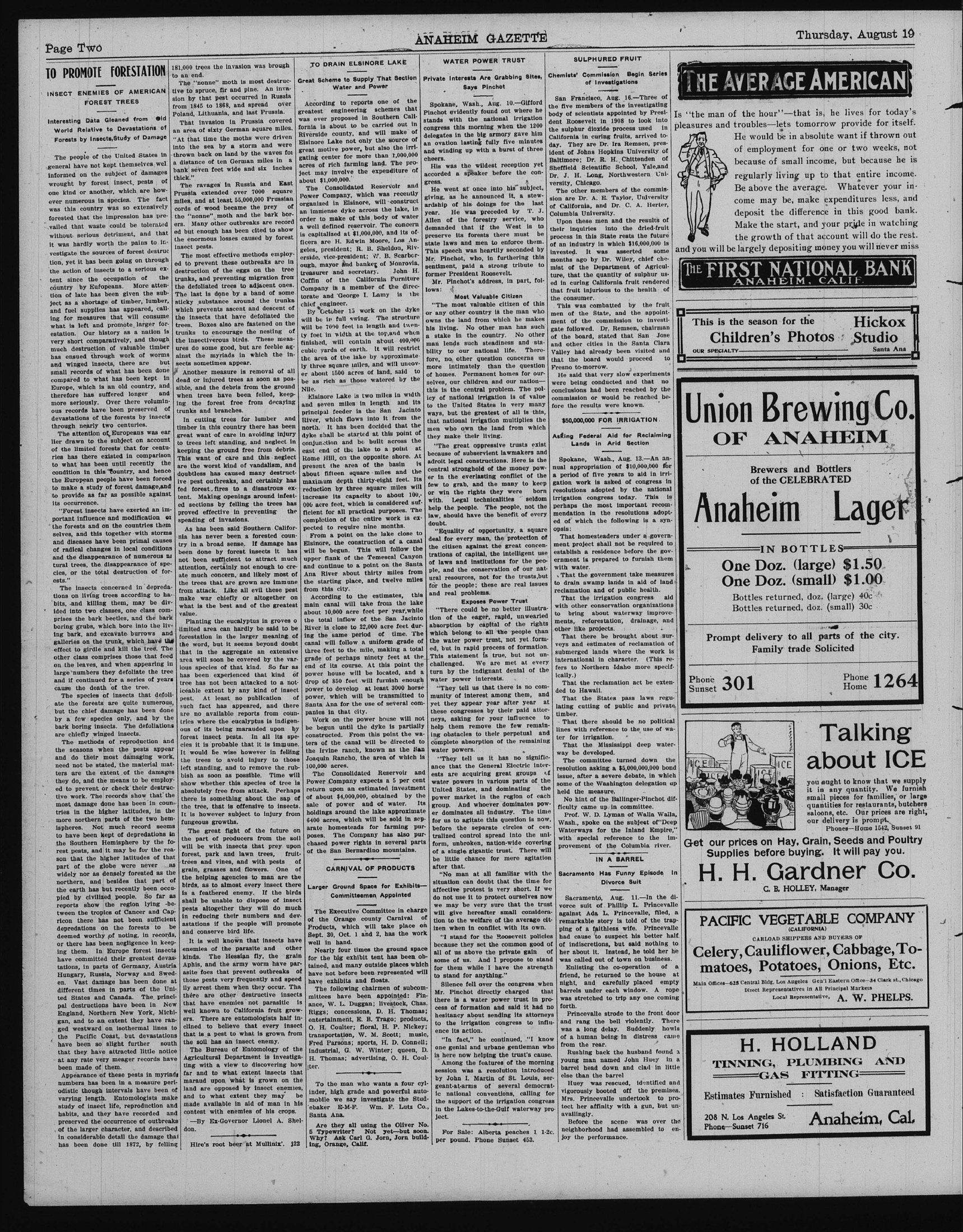
Searchable text
TO PROMOTE FORESTATION
INSECT ENEMIES OF AMERICAN FOREST TREES
Interesting Data Gleaned from Old World Relative to Devastations of Forests by Insects, Study of Damage
The people of the United States in general have not kept themselves well informed on the subject of damages wrought by forest insect pests of one kind or another, which are however numerous in species. The fact was this country was so extensively forested that the impression has prevailed that waste could be tolerated without serious detriment, and that it was hardly worth the pains to investigate the sources of forest destruction, yet it has been going on through the action of insects to a serious extent since the occupation of the country by Europeans. More attention of late has been given the subject as a shortage of timber, lumber, and fuel supplies has appeared, calling for measures that will consume what is left and promote larger forestation. Our history as a nation is very short comparatively, and though much destruction of valuable timber has ensued through work of worms and winged insects, there are but small records of what has been done compared to what has been kept in Europe, which is an old country, and therefore has suffered longer and more seriously. Over there voluminous records have been preserved of devastations of the forests by insects through nearly two centuries.
The attention of Europeans was earlier drawn to the subject on account of the limited forests that for centuries has there existed in comparison with 181,000 trees the invasion was brought to an end.
The "nonne" moth is most destructive to spruce, fir and pine. An invasion by that pest occurred in Russia from 1845 to 1868, and spread over Poland, Lithuania, and last Prussia.
That invasion in Prussia covered an area of sixty German square miles. "At that time the moths were driven into the sea by a storm and were thrown back on land by the waves for a distance of ten German miles in a bank seven feet wide and six inches thick."
The ravages in Russia and East Prussia extended over 7000 square miles, and at least 55,000,000 Prussian cords of wood became the prey of the "nonne" moth and the bark borers. Many other outbreaks are recorded but enough has been cited to show the enormous losses caused by forest insect pests.
The most effective methods employed to prevent these outbreaks are in destruction of the eggs on the tree trunks, and preventing migration from the defoliated trees to adjacent ones. The last is done by a band of some sticky substance around the trunks which prevents ascent and descent of the insects that have defoliated the trees. Boxes also are fastened on the trunks to encourage the nesting of the insectivorous birds. These measures do some good, but are feeble against the myriads in which the insects sometimes appear.
Another measure is removal of all dead or injured trees as soon as possible, and the debris from the ground when trees have been felled, keeping the forest free from decaying trunks and branches.
In cutting trees for lumber and timber in this country there has been great want of care in avoiding injury to trees left standing, and neglect in keeping the ground free from debris. This want of care and this neglect
TO DRAIN ELSE
Great Scheme to Survive Water and
According to repeated greatest engineering was ever proposed fornia is about to Riverside county, an Elsinore Lake not great motive power gating center for many acres of rich farmiject may involve t about $1,000,000.
The Consolidate Power Company, who organized in Elsinore an immense dyke order to make of it a well defined reseris is capitalized at $11 ficers are H. Edwiges, president; R. erside, vice-president;ough, mayor and b treasurer and secr Coffin of the O Company is a meritorate and George chief engineer.
By October 15 will be in full swifl will be 7000 feet in ty feet in width and finished, will concubic yards of earthe area of the laily three square miierer about 1500 acres be as rich as thou Nile.
Elsinore Lake is and seven miles principal feeder is River, which flow north. It has been dyke shall be start conjunction and be east end of the l Rome Hill, on the
and winged insects, there are but small records of what has been done compared to what has been kept in Europe, which is an old country, and therefore has suffered longer and more seriously. Over there voluminous records have been preserved of devastations of the forests by insects through nearly two centuries.
The attention of Europeans was earlier drawn to the subject on account of the limited forests that for centuries has there existed in comparison to what has been until recently the condition in this country, and hence the European people have been forced to make a study of forest damage, and to provide as far as possible against its occurrence.
"Forest insects have exerted an important influence and modification or the forests and on the countries them selves, and this together with storms and diseases have been primal causes of radical changes in local conditions and the disappearance of numerous natural trees, the disappearance of species, or the total destruction of forests."
The insects concerned in depredations on living trees according to habits, and killing them, may be divided into two classes, one class comprises the bark beetles, and the bark boring grubs, which bore into the living bark, and excavate burrows and galleries on the trunk, which have the effect to girdle and kill the tree. The other class comprises those that feed on the leaves, and when appearing in large numbers they defoliate the tree and if continued for a series of years cause the death of the tree.
The species of insects that defoliate the forests are quite numerous, but the chief damage has been done by a few species only, and by the bark boring insects. The defoliations are chiefly winged insects.
The methods of reproduction and the seasons when the pests appear and do their most damaging work, need not be stated, the material matters are the extent of the damages they do, and the means to be employed to prevent or check their destructive work. The records show that the most damage done has been in countries in the higher latitudes, in the more northern parts of the two hemispheres. Not much record seems to have been kept of depredations in the Southern Hemisphere by the forest pests, and it may be for the reason that the higher latitudes of that part of the globe were never as
Another measure is removal of all dead or injured trees as soon as possible, and the debris from the ground when trees have been felled, keeping the forest free from decaying trunks and branches.
In cutting trees for lumber and timber in this country there has been great want of care in avoiding injury to trees left standing, and neglect in keeping the ground free from debris. This want of care and this neglect are the worst kind of vandalism, and doubtless has caused many destructive pest outbreaks, and certainly has fed forest fires to a disastrous extent. Making openings around infested sections by felling the trees has proved effective in preventing the spreading of invasions.
As has been said Southern California has never been a forested country in a broad sense. If damage has been done by forest insects it has not been sufficient to attract much attention, certainly not enough to create much concern, and likely most of the trees that are grown are immune from attack. Like all evil these pest make war chiefly or altogether on what is the best and of the greatest value.
Planting the eucalyptus in groves o limited area can hardly be said to be forestation in the larger meaning of the word, but it seems beyond doubt that in the aggregate an extensive area will soon be covered by the various species of that kind. So far as has been experienced that kind of tree has not been attacked to a noticeable extent by any kind of insect pest. At least no publication of such fact has appeared, and there are no available reports from countries where the eucalyptus is indigenous of its being marauded upon by forest insect pests. In all its species it is probable that it is immune. It would be wise however in felling the trees to avoid injury to those left standing, and to remove the rubish as soon as possible. Time will show whether this species of tree is absolutely free from attack. Perhaps there is something about the sap of the tree, that is offensive to insects. It is however subject to injury from funguous growths.
The great fight of the future on the part of producers from the soil will be with insects that prey upon forest, park and lawn trees, fruit trees and vines, and with pests of grain grasses and flowers. One of
ters are the extent of the damages they do, and the means to be employed to prevent or check their destructive work. The records show that the most damage done has been in countries in the higher latitudes, in the more northern parts of the two hemispheres. Not much record seems to have been kept of depredations in the Southern Hemisphere by the forest pests, and it may be for the reason that the higher latitudes of that part of the globe were never as widely nor as densely forested as the northern, and besides that part of the earth has but recently been occupied by civilized people. So far as reports show the region lying between the tropics of Cancer and Capricon there has not been sufficient depredations on the forests to be deemed worthy of noting, in records, or there has been negligence in keeping them. In Europe forest insects have committed their greatest devastations, in parts of Germany, Austria Hungary, Russia, Norway and Sweden. Vast damage has been done at different times in parts of the United States and Canada. The principal destructions have been in New England, Northern New York, Michigan, and to an extent they have ranged westward on isothermal lines to the Pacific Coast, but devastations have been so slight further south that they have attracted little notice at any rate very meager records have been made of them.
Appearance of these pests in myriad numbers has been in a measure periodic though intervals have been of varying length. Entomologists make study of insect life, reproduction and habits, and they have recorded and preserved the occurrence of outbreaks of the larger character, and described in considerable detail the damage that has been done till 1872, by felling
bish as soon as possible. Time will show whether this species of tree is absolutely free from attack. Perhaps there is something about the sap of the tree, that is offensive to insects. It is however subject to injury from fungeous growths.
The great fight of the future on the part of producers from the soil will be with insects that prey upon forest, park and lawn trees, fruit trees and vines, and with pests of grain, grasses and flowers. One of the helping agencies to man are the birds, as to almost every insect there is a feathered enemy. If the birds shall be unable to dispose of insect pests altogether they will do much in reducing their numbers and devastations if the people will promote and conserve bird life.
It is well known that insects have enemies of the parasite and other kinds. The Hessian fly, the grain Aphis, and the army worm have parasite foes that prevent outbreaks of those pests very frequently and speedily arrest them when they occur. Tha there are other destructive insects that have enemies not parasitic is well known to California fruit growers. There are entomologists half inclined to believe that every insect that is a pest to what is grown from the soil has an insect enemy.
The Bureau of Entomology of the Agricultural Department is investigating with a view to discovering how far and to what extent insects that maraud upon what is grown on the land are opposed by insect enemies, and to what extent they may be made available in aid of man in his contest with enemies of his crops.
—By Ex-Governor Lionel A. Sheldon.
Hire's root beer at Mullinix'. j22
TO DRAIN ELSINORE LAKE
Great Scheme to Supply That Section Water and Power
According to reports one of the greatest engineering schemes that was ever proposed in Southern California is about to be carried out in Riverside county, and will make of Elsinore Lake not only the source of great motive power, but also the irrigating center for more than 1,000,000 acres of rich farming land. The project may involve the expenditure of about $1,000,000.
The Consolidated Reservoir and Power Company, which was recently organized in Elsinore, will construct an immense dyke across the lake, in order to make of this body of water a well defined reservoir. The concern is capitalized at $1,000,000, and its officers are H. Edwin Moore, Los Angeles, president; R. B. Sheldon, Riverside, vice-president; W. B. Scarborough, mayor and banker of Monrovia, treasurer and secretary. John H. Coffin of the California Furniture Company is a member of the directorate and George I. Lamy is the chief engineer.
By October 15 work on the dyke will be in full swing. The structure will be 7000 feet in length and twenty feet in width at the top, and when finished, will contain about 400,000 cubic yards of earth. It will restrict the area of the lake by approximately three square miles, and will uncover about 1500 acres of land, said to be as rich as those watered by the Nile.
Elsinore Lake is two miles in width and seven miles in length and its principal feeder is the San Jacinto River, which flows into it from the north. It has been decided that the dyke shall be started at this point of conjunction and be built across the east end of the lake to a point at Rome Hill, on the opposite shore. At
WATER POWER TRUST
Private Interests Are Grabbing Sites, Says Pinchot
Spokane, Wash., Aug. 10.—Gifford Pinchot evidently found out where he stands with the national irrigation congress this morning when the 1200 delegates in the big armory gave him an ovation lasting fully five minutes and winding up with a burst of three cheers.
His was the wildest reception yet accorded a speaker before the congress.
He went at once into his subject, giving, as he announced it, a stewardship of his doings for the last year. He was preceded by T. J. Allen of the forestry service, who demanded that if the West is to preserve its forests there must be state laws and men to enforce them. This speech was heartily seconded by Mr. Pinchot, who, in furthering this sentiment, paid a strong tribute to former President Roosevelt.
Mr. Pinchot's address, in part, follows:
Most Valuable Citizen
"The most valuable citizen of this or any other country is the man who owns the land from which he makes his living. No other man has such a stake in the country. No other man lends such steadiness and stability to our national life. Therefore, no other question concerns us more intimately than the question of homes. Permanent homes for ourselves, our children and our nation—this is the central problem. The policy of national irrigation is of value to the United States in very many ways, but the greatest of all is this, that national irrigation multiplies the men who own the land from which they make their living."
The great oppressive trusts exist because of subservient lawmakers and local constructions. Here is the
ly three square miles, and will uncover about 1500 acres of land, said to be as rich as those watered by the Nile.
Elsinore Lake is two miles in width and seven miles in length and its principal feeder is the San Jacinto River, which flows into it from the north. It has been decided that the dyke shall be started at this point of conjunction and be built across the east end of the lake to a point at Rome Hill, on the opposite shore. At present the area of the basin is about fifteen square miles and the maximum depth thirty-eight feet. Its reduction by three square miles will increase its capacity to about 100,006 acre feet, which is considered sufficient for all practical purposes. The completion of the entire work is expected to require nine months.
From a point on the lake close to Elsinore, the construction of a canal will be begun. This will follow the upper flank of the Temescal Canyon and continue to a point on the Santa Ana River about thirty miles from the starting place, and twelve miles from this city.
According to the estimates, this main canal will take from the lake about 10,000 acre feet per year, while the total inflow of the San Jacinto River is close to 22,000 acre feet during the same period of time. The canal will follow a uniform grade of three feet to the mile, making a total grade of perhaps ninety feet at the end of its course. At this point the power house will be located, and a drop of 850 feet will furnish enough power to develop at least 3000 horse power, which will be transmitted to Santa Ana for the use of several companies in that city.
Work on the power house will not be begun until the dyke is partially constructed. From this point the waters of the canal will be directed to the Irvine ranch, known as the San Joaquin Rancho, the area of which is 100,000 acres.
The Consolidated Reservoir and Power Company expects a 5 per cent return upon an estimated investment of about $4,000,000, obtained by the sale of power and of water. Its holdings around the lake approximate 6400 acres, which will be sold in separate homesteads for farming purposes. The Company has also purchased power rights in several parts of the San Bernardino mountains.
more intimately than the question of homes. Permanent homes for ourselves, our children and our nation—this is the central problem. The policy of national irrigation is of value to the United States in very many ways, but the greatest of all is this, that national irrigation multiplies the men who own the land from which they make their living.
"The great oppressive trusts exist because of subservient lawmakers and adroit legal constructions. Here is the central stronghold of the money power in the everlasting conflict of the few to grab, and the many to keep or win the rights they were born with. Legal technicalities seldom help the people. The people, not the law, should have the benefit of every doubt.
"Equality of opportunity, a square deal for every man, the protection of the citizen against the great concentrations of capital, the intelligent use of laws and institutions for the people, and the conservation of our natural resources, not for the trusts, but for the people; these are real issues and real problems."
Exposes Power Trust
"There could be no better illustration of the eager, rapid, unwearied absorption by capital of the rights which belong to all the people than the water power trust, not yet formed, but in rapid process of formation. This statement is true, but not unchallenged. We are met at every turn by the indignant denial of the water power interests.
"They tell us that there is no community of interest among them, and yet they appear year after year at these congresses by their paid attorneys, asking for your influence to help them remove the few remaining obstacles to their perpetual and complete absorption of the remaining water powers.
"They tell us it has no significance that the General Electric interests are acquiring great groups of water powers in various parts of the United States, and dominating the power market in the region of each group. And whoever dominates power dominates all industry. The time for us to agitate this question is now, before the separate circles of centralized control spread into the uniform, unbroken, nation-wide covering of a single gigantic trust. There will be little chance for mere agitation after that."
The Consolidated Reservoir and Power Company expects a 5 per cent return upon an estimated investment of about $4,000,000, obtained by the sale of power and of water. Its holdings around the lake approximate 6400 acres, which will be sold in separate homesteads for farming purposes. The Company has also purchased power rights in several parts of the San Bernardino mountains.
CARNIVAL OF PRODUCTS
Larger Ground Space for Exhibits—Committeemen Appointed
The Executive Committee in charge of the Orange county Carnival of Products, which will take place on Sept. 30, Oct. 1 and 2, has the work well in hand.
Nearly four times the ground space for the big exhibit tent has been obtained, and many outside places which have not before been represented will have exhibits and floats.
The following chairmen of subcommittees have been appointed: Finance, W. L. Duggan; livestock, Chas. Riggs; concessions, D. H. Thomas; entertainment, E. B. Trago; products, O. H. Coulter; floral, H. P. Nickey; transportation, W. M. Scott; music, Fred Parsons; sports, H. D. Connell; industrial, G. W. Winter; queen, D. H. Thomas; advertising, O. H. Coulter.
To the man who wants a four cylinder, high grade and powerful automobile we say investigate the Studebaker E-M-F. Wm. F. Lutz Co., Santa Ana.
Are they all using the Oliver No. 5 Typewriter? Not yet—but soon. Why? Ask Carl G. Jorn, Jorn building, Orange, Calif.
ests are acquiring great groups of water powers in various parts of the United States, and dominating the power market in the region of each group. And whoever dominates power dominates all industry. The time for us to agitate this question is now, before the separate circles of centralized control spread into the uniform, unbroken, nation-wide covering of a single gigantic trust. There will be little chance for mere agitation after that.
"No man at all familiar with the situation can doubt that the time for affective protest is very short. If we do not use it to protect ourselves now we may be very sure that the trust will give hereafter small consideration to the welfare of the average citizen when in conflict with its own.
"I stand for the Roosevelt policies because they set the common good of all of us above the private gain of some of us. And I propose to stand for them while I have the strength to stand for anything."
Silence fell over the congress when Mr. Pinchot directly charged that there is a water power trust in process of formation and said it had no hesitancy about sending its attorneys to the irrigation congress to influence its action.
"In fact," he continued, "I know one genial and urbane gentleman who is here now helping the trust's cause.
Among the features of the morning session was a resolution introduced by John I. Martin of St. Louis, sergeant-at-arms of several democratic national conventions, calling for the support of the irrigation congress in the Lakes-to-the-Gulf waterway project.
For Sale: Alberta peaches 1 1·2c. per pound. Phone Sunset 453.
issue, after a severe debate, in which some of the Washington delegation up held the measure.
No hint of the Ballinger-Pinchot difficulty came up in committee.
Prof. W. D. Lyman of Walla Walla, Wash., spoke on the subject of "Deep Waterways for the Inland Empire," with special reference to the improvement of the Columbia river.
IN A BARREL
Sacramento Has Funny Episode In Divorce Suit
Sacramento, Aug. 11.—In the divorce suit of Phillip L. Princevalle against Ada L. Princevalle, filed, a remarkable story is told of the trapping of a faithless wife. Princevalle had cause to suspect his better half of indiscretions, but said nothing to her about it. Instead, he told her he was called out of town on business.
Enlisting the co-operation of a friend, he returned to the house at night, and carefully placed empty barrels under each window. A rope was stretched to trip any one coming forth.
Princevalle strode to the front door and rang the bell violently. There was a long delay. Suddenly howls of a human being in distress came from the rear.
Rushing back the husband found a young man named John Huey in a barrel head down and clad in little else than the barrel.
Huey was rescued, identified and vigorously booted off the premises. Mrs. Princevalle undertook to protect her affinity with a gun, but unavailingly.
Before the scene was over the neighborhood had assembled to enjoy the performance.
THURSDAY, AUGUST 19
THE AVERAGE AMERICAN
Is "the man of the hour"—that is, he lives for today's pleasures and troubles—lets tomorrow provide for itself.
He would be in absolute want if thrown out of employment for one or two weeks, not because of small income, but because he is regularly living up to that entire income. Be above the average. Whatever your income may be, make expenditures less, and deposit the difference in this good bank. Make the start, and your pride in watching the growth of that account will do the rest. and you will be largely depositing money you will never miss
THE FIRST NATIONAL BANK
ANAHEIM, CALIF.
This is the season for the Children's Photos Studio
OUR SPECIALTY___ Santa Ana
Union Brewing Co.
OF ANAHEIM
Union Brewing Co.
OF ANAHEIM
Brewers and Bottlers
of the CELEBRATED
Anaheim Lager
IN BOTTLES
One Doz. (large) $1.50
One Doz. (small) $1.00
Bottles returned, doz. (large) 40c
Bottles returned, doz. (small) 30c
Prompt delivery to all parts of the city.
Family trade Solicited
Phone Sunset 301 Phone Home 1264
Talking about ICE
you ought to know that we supply it in any quantity. We furnish small pieces for families, or large quantities for restaurants, butchers saloons, etc. Our prices are right, our delivery is prompt.
Phones—Home 1542, Sunset 91
Get our prices on Hay, Grain, Seeds and Poultry Supplies before buying. It will pay you.
Get our prices on Hay, Grain, Seeds and Poultry Supplies before buying. It will pay you.
H. H. Gardner Co.
C. B. HOLLEY, Manager
PACIFIC VEGETABLE COMPANY
(CALIFORNIA)
CARLOAD SHIPPERS AND BUYERS OF
Celery, Cauliflower, Cabbage, Tomatoes, Potatoes, Onions, Etc.
Main Offices—625 Central Bldg, Los Angeles Gen'l Eastern Office—34 Clark st., Chicago
Direct Representatives in All Principal Markets
Local Representative, A. W. PHELPS.
H. HOLLAND
TINNING, PLUMBING AND
GAS FITTING
Estimates Furnished: Satisfaction Guaranteed
208 N. Los Angeles St.
Phone—Sunset 716
Anaheim, Cal.