anaheim-gazette 1909-08-05
Scanned page
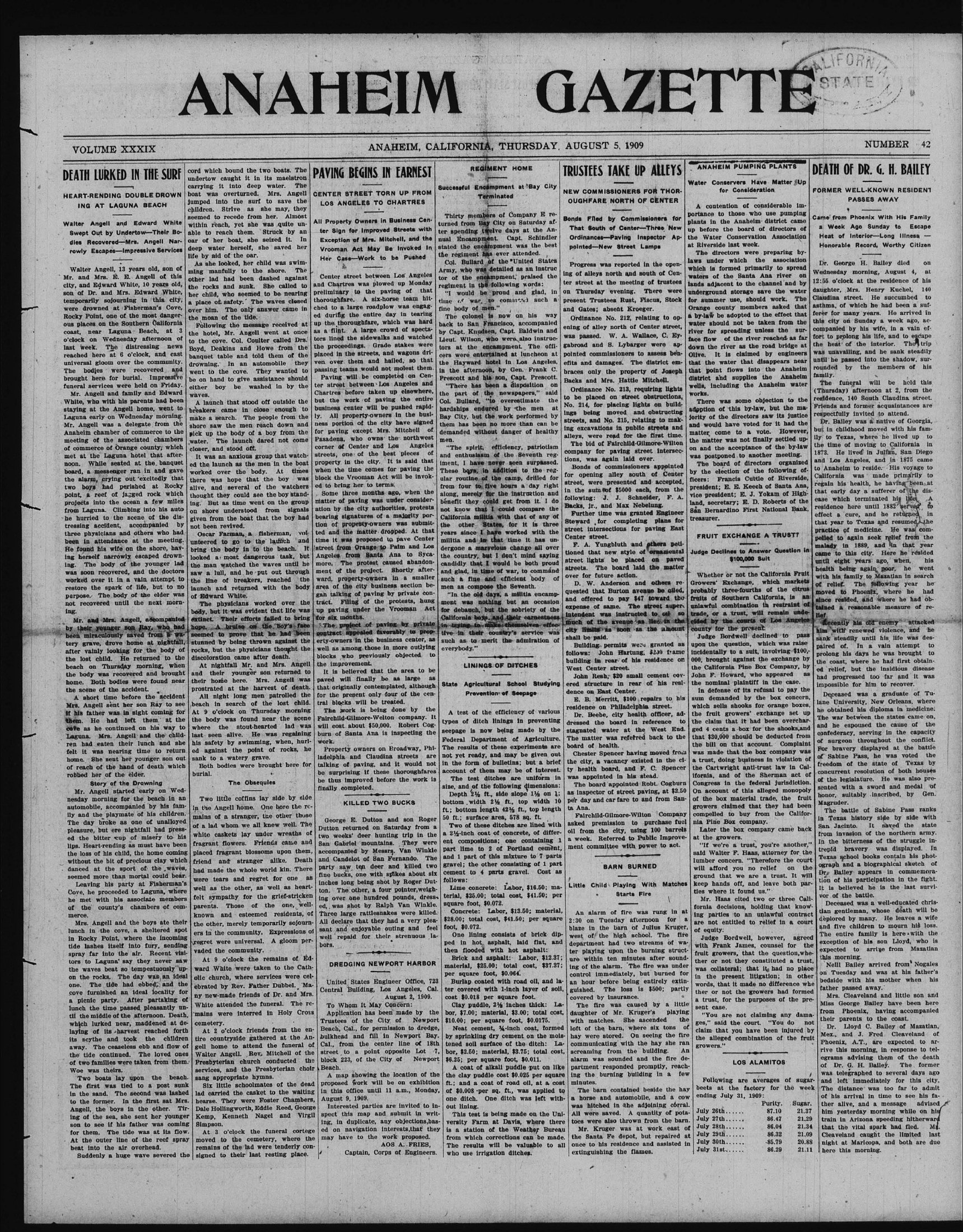
Searchable text
DEATH LURKED IN THE SURF
HEART-RENDING DOUBLE DROWN
ING AT LAGUNA BEACH
Walter Angell and Edward White
Swept Out by Undertow—Their Bodies Recovered—Mrs. Angell Narrowly Escapes—Impressive Services
Walter Angell, 13 years old, son of Mr. and Mrs. E. E. Angell of this city, and Edward White, 10 years old, son of Dr. and Mrs. Edward White, temporarily sojourning in this city, were drowned at Fisherman's Cove, Rocky Point, one of the most dangerous places on the Southern California coast, near Laguna Beach, at 3 o'clock on Wednesday afternoon of last week. The distressing news reached here at 6 o'clock, and cast universal gloom over the community. The bodies were recovered and brought here for burial. Impressive funeral services were held on Friday.
Mr. Angell and family and Edward White, who with his parents had been staying at the Angell home, went to Laguna early on Wednesday morning. Mr. Angell was a delegate from the Anaheim chamber of commerce to the meeting of the associated chambers of commerce of Orange county; which met at the Laguna hotel that after-
cord which bound the two boats. The undertow caught it in its maelstron carrying it into deep water. The boat was overturned. Mrs. Angell jumped into the surf to save the children. Strive as she may, they seemed to recede from her. Almost within reach, yet she was quite unable to reach them. Struck by an oar of her boat, she seized it. In deep water herself, she saved her life by aid of the oar.
As she looked, her child was swimming manfully to the shore. The other lad had been dashed against the rocks and sunk. She called to her child, who seemed to be nearing a place of safety. The waves closed over him. The only answer came in the moan of the tide.
Following the message received at the hotel, Mr. Angell went at once to the cove. Col. Coulter called Drs. Boyd, Deakins and Howe from the banquet table and told them of the drowning. In an automobile they went to the cove. They wanted to be on hand to give assistance should either boy be washed in by the waves.
A launch that stood off outside the breakers came in close enough to make a search. The people from the shore saw the men reach down and pick up the body of a boy from the water. The launch dared not come closer, and stood off.
It was an anxious group that watch-
The bodies were recovered and brought here for burial. Impressive funeral services were held on Friday.
Mr. Angell and family and Edward White, who with his parents had been staying at the Angell home, went to Laguna early on Wednesday morning. Mr. Angell was a delegate from the Anaheim chamber of commerce to the meeting of the associated chambers of commerce of Orange county; which met at the Laguna hotel that afternoon. While seated at the banquet board, a messenger ran in and gave the alarm, crying out excitedly that two boys had perished at Rocky point, a reef of jagged rock which projects into the ocean a few miles from Laguna. Climbing into his auto he hurried to the scene of the distressing accident, accompanied by three physicians and others who had been in attendance at the meeting. He found his wife on the shore, having herself narrowly escaped drowning. The body of the younger lad was soon recovered, and the doctors worked over it in a vain attempt to restore the spark of life, but to no purpose. The body of the elder was not recovered until the next morning.
Mr. and Mrs. Angell, accompanied by their younger son Ray, who had been miraculously saved from a watery grave, drove home at nightfall, after vainly looking for the body of the lost child. He returned to the beach on Thursday morning, when the body was recovered and brought home. Both bodies were found near the scene of the accident.
A short time before the accident Mrs. Angell sent her son Ray to see if his father was in sight coming for them. He had left them at the cove as he continued on his way to Laguna. Mrs. Angell and the children had eaten their lunch and she felt it was nearing time to return home. She sent her younger son out of reach of the hand of death which robbed her of the elder.
Story of the Drowning
Mr. Angell started early on Wednesday morning for the beach in an automobile, accompanied by his family and the playmate of his children. The day broke as one of unalloyed pleasure, but ere nightfall had pressed the bitter cup of misery to his lips. Heart-rending as must have been the loss of his child, the home coming without the bit of precious clay which danced at the sport of the waves,
The Obsequies
Two little coffins lay side by side in the Angell home. One bore the remains of a stranger, the other those of a lad whom we all knew well. The white caskets lay under wreaths of fragrant flowers. Friends came and placed fragrant blossoms upon them, friend and stranger alike. Death had made the whole world kin. There drowning. In an automobile they went to the cove. They wanted to be on hand to give assistance should either boy be washed in by the waves.
A launch that stood off outside the breakers came in close enough to make a search. The people from the shore saw the men reach down and pick up the body of a boy from the water. The launch dared not come closer, and stood off.
It was an anxious group that watched the launch as the men in the boat worked over the body. At times there was hope that the boy was alive, and several of the watchers thought they could see the boy standing. But as time went on the group on shore understood from signals given from the boat that the boy had not been revived.
Oscar Farman, a fisherman, volunteered to go to the launch and bring the body in to the beach. It looked a most dangerous task, but the man watched the waves until he saw a lull, and he put out through the line of breakers, reached the launch and returned with the body of Edward White.
The physicians worked over the body, but it was evident that life was extinct. Their efforts failed to bring hope. A bruise on the boy's face seemed to prove that he had been stunned by being thrown against the rocks, but the physicians thought the discoloration came after death.
At nightfall Mr. and Mrs. Angell and their younger son returned to their home here. Mrs. Angell was prostrated at the harvest of death.
All night long men patrolled the beach in search of the lost child. At 9 o'clock on Thursday morning the body was found near the scene where the stout-hearted lad was last seen alive. He was regaining his safety by swimming, when, hurlled against the point of rocks, he sank to a watery grave.
Both bodies were brought here for burial.
Paving will alter street better Chartres before but the work business center only. All properness portion of for paving ex-Pasadena, where corner of Cen streets, one or property in tha when time block the Vrood ed to bring he
Some three matter of paviation by the co bearing signation of property and then time it was placed street from O Angeles from more. The placement of the ward, property area of the cangan talking of tract. Filling up paving until for six months.
The project contract appearserty-owners in well as among blocks who paythe improvement.
It is believable paved will fi f that originally for the present tral blocks ww
The work Fairchild-Gilm will cost above burn of Santa work.
Property over ladelphia and talking of pa be surprising be thus impr finally compli
Story of the Drowning
Mr. Angell started early on Wednesday morning for the beach in an automobile, accompanied by his family and the playmate of his children. The day broke as one of unalloyed pleasure, but ere nightfall had pressed the bitter cup of misery to his lips. Heart-rending as must have been the loss of his child, the home coming without the bit of precious clay which danced at the sport of the waves, seemed more than mortal could bear.
Leaving his party at Fisherman's Cove, he proceeded to Laguna, where he met with his associate members of the county's chambers of commerce.
Mrs. Angell and the boys ate their lunch in the cove, a sheltered spot in Rocky Point, where the incoming tide lashes itself into fury, sending spray far into the air. Recent visitors to Laguna say they never saw the waves beat so tempestuously upon the rocks. The day was an ideal one. The tide had ebbed, and the cove furnished an ideal locality for a picnic party. After partaking of lunch the time passed pleasantly until the middle of the afternoon. Death, which lurked near, maddened at delaying of its harvest reached forth its scythe and took the children away. The ceaseless ebb and flow of the tide continued. The loved ones of two families were taken from them. Woe was theirs.
Two boats lay upon the beach. The first was tied to a post sunk in the sand. The second was lashed to the former. In the first sat Mrs. Angell, the boys in the other. Tiring of the sea, she sent her younger son to see if his father was coming for them. The tide was at its flow. At the outer line of the reef spray beat into the air overhead.
Suddenly a huge wave severed the
The Obsequies
Two little coffins lay side by side in the Angell home. One bore the remains of a stranger, the other those of a lad whom we all knew well. The white caskets lay under wreaths of fragrant flowers. Friends came and placed fragrant blossoms upon them, friend and stranger alike. Death had made the whole world kin. There were tears and regret for one as well as the other, as well as heartfelt sympathy for the grief-stricken parents. Those of the one, well-known and esteemed residents, of the other, merely temporarily sojourners in the community. Expressions of regret were universal. A gloom pervaded the community.
At 9 o'clock the remains of Edward White were taken to the Catholic church, where services were celebrated by Rev. Father Dubbel. Many new-made friends of Dr. and Mrs. White attended the funeral. The remains were interred in Holy Cross cemetery.
At 2 o'clock friends from the entire countryside gathered at the Angell home to attend the funeral of Walter Angell. Rev. Mitchell of the Presbyterian church conducted the services, and the Presbyterian choir sang appropriate hymns.
Six little schoolmates of the dead lad carried the casket to the waiting hearse. They were Foster Chambers, Dale Hollingworth, Eddie Reed, George Kemp, Kenneth Nagel and Virgil Simpson.
At 3 o'clock the funeral cortegue moved to the cemetery, where the remains of the lad were tenderly consigned to their last resting place.
ANAHEIM, CALIFORNIA, THURSDAY, AUGUST 5, 1909
PAVING BEGINS IN EARNEST
CENTER STREET TORN UP FROM LOS ANGELES TO CHARTRES
All Property Owners in Business Center Sign for Improved Streets with Exception of Mrs. Mitchell, and the Vrooman Act May Be Invoked In Her Case—Work to be Pushed
Center street between Los Angeles and Chartres was plowed up Monday preliminary to the paving of that thoroughfare. A six-horse team hitched to a large roadplow was engaged during the entire day in tearing up the thoroughfare, which was hard as a flint. A large crowd of spectators lined the sidewalks and watched the proceedings. Grade stakes were placed in the streets, and wagons driven over them and hailed, so that passing teams would not molest them.
Paving will be completed on Center street between Los Angeles and Chartres before taken up elsewhere, but the work of paving the entire business center will be pushed rapidly. All property owners in the business portion of the city have signed for paving except Mrs. Mitchell of Pasadena, who owns the northwest corner of Center and Los Angeles streets, one of the best pieces of
REGIMENT HOME
Successful Encampment at Bay City Terminated
Thirty members of Company E returned from Bay City on Saturday after spending twelve days at the Annual Encampment. Capt. Schindler stated the encampment was the best the regiment has ever attended.
Col. Bullard of the United States Army, who was detailed as an instructor of the encampment, praised the regiment in the following words:
"I would be proud and glad, in time of war, to command such a fine body of men."
The colonel is now on his way back to San Francisco, accompanied by Capt. Knudsen, Capt. Baldwin and Lieut. Wilson, who were also instructors at the encampment. The officers were entertained at luncheon at the Hayward hotel in Los Angeles, in the afternoon, by Gen. Frank C. Prescott and his son, Capt. Prescott.
“There has been a disposition on the part of the newspapers,” said Col. Bullard, “to overestimate the hardships endured by the men at Bay City, but the work performed by them has been no more than can be demanded without danger of healthy men.
“The spirit, efficiency, patriotism and enthusiasm of the Seventh regiment.”
TRUSTEES TAKE UP ALLEYS
NEW COMMISSIONERS FOR THOROUGHFARE NORTH OF CENTER
Bonds Filed by Commissioners for That South of Center—Three New Ordinances—Paving Inspector Appointed—New Street Lamps
Progress was reported in the opening of alleys north and south of Center street at the meeting of trustees on Thursday evening. There were present Trustees Rust, Fiscus, Stock and Gates; absent Kroeger.
Ordinance No. 212, relating to opening of alley north of Center street was passed. W. A. Wallace, C. Eyebroad and S. Lybarger were appointed commissioners to assess benefits and damages. The district embraces only the property of Joseph Backs and Mrs. Hattie Mitchell.
Ordinance No. 213, requiring lights to be placed on street obstructions No. 214, for placing lights on buildings being moved and obstructing streets, and No. 215, relating to making excavations in public streets and alleys, were read for the first time.
The bid of Fairchild-Gilmore-Wiltor company for paving street intersections was again laid over.
Paving will be completed on Center street between Los Angeles and Chartres before taken up elsewhere, but the work of paving the entire business center will be pushed rapidly. All property owners in the business portion of the city have signed for paving except Mrs. Mitchell of Pasadena, who owns the northwest corner of Center and Los Angeles streets, one of the best pieces of property in the city. It is said that when the time comes for paving the block the Vrooman Act will be invoked to bring her to terms.
Some three months ago, when the matter of paving was under consideration by the city authorities, protests bearing signatures of a majority portion of property owners was submitted and the matter dropped. At that time it was proposed to pave Center street from Orange to Palm and Los Angeles from Santa Ana to Sycamore. The protest caused abandonment of the project. Shortly afterward, property owners in a smaller area of the city business section began talking of paving by private contract. Filing of the protests, hung up paving under the Vrooman Act for six months.
The project of paving by private contract appealed favorably to property owners in the business center, as well as among those in more outlying blocks who previously objected to the improvement.
It is believed that the area to be paved will finally be as large as that originally contemplated, although for the present only four of the central blocks will be treated.
The work is being done by the Fairchild-Gilmore-Welton company. It will cost about $50,000. Robert Cogburn of Santa Ana is inspecting the work.
Property owners on Broadway, Philadelphia and Claudina streets are talking of paving, and it would not be surprising if these thoroughfares be thus improved before the work is finally completed.
KILLED TWO BUCKS
George E. Dutton and son Roger Dutton returned on Saturday from a two weeks' deer hunting trip in the San Gabriel mountains. They were accompanied by Messrs. Van Winkle and Candelot of San Fernando. The party saw ten deer and killed two the Hayward hotel in Los Angeles, in the afternoon, by Gen. Frank C. Prescott and his son, Capt. Prescott.
“There has been a disposition on the part of the newspapers,” said Col. Bullard, “to overestimate the hardships endured by the men at Bay City, but the work performed by them has been no more than can be demanded without danger of healthy men.
“The spirit, efficiency, patriotism and enthusiasm of the Seventh regiment, I have never seen surpassed. These boys, in addition to the regular routine of the camp, drilled for from four to five hours a day right along, merely for the instruction and benefit they could get from it. I do not know that I could compare the California militia with that of any of the other States, for it is three years since I have worked with the militia and in that time it has undergone a marvelous change all over the country, but I don't mind saying candidly that I would be both proud and glad, in time of war, to command such a fine and efficient body of men as compose the Seventh.
"In the old days, a militia encampment was nothing but an occasion for debauchy, but the sobriety of the California boys, and their earnestness in trying to make themselves effective in their country's service was such as to merit the admiration of everybody."
LININGS OF DITCHES
State Agricultural School Studying Prevention of Seepage
A test of the efficiency of various types of ditch linings in preventing seepage is now being made by the Federal Department of Agriculture. The results of these experiments are not yet ready, and may be given out in the form of bulletins; but a brief account of them may be of interest.
The test ditches are uniform in size, and of the following dimensions:
Depth 2½ ft., side slope 1½ on 1; bottom width 2½ ft., top width 10 ft.; bottom length 42½ ft., top length 50 ft.; surface area, 578 sq. ft.
Two of these ditches are lined with a 2½-inch coat of concrete, of different compositions; one containing 1 part lime to 2 of Portland cement, and 1 part of this mixture to 7 parts gravel; the other consisting of 1 part Hayward hotel in Los Angeles, in the afternoon, by Gen. Frank C. Prescott and his son, Capt. Prescott.
Ordinance No. 213, requiring lights to be placed on street obstructions No. 214, for placing lights on buildings being moved and obstructing streets, and No. 215, relating to making excavations in public streets and alleys, were read for the first time.
The bid of Fairchild-Gilmore-Wilton company for paving street intersections, was again laid over.
Bonds of commissioners appointed for opening alley south of Center street, were presented and accepted in the sum of $5000 each, from the following: J. J. Schneider, F. A. Backs, jr., and Max Nebelung.
Further time was granted Engineer Steward for completing plans for street intersections for paving East Center street.
F. A. Yungbluth and others petitioned that new style of ornaments street lights be placed on pavement streets. The board laid the matter over for future action.
D. W. Anderson and others requested that Burton avenue be oiled and offered to pay $47 toward the expense of same. The street superintendent was instructed to oil much of the avenue as lies in the city limits as soon as the amount shall be paid.
Building permits were granted as follows: John Hartung, $200 frame building in rear of his residence on West Center street.
John Resh, $20 small cement covered structure in rear of his residence on East Center.
E. B. Merritt, $100 repairs to his residence on Philadelphia street.
Dr. Beebe, city health officer, adressed the board in reference to stagnated water at the West End. The matter was referred back to the board of health.
Chester Spencer having moved from the city, a vacancy existed in the city health board, and F. C. Spence was appointed in his stead.
The board appointed Robt. Cogburn as inspector of street paving, at $2.5 per day and car fare to and from Santa Ana.
Fairchild-Gilmore-Wilton Company asked premission to purchase fuel oil from the city, using 100 barrels a week. Referred to Public Improvement committee with power to act.
BARN BURNED
KILLED TWO BUCKS
George E. Dutton and son Roger Dutton returned on Saturday from a two weeks' deer hunting trip in the San Gabriel mountains. They were accompanied by Messrs. Van Winkle and Candelot of San Fernando. The party saw ten deer and killed two fine bucks, one with spikes about six inches long being shot by Roger Dutton. The other, a four pointer, weighing over one hundred pounds, dressed, was shot by Ralph Van Winkle. Three large rattlesnakes were killed. All declare that they had a very pleasant and enjoyable outing and feel well repaid for their strenuous labors.
DREDGING NEWPORT HARBOR
United States Engineer Office, 723 Central Building, Los Angeles, Cal.
August 2, 1909.
To Whom It May Concern:
Application has been made by the Trustees of the City of Newport Beach, Cal., for permission to dredge, bulkhead and fill in Newport Bay. Cal., from the center line of 18th street to a point opposite Lot 7, block 223, of the City of Newport Beach.
A map showing the location of the proposed work will be on exhibition in this office until 11 a.m., Monday, August 9, 1909.
Interested parties are invited to inspect this map and submit in writing, in duplicate, any objections, based on navigation interests, that they may have to the work proposed.
AOS A. FRIES,
Captain, Corps of Engineers.
The test ditches are uniform in size, and of the following dimensions:
Depth 2½ ft., side slope 1½ on 1; bottom width 2½ ft., top width 10 ft.; bottom length 42½ ft., top length 50 ft.; surface area, 578 sq. ft.
Two of these ditches are lined with a 2½-inch coat of concrete, of different compositions; one containing 1 part lime to 2 of Portland cement, and 1 part of this mixture to 7 parts gravel; the other consisting of 1 part cement to 4 parts gravel. Cost as follows:
Lime concrete: Labor, $16.50; material, $25.00; total cost, $41.50; per square foot, $0.072.
Concrete: Labor, $13.50; material, $28.00; total cost, $41.50; per square foot, $0.072.
One lining consists of brick dipped in hot asphalt, laid flat, and then flooded with hot asphalt:
Brick and asphalt: Labor, $12.37; material, $25.00; total cost, $37.37; per square foot, $0.064.
Burlap coated with road oil, and later covered with 1-inch layer of soil, cost $0.018 per square foot.
Clay puddle, 2½ inches thick: Labor, $7.00; material, $3.00; total cost, $10.00; per square foot, $0.0175.
Neat cement, ¼-inch coat, formed by sprinkling dry cement on the moistened soil surface of the ditch: Labor, $2.50; material, $3.75; total cost, $6.25; per square foot, $0.011.
A coat of alkali puddle put on like the clay puddle cost $0.025 per square ft.; and a coat of road oil, at a cost of $0.008 per sq. ft., was applied to one ditch. One ditch was left without lining.
This test is being made on the University Farm at Davis, where there is a station of the Weather Bureau from which corrections can be made. The results will be valuable to all who use irrigation ditches.
An alarm of fire was rung in at 2:30 on Tuesday afternoon for blaze in the barn of Julius Kruger's west of the high school. The department had two streams of water playing upon the burning structure within ten minutes after sounding of the alarm. The fire was uncontrolled immediately, but burned for an hour before being entirely extinguished. The loss is $500; part covered by insurance.
The fire was caused by a little daughter of Mr. Kruger's playmate with matches. She ascended to loft of the barn, where six tons of hay were stored. On seeing the fire communicating with the hay she was screaming from the building. Alarm was sounded and the fire department responded promptly, reading the burning building in a few minutes.
The barn contained beside the barn a horse and automobile, and a cow was hitched in the adjoining corner. All were saved. A quantity of pooes were also thrown from the barn.
Mr. Kruger was at work east of the Santa Fe depot, but repaired once to his residence and assisted extinguishing the flames.
TAKE UP ALLEYS
MISSIONERS FOR THORTHE NORTH OF CENTER
by Commissioners for
of Center—Three New
Paving Inspector Apnew Street Lamps
was reported in the opennorth and south of Centhe meeting of trustees
evening. There were
tees Rust, Fiscus, Stock
absent Kroeger.
No. 212, relating to opny north of Center street,
W. A. Wallace, C. EyS. Lybarger were apmissioners to assess benimages. The district emthe property of Joseph
Mrs. Hattie Mitchell.
No. 213, requiring lights
on street obstructions,
placing lights on buildmoved and obstructing.
No. 215, relating to makons in public streets and
read for the first time.
Fairchild-Gilmore-Wilton
paving street intersecgain laid over.
ANAHEIM PUMPING PLANTS
Water Conservers Have Matter Up for Consideration.
A contention of considerable importance to those who use pumping plants in the Anaheim district came up before the board of directors of the Water Conservation Association at Riverside last week.
The directors were preparing by-laws under which the association which is formed primarily to spread waters of the Santa Ana river on lands adjacent to the channel and by underground storage save the water for summer use, should work. The Orange county members asked that a by-law be adopted to the effect that water should not be taken from the river for spreading unless the surface flow of the river reached as far down the river as the road bridge at Olive. It is claimed by engineers that the water that disappears near that point flows into the Anaheim district and supplies the Anaheim wells, including the Anaheim water works.
There was some objection to the adoption of this by-law, but the majority of the directors saw its justice and would have voted for it had the matter come to a vote. However, the matter was not finally settled upon and the acceptance of the by-law was postponed to another meeting.
DEATH OF DR. G. H. BAILEY
FORMER WELL-KNOWN RESIDENT
PASSES AWAY
Came from Phoenix With His Family
a Week Ago Sunday to Escape Heat of Interior—Long Illness — Honorable Record, Worthy Citizen
Dr. George H. Bailey died on Wednesday morning, August 4, at 12:55 o'clock at the residence of his daughter, Mrs. Henry Kuchel, 140 Claudina street. He succumbed to asthma, of which he had been a sufferer for many years. He arrived in this city on Sunday a week ago, accompanied by his wife, in a vain effort to prolong his life, and to escape the heat of the interior. The trip was unavailing, and he sank steadily until he passed into the shadow, surrounded by the members of his family.
The funeral will be held this (Thursday) afternoon at 2, from the residence, 140 South Claudina street. Friends and former acquaintances are respectfully invited to attend.
Dr. Bailey was a native of Georgia, but in childhood moved with his family to Texas, where he lived up to the time of moving to California in 1873. He lived in Julian, San Diego and Los Angeles and in 1875 came
FRUIT EXCHANGE A TRUST?
Judge Declines to Answer Question in $100,000 Suit
Whether or not the California Fruit Growers' Exchange, which markets probably three-fourths of the citrus fruits of Southern California, is an unlawful combination in restraint of trade, or a trust, will remain undecided by the courts of Los Angeles county for the present.
Judge Bordwell declined to pass upon the question, which was raise incidentally to a suit, involving $100,000, brought against the exchange by the California Pine Box Company, by John F. Howard, who appeared as the nominal plaintiff in the case.
In defense of its refusal to pay the sum demanded by the box concern, which sells shooks for orange boxes, the fruit growers' exchange set up the claim that it had been overcharged 4 cents a box for the shocks, and that $30,000 should be deducted from the bill on that account. Complaint was made that the box company was a trust, doing business in violation of the Cartwright anti-trust law in California, and of the Sherman act of Congress in the federal jurisdiction. On account of this alleged monopoly of the box material trade, the fruit growers claimed that they had been compelled to buy from the California Pine Box company.
Later the box company came back at the growers.
"If we're a trust, you're another," said Walter F. Haas, attorney for the lumber concern. "Therefore the court will afford you no relief on the rounded by the members of his family.
The funeral will be held this (Thursday) afternoon at 2, from the residence, 140 South Claudina street. Friends and former acquaintances are respectfully invited to attend.
Dr. Bailey was a native of Georgia, but in childhood moved with his family to Texas, where he lived up to the time of moving to California in 1873. He lived in Julian, San Diego and Los Angeles, and in 1875 came to Anaheim to reside. His voyage to California was made primarily to regain his health, he having been at that early day a sufferer of the disease which terminated his life. A residence here until 1882 served to effect a cure, and he returned in that year to Texas and resumed the practice of medicine. He was compelled to again seek relief from the malady in 1889, and in that year came to this city. Here he resided until eight years ago, when, his health being again poor, he went with his family to Mazatlan in search of relief. The following year he moved to Phoenix, where he had since resided, and where he had obtained a reasonable measure of relief.
Recently his old enemy attacked him with renewed violence, and he sank steadily until his life was despaired of. In a vain attempt to prolong his days he was brought to the coast, where he had first obtained relief, but the insidious disease had progressed too far and it was impossible for him to recover.
Deceased was a graduate of Tulane University, New Orleans, where he obtained his diploma in medicine. The war between the states came on, and he espoused the cause of the confederacy, serving in the capacity of surgeon throughout the conflict. For bravery displayed at the battle of Sabine Pass, he was voted the freedom of the state of Texas by concurrent resolution of both houses of the legislature. He was also presented with a sword and medal of honor, suitably inscribed, by Gen. Magruder.
The battle of Sabine Pass ranks in Texas history side by side with San Jacinto. It saved the state from invasion of the northern army. In the bitterness of the struggle bravery was displayed. In Texas school books contain his photograph and a biographical sketch of
BARN BURNED
Playing With Matches Starts Fire
of fire was rung in at
tuesday afternoon for a
the barn of Julius Kruger,
the high school. The fire
had two streams of waup upon the burning structten minutes after soundalarm. The fire was under
immediately, but burned for
before being entirely extincated. The loss is $500; partly
by insurance.
was caused by a little
of Mr. Kruger's playing
matches. She ascended the
barn, where six tons of
restored. On seeing the fire
hitting with the hay she ran
from the building. An
sounded and the fire deresponded promptly, reachburning building in a few
contained beside the hay
and automobile, and a cow
died in the adjoining corral.
Saved. A quantity of potaalso thrown from the barn.
Kruger was at work east of
Fe depot, but repaired at
his residence and assisted in
firing the flames.
COLLAMITOS
Following are averages of sugar-beets at the factory for the week ending July 31, 1909:
Purity. Sugar.
July 26th.....87.10 21.37
July 27th.....86.47 21.29
July 28th.....86.04 21.34
July 29th.....86.32 21.09
July 30th.....85.79 20.88
July 31st.....86.29 21.11
Deceased was a well-educated christian gentleman, whose death will be deplored by many. He leaves a wife and five children to mourn his loss. The entire family is here with the exception of his son Lloyd, who is expected to arrive from Mazatlan this morning.
Neill Bailey arrived from Nogales on Tuesday and was at his father's bedside with his mother when his father passed away.
Mrs. Cleaveland and little son and Miss George Bailey have been here from Phoenix, having accompanied their parents to the coast.
Dr. Lloyd C. Bailey of Mazatlan, Mex., and J. Fred Cleaveland of Phoenix, A.T., are expected to arrive this morning, in response to telegrams advising them of the death of Dr. G. H. Bailey. The former was telegraphed to several days ago and left immediately for this city. The distance was too far to admit of his arrival in time to see his father alive, and a message advised him yesterday morning while on his train in Arizona speeding hitherward that the vital spark had fled. Mr. Cleaveland caught the limited last night at Maricopa, and both are due here this morning.