anaheim-gazette 1909-07-29
Scanned page
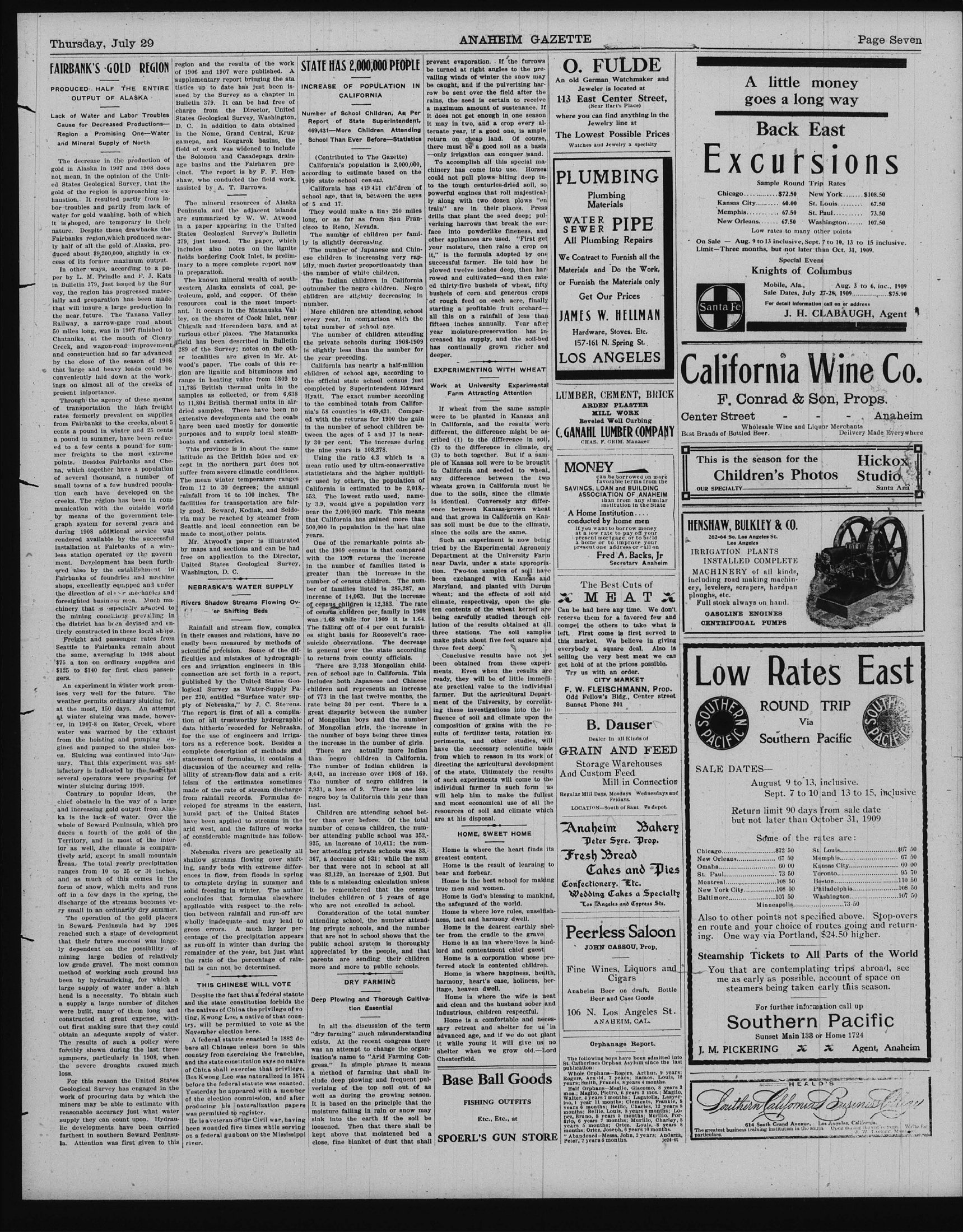
Searchable text
FAIRBANK'S GOLD REGION
PRODUCED HALF THE ENTIRE OUTPUT OF ALASKA
Lack of Water and Labor Troubles Cause for Decreased Productions—Region a Promising One—Water and Mineral Supply of North
The decrease in the production of gold in Alaska in 1907 and 1908 does not mean, in the opinion of the United States Geological Survey, that the gold of the region is approaching exhaustion. It resulted partly from labor troubles and partly from lack of water for gold washing, both of which it is hoped, are temporary in their nature. Despite these drawbacks the Fairbanks region, which produced nearly half of all the gold of Alaska, produced about $9,200,000, slightly in excess of its former maximum output.
In other ways, according to a paper by L. M. Prindle and F. J. Katz in Bulletin 379, just issued by the Survey, the region has progressed materially and preparation has been made that will insure a large production in the near future. The Tanana Valley Railway, a narrow-gage road about 50 miles long, was in 1907 finished to Chatanika, at the mouth of Cleary Creek, and wagon-road improvement and construction had so far advanced by the close of the season of 1908 that large and heavy loads could be conveniently laid down at the workings on almost all of the creeks of present importance.
Through the agency of these means of transportation the high freight rates formerly prevalent on supplies from Fairbanks to the creeks, about 5 cents a pound in winter and 25 cents a pound in summer, have been reduced to a few cents a pound for summer freights to the most extreme region and the results of the work of 1906 and 1907 were published. A supplementary report bringing the statistics up to date has just been issued by the Survey as a chapter in Bulletin 379. It can be had free of charge from the Director, United States Geological Survey, Washington, D. C. In addition to data obtained in the Nome, Grand Central, Kruzgamepa, and Kougarok basins, the field of work was widened to include the Solomon and Casadepaga drainage basins and the Fairhaven precinct. The report is by F. F. Henshaw, who conducted the field work, assisted by A. T. Barrows.
The mineral resources of Alaska Peninsula and the adjacent islands are summarized by W. W. Atwood in a paper appearing in the United States Geological Survey's Bulletin 379, just issued. The paper, which includes also notes on the lignite fields bordering Cook Inlet, is preliminary to a more complete report now in preparation.
The known mineral wealth of southwestern Alaska consists of coal, petroleum, gold, and copper. Of these resources coal is the most important. It occurs in the Matanuska Valley, on the shores of Cook Inlet, near Chignik and Herendeen bays, and at various other places. The Matanuska field has been described in Bulletin 289 of the Survey; notes on the other localities are given in Mr. Atwood's paper. The coals of this region are lignitic and bituminous and range in heating value from 5809 to 11,785 British thermal units in the samples as collected, or from 6,638 to 11,804 British thermal units in air-dried samples. There have been no extensive developments and the coals have been used mostly for domestic purposes and to supply local steamboats and canneries.
This province is in about the same latitude as the British Isles and ex-
STATE HAS 2,000 INCREASE OF CALIFORNIA
Number of School Report of State 469,431—More O School Than Ever
(Contributed to California's population according to estimate 1909 state school year)
The number of children is slightly decreased.
The number of ese children is indidly much faster than the number of wh
The Indian child outnumber the nee children are slighl number.
More children are every year, in co total number of
The number othe private schoo is slightly less tha the year preceding California has n children of schoo the official state completed by Sup Hyatt. The exact to the combined nia's 58 counties ed with the return in the number oftween the ages ol ly 30 per cent. the nine years is Using the rat
Through the agency of these means of transportation the high freight rates formerly prevalent on supplies from Fairbanks to the creeks, about 5 cents a pound in winter and 25 cents a pound in summer, have been reduced to a few cents a pound for summer freights to the most extreme points. Besides Fairbanks and Chema, which together have a population of several thousand, a number of small towns of a few hundred population each have developed on the creeks. The region has been in communication with the outside world by means of the government telegraph system for several years and during 1908 additional service was rendered available by the successful installation at Fairbanks of a wireless station operated by the government. Development has been furthered also by the establishment in Fairbanks of foundries and machine shops, excellently equipped and under the direction of clear mechanics and foresighted business men. Much machinery that is especially adapted to the mining conditions prevailing in the district has been devised and entirely constructed in these local shops.
Freight and passenger rates from Seattle to Fairbanks remain about the same, averaging in 1908 about $75 a ton on ordinary supplies and $125 to $140 for first class passengers.
An experiment in winter work promises very well for the future. The weather permits ordinary sluicing for, at the most, 150 days. An attempt at winter sluicing was made, however, in 1907-8 on Ester Creek, where water was warmed by the exhaust from the hoisting and pumping engines and pumped to the sluice boxes. Sluicing was continued into January. That this experiment was satisfactory is indicated by the fact that several operators were preparing for winter sluicing during 1909.
Contrary to popular ideas, the chief obstacle in the way of a large and increasing gold output from Alaska is the lack of water. Over the whole of Seward Peninsula, which produces a fourth of the gold of the Territory, and in most of the interior as well, the climate is comparatively arid, except in small mountain areas. The total yearly precipitation ranges from 10 to 35 or 30 inches wood's paper. The coals of this region are lignitic and bituminous and range in heating value from 5809 to 11,785 British thermal units in the samples as collected, or from 6,638 to 11,804 British thermal units in air-dried samples. There have been no extensive developments and the coals have been used mostly for domestic purposes and to supply local steamboats and canneries.
This province is in about the same latitude as the British Isles and except in the northern part does not suffer from severe climatic conditions. The mean winter temperature ranges from 12 to 30 degrees; the annual rainfall from 16 to 100 inches. The facilities for transportation are fairly good. Seward, Kodiak, and Seldovia may be reached by steamer from Seattle and local connection can be made to most other points.
Mr. Atwood's paper is illustrated by maps and sections and can be had free on application to the Director, United States Geological Survey, Washington, D.C.
NEBRASKA'S WATER SUPPLY
Rivers Shadow Streams Flowing Over Shifting Beds
Rainfall and stream flow, complex in their causes and relations, have no easily been measured by methods of scientific precision. Some of the difficulties and mistakes of hydrographers and irrigation engineers in this connection are set forth in a report, published by the United States Geological Survey as Water-Supply Paper 230, entitled "Surface water supply of Nebraska," by J. C. Stevens.
The report is first of all a compilation of all trustworthy hydrographic data hitherto recorded for Nebraska, for the use of engineers and irrigators as a reference book. Besides a complete description of methods and statement of formulas, it contains a discussion of the accuracy and reliability of stream-flow data and a criticism of the estimates sometimes made of the rate of stream discharge from rainfall records. Formulas developed for streams in the eastern, humid part of the United States have been applied to streams in the arid west, and the failure of works of considerable magnitude has followed.
Nebraska rivers are practically all shallow streams flowing over shifting, sandy beds with extreme differ-
Contrary to popular ideas, the chief obstacle in the way of a large and increasing gold output from Alaska is the lack of water. Over the whole of Seward Peninsula, which produces a fourth of the gold of the Territory, and in most of the interior as well, the climate is comparatively arid, except in small mountain areas. The total yearly precipitation ranges from 10 to 25 or 30 inches, and as much of this comes in the form of snow, which melts and runs off in a few days in the spring, the discharge of the streams becomes very small in an ordinarily dry summer.
The operation of the gold placers in Seward Peninsula had by 1906 reached such a stage of development that their future success was largely dependent on the possibility of mining large bodies of relatively low grade gravel. The most common method of working such ground has been by hydraulicking, for which a large supply of water under a high head is a necessity. To obtain such a supply a large number of ditches were built, many of them long and constructed at great expense, without first making sure that they could obtain an adequate supply of water. The results of such a policy were forcibly shown during the last three summers, particularly in 1908, when the severe droughts caused much loss.
For this reason the United States Geological Survey has engaged in the work of procuring data by which the miners may be able to estimate with reasonable accuracy just what water supply they can count upon. Hydraulic developments have been carried farthest in southern Seward Peninsula. Attention was first given to this ability of stream-flow data and a criticism of the estimates sometimes made of the rate of stream discharge from rainfall records. Formulas developed for streams in the eastern, humid part of the United States have been applied to streams in the arid west, and the failure of works of considerable magnitude has followed.
Nebraska rivers are practically all shallow streams flowing over shifting, sandy beds with extreme differences in flow, from floods in spring to complete drying in summer and solid freezing in winter. The author concludes that formulas elsewhere applicable with respect to the relation between rainfall and run-off are wholly inadequate and may lead to gross errors. A much larger percentage of the precipitation appears as run-off in winter than during the remainder of the year, but just what the ratio of the percentage of rainfall is can not be determined.
THIS CHINESE WILL VOTE
Despite the fact that a federal statute and the state constitution forbids the natives of China the privilege of voting, Kwong Lee, a native of that country, will be permitted to vote at the November election here.
A federal statute enacted in 1882 debarbs all Chinese unless born in this country from exercising the franchise, and the state constitution says no native of China shall exercise that privilege. But Kwong Lee was naturalized in 1874 before the federal statute was enacted. Yesterday he appeared with a member of the election commission, and after producing his naturalization papers was permitted to register.
He is a veteran of the Civil war, having been wounded five times while serving on a federal gunboat on the Mississippi river.
In all the days "dry farming" exists. At the time was an attempt to utilization's name growth." In similar a method of fills deep plow verizing of the well as during It is based on moisture falling sink into the loosened. They kept above the close, fine blan
STATE HAS 2,000,000 PEOPLE
INCREASE OF POPULATION IN CALIFORNIA
Number of School Children, As Per Report of State Superintendent, 469,431—More Children Attending School Than Ever Before—Statistics
(Contributed to The Gazette)
California's population is 2,000,000, according to estimate based on the 1909 state school census.
California has 439,451 children of school age, that is, between the ages of 5 and 17.
They would make a line 250 miles long, or as far as from San Francisco to Reno, Nevada.
The number of children per family is slightly decreasing.
The number of Japanese and Chinese children is increasing very rapidly, much faster proportionately than the number of white children.
The Indian children in California outnumber the negro children. Negro children are slightly decreasing in number.
More children are attending school every year, in comparison with the total number of school age.
The number of children attending the private schools during 1908-1909 is slightly less than the number for the year preceding.
California has nearly a half-million children of school age, according to the official state school census just completed by Superintendent Edward Hyatt. The exact number according to the combined totals from California's 58 counties is 469,431. Compared with the returns for 1900 the gain in the number of school children between the ages of 5 and 17 is nearly 30 per cent. The increase during the nine years is 108,278.
Using the ratio 4.3 which is a prevent evaporation. If the furrows be turned at right angles to the prevailing winds of winter the snow may be caught, and if the pulverizing harrow be sent over the field after the rains, the seed is certain to receive a maximum amount of sustenance. If it does not get enough in one season it may in two, and a crop every alternate year, if a good one, is ample return on cheap land. Of course, there must be a good soil as a basis—only irrigation can conquer sand.
To accomplish all this special machinery has come into use. Horses could not pull plows biting deep into the tough centuries-dried soil, so powerful engines that roll majestically along with two dozen plows "entrain" are in their places. Press drills that plant the seed deep; pulverizing harrows that break the surface into powderlike fineness, and other appliances are used. "First get your moisture, then raise a crop on it," is the formula adopted by one successful farmer. He told how he plowed twelve inches deep, then harrowed and cultivated—and then raised thirty-five bushels of wheat, fifty bushels of corn and generous crops of rough feed on each acre, finally starting a profitable fruit orchard—all this on a rainfall of less than fifteen inches annually. Year after year moisture-preservation has increased his supply, and the soil-bed has continually grown richer and deeper.
EXPERIMENTING WITH WHEAT
Work at University Experimental Farm Attracting Attention
If wheat from the same sample were to be planted in Kansas and in California, and the results were different, the difference might be ascribed (1) to the difference in soil, (2) to the difference in climate, or (3) to both together. But if a sam-
California has nearly a half-million children of school age, according to the official state school census just completed by Superintendent Edward Hyatt. The exact number according to the combined totals from California's 58 counties is 469,431. Compared with the returns for 1900 the gain in the number of school children between the ages of 5 and 17 is nearly 30 per cent. The increase during the nine years is 108,278.
Using the ratio 4.3 which is a mean ratio used by ultra-conservative statisticians and the higher multiplier used by others, the population of California is estimated to be 2,018,-553. The lowest ratio used, namely 3.9, would give a population very near the 2,000,000 mark. This means that California has gained more than 500,000 in population in the last nine years.
One of the remarkable points about the 1909 census is that compared with the 1908 returns the increase in the number of families listed is greater than the increase in the number of census children. The number of families listed is 285,287, an increase of 14,063. But the increase of census children is 12,383. The rate of census children per family in 1908 was 1.68 while for 1909 it is 1.64. The falling off of 4 per cent furnishes slight basis for Roosevelt's race-suicide observations. The decrease is general over the state according to returns from county officials.
There are 3,738 Mongolian children of school age in California. This includes both Japanese and Chinese children and represents an increase of 773 in the last twelve months, the rate being 30 per cent. There is a great disparity between the number of Mongolian boys and the number of Mongolian girls, the increase in the number of boys being three times the increase in the number of girls.
There are actually more Indian than negro children in California. The number of Indian children is 3,443, an increase over 1908 of 169. The number of negro children is 2,931, a loss of 9. There is one less negro boy in California this year than last.
Children are attending school better than ever before. Of the total number of census children, the number attending public school was 352,-935, an increase of 10,411; the number attending private schools was 33,-367, a decrease of 931; while the number that were not in school at all
EXPERIMENTING WITH WHEAT
Work at University Experimental Farm Attracting Attention
If wheat from the same sample were to be planted in Kansas and in California, and the results were different, the difference might be ascribed (1) to the difference in soil, (2) to the difference in climate, or (3) to both together. But if a sample of Kansas soil were to be brought to California and seeded to wheat, any difference between the two wheats grown in California must be due to the soils, since the climate is identical. Conversely any difference between Kansas-grown wheat and that grown in California on Kansas soil must be due to the climate, since the soils are the same.
Such an experiment is now being tried by the Experimental Agronomy Department at the University Farm near Davis, under a state appropriation. Two-ton samples of soil have been exchanged with Kansas and Maryland, and planted with Durum wheat; and the effects of soil and climate, respectively, upon the gluten contents of the wheat kernel are being carefully studied through collation of the results obtained at all three stations. The soil samples make plats about five feet square and three feet deep.
Conclusive results have not yet been obtained from these experiments. Even when the results are ready, they will be of little immediate practical value to the individual farmer. But the agricultural Department of the University, by correlating these investigations into the influence of soil and climate upon the composition of grains with the results of fertilizer tests, rotation experiments, and other studies, will have the necessary scientific basis from which to reason in its work of directing the agricultural development of the state. Ultimately the results of such experiments will come to the individual farmer in such form as will help him to make the fullest and most economical use of all the resources of soil and climate which are at his disposal.
HOME, SWEET HOME
Home is where the heart finds its greatest content.
Home is the result of learning to
The number of negro children is 2,931, a loss of 9. There is one less negro boy in California this year than last.
Children are attending school better than ever before. Of the total number of census children, the number attending public school was 352,935, an increase of 10,411; the number attending private schools was 33,367, a decrease of 931; while the number that were not in school at all was 83,129, an increase of 2,903. But this is a misleading calculation unless it be remembered that the census includes children of 5 years of age who are not enrolled in school.
Consideration of the total number attending school, the number attending private schools, and the number that are not in school shows that the public school system is thoroughly appreciated by the people, and that parents are sending their children more and more to public schools.
DRY FARMING
Deep Plowing and Thorough Cultivation Essential
In all the discussion of the term "dry farming" much misunderstanding exists. At the recent congress there was an attempt to change the organization's name to "Arid Farming Congress." In simple phrase it means a method of farming that shall include deep plowing and frequent pulverizing of the top soil out of as well as during the growing season. It is based on the principle that the moisture falling in rain or snow may sink into the earth if the soil be loosened. Then that there shall be kept above that moistened bed a close, fine blanket of dust that shall
HOME, SWEET HOME
Home is where the heart finds its greatest content.
Home is the result of learning to bear and forbear.
Home is the best school for making true men and women.
Home is God's blessing to mankind, the safeguard of the world.
Home is where love rules, unselfishness, tact and harmony dwell.
Home is the dearest earthly shelter from the cradle to the grave.
Home is an inn where love is landlord and contentment chief guest.
Home is a corporation whose preferred stock is contented children.
Home is where happiness, health, harmony, heart's ease, holiness, heritage, heaven dwell.
Home is where the wife is neat and clean and the husband sober and industrious, children respectful.
Home is a comfortable and necessary retreat and shelter for us in advanced age, and if we do not plant it while young it will give us no shelter when we grow old.—Lord Chesterfield.
Base Ball Goods
FISHING OUTFITS
Etc., Etc., at
SPOERL'S GUN STORE
A little money goes a long way
Back East Excursions
Sample Round Trip Rates
Chicago.....$72.50 New York.....$108.50
Kansas City.....60.00 St. Louis.....67.50
Memphis.....67.50 St. Paul.....73.50
New Orleans.....67.50 Washington.....107.50
Low rates to many other points
On Sale — Aug. 9 to 13 inclusive, Sept. 7 to 10, 13 to 15 inclusive.
Limit—Three months, but not later than Oct. 31, 1909.
Special Event
Knights of Columbus
Mobile, Ala., Aug. 3 to 6, inc., 1909
Sale Dates, July 27-28, 1909.....$75.90
For detail information call on or address
J. H. CLABAUGH, Agent
California Wine Co.
F. Conrad & Son, Props.
Center Street - Anaheim
Wholesale Wine and Liquor Merchants
Best Brands of Bottled Beer.
Delivery Made Everywhere
California Wine Co.
F. Conrad & Son, Props.
Center Street - Anaheim
Wholesale Wine and Liquor Merchants
Best Brands of Bottled Beer.
Delivery Made Everywhere
This is the season for the
Children's Photos
Hickox Studio
OUR SPECIALTY
Santa Ana
HENSHAW, BULKLEY & CO.
262-64 So. Los Angeles St.
Los Angeles
IRRIGATION PLANTS
INSTALLED COMPLETE
MACHINERY of all kinds,
including road making machinery,
levelers, scrapers, hardpan ploughs, etc.
Full stock always on hand.
GASOLINE ENGINES
CENTRIFUGAL PUMPS
Low Rates East
ROUND TRIP
Via
Southern Pacific
SALE DATES—
August 9 to 13, inclusive.
Sept. 7 to 10 and 13 to 15, inclusive
Return limit 90 days from sale date
but not later than October 31, 1909
Some of the rates are:
Chicago.....$72 50
St. Louis.....$67 50
New Orleans.....67 50
Memphis.....67 50
Omaha.....60 00
Kansas City.....60 00
August 9 to 13, inclusive.
Sept. 7 to 10 and 13 to 15, inclusive
Return limit 90 days from sale date
but not later than October 31, 1909
Some of the rates are:
Chicago.....$72 50 St. Louis.....$67 50
New Orleans.....67 50 Memphis.....67 50
Omaha.....60 00 Kansas City.....60 00
St. Paul.....73 50 Toronto.....95 70
Montreal.....108 50 Boston.....110 50
New York City.....108 50 Philadelphia.....108 50
Baltimore.....107 50 Washington.....107 50
Minneapolis.....73-50
Also to other points not specified above. Stop-overs en route and your choice of routes going and returning. One way via Portland, $24.50 higher.
Steamship Tickets to All Parts of the World
You that are contemplating trips abroad, see me as early as possible, account of space on steamers being taken early this season.
For further information call up
Southern Pacific
Sunset Main 133 or Home 1724
J. M. PICKERING Agent, Anaheim
HEALD'S
Southern California Business College
614 South Grand Avenue, Los Angeles, California.
The greatest business training institution in the south. Open during the entire year. Write for particulars.