anaheim-gazette 1909-07-22
Scanned page
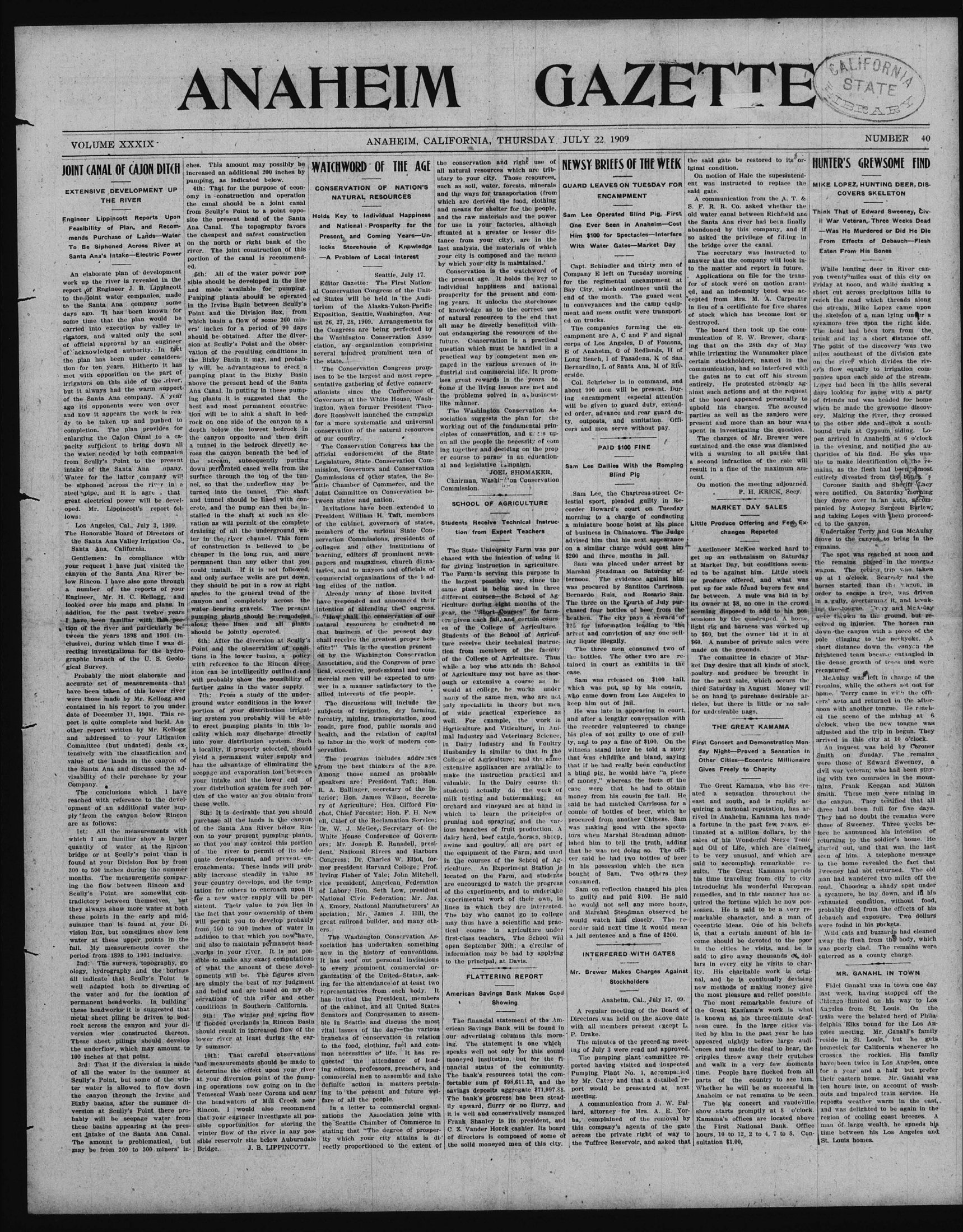
Searchable text
JOINT CANAL OF CAJON DITCH
EXTENSIVE DEVELOPMENT UP THE RIVER
Engineer Lippincott Reports Upon Feasibility of Plan, and Recommends Purchase of Lands—Water To Be Siphoned Across River at Santa Ana's Intake—Electric Power
An elaborate plan of development work up the river is revealed in the report of Engineer J. B. Lippincott to the joint water companies, made to the Santa Ana company some days ago. It has been known for some time that the plan would be carried into execution by valley irrigators, and waited only the seal of official approval by an engineer of acknowledged authority. In fact the plan has been under consideration for ten years. Hitherto it has met with opposition on the part of irrigators on this side of the river, but it always had the warm support of the Santa Ana company. A year ago its opponents were won over and now it appears the work is ready to be taken up and pushed to completion. The plan provides for enlarging the Cajon Canal to a capacity sufficient to bring down all the water needed by both companies.
This amount may possibly be increased an additional 200 inches by pumping, as indicated below.
4th: That for the purpose of economy in construction and operation the canal should be a joint canal from Scully's Point to a point opposite the present head of the Santa Ana Canal. The topography favors the cheapest and safest construction on the north or right bank of the river. The joint construction of this portion of the canal is recommended.
5th: All of the water power possible should be developed in the line and made available for pumping. Pumping plants should be operated in the Irvine Basin between Scully's Point and the Division Box, from which basin a flow of some 200 miners' inches for a period of 90 days should be obtained. After the diversion at Scully's Point and the observation of the resulting conditions in the Bixby Basin it may, and probably will, be advantageous to erect a pumping plant in the Bixby Basin above the present head of the Santa Ana Canal. In putting in these pumping plants it is suggested that the best and most permanent construction will be to sink a shaft in bedrock on one side of the canyon to a depth below the lowest bedrock in the canyon opposite and then drift a tunnel in the bedrock directly across the canyon beneath the bed of...
tion for ten years. Hitherto it has met with opposition on the part of irrigators on this side of the river, but it always had the warm support of the Santa Ana company. A year ago its opponents were won over and now it appears the work is ready to be taken up and pushed to completion. The plan provides for enlarging the Cajon Canal to a capacity sufficient to bring down all the water needed by both companies from Scully's Point to the present intake of the Santa Ana company. Water for the latter company will be siphoned across the river in a steel pipe, and it is agreed that great electrical power will be developed. Mr. Lippincott's report follows:
Los Angeles, Cal., July 3, 1909.
The Honorable Board of Directors of the Santa Ana Valley Irrigation Co., Santa Ana, California.
Gentlemen: In compliance with your request I have just visited the canyon of the Santa Ana River below Rincon. I have also gone through a number of the reports of your Engineer, Mr. H. C. Kellogg, and looked over his maps and plans. In addition, for the past twelve years I have been familiar with this portion of the river and particularly between the years 1898 and 1901 (inclusive), during which time I was directing investigations for the hydrographic branch of the U. S. Geological Survey.
Probably the most elaborate and accurate set of measurements that have been taken of this lower river were those made by Mr. Kellogg and contained in his report to you under date of December 11, 1901. This report is quite complete and lucid. Another report written by Mr. Kellogg and addressed to your Litigation Committee (but undated) deals extensively with the classification and value of the lands in the canyon of the Santa Ana and discussed the advisability of their purchase by your Company.
The conclusions which I have reached with reference to the development of an additional water supply from the canyon below Rincon are as follows:
1st: All the measurements with which I am familiar show a larger quantity of water at the Rincon bridge or at Scully's point than is found at your Division Box by from 300 to 500 inches during the summer will, be advantageous to erect a pumping plant in the Bixby Basin above the present head of the Santa Ana Canal. In putting in these pumping plants it is suggested that the best and most permanent construction will be to sink a shaft in bedrock on one side of the canyon to a depth below the lowest bedrock in the canyon opposite and then drift a tunnel in the bedrock directly across the canyon beneath the bed of the stream, subsequently putting down perforated cased wells from the surface through the top of the tunnel, so that the underflow may be turned into the tunnel. The shaft and tunnel should be lined with concrete, and the pump can then be installed in the shaft at such an elevation as will permit of the complete draining of all the underground water in the river channel. This form of construction is believed to be cheaper in the long run, and more permanent than any other that you could install. If it is not followed, and only surface wells are put down, they should be put in a row at right angles to the general trend of the canyon and completely across the water bearing gravels. The present pumping plants should be remodeled along these lines and all plants should be jointly operated.
6th: After the diversion at Scully's Point and the observation of conditions in the lower basins, a policy with reference to the Rincon diversion can be intelligently outlined and will probably show the possibility of further gains in the water supply.
7th: From a study of the underground water conditions in the lower portion of your distribution irrigating system you probably will be able to erct pumping plants in this locality which may discharge directly into your distribution system. Such a locality, if properly selected, should yield a permanent water supply and has the advantage of eliminating the seepage and evaporation lost between your intake and the lower end of your distribution system for such portion of the water as you obtain from these wells.
8th: It is desirable that you should purchase all the lands in the canyon of the Santa Ana River below Rincon to your present pumping plants, so that you may control this portion of the river to permit of its adequate development, and prevent encroachments. These lands will prob-
The conclusions which I have reached with reference to the development of an additional water supply from the canyon below Rincon are as follows:
1st: All the measurements with which I am familiar show a larger quantity of water at the Rincon bridge or at Scully's point than is found at your Division Box by from 300 to 500 inches during the summer months. The measurements comparing the flow between Rincon and Scully's Point are somewhat contradictory between themselves, but they always show more water at both these points in the early and mid-summer than is found at your Division Box, but sometimes show less water at these upper points in the fall. My measurements cover the period from 1898 to 1901 inclusive.
2nd: The surveys, topography, geology, hydrography and the borings all indicate that Scully's Point is well adapted both to diverting of the water and for the location of permanent headworks. In building these headworks it is suggested that metal sheet piling be driven to bedrock across the canyon and your diversion wier constructed thereon. These sheet pilings should develop the underflow, which may amount to 100 inches at that point.
3rd: That if the diversion is made of all the water in the summer at Scully's Point, but some of the winter water is allowed to flow down the canyon through the Irvine and Bixby basins, after the summer diversion at Scully's Point there probably will be seepage water from these basins appearing at the present intake of the Santa Ana Canal. The amount is problematical, but may be from 200 to 300 miners' in-
8th: It is desirable that you should purchase all the lands in the canyon of the Santa Ana River below Rincon to your present pumping plants, so that you may control this portion of the river to permit of its adequate development, and prevent encroachments. These lands will probably increase steadily in value as your country develops, and the temptation for others to encroach upon it for a new water supply will be persistent. Their value to you lies in the fact that your ownership of them will permit you to develop probably from 700 to 900 inches of water in addition to that which you now have, and also to maintain permanent headworks in your river. It is not possible to make any exact computations of what the amount of these developments will be. The figures given are simply the best of my judgment and belief and are based on my observations of this river and other conditions in Southern California.
9th: The winter and spring flow if flooded overlands in Rincon Basin should result in increased flow of the lower river at least during the early summer.
10th: That careful observations and measurements should be made to determine the effect upon your river at your diversion point of the pumping operations now going on in the Temescal Wash near Corona and near the headwaters of Mill Creek near Rincon. I would also recommend that your engineer investigate all possible opportunities for storing the winter flow of the river in any possible reservoir site below Auburndale Bridge.
J. B. LIPPINCOTT.
ANAHEIM, CALIFORNIA, THURSDAY JULY 22, 1909
WATCHWORD OF THE AGE
CONSERVATION OF NATION'S NATURAL RESOURCES
Holds Key to Individual Happiness and National Prosperity for the Present and Coming Years—Unlocks Storehouse of Knowledge —A Problem of Local Interest
Seattle, July 17.
Editor Gazette: The First National Conservation Congress of the United States will be held in the Auditorium of the Alaska-Yukon-Pacific Exposition, Seattle, Washington, August 26, 27, 28, 1909. Arrangements for the Congress are being perfected by the Washington Conservation Association, an organization comprising several hundred prominent men of the state.
The Conservation Congress promises to be the largest and most representative gathering of active conservationists since the Conference of Governors at the White House, Washington, when former President Theodore Roosevelt launched the campaign for a more systematic and universal conservation of the natural resources of our country.
The Conservation Congress has the official endorsement of the State Conservation Commission.
the conservation and right use of all natural resources which are tributary to your city. Those resources, such as soil, water, forests, minerals and the ways for transportation (from which are derived the food, clothing and means for shelter for the people, and the raw materials and the power for use in your factories, although situated at a greater or lesser distance from your city), are in the last analysis, the materials of which your city is composed and the means by which your city is maintained.
Conservation is the watchword of the present age. It holds the key to individual happiness and national prosperity for the present and coming years. It unlocks the storehouse of knowledge as to the correct use of natural resources to the end that all may be directly benefitted without endangering the resources of the future. Conservation is a practical question which must be handled in a practical way by competent men engaged in the various avenues of industrial and commercial life. It promises great rewards in the years to come if the living issues are met and the problems solved in a business-like manner.
The Washington Conservation Association suggests the plan for the working out of the fundamental principles of conservation, and uses upon all the people the necessity of coming together and deciding on the proper course to pursue in an education-
NEWSY BRIEFES OF THE WEEK
GUARD LEAVES ON TUESDAY FOR ENCAMPMENT
Sam Lee Operated Blind Pig, First One Ever Seen in Anaheim—Cost Him $100 for Spectacles—Interfer With Water Gates—Market Day
Capt. Schindler and thirty men of Company E left on Tuesday morning for the regimental encampment at Bay City, which continues until the end of the month. The guard went in conveyances and the camp equipment and mess outfit were transported on trucks.
The companies forming the encampment are A, C and F and signa corps of Los Angeles, D of Pomona E of Anaheim, G of Redlands, H of Long Beach, I of Pasadena, K of San Bernardino, L of Santa Ana, M of Riverside.
Col. Schrieber is in command, and about 900 men will be present. During encampment especial attention will be given to guard duty, extend ed order, advance and rear guard duity, outposts, and sanitation. Officers and men serve without pay.
PAID $100 FINE
The Conservation Congress promises to be the largest and most representative gathering of active conservationists since the Conference of Governors at the White House, Washington, when former President Theodore Roosevelt launched the campaign for a more systematic and universal conservation of the natural resources of our country.
The Conservation Congress has the official endorsement of the State Legislature, State Conservation Commission, Governors and Conservation Commissions of other states, the Seattle Chamber of Commerce, and the Joint Committee on Conservation between states and nation.
Invitations have been extended to President William H. Taft, members of the cabinet, governors of states, members of the various State Conservation Commissions, presidents of colleges and other institutions of learning, editors of prominent newspapers and magazines, church dignaries, and to mayors and officials of commercial organizations of the leading cities of the nation.
Already many of those invited have responded and announced their intention of attending the Congress.
"How shall the conservation of our natural resources be conducted so that business of the present day shall receive the greatest proper benefits?" This is the question presented by the Washington Conservation Association, and the Congress of practical, executive, professional and commercial men will be expected to answer in a manner satisfactory to the allied interests of the people.
The discussions will include the subjects of irrigation, dry farming, forestry, mining, transportation, good roads, pure food, public morals and health, and the relation of capital to labor in the work of modern conservation.
The program includes addresses from the best thinkers of the age. Among those named as probable speakers are: President Taft; Hon. R. A. Ballinger, secretary of the Interior; Hon. James Wilson, Secretary of Agriculture; Hon. Gifford Pinchot, Chief Forester; Hon. F. H. Newell, Chief of the Reclamation Service; Dr. W. J. McGee, Secretary of the White House Conference of Governors; Mr. Joseph E. Ransdell, president, National Rivers and Harbors Congress; Dr. Charles W. Elliot, former president Harvard College; Prof. Bernardino, L of Santa Ana, M of River side.
Col. Schrieber is in command, and about 900 men will be present. During encampment especial attention will be given to guard duty, extended order, advance and rear guard duty, outposts, and sanitation. Officers and men serve without pay.
PAID $100 FINE
Sam Lee Dallies With the Romping Blind Pig
Sam Lee, the Chartress-street Celestial sport, pleaded guilty in Recorder Howard's court on Tuesday morning to a charge of conducting a miniature booze hoist at his place of business in Chinatown. The Judge advised him that his next appearance on a similar charge would cost him $200 and three months in jail.
Sam was placed under arrest by Marshal Steadman on Saturday afternoon. The evidence against him was procured by Santitos Carrisosa Bernardo Ruiz, and Rosario Sainz. The three on the Fourth of July purchased four bottles of beer from the heathen. The city pays a reward of $25 for information leading to the arrest and conviction of any one selling liquor illegally.
The three men consumed two or three bottles. The other two are retained in court as exhibits in this case.
Sam was released on $100 bail which was put up by his cousin who came down from Los Angeles to keep him out of jail.
He was late in appearing in court and after a lengthy conversation with the recorder volunteered to change his plea of not guilty to one of guilty, and to pay a fine of $100. On the witness stand later he told a story that was childlike and bland, saying that if he had really been conducting a blind pig, he would have "a piece of money," whereas the facts of the case were that he had to obtain money from his cousin for bail. He said he had matched Carrisosa for a couple of bottles of beer, which he procured from another Chinese. Sam was making good with the spectators when Marshal Steadman admired him to tell the truth, adding that he was not doing so. The officer said he had two bottles of beer in his possession which the me
Among those named as probable speakers are: President Taft; Hon. R. A. Ballinger, secretary of the Interior; Hon. James Wilson, Secretary of Agriculture; Hon. Gifford Pinchot, Chief Forester; Hon. F. H. Newell, Chief of the Reclamation Service; Dr. W. J. McGee, Secretary of the White House Conference of Governors; Mr. Joseph E. Ransdell, president, National Rivers and Harbors Congress; Dr. Charles W. Elliot, former president Harvard College; Prof. Irving Fisher of Yale; John Mitchell, vice president, American Federation of Labor; Hon. Seth Low, president National Civic Federation; Mr. Jas. A. Emory, National Manufacturers' Association; Mr. James J. Hill, the great railroad builder, and many others.
The Washington Conservation Association has undertaken something new in the history of conventions. It has sent out personal invitations to every prominent commercial organization of the United States, asking for the attendance of at least two representatives from each body. It has invited the President, members of the cabinet, and all United States Senators and Congressmen to assemble in Seattle and discuss the most vital issues of the day—the various branches of conservation in relation to the food, clothing, fuel and common necessities of life. It has requested the attendance of leading editors, professors, preachers, and commercial men to assemble and take definite action in matters pertaining to the present and future welfare of all the people.
In a letter to commercial organizations the Association joins with the Seattle Chamber of Commerce stating that "The degree of prosperity which your city attains is directly proportioned to the extent of make the instruction practical and valuable. In the Dairy course students actually do the work of milk testing and buttermaking; an orchard and vineyard are at hand in which to learn the principles of pruning and spraying, and the various branches of fruit production. A dairy herd, beef cattle, horses, sheep, swine and poultry, all are part of the equipment of the Farm, and used in the courses of the School of Agriculture. An Experiment Station is located on the Farm, and students are encouraged to watch the progress of the experiments, and to undertake experimental work of their own, in lines in which they are interested. The boy who cannot go to college may thus have a scientific and practical course in agriculture under first-class teachers. The School will open September 20th; a circular of information may be had by applying to the principal, at Davis.
FLATTERING REPORT
American Savings Bank Makes Good Showing
The financial statement of the American Savings Bank will be found in our advertising columns this morning. The statement is one which speaks well not only for this sound moneyed institution, but for the financial status of the community. The bank's resources total the comfortable sum of $98,611.33, and the savings deposits aggregate $71,997.88. The bank's progress has been steadily upward, flurry or no flurry, and it is well and conservatively managed Frank Shanley is its president, and C. Z. Vander Horck cashier. Its board of directors is composed of some of the solid moneyed men of this city.
Sam on reflection changed his plan to guilty and paid $100. He said he would not sell any more books and Marshal Steadman observed him to tell the truth, adding that he was not doing so. The officer said he had two bottles of beer in his possession which the men bought of Sam. Two others then consumed.
Sam on reflection changed his plan to guilty and paid $100. He said he would not sell any more books and Marshal Steadman observed him to tell the truth, adding that he was not doing so. The officer said he had two bottles of beer in his possession which the men bought of Sam. Two others then consumed.
Mr. Brewer Makes Charges Against Stockholders
Anaheim, Cal., July 17, 00
A regular meeting of the Board Directors was held on the above day with all members present except P. Drake.
The minutes of the preceding meeting of July 3 were read and approved.
The pumping plant committee reported having visited and inspect Pumping Plant No. 1, accompanied by Mr. Catey and that a detailed report would be presented at next meeting.
A communication from J. W. Baldard, attorney for Mrs. A. E. Yba, complained of the removal of this company's agents of the group across the private right of way in the Tuffree Reservoir, and asked
BRIEF'S OF THE WEEK
VES ON TUESDAY FOR
ENCAMPMENT
Operated Blind Pig, First
Seen in Anaheim—Cost
for Spectacles—Interfere
Gates—Market Day
Handler and thirty men of left on Tuesday morningimental encampment at which continues until the month. The guard went peace and the camp equip-ness outfit were transportanies forming the enprise A, C and F and signal
s Angeles, D of Pomona,
am, G of Redlands, H of
I of Pasadena, K of San
L of Santa Ana, M of Rivber is in command, and
men will be present. Durment especial attention
on to guard duty, extendance and rear guard dution, and sanitation. Offinence serve without pay.
AID $100 FINE
the said gate be restored to its original condition.
On motion of Hale the superintendent was instructed to replace the
said gate.
A communication from the A. T. & S. F. R. R. Co. asked whether the old water canal between Richfield and the Santa Ana river has been finally abandoned by this company, and if so asked the privilege of filing in the bridge over the canal.
The secretary was instructed to answer that the company will look into the matter and report in future.
Applications on file for the transfer of stock were on motion granted, and an indemnity bond was accepted from Mrs. M. A. Carpenter in lieu of a certificate for five shares of stock which has become lost or destroyed.
The board then took up the com-munication of E. W. Brewer, charging that on the 28th day of May while irrigating the Wanamaker place certain stockholders, named in the communication, had so interfered with the gates as to cut off his stream entirely. He protested strongly against such actions and at the request of the board appeared personally to uphold his charges. The accused parties as well as the zanjero were present and more than an hour was spent in investigating the question.
The charges of Mr. Brewer were sustained and the case was dismissed with a warning to all parties that
HUNTER'S GREWSOME FIND
MIKE LOPEZ, HUNTING DEER, DISCOVERS SKELETON
Think That of Edward Sweeney, Civil War Veteran, Three Weeks Dead —Was He Murdered or Did He Die From Effects of Debauch—Flesh Eaten From His Bones
While hunting deer in River canyon twenty miles east of this city on Friday at noon, and while making a short cut across precipitous hills to reach the road which threads along the stream, Mike Lopez came upon the skeleton of a man lying under a sycamore tree upon the right side. The head had been torn from the trunk and lay a short distance off. The point of the discovery was two miles southeast of the division gate on the river which divides the river's flow equally to irrigation companies upon each side of the stream. Lopez had been in the hills several days looking for game with a party of friends and was headed for home when he made the grewsome discovery. Making the river, they crossed to the other side and took a south-bound train at Gypsum siding. Lopez arrived in Anaheim at 6 o'clock in the evening, and notified the authorities of his find. He was una-
AID $100 FINE
Allies With the Romping Blind Pig
In the Chartress-street Cen., pleaded guilty in Reard's court on Tuesday to a charge of conducting a booze hoist at his place in Chinatown. The Judge said that his next appearance for charge would cost him three months in jail.
Placed under arrest by Reardman on Saturday after the evidence against him led by Santitos Carrisosa, Ruiz, and Rosario Saiz, on the Fourth of July purged bottles of beer from the city pays a reward of information leading to the conviction of any one sell-belgally.
The men consumed two of the other two are recount as exhibits in the released on $100 bail. He put up by his cousin, down from Los Angeles to out of jail.
Date in appearing in court, lengthy conversation with her volunteered to change not guilty to one of guillotry a fine of $100. On the second later he told a story childlike and bland, saying had really been conducting it, he would have "a piece of whereas the facts of the case that he had to obtain in his cousin for bail. He matched Carrisosa for a bottles of beer, which he from another Chinese. Sam good with the spectacle Marshal Steadman admonition to tell the truth, adding is not doing so. The office had two bottles of beer possession which the men certain stockholders, made in communication, had so interfered with the gates as to cut off his stream entirely. He protested strongly against such actions and at the request of the board appeared personally to uphold his charges. The accused parties as well as the zanjero were present and more than an hour was spent in investigating the question.
The charges of Mr. Brewer were sustained and the case was dismissed with a warning to all parties that a second infraction of the rule will result in a fine of the maximum amount.
On motion the meeting adjourned. P. H. KRICK, Secy.
MARKET DAY SALES
Little Produce Offering and Farm Exchanges Reported
Auctioneer McKee worked hard to get up an enthusiasm on Saturday at Market Day, but conditions seemed to be against him. Little stock or produce offered, and what was put up for sale found buyers few and far between. A mule was bid in by its owner at $8, no one in the crowd seeming disposed to add to his possessions by the quadruped. A horse, light rig and harness was worked up to $60, but the owner bid it in at $60. A number of private sales were made on the grounds.
The committee in charge of Market Day desire that all kinds of stock, poultry and produce be brought in for the next sale, which occurs the third Saturday in August. Money will be on hand to purchase desirable articles, but there is little or no sale for undesirable nags.
THE GREAT KAMAMA
First Concert and Demonstration Monday Night—Proved a Sensation in Other Cities—Eccentric Millionaire Gives Freely to Charity
The Great Kamama, who has created a sensation throughout the east and south, and is rapidly acquiring a national reputation, has arrived in Anaheim, Kamama has made a fortune in the past few years. estimated at a million dollars, by the sales of his Wonderful Nerve Tonic and Oil of Life, which are claimed to be very unusual, and which are said to accomplish remarkable results.
The Great Kamama spends on the river which divides the River's flow equally to irrigation companies upon each side of the stream. Lopez had been in the hills several days looking for game with a party of friends and was headed for home when he made the grewsome discovery. Making the river, they crossed to the other side and took a southbound train at Gypsum siding. Lopez arrived in Anaheim at 6 o'clock in the evening, and notified the authorities of his find. He was unable to make identification of the remains, as the flesh had been almost entirely divested from the bones.
Coroner Smith and Sheriff Lacy were notified. On Saturday morning they drove over in an auto, accompanied by Autopsy Surgeon Burlew; and taking Lopez with them proceeded to the canyon.
Undertaker Terry and Gus McAulay drove to the canyon to bring in the remains.
The spot was reached at noon and the remains placed in the morgue wagon. The return trip was taken up at 1 o'clock. Scarcely had the horses started than the wagon, in order to escape a tree, was driven in a gully, overturning it, and breaking the tongue. Terry and McAulay were thrown to the ground, but received no injuries. The horses ran down the canyon with a piece of the pole clinging to the neckyoke. A short distance down the canyon the frightened team became entangled in the dense growth of trees and were recaptured.
McAulay was left in charge of the remains, while the others set out for home. Terry came in with the officers' auto and returned in the afternoon with another tongue. He reached the scene of the mishap at 6 o'clock, when the new tongue was adjusted and the trip in begun. They arrived in this city at 10 o'clock.
An inquest was held by Coroner Smith on Sunday. The remains were those of Edward Sweeney, a civil war veteran; who had been staying with two comrades in the mountains, Frank Keegan and Milton Smith. These men were mining in the canyon. They testified that all three had been full for five days. They had no doubt the remains were those of Sweeney. Three weeks before he announced his intention of returning to the soldier's home. He started out, and that was the last seen of him. A telephone message to the home revealed the fact that Sweeney had not returned. The old
The Great Kamama, who has created a sensation throughout the east and south, and is rapidly acquiring a national reputation, has arrived in Anaheim. Kamama has made a fortune in the past few years, estimated at a million dollars, by the sales of his Wonderful Nerve Tonic and Oil of Life, which are claimed to be very unusual, and which are said to accomplish remarkable results. The Great Kamama spends his time traveling from city to city introducing his wonderful European remedies, and in this manner has acquired the fortune which he now possesses. He is said to be a very remarkable character, and a man of eccentric ideas. One of his beliefs is, that a certain amount of his income should be devoted to the poor in the cities he visits, and he is said to give away thousands of dollars in every city he visits to charity. His charitable work is original, and he is continually devising new methods of making money give the most pleasure and relief possible.
The most remarkable feature of the Great Kamama's work is what is known as his three-minute deafness cure. In the large cities visited by him in the past year he has appeared nightly before large audiences and made the deaf to hear, cripples throw away their crutches and walk in a very few moments time. People have flocked from all parts of the country to see him. Whether he will be as successful in Anaheim or not remains to be seen.
The big concert and vaudeville show starts promptly at 8 o'clock. Kamama's offices are located above the First National Bank. Office hours, 10 to 12, 2 to 4, 7 to 8. Consultation $1.00,
with two comrades in the mountains, Frank Keegan and Milton Smith. These men were mining in the canyon. They testified that all three had been full for five days. They had no doubt the remains were those of Sweeney. Three weeks before he announced his intention of returning to the soldier's home. He started out, and that was the last seen of him. A telephone message to the home revealed the fact that Sweeney had not returned. The old man had wandered two miles off the road. Choosing a shady spot under a sycamore, he lay down, and if his exhausted condition, without food, probably died from the effects of his debauch and exposure. Two dollars were found in his pockets.
Wild cats and buzzards had cleaned away the flesh from the body, which was poorly clad. The remains were entered as a county charge.
MR. GANAHL IN TOWN
Fidel Ganahl was in town one day last week, having stopped off the Chicago limited on his way to Los Angeles from St. Louis. On the train were the belated herd of Philadelphia Elks bound for the Los Angeles meeting. Mr. Ganahl's family reside in St. Louis, but he gets homesick for California whenever he crosses the rockies. His family have been twice in Los Angeles, once for a year and a half but prefer their eastern home. Mr. Ganahl was ten hours late, on account of wash-outs and impaired train service. He reports weather warm in the east, and was delighted to be again in the region of cooling coast breezes. A man of large wealth, he spends his time between his Los Angeles and St. Louis homes.