anaheim-gazette 1909-07-08
Scanned page
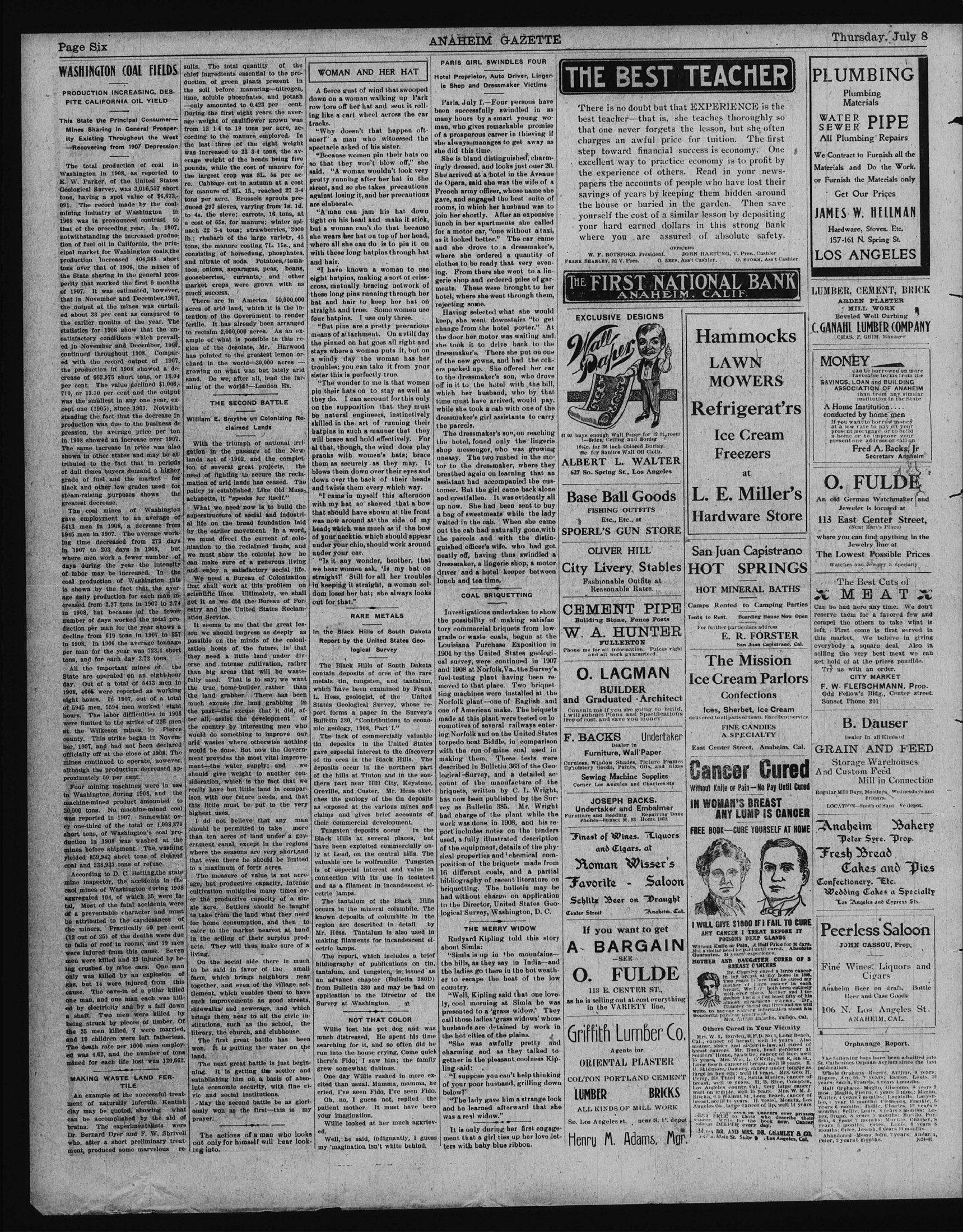
Searchable text
WASHINGTON COAL FIELDS
PRODUCTION INCREASING, DES-PITE CALIFORNIA OIL YIELD
This State the Principal Consumer—Mines Sharing in General Prosperity Existing Throughout the West—Recovering from 1907 Depression.
The total production of coal in Washington in 1908, as reported to E. W. Parker, of the United States Geological Survey, was 3,016,557 short tons, having a spot value of $6,673,-091. The record made by the coalmining industry of Washington in 1908 was in pronounced contrast to that of the preceding year. In 1907, notwithstanding the increased production of fuel oil in California, the principal market for Washington coals,the production increased 404,348 short tons over that of 1906, the mines of the State sharing in the general prosperity that marked the first 9 months of 1907. It was estimated, however, that in November and December,1907, the output at the mines was curtailed about 33 per cent as compared to the earlier months of the year. The statistics for 1908 show that the unsatisfactory conditions which prevailed in November and December,1907, continued throughout 1908. Compared with the record output of 1907, the production in 1908 showed a decrease of 663,975 short tons, or 18.04 per cent. The value declined $1,006,-710, or 13.10 per cent and the output was the smallest in any one year, except one (1905), since 1903. Notwithstanding the fact that the decrease in production was due to the business depression, the average price per ton in 1908 showed an increase over 1907. The same increase in price was also shown in other states and may be at results. The total quantity of the chief ingredients essential to the production of green plants present in the soil before manuring—nitrogen, lime, soluble phosphates, and potash—only amounted to 0.423 per cent. During the first eight years the average weight of cauliflower grown was from 13 1-4 to 19 tons per acre, according to the manure employed. In the last three of the eight weight was increased to 23 3-4 tons, the average weight of the heads being five pounds, while the cost of manure for the largest crop was 8L. 5s per acre. Cabbage cut in autumn at a cost for manure of 8L. 15., reached 27 3-4 tons per acre. Brussels sprouts produced 297 sieves, varying from 1s. 1d. to 4s. the sieve; carrots, 16 tons, at a cost of 65s. for manure; winter spinach 22 3-4 tons; strawberries, 3000 lb.; rhubarb of the large variety, 45 tons, the manure costing 7L. 15s., and consisting of horsedung, phosphates, and nitrate of soda. Potatoes./tomatoes, onions, asparagus, peas, beans, gooseberries, currants, and other market crops were grown with as much success.
There are in America 50,000,000 acres of arid land, which it is the intention of the Government to render fertile. It has already been arranged to reclaim 2,000,000 acres. As an example of what is possible in this region of the desolate, Mr. Harwood has pointed to the greatest lemon orchard in the world—30,000 acres — growing on what was but lately arid sand. Do we, after all, lead the farming of the world?—London Ex.
THE SECOND BATTLE
William E. Smythe on Colonizing Reclaimed Lands
With the triumph of national irrigation in the passage of the New lands act of 1902 and the complete
the production in 1908 showed a decrease of 663,975 short tons, or 18.04 per cent. The value declined $1,006,710, or 13.10 per cent and the output was the smallest in any one year, except one (1905), since 1903. Notwithstanding the fact that the decrease in production was due to the business depression, the average price per ton in 1908 showed an increase over 1907. The same increase in price was also shown in other states and may be attributed to the fact that in periods of dull times buyers demand a higher grade of fuel and the market for slack and other low grades used for steam-raising purposes shows the greatest decrease.
The coal mines of Washington gave employment to an average of 5413 men in 1908, a decrease from 5945 men in 1907. The average working time decreased from 273 days in 1907 to 203 days in 1908, but where men work a fewer number of days during the year the intensity of labor may be increased. In the coal production of Washington this is shown by the fact that the average daily production for each man increased from 2.27 tons in 1907 to 2.74 in 1908, but because of the fewer number of days worked the total production per man for the year shows a decline from 619 tons in 1907 to 557 in 1908. In 1906 the average tonnage per man for the year was 723.4 short tons, and for each day 2.72 tons.
All the important mines of the State are operated on an eight-hour day. Out of a total of 5413 men in 1908, 4666 were reported as working eight hours. In 1907, out of a total of 5945 men, 5594 men worked eight hours. The labor difficulties in 1908 were limited to the strike of 226 men at the Wilkeson mines, in Pierce county. This strike began in November, 1907, and had not been declared officially off at the close of 1908. The mines continued to operate, however, although the production decreased approximately 50 per cent.
Four mining machines were in use in Washington during 1908, and the machine-mined product amounted to 20,000 tons. No machine-mined coal was reported in 1907. Somewhat over one-third of the total or 1,098,879 short tons, of Washington's coal production in 1908 was washed at the mines before shipment. The washing yielded 859,942 short tons of cleaned coal and 238,937 tons of refuse.
With the triumph of national irrigation in the passage of the Newlands act of 1902, and the completion of several great projects, the need of fighting to secure the reclamation of arid lands has ceased. The policy is established. Like Old Massachusetts, it "speaks for itself."
What we need now is to build the superstructure of social and industrial life on the broad foundation laid by the earlier movement. In a word, we must direct the current of colonization to the reclaimed lands, and we must show the colonist how he can make sure of a generous living and enjoy a satisfactory social life.
We need a Bureau of Colonization that shall work at this problem on scientific lines. Ultimately, we shall get it as we did the Bureau of Forestry and the United States Reclamation Service.
It seems to me that the great lesson we should impress as deeply as possible on the minds of the colonization hosts of the future, is that they need a little land under diverse and intense cultivation, rather than big areas that will be wastefully used. That is to say, we want the true home-builder rather than the land grabber. There has been much excuse for land grabbing in the past—the excuse that it did, after all, assist the development of the country by interesting men who would do something to improve our arid wastes where otherwise nothing would be done. But now the Government provides the most vital improvement—the water supply; and we should give weight to another consideration, which is the fact that we really have but little land in comparison with our future needs, and that this little must be put to the very highest uses.
I do not believe that any man should be permitted to take more than ten acres of land under a government canal, except in the regions where the seasons are very short,and that even there he should be limited to a maximum of forty acres.
THE SECOND BATTLE
William E. Smythe on Colonizing Reclaimed Lands
With the triumph of national irrigation in the passage of the Newlands act of 1902, and the completion of several great projects, the need of fighting to secure the reclamation of arid lands has ceased. The policy is established. Like Old Massachusetts, it "speaks for itself."
What we need now is to build the superstructure of social and industrial life on the broad foundation laid by the earlier movement. In a word, we must direct the current of colonization to the reclaimed lands, and we must show the colonist how he can make sure of a generous living and enjoy a satisfactory social life.
We need a Bureau of Colonization that shall work at this problem on scientific lines. Ultimately, we shall get it as we did the Bureau of Forestry and the United States Reclamation Service.
It seems to me that the great lesson we should impress as deeply as possible on the minds of the colonization hosts of the future, is that they need a little land under diverse and intense cultivation, rather than big areas that will be wastefully used. That is to say, we want the true home-builder rather than the land grabber. There has been much excuse for land grabbing in the past—the excuse that it did, after all, assist the development of the country by interesting men who would do something to improve our arid wastes where otherwise nothing would be done. But now the Government provides the most vital improvement—the water supply; and we should give weight to another consideration, which is the fact that we really have but little land in comparison with our future needs, and that this little must be put to the very highest uses.
I do not believe that any man should be permitted to take more than ten acres of land under a government canal, except in the regions where the seasons are very short,and that even there he should be limited to a maximum of forty acres.
The Black Hills contain deposits of tin deposits; gave especial importance of tin ores in deposits occur at hills at thern part near Oreville, and Chesapeake geology as exposed at claims and gave their commercials.
Tungsten deBlack Hills have been expoly at Lead, or valuable ore is is of especial
Four mining machines were in use in Washington during 1908, and the machine-mined product amounted to 20,000 tons. No machine-mined coal was reported in 1907. Somewhat over one-third of the total or 1,098,879 short tons, of Washington's coal production in 1908 was washed at the mines before shipment. The washing yielded 859,942 short tons of cleaned coal and 238,937 tons of refuse.
According to D. C. Botting, the state mine inspector, the accidents in the caol mines of Washington during 1908 aggregated 104, of which 25 were fatal. Most of the fatal accidents were of a preventable character and must be attributed to the carelessness of the miners. Practically 50 per cent (12 out of 25) of the deaths were due to falls of roof in rooms, and 19 men were injured from this cause. Seven men were killed and 23 injured by being crushed by mine cars. One man only was killed by an explosion of gas, but 14 were injured from this cause. The cave-in of a pillar killed one man, and one man each was killed by electricity and by a fall down a shaft. Two men were killed by being struck by pieces of timber. Of the 25 men killed, 7 were married, and 19 children were left fatherless. The death rate per 1000 men employed was 4.62, and the number of tons mined for each life lost was 120,662.
MAKING WASTE LAND FERTILE
An example of the successful treatment of naturally infertile Kentish clay may be quoted, showing what can be accomplished by the aid of brains. The experimentalists were Dr. Bernard Dyer and F. W. Shrivell who, after a short preliminary treatment, produced some marvelous re-
should give weight to another consideration, which is the fact that we really have but little land in comparison with our future needs, and that this little must be put to the very highest uses.
I do not believe that any man should be permitted to take more than ten acres of land under a government canal, except in the regions where the seasons are very short, and that even there he should be limited to a maximum of forty acres.
The measure of value is not acreage, but productive capacity. Intense cultivation multiplies many times over the productive capacity of a single acre. Settlers should be taught to take from the land what they need for home consumption, and then to cater to the market nearest at hand in the selling of their surplus products. They will thus make sure of a living.
On the social side there is much to be said in favor of the small farm, which brings neighbors near together, and even of the village settlement, which enables them to have such improvements as good streets, sidewalks/and sewerage, and which brings them near to all the civic institutions, such as the school, the library, the church, and clubhouse.
The first great battle has been won. It is putting the water on the land.
The next great battle is just beginning. It is getting the settler and establishing him on a basis of absolute economic security, with fine civic and social institutions.
May the second battle be as gloriously won as the first—this is my prayer.
The actions of a man who looks out only for himself will bear looking into.
WOMAN AND HER HAT
A fierce gust of wind that swooped down on a woman walking up Park row tore off her hat and sent it rolling like a cart wheel across the car tracks.
"Why doesn't that happen oftener?" a man who witnessed the spectacle asked of his sister.
"Because women pin their hats on so that they won't blow off," she said. "A woman wouldn't look very pretty running after her hat in the street, and so she takes precautions against losing it, and her precautions are elaborate.
"A man can jam his hat down tight on his head and make it stick, but a woman can't do that because she wears her hat on top of her head, where all she can do is to pin it on with those long hatpins through hat and hair.
"I have known a woman to use eight hatpins, making a sort of criss-cross, mutually bracing network of these long pins running through her hat and hair to keep her hat on straight and true. Some women use four hatpins. I use only three."
"But pins are a pretty precarious means of attachment. On a still day the pinned on hat goes all right and stays where a woman puts it, but on a windy day the woman has her troubles; you can take it from your sister this is perfectly true.
"The wonder to me is that women pin their hats on to stay as well as they do. I can account for this only on the supposition that they must be natural engineers, instinctively skilled in the art of running their hatpins in such a manner that they will brace and hold effectively. For al that, though, the wind does play pranks with women's hats; brace"
PARIS GIRL SWINDLES FOUR
Hotel Proprietor, Auto Driver, Lingerie Shop and Dressmaker Victims
Paris, July 1.—Four persons have been successfully swindled in as many hours by a smart young woman, who gives remarkable promise of a prosperous career in thieving if she always manages to get away as she did this time.
She is bland distinguished, charmingly dressed, and looks just over 20. She arrived at a hotel in the Avenue de Opera, said she was the wife of a French army officer, whose name she gave, and engaged the best suite of rooms, in which her husband was to join her shortly. After an expensive lunch in her apartments she called for a motor car, "one without a taxi, as it looked better." The car came and she drove to a dressmaker's, where she ordered a quantity of clothes to be ready that very evening. From there she went to a lingerie shop and ordered piles of garments. These were brought to her hotel, where she went through them, rejecting some.
Having selected what she would keep, she went downstairs "to get change from this hotel porter." At the door her motor was waiting and she took it to drive back to the dressmaker's. There she put on one of the new gowns, and had the others packed up. She offered her car to the dressmaker's son, who drove off in it to the hotel with the bill, which her husband, who by that time must have arrived, would pay. while she took a cab with one of the dressmaker's girl assistants to carry the parcels.
The dressmaker's son, on reaching the hotel, found only the lingerie shop messenger, who was growing uneasy. The two rushed in the mo-
The wonder to me is that women pin their hats on to stay as well as they do. I can account for this only on the supposition that they must be natural engineers, instinctively skilled in the art of running their hatpins in such a manner that they will brace and hold effectively. For al that, though, the wind does play pranks with women's hats; brace them as securely as they may. It blows them down over their eyes and down over the back of their heads and twists them every which way.
"I came in myself this afternoon with my hat so skewed that a bow that should have shown at the front was now around at the side of my head; which was much as if the bow of your necktie, which should appear under your chin, should work around under your ear.
"Is it any wonder, brother, that we hear women ask, 'Is my hat on straight?' Still for all her troubles in keeping it straight, a woman seldom loses her hat; she always looks out for that."
RARE METALS
In the Black Hills of South Dakota Report by the United States Geological Survey
The Black Hills of South Dakota contain deposits of ores of the rare metals tin, tungsten, and tantalum, which have been examined by Frank L. Hess, geologist, of the United States Geological Survey, whose report forms a paper in the Survey's Bulletin 380, "Contributions to economic geology, 1908, Part I."
The lack of commercially valuable tin deposits in the United States gave especial interest to the discovery of tin ores in the Black Hills. The deposits occur in the northern part of the hills at Tinton and in the southern part near Hill City, Keystone, Oreville, and Custer. Mr. Hess sketches the geology of the tin deposits as exposed at the various mines and claims and gives brief accounts of their commercial development.
Tungsten deposits occur in the Black Hills at several places, but have been exploited commercially only at Lead, on the central hills. The valuable ore is wolframite. Tungsten is of especial interest and value in troubles; you can take it from your sister this is perfectly true.
"The wonder to me is that women pin their hats on to stay as well as they do. I can account for this only on the supposition that they must be natural engineers, instinctively skilled in the art of running their hatpins in such a manner that they will brace and hold effectively. For al that, though, the wind does play pranks with women's hats; brace them as securely as they may. It blows them down over their eyes and down over the back of their heads and twists them every which way.
"I came in myself this afternoon with my hat so skewed that a bow that should have shown at the front was now around at the side of my head; which was much as if the bow of your necktie, which should appear under your chin, should work around under your ear.
"Is it any wonder, brother, that we hear women ask, 'Is my hat on straight?' Still for all her troubles in keeping it straight, a woman seldom loses her hat; she always looks out for that."
Investigations undertaken to show the possibility of making satisfactory commercial briquets from low-grade or waste coals, begun at the Louisiana Purchase Exposition in 1904 by the United States geological survey, were continued in 1907 and 1908 at Norfolk,Va., the Survey's fuel-testing plant having been removed to that place. Two briquetting machines were installed at the Norfolk plant—one of English and one of American make. The briquets made at this plant were tested on lo comotives of several railways entering Norfolk and on the United States torpedo boat Biddle, in comparison with the run-of-mine coal used in making them. These tests were described in Bulletin 363 of the Geological Survey, and a detailed account of the manufacture of the briquets, written by C. L. Wright, has now been published by the Survey as Bulletin 385. Mr. Wright had charge of the plant while the work was done in 1908, and his report includes notes on the binders used, a fully illustrated description of the equipment, details of the physical properties and chemical composition of the briquets made from
of the hills at Tinton and in the southern part near Hill City, Keystone, Oreville, and Custer. Mr. Hess sketches the geology of the tin deposits as exposed at the various mines and claims and gives brief accounts of their commercial development.
Tungsten deposits occur in the Black Hills at several places, but have been exploited commercially only at Lead, on the central hills. The valuable ore is wolframite. Tungsten is of especial interest and value in connection with its use in toolsteel and as a filament in incandescent electric lamps.
The tantalum of the Black Hills occurs in the mineral columbite. The known deposits of columbite in the region are described in detail by Mr. Hess. Tantalum is also used in making filaments for incandescent electric lamps.
The report, which includes a brief bibliography of publications on tin, tantalum, and tungsten, is issued as an advance chapter (Bulletin 380D) from Bulletin 380 and may be had on application to the Director of the Survey at Washington.
NOT THAT COLOR
Willie lost his pet dog and was much distressed. He spent his time searching for it, and so often did he run into the house crying. Come quick there's Fido; I saw him; the family grew somewhat dubious.
One day Willie rushed in more excited than usual. Mamma, mamma, he cried, I've seen Fido, I've seen Fido.
Oh, no, I guess not, replied the patient mother. It must have been your imagination.
Willie looked at her much aggrieved.
Well, he said, indignantly, I guess my 'magination isn't white behind.
THE MERRY WIDOW
Rudyard Kipling told this story about Simla:
"Simla is up in the mountains—the hills, as they say in India—and the ladies go there in the hot weather to escape the heat of the low country.
"Well, Kipling said that one lovely, cool morning at Simla he was presented to a 'grass widow.' They call those ladies 'grass widows' whose husbands are detained by work in the hot cities of the plains.
"She was awfully pretty and charming and as they talked together in the pleasant coolness Kipling said:
"I suppose you can't help thinking of your poor husband, grilling down below?"
"The lady gave him a strange look and he learned afterward that she was a real widow."
It is only during her first engagement that a girl ties up her love letters with baby blue ribbon."
BEST TEACHER
is no doubt but that EXPERIENCE is the teacher—that is, she teaches thoroughly so none never forgets the lesson, but she often does an awful price for tuition. The first toward financial success is economy. One decent way to practice economy is to profit by experience of others. Read in your news-logs the accounts of people who have lost their years of years by keeping them hidden around house or buried in the garden. Then save self the cost of a similar lesson by depositing hard earned dollars in this strong bank you are assured of absolute safety.
OFFICERS
BOTSFORD, President.
JOHN HARTUNG, V. Pres., Cashier
Y, 2d V. Pres.
O. ZEUS, Ass't Cashier.
O. STORM, Ass't Cashier.
FIRST NATIONAL BANK
ANAHEIM, CALIF.
SIVE DESIGNS
Hammocks
LAWN
MOWERS
Refrigerat'rs
Ice Cream
Freezers
PLUMBING
Plumbing
Materials
WATER PIPE
All Plumbing Repairs
We Contract to Furnish all the Materials and Do the Work,
or Furnish the Materials only
Get Our Prices
JAMES W. HELLMAN
Hardware, Stoves, Etc.
157-161 N. Spring St.
LOS ANGELES
LUMBER, CEMENT, BRICK
ARDEN PLASTER
MILL WORK
Beveled Well Curbing
C. GANAHL LUMBER COMPANY
CHAS. F. GRIM. Manager
MONEY
can be borrowed on more favorable terms from the SAVINGS, LOAN and BUILDING ASSOCIATION OF ANAHEIM than from any similar institution in the State.
A Home Institution... conducted by home men
If you want to borrow money at a low rate to pay off your present mortgage, or to build a home or to improve your present one address or call on Fred A. Backs, Jr.
Secretary Anheim
LAWN MOWERS
Refrigerat’rs
Ice Cream
Freezers
at
L. E. Miller’s
Hardware Store
San Juan Capistrano
HOT SPRINGS
HOT MINERAL BATHS
Camps Rented to Camping Parties
Tents to Rent. Boarding House Now Open
For further particulars address
E. R. FORSTER
San Juan Capistrano, Cal.
The Mission Ice Cream Parlors
Confections
Ices, Sherbet, Ice Cream delivered to all parts of town. Excellent service
FINE CANDIES
A.SPECIALTY
East Center Street, Anaheim, Cal.
Cancer Cured
Without Knife or Pain—No Pay Until Cured
IN WOMAN’S BREAST ANY LUMP IS CANCER
FREE BOOK—CURE YOURSELF AT HOME
MONEY
can be borrowed on more favorable terms from the SAVINGS, LOAN and BUILDING ASSOCIATION OF ANAHEIM than from any similar institution in the State
A Home Institution... conducted by home men
If you want to borrow money at a low rate to pay off your present mortgage, or to build a home or to improve your present one address or call on Fred A. Backs, Jr.
Secretary Anaheim
O. FULDE
An old German Watchmaker and Jeweler is located at 113 East Center Street,
(Near Hart's Place)
whsre you can find anything in the Jewelry line at The Lowest Possible Prices
Watches and Jewelry a specialty
The Best Cuts of MEAT
Can be had here any time. We don’t reserve them for a favored few and compel the others to take what is left. First come is first served in this market. We believe in giving everybody a square deal. Also in selling the very best meat we can get hold of at the prices possible.
Try us with an order.
CITY MARKET
F. W. FLEISCHMANN, Prop.
Odd Fellow's Bldg., Center street
Sunset Phone 201
B. Dauser
Dealer In all Kinds of GRAIN AND FEED
Storage Warehouses.
And Custom Feed
Mill in Connection
Regular Mill Days, Mondays, Wednesdays and Fridays.
LOCATION—South of San Francisco.
Anaheim Bakery
Peter Syre. Prop.
Fresh Bread
Cakes and Dies
Without Knife or Pain—No Pay Until Cured
IN WOMAN'S BREAST ANY LUMP IS CANCER
FREE BOOK—CURE YOURSELF AT HOME
I WILL GIVE $1000 IF I FAIL TO CURE ANY CANCER I TREAT BEFORE IT POISONS DEEP GLANDS
Without Knife or Pain, at Half Price for 30 days. Not a dollar need be paid until cured. Absolute Guarantee. 34 years' experience.
MOTHER AND DAUGHTER CURED OF 3 BREAST CANCERS
Dr. Chamley cured a large cancer in my breast at my home in 1892. Two years later that he cured my mother of large cancer in each breast. We live both been entirely well ever since. Mother and I together know of at least fifty of his almost miraculous cases. Dr. Chamley saved our lives and we will write to anyone wanting information about his wonderful painless treatment.
Mrs. Arthur Iralache, Vallejo, Cal.
Others Cured in Your Vicinity
Mrs. W. L. Borden, R.F.D. No.1, Long Beach, Cal., cancer of breast; well 14 years. Also mother, sister and sister-in-law, all cured of breast cancers. Mr. Beek, head gardener at Soldiers' Home, Sawtelle; cancer of face, well 15 years, Mrs. Wu, L. O'Kelly, 940 E, 5th St., Long Beach, cancer of breast, well 10 years. K. U. Skidmore, Downey, cancer under tongue as large as hen egg; well 14 years. Mrs. Geo. H. Perry, 310 Third St., Santa Monica, cancer of breast, well 10 years. H. B. Rice, Compton, Los Angeles county, Cal., very large cancer wart on temple, well 15 years. Mrs. W. M. J. Ritcha, 6 5 Walnut St., Long Beach, cancer of breast, well 13 years. H. Terrel, Moneta, Los Angeles Co., large cancer of lip, well 14 years.
SENT FREE to those who describe their poisonous DEEPER every day.
DR. AND MRS. DR. CHAMLEY & CO.
747 S. Main St. Suite • Los Angeles, Cal.
Orphanage Report.
The following boys have been admitted into St. Catherine Orphan Asylum since the last publication:
Whole Orphans—Rogers, Arthur, 9 years;
Rogers, Arnold, 7 years; Rainos, Louis, 12 years; Smith, Francis, 8 years 4 months.
Half Orphans—Maglio, Glaceomo, 8 years 3 mos.; Maglio, Pietro, 6 years 3 mos.; Maglie, Walter, 4 years 7 months; Lagatolla, Lazyerio, 1 year 11 months; Clemends, Frankie, 5 years 6 months; Bellic, Charles, 12 years 9 months; Belle, Louis, 8 years 8 months; Lopez, Bruno, 8 years 5 months; Murillo, Porfirio, 6 years 7 months; Murillo, Charley, 8 years 5 months; Ortez, Louis, 8 years 8 months; Ortez, Joseph, 6 years 10 months.
Abandoned—Messa John, 2 years; Andaraa Peter, 2 years 6 months.