anaheim-gazette 1909-07-01
Scanned page
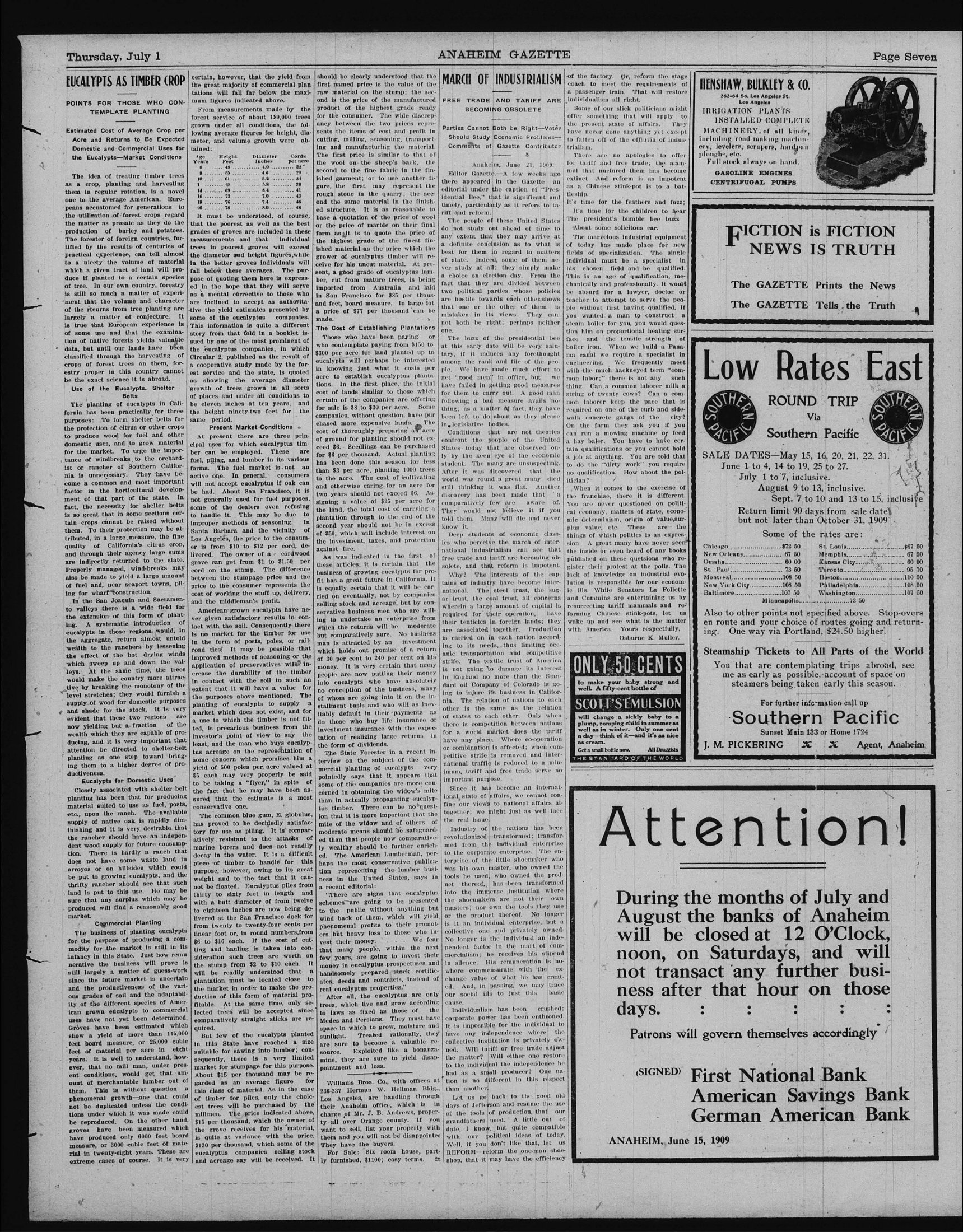
Searchable text
EUCALYPTS AS TIMBER CROP
POINTS FOR THOSE WHO CONTEMPLATE PLANTING
Estimated Cost of Average Crop per Acre and Returns to Be Expected Domestic and Commercial Uses for the Eucalypts—Market Conditions
The idea of treating timber trees as a crop, planting and harvesting them in regular rotation, is a novel one to the average American. Europeans accustomed for generations to the utilization of forest crops regard the matter as prosaic as they do the production of barley and potatoes. The forester of foreign countries, fortified by the results of centuries of practical experience, can tell almost to a nicety the volume of material which a given tract of land will produce if planted to a certain species of tree. In our own country, forestry is still so much a matter of experiment that the volume and character of the rteurns from tree planting are largely a matter of conjecture. It is true that European experience is of some use and that the examination of native forests yields valuable data, but until our lands have been classified through the harvesting of crops of forest trees on them, forestry proper in this country cannot be the exact science it is abroad.
Use of the Eucalyptus. Shelter Belts
The planting of eucalypts in California has been practically for three purposes: To form shelter belts for the protection of citrus or other crops to produce wood for fuel and other domestic uses, and to grow material for the market. To urge the importance of windbreaks to the orchard certain, however, that the yield from the great majority of commercial plantations will fall far below the maximum figures indicated above.
From measurements made by the forest service of about 180,000 trees grown under all conditions, the following average figures for height, diameter, and volume growth were obtained:
Age Years Height Feet Diameter Inches Cords per acre
6 48 4.0 22
8 55 4.6 29
10 61 5.2 34
1 65 5.8 38
14 69 6.4 41
16 73 7.0 43
18 76 7.4 46
20 78 8.0 48
It must be understood, of course, that the poorest as well as the best grades of groves are included in these measurements and that individual trees in poorest groves will exceed the diameter and height figures, while in the better groves individuals will fall below these averages. The purpose of quoting them here is expressed in the hope that they will serve as a mental corrective to those who are inclined to accept as authoritative the yield estimates presented by some of the eucalyptus companies. This information is quite a different story from that fold in a booklet issued by one of the most prominent of the eucalyptus companies, in which Circular 2, published as the result of a cooperative study made by the forest service and the state, is quoted as showing the average diameter growth of trees grown in all sorts of places and under all conditions to be eleven inches at ten years, and the height ninety-two feet for the same period.
Present Market Conditions
At present there are three principal uses for which eucalyptus timber can be employed. These are fuel piling and lumber in its various certain, however, that the yield from the great majority of commercial plantations will fall far below the maximum figures indicated above.
From measurements made by the forest service of about 180,000 trees grown under all conditions, the following average figures for height, diameter, and volume growth were obtained:
Age Years Height Feet Diameter Inches Cords per acre
6 48 4.0 22
8 55 4.6 29
10 61 5.2 34
1 65 5.8 38
14 69 6.4 41
16 73 7.0 43
18 76 7.4 46
20 78 8.0 48
Use of the Eucalypts. Shelter Belts
The planting of eucalyptus in California has been practically for three purposes: To form shelter belts for the protection of citrus or other crops to produce wood for fuel and other domestic uses, and to grow material for the market. To urge the importance of windbreaks to the orchardist or rancher of Southern California is unnecessary. They have become a common and most important factor in the horticultural development of that part of the state. In fact, the necessity for shelter belts is so great that in some sections certain crops cannot be raised without them. To their protection may be attributed, in a large measure, the fine quality of California's citrus crop, and through their agency large sums are indirectly returned to the state. Properly managed, wind-breaks may also be made to yield a large amount of fuel and, near seaport towns, piling for wharf construction.
In the San Joaquin and Sacramento valleys there is a wide field for the extension of this form of planting. A systematic introduction of eucalyptus in those regions would, in the aggregate, return almost untold wealth to the ranchers by lessening the effect of the hot drying winds which sweep up and down the valleys. At the same time, the trees would make the country more attractive by breaking the monotony of the level stretches; they would furnish a supply of wood for domestic purposes and shade for the stock. It is very evident that these two regions are now yielding but a fraction of the wealth which they are capable of producing, and it is very important that attention be directed to shelter-belt planting as one step toward bringing them to a higher degree of productiveness.
Eucalyptus for Domestic Uses
Closely associated with shelter belt planting has been that for producing material suited to use as fuel, posts, etc., upon the ranch. The available supply of native oak is rapidly diminishing and it is very desirable that the rancher should have an independent wood supply for future consumption. There is hardly a ranch that does not have some waste land in arroyos or on hillsides which could crops of forest trees on them, forestry proper in this country cannot be the exact science it is abroad.
Present Market Conditions
At present there are three principal uses for which eucalyptus timber can be employed. These are fuel, piling, and lumber in its various forms. The fuel market is not an active one. In general, consumers will not accept eucalyptus if oak can be had. About San Francisco, it is not generally used for fuel purposes, some of the dealers even refusing to handle it. This may be due to improper methods of seasoning. In Santa Barbara and the vicinity of Los Angeles, the price to the consumer is from $10 to $12 per cord, delivered. The owner of a cordwood grove can get from $1 to $1.50 per cord on the stump. The difference between the stumpage price and the price to the consumer represents the cost of working the stuff up, delivery, and the middleman's profit.
American grown eucalyptus have never given satisfactory results in contact with the soil. Consequently there is no market for the timber for use in the form of posts, poles, or railroad ties. It may be possible that improved methods of seasoning or the application of preservatives will increase the durability of the timber in contact with the soil to such an extent that it will have a value for the purposes above mentioned. The planting of eucalyptus to supply a market which does not exist, and for a use to which the timber is not fitted, is precarious business from the investor's point of view to say the least, and the man who buys eucalyptus acreage on the representation of some concern which promises him a yield of 500 poles per acre valued at $5 each may very properly be said to be taking a "flyer," in spite of the fact that he may have been assured that the estimate is a most conservative one.
The common blue gum, E. globulus, has proved to be decidedly satisfactory for use as pilling. It is comparatively resistant to the attacks of marine borers and does not readily decay in the water. It is a difficult piece of timber to handle for this purpose however owing to its great cooperative study made by the forest service and the state, is quoted as showing the average diameter growth of trees grown in all sorts of places and under all conditions to be eleven inches at ten years, and the height ninety-two feet for the same period.
As was indicated these articles business of great fit has a great is equally certainied on event selling stock servative busi ing to undertake which the retu but comparati man is attract which holds out of 30 per cent money. It is people are ne into eucalypt no conception of whom are stallment base itably default do those whose investment intation of rea tion the form of o
The State interview on th mercial plant pointedly says some of the cerned in obje than in actual tus timber.
Ion that it is mite of the w moderate me ed than that ly wealthy s ed. The Am haps the mo ntion represe
Eucalyptus for Domestic Uses
Closely associated with shelter belt planting has been that for producing material suited to use as fuel, posts, etc., upon the ranch. The available supply of native oak is rapidly diminishing and it is very desirable that the rancher should have an independent wood supply for future consumption. There is hardly a ranch that does not have some waste land in arroyos or on hillsides which could be put to growing eucalypts, and the thrifty rancher should see that such land is put to this use. He may be sure that any surplus which may be produced will find a reasonably good market.
Commercial Planting
The business of planting eucalyptus for the purpose of producing a commodity for the market is still in its infancy in this State. Just how remunerative the business will prove is still largely a matter of guess-work since the future market is uncertain and the productiveness of the various grades of soil and the adaptability of the different species of American grown eucalyptus to commercial uses have not yet been determined. Groves have been estimated which show a yield of more than 115,000 feet board measure, or 25,000 cubic feet of material per acre in eight years. It is well to understand, however, that no mill man, under present conditions, would get that amount of merchantable lumber out of them. This is without question a phenomenal growth—one that could not be duplicated unless the conditions under which it was made could be reproduced. On the other hand, groves have been measured which have produced only 6000 feet board measure, or 3000 cubic feet of material in twenty-eight years. These are extreme cases of course. It is very $5 each may very properly be said to be taking a "flyer," in spite of the fact that he may have been assured that the estimate is a most conservative one.
The common blue gum, E. globulus, has proved to be decidedly satisfactory for use as piling. It is comparatively resistant to the attacks of marine borers and does not readily decay in the water. It is a difficult piece of timber to handle for this purpose, however, owing to its great weight and to the fact that it cannot be floated. Eucalyptus piles from thirty to sixty feet in length and with a butt diameter of from twelve to eighteen inches are now being delivered at the San Francisco dock for from twenty to twenty-four cents per linear foot or, in round numbers, from $6 to $16 each. If the cost of cutting and hauling is taken into consideration such trees are worth on the stump from $2 to $10 each. It will be readily understood that a plantation must be located close to the market in order to make the production of this form of material profitable. At the same time, only selected trees will be accepted since comparatively straight sticks are required.
But few of the eucalyptus planted in this State have reached a size suitable for sawing into lumber; consequently, there is a very limited market for stumpage for this purpose. About $15 per thousand may be regarded as an average figure for this class of material. As in the case of timber for piles, only the choice trees will be purchased by the millmen. The price indicated above, $15 per thousand, which the owner of the grove receives for his material, is quite at variance with the price, $130 per thousand, which some of the eucalyptus companies selling stock and acreage say will be received.
ANAHEIM GAZETTE
MARCH OF INDUSTRIALISM
FREE TRADE AND TARIFF ARE BECOMING OBSOLETE
Parties Cannot Both be Right—Voter Should Study Economic Problems—Comments of Gazette Contributor
Anaheim, June 21, 1909.
Editor Gazette.—A few weeks ago there appeared in the Gazette an editorial under the caption of “Presidential Bee,” that is significant and timely, particularly as it refers to tariff and reform.
The people of these United States do not study out ahead of time to any extent that they may arrive at a definite conclusion as to what is best for them in regard to matters of state. Indeed, some of them never study at all; they simply make a choice on election day. From the fact that they are divided between two political parties whose policies are hostile towards each other, shows that one or the other of them is mistaken in its views. They cannot both be right; perhaps neither one.
The buzz of the presidential bee at this early date will be very salutary, if it induces any forethought among the rank and file of the people. We have made much effort to get “good men” in office, but we have failed in getting good measures for them to carry out. A good man following a bad measure avails nothing; as a matter of fact, they have been left to do about as they please in legislative bodies.
Conditions that are not theories confront the people of the United States today that are observed only by the keen eye of the economic of the factory. Or, reform the staff coach to meet the requirements of a passenger train. That will restore individualism all right.
Some of our slick politicians might offer something that will apply to the present state of affairs. They have never done anything yet except to fatten off of the effluvia of industrialism.
There are no apologies to offer for tariff and free trade; the manual that nurtured them has become extinct. And reform is as impotent as a Chinese stink-pot is to a bad-tieship.
It's time for the feathers and fuzziness.
It's time for the children to hear The president's bumble bee buzzing.
About some solicitous ear.
The marvelous industrial equipment of today has made place for new fields of specialization. The single individual must be a specialist in his chosen field and be qualified. This is an age of qualification, mechanically and professionally. It would be absurd for a lawyer, doctor or teacher to attempt to serve the people without first having qualified.
You wanted a man to construct a steam boiler for you, you would question him on proportional heating surface and the tensile strength of boiler iron. When we build a Panama canal we require a specialist in engineering. We frequently meet with the much hackneyed term “common labor;” there is not any such thing. Can a common laborer milk a string of twenty cows? Can a common laborer keep the pace that required on one of the curb and sidewalk concrete gangs of the city?
On the farm they ask you if you can run a mowing machine or feed a hay baler. You have to have certain qualifications or you cannot hold a job at anything. You are told that...
in knowing just what it costs per acre to establish eucalyptus plantations. In the first place, the initial cost of lands similar to those which certain of the companies are offering for sale is $8 to $30 per acre. Some companies, without question, have purchased more expensive lands. The cost of thoroughly preparing an acre of ground for planting should not exceed $6. Seedlings can be purchased for $6 per thousand. Actual planting has been done this season for less than $3 per acre, planting 1000 trees to the acre. The cost of cultivating and otherwise caring for an acre for two years should not exceed $6. Assigning a value of $25 per acre for the land, the total cost of carrying a plantation through to the end of the second year should not be in excess of $50, which will include interest on the investment, taxes, and protection against fire.
As was indicated in the first of these articles, it is certain that the business of growing eucalypts for profit has a great future in California. It is equally certain that it will be carried on eventually, not by companies selling stock and acreage, but by conservative business men who are willing to undertake an enterprise from which the returns will be moderate but comparatively sure. No business man is attracted by an investment which holds out promise of a return of 30 per cent to 240 per cent on his money. It is very certain that many people are now putting their money into eucalypts who have absolutely no conception of the business, many of whom are going into it on the installment basis and who will as inevitably default in their payments as do those who buy life insurance or investment insurance with the expectation of realizing large returns in the form of dividends.
The State Forester in a recent interview on the subject of the commercial planting of eucalypts very pointedly says that it appears that some of the companies are more concerned in obtaining the widow's mite than in actually propagating eucalyptus timber. There can be no question that it is more important that the mite of the widow and of others of moderate means should be safeguarded than that people now comparatively wealthy should be further enriched. The American Lumberman, perhaps the most conservative publication representing the lumber busi-
We have made much effort to get "good men" in office, but we have failed in getting good measures for them to carry out. A good man following a bad measure avails nothing; as a matter of fact, they have been left to do about as they please in legislative bodies.
Conditions that are not theories confront the people of the United States today that are observed only by the keen eye of the economic student. The many are unsuspecting. After it was discovered that the world was round a great many died still thinking it was flat. Another discovery has been made that a comparatively few are aware of. They would not believe it if you told them. Many will die and never know it.
Deep students of economic classes who perceive the march of international industrialism can see that free trade and tariff are becoming obsolete, and that reform is impotent.
Why? The interests of the captains of industry have become international. The steel trust, the sugar trust, the coal trust, all concerns wherein a large amount of capital is required for their operation, have their tenticles in foreign lands; they are associated together. Production is carried on in each nation according to its needs, thus limiting oceanic transportation and competitive strife. The textile trust of America is not going to damage its interest in England no more than the Standard oil Company of Colorado is going to injure its business in California. The relation of nations to each other is the same as the relation of states to each other. Only when there is competition between nations for a world market does the tariff have any place. Where co-operation or combination is affected; when competitive strife is removed and international traffic is reduced to a minimum, tariff and free trade serve no important purpose.
Since it has become an international state of affairs, we cannot confine our views to national affairs altogether; we might just as well face the real issue.
Industry of the nations has been revolutionized—transformed from the individual enterprise to the corporate enterprise. The enterprise of the little shoemaker who was his own master, who owned the
pointedly says that it appears some of the companies are more concerned in obtaining the widow's mite than in actually propagating eucalyptus timber. There can be no question that it is more important that the mite of the widow and of others of moderate means should be safeguarded than that people now comparatively wealthy should be further enriched. The American Lumberman, perhaps the most conservative publication representing the lumber business in the United States, says in a recent editorial:
"There are signs that eucalyptus schemes are going to be presented to the public without anything but wind back of them, which will yield phenomenal profits to their promoters but heavy loss to those who invest their money. We fear that many people, within the next few years, are going to invest their money in eucalyptus prospectuses and handsomely prepared stock certificates, deeds and contracts, instead of real eucalyptus properties."
After all, the eucalyptus are only trees, which live and grow according to laws as fixed as those of the Medes and Persians. They must have space in which to grow, moisture and sunlight. Treated rationally, they are sure to become a valuable resource. Exploited like a bonanza mine, they are sure to yield disappointment and loss.
Williams Bros. Co., with offices at 236-237 Herman W. Hellman Bldg., Los Angeles, are handling through their Anaheim office, which is in charge of Mr. J. B. Andrews, property all over Orange county. If you want to sell, list your property with them and you will not be disappointed. They have the buyers.
For Sale: Six room house, partly furnished, $1100; easy terms. 2t
Since it has become an international state of affairs, we cannot confine our views to national affairs altogether; we might just as well face the real issue.
Industry of the nations has been revolutionized—transformed; transformed from the individual enterprise to the corporate enterprise. The enterprise of the little shoemaker who was his own master, who owned the tools he used, who owned the product thereof, has been transformed into the immense institution where the shoemakers are not their own masters; nor own the tools they use or the product thereof. No longer is it an individual enterprise, but a collective one and privately owned. No longer is the individual an independent factor in the mart of commercialism; he receives his stipend in silence. His remuneration is nowhere commensurate with the exchange value of what he has created. And, in passing, we may trace our social ills to just this basic cause.
Individualism has been crushed; corporate power has been enthroned. It is impossible for the individual to have any independence where the collective institution is privately owned. Will tariff or free trade adjust the matter? Will either one restore to the individual the independence he had as a small producer? One nation is no different in this respect than another.
Let us go back to the good old days of Jefferson and resume the use of the tools of production, that our grandfathers used. A little out of date, I know, but quite compatible with our political ideas of today. Well, if you don't like that, let us REFORM—reform the one-man shoe-shop, that it may have the efficiency
HENSHAW, BULKLEY & CO.
262-64 So. Los Angeles St.
Los Angeles
IRRIGATION PLANTS
INSTALLED COMPLETE
MACHINERY of all kinds,
including road making machinery,
levelers, scrapers, hardpan ploughs, etc.
Full stock always on hand.
GASOLINE ENGINES
CENTRIFUGAL PUMPS
FICTION is FICTION
NEWS IS TRUTH
The GAZETTE Prints the News
The GAZETTE Tells the Truth
Low Rates East
ROUND TRIP Via
Southern Pacific
SALE DATES—May 15, 16, 20, 21, 22, 31.
LOW RATES East
ROUND TRIP Via Southern Pacific
SALE DATES—May 15, 16, 20, 21, 22, 31.
June 1 to 4, 14 to 19, 25 to 27.
July 1 to 7, inclusive.
August 9 to 13, inclusive.
Sept. 7 to 10 and 13 to 15, inclusive
Return limit 90 days from sale date but not later than October 31, 1909
Some of the rates are:
Chicago.....$72 50
New Orleans.....67 50
Omaha.....60 00
St. Paul.....73 50
Montreal.....108 50
New York City.....108 50
Baltimore.....107 50
Minneapolis.....73 50
Also to other points not specified above. Stop-overs en route and your choice of routes going and returning. One way via Portland, $24.50 higher.
Steamship Tickets to All Parts of the World
You that are contemplating trips abroad, see me as early as possible, account of space on steamers being taken early this season.
For further information call up
Southern Pacific
Sunset Main 133 or Home 1724
J. M. PICKERING Agent, Anaheim
Attention!
During the months of July and August the banks of Anaheim will be closed at 12 O'Clock, noon, on Saturdays, and will not transact any further business after that hour on those days.
Patrons will govern themselves accordingly
(SIGNED) First National Bank
American Savings Bank
German American Bank
ANAHEIM, June 15, 1909