anaheim-gazette 1909-07-01
Scanned page
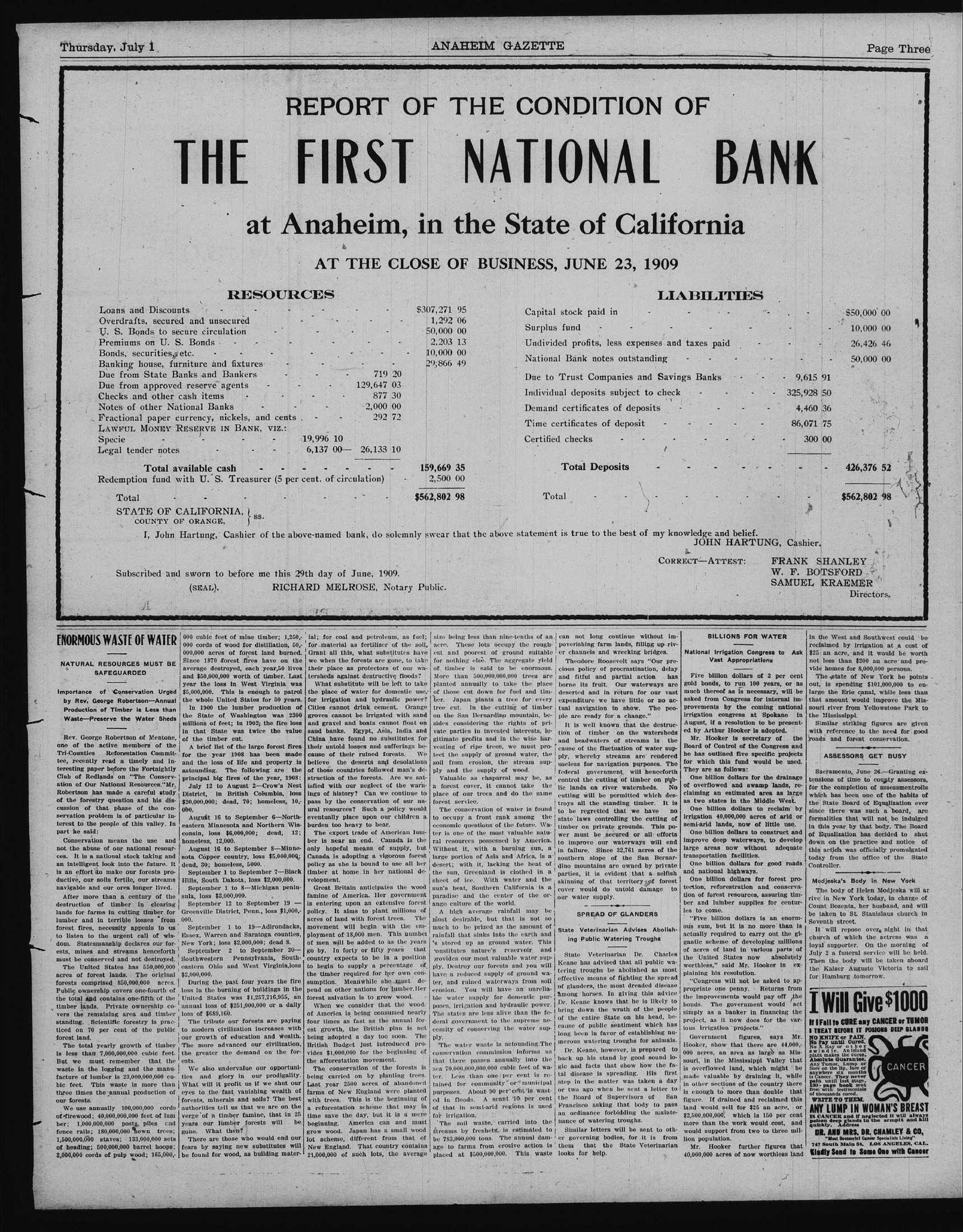
Searchable text
THURSDAY, JULY 1
REPORT
THE FIRST
at Anahe
AT T
RESOURCES
Loans and Discounts
Overdrafts, secured and unsecured
U. S. Bonds to secure circulation
Premiums on U. S. Bonds
Bonds, securities, etc.
Banking house, furniture and fixtures
Due from State Banks and Bankers
Due from approved reserve agents
Checks and other cash items
Notes of other National Banks
Fractional paper currency, nickels, and cents
LAWFUL MONEY RESERVE IN BANK, VIZ.:
Specie 19,996 10
Legal tender notes 6,137 00—
Banking house, furniture and fixtures
Due from State Banks and Bankers
Due from approved reserve agents
Checks and other cash items
Notes of other National Banks
Fractional paper currency, nickels, and cents
LAWFUL MONEY RESERVE IN BANK, VIZ.:
Specie 19,996 10
Legal tender notes 6,137 00—
Total available cash
Redemption fund with U. S. Treasurer (5 per cent. of circulated funds)
STATE OF CALIFORNIA,
COUNTY OF ORANGE,
ss.
I, John Hartung, Cashier of the above-named bank.
Subscribed and sworn to before me this 29th day of July
(SEAL). RICHARD MELROSE
ENORMOUS WASTE OF WATER
NATURAL RESOURCES MUST BE SAFEGUARDED
Importance of Conservation Urged by Rev. George Robertson—Annual Production of Timber is Less than Waste—Preserve the Water Sheds
Rev. George Robertson of Mentone, one of the active members of the Tri-Counties Reforestation Committee, recently read a timely and interesting paper before the Fortnightly Club of Redlands on "The Conservation of Our National Resources." Mr. Robertson has made a careful study of the forestry question and his discussion of that phase of the conservation problem is of particular interest to the people of this valley. In part he said:
Conservation means the use and not the abuse of our national resources. It is a national stock taking and an intelligent look into the future. It involves the use of mine timber; 1,250,000 cubic feet of mine timber; 1,250,000 cords of wood for distillation; 50,000,000 acres of forest land burned. Since 1870 forest fires have on the average destroyed each year,50 lives and $50,000,000 worth of timber. Last year the loss in West Virginia was $5,000,000. This is enough to patrol the whole United States for 50 years.
In 1900 the lumber production of the State of Washington was 2300 millions of feet; in 1902; the fire loss in that State was twice the value of the timber cut.
A brief list of the large forest fires for the year 1908 has been made and the loss of life and property is astounding. The following are the principal big fires of the year, 1908:
July 12 to August 2—Crow's Nest District, in British Columbia, loss $20,000,000; dead, 70; homeless, 10,000.
August 16 to September 6—North-eastern Minnesota and Northern Wisconsin, loss $6,000,000; dead, 12; homeless, 12,000.
August 16 to September 8—Minnesota Copper country, loss $5,000,000; dead, 30; homeless, 5000.
What substitutes the place of water for irrigation and cities cannot drain groves cannot be gravel and sand banks. Egg China have found their untold losses cause of their belief the desistion of those countries' construction of the isfied with our images of history? Pass by the natural resources? Eventually place burden too heavy.
The export tracer is near an only hopeful mall Canada is adoptive policy as she is
Club of Redlands on "The Conservation of Our National Resources." Mr. Robertson has made a careful study of the forestry question and his discussion of that phase of the conservation problem is of particular interest to the people of this valley. In part he said:
Conservation means the use and not the abuse of our national resources. It is a national stock taking and an intelligent look into the future. It is an effort to make our forests productive, our soils fertile, our streams navigable and our ores longer lived.
After more than a century of the destruction of timber in clearing lands for farms in cutting timber for lumber and in terrible losses from forest fires, necessity appeals to us to listen to the urgent call of wisdom. Statesmanship declares our forests, mines and streams henceforth must be conserved and not destroyed.
The United States has 550,000,000 acres of forest lands. The original forests comprised 850,000,000 acres. Public ownership covers one-fourth of the total and contains one-fifth of the timber lands. Private ownership covers the remaining area and timber standing. Scientific forestry is practiced on 70 per cent of the public forest land.
The total yearly growth of timber is less than 7,000,000,000 cubic feet. But we must remember that the waste in the logging and the manufacture of lumber is 23,000,000,000 cubic feet. This waste is more than three times the annual production of our forests.
We use annually 100,000,000 cords of firewood; 40,000,000,000 feet of lumber; 1,000,000,000 posts, piles and fence rails; 180,000,000 hewn trees; 1,500,000,000 staves; 133,000,000 sets of heading; 500,000,000 barrel hoops; 3,000,000 cords of pulp wood; 165,000,-principal big fires of the year, 1908:
July 12 to August 2—Crow's Nest District, in British Columbia, loss $20,000,000; dead, 70; homeless, 10,000.
August 16 to September 6—Northeastern Minnesota and Northern Wisconsin, loss $6,000,000; dead, 12; homeless, 12,000.
August 16 to September 8—Minnesota Copper country, loss $5,000,000; dead, 30; homeless, 5,000.
September 1 to September 7—Black Hills, South Dakota, loss $2,000,000.
September 1 to 8—Michigan peninsula, loss $3,000,000.
September 12 to September 19—Greenville District, Penn., loss $1,000,-
September 1 to 19—Adirondacks, Essex, Warren and Saratoga counties, New York; loss $2,000,000; dead 8.
September 2 to September 20—Southwestern Pennsylvania, Southeastern Ohio and West Virginia, loss $2,000,000.
During the past four years the fire loss in the burning of buildings in the United States was $1,257,716,955, an annual loss of $251,000,000 or a daily loss of $689,16O.
The tribute our forests are paying to modern civilization increases with our growth of education and wealth. The more advanced our civilization,the greater the demand on the forests.
We also undervalue our opportunities and glory in our prodigality. What will it profit us if we shut our eyes to the fast vanishing wealth of forests,minerals and soils? The best authorities tell us that we are on the verge of a timber famine,that in 25 years our lumber forests will be gone. What then?
There are those who would end our fears by saying new substitutes will be found for wood,as building mater-
The conservation being carried out last year 25OO farms of New England with trees. This a reforestation time save the day beginning. America grow wood. Japan lot scheme,difficult New England. The
REPORT OF THE CONDITION OF
FIRST NATIONAL
Anaheim, in the State of Californi
AT THE CLOSE OF BUSINESS, JUNE 23, 1909
SOURCES
$307,271 95 Capital stock paid in
1,292 06 Surplus fund
50,000 00 Undivided profits, less expenses and
2,203 13 National Bank notes outstanding
10,000 00
29,866 49 Due to Trust Companies and Savings
719 20 Individual deposits subject to check
129,647 03 Demand certificates of deposits
877 30
2,000 00 Time certificates of deposit
292 72
Certified checks
19,996 10
6,137 00— 26,133 10
Due to Trust Companies and Savings
Individual deposits subject to checks
Demand certificates of deposits
Time certificates of deposit
Certified checks
Total Deposits
159,669 35
2,500 00
$562,802 98
Corrected text:
The above-named bank, do solemnly swear that the above statement is true to the best of my knowledge.
This is 29th day of June, 1909.
RICHARD MELROSE, Notary Public.
Theodore Roosevelt says "Our precious policy of procrastination, delay and fitful and partial action has borne its fruit. Our waterways are deserted and in return for our vast expenditure we have little or no actual navigation to show. The people are ready for a change."
It is well known that the destruction of timber on the watersheds and headwaters of streams is the cause of the fluctuation of water supply, whereby streams are rendered useless for navigation purposes. The federal government will henceforth control the cutting of timber on public lands on river watersheds. No cutting will be permitted which destroys all the standing timber. It is to be regretted that we have no state laws controlling the cutting of timber on private grounds. This power must be secured or all efforts to improve our waterways will end in failure. Since 32,761 acres of the southern slope of the San Bernardino mountains are owned by private size being less than nine-tenths of an acre. These lots occupy the roughest and poorest of ground suitable for nothing else. The aggregate yield of timber is said to be enormous. More than 500,000,000 trees are planted annually to take the place of those cut down for fuel and timber. Japan plants a tree for every tree cut. In the cutting of timber on the San Bernardino mountain, besides considering the rights of private parties in invested interests, legitimate profits and in the wise harvesting of ripe trees, we must protect the supply of ground water, the soil from erosion, the stream supply and the supply of wood.
Valuable as chaparral may be, as a forest cover, it cannot take the place of our trees and do the same forest service.
The conservation of water is found to occupy a front rank among the economic questions of the future. Water is one of the most valuable natural resources possessed by America. Without it, with a burning sun, a large portion of Asia and Africa, is a desert; with it, lacking the heat of it can not long continue without impoverishing farm lands, filling up river channels and wrecking bridges.
Theodore Roosevelt says "Our precious policy of procrastination, delay and fitful and partial action has borne its fruit. Our waterways are deserted and in return for our vast expenditure we have little or no actual navigation to show. The people are ready for a change."
instruction of the forests. Are we satisfied with our neglect of the warnings of history? Can we continue to pass by the conservation of our natural resources? Such a policy would eventually place upon our children a burden too heavy to bear.
The export trade of American lumber is near an end. Canada is the only hopeful means of supply, but Canada is adopting a vigorous forest policy as she is bound to use all her timber at home in her national development.
Great Britain anticipates the wood famine of America. Her government is entering upon an extensive forest policy. It aims to plant millions of acres of land with forest trees. The movement will begin with the employment of 18,000 men. This number of men will be added to as the years go by. In forty or fifty years that country expects to be in a position to begin to supply a percentage of the timber required for her own consumption. Meanwhile she must depend on other nations for lumber.Her forest salvation is to grow wood.
When we consider that the wood of America is being consumed nearly four times as fast as the annual forest growth, the British plan is not being adopted a day too soon. The British Budget just introduced provides $1,000,000 for the beginning of the afforestation movement.
The conservation of the forests is being carried on by planting trees. Last year 2500 acres of abandoned farms of New England were planted with trees. This is the beginning of a reforestation scheme that may in time save the day, but it is a mere beginning. America can and must grow wood. Japan has a small wood lot scheme, different from that of New England. That country contains 21,000,000 of such lots, the average
Valuable as chaparral may be, as a forest cover, it cannot take the place of our trees and do the same forest service.
The conservation of water is found to occupy a front rank among the economic questions of the future. Water is one of the most valuable natural resources possessed by America. Without it, with a burning sun, a large portion of Asia and Africa, is a desert; with it, lacking the heat of the sun, Greenland is clothed in a sheet of ice. With water and the sun's heat, Southern California is a paradise and the center of the orange culture of the world.
A high average rainfall may be most desirable, but that is not so much to be prized as the amount of rainfall that sinks into the earth and 'stored up as ground water. This constitutes nature's reservoir and provides our most valuable water supply. Destroy our forests and you will have a reduced supply of ground water, and ruined waterways from soil erosion. You will have an unreliable water supply for domestic purposes, irrigation and hydraulic power. The states are less alive than the federal government to the supreme necessity of conserving the water supply.
The water waste is astounding.The conservation commission informs us that there passes annually into the sea 70,000,000,000 cubic feet of water. Less than one per cent is retained for community or municipal purposes. About 90 per cent is wasted in floods. A scant 10 per cent of that in semi-arid regions is used for irrigation.
The soil waste, carried into the streams by freshets, is estimated to be 783,000,000 tons. The annual damage to farms from erosive action is placed at $500,000,000. This waste
State Veterinarian Advises Abolishing Public Watering Troughs
State Veterinarian Dr. Charles Keane has advised that all public watering troughs be abolished as most effective means of fighting the spread of glanders, the most dreaded disease Among horses. In giving this advice Dr. Keane knows that he is likely to bring down the wrath of the people of the entire State on his head, because of public sentiment which has long been in favor of establishing numerous watering troughs for animals.
Dr. Keane, however, is prepared to back up his stand by good sound logic and facts that show how the fatal disease is spreading. His first step in the matter was taken a day or two ago when he sent a letter to the Board of Supervisors of San Francisco asking that body to pass an ordinance for bidding the maintenance of watering troughs.
Similar letters will be sent to other governing bodies, for it is from them that the State Veterinarian looks for help.
TION OF
NAL BANK
of California
JUNE 23, 1909
LIABILITIES
in $50,000 00
10,000 00
less expenses and taxes paid 26,426 46
tes outstanding 50,000 00
companies and Savings Banks 9,615 91
subject to check 325,928 50
of deposits 4,460 36
of deposit 86,071 75
300 00
Companies and Savings Banks - 9,615 91
Subject to check - 325,928 50
Deposits - 4,460 36
of deposit - 86,071 75
- 300 00
Deposits - 426,376 52
$562,802 98
The best of my knowledge and belief.
JOHN HARTUNG, Cashier.
Correct—Attest: FRANK SHANLEY
W. F. BOTSFORD
SAMUEL KRAEMER
Directors.
BILLIONS FOR WATER
National Irrigation Congress to Ask Vast Appropriations
Five billion dollars of 3 per cent gold bonds, to run 100 years, or as much thereof as is necessary, will be asked from Congress for internal improvements by the coming national irrigation congress at Spokane in August, if a resolution to be presented by Arthur Hooker is adopted.
Mr. Hooker is secretary of the Board of Control of the Congress and he has outlined five specific projects for which this fund would be used. They are as follows:
One billion dollars for the drainage of overflowed and swamp lands, reclaiming an estimated area as large as two states in the Middle West.
One billion dollars to reclaim by irrigation 40,000,000 acres of arid or semi-arid lands, now of little use.
One billion dollars to construct and improve deep waterways, to develop large areas now without adequate transportation facilities.
One billion dollars for good roads and national highways.
In the West and Southwest could be reclaimed by irrigation at a cost of $25 an acre, and it would be worth not less than $200 an acre and provide homes for 8,000,000 persons.
The state of New York he points out, is spending $101,000,000 to enlarge the Erie canal, while less than that amount would improve the Missouri river from Yellowstone Park to the Mississippi.
Similar striking figures are given with reference to the need for good roads and forest conservation.
ASSESSORS GET BUSY
Sacramento, June 26.—Granting extensions of time to county assessors, for the completion of assessment rolls which has been one of the habits of the State Board of Equalization ever since there was such a board, are formalities that will not be indulged in this year by that body. The Board of Equalization has decided to shut down on the practice and notice of this action was officially promulgated today from the office of the State Controller.
One billion dollars for the drainage of overflowed and swamp lands, reclaiming an estimated area as large as two states in the Middle West.
One billion dollars to reclaim by irrigation 40,000,000 acres of arid or semi-arid lands, now of little use.
One billion dollars to construct and improve deep waterways, to develop large areas now without adequate transportation facilities.
One billion dollars for good roads and national highways.
One billion dollars for forest protection, reforestation and conservation of forest resources, assuring timber and lumber supplies for centuries to come.
"Five billion dollars is an enormous sum, but it is no more than is actually required to carry out the gigantic scheme of developing millions of acres of land in various parts of the United States now absolutely worthless," said Mr. Hooker in explaining his resolution.
"Congress will not be asked to appropriate one penny. Returns from the improvements would pay off the bonds. The government would act simply as a banker in financing the project, as it now does for the various irrigation projects."
Government figures, says Mr. Hooker, show that there are 44,000,000 acres, an area as large as Missouri, in the Mississippi Valley that is overflowed land, which might be made valuable by draining it, while in other sections of the country there is enough to more than double that figure. If drained and reclaimed this land would sell for $25 an acre, or $2,500,000,000, which is 150 per cent more than the work would cost, and would support from two to three million population.
Mr. Hooker further figures that 40,000,000 acres of now worthless land
Modjeska's Body in New York
The body of Helen Modjeska will arrive in New York today, in charge of Count Bozenta, her husband, and will be taken to St. Stanislaus church in Seventh street.
It will repose overnight in that church of which the actress was a loyal supporter. On the morning of July 2 a funeral service will be held. Then the body will be taken aboard the Kaiser Auguste Victoria to sail for Hamburg tomorrow.
I Will Give $1000
If I Fall to CURE any CANCER or TUMOR I THREAT BEFORE IT POSIONS DEEP GLANDS
NO KNIFE or PAIN. No X Ray or other swindle. An island plant makes the cures. Absolute Guarantee. Any Tumor, Lump or Sore on the lip, face or anywhere six months is Cancer. They never pain until last stage. 130-page book sent free with testimonials of thousands cured.
WRITE TO THEM.
ANY LUMP IN WOMAN'S BREAST IS CANCER and if neglected it will always poison deep glands in the armpit and kill quickly. Address
DR. AND MRS. DR. CHAMLEY & CO,
"Most Successful Cancer Specialists Living"
747 South Main St. LOS ANGELES, CAL.
Kindly Send to Some One with Cancer