anaheim-gazette 1909-06-10
Scanned page
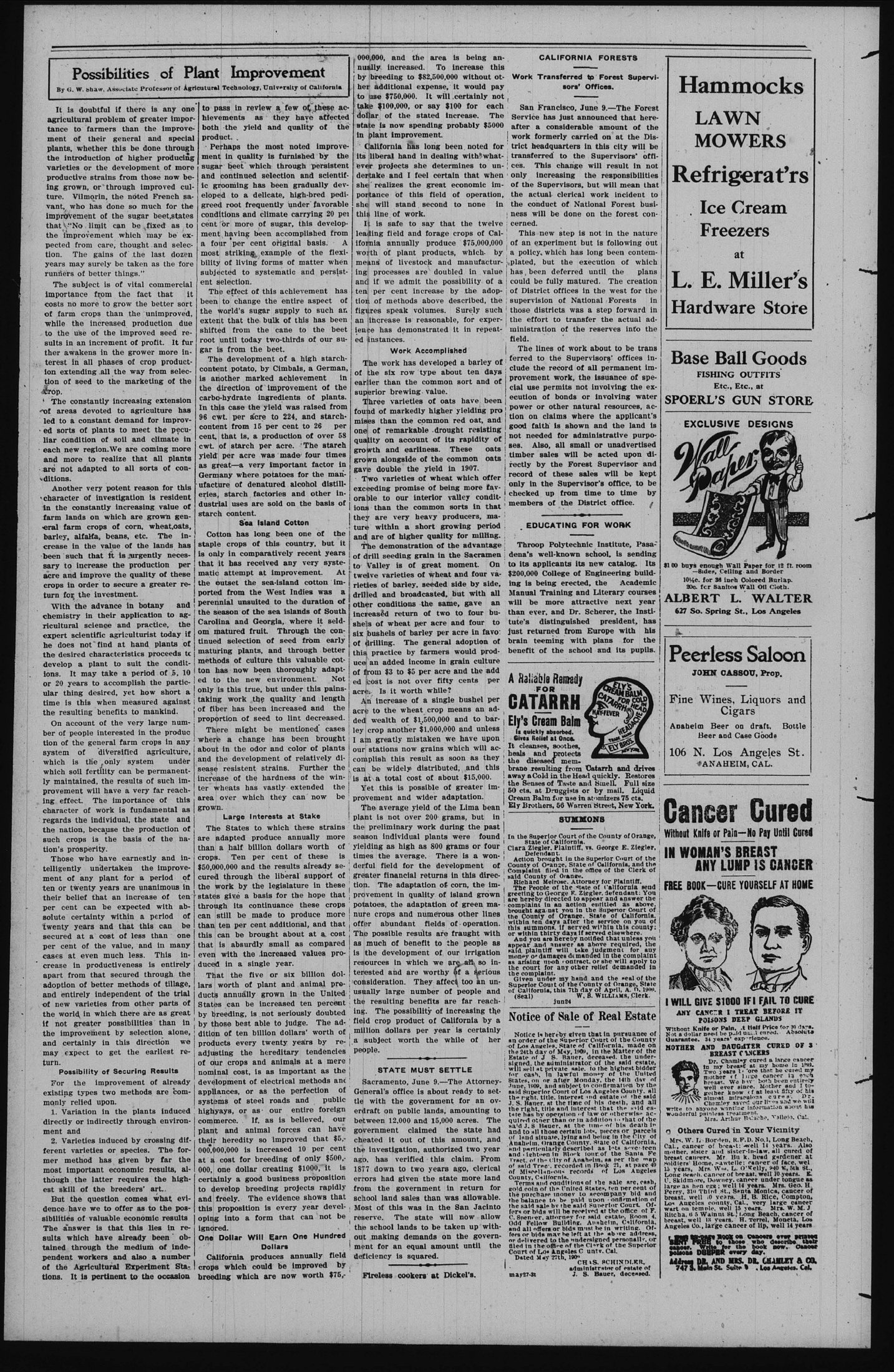
Searchable text
Possibilities of Plant Improvement
By G. W. Shaw, Associate Professor of Agricultural Technology, University of California
It is doubtful if there is any one agricultural problem of greater importance to farmers than the improvement of their general and special plants, whether this be done through the introduction of higher producing varieties or the development of more productive strains from those now being grown, or through improved culture. Vilmorin, the noted French savant, who has done so much for the improvement of the sugar beet, states that "No limit can be fixed as to the improvement which may be expected from care, thought and selection. The gains of the last dozen years may surely be taken as the fore runners of better things."
The subject is of vital commercial importance from the fact that it costs no more to grow the better sort of farm crops than the unimproved, while the increased production due to the use of the improved seed results in an increment of profit. It furthers awakens in the grower more interest in all phases of crop production extending all the way from selection of seed to the marketing of the crop.
The constantly increasing extension of areas devoted to agriculture has led to a constant demand for improved sorts of plants to meet the peculiar condition of soil and climate in each new region. We are coming more and more to realize that all plants are not adapted to all sorts of conditions.
Another very potent reason for this character of investigation is resident in the constantly increasing value of to pass in review a few of these achievements as they have affected both the yield and quality of the product.
Perhaps the most noted improvement in quality is furnished by sugar beet which through persistence and continued selection and scientific grooming has been gradually eloped to a delicate, high-bred greed root frequently under favorable conditions and climate carrying 20 percent or more of sugar, this development having been accomplished for a four per cent original basis. The most striking example of the flexibility of living forms of matter subjected to systematic and permanent selection.
The effect of this achievement been to change the entire aspect of the world's sugar supply to such extent that the bulk of this has been shifted from the cane to the bark root until today two-thirds of our sugar is from the beet.
The development of a high star content potato, by Cimbals, a German is another marked achievement in the direction of improvement of carbo-hydrate ingredients of plant. In this case the yield was raised from 96 cwt. per acre to 224, and star content from 15 per cent to 26 percent, that is, a production of over 96 cwt. of starch per acre. The star yield per acre was made four times as great—a very important factor Germany where potatoes for the manufacture of denatured alcohol diseries, starch factories and other dustrial uses are sold on the basis
of areas devoted to agriculture has led to a constant demand for improved sorts of plants to meet the peculiar condition of soil and climate in each new region. We are coming more and more to realize that all plants are not adapted to all sorts of conditions.
Another very potent reason for this character of investigation is resident in the constantly increasing value of farm lands on which are grown general farm crops of corn, wheat, oats, barley, alfalfa, beans, etc. The increase in the value of the lands has been such that it is urgently necessary to increase the production per acre and improve the quality of these crops in order to secure a greater return for the investment.
With the advance in botany and chemistry in their application to agricultural science and practice, the expert scientific agriculturist today if he does not find at hand plants of the desired characteristics proceeds to develop a plant to suit the conditions. It may take a period of 5, 10 or 20 years to accomplish the particular thing desired, yet how short a time is this when measured against the resulting benefits to mankind.
On account of the very large number of people interested in the production of the general farm crops in any system of diversified agriculture, which is the only system under which soil fertility can be permanently maintained, the results of such improvement will have a very far reaching effect. The importance of this character of work is fundamental as regards the individual, the state and the nation, because the production of such crops is the basis of the nation's prosperity.
Those who have earnestly and intelligently undertaken the improvement of any plant for a period of ten or twenty years are unanimous in their belief that an increase of ten per cent can be expected with absolute certainty within a period of twenty years and that this can be secured at a cost of less than one per cent of the value, and in many cases at even much less. This increase in productiveness is entirely
In this case the yield was raised from 96 cwt. per acre to 224, and standard content from 15 per cent to 26 percent, that is, a production of over 96 cwt. of starch per acre. The starch yield per acre was made four times as great—a very important factor in Germany where potatoes for the manufacture of denatured alcohol diseries, starch factories and other industrial uses are sold on the basis of starch content.
Sea Island Cotton
Cotton has long been one of the staple crops of this country, but it is only in comparatively recent year that it has received any very systematic attempt at improvement. The outset the sea-island cotton exported from the West Indies was perennial unsuited to the duration of the season of the sea islands of South Carolina and Georgia, where it seems matured fruit. Through the continued selection of seed from easily maturing plants, and through better methods of culture this valuable cotton has now been thoroughly adapted to the new environment. Only is this true, but under this partaking work the quality and length of fiber has been increased and the proportion of seed to lint decreased.
There might be mentioned cases where a change has been brought about in the odor and color of plants and the development of relatively sease resistant strains. Further increase of the hardness of the water wheats has vastly extended the area over which they can now be grown.
Large Interests at Stake
The States to which these straws are adapted produce annually more than a half billion dollars worth of crops. Ten per cent of these $50,000,000 and the results already occurred through the liberal support by the work by the legislature in those states give a basis for the hope that through its continuance these crops can still be made to produce more than ten per cent additional, and that this can be brought about at a cost that is absurdly small as compared even with the increased values produced in a single year.
telligently undertaken the improvement of any plant for a period of ten or twenty years are unanimous in their belief that an increase of ten per cent can be expected with absolute certainty within a period of twenty years and that this can be secured at a cost of less than one per cent of the value, and in many cases at even much less. This increase in productiveness is entirely apart from that secured through the adoption of better methods of tillage, and entirely independent of the trial of new varieties from other parts of the world in which there are as great if not greater possibilities than in the improvement by selection alone, and certainly in this direction we may expect to get the earliest return.
Possibility of Securing Results
For the improvement of already existing types two methods are commonly relied upon.
1. Variation in the plants induced directly or indirectly through environment and
2. Varieties induced by crossing different varieties or species. The former method has given by far the most important economic results, although the latter requires the highest skill of the breeders' art.
But the question comes what evidence have we to offer as to the possibilities of valuable economic results. The answer is that this lies in results which have already been obtained through the medium of independent workers and also a number of the Agricultural Experiment Stations. It is pertinent to the occasion $50,000,000 and the results already captured through the liberal support of the work by the legislature in the states give a basis for the hope that its continuance these crops can still be made to produce more than ten per cent additional, and that this can be brought about at a cost that is absurdly small as compared even with the increased values produced in a single year.
That the five or six billion dollars worth of plant and animal products annually grown in the United States can be increased ten percent by breeding, is not seriously doubted by those best able to judge. The condition of ten billion dollars' worth of products every twenty years by adjusting the hereditary tendency of our crops and animals at a nominal cost, is as important as development of electrical methods appliances, or as the perfection systems of steel roads and public highways, or as our entire forest commerce. If, as is believed, plant and animal forces can harm their heredity so improved that 1000,000,000 is increased 10 per cent at a cost for breeding of only $5,000, one dollar creating $1000, it certainly a good business proposition to develop breeding projects rapidly and freely. The evidence shows that this proposition is every year developing into a form that can not be ignored.
One Dollar Will Earn One Hundred Dollars
California produces annually five crops which could be improved by breeding which are now worth $
Improvement
University of California
A few of these accords they have affected and quality of the most noted improvement is furnished by the reach through persistent selection and scientific has been gradually devilicate, high-bred pedigently under favorable climate carrying 20 per cent of sugar, this development accomplished from its original basis. A example of the flexi-forms of matter when systematic and persist-this achievement has in the entire aspect of sugar supply to such an bulk of this has been the cane to the beet two-thirds of our su- beet.
Cent of a high starch by Cimbals, a German, mixed achievement in the improvement of the ingredients of plants. Yield was raised from one to 224, and starch per cent to 26 per production of over 58 per acre. The starch was made four times by important factor in potatoes for the man-术ured alcohol distilleries and other in- sale on the basis of 000,000, and the area is being annually increased. To increase this by breeding to $82,500,000 without other additional expense, it would pay to use $750,000. It will certainly not take $100,000, or say $100 for each dollar of the stated increase. The state is now spending probably $5000 in plant improvement.
California has long been noted for its liberal hand in dealing with whatever projects she determines to undertake and I feel certain that when she realizes the great economic importance of this field of operation, she will stand second to none in this line of work.
It is safe to say that the twelve leading field and forage crops of California annually produce $75,000,000 worth of plant products, which by means of livestock and manufacturing processes are doubled in value and if we admit the possibility of a ten per cent increase by the adoption of methods above described, the figures speak volumes. Surely such an increase is reasonable, for experience has demonstrated it in repeated instances.
Work Accomplished
The work has developed a barley of the six row type about ten days earlier than the common sort and of superior brewing value.
Three varieties of oats have been found of markedly higher yielding pro-mises than the common red oat, and one of remarkable drought resisting quality on account of its rapidity of growth and earliness. These oats grown alongside of the common oats gave double the yield in 1907.
Two varieties of wheat which offer exceeding promise of being more favorable to our interior valley conditions than the common sorts in that
CALIFORNIA FORESTS
Work Transferred to Forest Supervisors' Offices.
San Francisco, June 9.—The Service has just announced that after a considerable amount of work formerly carried on at the district headquarters in this city transferred to the Supervisors'ces. This change will result only increasing the responsibility of the Supervisors, but will meet the actual clerical work included in the conduct of National Forestness will be done on the forest concerned.
This new step is not in the form of an experiment but is following a policy which has long been complied, but the execution of it has been deferred until the could be fully matured. The chief of District offices in the west for supervision of National Forests those districts was a step forward the effort to transfer the actual administration of the reserves in field.
The lines of work about to be referred to the Supervisors' office include the record of all permanent provement work, the issuance of special use permits not involving the excution of bonds or involving power or other natural resource on claims where the applicant good faith is shown and the lack not needed for administrative uses. Also, all small or unadvertised timber sales will be acted upon directly by the Forest Supervisor's record of these sales will be only in the Supervisor's office, checked up from time to time members of the District office.
yield was raised from
to 224, and starch
per cent to 26 per
reproduction of over 58
hever acre. The starch
was made four times
by important factor in
potatoes for the manufactured alcohol distillories and other insold on the basis of
Island Cotton
being been one of the
most this country, but it
literatively recent years
drove any very systetic improvement. At
Sea-island cotton immigration West Indies was a
need to the duration of
the sea islands of South
Georgia, where it selldit. Through the condition of seed from early
and through better
pure this valuable cotten thoroughly adapted environment. Not
but under this painsthe quality and length
in increased and the
need to lint decreased.
be mentioned cases
has been brought
for and color of plants
ment of relatively disstrains. Further the hardness of the winvastly extended the
they can now be
Interests at Stake
which these strains
produce annually more
than dollars worth of
per cent of these is
the results already sethe liberal support of
the legislature in these
basis for the hope that
continuance these crops
de to produce more
not additional, and that
ought about at a cost
very small as compared
increased values prople year.
found of markedly higher yielding promises than the common red oat, and one of remarkable drought resisting quality on account of its rapidity of growth and earliness. These oats grown alongside of the common oats gave double the yield in 1907.
Two varieties of wheat which offer exceeding promise of being more favorable to our interior valley conditions than the common sorts in that they are very heavy producers, mature within a short growing period and are of higher quality for milling.
The demonstration of the advantage of drill seeding grain in the Sacramen to Valley is of great moment. On twelve varieties of wheat and four varieties of barley, seeded side by side, drilled and broadcasted, but with all other conditions the same, gave an increased return of two to four bushels of wheat per acre and four to six bushels of barley per acre in favor of drilling. The general adoption of this practice by farmers would produce an added income in grain culture of from $3 to $5 per acre and the added cost is not over fifty cents per acre. Is it worth while?
An increase of a single bushel per acre to the wheat crop means an added wealth of $1,500,000 and to barley crop another $1,000,000 and unless I am greatly mistaken we have upon our stations now grains which will accomplish this result as soon as they can be widely distributed, and this is at a total cost of about $15,000.
Yet this is possible of greater improvement and wider adaptation.
The average yield of the Lima bean plant is not over 200 grams, but in the preliminary work during the past season individual plants were found yielding as high as 800 grams or four times the average. There is a wonderful field for the development of greater financial returns in this direction. The adaptation of corn, the improvement in quality of island grown potatoes, the adaptation of green manure crops and numerous other lines offer abundant fields of operation. The possible results are fraught with as much of benefit to the people as is the development of our irrigation resources in which we are all so in-
EDUCATING FOR WORK
Throop Polytechnic Institute,
dena's well-known school, is sto its applicants its new catalog-
$200,000 College of Engineering.
ing is being erected, the AcadManual Training and Literary cowill be more attractive nextthan ever, and Dr. Scherer, the
tute's distinguished presidenjust returned from Europe with brain teeming with plans for benefit of the school and its pr
A Reliable Remedy FOR CATARRH Ely's Cream Balm is quickly absorbed. Gives Relief at Once.
It cleanses, soothes, heals and protects the diseased membrane resulting from Catarrh and away a Cold in the Head quickly. Rethe Senses of Taste and Smell. Fur 50 cts. at Druggists or by mail.
Cream Balm for use in atomizers 75 Ely Brothers, 56 Warren Street, New
SUMMONS
In the Superior Court of the County of State of California.
Clara Ziegler. Plaintiff, vs. George E. Defendant.
Action brought in the Superior Court
County of Orange, State of California.
Complaint filed in the office of the Oisaid County of Orange.
Richard Melrose. Attorney for Plaintiff.
The People of the State of California greeting to George E. Ziegler, defendant are hereby directed to appear and answer complaint in an action entitled as brought against you in the Superior Court of the County of Orange. State of California within ten days after the service on this summons. If served within this or within thirty days if served elsewhere.
And you are hereby notified that unappear and answer as above require said plaintiff will take judgment for money or damages demanded in the court as arising upon contract, or she will act the court for any other relief demand.
The results already seemed the liberal support of the legislature in these dissies for the hope that continuance these crops could to produce more than additional, and that brought about at a cost very small as compared with increased values pro-ple year.
or six billion dollars and animal pro-grown in the United States increased ten percent not seriously doubted able to judge. The addition dollars' worth of twenty years by reprehensitary tendencies and animals at a mere as important as the electrical methods and was the perfection of all roads and public for our entire foreign as is believed, our final forces can have no improved that $5,-increased 10 per cent breeding of only $500,-creating $1000, it is business proposition leading projects rapidly the evidence shows that is every year develop that can not be
Earn One Hundred Dollars produces annually field should be improved by are now worth $75,-
derful field for the development of greater financial returns in this direction. The adaptation of corn, the improvement in quality of island grown potatoes, the adaptation of green manure crops and numerous other lines offer abundant fields of operation. The possible results are fraught with as much of benefit to the people as is the development of our irrigation resources in which we are all so interested and are worthy of a serious consideration. They affect too an unusually large number of people and the resulting benefits are far reaching. The possibility of increasing the field crop product of California by a million dollars per year is certainly a subject worth the while of her people.
STATE MUST SETTLE
Sacramento, June 9.—The Attorney-General's office is about ready to settle with the government for an overdraft on public lands, amounting to between 12,000 and 15,000 acres. The government claimed the state had cheated it out of this amount, and the investigation, authorized two year ago, has verified this claim. From 1877 down to two years ago, clerical errors had given the state more land from the government in return for school land sales than was allowable. Most of this was in the San Jacinto reserve. The state will now allow the school lands to be taken up without making demands on the government for an equal amount until the deficiency is squared.
Fireless cookers at Dickel's.
Notice of Sale of Real E
Notice is hereby given that in pursuance an order of the Superior Court of the State of California greeting to George K. Ziegler, defendant are hereby directed to appear and answer complaint in an action entitled as brought against you in the Superior Court of the County of Orange. State of Cal within ten days after the service on this summons. If served within this or within thirty days if served elsewhere.
And you are hereby notified that unless appear and answer as above require said plaintiff will take judgment for money or damages demanded in the case as arising upon contract, or she will act the court for any other relief demand the complaint.
Given under my hand and the seasuperior Court of the County of Orange of California, this 7th day of April, A.(Seal)
W. B. WILLIAMS,
Jun24
CHAS. S. CHINDE administrator of est J. S. Bauer, deci
FORNIA FORESTS
ferred to Forest Supervisors' Offices.
Disco, June 9.—The Forest just announced that here considerable amount of the only carried on at the Disarters in this city will be to the Supervisors' offi-change will result in not using the responsibilities advisors, but will mean that arterical work incident to of National Forest busi-done on the forest con-step is not in the nature ment but is following out which has long been contem- the execution of which referred until the plans may matured. The creation offices in the west for the of National Forests in was a step forward in transfer the actual ad-of the reserves into the of work about to be trans- Supervisors' offices in ord of all permanent im-work, the issuance of spe-its not involving the ex-ponds or involving water her natural resources, acns where the applicant's shown and the land is or administrative purpo-l small or unadvertised will be acted upon die Forest Supervisor and these sales will be kept Supervisor's office, to be from time to time by the District office.
Hammocks
LAWN
MOWERS
Refrigerat'rs
Ice Cream
Freezers
at
L. E. Miller's
Hardware Store
Base Ball Goods
FISHING OUTFITS
Etc., Etc., at
SPOERL'S GUN STORE
EXCLUSIVE DESIGNS
Wall Paper
EXCLUSIVE DESIGNS
Wall Paper
$100 buys enough Wall Paper for 12 ft. room
—Sides, Ceiling and Border
10¼c. for 36 inch Colored Burlap.
20c. for Sanitos Wall Oil Cloth.
ALBERT L. WALTER
627 So. Spring St., Los Angeles
Peerless Saloon
JOHN CASSOU, Prop.
Fine Wines, Liquors and
Cigars
Anaheim Beer on draft. Bottle
Beer and Case Goods
106 N. Los Angeles St.
ANAHEIM, CAL.
Cancer Cured
Without Knife or Pain—No Pay Until Cured
IN WOMAN'S BREAST
ANY LUMP IS CANCER
FREE BOOK—CURE YOURSELF AT HOME
ANY LUMP IS CANCER
FREE BOOK—CURE YOURSELF AT HOME
I WILL GIVE $1000 IF I FAIL TO CURE
ANY CANCER I TREAT BEFORE IT
POISONS DEEP GLANDS
Without Knife or Pain, at Half Price for 30 days.
Not a dollar need be paid until cured. Absolute Guarantee. 34 years' experience.
MOTHER AND DAUGHTER CURED OF 3 BREAST CANCERS
Dr. Chamley cured a large cancer in my breast at my home in 1899.
Two years before that he cured my mother of large cancer in each breast. We have both been entirely well ever since. Mother and I together know of at least fifty of his almost miraculous cases. Dr. Chamley saved our lives and we will write to anyone wanting information about his wonderful painless treatment.
Mrs. Arthur Balche, Vallejo, Cal.
Others Cured in Your Vicinity
Mrs. W. L. Borden, R.F.D. No.1, Long Beach, Cal., cancer of breast: well 14 years. Also mother, sister and sister-in-law, all cured of breast cancers. Mr. Bu k. head gardener at Soldiers' Home, sawtelle: cancer of face, well 15 years, Mrs. Wm. L. O'Kelly, 940 K, 5th St., Long Beach, cancer of breast, well 10 years. E. U. Skidmore, Downey, cancer under tongue as large as hen egg; well 14 years. Mrs. Geo. H. Perry, 310 Third St., Santa Monica, cancer of breast, well 10 years. H. B. Rice, Compton, Los Angeles county, Cal., very large cancer wart on temple, well 15 years. Mrs. W. M. J Ritcha, 6 5 Walnut St., Long Beach, cancer of breast, well 18 years. H. Terrel, Moneta, Los Angeles Co., large cancer of lip, well 14 years.
Any book on cancers ever printed free to those who describe their cancer. Write for the book now. Cancer poisons deeper every day.
Address DR. AND MRS. DR. CHAMLEY & CO.
747 S. Main St. Suite 9 . Los Angeles, Cal.