anaheim-gazette 1909-05-20
Scanned page
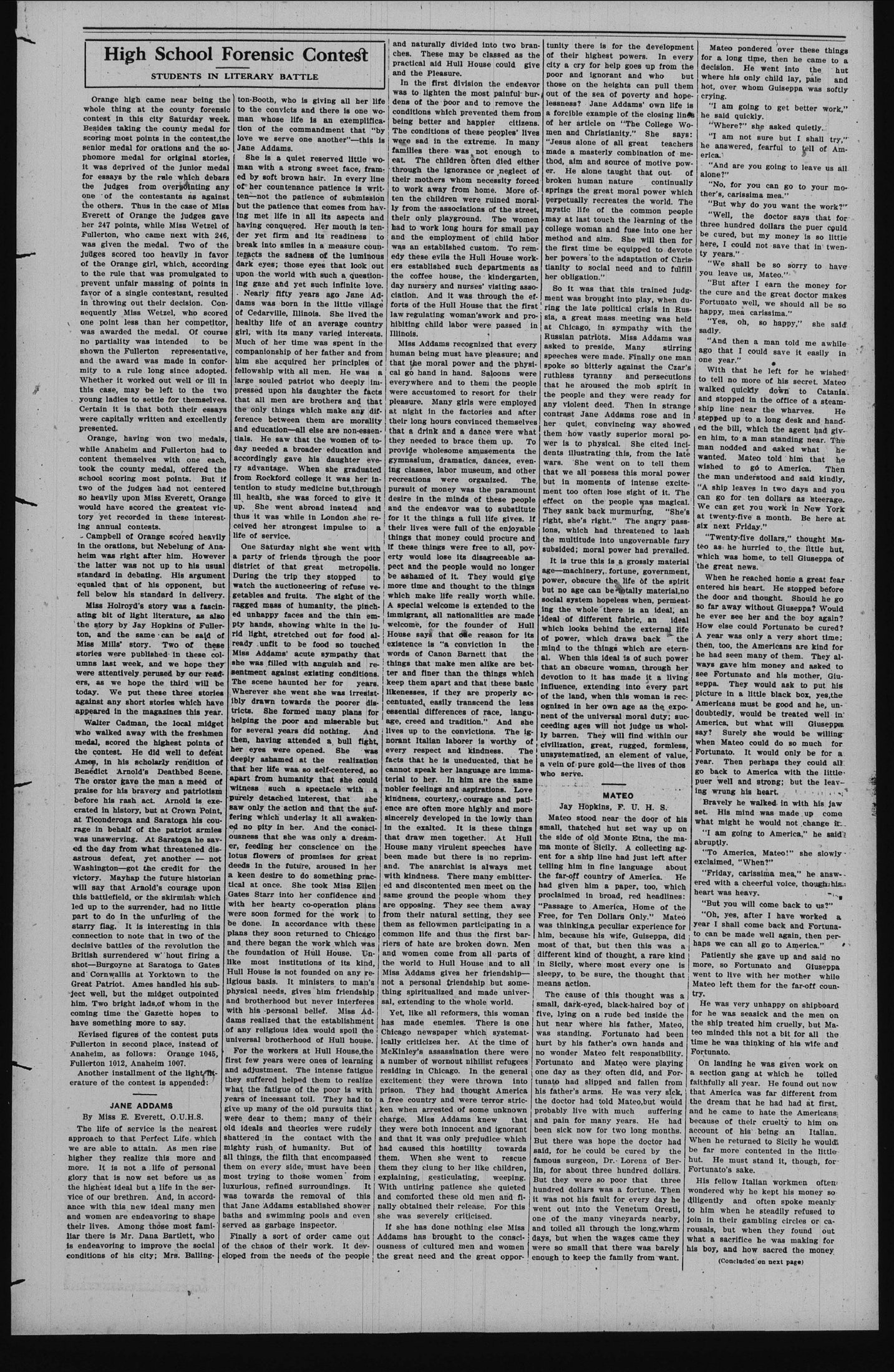
Searchable text
High School Forensic ConSTUDENTS IN LITERARY BATTLE
Orange high came near being the whole thing at the county forensic contest in this city Saturday week. Besides taking the county medal for scoring most points in the contest, the senior medal for orations and the sophomore medal for original stories, it was deprived of the junior medal for essays by the rule which debars the judges from overpointing any one of the contestants as against the others. Thus in the case of Miss Everett of Orange the judges gave her 247 points, while Miss Wetzel of Fullerton, who came next with 246, was given the medal. Two of the judges scored too heavily in favor of the Orange girl, which, according to the rule that was promulgated to prevent unfair massing of points in favor of a single contestant, resulted in throwing out their decision. Consequently Miss Wetzel, who scored one point less than her competitor, was awarded the medal. Of course no partiality was intended to be shown the Fullerton representative, and the award was made in conformity to a rule long since adopted. Whether it worked out well or ill in this case, may be left to the two young ladies to settle for themselves. Certain it is that both their essays were capitally written and excellently presented.
Orange, having won two medals, while Anaheim and Fullerton had to content themselves with one each, took the county medal, offered the school scoring most points. But if two of the judges had not centered so heavily upon Miss Everett, Orange would have scored the greatest victory-Booth, who is giving his life to the convicts and their man whose life is an indication of the commandment love we serve one another. Jane Addams.
She is a quiet reserve man with a strong sweetness by soft brown hair. Of her countenance patience—not the patience of but the patience that coming met life in all its having conquered. Her never yet firm and its break into smiles in a manner acts the sadness of the dark eyes; those eyes take upon the world with such ing gaze and yet such infinity. Nearly fifty years ago dams was born in the city of Cedarville, Illinois. She healthy life of an average girl, with its many variances. Much of her time was spent companionship of her father him she acquired her fellowship with all men. Large souled patriot who pressed upon his daughter that all men are brothers; the only things which matter between them and education—all else and details. He saw that the day needed a broader education accordingly gave his daily advantage. When she from Rockford college it tended to study medicine ill health, she was forced up. She went abroad in
Certain it is that both their essays were capitally written and excellently presented.
Orange, having won two medals, while Anaheim and Fullerton had to content themselves with one each, took the county medal, offered the school scoring most points. But if two of the judges had not centered so heavily upon Miss Everett, Orange would have scored the greatest victory yet recorded in these interesting annual contests.
Campbell of Orange scored heavily in the orations, but Nebelung of Anaheim was right after him. However the latter was not up to his usual standard in debating. His argument equaled that of his opponent, but fell below his standard in delivery.
Miss Holroyd's story was a fascinating bit of light literature, as also the story by Jay Hopkins of Fullerton, and the same can be said of Miss Mills' story. Two of these stories were published in these columns last week, and we hope they were attentively perused by our readers, as we hope the third will be today. We put these three stories against any short stories which have appeared in the magazines this year.
Walter Cadman, the local midget who walked away with the freshmen medal, scored the highest points of the contest. He did well to defeat Ames, in his scholarly rendition of Benedict Arnold's Deathbed Scene. The orator gave the man a meed of praise for his bravery and patriotism before his rash act. Arnold is executed in history, but at Crown Point, at Ticonderoga and Saratoga his courage in behalf of the patriot armies was unswerving. At Saratoga he saved the day from what threatened disastrous defeat, yet another — not Washington—got the credit for the victory. Mayhap the future historian will say that Arnold's courage upon this battlefield, or the skirmish which led up to the surrender, had no little part to do in the unfurling of the starry flag. It is interesting in this connection to note that in two of the decisive battles of the revolution the British surrendered without firing a shot—Burgoyne at Saratoga to Gates
the only things which mattered between them and education—all else and details. He saw that the way needed a broader edification accordingly gave his daily advantage. When she from Rockford college it tention to study medicine ill health, she was forced up. She went abroad in thus it was while in London received her strongest impulse life of service.
One Saturday night she a party of friends through district of that great During the trip they still watch the auctioneering of getables and fruits. The ragged mass of humanity ed unhappy faces and thpty hands, showing white rid light, stretched out for ready unfit to be food Miss Addams' acute symp she was filled with anguish sentiment against existing The scene haunted her f Wherever she went she widely drawn towards the districts. She formed many helping the poor and misfor several years did not then, having attended a her eyes were opened. deeply ashamed at the fact that her life was so self-apart from humanity that witness such a spectacle purely detached interest, saw only the action and thering which underlay it ed no pity in her. And ousness that she was only er, feeding her conscience lotus flowers of promises deeds in the future, around a keen desire to do something at once. She took Gates Starr into her confi with her hearty co-operation were soon formed for them be done. In accordance with plans they soon returned and there began the work on the foundation of Hull He like most institutions of
Washington—got the credit for the victory. Mayhap the future historian will say that Arnold's courage upon this battlefield, or the skirmish which led up to the surrender, had no little part to do in the unfurling of the starry flag. It is interesting in this connection to note that in two of the decisive battles of the revolution the British surrendered without firing a shot—Burgoyne at Saratoga to Gates and Cornwallis at Yorktown to the Great Patriot. Ames handled his subject well, but the midget outpointed him. Two bright lads, of whom in the coming time the Gazette hopes to have something more to say.
Revised figures of the contest puts Fullerton in second place, instead of Anaheim, as follows: Orange 1045, Fullerton 1012, Anaheim 1007.
Another installment of the light literature of the contest is appended:
JANE ADDAMS
By Miss E. Everett, O.U.H.S.
The life of service is the nearest approach to that Perfect Life, which we are able to attain. As men rise higher they realize this more and more. It is not a life of personal glory that is now set before us as the highest ideal but a life in the service of our brethren. And, in accordance with this new ideal many men and women are endeavoring to shape their lives. Among those most familiar there is Mr. Dana Bartlett, who is endeavoring to improve the social conditions of his city; Mrs. Balling-
Finally a sort of order of the chaos of their work eloped from the needs of th
Innsic Contest
BRIARY BATTLE
Both, who is giving all her life to convicts and there is one whose life is an exemplification of the commandment that "by love serve one another"—this is Addams.
It is a quiet reserved little woo with a strong sweet face, fram-soft brown hair. In every line of countenance patience is written out the patience of submission the patience that comes from hav-et life in all its aspects and conquered. Her mouth is tenet firm and its readiness to into smiles in a measure counsell the sadness of the luminous eyes; those eyes that look out the world with such a question-ize and yet such infinite love. Only fifty years ago Jane Addams was born in the little village Harville, Illinois. She lived the new life of an average country with its many varied interests. Of her time was spent in the relationship of her father and from the acquired her principles of ship with all men. He was a troubled patriot who deeply in-lived upon his daughter the facts that men are brothers and that any things which make any difference between them are morality education—all else are non-essen-He saw that the women of to-needed a broader education and singly gave his daughter evan-tage. When she graduated Rockford college it was her in-try to study medicine but, through it, she was forced to give it he went abroad instead and naturally divided into two branches. These may be classed as the practical aid Hull House could give and the Pleasure.
In the first division the endeavor was to lighten the most painful burdens of the poor and to remove the conditions which prevented them from being better and happier citizens. The conditions of these peoples' lives were sad in the extreme. In many families there was not enough to eat. The children often died either through the ignorance or neglect of their mothers whom necessity forced to work away from home. More often the children were ruined morally from the associations of the street, their only playground. The women had to work long hours for small pay and the employment of child labor was an established custom. To remedy these evils the Hull House workers established such departments as the coffee house, the kindergarten, day nursery and nurses' visiting association. And it was through the efforts of the Hull House that the first law regulating woman's work and prohibiting child labor were passed in Illinois.
Miss Addams recognized that every human being must have pleasure; and that the moral power and the physical go hand in hand. Saloons were everywhere and to them the people were accustomed to resort for their pleasure. Many girls were employed at night in the factories and after their long hours convinced themselves that a drink and a dance were what they needed to brace them up. To provide wholesome amusements the gymnasium, dramatics, dances, evening classes, labor museum, and other recreations were organized. The pursuit of money was the paramount desire in the minds of these people and the endeavor was to substitute tunity there is for those of their highest power city a cry for help good and ignorant and those on the heights out of the sea of povertylessness? Jane Addams a forcible example of her article on "The men and Christianity." "Jesus alone of all gods made a masterly com-method, aim and source of er. He alone taught broken human nature springs the great more perpetually recreates a mystic life of the day may at last touch the college woman and full method and aim. She the first time be equiv-her powers to the adapt-tianity to social need her obligation."
So it was that this ment was brought into ring the late political sia, a great mass meet at Chicago, in symp- Russian patriots. Miss asked to preside. Mrs speeches were made. Mrs spoke so bitterly again ruthless tyranny and that he aroused the people and they will any violent deed. The contrast Jane Addams her quiet convincing them how vastly super-wer is to physical. Students illustrating this wars. She went on that we all possess this but in moments of ment too often lose st effect on the people They sank back murmur-
Saturday night she went with her of friends through the poor of that great metropolis. On the trip they stopped to the auctioneering of refuse vessels and fruits. The sight of the mass of humanity, the pinch-happy faces and the thin emends, showing white in the lust, stretched out for food alumfitt to be food so touched Addams' acute sympathy that is filled with anguish and rest against existing conditions. Gene haunted her for years. Her she went she was irresistent towards the poorer disaffected. She formed many plans for the poor and miserable but rural years did nothing. And having attended a bull fight, she were opened. She was ashamed at the realization of life was so self-centered, so humanity that she could not such a spectacle with a detached interest, that she by the action and that the suffluch underlay it all awakening in her. And the conscient that she was only a dreaming her conscience on the powers of promises for great in the future, aroused in her desire to do something practicose. She took Miss Ellenarr into her confidence and her hearty co-operation plans formed for the work to begin.
In accordance with these they soon returned to Chicago he began the work which was dedication of Hull House. Unjust institutions of its kind, pressure. Many girls were employed at night in the factories and after their long hours convinced themselves that a drink and a dance were what they needed to brace them up. To provide wholesome amusements the gymnasium, dramatics, dances, evening classes, labor museum, and other recreations were organized. The pursuit of money was the paramount desire in the minds of these people and the endeavor was to substitute for it the things a full life gives. If their lives were full of the enjoyable things that money could procure and if these things were free to all, poverty would lose its disagreeable aspect and the people would no longer be ashamed of it. They would give more time and thought to the things which make life really worth while. A special welcome is extended to the immigrant, all nationalities are made welcome, for the founder of Hull House says that one reason for its existence is "a conviction in the words of Canon Barnett that the things that make men alike are better and finer than the things which keep them apart and that these basic likenesses, if they are properly accentuated, easily transcend the less essential differences of race, language, creed and tradition." And she lives up to the convictions. The ignorant Italian laborer is worthy of every respect and kindness. The facts that he is uneducated, that he cannot speak her language are immaterial to her. In him are the same nobler feelings and aspirations. Love kindness, courtesy, courage and patience are often more highly and more sincerely developed in the lowly than in the exalted. It is these things that draw men together. At Hull House many virulent speeches have been made but there is no reprimand. The anarchist is always met with kindness. There many embittered and discontented men meet on the same ground the people whom they are opposing. They see them away from their natural setting, they see them as fellowmen participating in a common life and thus the first barriers of hate are broken down. Men and women come from all parts of the world to Hull House and to all any violent deed. The contrast Jane Addams her quiet convincing them how vastly superwere is to physical. Students illustrating this wars. She went on that we all possess this but in moments of ment too often lose sight effect on the people They sank back murmur right, she's right." The lions, which had threaten the multitude into unsubsided; moral power.
It is true this is a great-machinery,. fortune power, obscure the life but no age can be totally social system hopeless ing the whole there is ideal of different fabric which looks behind the of power, which draws mind to the things whal. When this ideal is that an obscure woman devotion to it has major influence, extending in of the land, when this is organized in her own age nent of the universal mmeeding ages will not fly barren. They will f civilization, great, rugged unsystematized, an elephant a vein of pure gold—the who serve.
MATEO
Jay Hopkins, F.
Mateo stood near thre small, thatched hut seethe side of old Monte ma monte of Sicily. An ent for a ship line had telling him in fine langthe far-off country of A had given him a paper proclaimed in broad, r“Passage to America, Free, for Ten Dollars Owas thinking,a peculiar him, because his wife most of that, but then different kind of thoughin Sicily, where most e
In the future, aroused in her desire to do something practical once. She took Miss Ellen Carr into her confidence and her hearty co-operation plans formed for the work to begin.
In accordance with these they soon returned to Chicago where began the work which was dedication of Hull House. Unrest institutions of its kind, there is not founded on any reasis. It ministers to man's needs, gives him friendship motherhood but never interferes in personal belief. Miss Addams that the establishment religious idea would spoil the brotherhood of Hull house. The workers at Hull House,the years were ones of learning treatment. The intense fatigue helped them to realize the fatigue of the poor is with uncessant toil. They had to many of the old pursuits that ar to them; many of their ideas and theories were rudely in the contact with the rush of humanity. But of the filth that encompassed every side, must have been being to those women from refined surroundings. Itords the removal of this Addams established shower swimming pools and even garbage inspector.
A sort of order came out chaos of their work. It devoid the needs of the people and. The anarchist is always met with kindness. There many embittered and discontented men meet on the same ground the people whom they are opposing. They see them away from their natural setting, they see them as fellowmen participating in a common life and thus the first barriers of hate are broken down. Men and women come from all parts of the world to Hull House and to all Miss Addams gives her friendship—not a personal friendship but something spiritualized and made universal, extending to the whole world.
Yet, like all reformers, this woman has made enemies. There is one Chicago newspaper which systematically criticizes her. At the time of McKinley's assassination there were a number of wornout nihillist refugees residing in Chicago. In the general excitement they were thrown into prison. They had thought America a free country and were terror stricken when arrested of some unknown charge. Miss Addams knew that they were both innocent and ignorant and that it was only prejudice which had caused this hostility towards them. When she went to rescue them they clung to her like children, explaining, gesticulating, weeping. With untiring patience she quieted and comforted these old men and finally obtained their release. For this she was severely criticised.
If she has done nothing else Miss Addams has brought to the consciousness of cultured men and women the great need and the great oppor-telling him in fine language the far-off country of America had given him a paper proclaimed in broad, red "Passage to America," Free, for Ten Dollars O'clock was thinking,a peculiar him, because his wife, most of that, but then different kind of thoughts in Sicily, where most of sleepy, to be sure, the means action.
The cause of this thief small, dark-eyed, black-hair five, lying on a rude bed hut near where his father was standing. Fortunately hurt by his father's own no wonder Mateo felt me Fortunato and Mateo one day as they often o tunato had slipped and his father's arms. He wished the doctor had told Mateo probably live with much pain for many years been sick now for two days. But there was hope they said, for he could be cute famous surgeon, Dr. Lori lin, for about three hunts. But they were so poor hundred dollars was a fo it was not his fault for e went out into the Veneer one of the many vineyards and toiled all through the days, but when the wages were so small that there enough to keep the family
unity there is for the development of their highest powers. In every case a cry for help goes up from the war and ignorant and who but those on the heights can pull them out of the sea of poverty and hopefulness? Jane Addams' own life is a precible example of the closing lines in her article on "The College Women and Christianity." She says: "I us alone of all great teachers make a masterly combination of moral, aim and source of motive power. He alone taught that out of human nature continually brings the great moral power which petulously recreates the world. The static life of the common people at last touch the learning of the college woman and fuse into one her method and aim. She will then for the first time be equipped to devote powers to the adaptation of Christianity to social need and to fulfill obligation."
So it was that this trained judge was brought into play, when during the late political crisis in Russia a great mass meeting was held Chicago, in sympathy with the Russian patriots. Miss Addams was led to preside. Many stirring matches were made. Finally one man took so bitterly against the Czar's endless tyranny and persecutions that he aroused the mob spirit in people and they were ready for violent deed. Then in strange frast Jane Addams rose and in quiet convincing way showed how vastly superior moral power is to physical. She cited incidents illustrating this, from the late 19th century. She went on to tell them we all possess this moral power in moments of intense excitement too often lose sight of it. The act on the people was magical.
Mateo pondered over these things for a long time, then he came to a decision. He went into the hut where his only child lay, pale and hot, over whom Guiseppa was softly crying.
"I am going to get better work," he said quickly.
"Where?" she asked quietly.
"I am not sure but I shall try," he answered, fearful to tell of America.
"And are you going to leave us all alone?"
"No, for you can go to your mother's, carissima mea."
"But why do you want the work?"
"Well, the doctor says that for three hundred dollars the puer could be cured, but my money is so little here, I could not save that in twenty years."
"We shall be so sorry to have you leave us, Mateo."
"But after I earn the money for the cure and the great doctor makes Fortunato well, we should all be so happy, mea carissima."
"Yes, oh, so happy," she said sadly.
"And then a man told me awhile ago that I could save it easily in one year."
With that he left for he wished to tell no more of his secret. Mateo walked quickly down to Catania and stopped in the office of a steamship line near the wharves. He stepped up to a long desk and handed the bill, which the agent had given him, to a man standing near. The man nodded and asked what he wanted. Mateo told him that he wished to go to America. Then the man understood and said kindly, "A ship leaves in two days and you can go for ten dollars as steerage. We can get you work in New York."
In strange contrast Jane Addams rose and in quiet convincing way showed how vastly superior moral power is to physical. She cited incidents illustrating this, from the late 19th century. She went on to tell them we all possess this moral power in moments of intense excitement too often lose sight of it. The act on the people was magical. My sank back murmuring, "She's right," she's right." The angry passions which had threatened to lash multitude into ungovernable fury added; moral power had prevailed.
This true this is a grossly material machinery, fortune, government, or obscure the life of the spirit no age can be totally material, no system hopeless when, permeate the whole there is an ideal, an idea of different fabric, an ideal which looks behind the external life power, which draws back the mind to the things which are eternally When this ideal is of such power an obscure woman, through her action to it has made it a living existence, extending into every part of the land, when this woman is recited in her own age as the expo of the universal moral duty; succing ages will not judge us wholly. They will find within our organization, great, rugged, formless, automatized, an element of value, an of pure gold—the lives of those deserve.
MATEO
Jay Hopkins, F. U. H. S.
Mateo stood near the door of his house thatched hut set way up on side of old Monte Etna, the mahonte of Sicily. A collecting ager a ship line had just left after him in fine language about war-off country of America. He given him a paper, too, which aimed in broad, red headlines: age to America, Home of the Ten Dollars Only." Mateo thinking,a peculiar experience for because his wife, Guiseppa, did of that, but then this was a sent kind of thought, a rare kind of evil deed. Then in strange contrast Jane Addams rose and in quiet convincing way showed how vastly superior moral power is to physical. She cited incidents illustrating this, from the late 19th century. She went on to tell them we all possess this moral power in moments of intense excite- it too often lose sight of it. The act on the people was magical. My sank back murmuring, "She's right," she's right." The angry passions which had threatened to lash multitude into ungovernable fury added; moral power had prevailed.
This true this is a grossly material machinery,. fortune, government, or obscure the life of the spirit no age can be totally material, no system hopeless when, permeatethe whole there is an ideal, an idea of different fabric, an ideal which looks behind the external life power, which draws back the mind to the things which are eternally When this ideal is of such power an obscure woman, through her action to it has made it a living existence, extending into every part of the land, when this woman is recited in her own age as the expo of the universal moral duty; succing ages will not judge us wholly. They will find within our organization, great, rugged, formless, automatized, an element of value, an of pure gold—the lives of those serve.
Bravely he walked in with his jaw set. His mind was made up come what might he would not change it.
"I am going to America," he said abruptly.
"To America, Mateo!" she slowly exclaimed, "When?"
"Friday, carissima mea," he answered with a cheerful voice, though his heart was heavy.
"But you will come back to us?"
"Oh, yes, after I have worked a year I shall come back and Fortuna- to can be made well again, then perhaps we can all go to America."
Patiently she gave up and said no more, so Fortunato and Giuseppa
g him in fine language about far-off country of America. He given him a paper, too, which aimed in broad, red headlines:
"age to America, Home of the for Ten Dollars Only." Mateo thinking, a peculiar experience for because his wife, Guiseppa, did of that, but then this was a sent kind of thought, a rare kind really, where most every one is to be sure, the thought that action.
The cause of this thought was a dark-eyed, black-haired boy of lying on a rude bed inside the ear where his father, Mateo, standing. Fortunato had been by his father's own hands and under Mateo felt responsibility. Mateo and Mateo were playing day as they often did, and Fortunato had slipped and fallen from father's arms. He was very sick, doctor had told Mateo, but would live with much suffering in many years. He had sick now for two long months. There was hope the doctor had for he could be cured by the surgeon, Dr. Lorenz of Berkshire about three hundred dollars. They were so poor that three hundred dollars was a fortune. Then not his fault for every day he went into the Venetum Oresti, the many vineyards nearby, filled all through the long, warm out when the wages came they so small that there was barely to keep the family from want.
"Friday, carissima mea," he answered with a cheerful voice, though his heart was heavy.
"But you will come back to us?"
"Oh, yes, after I have worked a year I shall come back and Fortuna-to can be made well again, then perhaps we can all go to America."
Patiently she gave up and said no more, so Fortunato and Giuseppa went to live with her mother while Mateo left them for the far-off country.
He was very unhappy on shipboard for he was seasick and the men on the ship treated him cruelly, but Mateo minded this not a bit for all the time he was thinking of his wife and Fortunato.
On landing he was given work on a section gang at which he toiled faithfully all year. He found out now that America was far different from the dream that he had had at first, and he came to hate the Americans because of their cruelty to him on account of his being an Italian. When he returned to Sicily he would be far more contented in the little hut. He must stand it, though, for Fortunato's sake.
His fellow Italian workmen often wondered why he kept his money so diligently and often spoke meanly to him when he steadily refused to join in their gambling circles or carousals, but when they found out what a sacrifice he was making for his boy, and how sacred the money
(Concluded on next page)